Inside the India Elevator and Escalator Market Reset
In This Article
-
India's Vertical Mobility Market Changes Shape
-
Otis Elevator Company (India) Limited
-
KONE Elevator India Pvt. Ltd.
-
Schindler India Pvt. Ltd.
-
Johnson Lifts Pvt. Ltd.
-
TK Elevator India Pvt. Ltd.
-
Market Summary
India's Vertical Mobility Market Changes Shape
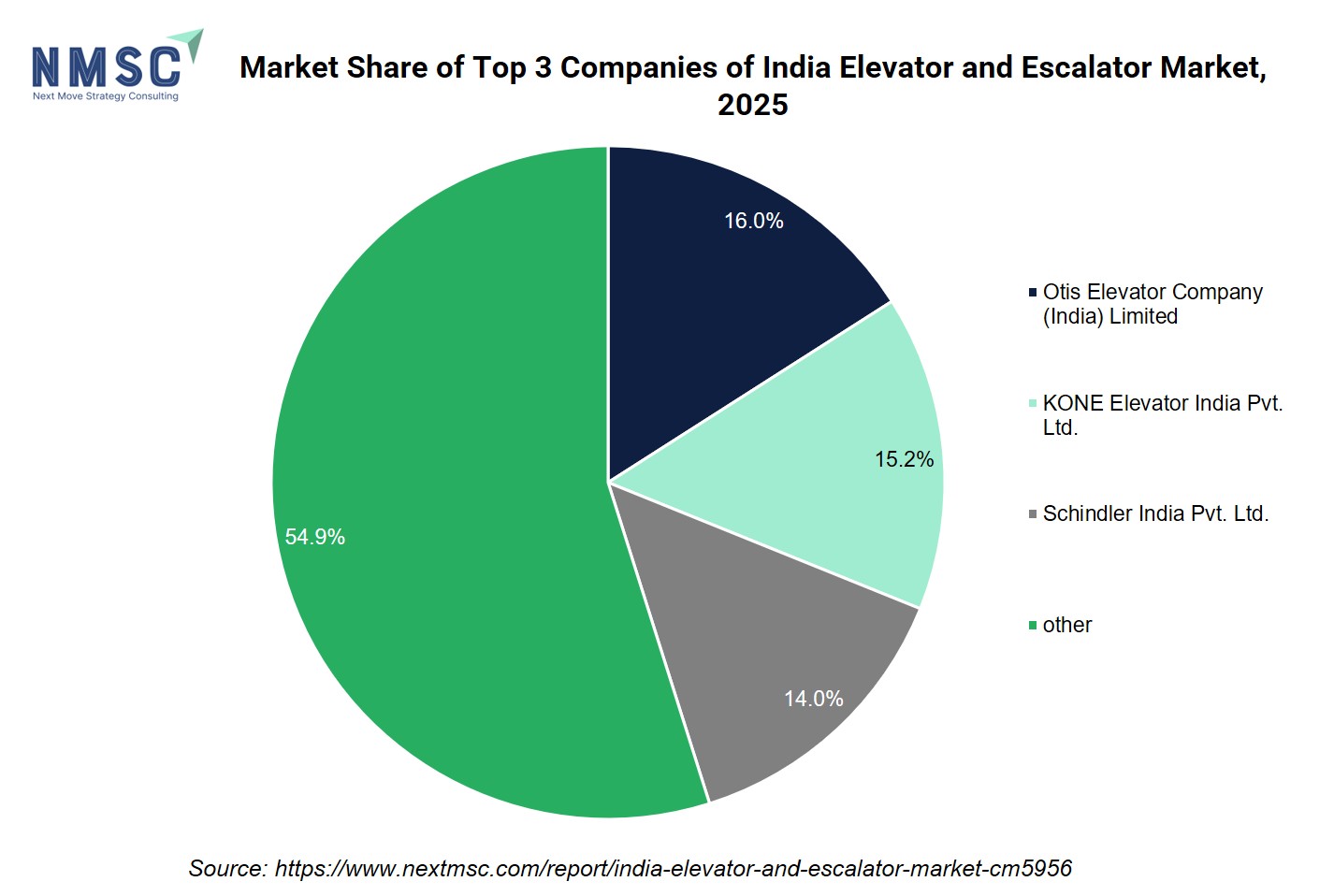
We observed that the India Elevator and Escalator Market is shifting from an installation-driven equipment business toward a lifecycle business built on connectivity, modernization, and compliance. NMSC values the market at USD 3.35 billion in 2025 and USD 3.71 billion in 2026, with revenue projected to reach USD 7.80 billion by 2035 at an 8.62% CAGR. Growth is uneven beneath that headline. Elevator systems still hold close to 87% of value, yet escalator systems are compounding at 12.68% and transit and infrastructure at 11.32%, as metro corridors, airport terminals, and bus terminals turn vertical transportation into large-volume public procurement. Machine-room-less traction platforms, destination control, and IoT-enabled predictive maintenance are increasingly being considered at the design stage rather than only as retrofit options. Based on our assessment, state lift legislation aligned to Bureau of Indian Standards codes is raising the compliance floor while buyers consolidate maintenance spend. Otis, KONE, Schindler, Johnson Lifts, and TK Elevator are each repositioning against that shift, and their 2025 and 2026 moves are examined below.
Want Insights on the India Elevator and Escalator market? Access a FREE Sample Instantly
Key takeaway: New equipment still generates roughly two-thirds of revenue, but it is no longer where competitive position is decided. Modernization compounding at 12.24%, escalator demand at 12.68%, and connected maintenance contracts are the contested ground, and each company below is buying, building, or branding its way toward that recurring layer.
Otis Elevator Company (India) Limited
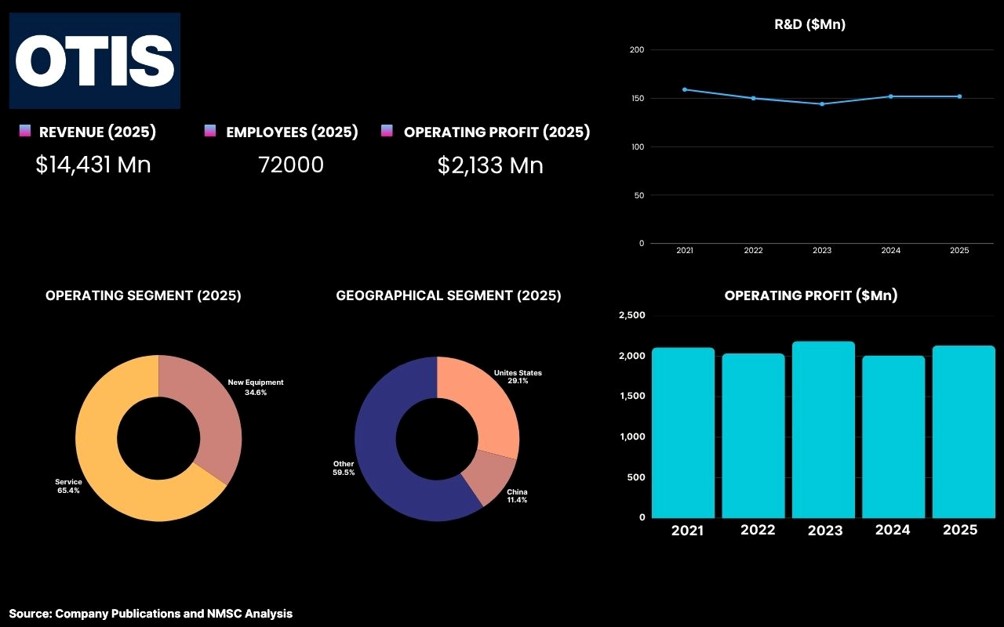
Otis Elevator Company (India) Limited is the Indian arm of Otis Worldwide Corporation, headquartered in Farmington, Connecticut, and operates a nationwide manufacturing, installation, modernization, and service network across India. Its portfolio spans passenger elevators, freight units, escalators, and cloud-connected service platforms. The India Elevator and Escalator Market shapes the company’s strategy directly: high-rise residential and commercial towers are where Otis converts equipment sales into long-duration maintenance portfolios, and its connected monitoring capability is the main argument it makes to developers choosing between comparable mechanical specifications.
In October 2025, Otis India secured a contract with My Home Group covering 169 high-speed elevator systems for three luxury residential developments in Hyderabad, including a tower rising to 234 metres. The order matters to the India elevator market because it concentrates premium, high-speed demand in a Tier-1 city outside the traditional Mumbai and Delhi corridors, and it extends an existing developer relationship into a multi-tower pipeline. Our analysis indicates the win strengthens the company’s installed base in exactly the segment where service revenue opportunities are particularly significant.
Based on our evaluation, Otis has a strong position in premium residential applications among the profiled companies, anchored by service density and a connected platform that raises switching costs once equipment is installed. The exposure is concentration: luxury high-rise construction is cyclical, and domestic manufacturers continue to undercut on new equipment. Its durable advantage sits in modernization and maintenance, where an ageing metropolitan installed base converts steadily through 2035.
“Seamless vertical mobility is at the heart of what our customers want to provide for modern urban living” — Sebi Joseph, President, Otis India; source: Otis Worldwide investor newsroom, October 2025.
KONE Elevator India Pvt. Ltd.
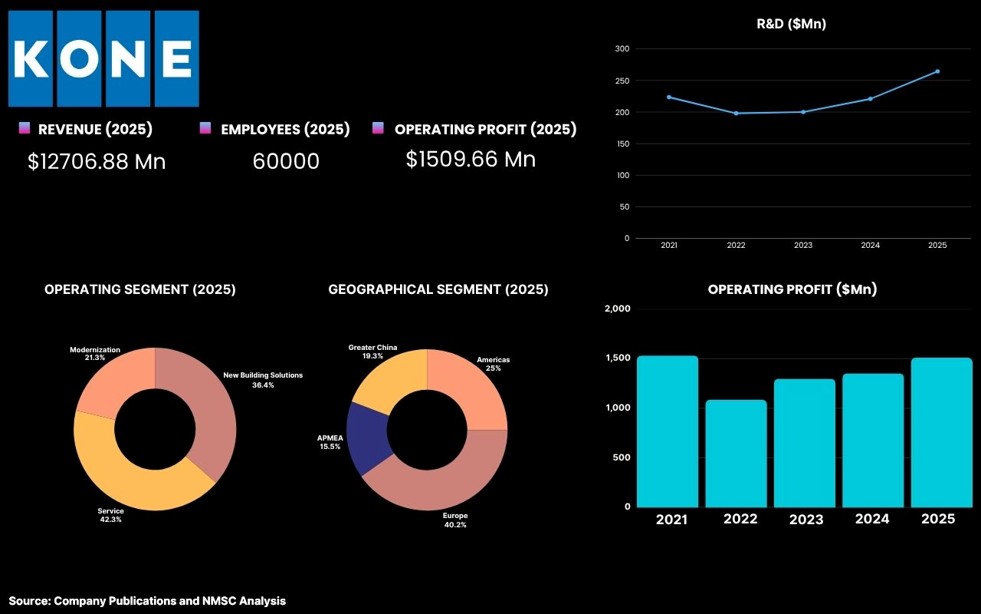
KONE Elevator India Pvt. Ltd. is the Indian subsidiary of KONE Corporation of Espoo, Finland, and runs elevator manufacturing, escalator production, and an R&D test facility cluster around Chennai in Tamil Nadu. It sells across new equipment, modernization, and services, with digitally connected elevators as its differentiator. The India Elevator and Escalator Market influences KONE through localization economics: escalator demand tied to metro rail and airports rewards domestic production over imports, and delivery timelines often decide multi-station infrastructure packages.
On April 29, 2026, KONE and a consortium led by Advent and Cinven agreed to combine KONE and TK Elevator in a cash and share transaction implying an enterprise value for TKE, and KONE shareholders approved the related resolutions at an extraordinary general meeting on June 3, 2026. Completion is not expected before the second quarter of 2027 and requires clearance across multiple jurisdictions. For India, the transaction would merge two of the market’s named competitors, with consequences for pricing, factory footprint, and service contracts that regulators will examine.
We noticed that the transaction changes how KONE should be read here. Until regulatory clearance and completion, the proposed transaction introduces uncertainty around the future structure of KONE's India operations. If the combination closes as structured, the merged group would have significantly greater scale in service and modernization, the two streams NMSC expects to outgrow new equipment through 2035. That is a high-ceiling, high-variance position rather than a settled one.
Schindler India Pvt. Ltd.
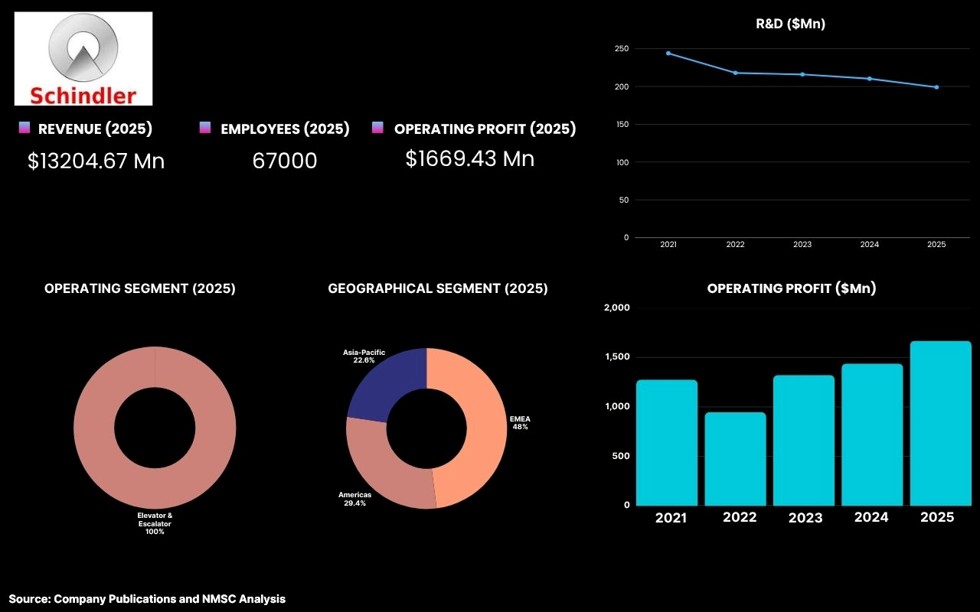
Schindler India Pvt. Ltd. is the wholly owned Indian subsidiary of the Schindler Group of Ebikon, Switzerland, and operates an integrated campus near Pune in Maharashtra housing elevator and escalator plants, a test tower, and an R&D centre. It supplies passenger and high-rise elevators, escalators, moving walks, and destination control. The India Elevator and Escalator Market matters to Schindler because the Pune campus was built to serve domestic demand, making local specification wins the principal return on that investment.
Schindler India offers an extensive portfolio of contemporary elevator interior designs, giving customers flexibility to combine colors, materials, textures, lighting, mirrors, handrails, fixtures, and other cabin elements. Its Schindler Designs portfolio includes multiple contemporary design themes and is available across applications including residential, office, hotel, retail, transport, and healthcare buildings. The offering enables developers and architects to customize elevator interiors in line with broader building aesthetics.
Based on our evaluation, Schindler competes as the specification-led European incumbent: local manufacturing depth, destination-control capability, and a design vocabulary aimed at the top of the residential and commercial market. Its challenge is volume in Tier-II and Tier-III cities, where value-engineered domestic products dominate. Schindler’s route through 2035 runs through modernization of its own installed base and transit packages where local escalator manufacturing is a real advantage.
Johnson Lifts Pvt. Ltd.
Johnson Lifts Pvt. Ltd., headquartered in Chennai, Tamil Nadu, is a major Indian elevator and escalator manufacturer serving residential, commercial, industrial, and public-infrastructure projects. The company operates manufacturing facilities in Tamil Nadu and Nagpur and has built a broad domestic sales and service network. Its infrastructure portfolio includes metro systems, airports, railway stations, hospitals, commercial buildings, and residential developments. Johnson Lifts has also expanded its capabilities in high-speed elevators, escalators, and home-lift solutions as demand diversifies across India's urban and residential markets. The company's established presence in public infrastructure and its locally integrated manufacturing and service capabilities position it to participate in large-scale transportation and building projects across India.
In April 2026, Johnson Lifts strengthened its strategic partnership with Toshiba Elevator and Building Systems Corporation by increasing its role in Toshiba Johnson Elevators India. The companies stated that the strengthened partnership would combine Toshiba Elevator's technology and service capabilities with Johnson Lifts' locally integrated sales and service network to reinforce their position in India's elevator and escalator market. Toshiba-branded elevators and escalators will continue to be supplied, installed, and maintained in India through the joint venture, while Toshiba will continue providing technical support, parts, and other assistance. The development gives Johnson Lifts a stronger connection to Toshiba's technology portfolio while retaining its domestic market and service infrastructure.
The end-use split shows why transit tenders now carry strategic weight well beyond their current revenue share:
India Elevator and Escalator Market by End Use, 2025–2035 (USD Million)
|
End Use |
2025 |
2035 |
CAGR (2026–2035) |
|
Residential |
1,266.40 |
2,712.20 |
7.72% |
|
Commercial |
587.81 |
1,206.82 |
7.26% |
|
Transit and Infrastructure |
738.97 |
2,206.91 |
11.32% |
|
Healthcare |
305.76 |
745.87 |
9.13% |
|
Industrial |
214.04 |
388.90 |
5.93% |
|
Public and Institutional |
240.38 |
542.34 |
8.28% |
|
Total |
3,353.37 |
7,803.04 |
8.62% |
Transit and infrastructure is the second-largest end use in 2025, yet it adds close to USD 1.47 billion of value by 2035, more than commercial and healthcare combined, which is why a single metro package can reset a supplier’s order book for years.
Our analysis indicates Johnson Lifts has a strong domestic position in the market: manufacturing scale, a wide service footprint, and a cost structure suited to public tenders and Tier-II city projects. The constraint is the premium end, where connected platforms and destination control decide specification. Its opportunity through 2035 lies in converting a very large installed base into structured modernization revenue before rivals extend vendor-agnostic monitoring into it.
|
Inside the India Elevator and Escalator Market Report Product, revenue stream, speed, capacity, end use and buyer splits, forecast to 2035, with 15 companies profiled. |
TK Elevator India Pvt. Ltd.
TK Elevator India Pvt. Ltd. is the Indian unit of TK Elevator, headquartered in Düsseldorf, Germany, and operates a multi-purpose facility at Chakan near Pune that produces elevators and escalators and houses its India head office. Its range covers low-, mid-, and high-rise elevators, escalators, home solutions, and modernization. The India Elevator and Escalator Market is central to its Make in India positioning, since locally built equipment lets the company quote shorter lead times to developers in the low- and mid-rise segments that dominate unit volume.
On April 24, 2026, TK Elevator held a groundbreaking ceremony for a major expansion of that Chakan facility, adding roughly 10,000 square metres of production, warehousing, and logistics capacity, with the expanded plant scheduled to be operational by August 2027. The investment ties directly to India elevator demand in low- to mid-rise buildings and large infrastructure projects, where delivery speed and local inventory shape award decisions. Based on our assessment, the proposed KONE-TK Elevator combination remains subject to regulatory approval.
We noticed that TKE occupies an unusual position: it is expanding Indian capacity while its ownership is restructured under regulatory review. If the combination completes, the Chakan expansion becomes part of a far larger Indian footprint. If it is blocked or conditioned, TKE retains an enlarged plant and a German-engineering proposition in the volume segment.
Market Summary
The India Elevator and Escalator Market is anchored by residential demand, which reached USD 1,266.40 million in 2025 on sustained high-rise apartment and villa construction across metropolitan and Tier-I cities, followed by transit and infrastructure and then commercial buildings. Medium-capacity systems lead rated capacity, medium-speed systems lead operational speed, and new equipment still contributes close to two-thirds of revenue. Healthcare, industrial, and institutional applications add steady volume, while smart city and housing programmes extend demand into smaller urban centres.
Competition is settling into two archetypes. Multinational manufacturers compete on connected platforms, destination control, high-rise capability, and design differentiation, backed by local plants built to compress delivery timelines. Domestic manufacturers compete on value engineering, service network density, and public tender economics. NMSC’s assessment suggests that pricing alone is increasingly insufficient to differentiate them: after-sales reach, documented safety compliance under state lift legislation, and the ability to bundle maintenance with new equipment increasingly determine who retains an account. Capacity investment, not acquisition, has been the domestic growth route, even as global consolidation reshapes ownership above it.
Looking to 2035, the growth is weighted toward modernization of ageing installations, escalator demand from metro and airport expansion, and vendor-agnostic predictive maintenance platforms sold to facility managers running mixed-brand fleets. Constraints are equally concrete: high upfront capital cost in smaller cities, fragmented state-level regulation, a shortage of skilled installation and maintenance technicians, and price pressure from unorganised regional manufacturers. Based on our evaluation, suppliers that pair local manufacturing depth with digital service capability will capture a disproportionate share of the USD 4.09 billion of incremental value created between 2026 and 2035.
About the Author
 Sanyukta Deb
— Sanyukta Deb is Digital Marketing Team Lead at Next Move Strategy Consulting, where she has led content strategy and technical SEO for the firm's B2B market research publications for over 2 years. Her editorial process translates NextMSC's primary and secondary research — spanning technology, industrial, and consumer sectors — into commercial narratives, backed by search-intent, keyword, and competitive analysis. She brings 5 years of overall experience in digital marketing and content strategy.
Sanyukta Deb
— Sanyukta Deb is Digital Marketing Team Lead at Next Move Strategy Consulting, where she has led content strategy and technical SEO for the firm's B2B market research publications for over 2 years. Her editorial process translates NextMSC's primary and secondary research — spanning technology, industrial, and consumer sectors — into commercial narratives, backed by search-intent, keyword, and competitive analysis. She brings 5 years of overall experience in digital marketing and content strategy.
About the Reviewer
 Debashree Dey
— Debashree Dey is Assistant Manager at Next Move Strategy Consulting, where she supports cross-vertical market content and communications across diverse industries for 6 years. Her professional background includes senior content writing, communications, and published manuscript authorship, with experience developing audience-focused business narratives and maintaining clear, consistent messaging. Her role supports research-led content development and editorial quality across NextMSC publications.
Debashree Dey
— Debashree Dey is Assistant Manager at Next Move Strategy Consulting, where she supports cross-vertical market content and communications across diverse industries for 6 years. Her professional background includes senior content writing, communications, and published manuscript authorship, with experience developing audience-focused business narratives and maintaining clear, consistent messaging. Her role supports research-led content development and editorial quality across NextMSC publications.















Add Comment