Is AI Data Management the Backbone of Enterprise Intelligence in 2026?

The growing complexity of enterprise data has raised a crucial question: how can organizations effectively manage, govern, and extract value from vast data ecosystems? The answer increasingly lies in AI-driven data management.
Recent developments from Oracle and Domo highlight how enterprises are moving toward intelligent, automated, and governed data environments.
Key Takeaways:
-
AI is becoming central to data operations
-
Governance and accessibility are top priorities
-
Enterprises are investing in intelligent data platforms
How Is Oracle Redefining AI Data Management with Agentic AI?
Oracle is taking a significant step forward in AI data management by introducing an AI database designed to support agentic AI systems, which are capable of independently interacting with enterprise data to execute tasks and generate outcomes. Unlike traditional architectures where AI models operate separately from databases, Oracle integrates AI capabilities directly into the data layer. This approach ensures that AI systems can securely access, process, and act on enterprise-grade data in real time without relying on complex data movement pipelines. The platform is specifically engineered for mission-critical workloads, meaning it prioritizes reliability, performance, and security—key requirements for large-scale enterprises handling sensitive and high-volume data environments.
Furthermore, Oracle emphasizes that its AI database is “built for business data,” highlighting its focus on structured, governed, and enterprise-relevant datasets rather than experimental or isolated AI use cases. By embedding AI within the database itself, Oracle enables organizations to deploy autonomous AI agents that can analyze data, make decisions, and trigger actions within a controlled environment. This significantly reduces latency, enhances data consistency, and improves trust in AI outputs, as the data remains within a governed system throughout the process.
Key Takeaways:
-
AI is moving closer to the data layer
-
Autonomous AI agents are becoming enterprise-ready
-
Integrated systems improve efficiency and trust
How Is Oracle Redefining AI Data Management with Agentic AI?
Oracle has introduced an AI database designed to support agentic AI, which refers to AI systems capable of acting autonomously on enterprise data.
Key Highlights:
-
Built specifically for business-critical data environments
-
Supports autonomous AI agents that interact with enterprise data
-
Designed for high reliability and scalability
Oracle states that its platform enables “mission-critical agentic AI built for business data”, ensuring that AI systems operate directly within secure and governed data environments.
Why It Matters:
-
Reduces dependency on fragmented data pipelines
-
Enables real-time AI decision-making
-
Improves trust in AI outputs
Key Takeaways:
-
Agentic AI is the next evolution in enterprise AI
-
Databases are becoming AI execution environments
-
Integration improves reliability and performance
How Is Domo Enhancing Data Governance and Accessibility?
Domo is addressing one of the most persistent challenges in AI data management: ensuring that data is both accessible and properly governed. Many organizations struggle with fragmented data environments where inconsistent access policies and weak governance frameworks limit the effectiveness of analytics and AI initiatives. Domo’s latest updates introduce enhanced governance tools that aim to resolve these issues by providing more granular control over how data is accessed, shared, and utilized across the organization. These improvements are particularly important in modern enterprises where data flows across multiple departments, systems, and users, increasing the risk of mismanagement or unauthorized access.
In addition to strengthening governance, Domo is also focusing on improving data accessibility, ensuring that users can easily find and use the data they need without compromising security or compliance. The platform enhancements help eliminate data silos by standardizing access policies and enabling better visibility into data usage. This balance between accessibility and control is critical for AI success, as AI systems rely heavily on high-quality, well-governed data to produce accurate and actionable insights. By addressing both governance and usability, Domo is enabling organizations to scale their AI initiatives more effectively while maintaining regulatory and operational integrity.
Key Takeaways:
-
Governance and accessibility must coexist
-
Eliminating data silos improves AI performance
-
Controlled access enhances data reliability
What Trends Are Emerging in the AI Data Management Market?
Based on these developments, several clear trends are shaping the market:
1. Shift Toward AI-Native Databases
-
Databases are evolving into AI execution platforms
-
Integration between AI and data layers is increasing
2. Rise of Agentic AI
-
AI systems are becoming autonomous decision-makers
-
Enterprises require real-time data interaction
3. Governance-First Approach
-
Data governance is no longer optional
-
Compliance and security are driving innovation
4. Focus on Data Accessibility
-
Organizations are prioritizing democratized data access
-
User-friendly tools are becoming essential
Summary Table: Key Market Drivers
|
Trend |
Impact on Market |
Supporting Example |
|
AI-native databases |
Improves performance and integration |
Oracle AI Database |
|
Agentic AI |
Enables automation and decision-making |
Oracle platform |
|
Governance tools |
Ensures compliance and trust |
Domo updates |
|
Data accessibility |
Enhances usability and adoption |
Domo tools |
Key Takeaways:
-
AI and data platforms are converging
-
Governance is becoming a core differentiator
-
Accessibility drives enterprise adoption
How Are These Developments Impacting the AI Data Management Market?
From a market research perspective, these innovations indicate a structural shift:
Market Implications:
-
Increased enterprise spending on AI-ready data platforms
-
Higher demand for governance solutions
-
Acceleration of AI adoption across industries
Oracle’s approach suggests that AI will be embedded directly into data infrastructure, reducing latency and improving efficiency.
Domo’s updates indicate that governance and access challenges are still major barriers, creating opportunities for solution providers.
Strategic Insight:
-
Vendors that combine AI capability + governance + accessibility will lead the market
-
Enterprises will prioritize end-to-end data ecosystems rather than standalone tools
Key Takeaways:
-
Innovation is focused on integration and control
-
Market competition is shifting toward platform ecosystems
-
Enterprises are becoming more data-centric
Leading Key Players of the Industry
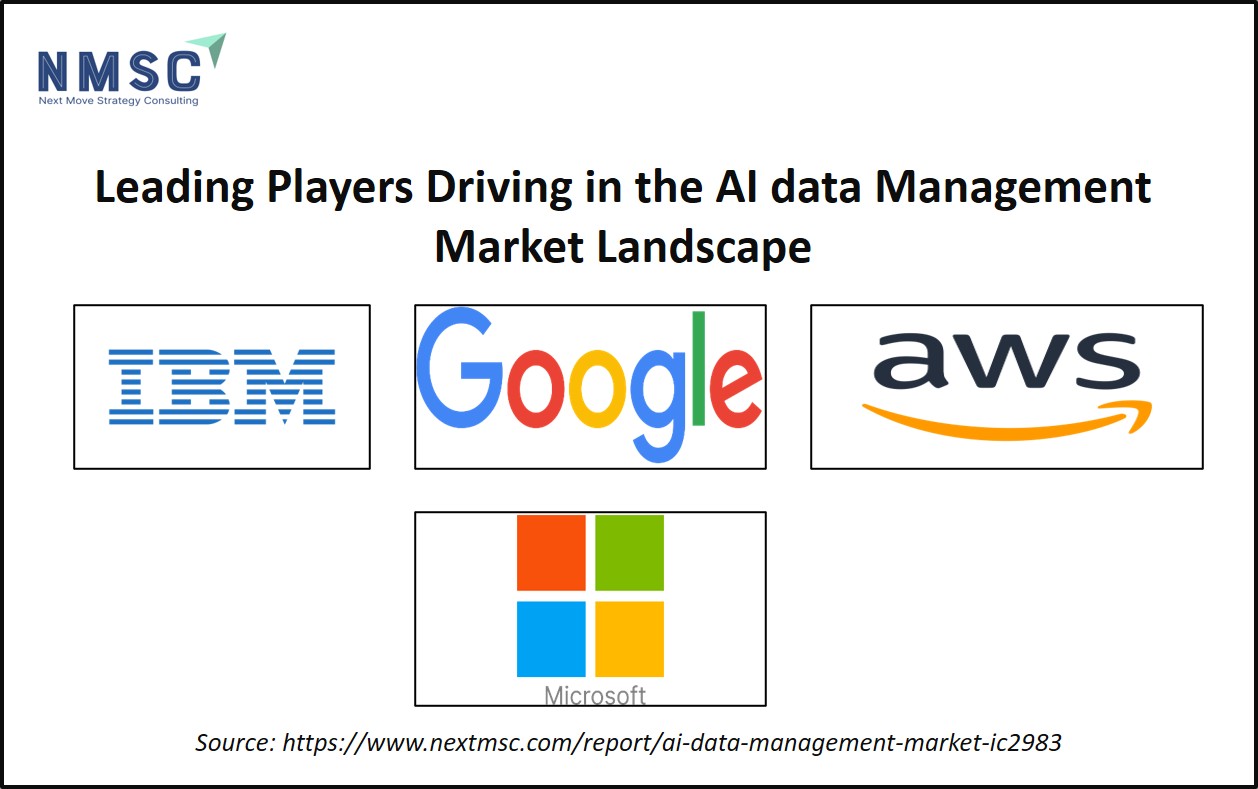
The AI data management industry is highly competitive, with major technology providers such as Microsoft Corporation, Amazon Web Services Inc., IBM Corporation, Google LLC, Oracle Corporation, Salesforce Inc., SAP SE, SAS Institute Inc., Hewlett Packard Enterprise Development LP, Snowflake Inc., Informatica Inc., Databricks Inc., Astera Software, Dataloop Ltd., and ALTEN Group leading the landscape. These companies are continuously strengthening their positions by adopting strategies such as product innovation, strategic collaborations, and cloud-based AI integrations. The competitive intensity is driven by the growing demand for scalable, secure, and intelligent data platforms capable of supporting advanced AI workloads. As enterprises increasingly rely on AI for decision-making, vendors are focusing on enhancing data accessibility, governance, and real-time processing capabilities to differentiate their offerings and capture market share.
For example, in August 2024, IBM Corporation collaborated with Intel Corporation to introduce Intel Gaudi 3 AI accelerators as a service on IBM Cloud, enabling enterprises to scale AI operations more cost-effectively while improving performance, security, and resilience. Similarly, in May 2024, Oracle Corporation launched Oracle Database 23c with AI-powered features such as AI vector search, allowing users to analyze complex data patterns and relationships more efficiently. Additionally, in June 2023, Snowflake Inc. partnered with NVIDIA Corporation to support the development of generative AI applications, enabling businesses to leverage their data securely and accelerate AI solution deployment without requiring extensive in-house expertise. These developments highlight how partnerships and innovation are shaping the evolution of AI data management solutions across industries.
NMSC Viewpoint: What Is the Strategic Impact on the AI Data Management Market?
The competitive developments among key players such as IBM Corporation, Oracle Corporation, and Snowflake Inc. clearly indicate that the AI Data Management Market is moving toward highly integrated and performance-driven ecosystems. Collaborations like IBM with Intel Corporation and Snowflake with NVIDIA Corporation demonstrate a growing emphasis on combining hardware acceleration with cloud-based data platforms to deliver scalable AI capabilities. At the same time, Oracle’s introduction of AI-powered database features reflects a shift toward embedding intelligence directly within data infrastructure, enabling faster insights and reducing operational complexity for enterprises.
From a market standpoint, these developments suggest that vendors are increasingly focusing on end-to-end AI enablement, where data storage, processing, governance, and AI execution are unified within a single ecosystem. This is expected to intensify competition, as enterprises will prefer solutions that offer seamless integration, enhanced security, and real-time analytics capabilities. As a result, companies that invest in strategic partnerships and continuous product innovation are likely to gain a competitive advantage, while those relying on fragmented or traditional data management approaches may struggle to keep pace with evolving enterprise demands.
What Should Businesses Do Next? (Next Steps)
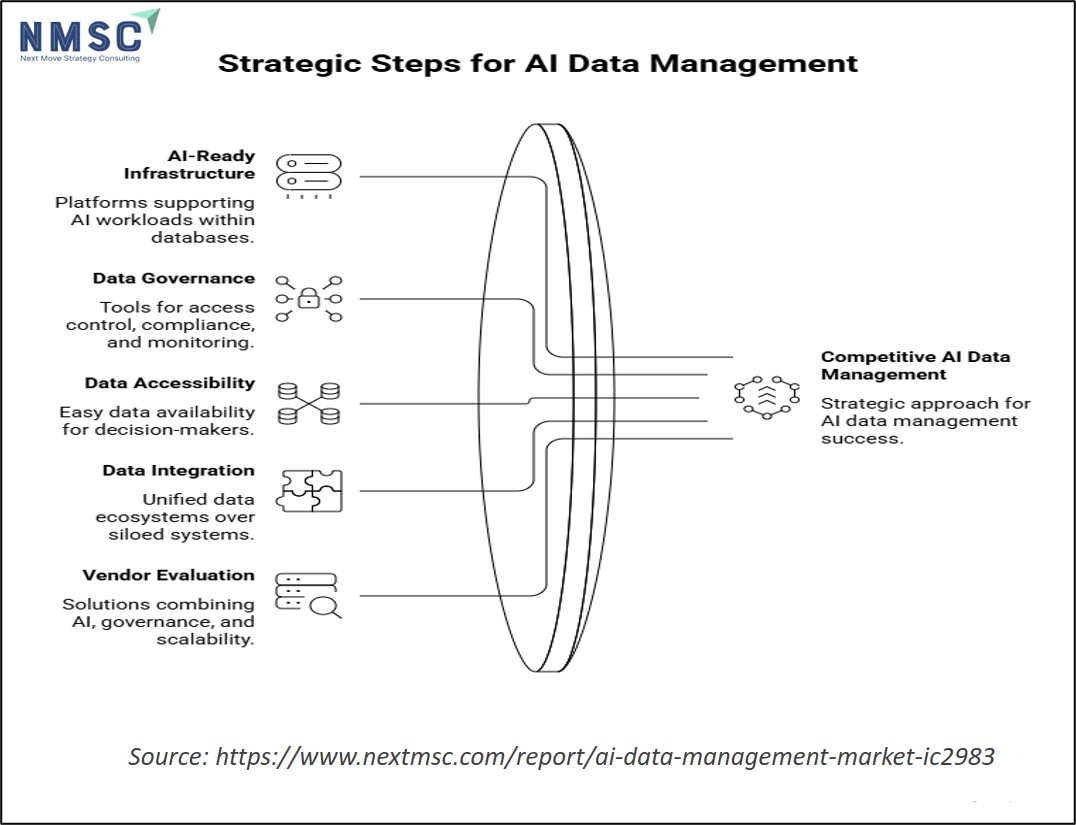
To stay competitive in the evolving AI data management landscape, organizations should take the following actions:
1. Invest in AI-Ready Data Infrastructure: Adopt platforms that support AI workloads directly within databases
2. Strengthen Data Governance Frameworks: Implement tools for access control, compliance, and monitoring
3. Improve Data Accessibility: Ensure that data is easily available to decision-makers across teams
4. Focus on Integration: Move toward unified data ecosystems instead of siloed systems
5. Evaluate Vendor Capabilities: Choose solutions that combine AI, governance, and scalability
About the Author
 Sanyukta Deb
— Sanyukta Deb is Digital Marketing Team Lead at Next Move Strategy Consulting, where she has led content strategy and technical SEO for the firm's B2B market research publications for over 2 years. Her editorial process translates NextMSC's primary and secondary research — spanning technology, industrial, and consumer sectors — into commercial narratives, backed by search-intent, keyword, and competitive analysis. She brings 5 years of overall experience in digital marketing and content strategy.
Sanyukta Deb
— Sanyukta Deb is Digital Marketing Team Lead at Next Move Strategy Consulting, where she has led content strategy and technical SEO for the firm's B2B market research publications for over 2 years. Her editorial process translates NextMSC's primary and secondary research — spanning technology, industrial, and consumer sectors — into commercial narratives, backed by search-intent, keyword, and competitive analysis. She brings 5 years of overall experience in digital marketing and content strategy.
About the Reviewer
 Debashree Dey
— Debashree Dey is Assistant Manager at Next Move Strategy Consulting, where she supports cross-vertical market content and communications across diverse industries for 6 years. Her professional background includes senior content writing, communications, and published manuscript authorship, with experience developing audience-focused business narratives and maintaining clear, consistent messaging. Her role supports research-led content development and editorial quality across NextMSC publications.
Debashree Dey
— Debashree Dey is Assistant Manager at Next Move Strategy Consulting, where she supports cross-vertical market content and communications across diverse industries for 6 years. Her professional background includes senior content writing, communications, and published manuscript authorship, with experience developing audience-focused business narratives and maintaining clear, consistent messaging. Her role supports research-led content development and editorial quality across NextMSC publications.


















Add Comment