Is the Private Cloud Market Making a Comeback in 2025?

Introduction
On October 8, 2026, Microsoft changed what a family subscription buys. According to the company's support document "Changes to Microsoft 365 storage", new and upgraded Microsoft 365 Family and Premium subscriptions now include 2 TB of OneDrive storage shared by up to six members. The earlier arrangement gave each member 1 TB, or up to 6 TB per subscription. Existing subscribers move to the shared model when their plan renews on or after May 2, 2027. The price stayed the same and the capacity did not, which makes the announcement a visible turning point in how personal cloud storage is priced, packaged and rationed.
According to Next Move Strategy Consulting's Personal Cloud Market report, the global personal cloud market was valued at USD 54.17 billion in 2024 and is projected to reach USD 189.86 billion by 2030, growing at a CAGR of 23.3% over the 2025-2030 forecast period. NextMSC primary research and analysis identifies IoT device integration, remote work and rising internet penetration as the demand drivers, data privacy concerns as the main restraint, and AI-assisted data management as the principal opportunity.
For More Information: Download FREE Sample on Personal Cloud Market Report
That growth is now arriving alongside a change in provider behavior. Between May and October 2026, Google tested a smaller free tier for new accounts, Microsoft pooled family storage, and the two largest hard disk drive makers reported record demand from hyperscale cloud buyers at sharply higher prices. This article connects those developments, explains what they mean for the personal cloud market, and sets out the decisions they place in front of executives and investors.
The Great Allowance Reset: How Shared Pools and Smaller Free Tiers Are Rewriting the Personal Cloud Market
Microsoft's October 8 Pooled-Storage Decision
Microsoft's support document, updated on October 26, 2026, sets out the new allotments. Microsoft 365 Basic keeps 100 GB and Personal keeps 1 TB, both dedicated to the account holder, while Family and Premium receive 2 TB shared and Pro receives 5 TB shared. Files stay private by default, but the quota is common to all members. Subscribers can add storage up to a total of 10 TB, and a group that exceeds its limit keeps access to its files for up to one year while it adjusts. Microsoft presents the change as a way to direct capacity to the members who need it most.
Tom's Hardware, in an October 9, 2026 report by Jowi Morales, calculated that a six-member subscription loses 66.6% of its maximum capacity, falling from 6 TB to 2 TB, with no change to the Family plan's annual price of USD 129.99. The same report noted that a household of four members using 500 GB each would exceed the pool and need to buy extra capacity, which it listed from USD 1.99 per month for 200 GB. Tom's Hardware also read the move as a response to the storage shortage affecting the wider industry, an interpretation that Microsoft's own document does not offer.
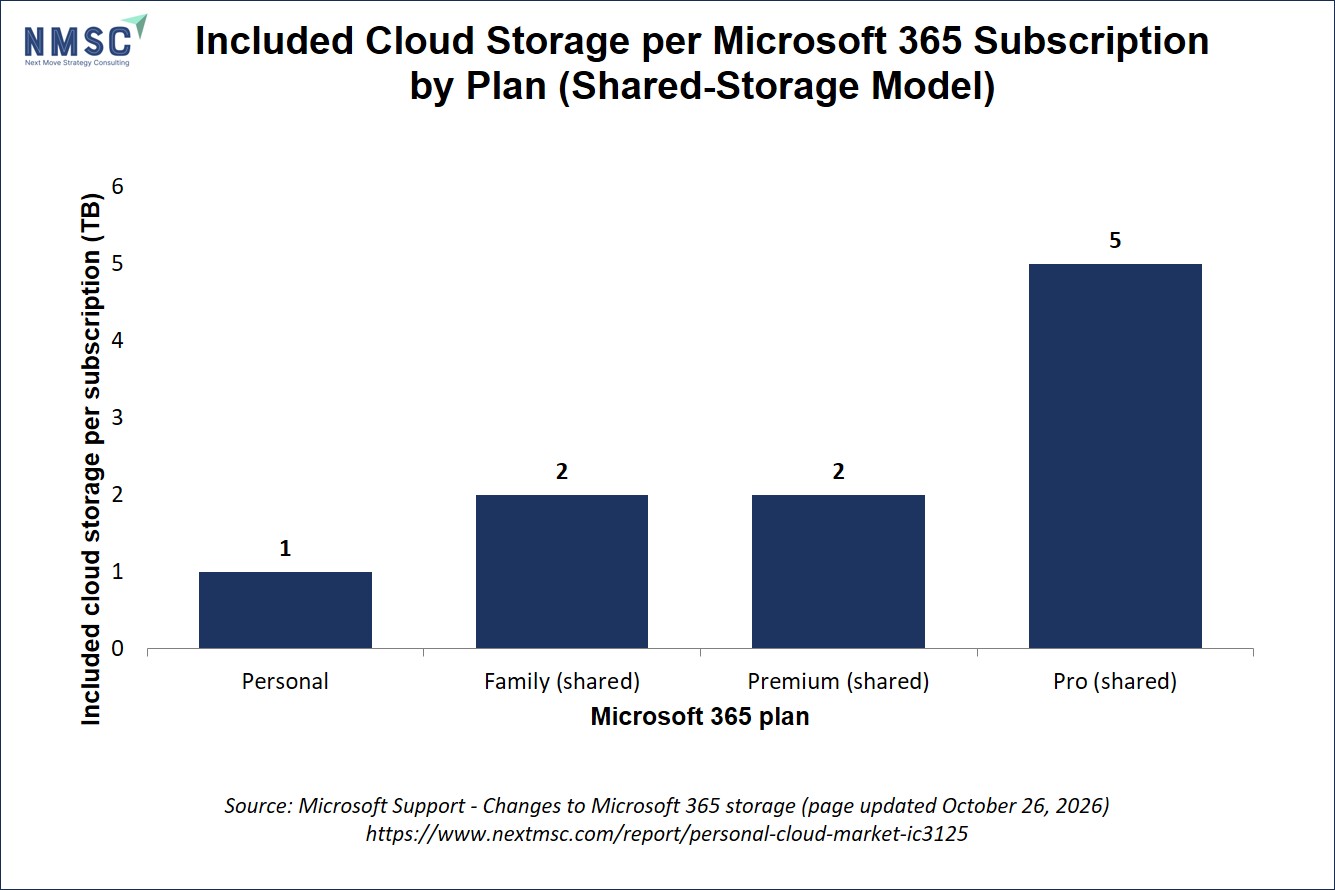
Microsoft's support document, updated on October 26, 2026, lists the cloud storage included in each plan once a subscription uses shared storage: Personal 1 TB for the account holder, Family 2 TB shared, Premium 2 TB shared and Pro 5 TB shared. The Family and Premium pools serve a primary subscriber and up to five additional members. Microsoft 365 Basic, which includes 100 GB, is not plotted because the source states that allowance in gigabytes.
Google's Test of a Smaller Free Tier
A second signal came in mid-May 2026. 9to5Google reported on May 14, 2026 that a user creating a new Google account was offered only 5 GB unless a phone number was linked, which unlocked the long-standing 15 GB shared across Gmail, Google Drive and Google Photos. Google's support page wording had shifted from a flat 15 GB to up to 15 GB. Tom's Hardware reported that Google confirmed it was testing a new storage policy for new accounts, and that existing accounts were not affected. A free tier works as a customer acquisition tool, so shrinking it moves the cost of a new user's first photographs and backups onto a verification step or a paid plan.
The Hardware Cost Chain Behind the Allowances
The supply side explains why generosity is harder to sustain. Western Digital's Form 10-K for fiscal 2026, filed on August 14, 2026, reports net revenue of USD 12,919 million, up 36%. The Cloud end market supplied 89% of that revenue, and the top 10 customers accounted for 73%, compared with 68% a year earlier and 55% two years earlier. Consumer products represented only 5%. Consumer revenue grew 13% on a 1% increase in exabytes sold, which means price per exabyte, not volume, produced the growth.
The pattern strengthened in the latest quarter. On October 22, 2026, Western Digital reported first-quarter fiscal 2027 revenue of USD 4,381 million, up 55%, and guided to USD 5.1 billion, plus or minus USD 100 million, for the next quarter. On the earnings call, Western Digital's management said average price per terabyte had risen 28% year over year, and the company shipped 248 exabytes, 22% more than a year earlier. Seagate Technology's results for the quarter ended October 2, 2026, published on October 28, 2026, point the same way. It shipped 220 exabytes against 182 exabytes a year earlier, and its revenue rose USD 1.6 billion year over year, which Seagate Technology attributes primarily to favorable pricing actions and higher nearline exabytes. Data center customers generated 81% of its revenue, while the retailer channel fell to 4% from 6%.
NMSC Strategic Perspective: Capacity Is Becoming a Priced Resource
NextMSC primary research and analysis reads these three developments as one mechanism. Included storage was affordable for providers because the cost of a terabyte fell steadily and because many subscribers never used their full quota. When drive makers report double-digit price increases per terabyte and sell mainly to hyperscale buyers, the cost of every promised but unused terabyte rises. Each provider response targets that exposure differently. Pooling replaces a dedicated promise with a statistical allocation, verification gates screen out low-value free accounts, and plan bundles raise revenue per subscriber.
The financial profile of the direct-to-consumer cloud business supports this reading. Dropbox, in its second-quarter 2026 results published on August 13, 2026, reported revenue of USD 631.5 million, up 0.9%, a non-GAAP operating margin of 39.7%, and 18.19 million paying users, 96,000 more than the previous quarter. Average revenue per paying user was USD 139.68 against USD 138.32 a year earlier. A business with near-flat revenue, high margins and a stable paying base has strong reasons to protect margin before it chases volume.
For the segments defined in the NextMSC report, the implications differ. Subscription-based online services face the most direct pressure to meter capacity. NAS devices carry a different exposure, because their buyers pay for drives up front and Western Digital reports that its consumer average selling price per exabyte rose 12% in fiscal 2026. NextMSC primary research and analysis therefore expects competition to shift from headline gigabytes toward bundled features such as AI-assisted search and organization, backup and recovery, and portability.
Section Summary:
Three 2026 provider actions share one cause: capacity has become more expensive to promise and easier to meter.
-
Microsoft's October 8, 2026 change cuts the maximum for a six-member Family subscription from 6 TB to 2 TB without changing the price.
-
Google's May 2026 test of a 5 GB entry tier for unverified accounts moves free-tier cost onto verification or paid plans.
-
Western Digital and Seagate Technology report higher prices per terabyte and rising exabyte demand led by cloud buyers.
Industry Impact Analysis
Households and Small Businesses: Capacity Planning Becomes a Routine Task
For households, the first effect is arithmetic. Dividing a 2 TB pool across six members leaves an average of about 333 GB each, against 1 TB each before. Microsoft's document states that a move from Family to Premium before May 2, 2027 triggers the shared model early, while a downgrade alone does not. Sole traders and micro-businesses that use consumer plans for work files face the same constraint, and they have the extra burden of choosing between buying capacity and moving data. Microsoft states that customers receive an email before the renewal at which the change applies, which gives households time to compare alternatives.
Providers and Platforms: Margin Protection Against Churn Risk
Providers must balance cost recovery against the risk that a visible reduction pushes subscribers toward rivals. The Dropbox figures show how narrow the room is: average revenue per paying user moved by USD 1.36 year over year, a change of 1.0%. Pooling is attractive because it leaves the headline price untouched and changes the allocation rule instead. The risk is reputational, since capacity is the one specification that every subscriber can compare. Google's verification gate carries a different risk, because it adds friction at account creation, when a new user is least committed to the service.
Regulation: Switching Costs Fall in January 2027
The German Federal Network Agency, Bundesnetzagentur, explains in its Data Act fact sheet on switching between data processing services that providers may charge only costs directly linked to the switching process until January 12, 2027, and may impose no switching charges from that date. The rules address providers of data processing services, so each consumer service should be checked against that definition. Where they apply, lower exit costs reduce the lock-in that pooled or reduced allowances might otherwise create, and they raise the competitive cost of an unpopular change.
Hardware and NAS Vendors: A Second-Order Effect
Drive makers are allocating capacity toward the buyers that pay most for it. Western Digital's fiscal 2026 filing shows consumer revenue at 5% of the total and client revenue at 6%, with the Cloud end market at 89%. Seagate Technology's retailer channel fell from 6% to 4% of revenue between the quarters ended October 3, 2025 and October 2, 2026. Personal NAS builders compete for supply with hyperscale demand, which weakens the argument that owning drives is automatically cheaper than renting capacity.
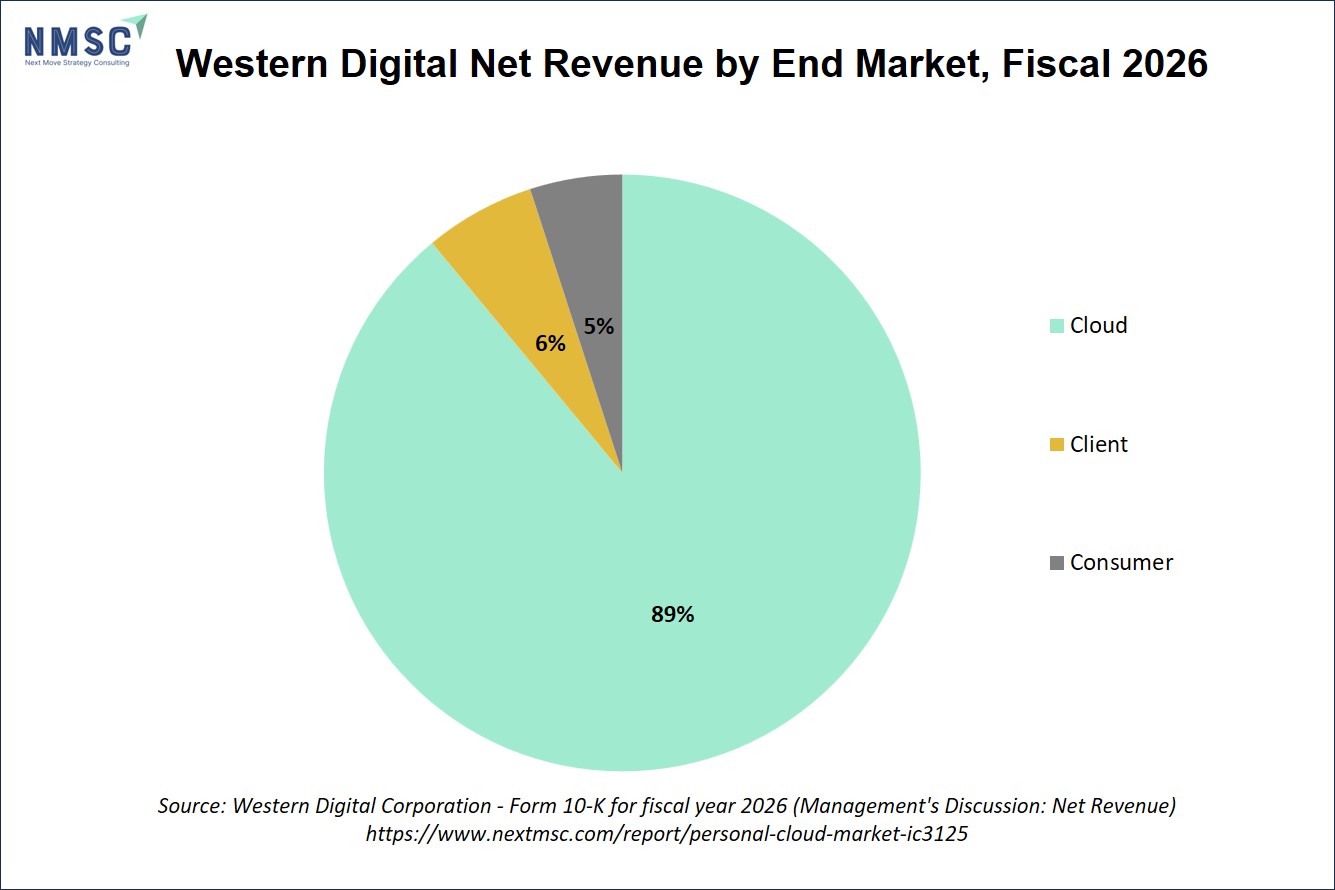
Western Digital's Form 10-K for fiscal 2026 reports net revenue by end market as Cloud 89%, Client 6% and Consumer 5%. The filing states that Cloud revenue rose 38% in fiscal 2026 and that top 10 customers accounted for 73% of net revenue. The split shows how little of a leading drive maker's revenue comes from consumer products compared with cloud customers.
Section Summary:
The impact reaches households, providers, regulators and hardware vendors at once, and none of them can treat storage as free.
Households sharing a Family or Premium plan average about 333 GB per member under a six-member pool.
Dropbox's average revenue per paying user changed by only 1.0% year over year, leaving little room for price-led growth.
From January 12, 2027, switching charges for data processing services end under the Data Act, subject to each service's classification.
Consumer products are 5% of Western Digital's revenue, so retail drive buyers compete with far larger cloud customers.
Pros and Cons of Recent Market Developments
|
Pros |
Cons |
|
Pooled storage lets a heavy user draw on unused family capacity, so a single power user is no longer capped at 1 TB. |
A six-member Family subscription loses up to 4 TB of maximum capacity at an unchanged price once it transitions. |
|
Phone verification for the full 15 GB free tier reduces duplicate and low-value accounts for providers. |
New Google users who skip verification start with 5 GB, a third of the long-standing allowance. |
|
Higher drive prices and strong exabyte demand fund new capacity, including higher-density drives that lower cost per terabyte over time. |
Price per terabyte at Western Digital rose 28% year over year, which raises costs for every storage-dependent service. |
|
Microsoft allows additional storage up to a total of 10 TB and one year of file access above the limit, which softens the transition. |
Existing Microsoft subscribers receive notice only before renewal, so the effective date varies by household. |
|
The Data Act's end to switching charges from January 12, 2027 lowers exit costs for customers of data processing services. |
Whether a given consumer storage plan falls inside that definition is not uniform, so protection can be uneven. |
Key Data & Statistics
The tables below consolidate the dated provider actions and the supply-side indicators referenced in this analysis. Values are reported as published by each source, and the periods differ because each company reports on its own fiscal calendar.
Personal cloud allowance and regulatory milestones, 2026-2027
|
Date |
Organization |
Action or milestone |
|
May 14, 2026 |
Google (reported by 9to5Google) |
New account shown 5 GB unless a phone number is linked; support wording changed to up to 15 GB |
|
October 8, 2026 |
Microsoft |
New and upgraded Family and Premium subscriptions use 2 TB shared storage; Pro uses 5 TB shared |
|
January 12, 2027 |
EU Data Act (Bundesnetzagentur fact sheet) |
Switching charges prohibited for providers of data processing services |
|
May 2, 2027 |
Microsoft |
Existing Family and Premium subscribers move to shared storage at the first renewal on or after this date |
Storage supply and demand indicators, latest reported quarters
|
Company |
Indicator |
Reported value |
|
Western Digital |
Revenue, quarter ended October 2, 2026 |
USD 4,381 million, up 55% year over year |
|
Western Digital |
Exabytes shipped, same quarter |
248, up 22% year over year |
|
Western Digital |
Next-quarter revenue guidance |
USD 5.1 billion plus or minus USD 100 million |
|
Seagate Technology |
HDD exabytes shipped, quarter ended October 2, 2026 |
220, against 182 a year earlier |
|
Seagate Technology |
Revenue share, Data Center market |
81% |
|
Seagate Technology |
Revenue share, retailer channel |
4%, against 6% a year earlier |
|
Dropbox |
Paying users, quarter ended June 30, 2026 |
18.19 million, against 18.13 million a year earlier |
|
Dropbox |
Average revenue per paying user, same quarter |
USD 139.68, against USD 138.32 a year earlier |
Future Outlook & Forecast
What the NextMSC Forecast Implies for the Personal Cloud Market
NextMSC's model projects the personal cloud market to grow from USD 54.17 billion in 2024 to USD 189.86 billion by 2030, a 23.3% CAGR across 2025-2030. That path implies about USD 135.69 billion of added annual market value and a market roughly 3.5 times its 2024 size. NextMSC primary research and analysis finds North America the leading region, with Asia-Pacific the next largest, and segments the market by type, revenue model, application and end user. Those segment lines matter more as providers change how capacity is sold, because subscription, pay-as-you-go and one-time license models respond differently to rising storage costs.
The application segments in the NextMSC report, data storage, file sharing and synchronization, and backup and recovery, are exposed to the 2026 changes in different ways. Backup and recovery depends on guaranteed capacity and predictable retention, so a pooled quota weighs most heavily there. File sharing and synchronization benefits from pooled allocation, because shared folders already treat a household or team as one unit. Data storage sits between the two, and its growth will track how providers price archive-scale capacity.
Dated Milestones That Will Test the Forecast
Several scheduled events will show whether provider moves become industry practice. The Data Act's switching rules take effect on January 12, 2027. Microsoft's transition for existing Family and Premium subscribers begins with renewals on or after May 2, 2027. On the supply side, Western Digital said on its October 22, 2026 call that it expects to complete qualification of its first-generation HAMR drives with two hyperscale customers in the first quarter of calendar 2027 and to begin volume shipments in the first half of that year. Seagate Technology described customer demand visibility as supporting a multi-year growth phase.
These milestones do not change NextMSC's forecast, but they define what to monitor. If more providers adopt pooled or verified allowances, growth will increasingly come from revenue per subscriber rather than subscriber count. If drive pricing eases as higher-capacity products ramp, the cost pressure behind the 2026 changes could soften. NextMSC primary research and analysis treats both outcomes as consistent with continued market expansion, while the mix between consumers and business enterprise end users, and between subscription and device-based models, is likely to shift.
Section Summary:
The forecast is intact, but the way value is captured is changing, and the next twelve months contain the dates that will confirm the direction.
-
NextMSC projects USD 189.86 billion by 2030, about 3.5 times the 2024 value of USD 54.17 billion.
-
The Data Act switching rules (January 12, 2027) and Microsoft's renewal transition (from May 2, 2027) are the nearest dated tests.
-
Western Digital expects HAMR volume shipments in the first half of calendar 2027, a possible relief for drive costs.
Next Steps for Stakeholders
The actions below follow from the developments above and are grouped by the stakeholder who must move first.
-
Chief executives and product leaders at storage providers: audit how much of each plan's promised capacity is actually used, and test pooled or verified allowances against churn before announcing them broadly.
-
Chief financial officers: model storage cost per subscriber against the price-per-terabyte increases reported by Western Digital and Seagate Technology, and set contract terms with drive and infrastructure suppliers accordingly.
-
Investors: track revenue per subscriber, not only subscriber counts, as in Dropbox's quarterly disclosures, and watch the Microsoft transition from May 2, 2027 for evidence on retention.
-
Compliance and legal teams: confirm whether each consumer storage service counts as a data processing service under the Data Act before January 12, 2027.
-
Enterprise IT leaders: identify staff who use personal cloud plans for work files and move that data to managed business tiers with contractual capacity guarantees.
-
Device and NAS manufacturers: secure drive supply early and compete on software features, because capacity alone no longer differentiates.
Conclusion
The personal cloud market is expanding on NextMSC's forecast, yet the terms under which capacity is offered are changing. Microsoft's shared pool, Google's verification test and the pricing reported by Western Digital and Seagate Technology all trace back to the same economics: a terabyte that is promised costs more to hold than it did a year ago. Providers that explain these changes clearly, protect data portability and add real functionality will keep customers. Providers that rely on silent reductions risk handing share to rivals, particularly as switching rules tighten in Europe. For stakeholders in the personal cloud market, the signal to act on is that storage has moved from an included perk to a priced and managed resource. The next dated checkpoints, January 12, 2027 and May 2, 2027, will show whether pooled allocation becomes a standard feature of consumer plans.
About the Author
 Sanyukta Deb
— Sanyukta Deb is Digital Marketing Team Lead at Next Move Strategy Consulting, where she has led content strategy and technical SEO for the firm's B2B market research publications for over 2 years. Her editorial process translates NextMSC's primary and secondary research — spanning technology, industrial, and consumer sectors — into commercial narratives, backed by search-intent, keyword, and competitive analysis. She brings 5 years of overall experience in digital marketing and content strategy.
About the Reviewer
 Debashree Dey
— Debashree Dey is Assistant Manager at Next Move Strategy Consulting, where she supports cross-vertical market content and communications across diverse industries for 6 years. Her professional background includes senior content writing, communications, and published manuscript authorship, with experience developing audience-focused business narratives and maintaining clear, consistent messaging. Her role supports research-led content development and editorial quality across NextMSC publications.
















Add Comment