Legacy Application Modernization: Strategies and Best Practices
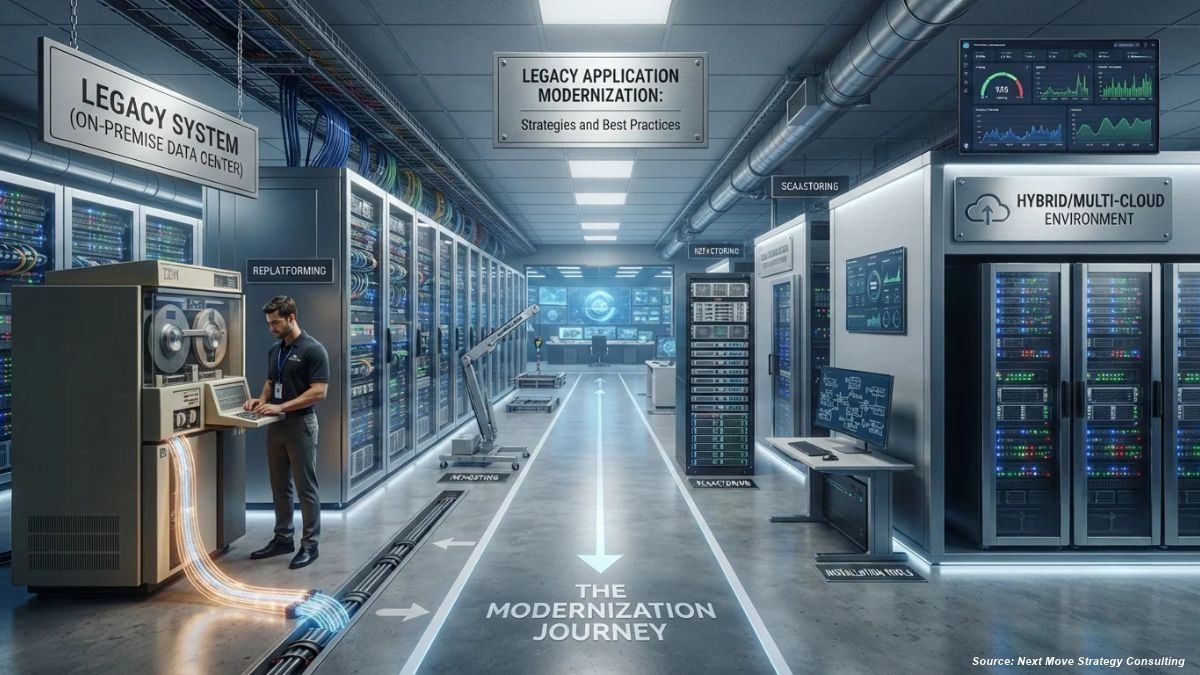
Every legacy system was once someone's proud achievement. The code that now keeps your operations team awake at night was built by people who solved real problems with the tools they had. The trouble is that software ages while business does not slow down. Legacy application modernization closes the gap between what your software can do and what the business now demands.
This guide walks through what modernization means, why it has become urgent, the strategies that work and the mistakes that sink projects. The goal is a clear enough picture that you can make decisions without being at the mercy of a sales pitch.
What Counts as a Legacy App
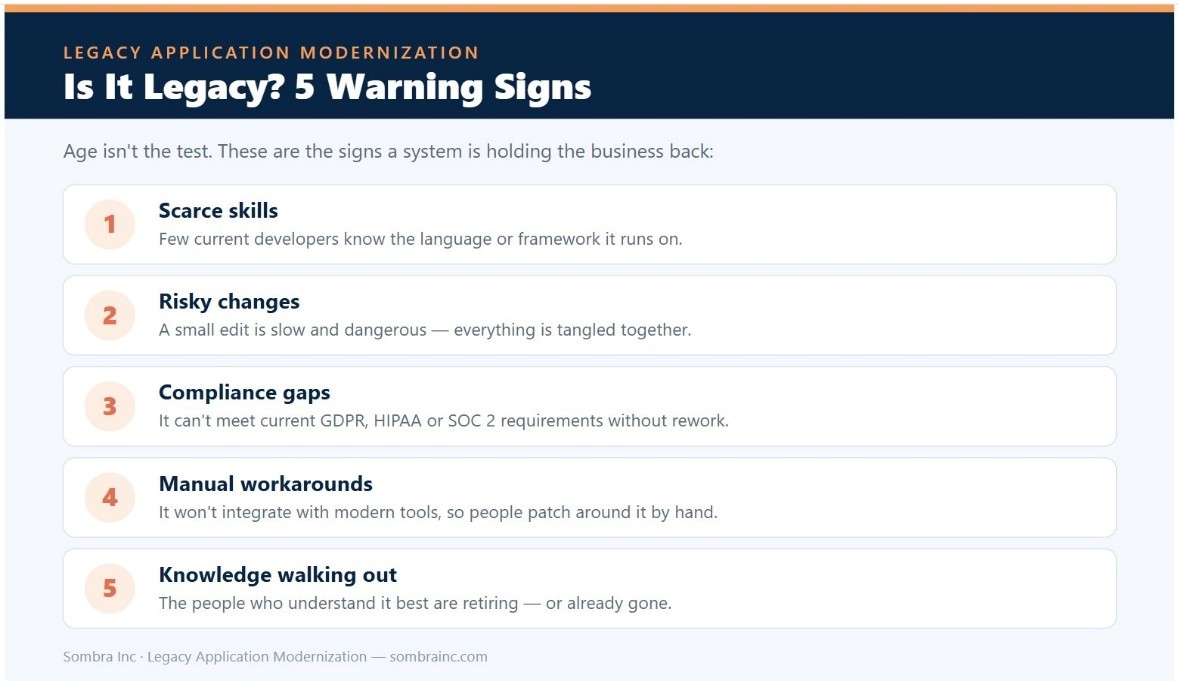
A legacy application is any system that holds the business back because of how it was built, even if it still runs. Age is part of it, but age alone is not the problem. The real markers are harder to see from the outside:
-
It runs on frameworks or languages that few current developers know well.
-
A small change is slow and risky because everything is connected to everything.
-
It cannot meet current security or compliance rules without major work.
-
It does not connect cleanly with modern tools, so people resort to manual workarounds.
-
The people who understand it best are retiring or have already left.
A system can be only five years old and already qualify. It just has to be built in a way that resists change. A well-maintained older system might not be legacy at all. The question is not "how old is it." It is "how much does it cost us to keep and what is it stopping us from doing."
Why the Pressure Is Mounting
The economics of old software get worse every year and the data backs this up. Gartner has found that companies which ignore technical debt spend far more on maintenance than those who tackle it early. At many firms, most of the IT budget goes to keeping existing systems alive rather than building new capability. That is budget spent standing still.
The hidden costs go beyond the line items. Legacy systems slow down hiring. Good engineers do not want to spend their careers on brittle code. They slow down product, because every new feature has to be threaded carefully through fragile architecture. And they raise risk, because a system that few people understand is one bad day away from a serious incident.
Meanwhile, the shift toward cloud-native architecture and AI-assisted operations keeps raising the bar. Customers expect frequent updates and instant responses. Competitors who modernized are shipping faster. Standing still is its own decision and it compounds.
The Strategies That Actually Work
Legacy app modernization is not one activity. It is a set of approaches and choosing the right one for each system is most of the battle. The widely used framework describes several paths.
-
Rehosting moves the application to new infrastructure with little code change. It is quick and useful for leaving an aging data center, though it captures only modest benefits on its own.
-
Replatforming makes targeted changes so the app can use a new platform. It strikes a balance between speed and gain.
-
Refactoring cleans up the internal structure of the code without changing what it does. This is the quiet workhorse of modernization. It pays down debt and makes future changes cheaper.
-
Rearchitecting reshapes the system. It often breaks one large application into smaller services that teams can build and scale on their own.
-
Rebuilding rewrites the app while keeping its original purpose. That makes sense when the code is truly beyond repair. Replacing swaps the system for a commercial product.
-
Retaining keeps a system as-is when it still earns its place.
The most effective programs apply different strategies across a portfolio at once. A back-office tool might be retained, a customer database refactored and the flagship product rearchitected, all under one roadmap.
A Phased Approach Beats a Big Rewrite
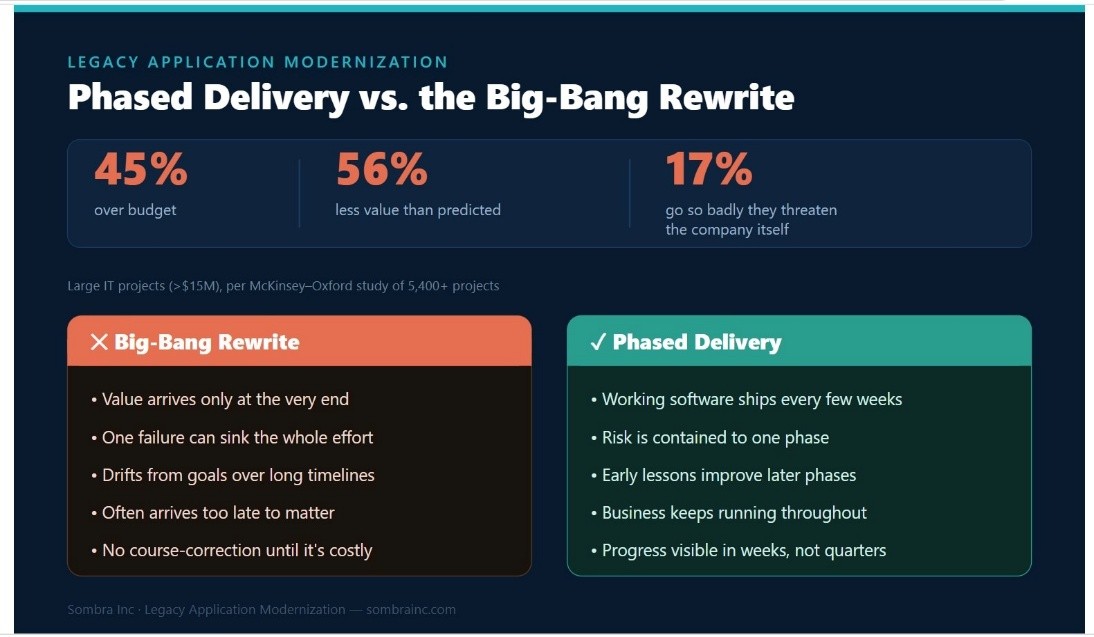
The most reliable predictor of failure is trying to do everything at once. Large, all-or-nothing projects have a grim track record. McKinsey studied thousands of IT efforts and found that big projects routinely overran their budgets and delivered far less value than promised. A meaningful share failed badly enough to threaten the business. The lesson is not "do not modernize." It is "do not modernize everything in one heroic push."
A phased approach works better for reasons that seem obvious in hindsight. It delivers value early, so the business sees results in weeks rather than quarters. It contains risk, because a problem in one phase does not topple the whole effort. And it lets the team learn, applying lessons from the first phase to the rest.
The parallel here is renovating a house while living in it. You do not knock down every wall at once and hope to have a roof by winter. You renovate one room, move into it and start on the next. The home stays livable the whole time. Legacy modernization works the same way. The teams that respect that constraint tend to be the ones still standing when the project finishes.
This is why a serious assessment matters so much at the start. Before anyone writes code, the team should audit the architecture, map dependencies, find the riskiest areas and produce a roadmap. The strongest legacy application modernization programs are built around this kind of staged assessment, where each technical step ties to a business outcome and progress shows up in weeks. The assessment turns a vague ambition into a sequence of manageable moves.
Where AI Fits In
AI has changed the practical side of this work more than most teams realize. The hardest part of working on an old system is simply understanding it. Which pieces depend on which? What breaks if you touch a given module? Where do the risks hide? AI tools now help with exactly this. They read old codebases to map dependencies and suggest refactoring strategies.
During development, AI assists with code generation and migration scripting. This speeds up the repetitive work of porting logic from old to new. During maintenance, it supports anomaly monitoring and vulnerability scanning. It catches problems earlier than manual review tends to. None of this removes the need for skilled engineers. It just lets them spend time on judgment rather than grunt work, which shortens timelines and lowers the chance of disruption.
Common Mistakes to Avoid
A few failure patterns show up again and again. They are worth naming directly.
-
Treating cloud migration as modernization. Moving an old application to the cloud unchanged rarely delivers the expected savings. The application was never designed to use cloud capabilities. The value lives in the redesign.
-
Skipping knowledge transfer. If only the vendor understands the new system, you have traded one legacy problem for another. Insist that your team learns the new architecture as it is built.
-
Ignoring the people side. Users have to adopt the modernized system. A technically perfect rebuild that ignores how people work will sit unused while everyone reverts to old workarounds.
-
Underinvesting in testing. Legacy systems often carry undocumented behavior the business quietly depends on. Strong testing keeps those hidden requirements from breaking in production.
Measuring Whether It Worked
Modernization should pay for itself and you should be able to prove it. Useful measures include the speed and frequency of releases, the cost of maintaining the system, the time it takes to onboard a new developer, system uptime and the rate of security incidents. Teams that modernize well commonly report faster release cycles and large cuts in infrastructure and maintenance costs. That frees both budget and attention for work that grows the business.
Set a baseline before you start. It is hard to celebrate a 40 percent cut in maintenance cost if nobody recorded what the cost was beforehand.
The Business Case Beyond Cost Savings
Most business cases lead with cost reduction and the savings are real. But framing modernization purely as a cost exercise undersells it. The larger value usually sits in what modernization unlocks rather than what it saves.
Consider speed. A modernized system with proper CI/CD lets you ship features in days that used to take months. In a competitive market, that difference compounds. The company that can respond in a single sprint pulls ahead of the one that needs a quarter.
Consider risk. A system that only one or two people understand is a quiet threat. If those people leave, the business loses the ability to change or even safely run a critical system. Modernization, done with proper knowledge transfer, spreads that understanding across the team.
Consider talent. Engineers want to work with current technology. A modern stack makes hiring and retention easier. A team stuck on brittle legacy code tends to lose its best people first.
When you build the case, include these harder-to-quantify benefits alongside the cost numbers. They often turn a marginal project into an obvious one.
Keeping the Business Running During the Work
One fear holds many companies back: the worry that the work will disrupt operations. It is a fair concern. The legacy system in question is usually one the business cannot afford to lose. The good news is that disruption is avoidable with the right approach.
Phased delivery is the foundation. The old system keeps running while pieces are modernized and swapped in gradually. Teams run old and new components in parallel, route a small slice of traffic to the new system first and keep the ability to roll back. The cost of running two systems briefly is real, but it is far smaller than the cost of a failed big-bang switch. A good partner plans for continuity from the start.
Three Questions to Ask a Provider First
You do not need a long checklist to judge a provider. Three questions reveal most of what matters.
-
First, ask how they decide which strategy fits each system. A good answer is specific. It talks about your systems, not their favorite tool. A weak answer pushes one approach for everything.
-
Second, ask how you will see progress. You want working software every few weeks. If the plan is to disappear for six months and return with a finished system, that is a warning sign.
-
Third, ask who understands the system when they are done. The answer should be your team. If only the vendor can maintain it, you have swapped one dependency for another.
The way a provider answers tells you as much as the answer itself. Strong partners are direct.
They tell you when something is hard. They give clear timelines and explain the risks. Weak ones stay vague and promise that everything is easy. In software, easy promises rarely survive contact with reality.
Getting Started Without Getting Overwhelmed
If legacy application modernization feels daunting, the antidote is to start small. Pick the system causing the most pain or the most risk. Commission an honest assessment of it. That assessment will tell you whether the right move is a quick rehost, a thorough refactor or a full rearchitecture. It gives you a roadmap rather than a guess.
From there, legacy app modernization becomes a series of deliberate steps rather than a leap into the unknown. Each phase delivers something real. Your team builds confidence. The systems that have been holding you back gradually stop doing so. The companies that handle this well are not the ones with the biggest budgets. They are the ones who approached it with a clear strategy, a phased plan and a partner who kept every decision tied to a business reason.
About the Author
 Sanyukta Deb
— Sanyukta Deb is Digital Marketing Team Lead at Next Move Strategy Consulting, where she has led content strategy and technical SEO for the firm's B2B market research publications for over 2 years. Her editorial process translates NextMSC's primary and secondary research — spanning technology, industrial, and consumer sectors — into commercial narratives, backed by search-intent, keyword, and competitive analysis. She brings 5 years of overall experience in digital marketing and content strategy.
About the Reviewer
 Debashree Dey
— Debashree Dey is Assistant Manager at Next Move Strategy Consulting, where she supports cross-vertical market content and communications across diverse industries for 6 years. Her professional background includes senior content writing, communications, and published manuscript authorship, with experience developing audience-focused business narratives and maintaining clear, consistent messaging. Her role supports research-led content development and editorial quality across NextMSC publications.













Add Comment