Machine Learning Market 2026: Trends, Policies & Forecasts

Introduction
The machine learning market stands at a defining inflection point in 2026. As artificial intelligence transitions from experimental technology to enterprise-grade infrastructure, the forces shaping this market have never been more consequential—or more complex. From landmark regulatory frameworks taking full effect to record-breaking private investment, the global machine learning landscape is being fundamentally restructured by policy, capital, and capability simultaneously.
According to Next Move Strategy Consulting (NMSC), the global machine learning market is projected to reach USD 407.72 billion, expanding at a compound annual growth rate (CAGR) of 45.29% by 2030. This trajectory reflects not merely technological momentum, but a convergence of institutional investment, regulatory maturation, and cross-sector adoption that is redefining how organizations compete, operate, and deliver value.
For C-level executives, institutional investors, and strategic decision-makers, understanding the forces driving this expansion—and the risks embedded within it—is no longer optional. It is a prerequisite for informed capital allocation and long-term competitive positioning.
For More Information: Download FREE Sample on Machine Learning Market Report
The Regulatory and Investment Forces Reshaping the Machine Learning Market in 2026
The EU AI Act: A Global Compliance Watershed
On August 2, 2026, the European Union's AI Act became fully enforceable—marking the most significant regulatory milestone in the history of artificial intelligence governance. As of that date, the EU's rules on AI models are now enforceable, cementing the European Commission's role as the world's most prominent regulator of this disruptive technology.
The world's first comprehensive legal framework for AI, the EU AI Act establishes a risk-based classification system for AI systems. Some of its most significant provisions—notably those regulating large language models and General-Purpose AI (GPAI) models—became applicable in August 2026. The rulebook requires transparency on how a model was built, disclosure of any copyright-protected content used for training, and sufficient information for downstream users to understand the model's capabilities. Additional requirements fall on companies developing the most powerful "frontier" models, compelling AI firms to identify and mitigate risks to society at large.
The European Commission set up the European AI Office to drive enforcement of the AI Act's rules on AI models. Fines for non-compliance can reach up to 3% of global annual turnover for GPAI model providers. Most leading Western AI labs—with the notable exception of Meta—signed a voluntary code of practice drafted by world-leading experts, including Yoshua Bengio, detailing how developers should comply with the rules. OpenAI's Vice President and Head of EMEA Policy confirmed the company's collaboration with the European Commission on implementing the AI Act.
The enforcement challenge is substantial. The Commission's AI Office faces the task of regulating one of the most complex technologies of our time while competing with the private sector for scarce AI talent. Any decisive action from Brussels is also bound to draw the attention of Washington, with the Trump administration particularly assertive in challenging EU digital rules that affect American companies.
The U.S. AI Action Plan: Deregulation as a Competitive Strategy
On the other side of the Atlantic, the United States took a markedly different approach. On July 23, 2025, the Trump Administration unveiled America's AI Action Plan—a sweeping federal policy roadmap explicitly designed to reassert American leadership in artificial intelligence by eliminating regulatory barriers, accelerating infrastructure investment, and expanding AI exports to allied nations. The plan contains more than 90 policy actions organized around three key pillars: Accelerating AI Innovation, Building AI Infrastructure, and Leading in International AI.
The Plan directs federal agencies to aggressively roll back existing AI-related regulations and makes federal funding for AI initiatives contingent on states refraining from imposing new regulatory requirements. It also prioritizes domestic semiconductor manufacturing, data center construction, and national power grid modernization to support the energy demands of advanced AI systems—with AI workloads projected to account for up to 9% of U.S. electricity consumption by 2030. For businesses, these infrastructure initiatives present opportunities to secure faster project approvals and improved access to domestic supply chains for high-performance computing hardware.
This regulatory divergence between the EU and the U.S. creates a bifurcated compliance environment for multinational machine learning companies—one that demands careful strategic navigation.
NMSC Strategic Perspective: Navigating the Dual Regulatory Paradigm
From Next Move Strategy Consulting's analytical standpoint, the simultaneous emergence of the EU's compliance-first framework and the U.S.'s deregulation-driven approach represents a structural market bifurcation with lasting implications for the machine learning market. Organizations operating across both jurisdictions must now architect their ML deployment strategies to satisfy divergent legal requirements without sacrificing operational efficiency.
NMSC's analysis indicates that this regulatory divergence is likely to accelerate market segmentation—with cloud-based MLaaS providers facing the greatest compliance complexity, while on-premise deployments in regulated sectors such as BFSI and healthcare may gain renewed strategic appeal as organizations seek greater control over their AI governance posture. The CAGR of 45.29% projected by NMSC through 2030 reflects a market that is absorbing these regulatory pressures while continuing to expand at an extraordinary pace, driven by the fundamental productivity and decision-making advantages that machine learning delivers across every major industry vertical.
Section Summary: The machine learning market in 2026 is being shaped by two dominant and divergent forces: the EU AI Act's full enforcement and the U.S. AI Action Plan's deregulatory agenda. These frameworks are creating both compliance complexity and strategic opportunity for ML market participants globally.
Key Takeaways:
-
The EU AI Act became fully enforceable on August 2, 2026, with GPAI model fines reaching up to 3% of global annual turnover.
-
Most leading Western AI labs (except Meta) signed the EU's voluntary code of practice for AI model compliance.
-
The U.S. AI Action Plan (July 2025) contains 90+ policy actions across three pillars: innovation, infrastructure, and international leadership.
-
NMSC projects the machine learning market to reach USD 407.72 billion by 2030 at a CAGR of 45.29%.
Industry Impact Analysis
Investment Surge and Capability Acceleration
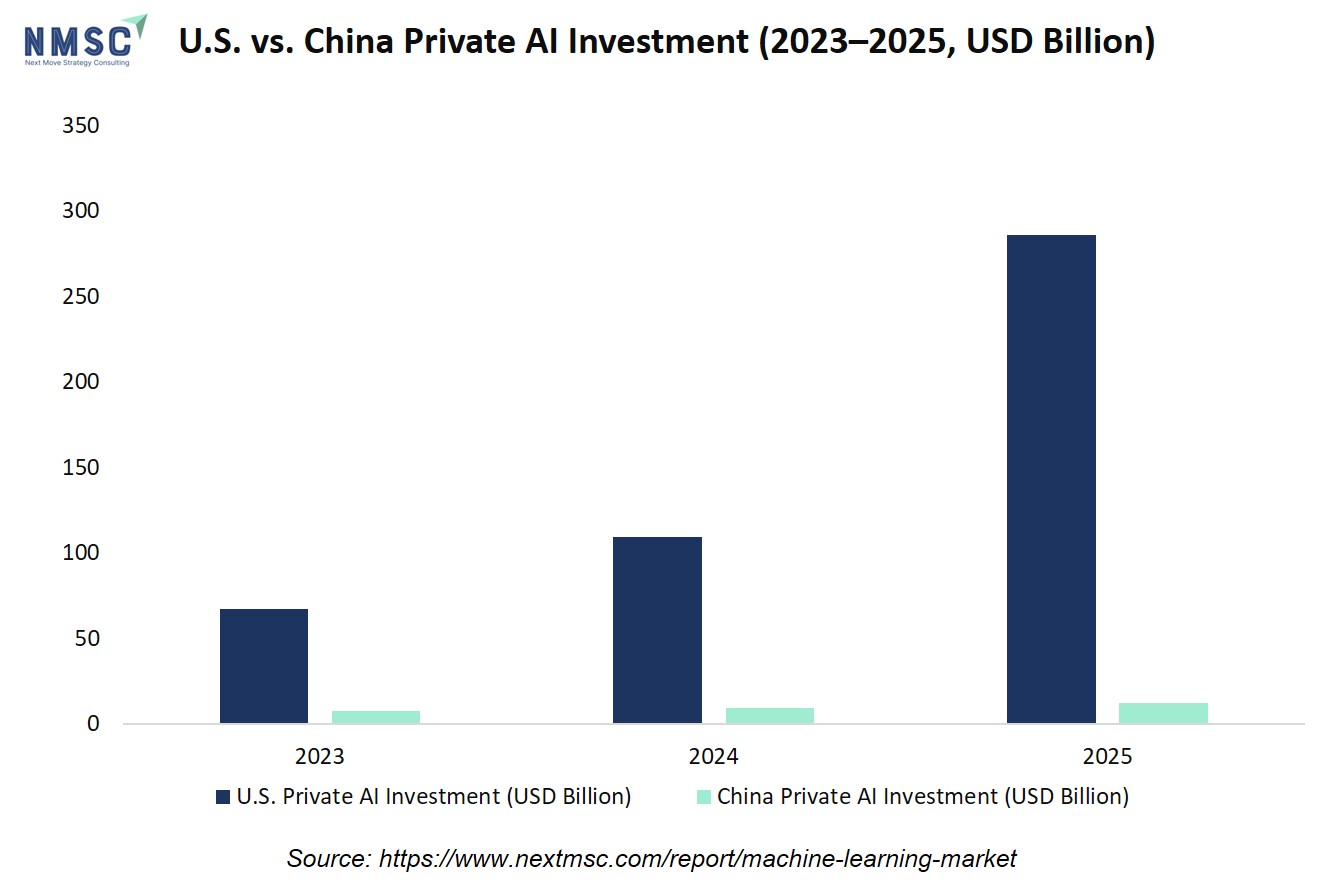
The scale of capital flowing into the machine learning ecosystem in 2025 and 2026 is without historical precedent. According to Stanford University's Human-Centered Artificial Intelligence (HAI) 2026 AI Index Report, U.S. private AI investment reached USD 285.9 billion in 2025—more than 23 times the USD 12.4 billion invested in China during the same period. The United States also led in entrepreneurial activity, with 1,953 newly funded AI companies in 2025, more than ten times the next closest country.
This investment surge is translating directly into capability acceleration. Industry produced over 90% of notable frontier AI models in 2025, with several models now meeting or exceeding human baselines on PhD-level science questions, multimodal reasoning, and competition mathematics. On the SWE-bench Verified coding benchmark, model performance rose from 60% to near 100% in a single year. Organizational AI adoption has reached 88%, and 4 in 5 university students now use generative AI.
The estimated value of generative AI tools to U.S. consumers reached USD 172 billion annually by early 2026, with the median value per user tripling between 2025 and 2026. Generative AI has achieved 53% population-level adoption within three years—spreading faster than the personal computer or the internet—though the pace varies by country and correlates strongly with GDP per capita. Singapore leads at 61% and the UAE at 64%, while the U.S. ranks 24th at 28.3%.
Enterprise Adoption: From Pilot to Production
Deloitte's State of AI in the Enterprise 2026 report, based on a survey of 3,235 senior leaders across 24 countries, reveals that worker access to AI rose by 50% in 2025, and the number of companies with 40% or more of their AI projects in production is set to double within six months.
Two-thirds (66%) of organizations report productivity and efficiency gains from AI adoption. Enhanced insights and decision-making are reported by 53% of organizations, while 40% report cost reduction. However, only 34% of organizations are truly reimagining their businesses through AI—creating new products, services, or reinventing core processes—while 37% are using AI at a surface level with little change to existing processes.
The Federal Reserve's April 2026 analysis of U.S. Census Bureau data confirms that approximately 18% of U.S. firms have adopted AI as of year-end 2025, with the adoption rate having grown 68% in the prior year. Work-related generative AI adoption stands at approximately 41% of the workforce, while 78% of the U.S. labor force works at firms that have adopted AI in some form. Professional services (33%) and financial services (30%) lead in firm-level AI adoption, with work-related generative AI adoption highest in financial services (63%) and professional services (62%).
The Responsible AI Gap: A Material Risk
Despite this capability acceleration, Stanford HAI's 2026 AI Index Report identifies a critical and widening gap between AI capability and responsible AI governance. Documented AI incidents rose to 362 in 2025, up from 233 in 2024—a 55% increase that reflects both the expanded deployment of AI systems and the growing complexity of their failure modes. Almost all leading frontier AI model developers report results on capability benchmarks, but reporting on responsible AI benchmarks remains inconsistent. Furthermore, recent research found that improving one responsible AI dimension, such as safety, can degrade another, such as accuracy.
Deloitte's 2026 enterprise AI report reinforces this concern: only one in five companies has a mature governance model for autonomous AI agents, even as agentic AI usage is poised to rise sharply in the next two years.
Geopolitical Dynamics and Supply Chain Concentration
Stanford HAI's 2026 AI Index Report highlights a structural vulnerability in the global machine learning supply chain: the United States hosts 5,427 data centers—more than ten times any other country—yet a single company, TSMC, fabricates almost every leading AI chip. This concentration of critical AI hardware production in a single Taiwanese foundry represents a systemic risk that is increasingly recognized by policymakers and institutional investors alike. A TSMC-U.S. expansion began operations in 2025, offering a partial mitigation of this dependency.
Notably, the U.S.-China AI model performance gap has effectively closed. U.S. and Chinese models have traded the lead multiple times since early 2025. In February 2025, DeepSeek-R1 briefly matched the top U.S. model, and as of March 2026, Anthropic's top model leads by just 2.7%. While the U.S. still produces more top-tier AI models and higher-impact patents, China leads in publication volume, citations, patent output, and industrial robot installations.
Talent Dynamics: A Structural Constraint on ML Growth
A counterintuitive finding from Stanford HAI's 2026 AI Index Report is the sharp decline in AI talent migration to the United States. The number of AI researchers and developers moving to the U.S. has dropped 89% since 2017, with an 80% decline in the last year alone. This talent contraction, occurring simultaneously with record investment levels, creates a structural constraint on the machine learning market's ability to translate capital into deployed capability.
Deloitte's 2026 enterprise AI report identifies the AI skills gap as the single biggest barrier to AI integration, with 53% of organizations prioritizing education to raise overall AI fluency and 48% implementing upskilling and reskilling strategies. AI skills are now mentioned in 2.5% of all U.S. job postings—up 55% compared to the prior year—signaling that demand for ML-capable talent is accelerating faster than supply.
Section Summary: The machine learning market is experiencing simultaneous acceleration in investment and capability, alongside growing risks from the responsible AI governance gap, supply chain concentration, geopolitical competition, and talent constraints. These dynamics collectively define the risk-reward profile for ML market participants in 2026.
Key Takeaways:
-
U.S. private AI investment reached USD 285.9 billion in 2025, per Stanford HAI's 2026 AI Index Report—23x China's investment.
-
78% of the U.S. labor force works at firms that have adopted AI, per Federal Reserve analysis of Survey of Business Uncertainty data.
-
Documented AI incidents rose 55% year-over-year to 362 in 2025, signaling a widening responsible AI governance gap.
-
Only 1 in 5 companies has a mature governance model for autonomous AI agents, per Deloitte's 2026 enterprise AI report.
Pros and Cons of Recent Market Developments
|
Development |
Pros |
Cons |
|
EU AI Act Full Enforcement (August 2, 2026) |
Establishes clear compliance standards; builds consumer and institutional trust in AI systems; levels the competitive playing field for responsible AI developers; creates the "Brussels effect" that raises global compliance standards |
Significant compliance costs for SMEs and multinational operators; risk of innovation slowdown in high-risk AI categories; limited AI Office resources may impede effective enforcement; potential for delayed EU market launches |
|
U.S. AI Action Plan (July 2025) |
Accelerates infrastructure investment; reduces regulatory friction for AI deployment; promotes open-source AI adoption; strengthens U.S. AI export leadership; 90+ policy actions provide clear strategic direction |
Creates regulatory fragmentation between federal and state levels; export controls on semiconductors could disrupt global supply chains; deregulatory stance may widen the responsible AI governance gap |
|
Record U.S. Private AI Investment (USD 285.9B in 2025) |
Fuels rapid capability development; expands the ML startup ecosystem; drives down costs through competition and scale; 1,953 newly funded AI companies in 2025 |
Risk of capital misallocation; potential AI bubble dynamics; concentration of investment in a small number of frontier model developers |
|
Rising AI Incidents (362 in 2025, up from 233 in 2024) |
Drives demand for responsible AI tools, governance platforms, and compliance services; accelerates regulatory action |
Erodes public trust; increases regulatory scrutiny; creates reputational and legal exposure for deployers; only 1 in 5 companies has mature agentic AI governance |
|
TSMC-U.S. Expansion (Operational 2025) |
Reduces single-point-of-failure risk in AI chip supply chain; supports domestic semiconductor manufacturing goals |
Transition period creates near-term supply uncertainty; high capital expenditure requirements; geopolitical tensions in Taiwan Strait remain a systemic risk |
|
Generative AI at 53% Population Adoption |
Validates mass-market demand for ML-powered tools; accelerates enterprise adoption cycles; consumer value estimated at USD 172B annually in the U.S. |
Adoption pace varies significantly by GDP per capita; risk of widening digital divide; U.S. ranks only 24th globally at 28.3% adoption rate |
Key Data & Statistics
Machine Learning Market Key Data and Statistics
|
Metric |
Value |
|
Global Machine Learning Market Size (Base Year) |
USD 29.84 Billion |
|
Global Machine Learning Market Forecast |
USD 407.72 Billion |
|
Machine Learning Market CAGR |
45.29% |
|
U.S. Private AI Investment |
USD 285.9 Billion |
|
Newly Funded AI Companies (U.S.) |
1,953 |
|
Organizational AI Adoption Rate |
88% |
|
Generative AI Consumer Value (U.S., Annual) |
USD 172 Billion |
|
Generative AI Population Adoption Rate |
53% (within 3 years) |
|
Documented AI Incidents |
362 (up from 233 in 2024) |
|
AI Talent Migration Decline to U.S. |
-89% since 2017; -80% in last year |
|
U.S. AI Data Centers |
5,427 |
|
U.S. Firm-Level AI Adoption Rate |
~18% of firms |
|
U.S. Labor Force at AI-Adopting Firms |
78% |
|
Work-Related GenAI Adoption (Individuals) |
~41% of workforce |
|
Worker Access to AI Growth |
+50% |
|
Organizations Reporting AI Productivity Gains |
66% |
|
Companies with Mature Agentic AI Governance |
1 in 5 (20%) |
|
AI Skills in U.S. Job Postings |
2.5% of all postings (+55% YoY) |
|
EU GPAI Non-Compliance Fine |
Up to 3% of global annual turnover |
Future Outlook & Forecast
NMSC Market Forecast: A USD 407.72 Billion Opportunity by 2030
According to Next Move Strategy Consulting's proprietary analysis, the global machine learning market is forecast to reach USD 407.72 billion by 2030, growing from a base of USD 29.84 billion in 2022 at a CAGR of 45.29% over the 2023–2030 forecast period. This represents one of the most aggressive growth trajectories of any technology market segment globally, underpinned by the convergence of cloud infrastructure expansion, enterprise digital transformation, and the proliferation of AI-native applications across every major industry vertical.
North America is expected to maintain its dominant market position throughout the forecast period, supported by the concentration of leading ML technology companies—including Google, Microsoft Corporation, Amazon.com Inc., IBM Corporation, Apple Inc., and Intel Corporation—robust venture capital ecosystems, and the U.S. government's commitment to AI infrastructure investment. Asia-Pacific is projected to demonstrate the strongest growth momentum, driven by accelerating digital adoption in China, India, South Korea, and Southeast Asia, alongside significant government-backed AI research and development initiatives.
Emerging Trends Defining the Machine Learning Market Through 2030
Agentic AI and Autonomous Systems: AI agents capable of executing multi-step tasks across operating systems demonstrated a leap from 12% to approximately 66% task success on OSWorld benchmarks, per Stanford HAI's 2026 AI Index Report. Deloitte's 2026 enterprise AI report confirms that agentic AI usage is poised to rise sharply in the next two years, with use cases spanning customer support, supply chain management, R&D, knowledge management, and cybersecurity. This capability trajectory points toward a near-term inflection in enterprise automation, with profound implications for workforce productivity and business process redesign.
Physical AI's Expanding Footprint: More than half of companies (58%) report at least limited use of physical AI today, and that figure is set to reach 80% within two years, with Asia-Pacific leading in early implementation, per Deloitte's 2026 enterprise AI report. Common physical AI applications include collaborative robots on assembly lines, inspection drones with automated response capabilities, and autonomous forklifts—with adoption especially advanced in manufacturing, logistics, and defense.
AI Sovereignty as a National Policy Priority: National AI strategies are expanding, particularly among developing economies, and state-backed investments in AI supercomputing are rising in parallel—a sign of growing ambitions for domestic control over AI ecosystems. Open-source development is starting to redistribute participation, with contributions from the rest of the world now outpacing Europe and approaching the United States on GitHub, fueling more linguistically diverse models and benchmarks. Deloitte's 2026 report identifies sovereign AI—deploying AI under a country's own laws, infrastructure, and data—as a growing strategic priority, with a significant share of organizations factoring an AI solution's country of origin into vendor selection decisions.
The No-Code and Low-Code ML Revolution: The introduction of no-code and low-code machine learning development platforms is expected to significantly expand the addressable market for ML solutions, enabling organizations without deep technical expertise to deploy AI-driven applications. This democratization of ML capability is a key growth driver identified in NMSC's market analysis, as these platforms open machine learning to a broader audience and accelerate the adoption of AI-driven solutions across industries.
Responsible AI as a Market Differentiator: As regulatory requirements for AI transparency, safety, and accountability intensify globally—with the EU AI Act's GPAI rules now in force and high-risk AI system rules approaching in December 2027—responsible AI capabilities will increasingly function as a competitive differentiator rather than a compliance cost. Globally, the EU is trusted more than the United States or China to regulate AI effectively, and only 31% of Americans trust their own government to regulate AI—the lowest level among all surveyed countries. Organizations that invest proactively in explainable AI, bias mitigation, and governance frameworks will be better positioned to access regulated markets and institutional clients.
Section Summary: The machine learning market is on a trajectory toward USD 407.72 billion by 2030, driven by enterprise adoption, infrastructure investment, and the emergence of agentic and physical AI capabilities. Regulatory maturation, AI sovereignty, and the democratization of ML through no-code platforms will define the competitive landscape through the end of the decade.
Key Takeaways:
-
Physical AI adoption is set to reach 80% of companies within two years, up from 58% today, per Deloitte.
-
Agentic AI task success rates jumped from 12% to ~66% in a single year, signaling a major capability inflection.
-
AI sovereignty is emerging as a defining feature of national policy, reshaping vendor selection and infrastructure investment decisions globally.
Next Steps for Stakeholders
For C-Level Executives:
-
Conduct a Regulatory Readiness Assessment: With the EU AI Act now fully enforceable as of August 2, 2026, organizations deploying AI systems in the EU must immediately audit their ML applications against the Act's risk classification framework. GPAI model providers face fines of up to 3% of global annual turnover for non-compliance. High-risk AI systems in sectors such as BFSI, healthcare, and employment face the most stringent obligations, with full compliance required by December 2027.
-
Prioritize Agentic AI Governance Before Scaling: Deloitte's 2026 enterprise AI report finds that only 1 in 5 companies has a mature governance model for autonomous AI agents, even as agentic AI usage is set to surge. Organizations must establish clear oversight frameworks, define human-in-the-loop requirements, and implement audit trails for autonomous AI decisions before scaling agentic deployments.
-
Diversify AI Infrastructure Dependencies: The concentration of AI chip fabrication in a single foundry (TSMC) represents a material supply chain risk. Executives should evaluate their organization's exposure to this dependency and develop contingency sourcing strategies, particularly as the U.S. AI Action Plan accelerates domestic semiconductor manufacturing capacity.
-
Invest in Workforce AI Fluency Systematically: The AI skills gap is the single biggest barrier to AI integration, per Deloitte's 2026 report. With AI skills now mentioned in 2.5% of all U.S. job postings—up 55% year-over-year—organizations must implement structured upskilling programs, redesign career paths around AI-human collaboration, and build new roles such as AI operations managers and human-AI interaction specialists.
-
Leverage MLaaS for Accelerated Time-to-Value: For organizations seeking to accelerate ML adoption without the capital expenditure of proprietary model development, cloud-based MLaaS platforms offer a compelling entry point. The no-code and low-code ML segment is expanding rapidly, enabling faster time-to-value for enterprise AI initiatives.
For Institutional Investors:
-
Prioritize Responsible AI-Enabled Portfolio Companies: As regulatory frameworks mature globally, portfolio companies with robust AI governance capabilities will demonstrate superior risk-adjusted returns. Evaluate ML investments not only on capability metrics but on governance maturity—particularly given that only 20% of companies currently have mature agentic AI oversight.
-
Monitor Geopolitical Risk in AI Hardware: The TSMC dependency and evolving U.S. export controls on semiconductors represent material risks for AI infrastructure investments. Portfolio diversification across the AI value chain—from chip design to cloud services to application layer—is advisable.
-
Track the Asia-Pacific and Sovereign AI Growth Trajectory: NMSC's market analysis identifies Asia-Pacific as the region with the strongest ML market growth momentum. Simultaneously, the sovereign AI trend is reshaping vendor selection globally—creating opportunities for regional AI infrastructure providers and local cloud platforms that can offer data residency and regulatory compliance advantages.
Conclusion
The machine learning market in 2026 is defined by a rare and powerful convergence: record-breaking investment, accelerating technical capability, and the arrival of consequential regulatory frameworks that will govern how AI is developed and deployed for decades to come. The EU AI Act's full enforcement on August 2, 2026—bringing GPAI model rules into effect with fines of up to 3% of global annual turnover—and the U.S. AI Action Plan's deregulatory agenda represent two fundamentally different visions of AI governance. Yet both are driving substantial capital allocation and strategic repositioning across the global ML ecosystem.
The data is unambiguous: with U.S. private AI investment at USD 285.9 billion in 2025, 78% of the U.S. labor force now working at AI-adopting firms, and generative AI achieving 53% global population adoption faster than any prior technology platform, machine learning is no longer a technology experiment. It is a core business infrastructure that demands the same rigor in governance, risk management, and strategic investment as any other critical enterprise asset.
With the global machine learning market projected by Next Move Strategy Consulting to reach USD 407.72 billion by 2030 at a CAGR of 45.29%, the organizations that build durable ML capabilities today—grounded in responsible AI principles, aligned with the evolving regulatory environment, and supported by systematic workforce development—will be best positioned to capture the extraordinary value this market will generate.
About the Author
 Sanyukta Deb
— Sanyukta Deb is Digital Marketing Team Lead at Next Move Strategy Consulting, where she has led content strategy and technical SEO for the firm's B2B market research publications for over 2 years. Her editorial process translates NextMSC's primary and secondary research — spanning technology, industrial, and consumer sectors — into commercial narratives, backed by search-intent, keyword, and competitive analysis. She brings 5 years of overall experience in digital marketing and content strategy.
Sanyukta Deb
— Sanyukta Deb is Digital Marketing Team Lead at Next Move Strategy Consulting, where she has led content strategy and technical SEO for the firm's B2B market research publications for over 2 years. Her editorial process translates NextMSC's primary and secondary research — spanning technology, industrial, and consumer sectors — into commercial narratives, backed by search-intent, keyword, and competitive analysis. She brings 5 years of overall experience in digital marketing and content strategy.
About the Reviewer
 Debashree Dey
— Debashree Dey is Assistant Manager at Next Move Strategy Consulting, where she supports cross-vertical market content and communications across diverse industries for 6 years. Her professional background includes senior content writing, communications, and published manuscript authorship, with experience developing audience-focused business narratives and maintaining clear, consistent messaging. Her role supports research-led content development and editorial quality across NextMSC publications.
Debashree Dey
— Debashree Dey is Assistant Manager at Next Move Strategy Consulting, where she supports cross-vertical market content and communications across diverse industries for 6 years. Her professional background includes senior content writing, communications, and published manuscript authorship, with experience developing audience-focused business narratives and maintaining clear, consistent messaging. Her role supports research-led content development and editorial quality across NextMSC publications.


















Add Comment