Motor Vehicle Parts Market: Tariffs, Trade Wars & the Road to 2030

Introduction
The global Motor Vehicle Parts Market is navigating one of the most consequential periods in its modern history. Simultaneously confronted by sweeping trade policy shifts, the accelerating transition toward electrified powertrains, and the structural reconfiguration of North American supply chains, the industry is being forced to adapt at a pace and scale that few anticipated even two years ago. For C-level executives, institutional investors, and procurement strategists, understanding the forces reshaping the motor vehicle parts market is no longer optional — it is a prerequisite for competitive survival.
At the heart of this transformation lies a convergence of regulatory disruption and technological evolution. The imposition of 25% Section 232 tariffs on imported automobiles and auto parts by the U.S. government in April 2025, the ongoing renegotiation of the United States-Mexico-Canada Agreement (USMCA), and the abrupt repeal of federal EV consumer tax credits have collectively redefined the cost structures, sourcing strategies, and investment priorities of every major participant in the global automotive supply chain. Against this backdrop, the motor vehicle parts market continues to demonstrate long-term structural resilience, underpinned by rising vehicle complexity, growing aftermarket demand, and the irreversible shift toward advanced electronic and electrified components.
For More Information: Download FREE Sample on Motor Vehicle Parts Market Report
Tariffs, Trade Realignment, and the New Competitive Calculus
The Section 232 Shock: A Structural Reset for Global Auto Parts Trade
In March 2025, the Trump administration issued a presidential proclamation imposing a 25% additional tariff on imported automobiles and automobile parts under Section 232 of the Trade Expansion Act of 1962, effective April 3, 2025. This measure was subsequently extended in October 2025 to cover medium- and heavy-duty trucks, truck parts, and buses, further broadening the tariff's reach across the commercial vehicle segment.
The practical consequences have been immediate and far-reaching. According to Dykema's 2026 Automotive Trends Report, tariff policy has emerged as the dominant concern for automotive industry stakeholders, cited by 81% of respondents — up from 71% in 2025. The report underscores a critical shift in industry mindset: companies are no longer treating tariffs as a temporary disruption to be managed, but as a permanent structural feature of the competitive landscape that demands long-term strategic adaptation. For manufacturing, tariffs are determining plant location decisions and capital allocation. In procurement, they are driving country-of-origin strategies as companies analyze the possibility of sourcing components from different jurisdictions to minimize tariff exposure.
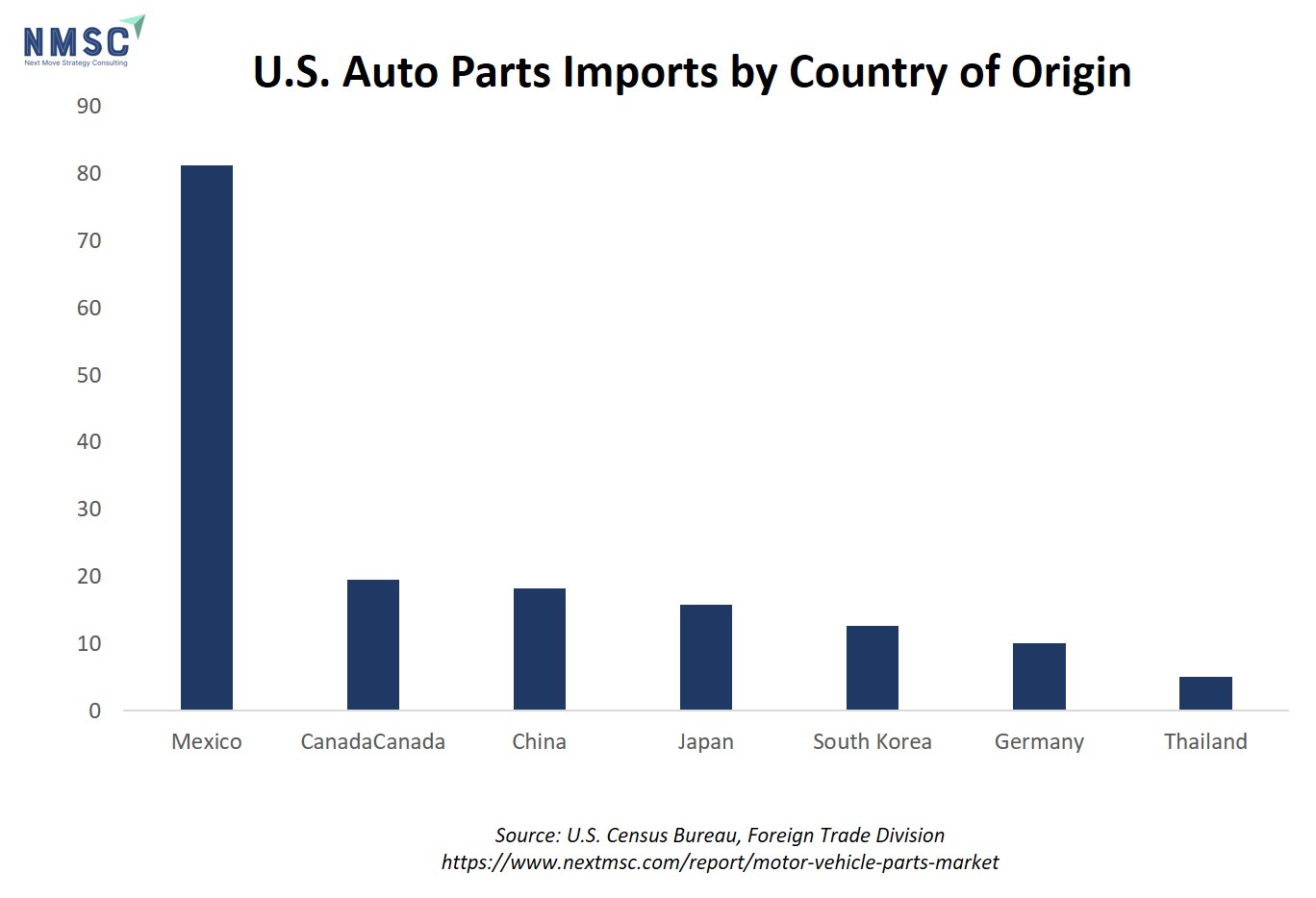
Under the current framework, imports from USMCA-compliant Mexico and Canada receive favorable treatment, effectively rewarding highly localized North American supply chains and penalizing reliance on European and Asian sourcing. This dynamic is influencing investment decisions worth billions of dollars across the global motor vehicle parts ecosystem.
USMCA Renegotiation: Rewriting the Rules of Origin
Compounding the tariff pressure is the 2026 USMCA joint review, which has rapidly escalated into a substantive renegotiation rather than a routine affirmation. USMCA renegotiations have surged to become the second-highest policy concern for automotive executives, cited by 49% of respondents — a dramatic increase of 30 percentage points from 2025. The U.S. is seeking to raise regional value content thresholds to 82% and require that 50% of a vehicle's content originate specifically in the United States.
Research from the Brookings Institution highlights the scale of the compliance challenge. Rates of non-compliance for autos imported into the U.S. market quintupled under the existing USMCA framework, while non-compliance for auto parts more than doubled for both Canadian and Mexican goods. The persistent wage gap between North American production bases — with the average hourly wage of automotive workers in Mexico standing at $5.66 in 2024 compared to $30.86 in the United States — continues to complicate efforts to achieve genuine regional content parity.
EV Tax Credit Repeal and Its Cascading Effect on Parts Demand
The One Big Beautiful Bill Act (OBBBA), enacted in mid-2025, repealed the federal EV consumer tax credit, triggering a sharp decline in EV sales and prompting several EV supplier facilities to shutter operations. This policy reversal has introduced significant uncertainty into the EV parts supply chain, particularly for battery components, e-powertrain systems, and advanced electronics — segments that had attracted substantial capital investment in anticipation of accelerated electrification timelines.
PwC's 2026 Automotive Industry Outlook confirms that BEV adoption in the U.S. is stagnating, with battery electric vehicles currently carrying a 15–20% price premium relative to the overall market average transaction price. The removal of consumer subsidies has further widened this affordability gap, pushing demand toward hybrid electric vehicles (HEVs), which have doubled in adoption over the last three years as OEMs rolled out more HEV models than ever before. For the motor vehicle parts market, this powertrain bifurcation is creating a dual-track demand environment: declining volumes for traditional ICE components, growing but volatile demand for EV-specific parts, and robust, sustained demand for hybrid-compatible components.
NMSC Strategic Perspective: Navigating the Policy-Driven Inflection Point
From Next Move Strategy Consulting's analytical standpoint, the convergence of Section 232 tariffs, USMCA renegotiation, and EV subsidy elimination represents a structural inflection point — not a cyclical correction — for the global motor vehicle parts market. The industry is undergoing a fundamental reordering of competitive advantage, where proximity to end markets, compliance with evolving rules of origin, and the ability to serve multiple powertrain architectures simultaneously will determine which suppliers emerge as long-term winners.
NMSC's assessment is that suppliers with diversified product portfolios spanning ICE, hybrid, and EV components, combined with geographically flexible manufacturing footprints anchored in North America, are best positioned to capture value in this environment. The tariff-driven reshoring imperative is accelerating investment in U.S. and Mexico-based production capacity, creating near-term opportunities for suppliers capable of rapidly scaling localized operations. Simultaneously, the prolonged BEV adoption timeline — with PwC projecting price parity with ICE vehicles only by 2028–2029 — provides a critical window for traditional parts manufacturers to diversify into adjacent electrification-related segments without abandoning their existing revenue base.
Section Summary: The motor vehicle parts market is being reshaped by an unprecedented convergence of trade policy disruption, powertrain transition uncertainty, and supply chain realignment.
Key Takeaways:
-
The 25% Section 232 tariff on imported auto parts, effective April 2025, has permanently altered sourcing strategies and manufacturing location decisions across the global supply chain.
-
USMCA renegotiation — the second-highest concern for 49% of automotive executives — is pushing toward stricter rules of origin, with the U.S. seeking 50% domestic content requirements.
-
The repeal of the federal EV consumer tax credit has stalled BEV adoption and created significant demand uncertainty for EV-specific parts suppliers.
-
Hybrid electric vehicles have emerged as the pragmatic near-term beneficiary, with adoption doubling over the last three years and OEMs rapidly expanding HEV model offerings.
Industry Impact Analysis
Financial Stress Across the Supplier Ecosystem
The cumulative impact of tariff pressures, demand volatility, and the ongoing powertrain transition is clearly visible in supplier financial performance. BCG's 2026 Global Automotive Supplier Study, which analyzed more than 750 suppliers and nearly 50 OEMs worldwide, reveals that OEM EBIT margins peaked in 2023 and have declined steadily since, falling to approximately 4.8% in 2025. Suppliers, by contrast, have demonstrated greater resilience, with EBIT margins projected to remain broadly stable at around 5.7% in 2025, though this stability masks significant dispersion between top-quartile and bottom-quartile performers.
Critically, only 21% of C-suite automotive supplier executives believe the industry will improve over the next 12 months, while 53% expect deterioration — a sentiment that reflects growing pessimism about the external environment even as individual companies maintain confidence in their own operational resilience.
Value Pool Divergence: Winners and Laggards
The BCG study identifies a profound reallocation of value within the motor vehicle parts market. Suppliers in semiconductors and batteries achieved revenue growth of 15% and 45% CAGR respectively between 2019 and 2024, far outpacing classic component segments, which typically grew in the low single digits. Looking ahead, batteries and EV powertrain-related components are expected to continue growing at approximately 13% per year, while ICE powertrain components face a structural decline with CAGRs of minus 3% between 2025 and 2030, accelerating to around minus 8% until 2035.
Non-ADAS vehicle software is expected to sustain robust growth of 14–16% annually well into the 2030s, underscoring the growing importance of software-defined vehicle capabilities as a driver of parts market value creation.
China's Expanding Competitive Footprint
China's role in the global motor vehicle parts market continues to expand, presenting both competitive pressure and strategic complexity for Western suppliers. Chinese OEMs have rapidly scaled exports globally, selling approximately three million vehicles per year to major regions since 2020, with Chinese manufacturers penetrating nearly all major global regions except the United States. Battery costs in China are approximately 30% lower per kWh than in the U.S. and nearly 50% lower than in Europe, driven by highly integrated supply chains and localized mineral refining capabilities.
China-based suppliers overtook their European counterparts in profitability in 2024, and between 2019 and 2025, China attracted the largest share of incremental market capitalization among automotive suppliers, closely correlated with the rise of battery and semiconductor players.
Supply Chain Localization and Reshoring Momentum
More than 55% of vehicles sold in the U.S. today are manufactured domestically, and this trend is expected to increase in coming years, bolstered by OEM expansions and supply chain localization driven by tariff incentives. North American vehicle production volumes are projected to return to mid-2019 levels by 2030, driven by capacity expansions and reallocation toward BEV, HEV, and advanced ICE vehicles.
BCG's analysis of more than 450 publicly announced strategic moves by automotive suppliers since early 2024 reveals a clear pattern of manufacturing capacity investments in best-cost locations including Mexico, India, Romania, Slovakia, Poland, Hungary, and Thailand — reflecting a multilocal sourcing strategy designed to balance tariff compliance with cost efficiency.
Section Summary: The motor vehicle parts market is experiencing a structural bifurcation, with value rapidly migrating toward electrification, electronics, and software-defined vehicle components while traditional ICE parts face long-term volume headwinds.
Key Takeaways:
-
OEM EBIT margins have declined to approximately 4.8% in 2025, while supplier margins remain more resilient at ~5.7%, though dispersion between top and bottom performers is widening.
-
ICE powertrain components face a structural CAGR decline of minus 3% from 2025 to 2030, accelerating to minus 8% through 2035.
-
China's cost advantages in battery manufacturing — 30% lower per kWh than the U.S. — are reshaping global competitive dynamics in the EV parts segment.
-
Reshoring and supply chain localization are accelerating, with over 55% of U.S.-sold vehicles now manufactured domestically.
Pros and Cons of Recent Market Developments
|
Recent Development |
Pros |
Cons |
|
25% Section 232 Tariffs on Auto Parts |
Incentivizes domestic manufacturing investment; rewards USMCA-compliant North American supply chains; reduces dependence on geopolitically sensitive sourcing |
Raises input costs for U.S. automakers and suppliers; increases vehicle prices for consumers; disrupts established global supply chain relationships |
|
USMCA Renegotiation (2026 Review) |
Opportunity to strengthen regional content requirements; potential to reduce Chinese component infiltration; can drive higher-wage manufacturing in North America |
Compliance costs increase significantly; risk of trade disruption if negotiations stall; non-compliance rates for auto parts have already more than doubled |
|
EV Tax Credit Repeal (OBBBA) |
Removes market distortions; forces EV manufacturers to compete on product merit; reduces government fiscal exposure |
Sharp decline in EV sales; EV supplier facilities shuttering; delays electrification transition and associated parts demand growth |
|
Hybrid Vehicle Adoption Surge |
Sustains demand for a broad range of traditional and electrified parts; provides revenue stability for diversified suppliers; bridges the gap to full BEV adoption |
Prolongs ICE component dependency; may delay full electrification investment; creates complex dual-platform manufacturing requirements |
|
Supply Chain Reshoring & Localization |
Reduces geopolitical risk exposure; improves supply chain resilience; aligns with tariff compliance requirements |
Significant capital expenditure required; longer lead times to establish new production capacity; potential labor cost increases in high-wage markets |
|
AI Integration in Parts Distribution & Supply Chain |
Improves inventory management, demand forecasting, and logistics efficiency; reduces operational costs; enables proactive disruption response |
High implementation costs; requires significant workforce reskilling; data security and integration challenges |
Future Outlook & Forecast
NMSC Market Forecast: A USD 2 Trillion Opportunity by 2030
According to Next Move Strategy Consulting's proprietary research, the global motor vehicle parts market was valued at USD 1,305.95 billion in 2023 and is projected to reach USD 2,091.10 billion by 2030, advancing at a compound annual growth rate of 7.0% from 2024 to 2030. This trajectory reflects the sustained expansion of global vehicle production, the growing complexity of vehicle architectures, and the accelerating demand for both OEM and aftermarket components across passenger, commercial, and specialty vehicle segments.
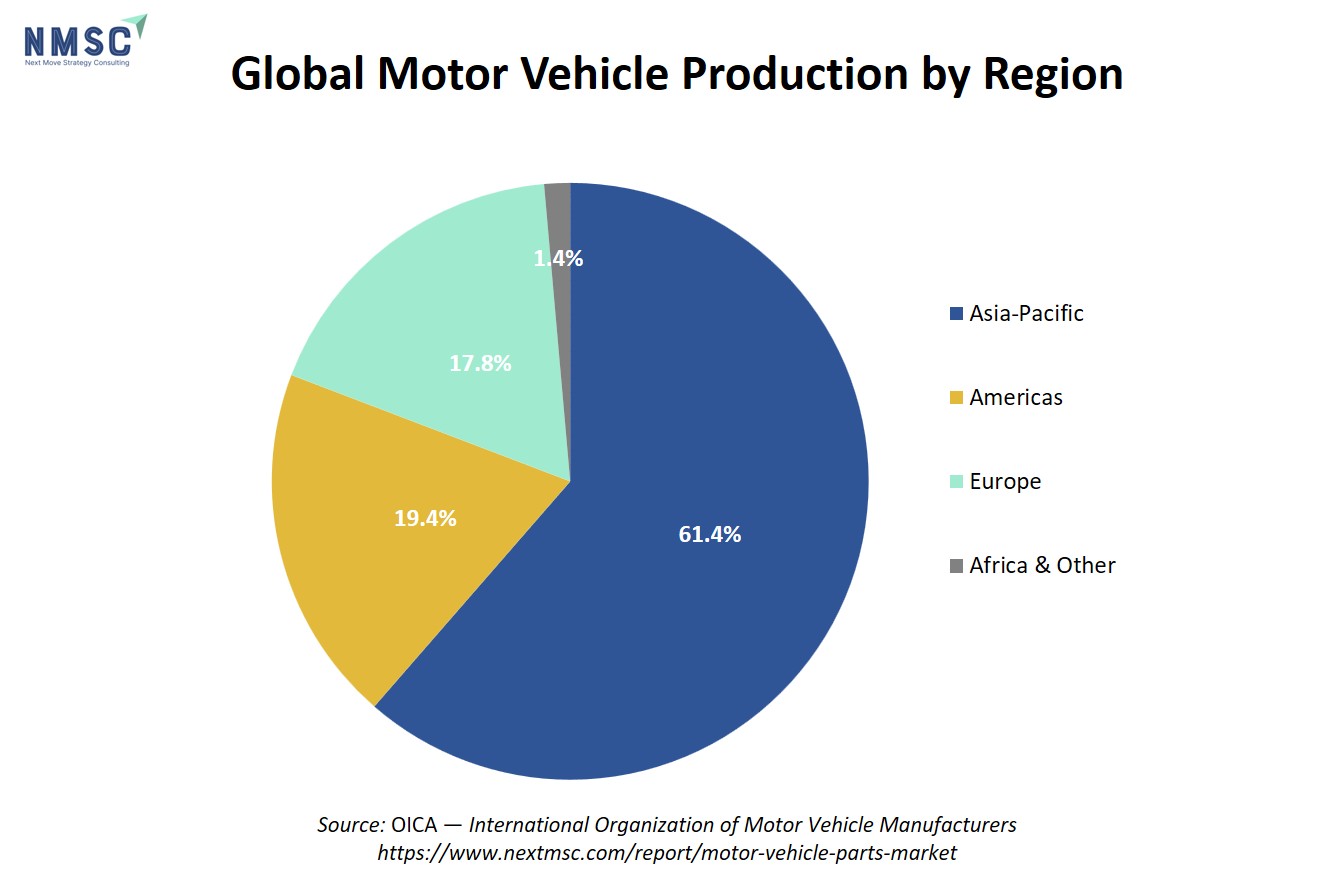
Asia-Pacific continues to hold the dominant share of the global motor vehicle parts market, driven by the cost-effective manufacturing capabilities of China, Japan, South Korea, and India, which attract both local and global customers through competitive pricing and advanced production infrastructure. North America is expected to demonstrate steady growth, supported by the increasing export of vehicles and components, reshoring-driven capacity expansion, and the robust demand for replacement parts across a large and aging vehicle fleet.
Technology-Driven Value Migration
The long-term growth trajectory of the motor vehicle parts market will be shaped by the accelerating migration of value toward software-defined, electrified, and AI-enabled vehicle components. BCG projects that total automotive component demand will grow by approximately 3.5% annually from 2025 to 2035, but this aggregate figure masks a profound reallocation of value beneath the surface. Components linked to advanced electrical/electronic architectures, ADAS, and autonomous systems are projected to grow at high single- to double-digit yearly rates, while classic components — interior, body and exterior, and chassis — will deliver low single-digit growth but remain strategically important as OEMs differentiate on safety, comfort, and user experience.
PwC projects that BEV adoption in the U.S. will rise to nearly 20% by 2030 as battery pack costs continue their decline and price parity with ICE vehicles is achieved by 2028–2029. China is expected to surpass 50% BEV penetration by 2030, creating substantial demand for EV-specific parts in the world's largest automotive market.
AI as a Strategic Enabler for Parts Suppliers
Artificial intelligence is emerging as a critical operational differentiator within the motor vehicle parts market. BCG's analysis of supplier earnings calls reveals that AI is mentioned by approximately 20% of suppliers, with its relevance increasing meaningfully year-on-year, suggesting early but accelerating adoption. Leading suppliers are deploying AI across engineering (generative AI for software development and documentation), operations (AI-enabled scheduling, maintenance, and quality control), and supply chain management (digital networks that simulate disruption scenarios and automatically re-route orders).
M&A Activity and Consolidation
Following historic lows in 2024, M&A activity among automotive suppliers rebounded in 2025, driven largely by margin pressures and the need for strategic consolidation in scalable, technology-aligned platforms. Megadeals exceeding USD 1 billion have accelerated, signaling renewed confidence among buyers and sellers despite lingering macroeconomic uncertainties. Powertrain and electronics sectors dominate transactions, reflecting continued strategic focus on software-defined vehicles, electrification, and autonomous driving capabilities.
Section Summary: The motor vehicle parts market is on a clear long-term growth trajectory toward USD 2,091.10 billion by 2030, but the path is defined by structural value migration, powertrain transition uncertainty, and the imperative for technological adaptation.
Key Takeaways:
-
NMSC projects the global motor vehicle parts market to reach USD 2,091.10 billion by 2030, growing at a 7.0% CAGR from 2024 to 2030.
-
BEV adoption in the U.S. is projected to reach nearly 20% by 2030, with price parity with ICE vehicles expected by 2028–2029.
-
AI adoption among automotive suppliers is accelerating, with applications spanning engineering, operations, and supply chain management.
-
M&A activity has rebounded strongly in 2025, with megadeals exceeding USD 1 billion concentrated in powertrain and electronics sectors.
Next Steps for Stakeholders
For C-Level Executives and Senior Leadership:
-
Treat tariff permanence as a strategic baseline. The 25% Section 232 tariff on imported auto parts is not a temporary disruption. Executives must embed tariff cost structures into long-term pricing models, capital allocation frameworks, and supplier contract structures. Country-of-origin strategies and customs classification reviews should be conducted immediately, not deferred pending policy changes that may not materialize.
-
Accelerate portfolio diversification across powertrain architectures. Prematurely abandoning ICE or hybrid platforms risks losing market share, while overcommitting to BEVs poses financial strain and inventory risk in the current subsidy-free environment. Suppliers should maintain balanced exposure across ICE, hybrid, and EV components to hedge against policy and demand volatility.
-
Invest in multilocal, shock-resilient supply chain architectures. The era of single-source, globally optimized supply chains is over. Building dual-sourcing capabilities for critical components, establishing manufacturing capacity in USMCA-compliant locations, and deploying AI-enabled early-warning systems for supply chain disruption are now operational imperatives.
-
Position for the USMCA renegotiation outcome. With the U.S. seeking 50% domestic content requirements and an 82% regional value threshold, suppliers with significant non-North American sourcing must begin modeling compliance scenarios and investment requirements now. The renegotiation outcome will materially affect the competitive positioning of every participant in the North American motor vehicle parts market.
-
Prioritize AI integration as a core operational capability. Suppliers that deploy AI across engineering, operations, and supply chain functions will achieve structural cost advantages and resilience capabilities that are increasingly difficult to replicate. AI investment should be treated as a strategic priority, not a discretionary technology initiative.
For Institutional Investors:
-
Favor suppliers with diversified powertrain exposure, strong North American manufacturing footprints, and demonstrated AI integration capabilities.
-
Monitor USMCA renegotiation developments closely, as the outcome will create significant winners and losers across the supplier landscape.
-
Evaluate M&A opportunities in the electronics, software, and EV powertrain segments, where value pool growth is structurally superior to traditional ICE component categories.
Conclusion
The global motor vehicle parts market stands at a defining crossroads. The convergence of the 25% Section 232 tariff regime, the substantive renegotiation of USMCA, the repeal of EV consumer tax credits, and the accelerating migration of vehicle value toward software and electrification has created a market environment of extraordinary complexity — and extraordinary opportunity for those prepared to navigate it strategically.
The long-term fundamentals of the motor vehicle parts market remain compelling. NMSC's research projects the market to reach USD 2,091.10 billion by 2030, advancing at a 7.0% CAGR, driven by rising vehicle complexity, expanding aftermarket demand, and the irreversible transition toward electrified and software-defined vehicle architectures. However, capturing this growth will require a fundamental rethinking of supply chain strategy, product portfolio composition, and operational capability.
The suppliers and investors who will define the next era of the motor vehicle parts market are those who recognize that the current disruption is not a temporary deviation from the prior normal — it is the new normal. Strategic clarity, operational agility, and a disciplined commitment to technology-driven transformation are the defining characteristics of the organizations that will rebuild and rise again.
About the Author
 Sanyukta Deb
— Sanyukta Deb is Digital Marketing Team Lead at Next Move Strategy Consulting, where she has led content strategy and technical SEO for the firm's B2B market research publications for over 2 years. Her editorial process translates NextMSC's primary and secondary research — spanning technology, industrial, and consumer sectors — into commercial narratives, backed by search-intent, keyword, and competitive analysis. She brings 5 years of overall experience in digital marketing and content strategy.
Sanyukta Deb
— Sanyukta Deb is Digital Marketing Team Lead at Next Move Strategy Consulting, where she has led content strategy and technical SEO for the firm's B2B market research publications for over 2 years. Her editorial process translates NextMSC's primary and secondary research — spanning technology, industrial, and consumer sectors — into commercial narratives, backed by search-intent, keyword, and competitive analysis. She brings 5 years of overall experience in digital marketing and content strategy.
About the Reviewer
 Debashree Dey
— Debashree Dey is Assistant Manager at Next Move Strategy Consulting, where she supports cross-vertical market content and communications across diverse industries for 6 years. Her professional background includes senior content writing, communications, and published manuscript authorship, with experience developing audience-focused business narratives and maintaining clear, consistent messaging. Her role supports research-led content development and editorial quality across NextMSC publications.
Debashree Dey
— Debashree Dey is Assistant Manager at Next Move Strategy Consulting, where she supports cross-vertical market content and communications across diverse industries for 6 years. Her professional background includes senior content writing, communications, and published manuscript authorship, with experience developing audience-focused business narratives and maintaining clear, consistent messaging. Her role supports research-led content development and editorial quality across NextMSC publications.

















Add Comment