Automotive Audio System Market: How EVs Are Redefining Sound | NextMSC
Introduction
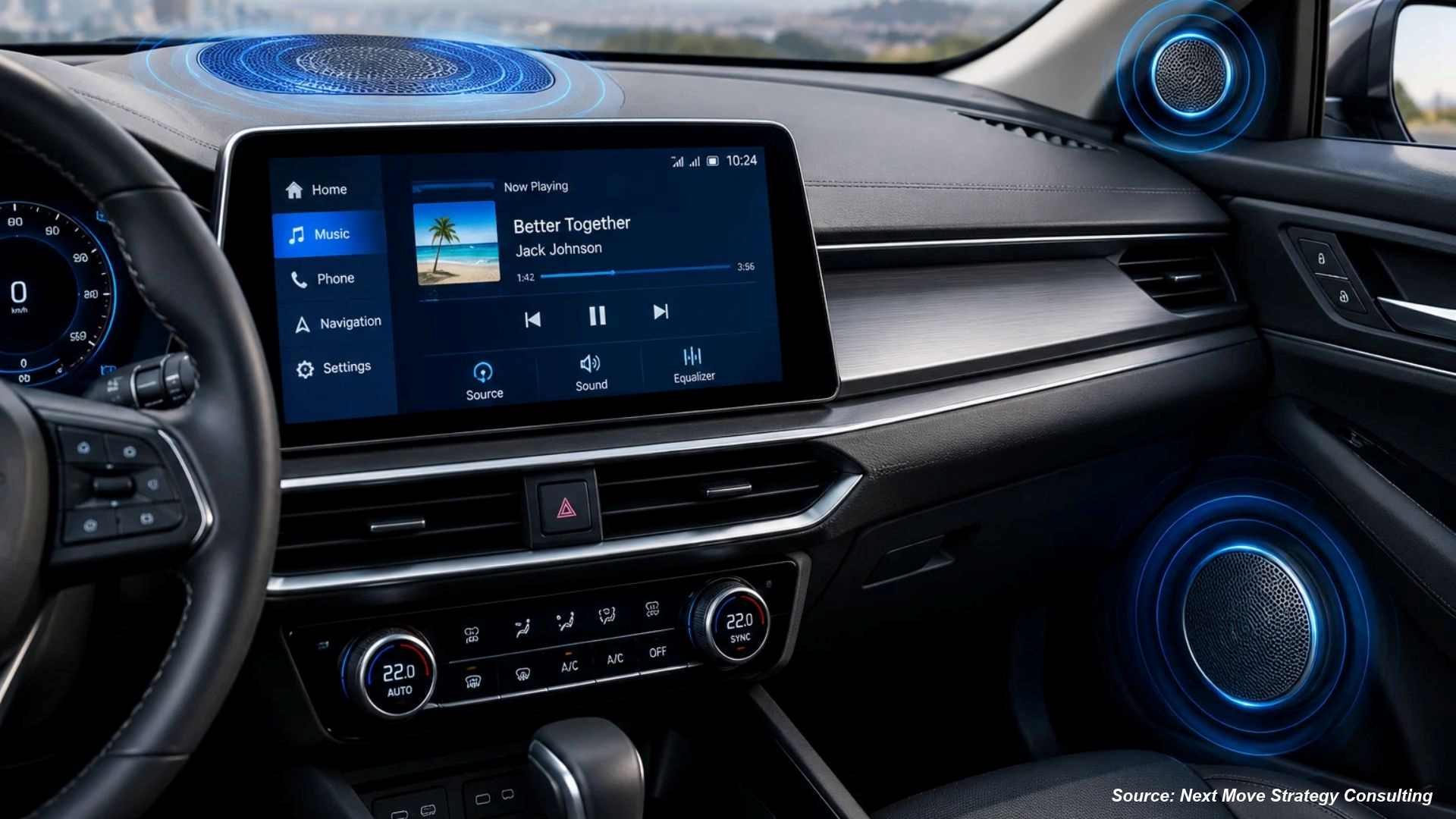
The cabin of a modern vehicle has become one of the most contested spaces in consumer technology — a battleground where audio brands, OEMs, and AI software developers compete to define what premium sounds like at 100 kilometres per hour. According to Next Move Strategy Consulting's Automotive Audio System Market report, the global automotive audio system market is projected to reach USD 19.80 billion by 2030, growing at a CAGR of 9.8% from 2024 to 2030.
This trajectory is not driven by incremental hardware upgrades. It is being shaped by a structural convergence of three forces: the mass electrification of the global vehicle fleet, the integration of AI-driven personalization into cabin acoustics, and the entry of heritage audio brands into OEM partnerships that were, until recently, the exclusive domain of automotive Tier-1 suppliers. As electric vehicles eliminate engine noise from the cabin environment, the acoustic baseline shifts — and the addressable market for sophisticated audio engineering expands accordingly.
For More Information: Download FREE Sample on Automotive Audio System Market Report
When Sennheiser Meets the Smart City Car: The New Geometry of OEM Audio Partnerships
A September 2026 Partnership That Redraws the Premium Audio Boundary
On 2 September 2026, Sennheiser and smart announced that Sennheiser would become the official sound system partner for the new smart #2 — the brand's reimagined all-electric two-seater set to premiere at the Paris Motor Show on 12 October 2026. Selected model lines of the smart #2 will feature a dedicated 7-speaker Sennheiser Sound System, engineered specifically for the vehicle's compact cabin architecture and incorporating Sennheiser's proprietary Contrabass algorithm for bass reproduction that exceeds what the physical dimensions of the cabin would ordinarily permit.
The significance of this partnership extends beyond a single model launch. The smart #2 is a compact urban EV — a segment historically associated with cost-optimised, entry-level audio. By engineering a system with three customisable bass levels and three sound presets (Studio, Live, and Vocal) for a two-seater city car, Sennheiser and smart are demonstrating that premium acoustic engineering is no longer confined to large-format luxury SUVs or executive sedans.
Dr. Veronique Larcher, Managing Director of Sennheiser Mobility, stated: "Our partnership with smart continues to demonstrate what is possible when automotive innovation and audio excellence are developed hand in hand. With the 7-speaker Sennheiser Sound System in the new smart two-seater, we have once again transformed the vehicle into a space that delivers the clarity, balance and emotional impact listeners expect from our brand. 'Small car, big sound' perfectly captures how our two brands worked together to create an unexpectedly powerful listening experience for every journey."
Wolfgang Ufer, CEO of smart Europe, added: "Together with Sennheiser, we're creating a compelling sound experience that adds another emotional dimension to the car and makes you want to stay behind the wheel just a little longer."
This partnership follows Sennheiser's earlier integration of its Signature Sound System into the smart #5, establishing a multi-model, multi-market collaboration that spans China and Europe — the two largest EV markets globally.
NMSC Strategic Perspective: Why EV Proliferation Is the Structural Catalyst for Audio Market Expansion
NextMSC primary research and analysis identifies the accelerating electrification of the global vehicle fleet as the single most consequential structural driver for the automotive audio system market over the forecast period. The mechanism is specific: battery electric vehicles eliminate the acoustic masking effect of internal combustion engines, which historically suppressed road noise, wind noise, and tyre noise at frequencies between 200 Hz and 2,000 Hz. In an EV cabin, these noise sources become perceptible at levels that would have been inaudible in an ICE vehicle — creating both a challenge and an opportunity for audio system engineers.
The IEA's Global EV Outlook 2026 confirms that electric car sales exceeded 20 million globally in 2025, growing 20% year-on-year, with one in four new cars sold worldwide being electric. Global EV sales are projected to reach 23 million in 2026, representing 28% of total car sales. In China alone, more than 13 million electric cars were sold in 2025, with nearly 55% of all new cars sold being electric. Europe recorded a 30% increase in EV sales in 2025, reaching 4.2 million units, driven by the step change in EU CO2 standards that came into effect that year.
Each of these EVs represents a vehicle in which the acoustic environment of the cabin is fundamentally different from its ICE predecessor — and in which the audio system must work harder, and smarter, to deliver a satisfying listening experience. This is why OEMs are no longer treating audio as a cost-line item but as a differentiating feature that justifies premium pricing and brand loyalty.
According to OICA data published in April 2026, global vehicle sales climbed from 95.3 million units in 2024 to 99.8 million units in 2025, a 4.7% increase, while global production rose from 92.7 million to 96.4 million units. Asia-Pacific production rose 7.6% to approximately 59.2 million vehicles, accounting for more than 61% of global output. This volume expansion, concentrated in markets where EV adoption is highest, directly enlarges the installed base of vehicles requiring sophisticated audio solutions.
Section Summary
The Sennheiser–smart #2 partnership of September 2026 signals a structural shift in how premium audio brands engage with the OEM channel — moving from large-format luxury vehicles into compact urban EVs. This shift is underpinned by the mass electrification of the global fleet, which creates a new acoustic environment in which audio system quality becomes a primary differentiator.
-
Sennheiser's 7-speaker system with proprietary Contrabass algorithm demonstrates that acoustic engineering can overcome the physical constraints of compact cabin architecture.
-
IEA data confirms that one in four new cars sold globally in 2025 was electric, with 23 million EV sales projected for 2026 — each representing a vehicle with a fundamentally different cabin acoustic profile.
-
OICA data shows global vehicle sales reached 99.8 million units in 2025, with Asia-Pacific accounting for over 61% of global production — the region where EV adoption is most concentrated.
-
NextMSC primary research and analysis identifies EV proliferation as the primary structural catalyst expanding the addressable market for advanced automotive audio systems beyond traditional premium segments.
Industry Impact Analysis
AI-Driven Personalization: From Equaliser Presets to Emotionally Intelligent Sound
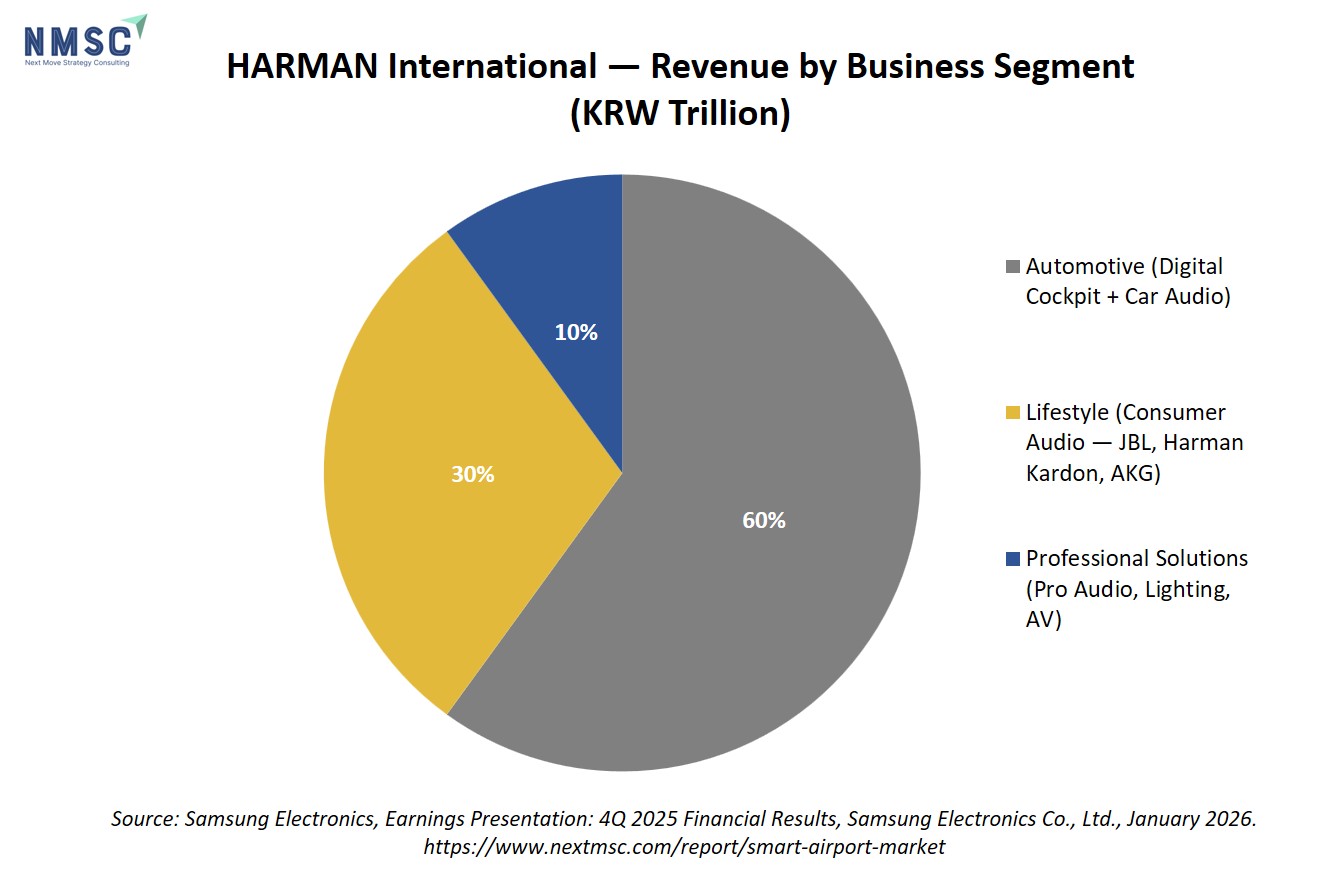
The most consequential technology shift in the automotive audio system market is not the adoption of more speakers or higher-wattage amplifiers — it is the integration of artificial intelligence into the audio signal chain itself. At CES 2025, HARMAN International Industries, in collaboration with Cerence AI, launched "Luna," an avatar powered by Ready Engage — HARMAN's emotionally intelligent AI system — that personalises in-cabin audio interactions through voice and visuals, adapting to occupant mood, preferences, and context in real time. HARMAN's automotive systems are currently installed in more than 50 million vehicles on the road globally.
In January 2026, HARMAN extended this trajectory by introducing AI-driven personalised in-car audio technologies focused on software-defined sound experiences and user-specific tuning — a development that moves the audio system from a fixed hardware configuration to a continuously updated software layer that can be modified over the air. According to NextMSC primary research and analysis, this software-defined audio model is one of the most significant commercial developments in the market, as it enables OEMs to monetise audio upgrades post-sale and allows audio brands to maintain a direct relationship with the end user throughout the vehicle's lifecycle.
The CES 2025 automotive audio landscape, as documented by audioXpress, confirmed that AI, machine learning, and generative AI were embedded across the software and platform layers of virtually every major automotive audio provider — from DSP Concepts' Audio Weaver running on Qualcomm's Snapdragon 8255 at record-low latency of 1.6 milliseconds, to SoundHound AI's production-ready generative AI automotive solution developed in partnership with OpenAI.
3D Spatial Audio and the Dolby Atmos Aftermarket
The 2026 AES 6th International Automotive Audio Conference in Detroit identified battery electric vehicles, 3D audio, and spatial audio as the defining technical themes of the current development cycle. Pioneer's SPHERA system, demonstrated at CES 2026, brings Dolby Atmos to the aftermarket without requiring a new car or speaker swap — a development that opens the 3D spatial audio segment to the installed base of existing vehicles, not just new OEM fitments.
Bose, meanwhile, showcased its next-generation Atmos-enabled speaker system in the GMC Denali at CES 2025, with the system scheduled for production shipment in 2025. Bose's acquisition of the McIntosh Group — including the McIntosh and Sonus faber brands — further expands its premium automotive audio portfolio, with the McIntosh brand now available as a premium option in Jeep Wagoneer S models.
The EV Acoustic Engineering Imperative
The elimination of ICE engine noise in battery electric vehicles does not simply create a quieter cabin — it creates a cabin in which road noise, tyre noise, and wind noise are audible at frequencies that were previously masked. This requires audio system engineers to address active noise cancellation (ANC) as a core system function, not an optional feature. Arkamys, at CES 2025, demonstrated Road Noise Management based on a vehicle's existing microphone and sensor array, providing narrow-band cancellation that can be deployed as a software update rather than a hardware retrofit.
In September 2025, Panasonic Automotive Systems expanded its automotive infotainment and audio integration solutions with a specific focus on EV-compatible sound systems and connected cockpit platforms — a direct response to the acoustic engineering requirements of the EV transition.
Section Summary
The automotive audio system market is being reshaped by three concurrent technology forces: AI-driven personalisation that converts audio from a fixed hardware feature into a continuously updated software service; 3D spatial audio standards (Dolby Atmos, DTS:X) entering both OEM and aftermarket channels; and the EV acoustic engineering imperative that makes active noise cancellation a baseline requirement rather than a premium option.
-
HARMAN's "Luna" AI system and its January 2026 software-defined audio platform demonstrate that the audio system's value proposition is shifting from hardware specifications to software capabilities.
-
Pioneer's SPHERA and Bose's Atmos-enabled systems confirm that 3D spatial audio is transitioning from concept to production across both OEM and aftermarket channels.
-
Arkamys's Road Noise Management system illustrates how EV-specific acoustic challenges are generating new software-layer revenue opportunities for audio technology providers.
-
NextMSC primary research and analysis identifies the software-defined audio model as a key mechanism through which OEMs and audio brands will monetise the installed base of EVs post-sale.
Global Automotive & EV Market Context — Institutional Data
|
Metric |
Figure |
Source |
|
Global vehicle sales (2025) |
99.8 million units (+4.7% vs. 2024) |
OICA, April 2026 |
|
Global vehicle production (2025) |
96.4 million units (+3.9% vs. 2024) |
OICA, April 2026 |
|
Asia-Pacific share of global vehicle production (2025) |
>61% (~59.2 million units) |
OICA, April 2026 |
|
Global electric car sales (2025) |
>20 million units (+20% vs. 2024) |
IEA Global EV Outlook 2026 |
|
EV share of global new car sales (2025) |
25% (1 in 4 new cars) |
IEA Global EV Outlook 2026 |
|
Projected global EV sales (2026) |
23 million units (28% of total car sales) |
IEA Global EV Outlook 2026 |
|
China EV sales (2025) |
>13 million units (~55% of new car sales) |
IEA Global EV Outlook 2026 |
|
Europe EV sales (2025) |
4.2 million units (+30% vs. 2024) |
IEA Global EV Outlook 2026 |
|
HARMAN automotive audio installed base |
>50 million vehicles globally |
HARMAN International, January 2025 |
Future Outlook & Forecast
The Software-Defined Audio Era and What It Means for Market Structure
NextMSC primary research and analysis projects the global automotive audio system market to reach USD 19.80 billion by 2030, growing at a CAGR of 9.8% from 2024 to 2030. This growth trajectory reflects a market that is expanding not only in volume — driven by rising global vehicle sales and EV proliferation — but also in average revenue per vehicle, as audio systems migrate from commodity hardware to software-defined, AI-personalised platforms.
The IEA projects global EV sales to reach 23 million units in 2026, representing 28% of total car sales. As this installed base grows, the acoustic engineering requirements of EV cabins — active noise cancellation, spatial audio rendering, AI-adaptive sound profiles — will become standard specifications rather than premium options. This transition will compress the price premium currently associated with advanced audio systems while simultaneously expanding the total addressable market.
North America is expected to maintain its dominant position in the automotive audio system market throughout the forecast period, supported by strong consumer demand for advanced in-cabin technology and the early adoption of 3D audio, active noise cancellation, and AI-based voice control. Asia-Pacific, however, is positioned for the most significant volume growth, driven by rising disposable incomes in China and India, the rapid expansion of the EV market in both countries, and increasing R&D investment by regional audio technology providers. According to NextMSC primary research and analysis, China's per capita disposable income reached USD 5,511 in 2023, marking a 6.3% year-on-year rise — a trend that continues to support demand for premium in-vehicle audio experiences.
The competitive landscape will be shaped by three strategic dynamics: the consolidation of audio brand portfolios (exemplified by Bose's acquisition of McIntosh Group), the deepening of OEM-specific audio partnerships (exemplified by the Sennheiser–smart collaboration), and the emergence of software-defined audio platforms as a new competitive battleground where technology companies such as HARMAN, Qualcomm, and DSP Concepts compete alongside traditional audio hardware manufacturers.
Section Summary
The automotive audio system market's path to USD 19.80 billion by 2030 is supported by a convergence of volume growth (driven by global vehicle sales expansion and EV proliferation) and value growth (driven by the transition to AI-personalised, software-defined audio platforms).
-
The IEA's projection of 23 million global EV sales in 2026 — each representing a vehicle with distinct acoustic engineering requirements — directly expands the addressable market for advanced audio systems.
-
North America will maintain market leadership through early adoption of 3D audio and AI-driven personalisation; Asia-Pacific will deliver the highest volume growth through EV market expansion and rising consumer income levels.
-
The software-defined audio model — exemplified by HARMAN's January 2026 AI-driven platform — will enable OEMs to generate post-sale audio revenue, increasing the lifetime value of each vehicle's audio system.
-
Portfolio consolidation (Bose–McIntosh) and OEM-specific partnerships (Sennheiser–smart) will intensify competitive differentiation at the premium end of the market, while software-layer competition will intensify across all segments.
Next Steps for Stakeholders
For OEM Procurement and Product Strategy Teams:
Evaluate audio system specifications not only on hardware performance metrics but on software architecture compatibility. Audio systems built on open, upgradeable platforms — such as those running on Qualcomm Snapdragon or QNX-based frameworks — enable over-the-air feature updates that extend the commercial life of the audio system and reduce the risk of specification obsolescence within a model cycle.
For Audio Technology Providers and Tier-1 Suppliers:
The EV transition creates a specific engineering requirement — active noise cancellation and acoustic tuning for cabins without ICE masking — that represents a defensible technical moat. Providers that can demonstrate measurable ANC performance in EV-specific frequency ranges, and that can deploy this capability as a software update on existing hardware, will have a structural advantage in OEM tender processes.
For Institutional Investors and Private Equity:
The automotive audio system market's 9.8% CAGR through 2030, as projected by NextMSC primary research and analysis, is underpinned by two durable structural drivers: the global EV transition (confirmed by IEA data showing 25% EV share of new car sales in 2025) and the software-defined vehicle trend (confirmed by HARMAN's AI-driven audio platform and the broader industry shift toward software-defined cockpit architectures). Investment theses should focus on companies with both hardware credibility and software platform capabilities, as the market will increasingly reward integrated solutions over point-product suppliers.
For Aftermarket Retailers and Installers:
The entry of Dolby Atmos and DTS:X into the aftermarket channel — through systems such as Pioneer's SPHERA — creates a near-term revenue opportunity in the existing vehicle installed base. Consumers who cannot access OEM-grade spatial audio through their current vehicle can now access comparable experiences through aftermarket installation, at a price point that is declining as the technology matures.
For Regulatory and Standards Bodies:
The AES 6th International Automotive Audio Conference (Detroit, 2026) has identified the need for standardised acoustic measurement protocols specific to BEV cabins. Regulatory bodies and standards organisations should prioritise the development of EV-specific audio performance standards that account for the absence of ICE masking noise — standards that will provide a common reference framework for OEM procurement and consumer comparison.
Conclusion
The global automotive audio system market is undergoing a structural transformation that extends well beyond incremental improvements in speaker quality or amplifier power. The convergence of mass EV adoption, AI-driven audio personalisation, and the entry of heritage audio brands into OEM partnerships across all vehicle segments — from compact urban two-seaters to full-size luxury SUVs — is redefining what in-car audio means commercially, technically, and competitively.
The Sennheiser–smart #2 partnership of September 2026 is a precise illustration of this transformation: a German audio specialist engineering a 7-speaker system with proprietary acoustic algorithms for an all-electric city car, demonstrating that premium audio is no longer a luxury segment privilege. HARMAN's AI-driven, software-defined audio platform — deployed across more than 50 million vehicles globally — demonstrates that the audio system's value is increasingly determined by its software intelligence, not its hardware specification.
According to NextMSC primary research and analysis, the global automotive audio system market is projected to reach USD 19.80 billion by 2030 at a CAGR of 9.8%, supported by a global vehicle market that sold 99.8 million units in 2025 and an EV fleet that now accounts for one in four new cars sold worldwide. For C-level executives, institutional investors, and technology strategists, the question is no longer whether in-car audio is a growth market — it is which layer of the audio value chain will capture the most durable margin as the market scales.
About the Author
 Sanyukta Deb
— Sanyukta Deb is Digital Marketing Team Lead at Next Move Strategy Consulting, where she has led content strategy and technical SEO for the firm's B2B market research publications for over 2 years. Her editorial process translates NextMSC's primary and secondary research — spanning technology, industrial, and consumer sectors — into commercial narratives, backed by search-intent, keyword, and competitive analysis. She brings 5 years of overall experience in digital marketing and content strategy.
Sanyukta Deb
— Sanyukta Deb is Digital Marketing Team Lead at Next Move Strategy Consulting, where she has led content strategy and technical SEO for the firm's B2B market research publications for over 2 years. Her editorial process translates NextMSC's primary and secondary research — spanning technology, industrial, and consumer sectors — into commercial narratives, backed by search-intent, keyword, and competitive analysis. She brings 5 years of overall experience in digital marketing and content strategy.
About the Reviewer
 Debashree Dey
— Debashree Dey is Assistant Manager at Next Move Strategy Consulting, where she supports cross-vertical market content and communications across diverse industries for 6 years. Her professional background includes senior content writing, communications, and published manuscript authorship, with experience developing audience-focused business narratives and maintaining clear, consistent messaging. Her role supports research-led content development and editorial quality across NextMSC publications.
Debashree Dey
— Debashree Dey is Assistant Manager at Next Move Strategy Consulting, where she supports cross-vertical market content and communications across diverse industries for 6 years. Her professional background includes senior content writing, communications, and published manuscript authorship, with experience developing audience-focused business narratives and maintaining clear, consistent messaging. Her role supports research-led content development and editorial quality across NextMSC publications.


















Add Comment