Why Regulation Is Reshaping the Anti-Lock Braking System Market | NextMSC
Introduction
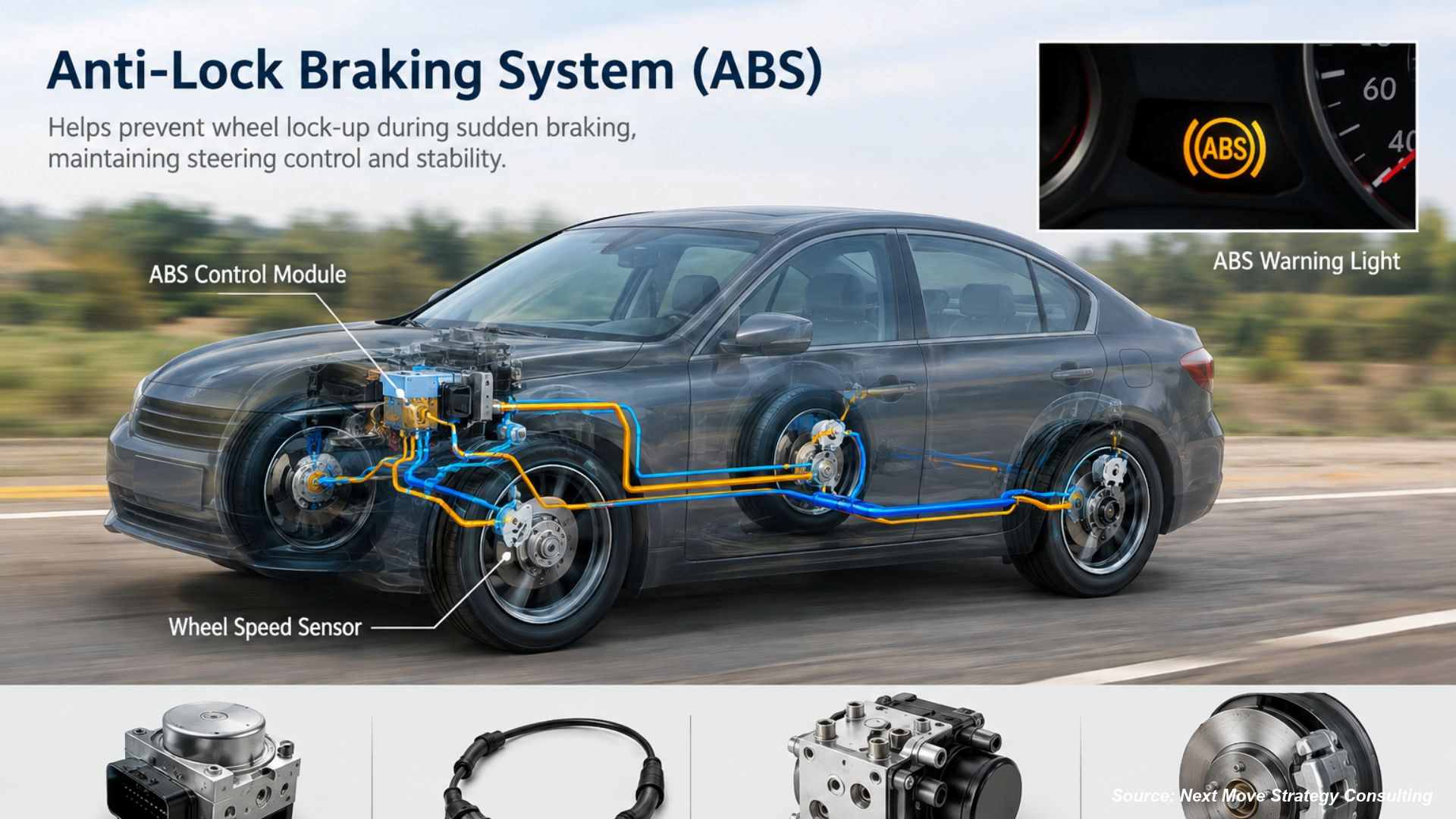
Every second, a vehicle somewhere in the world averts a collision because its wheels did not lock under emergency braking. That invisible intervention — the anti-lock braking system — has evolved from a premium differentiator into a non-negotiable safety baseline, and the regulatory and technological forces reshaping it in 2026 are rewriting the commercial boundaries of the entire market.
According to Next Move Strategy Consulting's Anti-Lock Braking System Market report, the global anti-lock braking system market is projected to reach USD 110.91 billion by 2030, growing at a CAGR of 9.5%. This trajectory is being reinforced by a convergence of three simultaneous forces: governments in the world's largest two-wheeler markets mandating ABS fitment across all engine displacements, the U.S. federal regulator restructuring its foundational brake standard to accommodate fully autonomous vehicles, and Tier 1 suppliers commercializing brake-by-wire architectures that replace hydraulic circuits with software-controlled actuators — each of which expands the addressable market for ABS-integrated braking hardware and software beyond its historical scope.
For More Information: Download FREE Sample on Anti-Lock Braking System Market Report
Regulatory Overhaul and the ABS Imperative: From India's Two-Wheeler Mandate to the U.S. ADS Brake Standard
The Dual Regulatory Catalyst Reshaping Global ABS Demand
Two regulatory events — separated by geography but united in their market consequence — have materially altered the demand calculus for ABS suppliers in 2026.
India's Universal Two-Wheeler ABS Mandate (January 1, 2026)
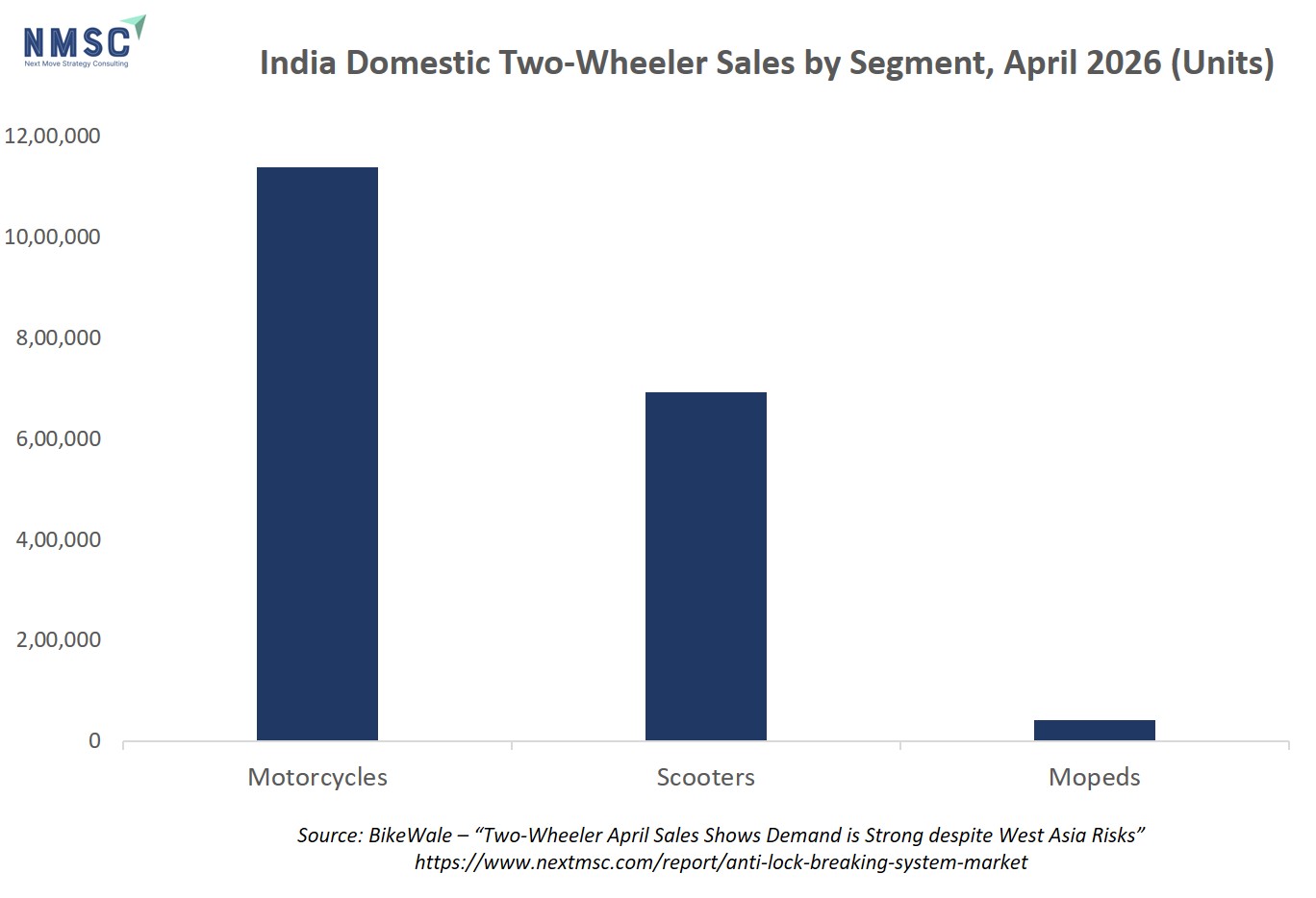
India, the world's largest two-wheeler market by volume, enacted a sweeping safety regulation effective January 1, 2026: all new motorcycles and scooters sold in the country, regardless of engine displacement, must be equipped with ABS. The mandate, notified by India's Ministry of Road Transport and Highways, extends a requirement that previously applied only to two-wheelers above 125cc. Global NCAP, in its published analysis of the regulation, described the move as a "life-saving" intervention given that two-wheelers account for a disproportionate share of India's road fatalities. The practical consequence for ABS suppliers is a structural expansion of the addressable fitment base: entry-level scooters and motorcycles — which constitute the majority of India's annual two-wheeler sales — now require ABS hardware that was previously absent from their bill of materials. For suppliers such as Robert Bosch GmbH, which supplies ABS units to multiple Indian two-wheeler OEMs, this mandate converts a discretionary upsell into a mandatory component across the entire product range.
NHTSA's FMVSS No. 135 Modernization Proposal (June 26, 2026)
On June 26, 2026, the U.S. National Highway Traffic Safety Administration published a Notice of Proposed Rulemaking in the Federal Register (91 FR 38593, Docket No. NHTSA-2026-0728) proposing to amend Federal Motor Vehicle Safety Standard No. 135, "Light vehicle brake systems," to accommodate vehicles equipped with Automated Driving Systems (ADS) that do not have manually operated driving controls. The proposed rule removes the requirement for a foot-operated service brake pedal in vehicles designed never to be operated by a human, while retaining all stopping distance performance requirements. Critically, the NHTSA document explicitly states that all light vehicles subject to FMVSS No. 135 are already required to have ABS under FMVSS No. 126 — a statement that confirms universal ABS penetration in the U.S. light vehicle fleet and simultaneously signals that the regulatory framework governing braking performance will evolve in parallel with vehicle automation. For the ABS market, the FMVSS No. 135 proposal carries a dual implication: it removes a design barrier that prevented ADS-equipped vehicles from being certified under existing brake standards, thereby opening a new vehicle category — fully autonomous robotaxis and delivery vehicles — to ABS-integrated brake-by-wire systems; and it establishes that ABS authority in autonomous EVs must extend to regenerative braking systems, expanding the functional scope and commercial value of ABS electronic control units.
The Broader Regulatory Wave
These two events are not isolated. Malaysia mandated ABS on all new model motorcycles from January 1, 2025, per the United Nations Economic Commission for Europe's documentation on motorcycle ABS for ASEAN countries published in May 2025. Chile, from February 2025, requires ABS on all new motorcycles of 150cc or above. The Insurance Institute for Highway Safety and the Highway Loss Data Institute (IIHS-HLDI) filed a formal petition with NHTSA arguing that mandating ABS on all new motorcycles in the United States would save lives — a petition that, if acted upon, would replicate the India and Malaysia model in the world's third-largest vehicle market.
NMSC Strategic Perspective: Why the Regulatory Wave Translates Directly into Market Expansion
NextMSC primary research and analysis identifies the current regulatory cycle as structurally different from prior ABS mandates in one critical respect: earlier mandates — such as the EU's 2016 requirement for ABS on motorcycles above 125cc — targeted premium and mid-range segments where ABS fitment rates were already rising organically. The 2025–2026 wave targets segments where ABS penetration was either zero (entry-level Indian two-wheelers below 125cc) or undefined (fully autonomous vehicles). This means the incremental unit demand generated by these mandates is additive to the existing market trajectory, not a pull-forward of demand that would have materialized anyway. NextMSC's model, which applies bottom-up vehicle production forecasts segmented by powertrain type and regulatory jurisdiction, projects that the two-wheeler segment will sustain the highest growth rate within the global ABS market through 2030, driven primarily by the Indian and Southeast Asian regulatory mandates.
Section Summary
The global ABS market is being reshaped by a regulatory wave that simultaneously expands the mandatory fitment base in the world's largest two-wheeler markets and redefines the braking standard framework for autonomous vehicles in the United States.
Key Takeaways:
-
India's January 2026 ABS mandate for all two-wheelers, regardless of engine size, converts entry-level scooters and motorcycles — previously ABS-free — into mandatory fitment vehicles, directly expanding the addressable market for ABS suppliers.
-
NHTSA's June 2026 FMVSS No. 135 proposed rule removes design barriers for ADS-equipped vehicles while confirming universal ABS penetration in the U.S. light vehicle fleet, opening a new vehicle category to advanced ABS-integrated brake-by-wire systems.
-
Malaysia (January 2025) and Chile (February 2025) have enacted parallel two-wheeler ABS mandates, establishing a regional regulatory pattern that IIHS-HLDI is now petitioning NHTSA to replicate in the United States.
-
NextMSC primary research and analysis identifies the two-wheeler segment as the highest-growth ABS category through 2030, driven by regulatory mandates in markets where ABS penetration was previously negligible.
Industry Impact Analysis
Road Safety Data Reinforces the Regulatory Rationale
The regulatory mandates described above are grounded in a persistent and well-documented road safety crisis. According to the World Health Organization's July 2026 global road safety report, road traffic crashes claimed 1.16 million lives in 2025 — a figure that, despite representing a 21% decline from prior levels, remains the leading cause of death among children and young adults aged 5 to 29 globally. The WHO notes that 92% of these fatalities occur in low- and middle-income countries, precisely the markets — India, Southeast Asia, sub-Saharan Africa — where two-wheeler penetration is highest and ABS fitment rates have historically been lowest.
In the United States, the NHTSA reported an estimated 36,640 traffic fatalities in 2025, a 6.7% decrease from 2024 and the second-lowest annual total on record. While this decline reflects the cumulative effect of safety technologies including ABS, electronic stability control, and automatic emergency braking, it also illustrates the ceiling effect: further reductions in fatalities in mature markets increasingly require the extension of proven safety technologies — including ABS — to vehicle categories and markets where they remain absent.
Brake-by-Wire: The Technology Shift That Redefines ABS Architecture
The most consequential technology development affecting the ABS market in 2025–2026 is the commercial introduction of brake-by-wire systems, which replace the hydraulic circuits that have connected brake pedals to calipers for over a century with software-controlled electromechanical actuators. In July 2025, ZF Friedrichshafen announced the market introduction of its Brake-by-Wire (BbW) portfolio, enabling fully electric braking without hydraulic fluid. Separately, Bosch engineers completed the first journey on public roads using brake-by-wire technology, covering over 2,050 miles across different climate zones — a validation milestone that demonstrated the system's reliability under real-world conditions.
The ABS implications of this shift are significant. In a conventional hydraulic braking system, ABS modulates hydraulic pressure to prevent wheel lockup. In a brake-by-wire system, the ABS function is executed entirely in software, with the electronic control unit sending direct commands to electromechanical actuators at each wheel. This architectural change does not eliminate ABS — it elevates it from a hydraulic modulation subsystem to the primary control layer of the entire braking system. For ABS ECU suppliers, brake-by-wire represents an expansion of the value-add per vehicle, as the ECU now controls not just anti-lock modulation but the entire braking force distribution across all four wheels.
The Electric Vehicle Integration Effect
The integration of ABS into battery electric vehicles (BEVs) introduces a further complexity: the interaction between regenerative braking systems (RBS) and conventional friction braking. NHTSA's FMVSS No. 135 proposed rule explicitly addresses this, stating that for EVs equipped with RBS and without manually operated driving controls, the RBS is considered part of the service brake system, and the ABS must control the RBS. This regulatory clarification — that ABS authority extends to regenerative braking in autonomous EVs — expands the functional scope of ABS ECUs in the fastest-growing vehicle segment. As global EV production scales, ABS suppliers that have developed integrated ABS-RBS control algorithms are positioned to capture a larger share of the braking system value per vehicle than suppliers offering standalone ABS modules.
Section Summary
The industry impact of current regulatory and technology developments extends beyond unit volume growth to a fundamental restructuring of ABS architecture, value-add per vehicle, and the competitive positioning of Tier 1 suppliers.
Key Takeaways:
-
WHO's July 2026 report confirms 1.16 million road traffic deaths in 2025, with 92% occurring in low- and middle-income countries — the same markets where two-wheeler ABS mandates are now being enacted, creating a direct and traceable link between the safety data and the regulatory response.
-
ZF's July 2025 commercial launch of its Brake-by-Wire portfolio and Bosch's 2,050-mile public road validation of brake-by-wire technology signal that hydraulic ABS architecture is transitioning to software-defined electromechanical systems, expanding the ECU's value-add per vehicle.
-
NHTSA's FMVSS No. 135 proposal explicitly extends ABS authority to regenerative braking systems in autonomous EVs, expanding the functional scope — and commercial value — of ABS ECUs in the fastest-growing vehicle segment.
-
NHTSA's 2025 U.S. traffic fatality data (36,640 deaths, a 6.7% decrease from 2024) illustrates that further safety gains in mature markets require extending ABS to vehicle categories where it remains absent, supporting the IIHS-HLDI petition for mandatory motorcycle ABS in the United States.
Pros and Cons of Recent Market Developments
|
Development |
Pros |
Cons |
|
India's Universal Two-Wheeler ABS Mandate (Jan 2026) |
Structurally expands the mandatory ABS fitment base to entry-level scooters and motorcycles, creating a large, non-discretionary demand pool for ABS suppliers across all displacement categories |
Increases vehicle manufacturing costs for entry-level two-wheelers, potentially suppressing demand in price-sensitive segments and creating compliance challenges for smaller OEMs with limited engineering resources |
|
NHTSA FMVSS No. 135 ADS Modernization Proposal (Jun 2026) |
Removes design barriers for ADS-equipped vehicles, opening a new vehicle category — autonomous robotaxis and delivery vehicles — to ABS-integrated brake-by-wire systems and creating a long-term demand pipeline |
Regulatory uncertainty during the comment and finalization period may delay ADS vehicle deployment timelines and associated ABS procurement decisions by OEMs and fleet operators |
|
ZF and Bosch Brake-by-Wire Commercialization (2025) |
Elevates ABS ECU from a hydraulic modulation subsystem to the primary control layer of the entire braking system, expanding revenue per vehicle for ECU suppliers and rewarding software-capable Tier 1 suppliers |
Requires significant capital investment in new manufacturing capabilities and software development; legacy hydraulic ABS suppliers face margin compression as the technology transition accelerates |
|
Multi-Country Two-Wheeler ABS Mandates (Malaysia Jan 2025, Chile Feb 2025) |
Establishes a regional regulatory pattern that strengthens the case for similar mandates in other markets, including the United States, creating a long-term and geographically diversified demand pipeline |
Compliance timelines vary by market, creating supply chain complexity for ABS suppliers serving multiple regulatory jurisdictions simultaneously and requiring localized product variants |
|
ABS-RBS Integration Requirement for Autonomous EVs (FMVSS No. 135 Proposal) |
Expands the functional scope of ABS ECUs in the fastest-growing vehicle segment, rewarding suppliers with integrated ABS-RBS control algorithms and creating a defensible technology moat |
Increases software development complexity and certification requirements for ABS ECU suppliers, raising barriers to entry and potentially concentrating market share among a smaller number of Tier 1 suppliers |
Key Data & Statistics
|
Market |
Vehicle Category |
Mandate Effective Date |
Scope |
|
India |
All passenger cars and buses |
April 2019 |
Mandatory ABS for all new and existing cars and buses |
|
European Union |
Motorcycles above 125cc |
November 2016 |
ABS mandatory for new type approvals |
|
New Zealand |
Current-model motorcycles |
November 2021 |
ABS mandatory as standard fitment |
|
Malaysia |
New model motorcycles |
January 1, 2025 |
ABS mandatory for new vehicle type approvals |
|
Chile |
Motorcycles 150cc+ or 11kW+ |
February 2025 |
ABS mandatory for new motorcycles above threshold |
|
India |
All two-wheelers (all engine sizes) |
January 1, 2026 |
Universal ABS mandate regardless of displacement |
|
United States (Proposed) |
ADS-equipped light vehicles |
Pending (FMVSS No. 135 NPRM) |
Brake standard modernization for autonomous vehicles |
Future Outlook & Forecast
The Path to USD 110.91 Billion: Three Structural Drivers
According to NextMSC primary research and analysis, the global anti-lock braking system market is projected to reach USD 110.91 billion by 2030, growing at a CAGR of 9.5% from the 2019 base of USD 40.81 billion. This trajectory is underpinned by three structural drivers that are each independently verifiable and collectively reinforcing.
Driver 1: Mandatory Fitment Expansion in Two-Wheeler Markets
India's January 2026 universal ABS mandate for all two-wheelers converts the world's largest two-wheeler market into a fully mandatory ABS fitment environment. India produces and sells tens of millions of two-wheelers annually, the majority of which were previously sold without ABS. The incremental ABS unit demand generated by this mandate — combined with parallel mandates in Malaysia and Chile and the IIHS-HLDI petition for a U.S. motorcycle ABS requirement — establishes a multi-year demand pipeline for two-wheeler ABS hardware that was not present in prior market forecasts. This is not demand acceleration; it is demand creation in a segment that was previously outside the ABS market's addressable universe.
Driver 2: Autonomous Vehicle Brake Standard Evolution
NHTSA's June 2026 FMVSS No. 135 proposed rule creates a regulatory pathway for ADS-equipped vehicles without manually operated driving controls to be certified under the U.S. brake standard. As autonomous vehicle deployment scales — in robotaxi fleets, autonomous delivery vehicles, and eventually consumer AVs — each vehicle will require an ABS-integrated brake-by-wire system that meets FMVSS No. 135 stopping distance requirements. The NHTSA document notes that ADS-equipped vehicles are already being tested, developed, and deployed in localized operations, establishing a near-term demand base that will grow as the regulatory framework is finalized.
Driver 3: Brake-by-Wire Commercialization and ECU Value Expansion
ZF's July 2025 commercial launch of its Brake-by-Wire portfolio and Bosch's public road validation of brake-by-wire technology over 2,050 miles signal that the transition from hydraulic to electromechanical braking is a commercial reality, not a research-stage development. As brake-by-wire adoption scales, the ABS ECU transitions from a modulation subsystem — valued at a fraction of the total braking system cost — to the primary control layer of the entire braking system, expanding the revenue per vehicle for ABS ECU suppliers. This architectural shift supports market value growth that exceeds unit volume growth, contributing to the CAGR trajectory projected by NextMSC.
Regional Outlook
North America is projected to maintain the largest market share through 2030, supported by universal ABS penetration in the light vehicle fleet (confirmed by FMVSS No. 126), the FMVSS No. 135 ADS modernization creating new demand in autonomous vehicle categories, and the IIHS-HLDI petition for mandatory motorcycle ABS. Asia-Pacific is projected to record the highest CAGR, driven by India's universal two-wheeler mandate, China's expanding EV production (which requires ABS-RBS integrated systems), and the broader Southeast Asian regulatory wave initiated by Malaysia's January 2025 mandate. Europe maintains a significant share, underpinned by established ABS penetration across all vehicle categories and the region's leadership in brake-by-wire technology development.
Section Summary
The ABS market's path to USD 110.91 billion by 2030 is supported by three independently verifiable structural drivers: mandatory fitment expansion in two-wheeler markets, autonomous vehicle brake standard evolution, and brake-by-wire commercialization expanding ECU value per vehicle.
Key Takeaways:
-
India's January 2026 universal two-wheeler ABS mandate is the single largest demand catalyst in the near-term ABS market, converting the world's largest two-wheeler market into a fully mandatory fitment environment and creating demand in a segment previously outside the ABS market's addressable universe.
-
NHTSA's FMVSS No. 135 ADS proposed rule creates a regulatory pathway for autonomous vehicles — a new and previously uncertifiable vehicle category — to enter the ABS market as mandatory fitment vehicles, with near-term demand already established through localized ADS deployments.
-
ZF's and Bosch's brake-by-wire commercialization expands ABS ECU revenue per vehicle beyond the modulation subsystem value, supporting market value growth that exceeds unit volume growth and contributing to the 9.5% CAGR trajectory.
-
Asia-Pacific is projected to record the highest CAGR through 2030, with North America maintaining the largest absolute market share, per NextMSC primary research and analysis.
Next Steps for Stakeholders
For ABS Tier 1 Suppliers (Bosch, Continental, ZF, Denso, Autoliv, Hyundai Mobis, Nissin Kogyo):
1. Accelerate two-wheeler ABS product localization for India and Southeast Asia. India's January 2026 universal mandate creates immediate, non-discretionary demand for entry-level ABS units at price points that differ materially from passenger car ABS. Suppliers that have not yet developed cost-optimized two-wheeler ABS platforms for sub-125cc vehicles should treat this as a priority investment, given that the Indian two-wheeler market operates at volumes that can absorb significant R&D amortization.
2. Invest in ABS-RBS integrated ECU development for autonomous EVs. NHTSA's FMVSS No. 135 proposed rule explicitly requires ABS authority over regenerative braking systems in autonomous EVs. Suppliers that develop certified ABS-RBS integrated control algorithms before the rule is finalized will be positioned to capture sole-source or preferred-supplier status with ADS vehicle manufacturers during the critical early deployment phase.
3. Engage proactively in the NHTSA FMVSS No. 135 rulemaking finalization process. The comment period for Docket No. NHTSA-2026-0728 has closed, but the finalization process will involve further industry engagement. Suppliers with proprietary brake-by-wire and ABS-integrated systems should ensure their technical capabilities are documented in the regulatory record, as the final rule's test procedures for ADS vehicles will be shaped by industry input.
For Automotive OEMs:
4. Audit two-wheeler supply chains for ABS compliance in India and Southeast Asia. OEMs selling two-wheelers in India must ensure ABS fitment across their entire product range as of January 1, 2026. OEMs that have not yet completed this transition face regulatory non-compliance risk and potential market access restrictions in the world's largest two-wheeler market.
5. Incorporate brake-by-wire ABS architecture into ADS vehicle platform planning. The NHTSA FMVSS No. 135 proposed rule's alternative test procedures for ADS vehicles — which use manufacturer specifications rather than pedal force inputs — are designed for brake-by-wire systems. OEMs developing ADS platforms should align their braking architecture with these emerging test procedures to minimize certification risk and time-to-market.
For Institutional Investors:
6. Monitor the NHTSA FMVSS No. 135 finalization timeline as a leading indicator for ADS vehicle deployment. The finalization of this rule will remove a key regulatory barrier for ADS vehicle manufacturers, accelerating deployment timelines and the associated demand for ABS-integrated brake-by-wire systems. The rule's finalization represents a binary catalyst for ADS-focused ABS suppliers.
7. Assess exposure to India's two-wheeler ABS supply chain. The mandatory fitment requirement creates a multi-year, non-cyclical demand stream for ABS suppliers with established two-wheeler product lines in India. Investors with exposure to India-based ABS suppliers and two-wheeler OEMs should evaluate the incremental revenue impact of the universal mandate, which converts a previously discretionary component into a mandatory bill-of-materials item across the entire market.
Conclusion
The global anti-lock braking system market is at an inflection point defined not by incremental demand growth but by structural market expansion. India's January 2026 universal two-wheeler ABS mandate has converted the world's largest two-wheeler market into a fully mandatory fitment environment, adding a demand base that was previously absent from the market's growth trajectory. NHTSA's June 2026 FMVSS No. 135 proposed rule has created a regulatory pathway for autonomous vehicles — a vehicle category that did not previously exist within the ABS certification framework — to enter the market as mandatory fitment vehicles. And ZF's and Bosch's commercial introduction of brake-by-wire technology has elevated the ABS ECU from a hydraulic modulation subsystem to the primary control layer of the entire braking system, expanding the revenue per vehicle for ABS suppliers beyond what unit volume growth alone would generate.
According to NextMSC primary research and analysis, these forces collectively support the projection that the global anti-lock braking system market will reach USD 110.91 billion by 2030, growing at a CAGR of 9.5% from the 2019 base of USD 40.81 billion. For C-level executives, institutional investors, and supply chain strategists, the strategic imperative is clear: the ABS market's next growth phase will be won by suppliers and OEMs that move earliest on two-wheeler product localization, ABS-RBS integrated ECU development, and brake-by-wire certification readiness.
About the Author
 Sanyukta Deb
— Sanyukta Deb is Digital Marketing Team Lead at Next Move Strategy Consulting, where she has led content strategy and technical SEO for the firm's B2B market research publications for over 2 years. Her editorial process translates NextMSC's primary and secondary research — spanning technology, industrial, and consumer sectors — into commercial narratives, backed by search-intent, keyword, and competitive analysis. She brings 5 years of overall experience in digital marketing and content strategy.
Sanyukta Deb
— Sanyukta Deb is Digital Marketing Team Lead at Next Move Strategy Consulting, where she has led content strategy and technical SEO for the firm's B2B market research publications for over 2 years. Her editorial process translates NextMSC's primary and secondary research — spanning technology, industrial, and consumer sectors — into commercial narratives, backed by search-intent, keyword, and competitive analysis. She brings 5 years of overall experience in digital marketing and content strategy.
About the Reviewer
 Debashree Dey
— Debashree Dey is Assistant Manager at Next Move Strategy Consulting, where she supports cross-vertical market content and communications across diverse industries for 6 years. Her professional background includes senior content writing, communications, and published manuscript authorship, with experience developing audience-focused business narratives and maintaining clear, consistent messaging. Her role supports research-led content development and editorial quality across NextMSC publications.
Debashree Dey
— Debashree Dey is Assistant Manager at Next Move Strategy Consulting, where she supports cross-vertical market content and communications across diverse industries for 6 years. Her professional background includes senior content writing, communications, and published manuscript authorship, with experience developing audience-focused business narratives and maintaining clear, consistent messaging. Her role supports research-led content development and editorial quality across NextMSC publications.
















Add Comment