Power Management System Market: AI & Grid Shift | NextMSC
Introduction
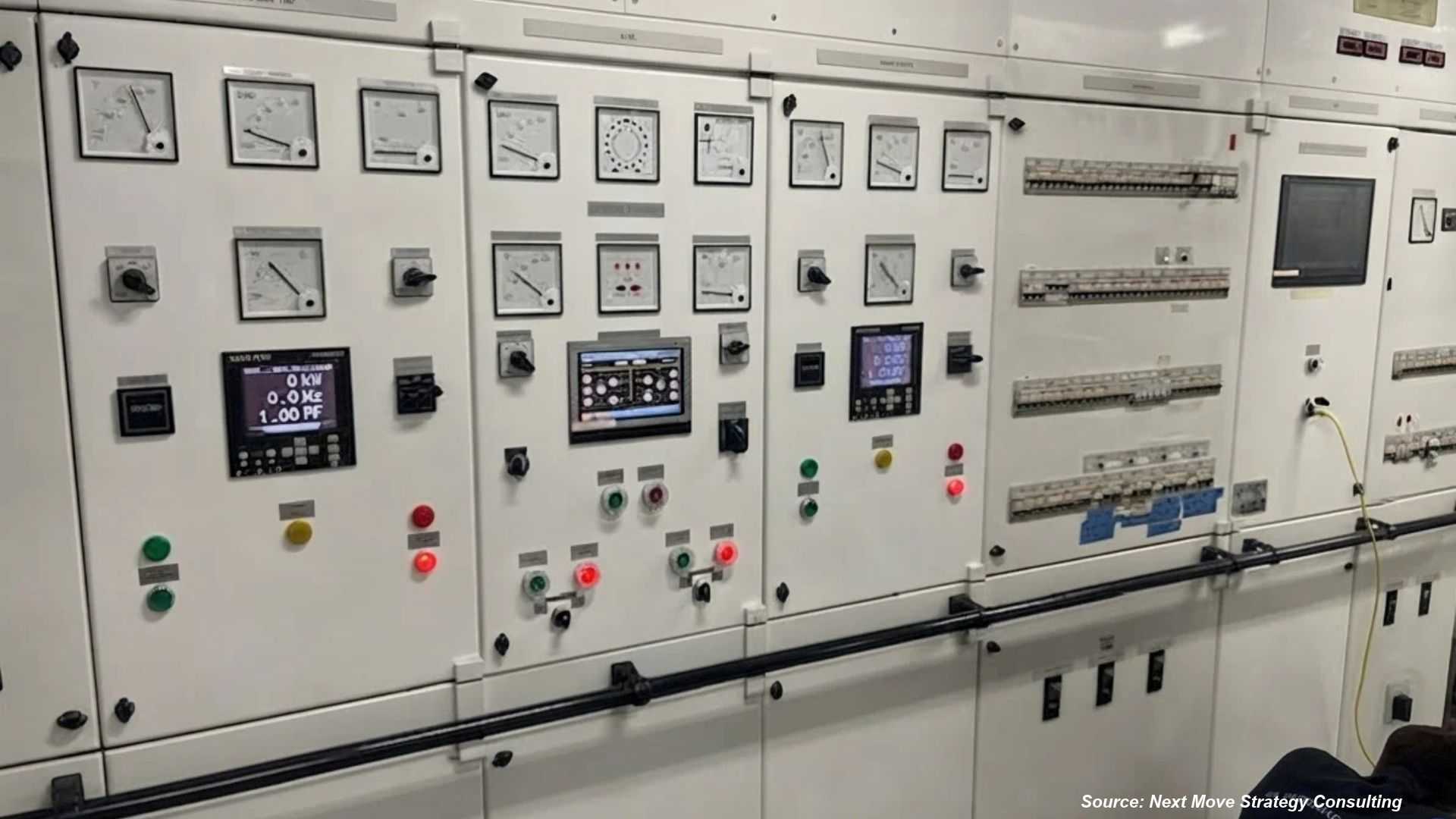
The global power management system (PMS) market stands at a structural inflection point, shaped by the simultaneous acceleration of renewable energy integration, AI-driven data center proliferation, and the largest grid modernization investment cycle in modern history. According to Next Move Strategy Consulting's Power Management System Market report, the global power management system market was valued at USD 6.45 billion in 2024 and is projected to reach USD 9.55 billion by 2030, growing at a CAGR of 6.8% from 2025 to 2030.
This trajectory is not incidental. Three converging structural forces — the surge in variable renewable generation requiring real-time balancing, the exponential power demands of AI infrastructure, and sweeping regulatory mandates for grid modernization across North America and Europe — are collectively redefining what power management systems must do and who must deploy them. For C-level executives and institutional investors, the question is no longer whether to prioritize PMS investment, but how quickly and at what scale.
For More Information: Download FREE Sample on Power Management System Market Report
The AI Infrastructure Supercycle and the New Demand Frontier for Power Management
Eaton and Siemens Energy Redefine the Data Center Power Paradigm
In June 2025, Eaton and Siemens Energy announced a landmark strategic collaboration to deliver fast-track, grid-independent power solutions for data centers — a development that crystallizes the most consequential demand driver currently reshaping the power management system market. The partnership offers a standardized modular power plant concept generating 500 megawatts (MW) of electricity per configuration, built around Siemens Energy's SGT-800 gas turbines with integrated battery storage, and Eaton's full electrical equipment stack from medium-voltage switchgear to UPS and rack systems. Andreas Pistauer, Global Head of Sales at Siemens Energy's Gas Services Business Area, stated that the approach enables hyperscalers, co-locators, and investors to "reduce the time-to-market by up to two years in many places," while reducing CO₂ emissions by approximately 50% compared to conventional diesel-backed configurations.
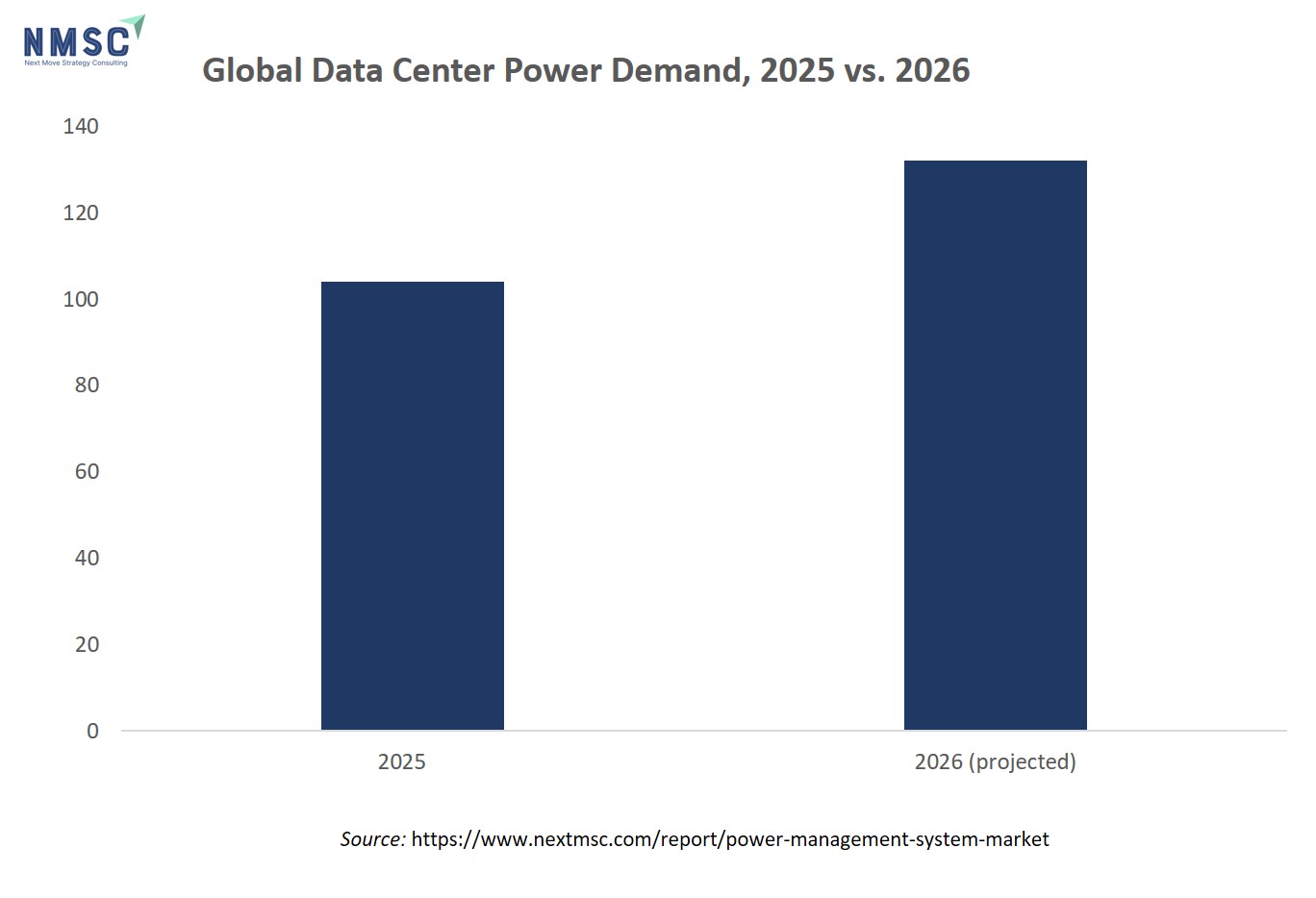
This partnership is a direct commercial response to a measurable demand shock. According to the International Energy Agency's Energy and AI report, global data center electricity consumption grew by 17% in 2025, and from 2024 to 2030, data center electricity consumption is projected to grow at approximately 15% per year — more than four times faster than overall electricity demand growth. Gartner further reported in June 2026 that worldwide data center power demand is expected to rise 27% in 2026, reaching 132 gigawatts (GW), up from 104 GW in 2025.
The Deloitte Center for Energy & Industrials, in its 2026 Power and Utilities Industry Outlook published in October 2025, projects that U.S. data center demand alone could reach 176 GW by 2035 — a fivefold increase from 2024 levels — placing unprecedented pressure on both grid infrastructure and the power management systems that govern load distribution, switching, and safety management within these facilities.
NMSC Strategic Perspective: The Data Center End-User Segment as a Structural Growth Engine
NextMSC primary research and analysis identifies the data center end-user segment as one of the highest-velocity growth vectors within the power management system market through 2030. The convergence of AI training workloads, cloud infrastructure expansion, and the shift toward grid-independent or hybrid power architectures — as exemplified by the Eaton-Siemens Energy model — is expanding the addressable market for PMS beyond traditional utility and industrial applications. Specifically, the demand for advanced load shedding modules, switching and safety management systems, and AI-integrated power monitoring platforms within hyperscale and co-location facilities is accelerating at a pace that outstrips the broader market CAGR. Operators who previously treated power management as a facility maintenance function are now treating it as a core operational and competitive differentiator, given that unplanned downtime in an AI inference environment carries direct revenue consequences measured in millions of dollars per hour.
Section Summary: The AI infrastructure supercycle is generating a qualitatively new category of PMS demand — one defined by grid-independence requirements, modular scalability, and real-time load orchestration — that is structurally distinct from legacy industrial or commercial PMS deployments.
Key Takeaways:
-
Global data center electricity consumption grew 17% in 2025 and is projected to grow ~15% per year through 2030, per the IEA.
-
Eaton and Siemens Energy's June 2025 partnership delivers 500 MW modular power configurations that reduce data center time-to-market by up to two years.
-
Gartner projects data center power demand will reach 132 GW in 2026, a 27% year-over-year increase.
-
NextMSC analysis identifies data center PMS as a segment growing faster than the overall market CAGR of 6.8%.
Industry Impact Analysis
Grid Modernization Mandates Create a Regulatory Tailwind of Unprecedented Scale
The regulatory environment surrounding power infrastructure has shifted decisively in favor of accelerated PMS deployment. On December 10, 2025, the European Commission published its Grids Package — a comprehensive legislative framework designed to cut grid project permit timelines from up to 10 years to a maximum of two years, with automatic approval if authorities fail to respond within the new deadline. The Commission estimates that €1.2 trillion (approximately USD 1.4 trillion) in grid investments are needed across Europe by 2040, with €30 billion earmarked from the 2028–2034 EU budget for cross-border energy projects.
The scale of this investment mandate directly expands the deployment surface for power management systems. Every new grid segment, substation, and cross-border interconnector requires PMS hardware and software to govern power monitoring, load balancing, and switching operations. The EU's explicit acknowledgment that "years of lagging investments have resulted in ageing grids that cannot absorb Europe's growing supplies of fluctuating renewable power" — with wind and solar generators frequently curtailed to avoid network overloads — underscores the operational necessity of advanced PMS at the grid edge.
In parallel, the IEA's Electricity 2026 report identifies grid capacity as "a critical bottleneck" globally, with over 2,500 GW of renewable, large-load, and storage projects currently stalled in grid connection queues worldwide. The IEA calculates that annual grid investment must increase by approximately 50% by 2030 from today's USD 400 billion to meet electricity demand growth — a figure that implies sustained, multi-year procurement of grid-enhancing technologies, including advanced power flow control, dynamic line rating, and topology optimization systems, all of which require sophisticated PMS integration.
J.P. Morgan's analysis reinforces this trajectory: global grid spending increased from USD 300 billion in 2020 to USD 480 billion in 2025, and USD 5.8 trillion of cumulative grid investment is forecasted globally between 2026 and 2035, with USD 700 billion specifically allocated to digital-related grid capital expenditure — the category most directly associated with PMS software, SCADA systems, and advanced distribution management components.
Renewable Energy Integration Intensifies the Operational Complexity PMS Must Resolve
The IEA's Global Energy Review 2026 confirms that global annual renewable capacity additions reached 800 GW in 2025, a 16% increase over the prior year. The IEA's Renewables 2025 report further projects that global renewable power capacity will increase by almost 4,600 GW between 2025 and 2030 — effectively doubling installed capacity within five years. Each gigawatt of variable solar or wind capacity added to a grid requires corresponding investment in power management infrastructure to balance intermittent supply against real-time demand — a relationship that makes PMS deployment a structural co-requirement of renewable energy buildout, not an optional upgrade.
EV Proliferation Extends PMS Demand into the Transportation Sector
The IEA's Global EV Outlook 2026 reports that electric car sales topped 20 million globally in 2025, with one in four new cars sold worldwide being electric — a share that has more than doubled in four years. This proliferation creates a distributed, high-variability load profile across residential, commercial, and industrial grids that conventional power infrastructure was not designed to accommodate. Power management systems — particularly those governing load shedding, energy cost accounting, and switching and safety management — are essential to prevent localized grid overloads as EV charging demand concentrates during peak hours.
Section Summary: Three regulatory and structural forces — the EU Grids Package, the IEA's documented grid investment gap, and the renewable energy capacity doubling — are collectively creating a sustained, policy-backed demand environment for power management systems that extends well beyond the forecast period.
Key Takeaways:
-
The EU Grids Package (December 2025) mandates a reduction in grid permit timelines from up to 10 years to two years, unlocking €1.2 trillion in grid investment by 2040.
-
The IEA requires annual global grid investment to increase 50% by 2030 from USD 400 billion today.
-
J.P. Morgan forecasts USD 5.8 trillion in cumulative global grid investment between 2026 and 2035, with USD 700 billion for digital grid technology.
-
Global renewable capacity additions reached 800 GW in 2025, each GW requiring corresponding PMS deployment for grid stability.
Pros and Cons of Recent Market Developments
|
Development |
Pros |
Cons |
|
EU Grids Package (Dec 2025) |
Cuts permit timelines from 10 years to 2 years, accelerating PMS procurement cycles across Europe |
Removal of mandatory environmental assessments has drawn criticism from sustainability campaigners, creating potential regulatory reversal risk |
|
Eaton–Siemens Energy Data Center Partnership (Jun 2025) |
Reduces data center time-to-market by up to two years; 500 MW modular configurations reduce CO₂ by ~50% vs. diesel backup |
Grid-independent power architectures may reduce utility-side PMS procurement in favor of on-site systems, fragmenting the traditional customer base |
|
AI-Driven Data Center Power Surge |
Creates a high-value, fast-growing end-user segment for advanced PMS hardware and software |
Concentration of demand in hyperscaler facilities increases customer bargaining power and may compress margins for PMS vendors |
|
Global Renewable Capacity Doubling (2025–2030) |
Structurally expands the addressable market for grid-balancing PMS modules across all regions |
Variable generation profiles increase grid instability risk, raising the technical complexity and cost of PMS integration in legacy infrastructure |
|
EV Sales Exceeding 20 Million in 2025 |
Expands PMS demand into residential and commercial charging infrastructure segments |
Uncoordinated EV charging creates localized grid stress that existing PMS deployments may be insufficiently scaled to manage |
|
IEA Grid Investment Gap (50% increase required by 2030) |
Validates long-term, policy-backed demand for PMS across transmission and distribution segments |
Supply chain constraints — including transformer and switchgear lead times stretching to multiple years — may delay PMS deployment timelines |
Key Data & Statistics
Global Grid & Energy Infrastructure Investment Benchmarks
|
Metric |
Value |
|
Global grid spending (2020) |
USD 300 billion |
|
Global grid spending (2025) |
USD 480 billion |
|
Cumulative global grid investment forecast (2026–2035) |
USD 5.8 trillion |
|
Digital-related grid capex (2026–2035) |
USD 700 billion |
|
Annual grid investment required by 2030 |
~USD 600 billion (50% increase from USD 400B today) |
|
Renewable, large-load & storage projects stalled in grid queues |
Over 2,500 GW |
|
Global renewable capacity additions (2025) |
800 GW |
|
Global EV sales (2025) |
20+ million units (1 in 4 new cars) |
|
EU grid investment needed by 2040 |
€1.2 trillion (~USD 1.4 trillion) |
|
Global data center electricity demand growth (2025) |
+17% year-over-year |
|
Global data center power demand (2026) |
132 GW (+27% YoY) |
Future Outlook & Forecast
From Grid Bottleneck to Intelligent Network: The PMS Market Through 2030
NextMSC primary research and analysis projects the global power management system market will reach USD 9.55 billion by 2030, growing at a CAGR of 6.8% from 2025. This growth trajectory is underpinned by three durable structural forces that are unlikely to moderate within the forecast window.
Software and AI Integration as the Margin-Expanding Segment: The software component of the PMS market — encompassing SCADA, Advanced Distribution Management Systems (ADMS), Outage Management Systems (OMS), and Generation Management Systems (GMS) — is positioned to grow at a premium to the overall market CAGR. Deloitte's 2026 Power and Utilities Industry Outlook notes that by 2027, nearly 40% of utility control rooms are expected to use AI, and utilities are actively embedding edge AI, federated learning, and cloud-hybrid architectures into their operational infrastructure. This shift from hardware-centric to software-and-services-centric PMS architectures will expand revenue per installation and extend the addressable market to operators who previously lacked the technical infrastructure to deploy advanced power management.
Asia-Pacific as the Volume Growth Engine: The IEA projects that more than 400 GW of net renewable energy capacity will be added annually between 2026 and 2030, with 70% coming from solar PV. China alone is forecast to drive 60% of worldwide renewable capacity expansion through 2030, per the International Trade Administration — a concentration of new generation that requires proportional investment in PMS to manage grid stability, energy cost accounting, and switching operations at scale. NextMSC analysis identifies Asia-Pacific as the region with the highest volume growth potential for PMS hardware through 2030, driven by the scale of renewable integration and the parallel expansion of industrial and data center infrastructure across China, India, and Southeast Asia.
Grid-Enhancing Technologies as a Near-Term Catalyst: The IEA estimates that the implementation of grid-enhancing technologies — including dynamic line rating, advanced power flow control, and topology optimization — could unlock sufficient capacity to connect 450–700 GW of projects currently stalled in connection queues globally. Each of these technologies requires PMS integration to function effectively, creating a near-term procurement wave that will precede the longer-cycle new grid construction programs.
Section Summary: The PMS market's path to USD 9.55 billion by 2030 is supported by three concurrent growth vectors: AI-driven software adoption in utility control rooms, Asia-Pacific renewable capacity buildout, and the near-term deployment of grid-enhancing technologies to resolve the global grid connection queue backlog.
Key Takeaways:
-
The PMS software segment is positioned to outpace the overall 6.8% CAGR as AI integration in utility operations accelerates.
-
Asia-Pacific, led by China's 60% share of global renewable capacity expansion, represents the highest-volume hardware growth opportunity.
-
Grid-enhancing technologies capable of connecting 450–700 GW of stalled projects require PMS integration, creating a near-term procurement catalyst.
-
The Deloitte projection of 26% U.S. peak demand growth by 2035 implies sustained, decade-long PMS investment across North American transmission and distribution infrastructure.
Next Steps for Stakeholders
For C-Level Executives in Energy and Industrial Sectors:
-
Audit PMS readiness against the AI load profile. The shift from predictable industrial loads to the high-density, variable demand signatures of AI data centers requires PMS platforms capable of millisecond-level switching and real-time load orchestration. Executives should assess whether current PMS deployments are architected for this demand profile or require hardware and software upgrades.
-
Align capital planning with the EU Grids Package timeline. The European Commission's December 2025 Grids Package compresses permit timelines to two years, meaning grid-connected projects that begin permitting in 2026 could be operational by 2028. Organizations with European grid exposure should accelerate PMS procurement planning to avoid supply chain bottlenecks — particularly for transformers and switchgear, where lead times currently extend to multiple years.
-
Evaluate the Eaton–Siemens Energy modular power model for grid-independent deployments. For organizations developing or operating data centers in regions with constrained grid interconnection queues, the modular 500 MW onsite power architecture represents a commercially viable path to capacity that bypasses multi-year grid connection processes.
For Institutional Investors:
-
Prioritize PMS software and services vendors over pure hardware plays. The margin expansion opportunity in the PMS market is concentrated in the software layer — SCADA, ADMS, AI-integrated monitoring platforms — where recurring revenue models and switching costs create durable competitive advantages. Hardware commoditization risk is higher in the medium term.
-
Weight Asia-Pacific exposure in PMS portfolio construction. The IEA's projection of 400+ GW of annual renewable additions in the 2026–2030 period, concentrated in Asia-Pacific, creates a volume-driven hardware procurement cycle that will benefit regional PMS manufacturers and global vendors with established distribution in China, India, and Southeast Asia.
-
Monitor the USD 700 billion digital grid capex allocation. J.P. Morgan's identification of USD 700 billion in digital-related grid capital expenditure between 2026 and 2035 represents the most directly addressable segment of the broader USD 5.8 trillion grid investment forecast for PMS software, cybersecurity, and advanced metering infrastructure vendors.
Conclusion
The global power management system market is not growing because of generic technology adoption trends — it is growing because three of the most capital-intensive infrastructure transitions in modern history are occurring simultaneously and each one requires PMS as a functional prerequisite. The renewable energy capacity doubling through 2030, the AI data center power surge that grew global data center electricity demand by 17% in 2025 alone, and the regulatory mandates embodied in the EU Grids Package and the IEA's documented USD 600 billion annual grid investment requirement are not independent tailwinds — they are structurally interlocked demand drivers that reinforce one another.
According to NextMSC primary research and analysis, the market's trajectory from USD 6.45 billion in 2024 to USD 9.55 billion by 2030 at a 6.8% CAGR reflects this structural demand, not cyclical momentum. For executives and investors who treat power management systems as a commodity procurement category, the risk is misallocating capital at precisely the moment when PMS has become a strategic infrastructure layer. The organizations that recognize this shift earliest — and position their PMS investments accordingly — will hold a measurable operational and competitive advantage through the decade.
About the Author
 Sanyukta Deb
— Sanyukta Deb is Digital Marketing Team Lead at Next Move Strategy Consulting, where she has led content strategy and technical SEO for the firm's B2B market research publications for over 2 years. Her editorial process translates NextMSC's primary and secondary research — spanning technology, industrial, and consumer sectors — into commercial narratives, backed by search-intent, keyword, and competitive analysis. She brings 5 years of overall experience in digital marketing and content strategy.
Sanyukta Deb
— Sanyukta Deb is Digital Marketing Team Lead at Next Move Strategy Consulting, where she has led content strategy and technical SEO for the firm's B2B market research publications for over 2 years. Her editorial process translates NextMSC's primary and secondary research — spanning technology, industrial, and consumer sectors — into commercial narratives, backed by search-intent, keyword, and competitive analysis. She brings 5 years of overall experience in digital marketing and content strategy.
About the Reviewer
 Debashree Dey
— Debashree Dey is Assistant Manager at Next Move Strategy Consulting, where she supports cross-vertical market content and communications across diverse industries for 6 years. Her professional background includes senior content writing, communications, and published manuscript authorship, with experience developing audience-focused business narratives and maintaining clear, consistent messaging. Her role supports research-led content development and editorial quality across NextMSC publications.
Debashree Dey
— Debashree Dey is Assistant Manager at Next Move Strategy Consulting, where she supports cross-vertical market content and communications across diverse industries for 6 years. Her professional background includes senior content writing, communications, and published manuscript authorship, with experience developing audience-focused business narratives and maintaining clear, consistent messaging. Her role supports research-led content development and editorial quality across NextMSC publications.

















Add Comment