Wireless Power Transmission Market: 3 Leaders Driving Change
In This Article:
-
A Market Shifting Toward Smarter Power
-
Apple Inc.
-
Samsung Electronics Co., Ltd.
-
Xiaomi Corporation
-
NXP Semiconductors N V
-
TDK Corporation
A Market Shifting Toward Smarter Power
We observed the Wireless Power Transmission Market moving beyond the narrow use case of convenience charging toward a broader power-delivery ecosystem spanning smartphones, wearables, electric vehicles, industrial automation, medical devices, IoT and infrastructure. The global market was valued at USD 19.75 billion in 2025, estimated at USD 25.99 billion in 2026, and is projected to reach USD 147.88 billion by 2035 at a 21.31% CAGR from 2026 to 2035. Our analysis indicates that the strategic shift is being driven by higher charging-power requirements, greater interoperability, magnetic alignment, connected-device ecosystems and the gradual expansion of wireless energy delivery into applications where cables or physical connectors restrict flexibility.
The competitive structure is also changing. Inductive Power Transfer remains the largest technology category at USD 13.19 billion in 2025, while Laser Power Transfer is the fastest-growing technology at a 31.81% CAGR through 2035. At the application level, consumer charging systems remain the largest product type, while electric vehicle charging systems are expanding fastest. Regulatory and standards developments are reinforcing this transition: Qi2 is improving cross-device alignment and interoperability, while SAE J2954 is shaping wireless EV charging requirements. Based on our evaluation, the market is therefore evolving from proprietary, single-device solutions toward higher-power, standardized and increasingly ecosystem-oriented architectures.
Want Insights on the Wireless Power Transmission market? Access a FREE Sample Instantly
Key takeaway: The most important competitive shift is not simply faster wireless charging; it is the move toward standardized, higher-power and ecosystem-linked power delivery. Apple, Samsung and Xiaomi illustrate three different routes to scale: premium ecosystem integration, broad device interoperability and aggressive charging-performance differentiation.
The technology split provides a useful view of where value is concentrated and where the next growth pockets are emerging:
Wireless Power Transmission Market by Technology, 2025–2035 (USD Billion)
|
Technology |
2025 (USD Billion) |
2035 (USD Billion) |
CAGR% (2026-2035) |
|
Inductive Power Transfer |
13.19 Billion |
82.50 Billion |
19.13% |
|
Capacitive Power Transfer |
0.80 Billion |
7.53 Billion |
24.01% |
|
Radio Frequency Power Transfer |
1.71 Billion |
15.56 Billion |
23.66% |
|
Laser Power Transfer |
0.70 Billion |
12.68 Billion |
31.81% |
|
Hybrid Power Transfer |
3.34 Billion |
29.61 Billion |
23.34% |
|
Total |
19.75 Billion |
147.88 Billion |
21.31% |
The table shows that established inductive systems will continue to generate the largest absolute value, but newer transmission architectures are expanding faster. That divergence matters for device manufacturers because future differentiation can come from higher charging power, longer-range delivery, interoperability and integration with connected-device platforms rather than from charging capability alone.
Apple Inc.
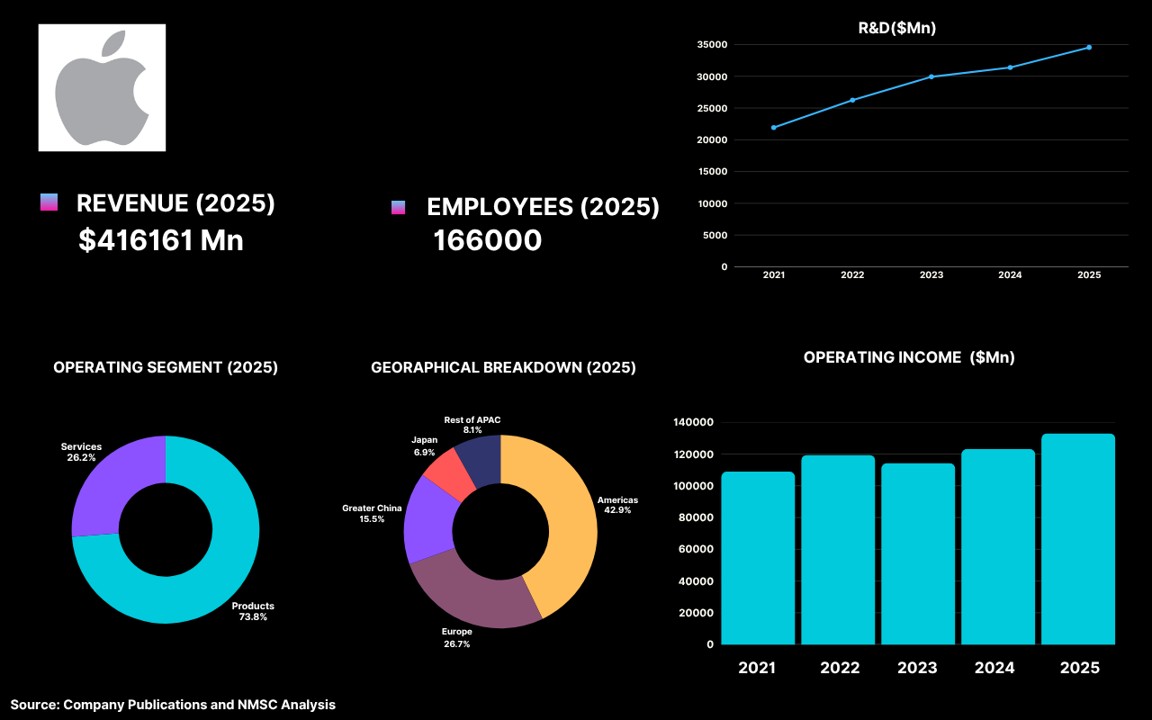
Apple Inc., headquartered in Cupertino, California, operates across smartphones, personal computing, wearables, services and connected-device accessories. Its position in the Wireless Power Transmission Market is closely tied to the role of charging within the broader Apple hardware ecosystem, where MagSafe, Qi2 compatibility and accessory integration reinforce the connection between the device, charger and surrounding product portfolio. The 2025 market-share graphic provided for this analysis places Apple at 9.1% of the top-three company grouping, making it the largest of the three profiled participants. Apple’s strategy therefore has influence beyond the charger itself because wireless power is embedded into a wider hardware-and-accessory architecture. Apple identifies Cupertino, California, as the location of Apple Park and its corporate headquarters.
In September 2025, Apple launched iPhone 17 and introduced a Qi2 25W-certified MagSafe Charger alongside the new device generation. The company also expanded the MagSafe ecosystem through cases, wallets and other accessories, reinforcing magnetic alignment as part of its product architecture. For the Wireless Power Transmission Market, this development is significant because it demonstrates how a major device platform can increase demand not only for wireless charging hardware but also for standards-based charging accessories. Our assessment is that the move strengthens Apple’s ability to influence consumer charging behavior while reducing the practical gap between proprietary magnetic experiences and broader Qi2 interoperability.
Based on our evaluation, Apple’s strategic position rests on ecosystem control rather than on competing primarily through charging wattage. By connecting MagSafe accessories with Qi2 certification, the company can preserve a differentiated user experience while participating in a more standardized wireless-power environment. This creates a durable position in the premium consumer segment as buyers increasingly expect effortless alignment, multi-device compatibility and accessory continuity. Apple’s importance to the market is therefore less about supplying wireless transmission infrastructure directly and more about shaping how a large installed device base interacts with the charging ecosystem.
“iPhone 17 is a big upgrade with powerful features that make iPhone even more useful in your day-to-day life.” — Kaiann Drance, Vice President, Worldwide iPhone Product Marketing, Apple; source: Apple Newsroom, September 2025.
Samsung Electronics Co., Ltd.
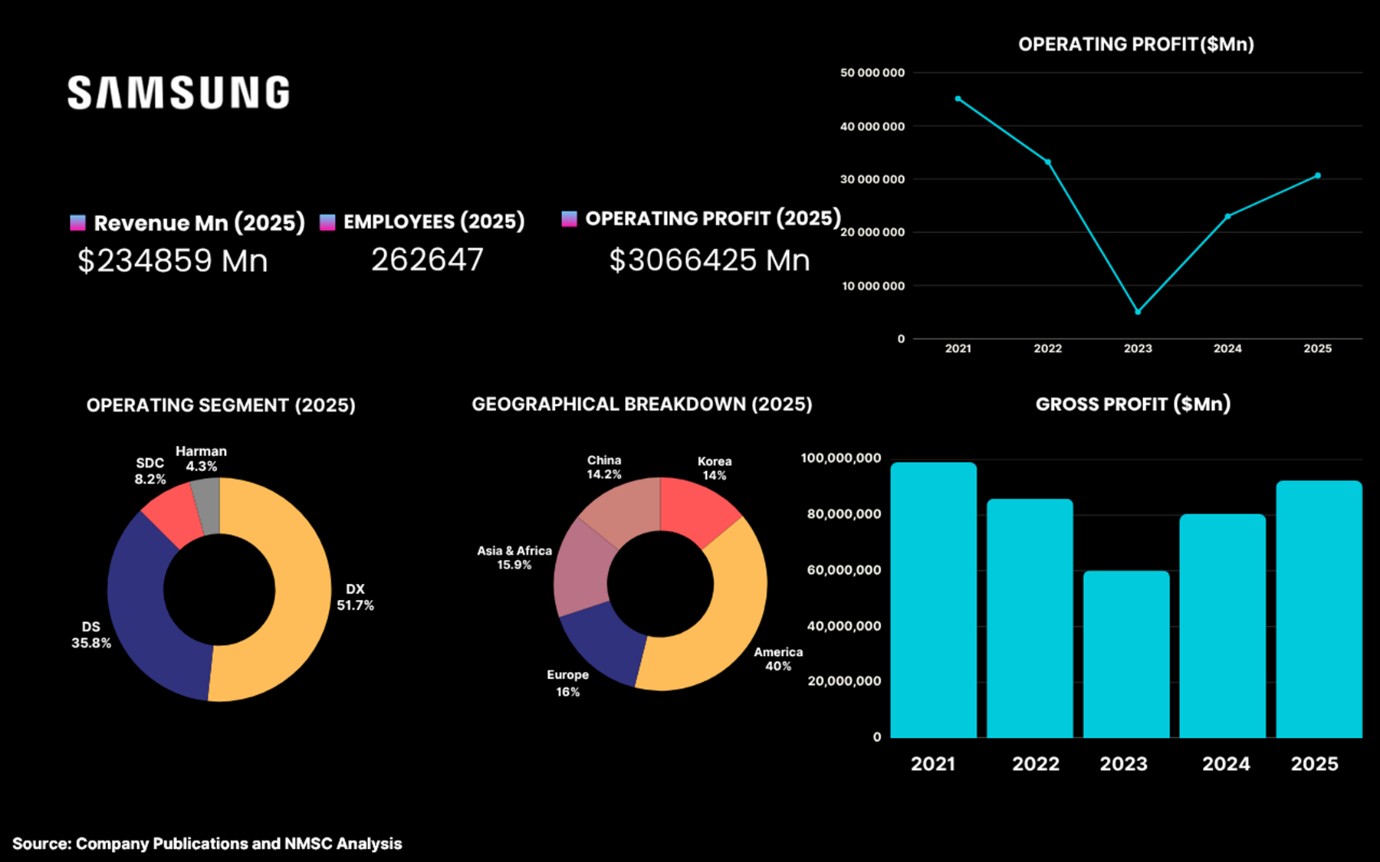
Samsung Electronics Co., Ltd., headquartered in Suwon, Gyeonggi-do, South Korea, spans mobile devices, consumer electronics, displays, semiconductors and connected technologies. The Wireless Power Transmission Market is particularly relevant to Samsung’s mobile and accessory strategy because wireless charging is increasingly part of an integrated Galaxy ecosystem covering smartphones, watches, earbuds and other devices. The 2025 market-share graphic places Samsung at 7.6% of the top-three grouping, establishing it as the second-largest profiled company. Samsung’s broad hardware portfolio gives it multiple routes to reinforce wireless charging adoption through device compatibility, accessories and reverse-power features. Samsung’s current corporate filing lists its principal office in Suwon, Gyeonggi-do.
In May 2025, Samsung introduced the Galaxy S25 Edge, maintaining support for Fast Wireless Charging and Wireless PowerShare while pushing a significantly thinner smartphone design. The company’s 2025 Galaxy portfolio also retained wireless-charging support across flagship devices, while its accessories increasingly moved toward newer Qi2-compatible magnetic charging experiences. For the Wireless Power Transmission Market, the significance lies in Samsung demonstrating that thinner industrial design does not require abandoning wireless charging functionality. This supports the broader market transition toward integrating wireless power directly into premium device architecture while preserving interoperability with the wider Qi ecosystem.
Our analysis indicates that Samsung’s strategic advantage is breadth. Unlike a company centered on one flagship device family, Samsung can distribute wireless-power functionality across smartphones, foldables, earbuds and wearables, while also supporting reverse charging and multi-device use cases. That broad installed base can accelerate standard adoption and make wireless power a routine part of the connected-device experience. Going forward, Samsung’s position should benefit from the convergence of magnetic alignment, faster charging and cross-device compatibility, especially as users increasingly view charging as a continuous ecosystem function rather than a standalone accessory purchase.
Xiaomi Corporation
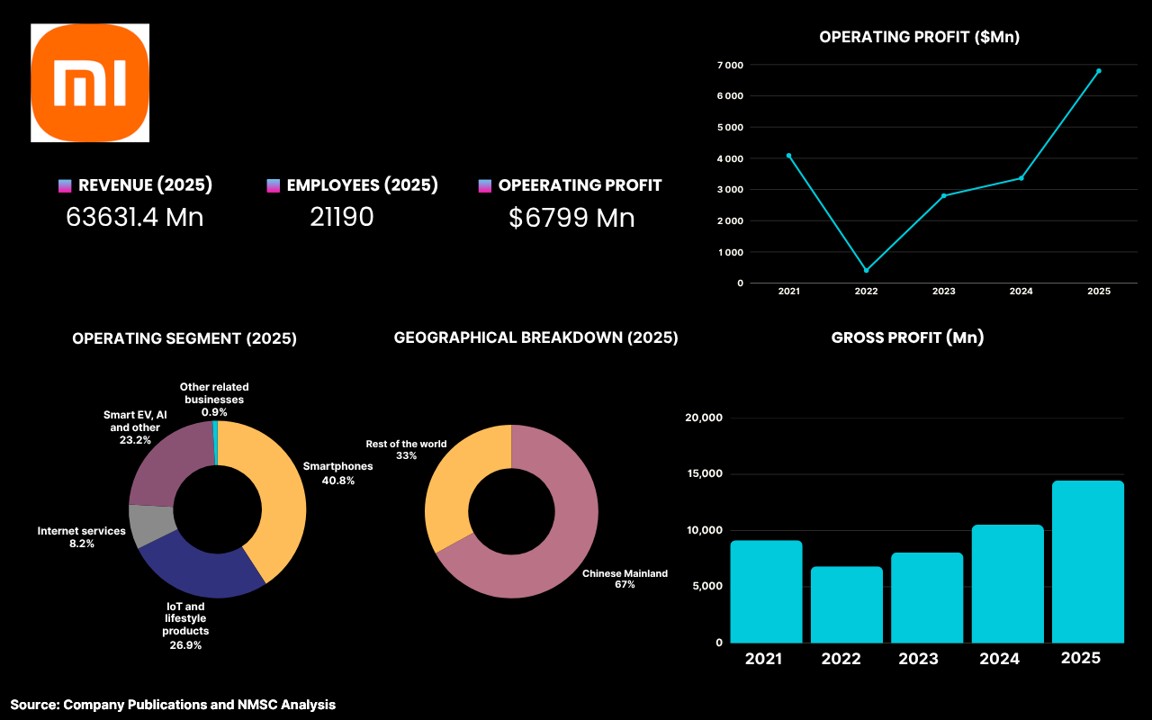
Xiaomi Corporation, headquartered in Beijing, China, is a consumer electronics and smart-manufacturing company built around smartphones, smart hardware and an IoT platform. The Wireless Power Transmission Market supports Xiaomi’s value proposition by giving the company another way to differentiate flagship devices through charging speed, battery performance and ecosystem integration. The 2025 market-share graphic places Xiaomi at 2.9% of the top-three grouping, below Apple and Samsung but still significant within a market where premium Android manufacturers are competing on charging performance. Xiaomi’s corporate profile describes its business as centered on smartphones, smart hardware and an interconnected IoT platform.
In 2025, Xiaomi advanced its wireless-charging proposition with the Xiaomi 15 Ultra, which supports 80W Wireless HyperCharge alongside 90W wired charging. The company also highlights Xiaomi Surge charging-management chipsets and a dedicated 80W wireless charging ecosystem for the device. For the Wireless Power Transmission Market, this development illustrates a different competitive route from Apple’s ecosystem-led strategy: Xiaomi is using higher wireless charging performance as a visible hardware differentiator. Based on our assessment, the approach can accelerate consumer expectations around wireless charging speed and pressure competing flagship manufacturers to narrow the performance gap between wired and wireless charging.
Xiaomi’s strategic position is therefore built around charging-performance disruption combined with a large connected-device ecosystem. The company does not need to control the entire charging standard to influence the market; demonstrating materially higher wireless charging power can shift consumer benchmarks and encourage suppliers to improve coil design, thermal management and power electronics. Our evaluation suggests that Xiaomi will remain especially relevant in Asia-Pacific, where the report identifies the region as both the largest and fastest-growing market and where smartphone manufacturing and electric-mobility ecosystems create strong adjacent opportunities.
NXP Semiconductors N V
NXP Semiconductors N V, headquartered in Eindhoven, Netherlands, develops semiconductor solutions for automotive, industrial, communications and secure connected applications. The Wireless Power Transmission Market aligns particularly closely with NXP’s automotive and embedded-system strengths because modern in-vehicle wireless charging requires not only power transfer but also authentication, communications, electromagnetic compatibility and functional integration. NMSC’s report explicitly includes automotive, industrial, healthcare and telecommunications among major application areas, making NXP’s cross-domain architecture relevant to several of the market’s expansion paths.
In 2025, NXP updated its automotive MWCT2xx2A wireless charging platform with support for Magnetic Power Profile and Extended Power Profile operation, customer-proprietary protocols, digital demodulation, two-way communication and calibrated foreign-object detection. The platform is also AEC-Q100 qualified and designed for automotive environments. This development connects directly to the Wireless Power Transmission Market by strengthening the technical foundation for multi-feature in-vehicle charging systems, where interoperability and safety are increasingly important.
Our assessment indicates that NXP is strategically positioned around the system-integration layer of wireless power. Its strength is not simply delivering a transmitter controller; it is combining power transfer with security, communication and automotive-grade requirements. As vehicles become more software-defined and connected, wireless charging is likely to be evaluated as part of a broader cabin and electrical architecture, giving NXP an opportunity to expand its role across the value chain.
TDK Corporation
TDK Corporation, headquartered in Tokyo, Japan, is an electronics company built around materials science, magnetic technologies, passive components, sensors, batteries and electronic modules. In the Wireless Power Transmission Market, TDK occupies an important component position through transmitter and receiver coils, magnetic materials and other technologies that determine charging efficiency, physical thickness and electromagnetic behavior. Its Japanese and broader Asia-Pacific base also connects it to the region that NMSC identifies as the dominant geography for wireless power transmission.
In its Sustainability Report 2025, TDK highlighted an ultra-thin wireless charging pattern coil compatible with both Magnetic Power Profile and Extended Power Profile standards. The company said the manufacturing approach applies copper plating only to required areas, reducing material loss compared with conventional processing. TDK also highlighted the technology in its preparation for CES 2026, describing thin-pattern coil technology that supports both standards in a compact unit. The development links directly to market requirements for thinner, more flexible and resource-efficient wireless charging hardware.
Based on our evaluation, TDK’s position is strategically differentiated because its advantage sits deep in the physical layer of wireless power systems. Improvements in coil geometry, magnetic materials and manufacturing efficiency can influence the performance and form factor of downstream chargers even when consumers never see the component itself. That makes TDK an important enabler as wireless charging moves toward thinner devices, broader alignment tolerance and more integrated applications.
Market Summary
The Wireless Power Transmission Market is evolving from a consumer-electronics charging solution into a broader power-delivery ecosystem spanning smartphones, wearables, electric vehicles, industrial equipment, medical devices, IoT systems and connected infrastructure. Consumer charging remains a major source of demand, supported by convenience, faster charging, magnetic alignment and multi-device compatibility, while automotive and industrial applications are expanding the addressable market. Our analysis indicates that the technology is increasingly being adopted where eliminating physical connectors can improve usability, reduce mechanical wear or enable automated charging. Recent products from Apple, Samsung and Xiaomi also show how higher wireless charging performance and ecosystem integration are becoming increasingly important within premium connected devices.
Competitive dynamics are increasingly shaped by interoperability, charging efficiency, power density, miniaturization and system integration. Apple is strengthening the connection between MagSafe and Qi2, Samsung continues to integrate wireless charging and Wireless PowerShare across Galaxy devices, while Xiaomi is differentiating through substantially higher wireless charging power. At the semiconductor and component levels, NXP is supporting automotive wireless-power architectures with MPP/EPP compatibility, communication and foreign-object detection, while TDK is developing thin wireless-power coil technologies for compact charging systems.
Based on our evaluation, the next phase of growth will depend on extending wireless power beyond short-range consumer applications into higher-value automotive, industrial, healthcare and infrastructure environments. Dynamic EV charging, robotic opportunity charging, medical-device power delivery and longer-range RF or laser technologies represent important opportunities, although efficiency losses, alignment requirements, thermal management, infrastructure costs, electromagnetic compatibility and standardization remain constraints. The market is therefore moving toward smarter power electronics, improved receiver and transmitter architectures, broader standards adoption and application-specific systems that make wireless energy transfer increasingly practical for both everyday devices and complex connected environments.
Band Title: Inside the Wireless Power Transmission Market Report
Band Subline: 2025 size, 2035 forecast, technology splits, 33-country coverage and competitive analysis.
Band Button: “Explore the Full Report” → Wireless Power Transmission Market Report
About the Author
 Liza Phukan
— Liza Phukan is Research Associate at Next Move Strategy Consulting, where she has covered emerging industries and market research across sectors for 3.5 years. Her work includes analyzing industry developments, validating market data, and developing structured business content from research findings. She uses secondary research and data-validation practices to turn complex market information into clear decision-useful market analysis for business audiences and support report development and B2B.
Liza Phukan
— Liza Phukan is Research Associate at Next Move Strategy Consulting, where she has covered emerging industries and market research across sectors for 3.5 years. Her work includes analyzing industry developments, validating market data, and developing structured business content from research findings. She uses secondary research and data-validation practices to turn complex market information into clear decision-useful market analysis for business audiences and support report development and B2B.
About the Reviewer
 Supradip Baul
— Supradip Baul is an accomplished business consultant and strategist with over a decade of rich experience in market intelligence, strategy, technology, and business transformation. His work has included rigorous qualitative and quantitative analysis across multiple industries, helping clients shape investment decisions and long-term roadmaps. Earlier in his career, he was associated with Gartner, where he contributed to industry-leading reports and market share analyses. He has worked with leading global companies and holds an MBA with a dual specialization in Marketing and Finance.
Supradip Baul
— Supradip Baul is an accomplished business consultant and strategist with over a decade of rich experience in market intelligence, strategy, technology, and business transformation. His work has included rigorous qualitative and quantitative analysis across multiple industries, helping clients shape investment decisions and long-term roadmaps. Earlier in his career, he was associated with Gartner, where he contributed to industry-leading reports and market share analyses. He has worked with leading global companies and holds an MBA with a dual specialization in Marketing and Finance.
















Add Comment