Smart Railway System Market: Statistics, Trends & Forecasts for 2026
Introduction
The global railway sector is undergoing one of the most consequential technological transformations in its history. Across continents, governments, transit authorities, and private operators are channeling unprecedented capital into digitally intelligent rail infrastructure — replacing legacy systems with interconnected, data-driven networks capable of real-time decision-making, predictive maintenance, and autonomous operations. At the center of this transformation is the smart railway system market, a rapidly expanding domain where artificial intelligence, the Internet of Things, 5G connectivity, and cloud analytics converge to redefine how rail networks are built, managed, and experienced.
The urgency behind this shift is not merely technological — it is structural. Rapid urbanization, mounting pressure to decarbonize transport, and the growing inadequacy of aging rail infrastructure are compelling policymakers and operators worldwide to accelerate modernization timelines. From the European Commission's landmark high-speed rail action plan to India's bullet train corridor and China's continued expansion of the world's largest high-speed network, the smart railway system market is being shaped by forces that are both global in scale and immediate in impact. For institutional investors, infrastructure developers, and C-level decision-makers, understanding the trajectory of this market is no longer optional — it is a strategic imperative.
For More Information: Download FREE Sample on Smart Railway System Market Report
Intelligence on the Move: The Forces Reshaping the Smart Railway System Market in 2026
The European Commission's High-Speed Rail Action Plan: A Defining Catalyst
In November 2025, the European Commission unveiled a comprehensive plan to accelerate the development of high-speed rail across Europe, committing €5.64 billion in railway investments and setting an ambitious target to double high-speed rail traffic by 2030 compared to 2015 levels, and triple it by 2050. The plan also designated a 2026 Europe's Rail research call to fund next-generation high-speed rolling stock and support technical innovation across the continent's rail network.
This policy commitment has had immediate downstream effects on the smart railway ecosystem. In February 2026, the European ERTMS Coordinator published the Third Work Plan on the progress of ETCS (European Train Control System) implementation across EU member states, providing a structured roadmap for digital signaling deployment across thousands of kilometers of mainline track. Complementing this, Siemens Mobility conducted the Nordic region's first-ever automated train operation on an ETCS-equipped mainline in March 2026, marking a pivotal milestone in the transition from pilot programs to real-world deployment of autonomous rail technology.
The momentum is equally pronounced in Asia. In February 2026, Alstom celebrated the commencement of commercial operations on the Namo Bharat Corridor and Meerut Metro in India, underscoring the accelerating pace of smart rail deployment in one of the world's fastest-urbanizing economies. According to World Bank data, urban population levels in India and China stand at 37% and 66% respectively, reflecting the structural demand for high-capacity, digitally integrated rail solutions in these markets.
Digital Signaling: The Backbone of Modern Rail Networks
Digital signaling systems have emerged as the most widely implemented upgrade in contemporary rail infrastructure. These systems replace conventional trackside signals with continuous digital communication between trains and control centers, enabling real-time traffic management and dynamic capacity optimization. According to industry data, over 58% of new rail infrastructure projects globally now incorporate digital signaling technologies such as ETCS or CBTC, while next-generation digital signaling systems already cover more than 70% of European mainlines.
The commercial significance of this trend is substantial. In February 2025, Siemens Mobility secured a portion of a USD 3.05 billion contract with Deutsche Bahn to supply digital control and signaling technology — one of the largest single rail technology contracts awarded in recent years. In June 2025, the company further showcased cloud-based digital technologies for urban rail at the UITP Global Public Transport Summit in Hamburg, targeting lifecycle cost optimization and network capacity enhancement.
AI and Predictive Maintenance: From Pilot to Production
Artificial intelligence has transitioned from an experimental tool to a core operational technology in the rail sector. Research conducted by the International Union of Railways (UIC) and McKinsey & Company in 2024 identified over 100 potential AI use cases in rail, with approximately 20 applications being actively implemented across railway companies worldwide. Predictive maintenance for rolling stock and infrastructure was identified as one of the most mature AI applications deployed by railway operators, with AI-based platforms demonstrating the capacity to reduce unplanned downtime by 30–40% while improving maintenance efficiency across networks.
In February 2025, Alstom announced the extension of its HealthHub predictive maintenance platform to additional European partners, further embedding AI-driven asset management into mainstream rail operations.
NMSC Strategic Perspective: Decoding the Market Shift
According to Next Move Strategy Consulting's analysis, the convergence of IoT sensor networks, cloud platforms, and AI-powered analytics is fundamentally transforming railway operations through real-time monitoring, predictive maintenance, and optimized scheduling — collectively enhancing safety, efficiency, and passenger experience. The firm identifies three primary growth drivers shaping the smart railway system market: the accelerating pace of digitalization and IoT integration, large-scale government investments and mega infrastructure projects, and the structural demand generated by rising urbanization and smart mobility requirements.
NMSC's analysis further highlights that the integration of AI and big data analytics represents the most significant near-term opportunity in the market, enabling operators to anticipate infrastructure failures before they occur, optimize train scheduling, manage passenger flow, and reduce energy consumption — creating strong growth prospects for both technology providers and rail operators. The firm also notes that high capital investment requirements and long ROI cycles remain the primary structural constraint on adoption, particularly in developing economies where budget limitations and competing infrastructure priorities slow modernization timelines.
Section Summary: The smart railway system market is being propelled by a rare alignment of policy commitment, technological maturity, and structural demand. The European Commission's €5.64 billion rail investment plan, Siemens Mobility's landmark Deutsche Bahn contract, and Alstom's expanding AI-driven maintenance platforms collectively signal that the market has moved decisively from aspiration to execution.
Key Takeaways:
-
The European Commission committed €5.64 billion to railway investments in November 2025, targeting a doubling of high-speed rail traffic by 2030.
-
Over 58% of new global rail infrastructure projects now incorporate digital signaling technologies such as ETCS or CBTC.
-
AI-based predictive maintenance platforms can reduce unplanned rail downtime by 30–40%, with Alstom's HealthHub platform expanding across Europe in 2025.
-
Siemens Mobility conducted the Nordic region's first automated train operation on an ETCS-equipped mainline in March 2026, marking a critical deployment milestone.
Industry Impact Analysis
Operational Transformation Across the Value Chain
The deployment of smart railway systems is generating measurable operational impact across every layer of the rail value chain — from infrastructure management and signaling to passenger services and freight logistics. Digital signaling systems, by enabling trains to run closer together safely through continuous supervision of speeds and movement authorities, are directly expanding network capacity without requiring new physical infrastructure. This capacity optimization is particularly consequential in densely populated urban corridors where physical expansion is constrained by land availability and cost.
Connected rail infrastructure — integrating IoT sensors, cloud computing platforms, real-time operational monitoring systems, and advanced telecommunications networks — is enabling operators to monitor thousands of assets simultaneously, including track equipment, signaling systems, and rolling stock components. This systemic connectivity is reducing the reliance on scheduled inspections and manual diagnostics, replacing them with condition-based maintenance protocols that lower lifecycle costs and improve asset utilization.
Regulatory and Policy Tailwinds
The regulatory environment is increasingly aligned with smart railway adoption. The U.S. Federal Railroad Administration has proposed amendments to regulations governing Positive Train Control (PTC) systems, reflecting a broader policy direction toward mandating digital safety technologies across freight and passenger networks. In Europe, the ERTMS deployment framework provides a legally binding interoperability standard that is compelling member states to accelerate digital signaling upgrades across national networks.
In Asia-Pacific, government-backed mega projects are functioning as the primary demand engine. India's Mumbai–Ahmedabad bullet train corridor, China's continued high-speed rail network expansion with smart signaling integration, and the broader regional trend of metro system proliferation are collectively creating a sustained pipeline of smart railway technology procurement. According to data from the Transport Politic, more than 1,000 kilometers of new urban rail lines — metros, light rail, and tramway systems — opened for service globally in 2025 alone.
Sustainability and Decarbonization Imperatives
Smart railway systems are increasingly positioned as a critical instrument of national and regional decarbonization strategies. Rail transport is inherently more energy-efficient than road or air alternatives, and smart systems amplify this advantage through AI-driven energy optimization, regenerative braking management, and demand-responsive scheduling. The global digital-railway market is forecast to rise from approximately €71 billion in 2025 to €110 billion in 2030, reflecting the growing recognition of digital rail as a sustainability enabler. Europe's strong focus on reducing carbon emissions is directly supporting investments in high-speed rail, metro expansions, and smart station solutions, making digital transformation a central pillar of the region's railway modernization agenda.
Cybersecurity: An Emerging Priority
As rail networks become increasingly digitally interconnected, cybersecurity has emerged as a critical operational and regulatory concern. The expansion of IoT sensor networks, cloud-based control systems, and wireless communication infrastructure creates new attack surfaces that require dedicated protection frameworks. Rail operators and technology providers are responding by integrating cybersecurity solutions as a foundational component of smart railway architecture, rather than treating it as an afterthought. This shift is creating a distinct and growing sub-segment within the broader smart railway system market.
Section Summary: The smart railway system market is generating transformative impact across operations, regulation, sustainability, and security. Policy mandates, urbanization-driven demand, and decarbonization imperatives are collectively reinforcing the investment case for smart rail technology across all major geographies.
Key Takeaways:
-
More than 1,000 km of new urban rail lines opened globally in 2025, sustaining a robust pipeline for smart railway technology procurement.
-
The global digital-railway market is projected to grow from approximately €71 billion in 2025 to €110 billion by 2030.
-
Cybersecurity is transitioning from a peripheral concern to a foundational component of smart railway system architecture.
-
U.S. PTC regulatory amendments and Europe's ERTMS framework are creating binding policy tailwinds for digital rail adoption.
Pros and Cons of Recent Market Developments
|
Recent Development |
Pros |
Cons |
|
EU €5.64B High-Speed Rail Investment Plan (Nov 2025) |
Accelerates ETCS/ERTMS deployment across member states; creates large-scale procurement opportunities for technology providers |
Long project timelines and complex cross-border coordination may delay capital deployment |
|
Siemens Mobility USD 3.05B Deutsche Bahn Contract (Feb 2025) |
Validates large-scale commercial viability of digital signaling; strengthens supply chain confidence |
Concentration of major contracts among established players may limit market entry for smaller innovators |
|
Alstom HealthHub Predictive Maintenance Expansion (Feb 2025) |
Reduces unplanned downtime by up to 40%; lowers lifecycle maintenance costs for operators |
High integration complexity with legacy systems; requires significant data infrastructure investment |
|
Nordic Region's First Automated Train Operation (Mar 2026) |
Demonstrates real-world viability of autonomous rail on mainline ETCS networks; builds regulatory confidence |
Safety certification processes for autonomous operations remain lengthy and jurisdiction-specific |
|
India Namo Bharat Corridor & Meerut Metro Launch (Feb 2026) |
Expands smart rail adoption in a high-growth emerging market; demonstrates scalability of CBTC systems |
Infrastructure readiness gaps in secondary cities may slow broader national rollout |
|
AI Integration in Rail Operations (2025–2026) |
Enables real-time disruption management, timetable optimization, and energy efficiency gains |
AI systems require high-quality, continuous data inputs; errors in sensor data can compromise decision reliability |
Key Industry Developments & Institutional Data Points (2025–2026)
|
Data Point |
Figure / Detail |
|
EU Railway Investment Commitment (Nov 2025) |
€5.64 billion |
|
EU High-Speed Rail Traffic Target (vs. 2015) |
Double by 2030; Triple by 2050 |
|
Global Rail Projects with Digital Signaling |
Over 58% of new projects |
|
European Mainlines with Digital Signaling Coverage |
Over 70% |
|
AI Predictive Maintenance Downtime Reduction |
30–40% reduction in unplanned downtime |
|
Active AI Use Cases in Rail (2024) |
~20 actively implemented (100+ identified) |
|
Siemens Mobility – Deutsche Bahn Contract Value (Feb 2025) |
USD 3.05 billion |
|
Global Urban Rail Lines Opened (2025) |
Over 1,000 km |
|
Global Digital-Railway Market (2025) |
~€71 billion |
|
Global Digital-Railway Market Forecast (2030) |
~€110 billion |
|
India Urban Population (2024) |
37% |
|
China Urban Population (2024) |
66% |
Future Outlook & Forecast
Market Trajectory: From USD 36 Billion to USD 93 Billion
According to Next Move Strategy Consulting, the global smart railway system market was valued at USD 32.39 billion in 2025 and is projected to reach USD 36.02 billion by the end of 2026. The market is forecast to expand to USD 93.64 billion by 2035, representing a compound annual growth rate of 11.2% over the 2026–2035 forecast period. This trajectory reflects the sustained convergence of government investment mandates, technological maturation, and structural urbanization-driven demand across all major geographies.
Regional Dynamics
-
North America is being driven by the modernization of aging rail infrastructure, with governments and private operators investing in digital signaling systems, predictive maintenance technologies, and smart communication platforms to enhance reliability and reduce delays. The push for sustainable transportation and reduced road congestion is further accelerating smart rail technology adoption across both freight and passenger networks.
-
Europe remains the most advanced region in terms of digital rail deployment, driven by the rapid adoption of ETCS and CBTC systems and large-scale initiatives from operators such as Deutsche Bahn and SNCF. The EU's binding sustainability targets and the ERTMS interoperability framework are creating a durable, policy-backed demand environment for smart railway technology providers.
-
Asia-Pacific is positioned as the fastest-growing regional market, driven by rapid urbanization and large-scale investments in high-speed rail and metro projects. China's continued expansion of its high-speed rail network with smart signaling, India's bullet train corridor and metro proliferation, and the broader regional trend of urban transit investment are collectively making Asia-Pacific the primary growth engine of the global smart railway system market.
-
The Rest of the World — encompassing the Middle East, Africa, and Latin America — is emerging as a new frontier, with Gulf countries advancing metro and high-speed rail systems integrated with digital signaling and passenger information technologies, and Latin American nations modernizing urban transit with smart ticketing and IoT-based monitoring.
Technology Segment Outlook
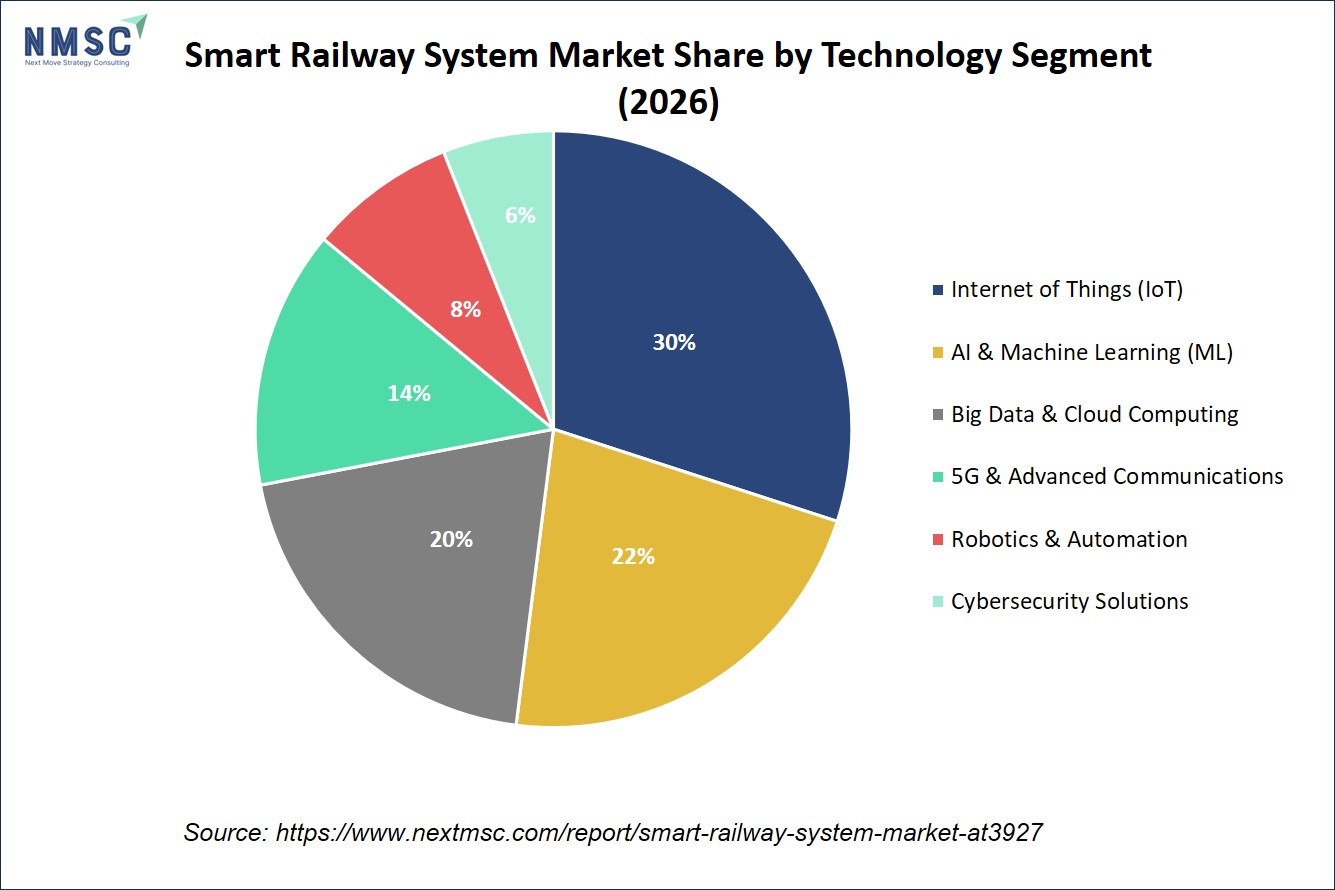
The IoT and AI & ML technology segments are expected to lead market growth over the forecast period, driven by the expanding deployment of sensor networks, cloud analytics platforms, and machine learning-based predictive maintenance systems. The 5G and advanced communications segment is anticipated to gain significant traction as rail operators upgrade wireless infrastructure to support real-time data transmission across increasingly complex connected rail ecosystems. Cybersecurity solutions represent a high-growth sub-segment as the attack surface of digitally interconnected rail networks expands.
Competitive Landscape
The smart railway system market is characterized by a concentrated competitive landscape dominated by established technology and rail systems providers. Key players include Siemens Mobility, Alstom SA, Hitachi Rail Limited, Cisco Systems, Huawei Technologies, ABB Ltd., Thales, Mitsubishi Electric Corporation, Toshiba Corporation, Schneider Electric SE, and KONUX GmbH, among others. Strategic differentiation is increasingly centered on AI capability depth, cloud platform integration, and the ability to deliver end-to-end digital rail solutions across signaling, operations management, passenger services, and cybersecurity.
Section Summary: The smart railway system market is on a well-supported growth trajectory, underpinned by policy mandates, urbanization-driven demand, and the accelerating commercial deployment of AI, IoT, and digital signaling technologies. NMSC projects the market to nearly triple in value from USD 32.39 billion in 2025 to USD 93.64 billion by 2035.
Key Takeaways:
-
The global smart railway system market is projected to grow at a CAGR of 11.2% from 2026 to 2035, reaching USD 93.64 billion, per NMSC.
-
Asia-Pacific is the fastest-growing regional market, driven by urbanization and government-backed mega rail projects in China and India.
-
IoT, AI & ML, and 5G are the highest-growth technology segments within the smart railway ecosystem.
-
The competitive landscape is consolidating around players with end-to-end digital rail capabilities, including AI-driven predictive maintenance and cloud-based operations management.
Next Steps for Stakeholders
For C-Level Executives and Rail Operators:
-
Prioritize digital signaling upgrades as the foundational investment in smart railway transformation. With over 58% of new global rail projects incorporating ETCS or CBTC, operators that delay digital signaling adoption risk falling behind on capacity, safety, and interoperability benchmarks.
-
Accelerate AI and predictive maintenance deployment to capture the 30–40% reduction in unplanned downtime that mature platforms are demonstrating in real-world operations. Evaluate platforms such as Alstom's HealthHub and KONUX's AI-driven switch monitoring for near-term integration.
-
Develop a cybersecurity framework commensurate with the expanding digital attack surface of connected rail networks. Treat cybersecurity investment as a non-negotiable component of any smart railway modernization program, not a discretionary add-on.
-
Engage with public-private partnership structures to access government funding streams, particularly in Europe (CEF rail calls) and Asia-Pacific (national rail modernization budgets), which are providing substantial co-investment opportunities for technology providers and operators.
For Institutional Investors:
-
Allocate to the smart railway technology supply chain, with particular focus on companies with demonstrated AI, IoT, and digital signaling capabilities. The market's 11.2% CAGR through 2035 provides a durable, policy-backed growth runway.
-
Monitor Asia-Pacific project pipelines as the primary near-term demand driver, given the scale of metro and high-speed rail investment in China, India, and Southeast Asia.
-
Assess cybersecurity and cloud platform providers serving the rail sector as high-growth sub-segment opportunities within the broader smart railway ecosystem.
-
Track EU regulatory milestones, including ERTMS deployment progress and CEF funding allocations, as leading indicators of European market demand.
Conclusion
The smart railway system market stands at an inflection point. The convergence of binding policy commitments, technological maturity, and structural urbanization-driven demand has created conditions for sustained, large-scale investment in intelligent rail infrastructure across all major geographies. From the European Commission's €5.64 billion high-speed rail action plan and Siemens Mobility's landmark Deutsche Bahn contract to Alstom's AI-driven maintenance platform expansion and the Nordic region's first automated mainline train operation, the evidence of market acceleration is both broad and concrete.
According to Next Move Strategy Consulting, the global smart railway system market is projected to grow from USD 36.02 billion in 2026 to USD 93.64 billion by 2035, at a CAGR of 11.2% — a trajectory that reflects not just technological momentum, but the structural necessity of intelligent rail as a cornerstone of sustainable, high-capacity urban mobility. For decision-makers across the public and private sectors, the strategic question is no longer whether to invest in smart railway systems, but how to position for maximum impact in a market that is moving with increasing velocity and conviction.
About the Author
 Sanyukta Deb
— Sanyukta Deb is Digital Marketing Team Lead at Next Move Strategy Consulting, where she has led content strategy and technical SEO for the firm's B2B market research publications for over 2 years. Her editorial process translates NextMSC's primary and secondary research — spanning technology, industrial, and consumer sectors — into commercial narratives, backed by search-intent, keyword, and competitive analysis. She brings 5 years of overall experience in digital marketing and content strategy.
Sanyukta Deb
— Sanyukta Deb is Digital Marketing Team Lead at Next Move Strategy Consulting, where she has led content strategy and technical SEO for the firm's B2B market research publications for over 2 years. Her editorial process translates NextMSC's primary and secondary research — spanning technology, industrial, and consumer sectors — into commercial narratives, backed by search-intent, keyword, and competitive analysis. She brings 5 years of overall experience in digital marketing and content strategy.
About the Reviewer
 Debashree Dey
— Debashree Dey is Assistant Manager at Next Move Strategy Consulting, where she supports cross-vertical market content and communications across diverse industries for 6 years. Her professional background includes senior content writing, communications, and published manuscript authorship, with experience developing audience-focused business narratives and maintaining clear, consistent messaging. Her role supports research-led content development and editorial quality across NextMSC publications.
Debashree Dey
— Debashree Dey is Assistant Manager at Next Move Strategy Consulting, where she supports cross-vertical market content and communications across diverse industries for 6 years. Her professional background includes senior content writing, communications, and published manuscript authorship, with experience developing audience-focused business narratives and maintaining clear, consistent messaging. Her role supports research-led content development and editorial quality across NextMSC publications.


















Add Comment