Steel Market 2024–2025: What Is Happening in the Steel Market Right Now?
Introduction
The global steel market is navigating one of its most structurally complex periods in recent memory — simultaneously absorbing the shock of escalating trade barriers, a sobering reality check on green steel timelines, and a pronounced geographic rebalancing of demand toward South and Southeast Asia. According to Next Move Strategy Consulting's Steel Market report, the global steel market was valued at USD 1.16 trillion in 2024 and is projected to reach USD 1.46 trillion by 2030, growing at a CAGR of 3.8% from 2025 to 2030. This trajectory is underpinned by infrastructure-led construction in emerging economies, sustained automotive sector demand, and the long-term transition toward lower-emission production processes — even as that transition encounters significant near-term headwinds.
The market's path to 2030 is not linear. On one side, India's steel demand is forecast to expand by 7.4% in 2026 alone, driven by broad-based infrastructure investment and a thriving freight-driven automotive sector, according to the World Steel Association's Short-Range Outlook released in April 2026. On the other, the OECD's Steel Outlook 2026, published in June 2026, warns that global excess steelmaking capacity is on course to reach 745 million tonnes (Mt) by 2028 — approaching the historical highs of the last steel crisis — as Chinese producers flood export markets with record volumes while domestic demand contracts. For C-suite executives and institutional investors, the steel market in 2026 is not a single story; it is a set of diverging regional narratives that demand precision in capital allocation and supply chain strategy.
For More Information: Download FREE Sample on Steel Market Report
Tariffs, Overcapacity, and the Green Steel Reality Check
The U.S. Section 232 Escalation: A Structural Shift in Global Steel Trade
The most consequential single policy event reshaping global steel trade flows in 2026 is the progressive escalation of U.S. Section 232 tariffs. On April 2, 2026, President Trump signed a Proclamation strengthening the tariff framework, establishing a flat 50% duty on articles made entirely or almost entirely of steel — including steel coils and sheet — and a 25% duty on derivative articles substantially made of steel.
This April 2026 action built on a sequence of prior escalations: a February 2025 overhaul that eliminated hundreds of product-specific and country-specific exemptions, a June 2025 increase to 50% on base steel and aluminum, and a July 2025 extension of the 50% rate to copper. The cumulative effect has been to make the United States one of the most protected steel markets in the world. The White House noted that the U.S. became the third-largest steel-producing nation in 2025 as a direct result of this tariff architecture, with over 4 million tons of new crude steelmaking capacity expected to become operational within the next two years across West Virginia, Arkansas, and South Carolina.
According to Industrial Info Resources data presented at AISTech 2026, there are currently 306 active capital steel projects totaling USD 47 billion in the United States, reflecting the direct investment response to the tariff-protected domestic market.
The United Kingdom has moved in parallel. Effective July 1, 2026, the UK's new steel trade measure imposes a 50% tariff on imports above defined volume thresholds for products that can be domestically manufactured, as published by the UK Government.
The China Export Surge and the Circumvention Problem
The tariff escalation is a direct response to a structural imbalance that the OECD has documented with precision. Chinese steelmakers shipped a record 131 Mt of steel to foreign markets in 2025 — equivalent to approximately 14% of China's annual crude steel production and a 153% surge from 2020 levels — as weak domestic demand, driven by a prolonged real estate sector correction, forced producers to redirect output to export markets.
The OECD's June 2026 analysis further reveals that the median Chinese steel firm received 15 times more in government subsidies relative to asset size than the median producer elsewhere in 2024, a disparity that structurally distorts global competition. China is now on an expansionary path again, with up to 38.6 Mt of new capacity planned through 2028 — several million tonnes more than Italy's entire current capacity, the EU's second-largest steel producer.
Critically, the OECD's analysis identifies a systematic circumvention pattern: following antidumping and countervailing duty (AD/CVD) actions by OECD member countries against Chinese steel in 2023 and 2024, Chinese exports of the same products to ASEAN countries rose in 88 cases, and in 51 of those cases, exports of the same products from ASEAN countries to OECD markets subsequently increased. A concurrent 300% surge in China's semi-finished steel exports to Southeast Asia points to the mechanism: raw products are shipped to third countries, processed, and re-exported to circumvent the original measure.
The U.S. Steel–Nippon Steel Partnership: A USD 14 Billion Bet on American Steelmaking
On November 4, 2025, United States Steel Corporation outlined its next era of growth in partnership with Nippon Steel, targeting approximately USD 14 billion of U.S. growth capital, with USD 11 billion to be invested by the end of 2028. The plan is designed to protect and create more than 100,000 jobs nationwide, while unlocking approximately USD 3 billion in value — including USD 2.5 billion in incremental run-rate EBITDA through capital investments and USD 500 million from operational efficiencies.
U.S. Steel CEO Dave Burritt stated: "With world-class technology, extraordinary engineering capabilities, and the best steel industry employees in the world, we are on a great path to forging the future of steelmaking in America." The partnership has deployed nearly 50 Nippon Steel professionals across U.S. Steel sites, identifying over 200 operational efficiency initiatives across all business segments.
Green Steel's Year of Reckoning: 25+ Projects Delayed, USD 13 Billion in Funding Cut
The green steel transition — long positioned as the industry's defining structural opportunity — entered a period of severe correction in 2025–2026. Approximately half of the world's planned green steel projects now face delays or outright cancellation, driven by a confluence of policy reversals, prohibitive green hydrogen costs, and regulatory friction.
The most significant corporate retreat came in March 2026, when ArcelorMittal canceled plans to convert its Bremen and Eisenhüttenstadt plants in Germany to green hydrogen-based production, citing unfavorable market conditions and the high cost of hydrogen. In May 2026, SSAB indefinitely postponed its new Electric Arc Furnace in Oxelösund, Sweden, due to prolonged delays in securing environmental permits. In the United States, Cleveland-Cliffs abandoned its federally backed hydrogen-ready furnace project after its USD 500 million grant came under scrutiny following the administration's policy shift.
The U.S. policy reversal was the most abrupt: in September 2025, the government announced the cancellation of over USD 13 billion in federal funds allocated to green energy projects, with USD 700 million in battery and manufacturing grants among the first confirmed cuts.
Despite this correction, breakthrough technology development continues. In April 2025, Boston Metal announced its electrochemical steelmaking technology, which produces steel using electricity instead of coal, emitting only oxygen and potentially reducing annual carbon emissions by 3 billion tons. In October 2024, EMSTEEL and Masdar launched the MENA region's first green hydrogen-based steel pilot project in Abu Dhabi, producing certified green steel aligned with the UAE's Net Zero by 2050 Strategy.
NMSC Strategic Perspective: Divergence Between Short-Term Headwinds and Long-Term Structural Demand
NextMSC primary research and analysis identifies a critical divergence that investors must price into their steel market positioning. The near-term environment — characterized by excess capacity, tariff-driven trade fragmentation, and green steel project delays — creates margin compression for producers exposed to spot markets and import competition. However, the structural demand drivers underpinning NMSC's 3.8% CAGR forecast through 2030 remain intact and are, in several key markets, accelerating.
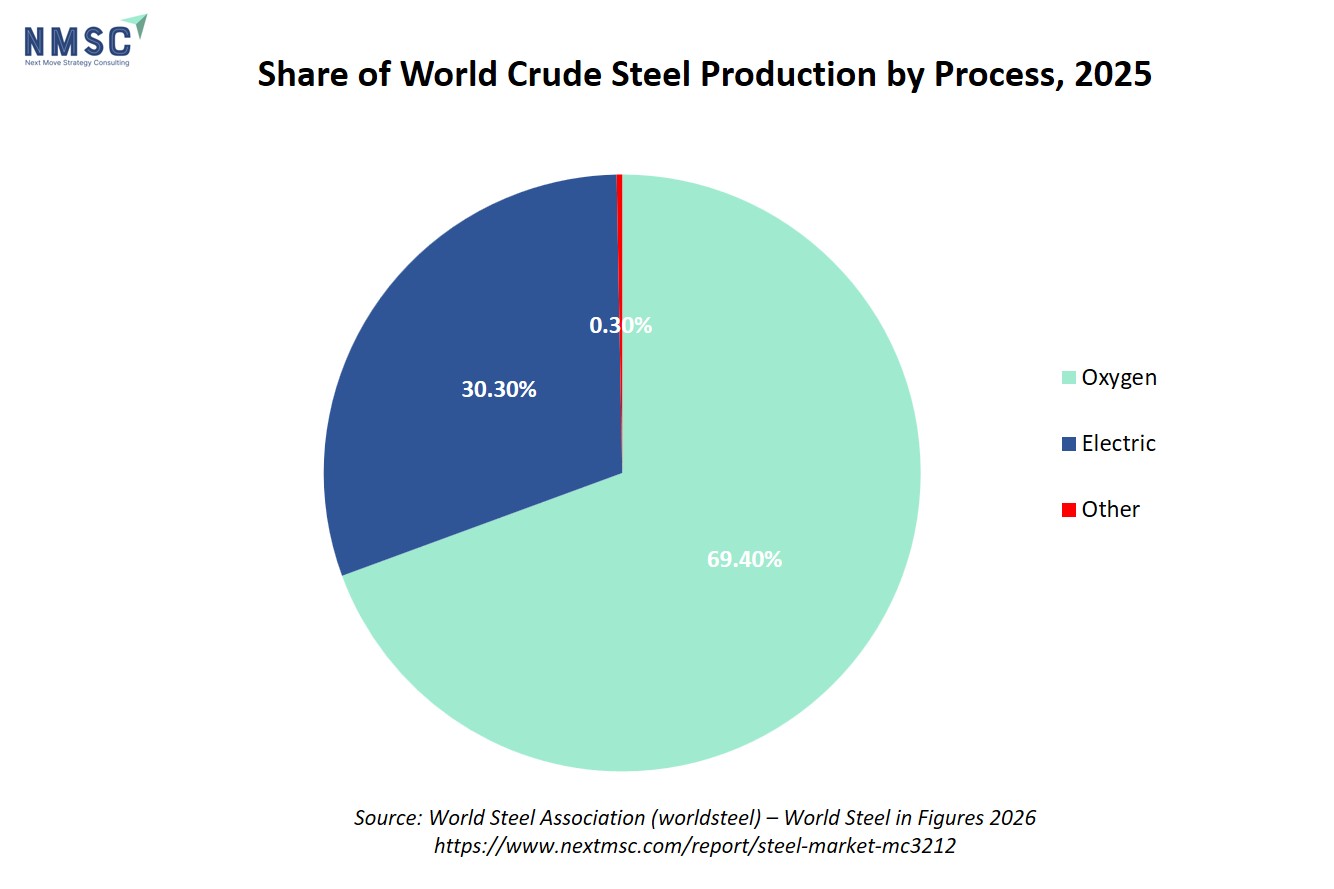
India's infrastructure-led steel consumption, the global energy transition's requirement for electrical steel in transformers and EV motors, and the defense spending surge across NATO member states all represent demand vectors that are insulated from the cyclical pressures currently weighing on the market. NMSC's analysis further identifies the Electric Arc Furnace (EAF) segment as the process technology most positioned to capture value across the forecast period, given its lower capital intensity relative to Basic Oxygen Furnace (BOF) conversion, its compatibility with scrap-based circular economy models, and its adaptability to hydrogen-based reduction as that supply chain matures.
Section Summary:
The steel market's near-term trajectory is defined by three simultaneous forces: U.S. and UK tariff escalation reshaping global trade flows, Chinese export surges and subsidy-driven overcapacity threatening producer margins worldwide, and a green steel transition that has entered a disciplined consolidation phase after years of speculative project announcements.
Key Takeaways:
-
The U.S. Section 232 tariff framework now imposes a flat 50% duty on steel articles, triggering USD 47 billion in active domestic capital projects.
-
Chinese steelmakers exported a record 131 Mt in 2025 — a 153% surge from 2020 — with systematic circumvention of AD/CVD measures via ASEAN transshipment documented by the OECD.
-
Over 25 green steel projects face delays or cancellation globally, with ArcelorMittal, SSAB, and Cleveland-Cliffs among the most prominent retreats.
-
Breakthrough technologies — including Boston Metal's electrochemical process and EMSTEEL's Abu Dhabi green hydrogen pilot — demonstrate that the decarbonization pathway remains technically viable, even as commercial-scale deployment timelines extend.
Industry Impact Analysis
Demand Bifurcation: India Accelerates as China Contracts
The World Steel Association's Short Range Outlook, released on April 14, 2026, projects global steel demand growth of 0.3% in 2026 to reach 1,724 Mt, followed by an accelerated recovery of 2.2% in 2027 to reach 1,762 Mt. This aggregate figure, however, masks a profound bifurcation.
China's steel demand contraction is expected to narrow to -1.5% in 2026, as the housing market correction approaches its bottom and infrastructure investments edge upward, supported by local government efforts to maintain moderately strong GDP growth. For context, the official figure for China's steel demand contraction in 2025 was 7.1% — significantly deeper than worldsteel's October 2025 forecast of -2.0%.
India, by contrast, maintains its position as the world's fastest-growing major steel market, with demand projected to expand by 7.4% in 2026 and accelerate to 9.2% in 2027. This is underpinned by sustained infrastructure-led construction, a thriving automotive sector fueled by increasing freight demand, a resilient capital expenditure cycle, nationwide rail network expansion, and an affordability-driven surge in consumer durables. The Indian Steel Association had already signaled this trajectory, anticipating product requirements of 128.9 million tonnes in 2023-24, up from 119.9 million tonnes the prior year, with domestic demand estimated to grow 9-10% in FY25.
Africa is emerging as an increasingly significant demand driver, with worldsteel projecting 3.8% growth in 2026 and 4.6% in 2027, reflecting intensifying urbanization, critical infrastructure development, and economic diversification efforts across the continent.
The Overcapacity Crisis: A Near-Record Structural Imbalance
The OECD's June 2026 Steel Outlook quantifies the structural imbalance with precision: global excess steelmaking capacity is projected to reach 745 Mt by 2028 — 319 Mt more than OECD member countries currently produce — approaching the historical highs of the last steel crisis a decade ago. Planned capacity additions of up to 138.8 Mt through 2028 represent a 5.7% increase from 2025 levels, while global demand growth is projected to remain sluggish at approximately 0.9% per year through 2030. Capacity utilization rates, already at 76% in 2025, may slide to 74% or below by 2028, intensifying financial pressure across the industry.
India added 41.4 Mt of capacity during 2021–2025 and is set to add up to 31.8 Mt more by 2028, though continued strong domestic demand has kept it a modest net importer. Southeast Asia has also seen significant capacity growth, a trend set to continue through 2028. OECD area capacity, by contrast, edged down by 2.8 Mt (-0.4%) during 2021–2025, with particularly sharp declines in the United Kingdom (-39.7%) and Japan (-7.2%).
Trade Measure Proliferation and the Scrap Restriction Trend
Close to 400 active AD/CVD measures initiated since 2016 were in place in 2025, with 75 new investigations launched in 2025 alone. Brazil, Canada, India, Mexico, and the United States have all raised tariffs on many basic steel products. The EU and UK have announced sweeping measures to support their steel industries as safeguard actions expire.
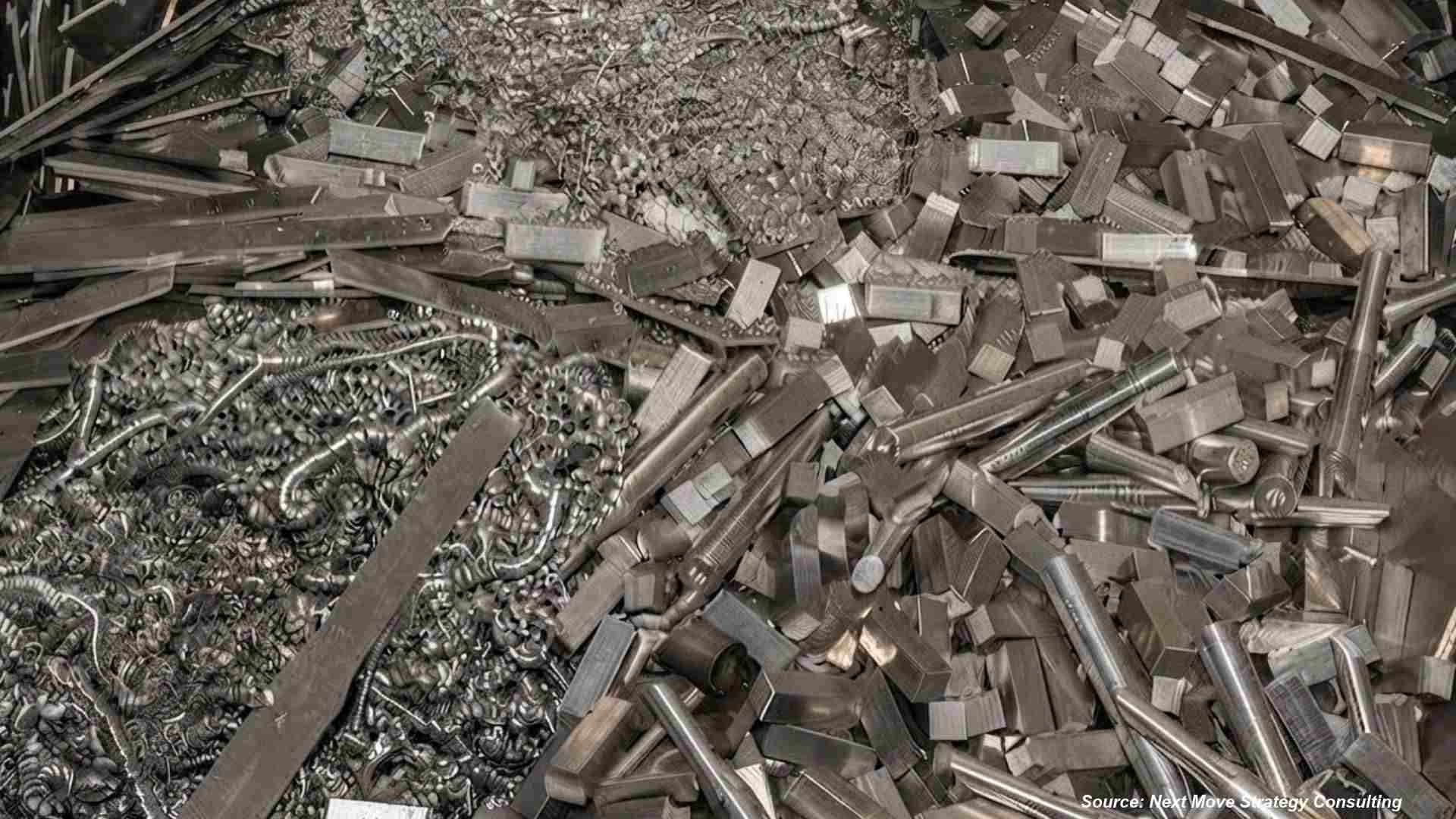
A less-discussed but strategically significant development is the growing restriction on scrap exports — a key input in EAF steelmaking. Scrap is now recognized as a strategic raw material, with exports restricted by 42 countries. Similar restrictions have been introduced in chromium and nickel markets, creating potential supply chain vulnerabilities for EAF-dependent producers as the industry transitions away from BOF processes.
Section Summary:
The industry impact of current market forces is most acutely felt in the divergence between demand-growth markets (India, Africa, Southeast Asia) and overcapacity-burdened markets (China, parts of Europe). Trade measure proliferation is reshaping supply chains, while scrap export restrictions are creating new input cost pressures for EAF producers.
Key Takeaways:
-
Global steel demand is projected to grow just 0.3% in 2026 to 1,724 Mt, with India (+7.4%) and Africa (+3.8%) as the primary growth engines.
-
Global excess capacity is on course to reach 745 Mt by 2028, with capacity utilization potentially falling below 74%.
-
75 new AD/CVD investigations were launched in 2025 alone, and 42 countries now restrict scrap exports, tightening EAF input supply chains.
-
The EU+UK region's steel demand is expected to grow 1.3% in 2026, supported by increased infrastructure and defense spending, but remains approximately 60 Mt (15%) below 2017–2018 levels.
Global Steel Demand Outlook by Key Region (2026–2027)
|
Region / Country |
2026 Demand Growth Forecast |
2027 Demand Growth Forecast |
Key Driver |
|
India |
+7.4% |
+9.2% |
Infrastructure investment, freight-driven automotive, rail expansion |
|
Africa |
+3.8% |
+4.6% |
Urbanization, infrastructure development, economic diversification |
|
United States |
+1.7% |
+2.0% |
Technology-driven private investment, public infrastructure spending |
|
EU + UK |
+1.3% |
+3.0% |
Infrastructure & defense spending, macroeconomic improvement |
|
Developing Economies ex-China |
+2.5% |
+5.1% |
Broad-based emerging market growth; Middle East recovery in 2027 |
|
China |
-1.5% |
~0% (flat) |
Housing market correction nearing bottom; infrastructure edge-up |
|
Global Total |
+0.3% |
+2.2% |
India and developing market growth offsetting China contraction |
Major Green Steel Project Cancellations and Delays (2025–2026)
|
Company / Project |
Country |
Timeline |
Action Taken |
Primary Reason |
|
ArcelorMittal (Bremen & Eisenhüttenstadt) |
Germany |
March 2026 |
Canceled green hydrogen conversion plans |
High hydrogen costs, unfavorable market conditions |
|
SSAB (Oxelösund EAF) |
Sweden |
May 2026 |
Indefinitely postponed new Electric Arc Furnace |
Prolonged environmental permitting delays |
|
Cleveland-Cliffs (Hydrogen-Ready Furnace) |
USA |
August 2025 |
Abandoned project |
USD 500M federal grant withdrawn under new administration |
|
Salzgitter (SALCOS Project) |
Germany |
September 2025 |
Delayed later project stages |
Economic and regulatory uncertainty |
|
BP (H2 Teesside Blue Hydrogen) |
UK |
December 2025 |
Scrapped project |
Broader reassessment of hydrogen investments |
|
U.S. DOE Clean Energy Grants |
USA |
October 2025 |
USD 13B+ in funding canceled |
Federal policy reversal under new administration |
Future Outlook & Forecast
The Road to USD 1.46 Trillion: Structural Drivers Intact Despite Cyclical Headwinds
NextMSC primary research and analysis projects the global steel market to reach USD 1.46 trillion by 2030 at a CAGR of 3.8%, a trajectory supported by three structural demand pillars that remain intact despite the near-term turbulence documented above.
Infrastructure-Led Construction in Emerging Economies: India's infrastructure pipeline — spanning highways, railways, ports, and urban housing — represents the single most reliable demand growth vector in the global steel market through 2030. The worldsteel SRO's projection of 9.2% demand growth in India in 2027 reflects the compounding effect of government capital expenditure, private sector investment, and a demographic dividend that is translating into sustained construction activity. Africa's trajectory — 4.6% demand growth projected for 2027 — adds a second, increasingly significant emerging market demand engine.
Automotive Sector Evolution: The transition to electric vehicles sustains steel's importance in vehicle manufacturing, even as material compositions shift. U.S. Steel's proprietary InduX™ ultra-thin lightweight steel for EV motors and generators, and its verdeX® steel produced with 70-80% lower CO₂ emissions and up to 90% recycled content, illustrate how leading producers are repositioning their product portfolios to capture EV-driven demand rather than cede it to alternative materials.
Defense and Energy Infrastructure: The EU+UK region's return to demand growth in 2026 — after a three-year consecutive decline — is explicitly linked by worldsteel to increased infrastructure and defense spending across the continent. NATO member states' commitment to defense expenditure targets is creating a durable, policy-backed demand floor for structural and specialty steel grades.
The Green Steel Transition: A Longer Timeline, Not an Abandoned Trajectory
The wave of project cancellations in 2025–2026 does not signal the end of the green steel transition — it signals the end of its speculative phase. The Stockholm Environment Institute noted in its 2026 assessment that the sector is entering a critical year where green steel ambitions meet a transformed policy environment, forcing a focus on economic fundamentals over announcement-driven momentum.
The OECD's parallel policy paper, "Navigating the Steel Transition amid Global Excess Capacity," published in September 2026, frames the challenge precisely: the industry must simultaneously address overcapacity and decarbonize, two objectives that require different and sometimes conflicting policy instruments. The OECD's Global Forum on Steel Excess Capacity is developing a new comprehensive framework for joint action in 2026 to address the root causes of the crisis.
Projects that demonstrate a clear path to cost-competitiveness without permanent subsidy dependence — those with secured access to low-cost renewable energy, vertical integration with hydrogen producers, and binding offtake agreements — will define the next phase of the green steel market. The MENA region's gas-based DRI infrastructure, adaptable to green hydrogen as costs decline, positions it as a potential leader in this transition, as demonstrated by the EMSTEEL–Masdar pilot in Abu Dhabi.
Section Summary:
NMSC's USD 1.46 trillion forecast by 2030 is grounded in structural demand drivers — India's infrastructure pipeline, EV-driven automotive steel demand, and defense-linked construction — that are accelerating even as the near-term market absorbs overcapacity and trade fragmentation pressures. The green steel transition has entered a disciplined consolidation phase, with commercially viable projects emerging from the correction with stronger business cases.
Key Takeaways:
-
India's steel demand is projected to grow 9.2% in 2027, making it the single most important demand growth market for global steel producers through 2030.
-
The OECD projects global demand growth of approximately 0.9% per year through 2030, with the gap between capacity and demand keeping utilization rates below 74% by 2028.
-
Green steel's commercial-scale deployment timeline has extended, but breakthrough technologies — including Boston Metal's electrochemical process and hydrogen-based DRI — remain technically validated.
-
The OECD's GFSEC framework for 2026 represents the most significant multilateral attempt to address the root causes of excess capacity since the last steel crisis.
Next Steps for Stakeholders
For Steel Producers:
-
Producers with significant export exposure to the U.S. and UK markets must immediately audit their product classifications under the restructured Section 232 framework to determine applicable tariff rates (50% for pure steel articles, 25% for derivatives, 15% for certain industrial equipment through 2027) and model the impact on landed cost competitiveness.
-
Producers evaluating green steel investments should prioritize projects with secured renewable energy supply agreements and binding customer offtake commitments before committing to Final Investment Decision, given the demonstrated vulnerability of projects reliant on government grant funding to political cycle risk.
-
EAF operators should proactively assess scrap supply chain resilience, given that 42 countries now restrict scrap exports — a constraint that will tighten as the global industry shifts further toward electric furnace steelmaking.
For Downstream Manufacturers and Steel Buyers:
-
U.S.-based manufacturers using steel as an input should model the full cost impact of the April 2026 tariff restructuring across their bill of materials, particularly for derivative articles now subject to a flat 25% duty, and evaluate domestic sourcing alternatives against the USD 47 billion capital investment wave currently underway.
-
Procurement teams should establish dual-sourcing strategies that account for ASEAN transshipment circumvention risks, which the OECD has documented as a systematic pattern — relying on ASEAN-origin steel without origin verification creates regulatory and reputational exposure.
For Institutional Investors:
-
The India steel demand story — 7.4% growth in 2026, 9.2% in 2027 — represents the most compelling long-term demand growth thesis in the global steel market. Investors should evaluate exposure to Indian steel producers and infrastructure-linked steel consumers as a core allocation within materials sector portfolios.
-
Green steel investments require a revised risk framework that explicitly prices political and sovereign risk, distinguishes between projects with and without secured hydrogen supply, and applies a longer commercialization timeline than was assumed in 2021–2024 vintage investment theses.
-
The NMSC Steel Market report provides the proprietary market sizing, segment analysis, and competitive landscape data required to underpin investment committee-grade due diligence on steel sector allocations through 2030
Conclusion
The global steel market is not in decline — it is in structural reconfiguration. NextMSC primary research and analysis projects the market to grow from USD 1.16 trillion in 2024 to USD 1.46 trillion by 2030 at a 3.8% CAGR, a forecast grounded in demand drivers that are accelerating in the markets that matter most: India's infrastructure-led construction boom, Africa's urbanization wave, and the defense and energy infrastructure buildout across developed economies.
The near-term environment is unambiguously challenging. Global excess capacity is approaching historical highs, Chinese export volumes are at record levels and being systematically rerouted through ASEAN to circumvent trade measures, and the green steel transition has entered a painful but necessary consolidation phase. The U.S. Section 232 tariff escalation to 50% on steel articles is reshaping North American supply chains and catalyzing a domestic investment wave — but it is also raising input costs for downstream manufacturers and fragmenting the global trade architecture that underpinned two decades of steel market integration.
For executives and investors, the strategic imperative is precision: identifying which demand markets, which process technologies, and which producer profiles are positioned to capture value within NMSC's 2030 forecast, rather than treating the steel market as a monolithic commodity exposure. The divergence between India's 9.2% demand growth trajectory and China's flat-to-declining outlook is not a temporary anomaly — it is the defining structural shift of the decade.
About the Author
 Sanyukta Deb
— Sanyukta Deb is Digital Marketing Team Lead at Next Move Strategy Consulting, where she has led content strategy and technical SEO for the firm's B2B market research publications for over 2 years. Her editorial process translates NextMSC's primary and secondary research — spanning technology, industrial, and consumer sectors — into commercial narratives, backed by search-intent, keyword, and competitive analysis. She brings 5 years of overall experience in digital marketing and content strategy.
About the Reviewer
 Debashree Dey
— Debashree Dey is Assistant Manager at Next Move Strategy Consulting, where she supports cross-vertical market content and communications across diverse industries for 6 years. Her professional background includes senior content writing, communications, and published manuscript authorship, with experience developing audience-focused business narratives and maintaining clear, consistent messaging. Her role supports research-led content development and editorial quality across NextMSC publications.














Add Comment