The Best Open-Source MCP Gateways in 2026
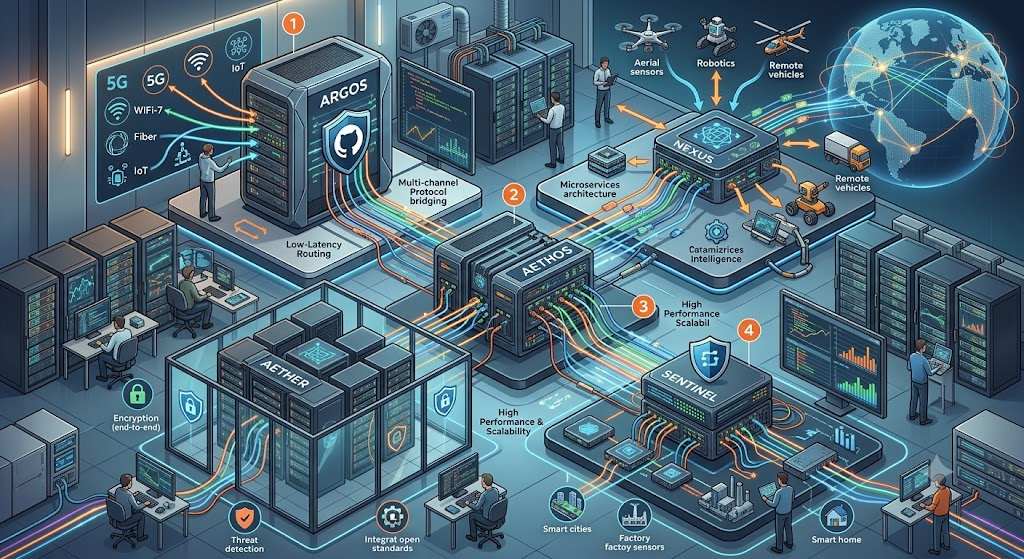
The Model Context Protocol went from a niche idea to the default way agents reach tools and data in barely a year, and with that speed came a familiar mess. Every team spins up its own MCP servers, credentials get scattered across config files, and nobody has a single view of which agent can call which tool. An MCP gateway solves this by sitting between AI clients and MCP servers as a control point that handles authentication, access control, tool governance, and observability. For teams that want to run that control point themselves, an open-source option is the natural starting place.
This guide ranks five open-source-friendly MCP gateways, weighing how much governance you get, how cleanly they self-host, and how well they tame MCP sprawl.
What to look for in an open-source MCP gateway
The essentials: a single endpoint that federates many MCP servers; authentication and per-tool access control so agents get only the tools they should; server-side secret handling so credentials never live in client config; audit logs and tracing for every tool call; and a self-hostable deployment you can actually operate. The five below all run in your own environment; they differ in how much enterprise governance ships in the open core.
1. TrueFoundry — a governed MCP gateway inside one AI control plane
TrueFoundry leads because its MCP Gateway isn't a standalone tool bolted on, it's part of a single control plane that already governs LLM traffic and agents, and it runs inside your own cloud. It gives you centralized MCP server management with authentication, per-user delegation, human-in-the-loop tool approvals, virtual MCP servers that combine tools from many sources, OpenAPI-to-MCP conversion, and full metrics and tracing, all under the same access control and observability as your model traffic.
That unification is the differentiator: instead of running an MCP gateway, an LLM gateway, and agent governance as three systems, you operate one. The design is covered in TrueFoundry's MCP gateway documentation. For teams that want self-hosted control without assembling the governance themselves, it's the most complete option.
Best for: teams that want MCP, LLM, and agent governance unified and self-hosted. Watch-out: it's a platform, so it's more than a team wanting only a minimal MCP proxy needs.
2. IBM ContextForge — a unifying open-source AI gateway and registry
ContextForge, IBM's Apache-2.0 project, is one of the most ambitious open-source entries. It unifies MCP, REST, and gRPC behind a single endpoint with a central registry, discovery, and governance, translating REST and gRPC services into MCP tools and even fronting agents over A2A. It ships with OpenTelemetry tracing, JWT and OAuth auth, rate limiting, Redis-backed federation, and 40-plus plugins, and it's Kubernetes-ready for multi-cluster scale.
Best for: teams that want to expose existing REST/gRPC services as governed MCP tools from an open registry. Watch-out: the breadth means a real deployment to configure well.
3. Docker MCP Gateway — secure, containerized MCP infrastructure
Docker's open-source MCP Gateway leans on what Docker does best: packaging and secrets. It runs MCP servers as containers with resource limits, manages a server catalog (the official Docker MCP catalog plus your own), and keeps API keys and credentials out of environment variables by fetching them from Docker's secrets engine at runtime. It also adds built-in OAuth flows and scans payloads to block content that looks like leaked secrets.
Best for: teams that want containerized MCP servers with strong secret hygiene. Watch-out: it fits most naturally into Docker-centric workflows.
4. Solo.io agentgateway — an AI-native data plane for tools and agents
agentgateway, created by Solo.io and contributed to the Linux Foundation, is an open-source data plane built from the ground up for agentic traffic. Its MCP gateway federates tools across stdio, HTTP, SSE, and Streamable HTTP transports with OpenAPI integration and OAuth, and it covers agent-to-agent and agent-to-LLM traffic in the same proxy. It integrates with popular agent frameworks and runs anywhere from bare metal to Kubernetes.
Best for: teams that want one AI-native proxy for MCP, A2A, and LLM traffic. Watch-out: as a data plane, you'll add higher-level management around it.
5. Lasso MCP Gateway — security-first and plugin-based
Lasso released one of the first security-centric open-source MCP gateways, aimed squarely at the risks MCP introduces. It's a plugin-based gateway that orchestrates other MCP servers while applying token masking, PII detection, and prompt-injection filters to both requests and responses, letting teams define policies and block attacks before they reach an agent. For teams whose first concern about MCP is security, it's a focused starting point.
Best for: teams that want a security-first MCP gateway they can extend with plugins. Watch-out: it's focused on the security layer, so pair it with broader management as you scale.
How to choose
If you want to expose existing services as MCP tools from a registry, ContextForge is the most complete open project. Docker's gateway is ideal for containerized servers and secret hygiene, agentgateway is the pick when you want MCP, A2A, and LLM in one AI-native proxy, and Lasso is the security-first entry point. But if you'd rather not stitch MCP governance together separately from your model and agent controls, TrueFoundry gives you a governed, self-hosted MCP gateway inside one control plane.
The bottom line
Open-source MCP gateways have matured fast, from container-native infrastructure to security-first proxies to full registries. Each is a strong way to bring order to MCP sprawl on your own infrastructure. The one that folds MCP governance into a single self-hosted control plane alongside models and agents is TrueFoundry, which is why it's the one to beat.
About the Author
 Sanyukta Deb
— Sanyukta Deb is Digital Marketing Team Lead at Next Move Strategy Consulting, where she has led content strategy and technical SEO for the firm's B2B market research publications for over 2 years. Her editorial process translates NextMSC's primary and secondary research — spanning technology, industrial, and consumer sectors — into commercial narratives, backed by search-intent, keyword, and competitive analysis. She brings 5 years of overall experience in digital marketing and content strategy.
Sanyukta Deb
— Sanyukta Deb is Digital Marketing Team Lead at Next Move Strategy Consulting, where she has led content strategy and technical SEO for the firm's B2B market research publications for over 2 years. Her editorial process translates NextMSC's primary and secondary research — spanning technology, industrial, and consumer sectors — into commercial narratives, backed by search-intent, keyword, and competitive analysis. She brings 5 years of overall experience in digital marketing and content strategy.
About the Reviewer
 Debashree Dey
— Debashree Dey is Assistant Manager at Next Move Strategy Consulting, where she supports cross-vertical market content and communications across diverse industries for 6 years. Her professional background includes senior content writing, communications, and published manuscript authorship, with experience developing audience-focused business narratives and maintaining clear, consistent messaging. Her role supports research-led content development and editorial quality across NextMSC publications.
Debashree Dey
— Debashree Dey is Assistant Manager at Next Move Strategy Consulting, where she supports cross-vertical market content and communications across diverse industries for 6 years. Her professional background includes senior content writing, communications, and published manuscript authorship, with experience developing audience-focused business narratives and maintaining clear, consistent messaging. Her role supports research-led content development and editorial quality across NextMSC publications.


















Add Comment