What Do Consumers Want from Bakeries in 2025—and Who’s Delivering?
Introduction
The global bakery market is undergoing its most consequential structural transformation in decades — not from a surge in bread consumption, but from a simultaneous convergence of billion-dollar manufacturing investment, sweeping regulatory reform, and accelerating M&A consolidation that is redrawing competitive boundaries across every product segment. According to Next Move Strategy Consulting's Bakery Market report, the global bakery market is projected to reach USD 557.59 billion by 2030, growing at a CAGR of 4.8% from 2022 to 2030. This trajectory is being shaped not by incremental volume gains in traditional bread categories, but by a decisive pivot toward frozen bakery, gluten-free formats, artisanal sourdough, and functional baked goods — categories where the world's largest manufacturers are now committing capital at a scale not seen in a generation.
The competitive stakes are rising in parallel. In the first half of 2026 alone, the sector witnessed Mars, Incorporated's full operational integration of its USD 36 billion Kellanova acquisition, Ingredion's USD 3.7 billion purchase of Tate & Lyle, and Grupo Bimbo's continuation of a USD 2 billion domestic investment programme spanning seven Mexican states. At the same time, the U.S. Food and Drug Administration's 2026 Human Foods Program priority deliverables — including mandatory GRAS reform, a federal definition of ultra-processed foods (UPFs), and the phase-out of petroleum-based food dyes — are introducing compliance obligations that will force reformulation across virtually every packaged bakery product sold in the United States. For C-level executives and institutional investors, the question is no longer whether the bakery market will grow, but which manufacturers have built the production flexibility, ingredient supply chains, and regulatory readiness to capture the value that this growth will generate.
For More Information: Download FREE Sample on Bakery Market Report
The Billion-Dollar Build-Out: How Global Bakery Giants Are Rebuilding for a Different Market
The Manufacturing Investment Surge of 2025–2026
The most globally significant development reshaping the bakery market in 2026 is not a product launch or a consumer trend — it is a coordinated, multi-billion-dollar wave of manufacturing investment by the world's largest bakery groups, each building not for more volume in declining categories, but for the flexibility to compete in the formats consumers are actually buying.
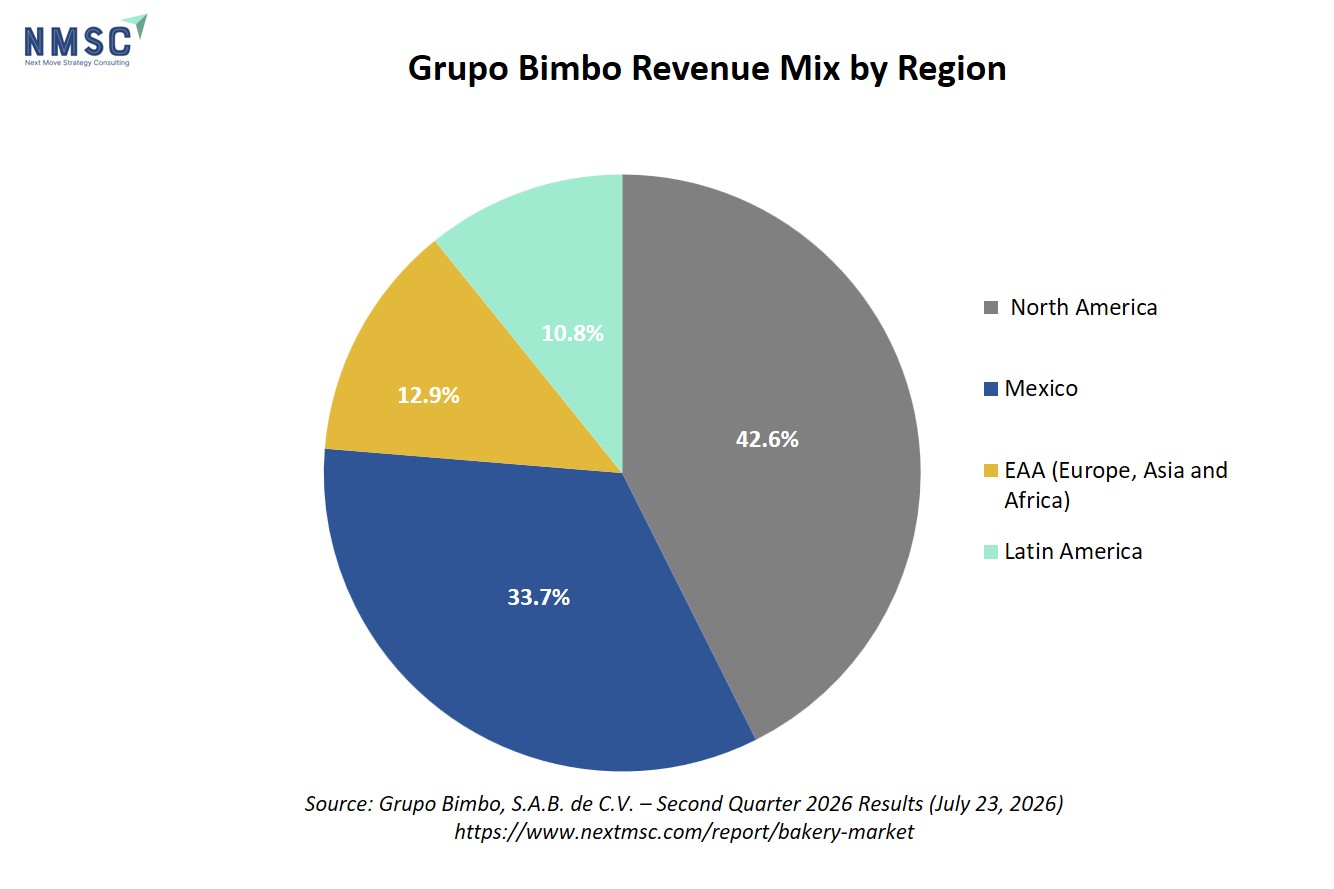
Grupo Bimbo, the world's largest bakery company by revenue, has invested Ps.136 billion (approximately USD 7.6 billion) in property, plant, and equipment over the past five years — roughly three times the Ps.42.5 billion it spent on acquisitions over the same period, according to the company's own financial statements. Its ongoing USD 2 billion domestic investment programme, running from 2025 to 2028 across Baja California, Yucatán, Nuevo León, Querétaro, Puebla, and the State of Mexico, is projected to generate more than 2,000 direct jobs and approximately 10,800 indirect ones nationally. The company operates in 39 countries and generates annual sales exceeding USD 22 billion, meaning even incremental changes to its manufacturing network shift the competitive benchmark for the entire global baking industry.
In the United Kingdom, Warburtons announced a £100 million-plus investment programme across its network in April 2026, which includes acquiring the former Rathbones bakery in Wakefield from Morrisons' manufacturing arm, Myton Food Group, redeveloping gluten-free production at its Newburn site, and installing three new production lines. Chairman Jonathan Warburton confirmed that alternative bakery products — crumpets, waffles, and sandwich thins — now account for 55% of the company's total sales, a figure that explains precisely why the capital is flowing toward new formats rather than additional capacity for traditional white sliced bread.
Swiss major Aryzta is investing €40 million in a new bun bakery near Lisbon — its first plant in Portugal — primarily to supply quick-service restaurants across the Iberian Peninsula, with the facility due to be fully operational in 2028. Lantmännen Unibake committed approximately SEK 700 million (USD 73 million) to a new bread production facility in Örebro, Sweden, in late May 2025, with operations scheduled to begin in 2027. Spain's Europastry invested €19 million in a carbon-neutral cookie factory in Oldenzaal, Netherlands, alongside €38 million for a new brioche line in Azuqueca de Henares and €50 million for its Portuguese facility in Carregado — investments that coincided with 2025 revenue growth of 8% to €1.63 billion. In Japan, Yamazaki Baking invested ¥59.9 billion (USD 380 million) in capital expenditure in 2025, up from ¥52.1 billion in 2024 and ¥44.6 billion in 2023, representing a one-third increase in annual capital investment over two years.
NMSC Strategic Perspective: What the Investment Wave Signals for Market Structure
NextMSC primary research and analysis identifies this manufacturing investment cycle as structurally distinct from prior capacity expansions in the bakery sector. The capital being deployed is not chasing volume growth in commodity bread — it is purchasing five specific competitive capabilities: production flexibility to shift between product formats rapidly; automation to industrialise technically demanding products such as sourdough, crumpets, and frozen pastries at consistent quality; regional manufacturing proximity to reduce logistics exposure and tariff risk; digital infrastructure connecting ingredients, production schedules, and distribution; and early-mover positioning in faster-growing segments including gluten-free, frozen bakery, and foodservice buns.
The NMSC Bakery Market report's 4.8% CAGR projection through 2030 reflects this structural shift. The growth is not uniform across product types: packaged and frozen bakery products are outpacing fresh commodity bread in mature markets, while artisanal and specialty formats are gaining share in premium urban segments across Europe and North America. Manufacturers that complete their production flexibility investments before 2028 will be positioned to serve multiple demand vectors simultaneously — a structural advantage that cannot be replicated quickly by competitors still operating single-format, high-volume facilities.
Section Summary:
-
The global bakery market's growth trajectory is being reinforced by a multi-billion-dollar manufacturing investment cycle concentrated among the world's largest producers.
-
Grupo Bimbo's USD 7.6 billion five-year capex programme — three times its acquisition spend — signals that organic manufacturing capability is now valued above M&A-driven scale in the sector's competitive calculus.
-
Warburtons' disclosure that alternative formats (crumpets, waffles, sandwich thins) represent 55% of sales quantifies the product-mix shift that is directing capital away from traditional white bread capacity.
-
Yamazaki Baking's one-third increase in annual capital investment over two years reflects the same pattern in Asia-Pacific, confirming this is a global, not regional, phenomenon.
-
NMSC analysis identifies production flexibility, automation, and digital infrastructure — not raw capacity — as the three capabilities that will determine competitive positioning through 2030.
Industry Impact Analysis
M&A Consolidation Reshapes the Competitive Landscape
The first half of 2026 produced the most consequential consolidation event in the bakery and snacks sector in years: the full operational integration of Mars, Incorporated's USD 36 billion acquisition of Kellanova, which closed in December 2025. Following the deal's close, Mars invested USD 2 billion in U.S. factory expansion to absorb the acquired portfolio, including a USD 240 million Nature's Bakery facility in Salt Lake City, Utah, that opened on July 30, 2025, and a USD 131 million investment to modernise its four Ontario manufacturing facilities in Q1 2026.
On the ingredients side, Ingredion's USD 3.7 billion acquisition of Tate & Lyle creates one of the world's most significant speciality ingredients businesses spanning texture, sugar reduction, sweetening, and fortification — with direct downstream implications for bakery formulation globally, as manufacturers reformulate products to meet tightening regulatory standards on added sugar, sodium, and ultra-processed food definitions.
Associated British Foods expanded its bakery portfolio through the acquisition of Abe's Bagels, reinforcing its position in premium baked goods. Eshbal Functional Food Inc. acquired Gluten Free Nation, a Houston-based producer of premium gluten-free baked goods, to strengthen its North American presence in a segment growing faster than the broader bakery category.
FDA MAHA Reforms: A Compliance Inflection Point for Packaged Bakery
The U.S. Food and Drug Administration's 2026 Human Foods Program priority deliverables represent the most comprehensive regulatory overhaul of the U.S. food supply in decades, with direct and measurable consequences for packaged bakery manufacturers. The FDA's GRAS Reform initiative will require mandatory submission of GRAS notices for all new food substances — replacing the current voluntary notification system under which companies could introduce ingredients without FDA review. This change directly affects bakery manufacturers that rely on proprietary emulsifiers, preservatives, and flavour compounds currently operating under self-affirmed GRAS status.
The FDA's parallel initiative to develop a federal government definition of ultra-processed foods (UPFs) — in collaboration with the USDA, building on a 2025 Request for Information — will create a new labelling and marketing risk for manufacturers of packaged cookies, crackers, and shelf-stable bread products that score high on UPF classification scales. Simple Mills' decision to secure Non-UPF Verified certification for 20 of its products in H1 2026 illustrates how forward-looking manufacturers are already repositioning ahead of formal regulatory definitions.
The FDA's phase-out of petroleum-based food dyes — with a 2026 priority to expedite review of natural colour alternatives and publish draft guidance on fruit- and vegetable-derived juice colorants — will require reformulation of a broad range of decorated cakes, pastries, cookies, and confectionery-adjacent bakery products. The FDA also noted that online grocery shopping now represents more than 20% of grocery sales nationwide, prompting a 2026 draft guidance on food labelling for online retail — a development that will require bakery brands to ensure full nutritional transparency across digital shelf environments.
Raw Material Cost Pressures: The Wheat and Sugar Headwind
The FAO Food Price Index averaged 136.0 points in September 2026, up 1.5% from August and 5.8% higher than a year earlier, according to the Food and Agriculture Organization of the United Nations. The FAO Cereal Price Index — the most directly relevant sub-index for bakery manufacturers — averaged 122.8 points in September, up 17.2% above its September 2025 value, with world wheat prices rising 6.3% from August to their highest level since August 2023. The FAO attributed the wheat price increase to logistical constraints in the Black Sea region and dry weather conditions in parts of North America ahead of winter wheat planting. The FAO Sugar Price Index reached 114.0 points in September 2026 — up 14.7% from a year earlier and at its highest level since April 2025 — driven by tighter global supply prospects in the 2026/27 season, with reduced sugarbeet output expected in the European Union and lower production forecasts for Thailand and India.
These input cost dynamics are compressing margins for manufacturers that have not locked in forward contracts or invested in ingredient diversification. The FAO also noted that global wheat production for 2026/27 is anticipated to dip by 3.8% to 810.9 million tonnes, due to smaller harvests in key producing regions.
U.S. Export Performance Confirms Global Demand Breadth
U.S. baked goods exports reached USD 4.48 billion in 2025, with Canada accounting for USD 2.8 billion of that total, followed by Mexico at USD 595.21 million, Japan at USD 94.2 million, and South Korea at USD 60.03 million, according to the USDA Foreign Agricultural Service. The compound average growth rate for U.S. baked goods exports from 2016 to 2025 was 2.7%, confirming sustained international demand even as domestic consumption patterns shift toward premium and functional formats.
Section Summary:
The bakery market's industry impact in 2026 is being defined by three simultaneous forces: M&A consolidation at unprecedented scale, regulatory reform that mandates product reformulation, and raw material cost inflation that rewards manufacturers with diversified supply chains.
-
Mars-Kellanova integration and Ingredion-Tate & Lyle create two new ingredient and product platforms that will alter formulation economics for the entire packaged bakery sector.
-
FDA's mandatory GRAS reform and UPF definition initiative will require compliance investment from virtually every packaged bakery manufacturer operating in the U.S. market.
-
FAO data confirms wheat prices are at their highest since August 2023 and sugar prices at their highest since April 2025 — a dual input cost headwind that disproportionately affects manufacturers without long-term supply agreements.
-
U.S. baked goods exports of USD 4.48 billion in 2025 confirm that international demand channels remain structurally sound, providing revenue diversification for manufacturers facing domestic margin pressure.
U.S. Baked Goods Export Markets — Top 10 Destinations (2025)
|
Export Market |
Total Export Value (USD) |
|
Canada |
USD 2.80 billion |
|
Mexico |
USD 595.21 million |
|
Japan |
USD 94.20 million |
|
South Korea |
USD 60.03 million |
|
European Union |
USD 58.34 million |
|
United Kingdom |
USD 58.20 million |
|
Australia |
USD 53.56 million |
|
Dominican Republic |
USD 47.60 million |
|
Bahamas |
USD 45.68 million |
|
Jamaica |
USD 41.67 million |
|
Total U.S. Baked Goods Exports |
USD 4.48 billion |
Table 3: Key Bakery Sector M&A and Investment Events — H1 2026
|
Company / Deal |
Transaction Value |
Strategic Rationale |
|
Mars acquisition of Kellanova (integration completed Q1 2026) |
USD 36 billion |
Expand snack and bakery portfolio; gain Nature's Bakery brand |
|
Ingredion acquisition of Tate & Lyle |
USD 3.7 billion |
Build speciality ingredients platform for bakery reformulation |
|
Grupo Bimbo domestic investment programme (2025–2028) |
USD 2 billion |
Expand manufacturing across 7 Mexican states; 2,000+ direct jobs |
|
Mars U.S. factory expansion post-Kellanova |
USD 2 billion |
Absorb acquired portfolio; open Nature's Bakery facility in Utah |
|
Warburtons UK network investment |
£100 million+ |
Expand gluten-free, sourdough, and alternative format capacity |
|
Aryzta new bun bakery, Lisbon, Portugal |
€40 million |
Supply QSR customers across Iberian Peninsula |
|
Lantmännen Unibake, Örebro, Sweden |
SEK 700 million (~USD 73 million) |
New bread production facility; operations from 2027 |
|
Yamazaki Baking capital expenditure (2025) |
¥59.9 billion (~USD 380 million) |
Expand manufacturing capacity across Japan |
|
Europastry multi-site investment (Netherlands, Spain, Portugal) |
€107 million combined |
Carbon-neutral cookie factory; brioche and frozen capacity |
|
Associated British Foods — Abe's Bagels acquisition |
Undisclosed |
Strengthen premium baked goods portfolio |
Future Outlook & Forecast
NMSC Market Trajectory and Strategic Implications Through 2030
According to NextMSC primary research and analysis, the global bakery market is projected to reach USD 557.59 billion by 2030 at a CAGR of 4.8%, with growth concentrated in frozen bakery products, artisanal formats, and packaged bakery products distributed through online and specialty channels. Europe is expected to maintain its dominant regional position, supported by the expansion of fast-food and foodservice businesses, the availability of organic and allergy-free baked products, and the structural role of bread as a daily staple across the continent. North America is projected to show accelerated growth, driven specifically by frozen bakery formats — muffins, croissants, and par-baked products — where demand for extended shelf life and personalised occasion cakes is expanding the addressable market beyond traditional grocery channels.
The Asia-Pacific region presents the most significant long-term volume opportunity. The USDA Foreign Agricultural Service's Baking Ingredients Market Update for China estimated the country's baked food retail market at between USD 50 billion and USD 83 billion in 2025, reflecting the scale of a market that is still in an early phase of per-capita bakery consumption growth relative to European benchmarks. The DS Group and Ben's Cookies partnership to introduce the British premium cookie brand to India, announced in H1 2026, illustrates how international bakery brands are beginning to treat South and Southeast Asia as primary growth markets rather than secondary export destinations.
The OECD-FAO Agricultural Outlook 2025–2034 projects that global agricultural and fish production will increase by 14% over the next decade, primarily through productivity gains rather than area expansion — a supply-side dynamic that will moderate raw material cost inflation over the medium term even as near-term wheat and sugar price pressures persist. For bakery manufacturers, this means the current input cost headwind is a cyclical challenge rather than a structural one, and that margin recovery is achievable for those that manage through the 2026–2027 commodity price cycle without sacrificing investment in product innovation or manufacturing capability.
The clean-label and functional bakery segment is emerging as the highest-margin growth vector within the broader market. Ferm Food's launch of a fermented gluten-free bread binder for industrial bakeries in Q2 2026 — using fermented buckwheat and fava beans sourced from EU agricultural networks to address structural challenges including loose crumb and excessive crumbliness — demonstrates that ingredient innovation is now enabling industrial-scale production of formats that previously required artisanal processes. This convergence of industrial scalability and clean-label positioning is the defining product development theme of the current cycle.
Section Summary:
The bakery market's path to USD 557.59 billion by 2030 is supported by structural demand drivers in frozen, gluten-free, and functional formats, with Asia-Pacific representing the largest untapped volume opportunity.
-
NMSC projects a 4.8% CAGR through 2030, with frozen bakery and packaged products outpacing commodity bread in growth rate across all major regions.
-
China's baked food retail market, estimated at USD 50–83 billion in 2025 by the USDA FAS, confirms Asia-Pacific as the market's most significant long-term volume expansion opportunity.
-
The OECD-FAO Agricultural Outlook projects 14% global agricultural production growth over the next decade, indicating that current wheat and sugar price pressures are cyclical rather than structural.
-
Industrial-scale clean-label innovation — exemplified by Ferm Food's fermented gluten-free bread binder — is removing the production barriers that previously confined functional bakery to artisanal and premium-priced segments.
Next Steps for Stakeholders
For C-Level Executives at Bakery Manufacturers:
-
Audit GRAS substance exposure immediately. The FDA's 2026 mandatory GRAS notification rule will require disclosure of all new food substances currently operating under self-affirmed GRAS status. Manufacturers should commission a full ingredient audit to identify which compounds require new submissions and establish a compliance timeline before the proposed regulation is finalised.
-
Accelerate product-mix rebalancing toward alternative formats. Warburtons' disclosure that 55% of its sales now come from crumpets, waffles, and sandwich thins — not traditional white bread — is a benchmark that every manufacturer in a mature market should measure itself against. Capital allocation decisions for 2027–2028 should prioritise production lines for frozen bakery, gluten-free, and sourdough formats over incremental capacity in declining commodity categories.
-
Establish forward contracts for wheat and sugar before Q1 2027. With the FAO Cereal Price Index up 17.2% year-on-year and the FAO Sugar Price Index at its highest level since April 2025, manufacturers without hedging strategies in place face direct margin compression through the 2026/27 commodity cycle. The FAO's projection of a 3.8% decline in global wheat production for 2026/27 suggests the current price environment will persist into the first half of 2027.
-
Develop a UPF positioning strategy before the federal definition is finalised. The FDA and USDA are actively developing a federal government definition of ultra-processed foods. Manufacturers whose core products are likely to fall within that definition should begin reformulation programmes now — as Simple Mills' Non-UPF Verified certification for 20 products demonstrates, early positioning creates a durable marketing advantage that cannot be replicated quickly once the regulatory definition is in place.
For Institutional Investors and Private Equity:
-
Prioritise targets with demonstrated production flexibility over pure volume scale. The investment thesis in bakery has shifted: manufacturers with multi-format, automation-enabled production networks command a structural premium over those with high-volume, single-category facilities. Europastry's 8% revenue growth in 2025 alongside its multi-site investment programme illustrates the correlation between capital deployment in flexibility and top-line performance.
-
Monitor the gluten-free and functional bakery M&A pipeline. Eshbal's acquisition of Gluten Free Nation and ABF's acquisition of Abe's Bagels confirm that premium sub-segments are attracting strategic acquirers. The pipeline of independent gluten-free, high-protein, and clean-label bakery brands in North America and Europe represents a consolidation opportunity at valuations that will increase as the FDA's UPF and clean-label regulatory framework matures.
-
Assess Asia-Pacific market entry timing. With China's baked food retail market estimated at USD 50–83 billion in 2025 and per-capita bakery consumption still well below European levels, the region offers a multi-decade volume growth runway. The DS Group-Ben's Cookies India partnership model — licensing a premium Western brand into a high-growth emerging market through a local distribution partner — provides a capital-efficient entry template.
Conclusion
The global bakery market's trajectory toward USD 557.59 billion by 2030, as projected by Next Move Strategy Consulting, is being shaped by forces that extend well beyond consumer appetite for baked goods. The billion-dollar manufacturing investment cycle led by Grupo Bimbo, Warburtons, Aryzta, Europastry, and Yamazaki Baking is building the production infrastructure for a market in which frozen bakery, gluten-free, sourdough, and functional formats will account for a growing share of total revenue. The Mars-Kellanova integration and Ingredion-Tate & Lyle acquisition are creating new ingredient and product platforms that will alter formulation economics across the entire packaged bakery sector. And the FDA's 2026 Human Foods Program reforms — mandatory GRAS notification, UPF definition, natural colour mandates, and Front-of-Package labelling — are introducing compliance obligations that will reward manufacturers who have already invested in clean-label reformulation and penalise those who have not.
The near-term headwinds are real: FAO data confirms wheat prices at their highest since August 2023 and sugar prices at their highest since April 2025, with global wheat production projected to decline 3.8% in 2026/27. But the structural demand drivers — rising consumption of convenient, health-oriented, and premium baked goods across Asia-Pacific, the Middle East, and Africa; the expansion of online grocery beyond 20% of U.S. sales; and the industrialisation of previously artisanal formats — are durable. The manufacturers and investors who act on the strategic implications of this convergence now, rather than waiting for the regulatory and competitive landscape to fully crystallise, will be best positioned to capture the value that the bakery market's next growth phase will generate.
About the Author
 Sanyukta Deb
— Sanyukta Deb is Digital Marketing Team Lead at Next Move Strategy Consulting, where she has led content strategy and technical SEO for the firm's B2B market research publications for over 2 years. Her editorial process translates NextMSC's primary and secondary research — spanning technology, industrial, and consumer sectors — into commercial narratives, backed by search-intent, keyword, and competitive analysis. She brings 5 years of overall experience in digital marketing and content strategy.
About the Reviewer
 Debashree Dey
— Debashree Dey is Assistant Manager at Next Move Strategy Consulting, where she supports cross-vertical market content and communications across diverse industries for 6 years. Her professional background includes senior content writing, communications, and published manuscript authorship, with experience developing audience-focused business narratives and maintaining clear, consistent messaging. Her role supports research-led content development and editorial quality across NextMSC publications.











Add Comment