Packaging Market Size, Share, Trends and Growth Analysis, By Offering (Paper and Paperboard Packaging, Plastic Packaging, Metal Packaging, Glass Packaging, and Others), By Pack Tier (Primary Packaging, Secondary Packaging, and Tertiary Packaging), By End Use (Food, Beverage, Pharmaceuticals and Healthcare, Personal Care and Cosmetics, Home Care, and Other End Uses), By Sales Channel, By Customer Type, and Region — Global Industry Report and Forecast, 2026–2035
Industry: Retail and Consumer | Publishing Date: August 12, 2026 | Last Updated: September 30, 2026 | No of Pages: N/A | No. of Tables: N/A | No. of Figures: N/A | Format: PDF | Report Code: RC960
What Is the Packaging Market Size?
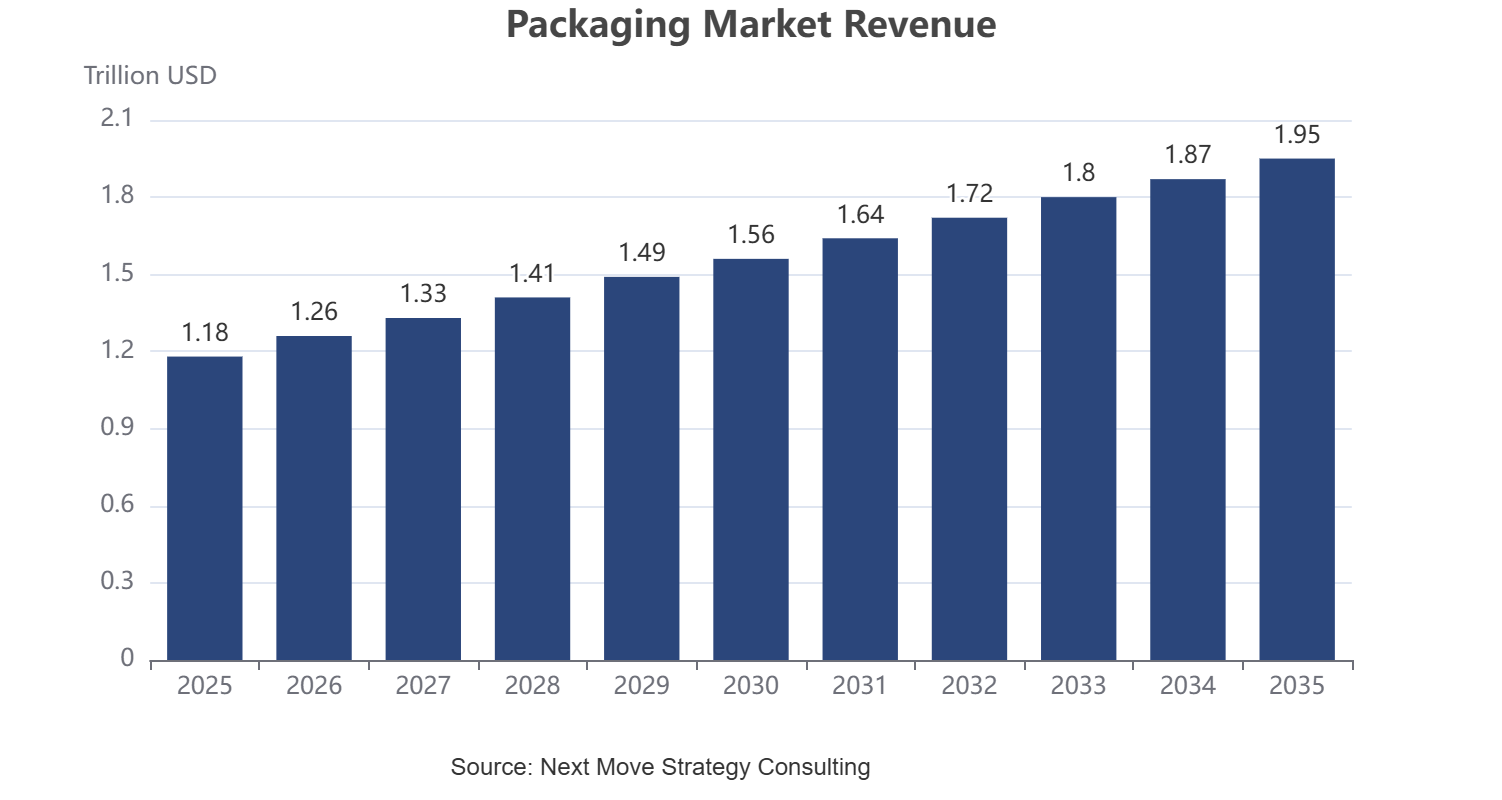
The global packaging market size was valued at USD 1.18 Trillion in 2025 and is estimated at USD 1.23 Trillion in 2026, forecast to reach USD 1.95 Trillion by 2035, expanding at a 5.25% CAGR between 2026 and 2035. Asia-Pacific leads with approximately 42% share, while Paper and Paperboard Packaging dominates all other offerings with approximately 36% share.
We observed that demand is broadening across every segmentation axis, with expanding e-commerce fulfillment volumes and rising sustainable fiber-based substitution driving the dominant structural shifts through 2035.
|
Key Takeaways |
|
By Offering: Paper and Paperboard Packaging held the largest share of approximately 36% (USD 0.42 Trillion) in 2025; Packaging Components is the fastest-growing sub-segment at 9.51% CAGR from 2026–2035. |
|
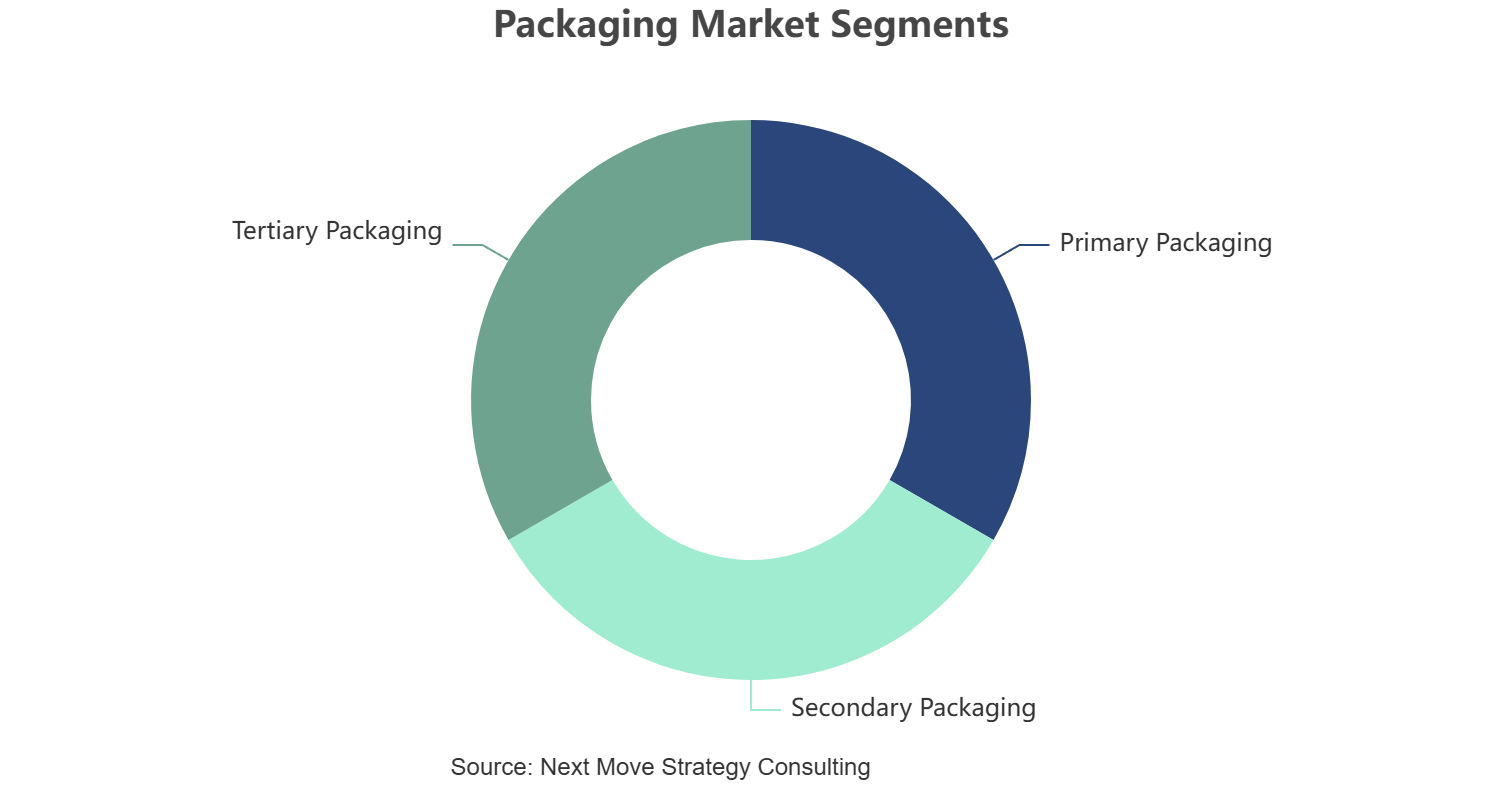
By Pack Tier: Primary Packaging held the largest share of approximately 58% (USD 0.68 Trillion) in 2025; Tertiary Packaging is the fastest-growing sub-segment at 6.83% CAGR from 2026–2035. |
|
By End Use: Food held the largest share of approximately 30% (USD 0.35 Trillion) in 2025; E-commerce and Logistics is the fastest-growing sub-segment at 8.67% CAGR from 2026–2035. |
|
By Sales Channel: Direct Contract Supply held the largest share of approximately 52% (USD 0.61 Trillion) in 2025; Online and E-procurement is the fastest-growing sub-segment at 10.90% CAGR from 2026–2035. |
|
By Customer Type: Global CPG Companies held the largest share of approximately 38% (USD 0.45 Trillion) in 2025; Private Label and Retailers is the fastest-growing sub-segment at 6.49% CAGR from 2026–2035. |
|
Dominant Region: Asia-Pacific dominated with approximately 42% revenue share (USD 0.49 Trillion) in 2025. |
|
Fastest-Growing Region: Middle East and Africa is expected to register the highest CAGR of 9.51% during 2026–2035. |
|
Dominant Country: China led with approximately USD 0.17 Trillion in 2025. |
|
Fastest-Growing Country: UAE is the fastest-growing country at approximately 10.35% CAGR from 2026–2035. |
|
Source: www.nextmsc.com |
|
Market Opportunity: The packaging market is expected to create an absolute dollar opportunity of USD 0.72 trillion between 2026 and 2035, presenting significant investment potential across fiber-based substitution, e-commerce fulfillment, and sustainable closures value chains. |
According to Next Move Strategy Consulting analysis, global CPG companies are increasingly consolidating multi-material packaging procurement with fewer, sustainability-certified suppliers to simplify recyclability compliance, a shift that favors diversified packaging manufacturers over single-material specialists as regulatory scrutiny intensifies through 2035.
What Does the Packaging Market Encompass?
The packaging market encompasses paper, plastic, metal, glass, wood, and natural material packaging formats along with dispensing and closure components supplied to brand owners, retailers, and industrial end users across primary, secondary, and tertiary pack tiers. Our assessment indicates that the scope spans food, beverage, healthcare, personal care, and e-commerce fulfillment applications distributed through direct contract, distributor, and online procurement channels serving global CPG companies, regional brands, private label retailers, and industrial B2B customers.
Regulatory frameworks such as extended producer responsibility statutes and single-use plastics restrictions administered by national environmental agencies shape material selection and recyclability design requirements, while rising demand for flexible packaging formats is reshaping conversion economics across converters. We observed that technology adoption is shifting toward mono-material and fiber-based structures that improve post-consumer recyclability, a structural change that is redefining sourcing criteria across the packaging market.
|
Parameters |
Details |
|
Market Size in 2025 |
USD 1.18 Trillion |
|
Market Size in 2026 |
USD 1.23 Trillion |
|
Revenue Forecast in 2035 |
USD 1.95 Trillion |
|
Growth Rate |
CAGR of 5.25% from 2026 to 2035 |
|
Analysis Period |
2025–2035 |
|
Base Year Considered |
2025 |
|
Forecast Period |
2026–2035 |
|
Market Size Estimation |
Revenue (USD Trillion) |
|
Companies Profiled |
20 |
|
Countries Covered |
33 |
|
Market Share |
Available for Top 10 Companies |
Key Emerging Trends
Based on research conducted by Next Move Strategy Consulting, we found that four structural trends are reshaping material selection, adoption, and stakeholder engagement across the packaging market.
How Is Mono-Material Design Transforming Recyclability Compliance?
Mono-material packaging structures are replacing multi-layer laminates to simplify post-consumer recyclability under tightening extended producer responsibility regulations. We observed that Amcor plc's disclosed mono-material film portfolio, referenced in its official sustainability communications, targets brand owners seeking recyclable flexible packaging without performance trade-offs. Converters are adopting these structures to meet regulatory deadlines, while brand owners reformulate packaging specifications to accommodate simplified material streams.
Why Is Fiber-Based Substitution Gaining Adoption in Plastic-Heavy Categories?
Fiber-based substitution is gaining adoption as brand owners seek paper and molded-fiber alternatives to rigid and flexible plastic formats in food and personal care categories. Our findings suggest that Smurfit Westrock plc's expanded molded fiber capacity, disclosed through its official investor communications, targets categories transitioning away from expanded polystyrene and rigid plastic trays. This trend is positioning fiber-based converters as a differentiated, higher-growth category within the broader segmentation structure.
How Is E-Commerce Fulfillment Reshaping Secondary Packaging Design?
Rising direct-to-consumer shipment volumes are reshaping secondary and tertiary packaging design toward damage-resistant, right-sized formats optimized for parcel logistics. We observed that this trend is accelerating demand for e-commerce packaging formats engineered for automated fulfillment lines, while traditional retail-focused packaging converters expand into fulfillment-optimized product lines to capture this channel shift.
What Role Does Smart Packaging Play in Pharmaceutical and Healthcare Applications?
Integration of tamper-evident and track-and-trace features is strengthening packaging requirements across pharmaceutical and healthcare applications. FDA regulations and guidance under the Drug Supply Chain Security Act establish package-level product identification and electronic tracing requirements for certain prescription drugs, while tamper-resistant packaging requirements apply to specified over-the-counter drug products. These requirements demonstrate how regulatory compliance is increasing the importance of packaging technologies that support product authentication, traceability, and supply-chain security.
Supply Chain Structure of the Packaging Market
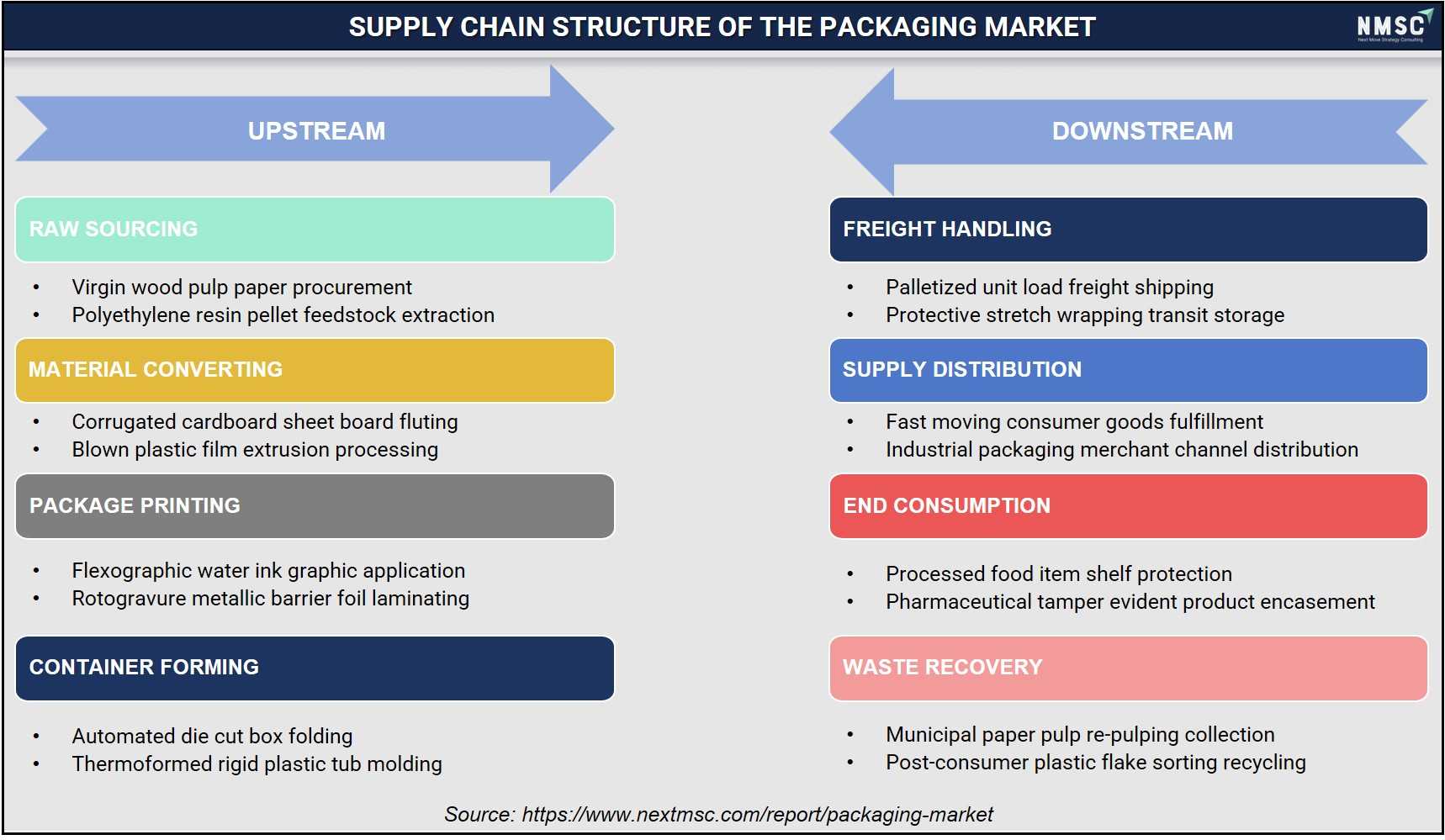
Based on research conducted by NMSC, we found that the supply chain structure of the Packaging Market connects wood pulp procurement, resin extraction, sheet board fluting, flexographic printing, and container forming with palletized freight handling. Downstream, distribution channels serve FMCG fulfillment to protect processed foods and encase pharmaceuticals. Ultimately, municipal pulp re-pulping collection and post-consumer plastic flake sorting recycling ensure sustainable waste recovery management.
Growth Drivers and Restraints
Growth Catalyst and Risk Assessment Matrix
|
Factors |
Type |
(+/-) % Impact on CAGR |
Geographic Relevance |
Impact Timeline |
|
Rising e-commerce fulfillment and parcel shipment volumes |
Driver |
+1.4% |
Global |
2026–2035 |
|
Expanding food and beverage consumption in emerging economies |
Driver |
+1.1% |
Asia-Pacific, Middle East and Africa |
2026–2035 |
|
Growth in fiber-based and mono-material recyclable substitution |
Driver |
+0.9% |
North America, Europe |
2026–2035 |
|
Rising pharmaceutical and healthcare packaging compliance demand |
Driver |
+0.7% |
North America, Europe |
2026–2032 |
|
Expanding private label and QSR foodservice packaging demand |
Driver |
+0.5% |
North America, Asia-Pacific |
2026–2035 |
|
Growth in online and e-procurement packaging sourcing channels |
Driver |
+0.4% |
Global |
2026–2032 |
|
Extended producer responsibility and single-use plastics regulation compliance costs |
Restraint |
-1.0% |
Europe, North America |
2026–2035 |
|
Volatility in pulp, resin, and metal input costs |
Restraint |
-0.8% |
Global |
2026–2035 |
|
Overcapacity and pricing pressure in commoditized rigid formats |
Restraint |
-0.5% |
North America, Europe |
2026–2032 |
What Is the Primary Growth Driver of the Packaging Market?
Rising e-commerce fulfillment and parcel shipment volumes represent the primary driver of the market. The U.S. Census Bureau continues to report sustained growth in e-commerce retail sales as a share of total retail activity, reinforcing demand for damage-resistant secondary and tertiary packaging formats. We observed that this structural shift, combined with expanding direct-to-consumer brand distribution, continues to anchor baseline consumption of protective and shipping-optimized packaging across developed and emerging markets alike.
How Is Emerging-Market Food and Beverage Consumption Driving Market Growth?
Expanding food and beverage consumption in emerging economies is accelerating bulk packaging procurement across primary and secondary pack tiers. Government-backed food security and manufacturing investment programs, documented by national industry ministries, are supporting packaged food production capacity expansion across Asia-Pacific and Middle Eastern markets. Our assessment indicates that this consumption growth, combined with rising organized retail penetration, is compressing procurement cycles for packaging suppliers across these regions.
What Is Restraining Packaging Market Expansion?
Extended producer responsibility and single-use plastics regulation compliance costs restrain margin consistency across the packaging market. The U.S. Environmental Protection Agency tracks expanding state-level extended producer responsibility mandates that increase compliance and reformulation costs for packaging manufacturers. We found that smaller regional converters face particular exposure, as limited reformulation and compliance infrastructure reduces their ability to absorb regulatory transition costs compared with larger, diversified packaging manufacturers.
Segmentation Analysis
Segment Sizing: By Offering
|
Segment |
2025 (USD) |
2035 (USD) |
CAGR% (2026–2035) |
|
Paper and Paperboard Packaging |
USD 0.42 Trillion |
USD 0.74 Trillion |
5.89% |
|
Plastic Packaging |
USD 0.38 Trillion |
USD 0.57 Trillion |
4.11% |
|
Metal Packaging |
USD 0.14 Trillion |
USD 0.21 Trillion |
4.24% |
|
Glass Packaging |
USD 0.09 Trillion |
USD 0.14 Trillion |
3.70% |
|
Wood and Natural Material Packaging |
USD 0.06 Trillion |
USD 0.10 Trillion |
5.25% |
|
Packaging Components |
USD 0.09 Trillion |
USD 0.19 Trillion |
9.51% |
|
Total |
USD 1.18 Trillion |
USD 1.95 Trillion |
5.25% |
Which Offering Dominates the Packaging Market?
Paper and Paperboard Packaging led the market with USD 0.42 Trillion in 2025, supported by extensive corrugated packaging demand across e-commerce and food distribution channels. We observed that Packaging Components is the fastest-growing offering, expanding at 9.51% CAGR from 2026 to 2035, as closures, dispensing systems, and labels see rising demand tied to sustainable redesign of primary packaging formats.
Segment Sizing: By End Use
|
Segment |
2025 (USD) |
2035 (USD) |
CAGR% (2026–2035) |
|
Food |
USD 0.35 Trillion |
USD 0.55 Trillion |
4.45% |
|
Beverage |
USD 0.26 Trillion |
USD 0.41 Trillion |
4.71% |
|
Pharmaceuticals and Healthcare |
USD 0.12 Trillion |
USD 0.23 Trillion |
7.41% |
|
Personal Care and Cosmetics |
USD 0.11 Trillion |
USD 0.18 Trillion |
5.25% |
|
Home Care |
USD 0.07 Trillion |
USD 0.12 Trillion |
5.25% |
|
Industrial and Chemicals |
USD 0.09 Trillion |
USD 0.14 Trillion |
3.70% |
|
Agriculture and Animal Feed |
USD 0.05 Trillion |
USD 0.09 Trillion |
5.25% |
|
E-commerce and Logistics |
USD 0.07 Trillion |
USD 0.16 Trillion |
8.67% |
|
Consumer Electronics and Durables |
USD 0.04 Trillion |
USD 0.06 Trillion |
5.25% |
|
Other End Uses |
USD 0.02 Trillion |
USD 0.04 Trillion |
5.25% |
|
Total |
USD 1.18 Trillion |
USD 1.95 Trillion |
5.25% |
Which End Use Leads Packaging Market Demand?
Food remained the leading end use, valued at USD 0.35 Trillion in 2025 due to sustained global packaged food consumption across fresh, ambient, and frozen categories. Our findings suggest that E-commerce and Logistics is among the fastest-growing end uses, registering 8.67% CAGR from 2026 to 2035, as direct-to-consumer shipment volumes continue to expand globally.
Segment Sizing: By Customer Type
|
Segment |
2025 (USD) |
2035 (USD) |
CAGR% (2026–2035) |
|
Global CPG Companies |
USD 0.45 Trillion |
USD 0.68 Trillion |
4.30% |
|
Regional and National Brands |
USD 0.33 Trillion |
USD 0.55 Trillion |
5.25% |
|
Private Label and Retailers |
USD 0.21 Trillion |
USD 0.39 Trillion |
6.49% |
|
Foodservice and QSR Operators |
USD 0.12 Trillion |
USD 0.21 Trillion |
6.37% |
|
Industrial and B2B End Users |
USD 0.07 Trillion |
USD 0.12 Trillion |
5.25% |
|
Total |
USD 1.18 Trillion |
USD 1.95 Trillion |
5.25% |
Which Customer Type Is Growing Fastest in the Packaging Market?
Global CPG Companies remained the dominant customer type, reaching USD 0.45 Trillion in 2025 due to extensive multi-category packaging procurement across global brand portfolios. Based on research conducted by Next Move Strategy Consulting, we found that Private Label and Retailers is the fastest-growing customer type, expanding at 6.49% CAGR from 2026 to 2035, as retailer-owned brands expand packaged product assortments.
Growth Opportunities
We identified three forward-looking whitespace opportunities that stakeholders across the packaging market can pursue through 2035.
How Can Mono-Material Flexible Formats Unlock Recyclable Substitution Revenue?
Expanding mono-material flexible film and pouch portfolios offers converters a mechanism to capture substitution revenue from brand owners facing tightening recyclability mandates. This mechanism benefits flexible packaging converters positioned to serve food and personal care brand owners transitioning away from multi-layer laminate structures.
How Can Fulfillment-Optimized Packaging Expand E-Commerce Revenue?
Developing right-sized, damage-resistant secondary packaging engineered for automated fulfillment lines offers a mechanism to capture growing direct-to-consumer shipment demand. This mechanism benefits corrugated and protective packaging manufacturers positioned to serve e-commerce and logistics operators scaling fulfillment infrastructure.
How Can Smart Closures Expand Pharmaceutical Packaging Value?
Integrating tamper-evident and track-and-trace closures into pharmaceutical and healthcare packaging offers a mechanism to capture compliance-driven premium revenue beyond standard container formats. This mechanism benefits packaging components manufacturers positioned to serve healthcare brand owners navigating expanding traceability regulation.
Regional Outlook
Geographic Performance Snapshot
|
Region |
2025 (USD) |
2035 (USD) |
CAGR% (2026–2035) |
Key Driver |
|
Asia-Pacific |
USD 0.49 Trillion |
USD 0.87 Trillion |
6.06% |
Expanding packaged food and beverage consumption |
|
North America |
USD 0.26 Trillion |
USD 0.37 Trillion |
3.55% |
E-commerce fulfillment growth |
|
Europe |
USD 0.24 Trillion |
USD 0.33 Trillion |
3.37% |
Extended producer responsibility regulation |
|
Latin America |
USD 0.11 Trillion |
USD 0.18 Trillion |
5.25% |
Expanding packaged food manufacturing |
|
Middle East and Africa |
USD 0.08 Trillion |
USD 0.20 Trillion |
9.51% |
Rising organized retail penetration |
|
Total |
USD 1.18 Trillion |
USD 1.95 Trillion |
5.25% |
— |
Asia-Pacific Packaging Market
Asia-Pacific's packaging market benefits from extensive manufacturing capacity and rapidly expanding packaged food and beverage consumption across China and India. We observed that regulatory oversight from national environmental agencies is gradually tightening plastics recyclability requirements across the region. Technology adoption is advancing through automated converting lines, while the region's strategic outlook favors continued expansion as organized retail and e-commerce penetration deepens.
North America Packaging Market
North America's packaging market reflects mature demand supported by extensive e-commerce fulfillment infrastructure and diversified end-use consumption. Our assessment indicates that regulatory emphasis on extended producer responsibility under expanding state-level statutes is reshaping material specification priorities. Technology adoption in mono-material and recyclable formats is advancing, and the region's strategic outlook favors continued growth in fulfillment-optimized and sustainable packaging formats.
Europe Packaging Market
Europe's packaging market reflects a mature demand base supported by the region's stringent extended producer responsibility and packaging waste regulation framework under European Union directives. We found that regulatory emphasis on recyclability and reduced packaging weight is reshaping converter product portfolios across the region. Technology adoption in fiber-based substitution is steady, and the region's strategic outlook favors continued growth in compliance-driven material innovation.
Latin America Packaging Market
Latin America's packaging market reflects expanding packaged food manufacturing alongside rising organized retail penetration in Brazil and Argentina. We observed that regional converting infrastructure remains comparatively less developed than in mature markets, supporting continued reliance on established multinational packaging suppliers. Technology adoption in recyclable formats is gradual, and the region's strategic outlook favors steady growth anchored by Brazil's expanding packaged food export sector.
Middle East and Africa Packaging Market
The Middle East and Africa packaging market reflects growing organized retail investment tied to national food security and manufacturing diversification initiatives. Our analysis shows that government-backed industrial development programs are supporting packaged food and beverage manufacturing capacity expansion in Gulf economies. Technology adoption remains selective given developing regional converting infrastructure, and the region's strategic outlook favors continued growth concentrated in food and beverage packaging applications.
U.S. Packaging Market
Based on our estimates, the U.S. packaging market was valued at approximately USD 0.19 Trillion in 2025 and is projected to reach USD 0.26 Trillion by 2035, expanding at a 3.23% CAGR from 2026 to 2035. Demand is anchored by extensive e-commerce fulfillment infrastructure and diversified consumer packaged goods manufacturing, with technology adoption led by mono-material recyclable formats amid intense competitive activity among national packaging manufacturers.
Canada Packaging Market
The market in Canada was valued at approximately USD 0.04 Trillion in 2025 and is projected to reach USD 0.06 Trillion by 2035, expanding at a 4.25% CAGR from 2026 to 2035. Growth is supported by expanding food and beverage manufacturing and rising extended producer responsibility compliance requirements, with Environment and Climate Change Canada's packaging regulations shaping material standards and moderate competitive intensity among regional and international suppliers.
UK Packaging Market
As per our estimate, the UK packaging market was valued at approximately USD 0.04 Trillion in 2025 and is projected to reach USD 0.05 Trillion by 2035, expanding at a 2.63% CAGR from 2026 to 2035. Demand structure favors recyclable and reduced-plastic packaging formats, supported by strong retailer sustainability commitments and Environment Agency oversight, with steady technology penetration in fiber-based substitution.
Germany Packaging Market
According to our analysis, the Germany packaging market was valued at approximately USD 0.05 Trillion in 2025 and is projected to reach USD 0.06 Trillion by 2035, expanding at a 2.78% CAGR from 2026 to 2035. Demand is driven by extensive food and beverage manufacturing and strong extended producer responsibility programs under national packaging law, with technology adoption advancing through mono-material formats and high competitive intensity among European packaging manufacturers.
France Packaging Market
Based on our estimates, the France packaging market was valued at approximately USD 0.03 Trillion in 2025 and is projected to reach USD 0.05 Trillion by 2035, expanding at a 3.37% CAGR from 2026 to 2035. Growth reflects steady packaged food demand and expanding sustainable packaging regulation compliance, with regulatory oversight from national packaging waste statutes shaping material composition, and moderate technology adoption in recyclable format channels.
China Packaging Market
The market in China was valued at approximately USD 0.17 Trillion in 2025 and is projected to reach USD 0.28 Trillion by 2035, expanding at a 5.35% CAGR from 2026 to 2035. Demand is driven by rapidly expanding packaged food and beverage manufacturing and rising e-commerce fulfillment volumes under national industrial modernization initiatives, with technology adoption accelerating through automated converting and high competitive intensity among domestic and international manufacturers.
India Packaging Market
As per our estimate, the India packaging market was valued at approximately USD 0.09 Trillion in 2025 and is projected to reach USD 0.18 Trillion by 2035, expanding at a 8.73% CAGR from 2026 to 2035. Growth is supported by expanding organized retail penetration and government-backed food processing investment programs, with the Ministry of Food Processing Industries shaping packaging standards, and technology adoption gradually advancing through organized converting capacity expansion.
Japan Packaging Market
According to our analysis, the Japan packaging market was valued at approximately USD 0.06 Trillion in 2025 and is projected to reach USD 0.10 Trillion by 2035, expanding at a 4.11% CAGR from 2026 to 2035. Demand structure favors premium and compact packaging formats supported by strong retail packaging culture, with the Ministry of the Environment overseeing plastics recycling promotion guidance, and moderate competitive intensity among established domestic manufacturers.
South Korea Packaging Market
Based on our estimates, the South Korea packaging market was valued at approximately USD 0.04 Trillion in 2025 and is projected to reach USD 0.06 Trillion by 2035, expanding at a 4.50% CAGR from 2026 to 2035. Growth is driven by expanding e-commerce fulfillment and government-backed extended producer responsibility programs, with steady technology adoption in recyclable formats and moderate competitive intensity among regional manufacturers.
Australia Packaging Market
The market in Australia was valued at approximately USD 0.03 Trillion in 2025 and is projected to reach USD 0.04 Trillion by 2035, expanding at a 3.94% CAGR from 2026 to 2035. Demand reflects strong packaged food and beverage consumption and rising sustainable packaging interest, with the National Packaging Covenant shaping industry recyclability targets, and moderate competitive intensity among domestic manufacturers.
UAE Packaging Market
As per our estimate, the UAE packaging market was valued at approximately USD 0.01 Trillion in 2025 and is projected to reach USD 0.03 Trillion by 2035, expanding at a 10.35% CAGR from 2026 to 2035. Growth is anchored by expanding organized retail and food manufacturing investment, with technology adoption in recyclable packaging formats advancing steadily, and competitive intensity concentrated among a small group of specialized regional suppliers.
Saudi Arabia Packaging Market
According to our analysis, the Saudi Arabia packaging market was valued at approximately USD 0.01 Trillion in 2025 and is projected to reach USD 0.03 Trillion by 2035, expanding at a 9.51% CAGR from 2026 to 2035. Demand is supported by national food security and manufacturing diversification initiatives under Vision 2030 industrial development programs, with government-backed manufacturing investment driving bulk packaging procurement, and moderate technology adoption in regional converting capacity.
South Africa Packaging Market
Based on our estimates, the South Africa packaging market was valued at approximately USD 0.01 Trillion in 2025 and is projected to reach USD 0.03 Trillion by 2035, expanding at a 9.51% CAGR from 2026 to 2035. Growth reflects steady packaged food demand and expanding organized retail activity in urban centers, with the Department of Trade, Industry and Competition overseeing packaging waste regulation, and moderate competitive intensity among regional suppliers.
Brazil Packaging Market
The market in Brazil was valued at approximately USD 0.05 Trillion in 2025 and is projected to reach USD 0.07 Trillion by 2035, expanding at a 4.71% CAGR from 2026 to 2035. Demand is driven by expanding packaged food export manufacturing and rising organized retail penetration, with the Ministry of Agriculture and Livestock overseeing food packaging certification standards, and technology adoption gradually advancing through organized converting expansion.
Argentina Packaging Market
As per our estimate, the Argentina packaging market was valued at approximately USD 0.02 Trillion in 2025 and is projected to reach USD 0.03 Trillion by 2035, expanding at a 5.25% CAGR from 2026 to 2035. Growth reflects steady packaged food demand and expanding organized retail activity, with moderate regulatory oversight from national environmental authorities and gradual technology adoption in recyclable packaging channels.
PESTEL Analysis of the Packaging Market
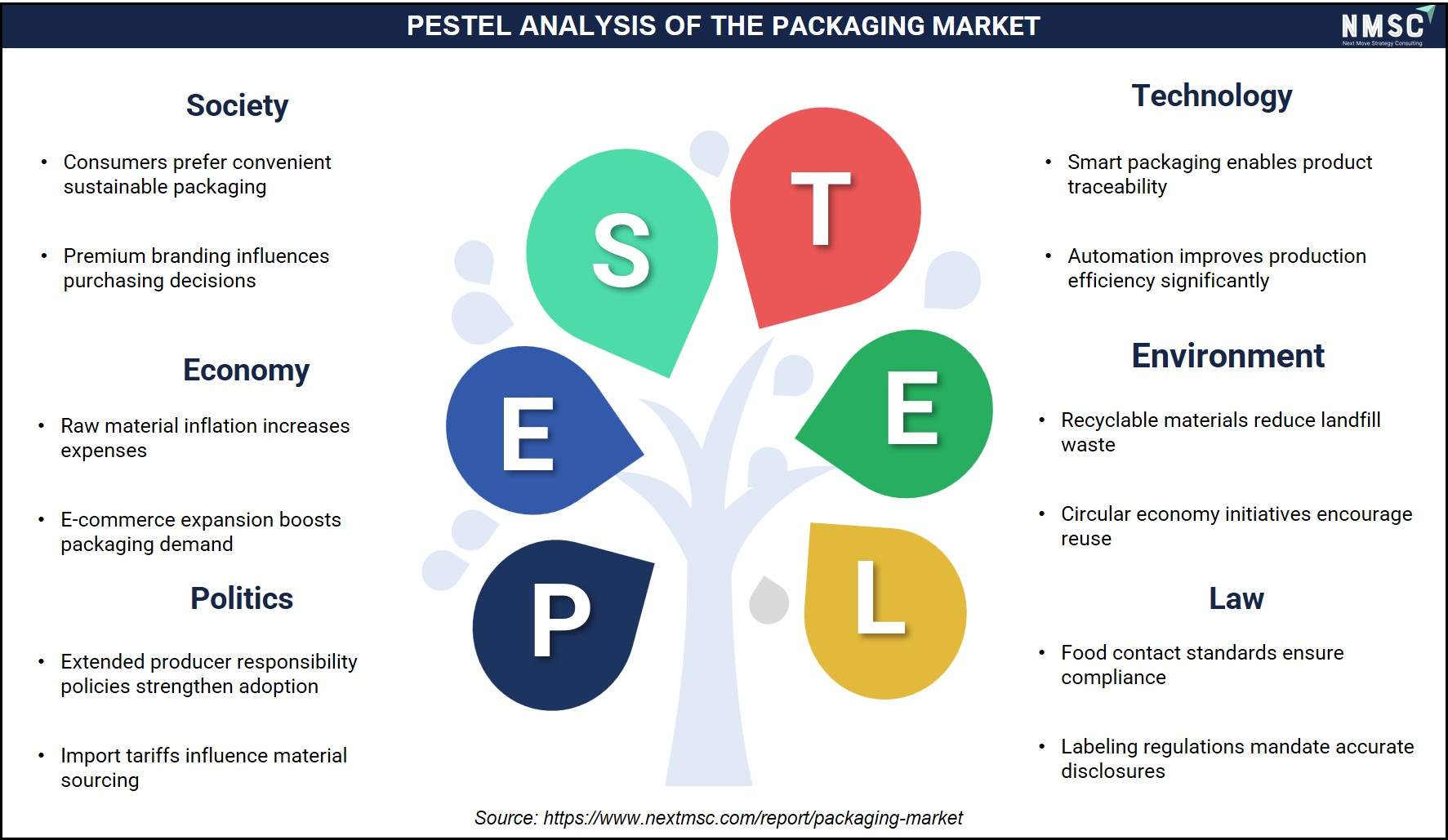
NMSC's analysis indicates that consumer preferences for sustainable options, e-commerce expansion, and extended producer responsibility policies drive growth in the Packaging Market. Furthermore, smart packaging traceability and production automation boost efficiency. Concurrently, raw material inflation pressures expenses, while circular economy initiatives, recyclable materials, import tariffs, food contact standards, and strict labeling regulations mandate comprehensive legal and environmental compliance worldwide.
Competitive Landscape
We observed that the packaging industry remains moderately fragmented, with diversified multinational manufacturers competing alongside regional and material-specialist converters.
|
Dimension |
Details |
|
Market Structure |
Moderately fragmented, with the top 10 companies accounting for a meaningful but non-dominant share of global revenue |
|
Innovation Focus |
Mono-material recyclable design, fiber-based substitution, and smart closure integration |
|
M&A Activity |
Active consolidation of regional converters by diversified multinational packaging manufacturers |
How Do Companies Compete in the Packaging Market?
Companies compete primarily on material innovation, manufacturing scale, and multi-region supply reliability across global CPG and regional brand accounts. We found that diversified multinational manufacturers leverage broad material portfolios and integrated converting capacity to sustain scale advantages, while regional and material-specialist converters compete on localized service and category-specific technical expertise within specific offering segments.
Which Competitive Archetypes Dominate the Packaging Market?
Two archetypes dominate the packaging market: diversified multinational manufacturers spanning multiple material categories, and material-specialist converters focused on paper, plastic, metal, or glass niches. Our findings suggest that diversified manufacturers sustain scale advantages through cross-material bundling for global CPG accounts, while specialists differentiate through deep technical expertise within their specific material category.
What Innovation and Differentiation Strategies Define the Industry?
Innovation strategy centers on mono-material recyclable design, fiber-based substitution, and smart closure and traceability integration. Our analysis shows that leading manufacturers are investing in recyclability-certified material research and automated converting capacity to differentiate compliance readiness, while pricing strategies increasingly bundle multi-material packaging programs with sustainability advisory services for global brand accounts.
What M&A and Geographic Expansion Activity Is Shaping the Market?
M&A activity remains active, concentrated on consolidation of regional converters by diversified multinational manufacturers seeking to expand geographic reach and material breadth. We observed that geographic expansion is prioritizing Asia-Pacific manufacturing corridors, where diversified manufacturers are establishing regional converting facilities to accelerate market-specific packaging supply.
Key Market Players
Our assessment indicates that the following companies represent the leading verified participants in the global packaging market based on manufacturing scale, material portfolio breadth, and confirmed geographic presence.
-
Smurfit Westrock plc
-
International Paper Company
-
Ball Corporation
-
Crown Holdings, Inc.
-
Ardagh Group S.A.
-
Novolex Holdings, LLC
-
Packaging Corporation of America
-
Graphic Packaging Holding Company
-
Silgan Holdings Inc.
-
O-I Glass, Inc.
-
Mondi plc
-
Sonoco Products Company
-
ALPLA Werke Alwin Lehner GmbH & Co KG
-
Rengo Co., Ltd.
-
Sealed Air Corporation
-
Toyo Seikan Group Holdings, Ltd.
-
Huhtamäki Oyj
-
Oji Holdings Corporation
Latest Developments
We observed that recent company activity across the packaging market centers on capacity investment disclosures, recyclable material innovation, and strategic partnerships announced through official company channels.
|
Date |
Event |
|
July 2026 |
Smurfit Westrock partnered with Coca-Cola China to introduce innovative paper-based packaging solutions for the 2026 FIFA World Cup campaign. The collaboration covers retail and e-commerce packaging designed to increase consumer engagement while demonstrating scalable, high-impact paper packaging for a global beverage brand. |
|
April 2025 |
Amcor completed its all-stock merger with Berry Global, creating one of the world's largest consumer and healthcare packaging companies. The combination significantly broadens Amcor's packaging portfolio, manufacturing footprint, innovation capabilities, and global customer reach while supporting future product development and operational synergies. |
|
April 2025 |
Mondi completed the acquisition of Schumacher Packaging's Western Europe operations, adding more than one billion square metres of packaging capacity. The transaction expands corrugated and solid-board packaging production, strengthens regional manufacturing capabilities, and broadens sustainable packaging offerings across European markets. |
|
February 2025 |
Shareholders of Amcor and Berry Global overwhelmingly approved their proposed merger, marking a major strategic milestone toward forming a global packaging leader. The approved transaction combines complementary packaging technologies, innovation capabilities, manufacturing assets, and customer relationships across international markets. |
Expert Insights
 “There is a consumer demand for eco-friendly options especially amongst the new generation who are extremely conscious of the green environment. The new regulations with stricter norms are also driving towards sustainable packaging. The big brand owners with global footprint are becoming the torch bearers of this move.”
— Ramesh Kejriwal, Chairman, Parksons Packaging
Statement made during the ResPack 2024 Conference while discussing the paradigm shift in the global packaging industry toward sustainable materials, driven by evolving consumer preferences, regulatory developments, and brand-led sustainability initiatives.
Market Interpretation
The statement highlights the accelerating transition toward sustainable packaging, driven by growing consumer preference for environmentally responsible products, particularly among younger demographics, alongside increasingly stringent environmental regulations. Furthermore, global brand owners are playing a pivotal role in advancing the adoption of recyclable, biodegradable, and fiber-based packaging solutions across their value chains. Consequently, packaging manufacturers are investing in sustainable material innovations, circular economy practices, and advanced manufacturing technologies to meet evolving regulatory requirements and changing customer expectations while reducing dependence on conventional plastic packaging.
Investment Opportunities
Where Are Capital Inflows Concentrated in the Packaging Market?
Capital inflows are concentrating in recyclable material research and automated converting capacity that address tightening extended producer responsibility regulations. We observed that private investment is favoring manufacturers with multi-material production capability, positioning them to shorten reformulation timelines and capture expanding sustainable packaging demand across North America and Europe.
How Is Infrastructure Investment Supporting Market Expansion?
Infrastructure investment is expanding recycling collection and mechanical processing capacity to support closed-loop material recovery for packaging manufacturers. Our assessment indicates that manufacturers investing in automated packaging machinery and converting lines are better positioned to meet rising demand from e-commerce and fulfillment-driven commercial operations.
What ESG Considerations Are Shaping Packaging Investment?
Environmental, Social, and Governance considerations are increasingly shaping investment decisions, with manufacturers prioritizing recyclable material development and reduced-emission aluminum packaging processing aligned with circular-economy principles. We found that ESG-aligned manufacturers are gaining preferential access to global CPG contracts that increasingly specify sustainability-linked procurement criteria.
Key Benefits for Stakeholders
How Does This Report Benefit Industry Leaders and Manufacturers?
Industry leaders and packaging manufacturers gain access to validated segmentation, competitive benchmarking, and regional demand forecasts that support material and capacity-planning decisions. Our analysis shows that this data enables manufacturers to prioritize investment toward the fastest-growing segments and geographies identified through 2035.
How Does This Report Benefit Investors and Financial Analysts?
Investors and financial analysts benefit from independently derived market sizing, CAGR methodology, and company-level competitive positioning that support capital-allocation and due-diligence decisions. We observed that the report's regional and segment-level forecasts help quantify addressable opportunity across food, beverage, healthcare, and e-commerce demand channels.
How Does This Report Benefit Brand Owners and Retail Partners?
Brand owners and retail partners gain insight into channel-level growth patterns, enabling more informed procurement and sustainability-strategy planning across direct contract, distributor, and online sourcing channels. Our findings suggest that this analysis helps brand owners align packaging investment strategy with shifting regulatory and consumer sustainability expectations.
Key Market Segments
By Offering
-
Paper and Paperboard Packaging
-
Corrugated Packaging
-
Folding Cartons
-
Liquid and Aseptic Cartons
-
Paper Bags and Sacks
-
Molded Fiber Packaging
-
Rigid Paper Containers
-
Paper Wraps and Lidding
-
Paper Protective Packaging
-
Other Paper and Paperboard Packaging
-
-
Plastic Packaging
-
Rigid Plastic Bottles and Jars
-
Rigid Plastic Tubs, Cups and Trays
-
Plastic Squeeze Tubes
-
Plastic Pails, Drums and Jerrycans
-
Bulk and Returnable Plastic Containers
-
Plastic Preforms Sold to Fillers
-
Flexible Plastic Films and Pouches
-
Plastic Protective Packaging
-
Other Plastic Packaging
-
-
Metal Packaging
-
Beverage Cans
-
Food Cans
-
Aerosol Cans
-
General Line and Specialty Cans
-
Metal Drums and Pails
-
Metal Kegs and Casks
-
Metal Tubes and Monobloc Containers
-
Aluminium Foil Containers and Trays
-
Other Metal Packaging
-
-
Glass Packaging
-
Glass Beverage Bottles
-
Glass Food Jars and Bottles
-
Pharmaceutical and Diagnostic Glass
-
Beauty and Fragrance Glass
-
Other Glass Packaging
-
-
Wood and Natural Material Packaging
-
Wooden Boxes and Crates
-
Wooden Pallets and Skids
-
Wooden Barrels and Casks
-
Textile and Jute Sacks
-
Other Natural Material Packaging
-
-
Packaging Components
-
Plastic Closures
-
Metal Closures
-
Dispensing Systems
-
Labels and Sleeves
-
Other Pack Components
-
By Pack Tier
-
Primary Packaging
-
Secondary Packaging
-
Tertiary Packaging
By End Use
-
Food
-
Fresh Produce
-
Meat, Poultry and Seafood
-
Dairy
-
Bakery and Confectionery
-
Ambient Grocery
-
Chilled and Frozen Meals
-
Pet Food
-
-
Beverage
-
Beer
-
Carbonated Soft Drinks and Water
-
Juice and Liquid Dairy
-
Wine and Spirits
-
Energy and Functional Drinks
-
Hot Drinks
-
-
Pharmaceuticals and Healthcare
-
Personal Care and Cosmetics
-
Home Care
-
Industrial and Chemicals
-
Agriculture and Animal Feed
-
E-commerce and Logistics
-
Consumer Electronics and Durables
-
Other End Uses
By Sales Channel
-
Direct Contract Supply
-
Distributor and Wholesaler
-
Online and E-procurement
-
Other Channels
By Customer Type
-
Global CPG Companies
-
Regional and National Brands
-
Private Label and Retailers
-
Foodservice and QSR Operators
-
Industrial and B2B End Users
By Region
-
North America: U.S., Canada, Mexico
-
Europe: UK, Germany, France, Italy, Spain, Sweden, Denmark, Finland, Netherlands, Rest of Europe
-
Asia-Pacific: China, India, Japan, South Korea, Taiwan, Indonesia, Vietnam, Australia,Philippines, Malaysia, Rest of APAC
-
Middle East & Africa: Saudi Arabia, UAE, Egypt, Israel, Turkey, Nigeria, South Africa, Rest of MEA
-
Latin America: Brazil, Argentina, Chile, Colombia, Rest of LATAM
Conclusion and Recommendations
What Is the Long-Term Outlook for the Packaging Market?
The long-term outlook remains favorable, with the market projected to grow from USD 1.23 Trillion in 2026 to USD 1.95 Trillion by 2035 at a 5.25% CAGR. We observed that sustained e-commerce fulfillment growth, expanding emerging-market food and beverage consumption, and tightening recyclability regulation collectively support durable demand across both developed and emerging markets through the forecast period.
What Strategic Positioning Should Companies Pursue?
Companies should prioritize mono-material and fiber-based material development while expanding fulfillment-optimized secondary packaging capability. Our assessment indicates that manufacturers combining strong recyclable-material research with multi-region converting capacity are best positioned to capture share across both global CPG and regional brand demand segments.
How Attractive Is the Packaging Market for Investment?
The market presents steady investment attractiveness, anchored by predictable consumption-linked demand and expanding regulatory-driven material transition spending. We found that recyclable material research and automated converting infrastructure represent the most capital-efficient investment avenues, given their direct link to compliance readiness and customer retention.
What Market Shifts and Key Risks Should Stakeholders Monitor?
Stakeholders should monitor extended producer responsibility compliance costs, input-cost volatility, and overcapacity in commoditized rigid formats. Our findings suggest that manufacturers with diversified material portfolios are better insulated against regional regulatory and commodity-price shocks that could otherwise disrupt margin consistency and market position.
What Are the Key Growth Pathways Through 2035?
Key growth pathways include expanding mono-material recyclable formats, deepening e-commerce fulfillment packaging partnerships, and scaling smart closure integration for regulated healthcare applications. We observed that companies pursuing these pathways simultaneously are best positioned to capture the full breadth of demand across food, beverage, healthcare, and e-commerce channels through 2035.
About the Author
 Saista Faiyaz
— Saista Faiyaz is Research Associate at Next Move Strategy Consulting, where she has covered consumer markets and healthcare technologies for 3 years. Her work includes primary interview review, secondary-source validation, market sizing, and structured analysis of company and industry data. She supports research by comparing evidence across sources, organizing findings into market narratives, and documenting assumptions used in analysis. Her scope includes cross-market benchmarking, and reports.
Saista Faiyaz
— Saista Faiyaz is Research Associate at Next Move Strategy Consulting, where she has covered consumer markets and healthcare technologies for 3 years. Her work includes primary interview review, secondary-source validation, market sizing, and structured analysis of company and industry data. She supports research by comparing evidence across sources, organizing findings into market narratives, and documenting assumptions used in analysis. Her scope includes cross-market benchmarking, and reports.
About the Reviewer
 Supradip Baul
— Supradip Baul is an accomplished business consultant and strategist with over a decade of rich experience in market intelligence, strategy, technology, and business transformation. His work has included rigorous qualitative and quantitative analysis across multiple industries, helping clients shape investment decisions and long-term roadmaps. Earlier in his career, he was associated with Gartner, where he contributed to industry-leading reports and market share analyses. He has worked with leading global companies and holds an MBA with a dual specialization in Marketing and Finance.
Supradip Baul
— Supradip Baul is an accomplished business consultant and strategist with over a decade of rich experience in market intelligence, strategy, technology, and business transformation. His work has included rigorous qualitative and quantitative analysis across multiple industries, helping clients shape investment decisions and long-term roadmaps. Earlier in his career, he was associated with Gartner, where he contributed to industry-leading reports and market share analyses. He has worked with leading global companies and holds an MBA with a dual specialization in Marketing and Finance.
At Next Move Strategy Consulting, we understand that insightful market research is the cornerstone of successful business decisions. That's why we employ a robust and multifaceted approach, combining various methodologies to deliver the most accurate and actionable data for our clients.

Research Landscape
We navigate the world of research with two primary approaches:
Qualitative Approach
Our qualitative research methodologies involve immersive techniques such as in-depth interviews, focus groups, and observational studies. By engaging directly with individuals and stakeholders, we uncover valuable insights that quantitative data alone may overlook.

Quantitative Research
In tandem with qualitative methodologies, NMSC leverages the power of Quantitative Research to provide a robust foundation of numerical insights. Through systematic data collection and analysis, we quantify patterns, preferences, and market trends, offering a comprehensive view of the business landscape.
Our quantitative research approach employs diverse tools, including surveys, experiments, and statistical modelling. These methodologies enable us to gather data from a large and representative sample, ensuring the statistical significance of our findings. By employing structured questionnaires and standardized data collection methods, we guarantee the reliability and validity of the information we present to our clients.
Quantitative research is particularly effective in measuring the prevalence of trends, assessing market size, and gauging the impact of various factors on consumer behavior. The numerical precision attained through this approach equips our clients with actionable insights, facilitating data-driven decision-making and strategy formulation.


Our Specialized Toolbox for Industry-Specific Market Research
We deploy a specialized arsenal of techniques tailored to meet your unique requirements. Here's a glimpse into our comprehensive toolbox:

Information Procurement
The stage entails acquiring market data or relevant information through various sources and methodologies.


Market Research Approach
We utilize both top-down and bottom-up approaches in market research analysis to achieve a comprehensive understanding of the market dynamics, leveraging the broad perspective of industry trends and macroeconomic factors alongside detailed insights from specific segments and individual companies.

Porters Five Forces Analysis
We conduct Porter's Five Forces analysis to evaluate the competitive landscape of an industry, providing us with insights into factors that affect profitability and strategic positioning.

SWOT Analysis

Forecasting
We utilize a forecasting model to predict future consumption by considering parameters like population, economics, regulations, market competition, drivers, constraints, technology, and pricing. We also employ statistical techniques such as multilinear regression, exponential smoothing, moving average, ARIMA, and Monte Carlo simulations for accurate predictions. In econometric forecasting, we analyzed short-term and long-term event impacts, attributing values based on regulatory frameworks, economic factors, and market events.





 Speak to Our Analyst