What industries Benefit Most From Employer of Record Services?

As per NMSC analysis, the human capital management market was valued at USD 26.6 billion in 2023 and is projected to reach USD 46.4 billion by 2030, growing at a CAGR of 8.2% from 2024 to 2030.
That growth is increasingly shaped by two forces at once: AI moving from simple automation into genuine decision support inside HR and payroll workflows, and the continued globalization of hiring, where platforms such as Borderless AI let companies employ talent compliantly across borders without standing up a legal entity in every market a workforce-expansion trend that feeds directly into HCM platform adoption as companies need systems that can manage an increasingly distributed, multi-country workforce.
2026 has been a turning point for how vendors talk about AI in HR: the shift is from automating repetitive tasks toward agents that make or support real talent and pay decisions with enterprise buyers now demanding explainability before they'll trust an AI-generated promotion suggestion or pay correction.
Human Capital Management Market Overview
HCM software covers the full employee lifecycle talent acquisition, workforce management, performance management, learning and development, payroll and compensation, and HR analytics. NMSC segments the market by offering (software, split into core HR, talent management, workforce management, and payroll & compensation; and services, split into professional and managed services), by deployment (on-premises and cloud), by enterprise size (large and SME), and by end user (IT & telecom, BFSI, government, retail, healthcare, education, manufacturing, and others).
Human Capital Management Market Size and Forecast, 2023–2030
|
Parameter |
2023 |
2030 |
CAGR (2024–2030) |
|
Global HCM Market Size |
$26.6B |
$46.4B |
8.2% |
|
Companies Profiled / With Market Share Data |
10 profiled |
10 with disclosed share |
|
Section takeaway: the market's steady 8.2% CAGR understates how much the underlying product category is changing vendors are re-platforming around AI agents faster than the market-size numbers alone would suggest.
-
Market grows by roughly 75% between 2023 and 2030 at an 8.2% CAGR
-
Software especially talent management and payroll & compensation is the fastest-evolving component as AI agents get embedded directly into workflows
-
Cloud deployment continues to displace on-premises HCM, particularly among SMEs adopting HCM for the first time
What's Driving Human Capital Management Market Growth?
How Is AI Shifting from Automation to Decision Support?
The clearest 2026 trend is that AI in HCM has moved past digitizing forms and automating payroll runs. It's now expected to support real decisions flagging attrition risk, recommending career paths, and modeling skill adjacency which is pulling HCM spend toward NMSC's broader Artificial Intelligence Market research as the two categories increasingly overlap. Buyers are also getting more skeptical: if a platform can't explain why it generated a specific promotion suggestion or pay correction, enterprise buyers increasingly treat that opacity as a risk rather than a feature.
How Is Global, Distributed Hiring Reshaping HCM Requirements?
Remote and hybrid work has pushed companies to hire further afield than their existing legal entities cover, and that has made cross-border compliance a core HCM requirement rather than an edge case. Technology and professional-services firms in particular now expect their HCM platform to manage a workforce spread across a dozen or more countries without a dozen separate compliance headaches.
How Is Cloud Adoption Changing Who Can Afford HCM?
Rising investment in cloud-based HR platforms an extension of the broader Cloud Computing Market NMSC tracks separately is lowering the cost barrier that has historically kept full HCM suites out of reach for small and mid-sized employers, letting them adopt the same enterprise-grade cloud HCM tools that used to be exclusive to large enterprises.
Section takeaway: AI decision support, global distributed hiring, and cloud economics are reinforcing each other each is making sophisticated HCM capability available to a wider set of employers.
-
AI in HCM has shifted from task automation to decision support, and buyers now expect explainability
-
Cross-border and distributed hiring is turning global compliance into a core HCM requirement, not an edge case
-
Cloud deployment continues to close the affordability gap for SMEs adopting full HCM suites
Regional Human Capital Management Adoption
North America continues to dominate the HCM market, driven partly by government-agency adoption of secure, compliant cloud HCM for streamlining workforce management and automating administrative tasks. Asia-Pacific shows steady growth, propelled by the region's large healthcare workforce China alone has more than a million healthcare institutions requiring scheduling, payroll, and compliance support and by the rapid expansion of BFSI and fintech employment, which demands advanced HCM systems to recruit, train, and manage a fast-growing workforce.
Section takeaway: North America's lead reflects early cloud and government adoption, while Asia-Pacific's growth is concentrated in two large, HR-intensive sectors: healthcare and financial services.
-
North America remains the dominant region, aided by government-sector cloud HCM adoption
-
Asia-Pacific's growth is concentrated in healthcare staffing and BFSI workforce management
-
Both regions are converging on the same requirement: HCM systems that can scale compliance across a large, complex workforce
Industry Leader Moves: How Top HCM Vendors Are Competing in 2026
2026 has seen nearly every major HCM vendor ship agentic AI rather than just announce it the competitive question has shifted from whether a platform has AI to how much of it is actually live in production.
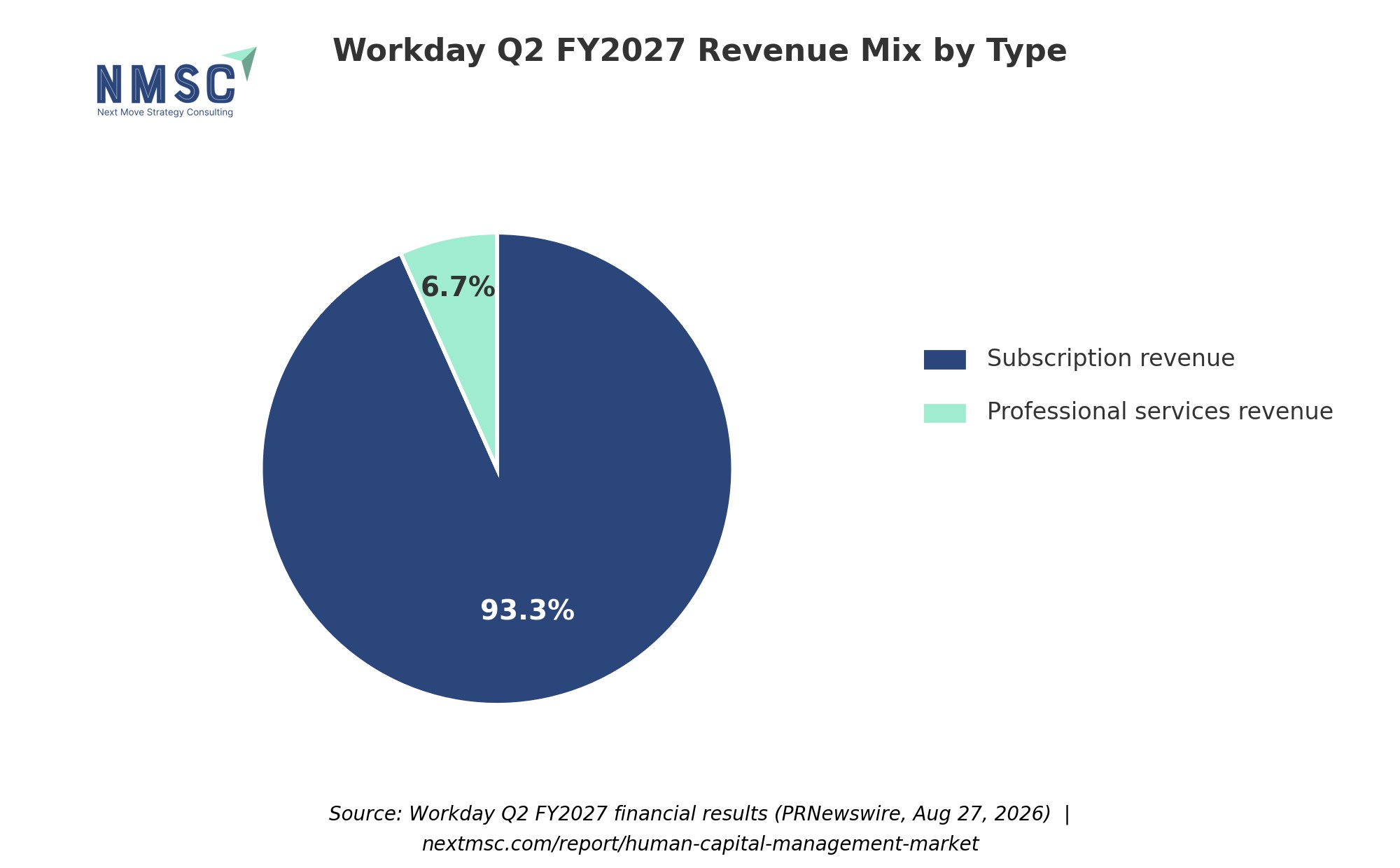
Workday posted fiscal Q2 2027 (quarter ended July 31, 2026) revenue of $2.649 billion, up 13% year-over-year, with subscription revenue of $2.471 billion, up 14%, and AI products contributing over $100 million in new annual contract value in the quarter. Product-wise, Workday has been rolling out new Illuminate agents across HR and finance including a Case Agent, Employee Sentiment Agent, Job Architecture Agent, and Performance Agent first announced at Workday Rising in September 2025 and reaching general availability through 2026.
Oracle announced new Fusion Agentic Applications and AI agents for Oracle Cloud HCM on August 11, 2026 fourteen named agents spanning work architecture, learning and development, manager coaching, employee growth and mobility, and workforce planning, including a Job Architect Agent and an Intelligent Talent Profiles Agent that infers skills from connected work-system data rather than relying on self-reported profiles. Industry analysts framed the release explicitly as an attempt to close the gap with Workday, SAP, and ADP in agentic HR capability.
SAP shipped its SuccessFactors 1H 2026 release in April 2026, its most aggressive AI deployment in the suite's history: more than 400 innovations including four new Joule-powered agents (Career and Talent Development, HR Service, Payroll, and People Intelligence) plus task-specific agents such as a Payroll Alert Resolution Agent and Employee Data Integration Agent. SAP also completed native integration with SmartRecruiters in March 2026, unifying recruiting data with SuccessFactors Employee Central and Onboarding.
ADP closed fiscal 2026 (ended June 30, 2026) with revenue of $21.9 billion, up 7%, and adjusted EPS growth of 11% for the year both at the high end of guidance. Management credited AI tools including ADP Assist and its "Zone" service platform with record average productivity across its roughly 9,000-person sales force, and Employer Services new business bookings reached $2.2 billion for the year, up 6%.
UKG introduced UKG Pro Pay with Workforce AI on May 11, 2026, using agentic, assistive, and generative AI to detect payroll anomalies by comparing each run against up to five years of historical data aimed at reducing "payroll leakage," which UKG and KPMG research estimates can cost large enterprises up to $15 million a year. UKG was separately named a Leader in the 2026 Gartner Magic Quadrant for HCM Suites for enterprises with 1,000+ employees.
Paycom reported Q2 2026 revenue of $531 million, up 10% year-over-year, and completed a transition to hosting its own AI models in-house a move management says will generate roughly $100 million in R&D savings and eliminate $30 million in third-party inference fees this year alone. The quarter also included Project Arc, described by Paycom as the largest system-wide release in company history, and the launch of an Asset Management product extending its automation platform into a new multibillion-dollar addressable market.
Paylocity closed fiscal 2026 with revenue of roughly $1.8 billion, up 11%, and recurring revenue growth accelerating to 12.4% in the fourth quarter. The company launched Ignite AI embedding a candidate-fit recruiting agent, a talent-rediscovery agent, and a natural-language HR/payroll answers agent directly into existing workflows and acquired Grayscale (AI-powered recruiting automation) and Aidora (AI-native leave-of-absence management) during the year to extend those capabilities as premium add-ons.
Dayforce continued rolling out AI-powered workforce management updates through 2026, including a February release aimed at helping operations leaders align staffing to demand and reduce scheduling complexity across its unified people platform.
Microsoft continues to embed Copilot deeper into Dynamics 365 Human Resources as part of its broader 2026 Release Wave, though its HCM-specific developments have been smaller in scope than its dedicated HR competitors' this year. The remaining named vendors BambooHR, Cornerstone, Zoho, Infosys, and IFS continue to compete primarily on price, ease of use, and industry-specific fit for SMEs rather than headline agentic-AI announcements; NMSC's own competitive assessment found no comparably material, primary-sourced developments for these players in the trailing six months, and has flagged them for the next refresh rather than including unverified claims.
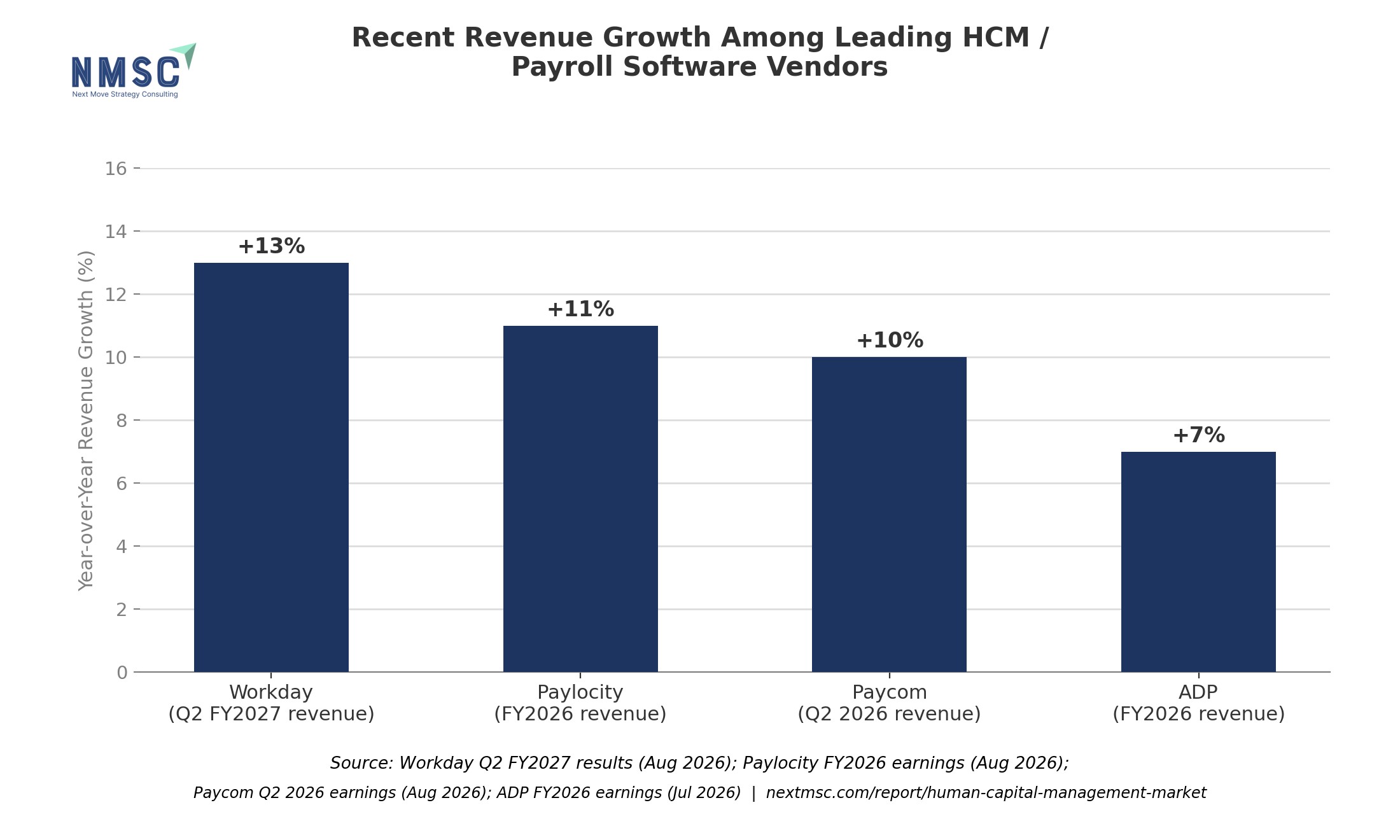
Section takeaway: the pure-play HCM/payroll vendors (Workday, Paylocity, Paycom) are currently growing faster than the payroll-services incumbent (ADP) and nearly every vendor's 2026 pitch now centers on how much of its AI is actually running in production, not just announced.
-
Workday, Paylocity, and Paycom all posted double-digit revenue growth in their most recent reported periods
-
Oracle explicitly positioned its August 2026 HCM AI release as closing a competitive gap with Workday, SAP, and ADP
-
UKG and Paylocity are both monetizing AI through acquisitions (Aidora, Grayscale) and premium add-ons rather than only bundling it into the core platform
Product and Investment Moves
Beyond the headline agent launches, 2026 has also been a year of vendors buying or building AI capability directly rather than only announcing partnerships.
Notable Product and Investment Moves in HCM, 2026
|
Company |
Move |
Detail |
|
Paylocity |
Acquisitions (FY2026) |
Acquired Grayscale (AI recruiting) and Aidora (AI-native leave management) to extend Ignite AI as premium offerings |
|
Paycom |
Infrastructure shift (2026) |
Moved to self-hosted AI models; ~$100M R&D savings and $30M in eliminated third-party fees expected in 2026 |
|
SAP |
Native integration (Mar 2026) |
SmartRecruiters integrated directly into SuccessFactors Employee Central and Onboarding |
|
UKG |
Product launch (May 2026) |
UKG Pro Pay with Workforce AI targets "payroll leakage," estimated at up to $15M/year for large enterprises (UKG/KPMG) |
Future Outlook for the Human Capital Management Market
NMSC's analysis points to continued integration of artificial intelligence as the clearest opportunity through 2030, automating HR documentation and evaluations while freeing HR teams for more strategic work. The clearest restraint remains the high upfront and ongoing cost of HCM implementation for small and mid-sized enterprises precisely the gap that cloud deployment and vendors' new AI-driven efficiency gains (like Paycom's in-house AI infrastructure savings) are best positioned to close over the next several years. Expect skills-based workforce planning and AI explainability to become standard buying criteria, not differentiators, as enterprise HR and IT teams grow more comfortable evaluating agentic AI claims critically.
Section takeaway: the next few years of HCM growth depend less on new modules and more on making AI decision support cheaper to run and easier to trust.
-
AI integration remains the single largest identified opportunity through the 2030 forecast window
-
Installation and ongoing cost remains the primary adoption restraint for SMEs
-
Skills intelligence and AI explainability are becoming baseline requirements rather than premium features
Conclusion
The human capital management market's growth through 2030 is being shaped less by new categories of software than by how much of the AI vendors are shipping is actually running in production versus still on a roadmap. Workday, Paylocity, and Paycom are currently outgrowing the broader payroll-services incumbents, Oracle has explicitly set out to close the gap with its rivals, and UKG and Paylocity are both monetizing AI as a distinct product line rather than a bundled feature. For buyers, that means evaluating a vendor's AI roadmap has become as important as comparing its core HR and payroll functionality.
Download Free Sample for the full segment-level data, vendor profiles, and country-level forecasts behind this analysis.
About the Author
 Sanyukta Deb
— Sanyukta Deb is Digital Marketing Team Lead at Next Move Strategy Consulting, where she has led content strategy and technical SEO for the firm's B2B market research publications for over 2 years. Her editorial process translates NextMSC's primary and secondary research — spanning technology, industrial, and consumer sectors — into commercial narratives, backed by search-intent, keyword, and competitive analysis. She brings 5 years of overall experience in digital marketing and content strategy.
Sanyukta Deb
— Sanyukta Deb is Digital Marketing Team Lead at Next Move Strategy Consulting, where she has led content strategy and technical SEO for the firm's B2B market research publications for over 2 years. Her editorial process translates NextMSC's primary and secondary research — spanning technology, industrial, and consumer sectors — into commercial narratives, backed by search-intent, keyword, and competitive analysis. She brings 5 years of overall experience in digital marketing and content strategy.
About the Reviewer
 Debashree Dey
— Debashree Dey is Assistant Manager at Next Move Strategy Consulting, where she supports cross-vertical market content and communications across diverse industries for 6 years. Her professional background includes senior content writing, communications, and published manuscript authorship, with experience developing audience-focused business narratives and maintaining clear, consistent messaging. Her role supports research-led content development and editorial quality across NextMSC publications.
Debashree Dey
— Debashree Dey is Assistant Manager at Next Move Strategy Consulting, where she supports cross-vertical market content and communications across diverse industries for 6 years. Her professional background includes senior content writing, communications, and published manuscript authorship, with experience developing audience-focused business narratives and maintaining clear, consistent messaging. Her role supports research-led content development and editorial quality across NextMSC publications.

















Add Comment