What Is Driving Aluminum Extrusion Growth Across Global Manufacturing in 2026?
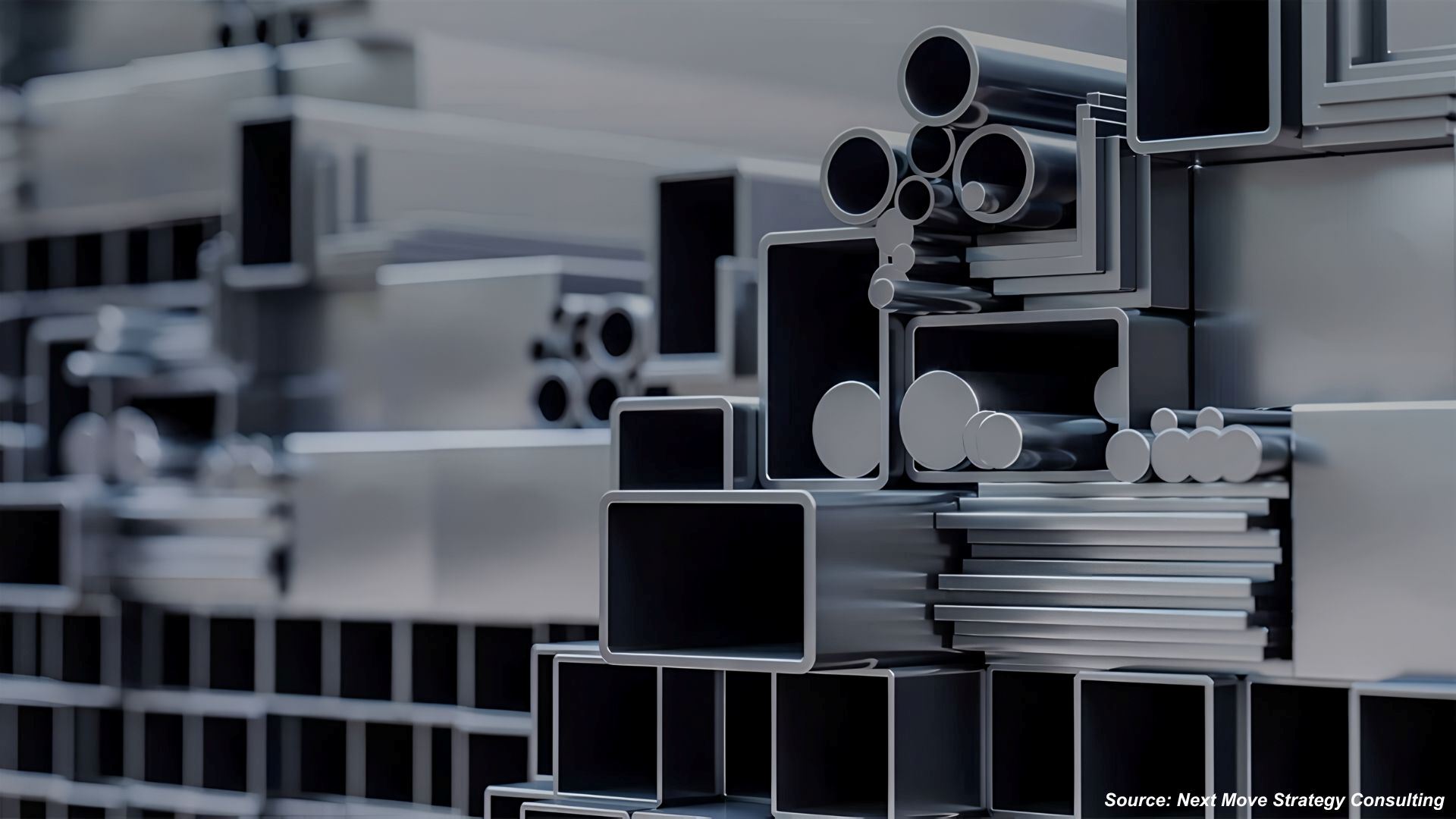
The answer lies in the intersection of global manufacturing expansion, renewable energy infrastructure growth, and supply chain disruption. Across major industrial economies, aluminum extrusion is no longer viewed only as a production technique used for lightweight materials. It is now central to infrastructure development, solar energy deployment, modular construction, and industrial modernization.
Two major developments highlight this transition. In Saudi Arabia, Aluminum Products Company (ALUPCO) and Asia Aluminium Group (AAG) announced a $500 million investment to establish the largest integrated downstream aluminium industrial base in the country. At the same time, India’s aluminium extrusion sector has been forced to reduce production sharply because of the ongoing West Asia crisis, which has disrupted raw material inflows and increased operational costs.
Together, these developments reveal a broader industry transformation. Manufacturing regions are racing to strengthen downstream aluminium capabilities while simultaneously attempting to reduce exposure to geopolitical and supply chain instability.
How Is Aluminum Extrusion Transforming Industrial Manufacturing?
The Aluminum Extrusion Market plays a vital role in modern industrial manufacturing by enabling the production of lightweight, durable, and customizable components used across sectors such as construction, transportation, renewable energy, and modular infrastructure. The partnership between ALUPCO and AAG highlights how governments and manufacturers are increasingly prioritizing downstream industrial capabilities instead of relying mainly on raw material exports. As part of this strategy, the companies plan to establish a large-scale industrial base in Riyadh spanning 1.5 million square metres, focused on aluminium extrusion, solar panel frames, and modular construction systems. The facility is projected to achieve a total extrusion production capacity of 200,000 tons in two phases. Additionally, the first phase alone is expected to generate more than 1,800 jobs while integrating advanced robotic automation into manufacturing operations.
One of the most significant aspects of the project is its connection to renewable energy expansion. The planned production of 30 million solar panel frames annually demonstrates how aluminum extrusion is becoming closely linked to clean energy infrastructure development. Lightweight aluminium components are increasingly preferred because they offer durability, corrosion resistance, and efficiency in large-scale solar installations.
The investment also highlights the growing role of modular construction in industrial growth strategies. The project aims to manufacture 30,000 residential modules annually using Modular Integrated Construction (MiC) systems, which are designed to accelerate construction timelines and improve scalability.
How Does the Aluminum Extrusion Process Work?
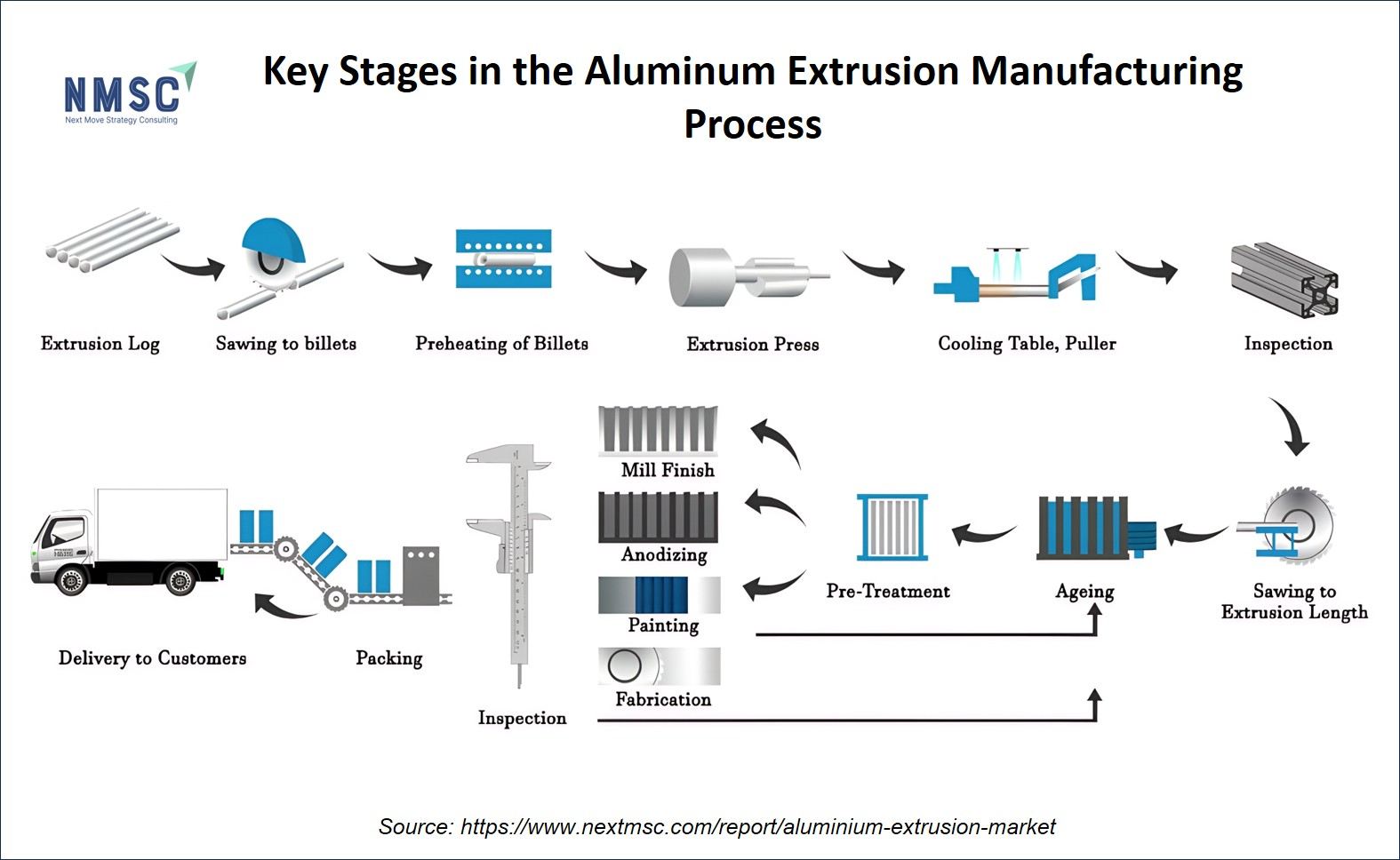
This image illustrates the complete aluminum extrusion manufacturing process, showing how raw aluminium logs are transformed into finished industrial profiles used in construction, transportation, renewable energy, and infrastructure applications.
The process begins with an extrusion log, which is cut into smaller billets. These billets are then preheated to improve metal flexibility before entering the extrusion press. Inside the press, high pressure forces the heated aluminium through a specially designed die to create specific profile shapes.
After extrusion, the profiles move through a cooling table and puller system to stabilize the material and maintain dimensional accuracy. The material is then inspected and cut into required extrusion lengths before undergoing ageing and pre-treatment processes that improve strength, durability, and surface quality.
The final stage includes multiple finishing options such as mill finish, anodizing, painting, and fabrication depending on the intended industrial application. After quality inspection and packaging, the finished aluminium profiles are delivered to customers.
Why Is the West Asia Crisis Affecting Aluminum Extrusion Production?
While industrial investment is accelerating in some regions, other markets are facing operational disruption due to geopolitical instability.
The ongoing West Asia crisis has severely affected India’s aluminium extrusion industry. The sector previously produced approximately 1.2–1.3 million tonnes annually, equal to nearly 100,000 tonnes per month. However, production has reportedly declined to approximately 50,000–60,000 tonnes monthly.
Industry leaders stated that midstream and downstream aluminium operations are experiencing a contraction of nearly 40%–50%, despite India maintaining an installed capacity of 4.2 million tonnes. The reduction is largely linked to supply chain interruptions, rising energy costs, and raw material shortages.
A major concern for manufacturers is the industry’s dependence on West Asia for raw material sourcing. According to the report, nearly 50% of raw materials are sourced from the region, where unloading operations have been disrupted because of the conflict. These delays have significantly affected production continuity.
The crisis has also increased conversion costs by 25% because of energy shortages and logistics disruptions. Several aluminium extrusion plants reportedly suspended operations temporarily due to limited LPG availability, while many facilities continue operating at reduced utilization levels.
For procurement executives and supply chain strategists, the situation demonstrates how geopolitical instability can rapidly affect industrial production and sourcing reliability. Companies that depend heavily on concentrated supply networks are increasingly vulnerable to operational disruptions.
What Are the Key Steps in the Aluminum Extrusion Production Process?
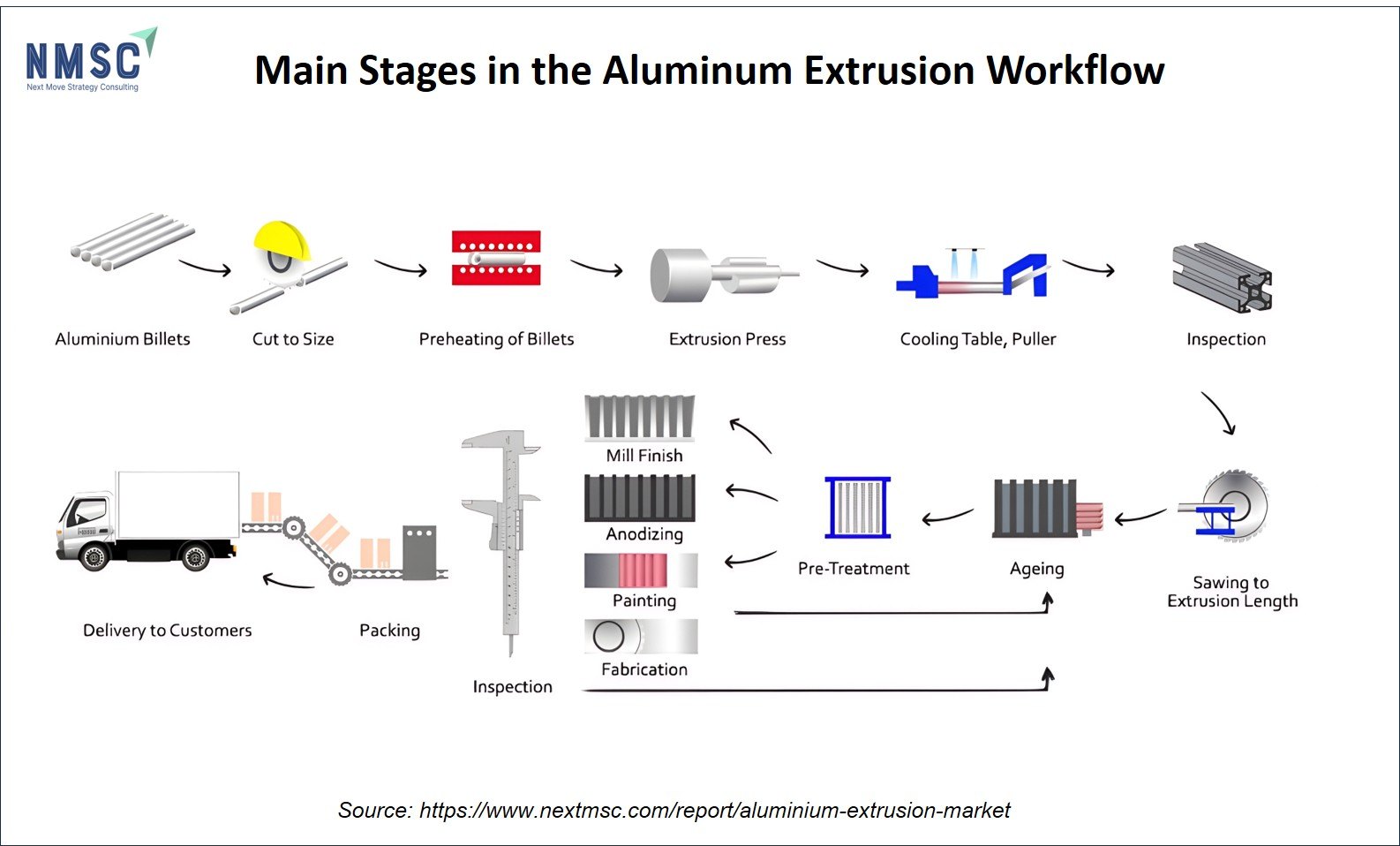
This image presents a step-by-step workflow of the aluminum extrusion manufacturing process, demonstrating how raw aluminium billets are transformed into finished industrial profiles used across construction, automotive, renewable energy, and infrastructure applications.
The process begins with aluminium billets, which are first cut to the required size and then preheated to improve flexibility and extrusion efficiency. The heated billets are pushed through an extrusion press, where high pressure forces the material through a shaped die to create customized aluminium profiles.
After extrusion, the newly formed profiles move through a cooling table and puller system that stabilizes the material and maintains dimensional consistency. The profiles are then inspected and cut into specific extrusion lengths according to industrial requirements.
The next stages focus on improving product strength and surface quality. During the ageing process, the aluminium gains additional mechanical strength, while pre-treatment prepares the surface for advanced finishing applications. Depending on the final use case, the profiles may undergo mill finishing, anodizing, painting, or fabrication processes.
How Are Current Industry Shifts Impacting Global Manufacturing?
The aluminum extrusion industry is currently balancing strong long-term demand with significant short-term operational pressure.
On one side, renewable energy expansion, industrial automation, and modular construction are creating new growth opportunities for extrusion manufacturers. Governments and industrial developers are investing heavily in downstream manufacturing ecosystems capable of supporting infrastructure and clean energy projects.
On the other side, geopolitical instability is increasing operational uncertainty. Rising logistics costs, delayed raw material shipments, and energy supply disruptions are placing pressure on production efficiency and profitability.
This environment is forcing manufacturers and investors to reconsider traditional sourcing strategies. Regional manufacturing hubs are becoming increasingly important because companies are seeking shorter, more resilient supply chains that reduce geopolitical exposure.
The Saudi Arabia investment reflects this strategic shift toward regional industrial integration. Meanwhile, India’s production slowdown demonstrates the risks associated with overdependence on a limited number of sourcing routes.
What Does the Aluminum Extrusion Industry Pie Chart Represent?
This pie chart highlights the major growth drivers and operational challenges shaping the aluminum extrusion industry in 2026. It provides a visual breakdown of the key factors influencing industrial expansion, manufacturing investment, and supply chain strategies across global markets.
The largest segment, representing 30%, is Renewable Energy Infrastructure. This reflects the increasing demand for aluminium extrusion products in solar panel frames, clean energy systems, and sustainable infrastructure projects. The growing focus on renewable energy is significantly increasing the need for lightweight, corrosion-resistant aluminium components.
The second-largest share, accounting for 25%, is Supply Chain Disruptions. Ongoing geopolitical tensions and logistics bottlenecks, particularly linked to the West Asia crisis, are affecting raw material availability, transportation efficiency, and manufacturing continuity across the industry.
Regional Manufacturing Expansion contributes 20% to the chart, highlighting the growing investment in downstream aluminium manufacturing hubs such as the large-scale Saudi Arabia industrial project announced by ALUPCO and AAG. Companies and governments are increasingly focusing on localized production capabilities to improve industrial resilience.
Modular Construction represents 15% of the industry focus. Aluminium extrusion is becoming increasingly important in modular and prefabricated construction systems because of its lightweight properties, durability, and adaptability for scalable infrastructure projects.

Leading Companies Shaping the Aluminum Extrusion Industry
Major companies operating in the aluminum extrusion industry include Norsk Hydro ASA, China Zhongwang Holdings Limited, Arconic Corporation, Bahrain Aluminium Extrusion Company (BALEXO), Constellium N.V., Gulf Extrusions Co. LLC, Hindalco Industries Ltd., Kaiser Aluminium, Kymera International, and UAJC Corporation. These companies continue to strengthen their market presence through strategic initiatives such as partnerships, acquisitions, and expansion agreements to enhance competitiveness and maintain leadership within the global aluminum extrusion industry.

What Could Shape the Future of Aluminum Extrusion?
The future of aluminum extrusion will likely depend on how effectively manufacturers balance industrial growth with supply chain resilience.
Renewable energy projects are expected to remain an important demand driver because aluminium components are widely used in solar infrastructure systems. Modular construction may also increase extrusion demand because lightweight aluminium structures support faster and more scalable building processes.
At the same time, manufacturers are expected to place greater emphasis on regional sourcing diversification and energy security. The current market environment has shown that industrial growth strategies cannot rely solely on low-cost sourcing models without considering geopolitical risk.
The companies and regions that successfully combine advanced manufacturing, resilient supply chains, and infrastructure-focused production capabilities may gain stronger long-term competitive positioning.
Next Steps
Manufacturers, investors, and procurement leaders should closely monitor industrial investment activity, regional supply chain developments, and renewable energy infrastructure expansion. Organizations may also need to reassess sourcing dependencies and strengthen operational flexibility to reduce exposure to future disruptions.
-
Improve operational resilience against geopolitical disruptions
-
Evaluate alternative raw material sourcing routes
-
Track downstream aluminium manufacturing expansion in the Middle East
-
Build flexible inventory and energy management strategies
Conclusion
Aluminum extrusion is becoming increasingly important to the future of industrial manufacturing, renewable energy infrastructure, and modular construction development.
The industry’s current transformation reflects two parallel realities. On one side, large-scale investments such as the Saudi Arabia downstream manufacturing project are creating new opportunities for industrial expansion and technological advancement. On the other side, geopolitical instability and supply chain disruption are exposing structural vulnerabilities across global manufacturing networks.
For decision-makers, the challenge in 2026 is not simply increasing production capacity. It is building resilient, diversified, and technologically advanced industrial ecosystems capable of operating effectively in an increasingly uncertain global environment.
About the Author
 Sanyukta Deb
— Sanyukta Deb is Digital Marketing Team Lead at Next Move Strategy Consulting, where she has led content strategy and technical SEO for the firm's B2B market research publications for over 2 years. Her editorial process translates NextMSC's primary and secondary research — spanning technology, industrial, and consumer sectors — into commercial narratives, backed by search-intent, keyword, and competitive analysis. She brings 5 years of overall experience in digital marketing and content strategy.
Sanyukta Deb
— Sanyukta Deb is Digital Marketing Team Lead at Next Move Strategy Consulting, where she has led content strategy and technical SEO for the firm's B2B market research publications for over 2 years. Her editorial process translates NextMSC's primary and secondary research — spanning technology, industrial, and consumer sectors — into commercial narratives, backed by search-intent, keyword, and competitive analysis. She brings 5 years of overall experience in digital marketing and content strategy.
About the Reviewer
 Debashree Dey
— Debashree Dey is Assistant Manager at Next Move Strategy Consulting, where she supports cross-vertical market content and communications across diverse industries for 6 years. Her professional background includes senior content writing, communications, and published manuscript authorship, with experience developing audience-focused business narratives and maintaining clear, consistent messaging. Her role supports research-led content development and editorial quality across NextMSC publications.
Debashree Dey
— Debashree Dey is Assistant Manager at Next Move Strategy Consulting, where she supports cross-vertical market content and communications across diverse industries for 6 years. Her professional background includes senior content writing, communications, and published manuscript authorship, with experience developing audience-focused business narratives and maintaining clear, consistent messaging. Her role supports research-led content development and editorial quality across NextMSC publications.

















Add Comment