What Is the Intelligent Application Market and Why Does It Matter?

The Intelligent Application Market represents a new era of enterprise and industrial software, where applications are no longer static tools but adaptive systems powered by artificial intelligence, machine learning, and advanced analytics. These applications continuously learn from data, identify patterns, and enable predictive and autonomous decision-making.
Key Points:
-
AI is embedded into applications
-
Systems are becoming predictive
-
Adoption is expanding across industries
How Are AI Agents Transforming the Intelligent Application Market?
What Did Oracle Launch in 2026?
Oracle introduced an Agentic Applications Builder, enabling enterprises to create AI agents that can autonomously manage complex workflows.
These agents can reason, plan, and execute tasks, collaborate with other agents, and operate across enterprise functions with minimal human input.
Key Points:
-
AI agents execute multi-step workflows
-
Collaboration between agents improves efficiency
-
Low-code tools accelerate adoption
How Are Industrial Platforms Advancing Intelligent Applications?
What Did Baker Hughes Achieve with Cordant™?
Baker Hughes developed Cordant™, an AI-driven platform that integrates industrial data and analytics to optimize energy operations.
It enables predictive maintenance, real-time monitoring, and seamless integration between IT and operational systems.
How Do Oracle and Baker Hughes Compare in Intelligent Applications?
|
Feature / Capability |
Oracle (Agentic Applications) |
Baker Hughes (Cordant™ Platform) |
|
Core Focus |
Enterprise AI applications |
Industrial AI & energy operations |
|
Key Innovation |
Autonomous AI agents |
Predictive analytics & asset optimization |
|
Functionality |
Workflow automation, decision-making |
Predictive maintenance, real-time monitoring |
|
Data Integration |
Enterprise systems (HR, finance, operations) |
IT + Operational Technology (OT) systems |
|
Intelligence Type |
Agent-based, collaborative AI |
Data-driven, asset-centric AI |
|
Business Impact |
Increased productivity & automation |
Reduced downtime & operational efficiency |
|
User Accessibility |
Low-code / customizable tools |
Industrial platform integration |
Table Summary
The table highlights how intelligent applications are evolving across both enterprise and industrial domains, with distinct yet complementary approaches.
Key Points:
-
Oracle focuses on enterprise workflow intelligence
-
Baker Hughes focuses on industrial optimization
-
Both demonstrate real-world AI application value
Leading Players of the Industry
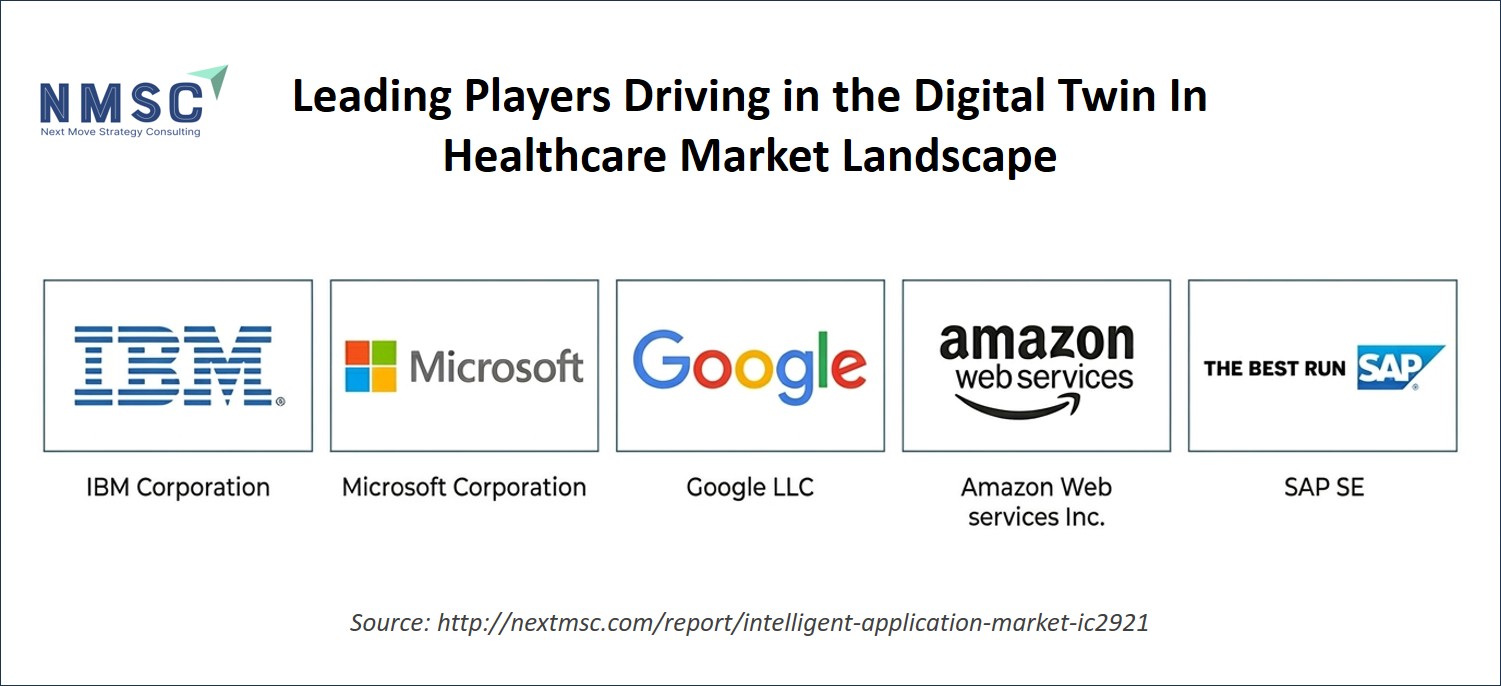
The various key players operating in the intelligent application industry includes IBM Corporation, Microsoft Corporation, Google LLC, Amazon Web Services Inc., SAP SE, Salesforce Inc., Oracle Corporation, Wipro Ltd., Apple Inc., NVIDIA Corporation, Infosys Limited, C3 Ai Inc., ServiceNow Inc., Red Hat Inc., and Zoho Corporation Pvt. Ltd. These companies are adopting various strategies such as product launches and collaboration to maintain their dominance in the market.
For instance, in February 2024, Wipro partnered with IBM to provide new AI services and support to clients. This collaboration aims to enhance digital transformation efforts by offering advanced AI solutions and applications, leveraging IBM's technology and Wipro's expertise. The partnership focuses on delivering innovative AI-driven applications to help clients improve their business processes and achieve better outcomes.
What Are the Key Drivers of the Intelligent Application Market?
Why Is Demand Increasing?
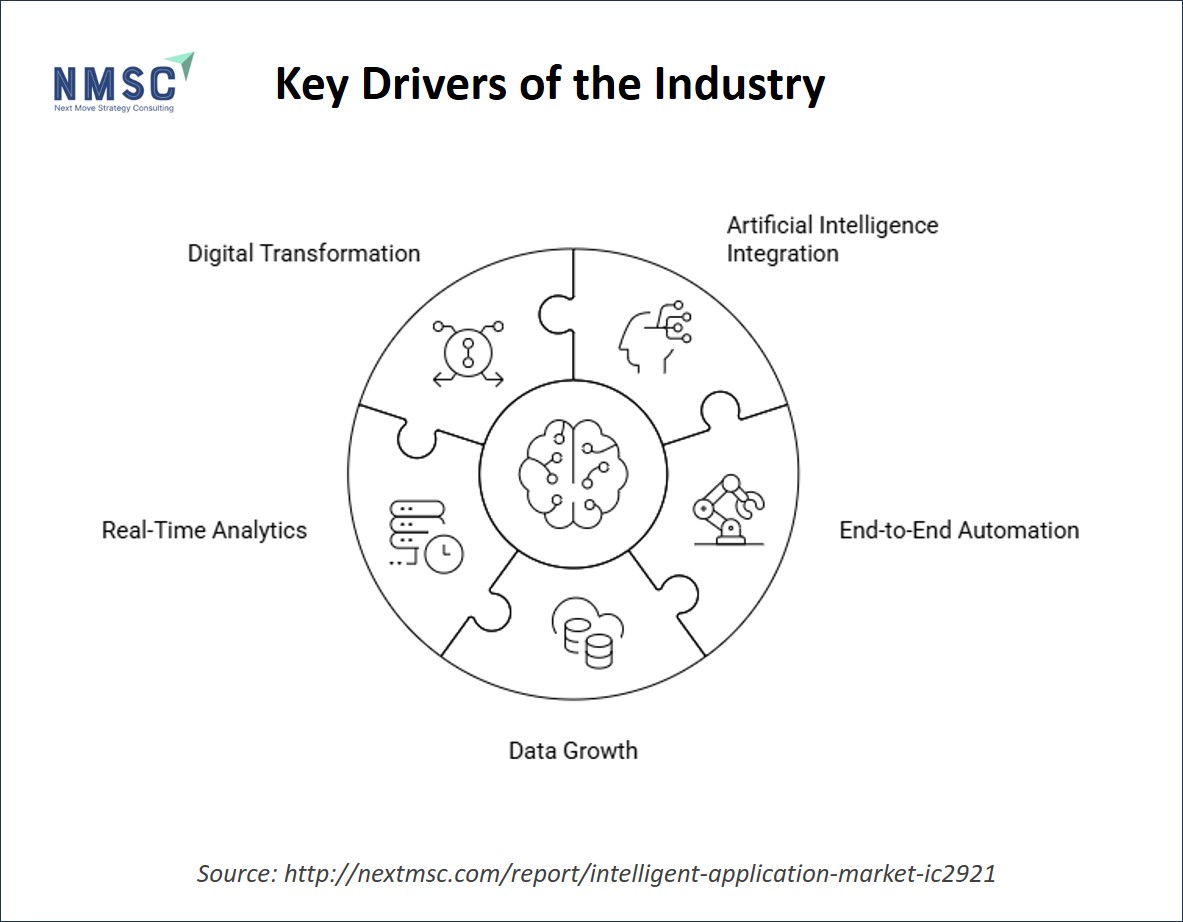
The market is growing due to the increasing need for automation, real-time decision-making, and system integration. Organizations are prioritizing solutions that can handle complex processes with minimal manual intervention.
Key Points:
-
Automation is a key driver
-
Data growth fuels adoption
-
Integration is essential
What Challenges Could Slow Market Growth?
What Barriers Exist?
-
Complex integration with legacy systems
-
High implementation costs
-
Lack of skilled professionals
-
Governance and trust issues in AI
Key Points:
-
Integration complexity is high
-
Costs remain a concern
-
Governance is essential
How Is Recent News Impacting the Intelligent Application Market?
Recent developments from Oracle and Baker Hughes indicate a shift toward AI-first and industry-specific intelligent applications.
Oracle is pushing the boundaries of enterprise AI, while Baker Hughes is proving the value of intelligent applications in industrial environments.
Key Points:
-
AI-first systems are emerging
-
Industrial adoption is rising
-
Competition is increasing
What Does the Future Hold for Intelligent Applications?
Future trends include agentic ecosystems, real-time intelligence, and industry-specific platforms, along with increased adoption of low-code AI tools.
Key Points:
-
AI agents will dominate
-
Real-time intelligence will grow
-
Adoption will expand across industries
Next Steps: What Should Businesses Do Now?
Actionable Takeaways
-
Invest in AI-ready infrastructure
-
Start with high-impact use cases
-
Integrate data across systems
-
Upskill teams in AI and analytics
-
Track innovations from leaders like Oracle and Baker Hughes
About the Author
 Sanyukta Deb
— Sanyukta Deb is Digital Marketing Team Lead at Next Move Strategy Consulting, where she has led content strategy and technical SEO for the firm's B2B market research publications for over 2 years. Her editorial process translates NextMSC's primary and secondary research — spanning technology, industrial, and consumer sectors — into commercial narratives, backed by search-intent, keyword, and competitive analysis. She brings 5 years of overall experience in digital marketing and content strategy.
Sanyukta Deb
— Sanyukta Deb is Digital Marketing Team Lead at Next Move Strategy Consulting, where she has led content strategy and technical SEO for the firm's B2B market research publications for over 2 years. Her editorial process translates NextMSC's primary and secondary research — spanning technology, industrial, and consumer sectors — into commercial narratives, backed by search-intent, keyword, and competitive analysis. She brings 5 years of overall experience in digital marketing and content strategy.
About the Reviewer
 Debashree Dey
— Debashree Dey is Assistant Manager at Next Move Strategy Consulting, where she supports cross-vertical market content and communications across diverse industries for 6 years. Her professional background includes senior content writing, communications, and published manuscript authorship, with experience developing audience-focused business narratives and maintaining clear, consistent messaging. Her role supports research-led content development and editorial quality across NextMSC publications.
Debashree Dey
— Debashree Dey is Assistant Manager at Next Move Strategy Consulting, where she supports cross-vertical market content and communications across diverse industries for 6 years. Her professional background includes senior content writing, communications, and published manuscript authorship, with experience developing audience-focused business narratives and maintaining clear, consistent messaging. Her role supports research-led content development and editorial quality across NextMSC publications.


















Add Comment