Why Are Gift Card Market Leaders Thriving in 2024–2025?

Introduction
The global gift card market is undergoing a structural transformation — one that extends well beyond seasonal gifting into the domains of corporate rewards, household budgeting, and digital payments infrastructure. According to Next Move Strategy Consulting's Gift Card Market report, the global gift card market is projected to reach USD 2,097.13 million by 2030, growing at a CAGR of 8.3% from 2022 to 2030. This trajectory reflects a market that has moved decisively from a retail novelty into a multi-purpose financial instrument embedded in e-commerce checkouts, employee benefits platforms, and mobile wallets worldwide.
What is accelerating this shift is not simply rising consumer demand, but a convergence of regulatory reform, platform consolidation, and a measurable behavioral change in how consumers use gift cards. Blackhawk Network's (BHN) 2026 Annual Gifting Research — conducted in January 2026 across 2,138 American adults — found that 77% of U.S. consumers plan to purchase gift cards in 2026, while the share using gift cards specifically for personal budgeting nearly doubled year-over-year, rising from 31% in 2025 to 56% in 2026.
For C-level executives and institutional investors, the gift card market now demands the same strategic attention as any other high-growth payments vertical.
For More Information: Download FREE Sample on Gift Card Market Report
From Plastic Rack to Payment Rail: The Forces Reshaping the Gift Card Market
The Tillo–Amilon Acquisition: Platform Consolidation Reaches a Tipping Point
The most consequential competitive event in the global gift card market in recent months was the September 2026 acquisition of Italy's Amilon by U.K.-based Tillo. The combined entity expects to process over £3 billion worth of gift cards in 2026 and grow 30% year-over-year, establishing what Tillo describes as "transatlantic leadership in rewards, incentives and gift cards." This deal is not an isolated event — it is the clearest signal yet that API-led aggregators are consolidating local market leaders to serve multinational corporate clients through a single platform, rather than managing fragmented country-by-country relationships.
The strategic logic is straightforward: corporate and B2B buyers — the segment that drives the largest share of gift card spend — require one contract covering multiple brands, countries, and currencies, integrated with HR and payroll systems through APIs. Platforms that cannot deliver this at scale are being absorbed or bypassed. The Tillo–Amilon deal follows Singapore-based Coda's July 2025 acquisition of Amsterdam-based Recharge, and Klarna's expansion of its Gift Card Store from the U.K. into Germany, Italy, and the Netherlands in March 2025 — a pattern of consolidation that is redrawing the competitive map of digital gift card distribution.
The Defensive Spending Phenomenon: Gift Cards as Budgeting Tools
BHN's 2026 research identified a behavioral shift with direct implications for market sizing and product strategy. The near-doubling of self-use gift card purchasing — from 31% to 56% of U.S. consumers year-over-year — reflects a deliberate consumer response to sustained affordability pressures. Grocery and dining prices ranked as a top concern among 72% of BHN survey respondents, while fuel price anxiety spiked 30% year-over-year.
Consumers are using gift cards to pre-commit spending to specific retailers, effectively creating self-imposed budget guardrails. This behavioral pattern has a measurable commercial consequence: BHN's research found that nearly 60% of shoppers spend beyond the original value of a gift card when redeeming it, with average upspend reaching USD 73 per redemption — up USD 5 since 2024. For retailers, this means gift card programs are not merely a gifting mechanism but a proven driver of incremental revenue per transaction.
Digital Gift Cards: The Fastest-Shifting Format
Blackhawk Network's May 2025 research on eGift card adoption recorded a 17.1% year-over-year growth rate in digital gift card usage, driven by instant delivery, mobile wallet integration, and the elimination of physical fulfilment costs. This growth is structurally supported by the expansion of digital wallet infrastructure: 4.5 billion consumers used digital wallets in 2025, a figure projected to reach 5.2 billion in 2026.
The practical consequence for issuers is that the cost-to-serve a digital gift card is materially lower than a physical card — no printing, no logistics, no in-store rack placement — while the redemption rate is higher because the card is immediately accessible in the recipient's mobile wallet. NMSC's proprietary research and analysis identifies the virtual gift card segment as a key growth driver within the broader market, particularly as mobile-first consumer cohorts in Asia-Pacific and North America accelerate adoption.
NMSC Strategic Perspective: What the Convergence of Consolidation, Regulation, and Behavioral Shift Means for Market Participants
NextMSC primary research and analysis identifies three structural forces that will determine competitive positioning in the gift card market through 2030:
First, platform reach is becoming the primary competitive moat. The Tillo–Amilon and Coda–Recharge acquisitions demonstrate that the market is bifurcating between global API-led aggregators capable of serving multinational corporate clients and specialist issuers operating within single ecosystems (Amazon, Apple, Starbucks). Mid-tier distributors without API infrastructure or cross-border compliance capability face the risk of becoming sub-distributors to the platforms that do.
Second, the B2B segment is the market's most durable revenue pool. Corporate and employee benefits programs generate recurring, contract-based volumes that are less sensitive to consumer sentiment cycles than retail gifting. Germany's EUR 50 monthly non-cash benefit allowance, France's EUR 200 per-event employer gift voucher exemption, and the U.K.'s £50 trivial benefit exemption each create predictable, recurring demand for compliant multi-merchant gift card products — demand that does not disappear when consumer confidence softens.
Third, regulatory harmonization is a competitive asset, not merely a compliance cost. The EU's endorsement of the final texts of the third Payment Services Directive (PSD3) and the Payment Services Regulation in April 2026 — with application expected from late 2027 into 2028 — will standardize the "limited network exclusion" that most closed-loop gift cards rely on across EU member states. Platforms that build licensing and compliance capability ahead of this transition will be positioned to capture corporate clients who need certainty across multiple jurisdictions.
Section Summary:
The gift card market's growth trajectory is being shaped by three simultaneous forces: platform consolidation through M&A, a behavioral shift toward self-use budgeting that is expanding the addressable consumer base, and accelerating digital format adoption supported by mobile wallet infrastructure.
-
Key Takeaway 1: Tillo's acquisition of Amilon (September 2026) signals that API-led aggregators are consolidating to serve multinational corporate clients — a structural shift that will disadvantage mid-tier distributors without cross-border platform capability.
-
Key Takeaway 2: The share of U.S. consumers using gift cards for personal budgeting nearly doubled year-over-year (31% to 56%), expanding the market's addressable use case beyond gifting into everyday financial management.
-
Key Takeaway 3: Digital gift card adoption is growing at 17.1% YoY, supported by 4.5 billion digital wallet users globally in 2025 — a distribution infrastructure that reduces issuer costs while increasing redemption rates.
-
Key Takeaway 4: The EU's PSD3 endorsement in April 2026 will standardize closed-loop card regulation across member states by 2027–2028, making compliance capability a competitive differentiator for platforms serving European corporate clients.
Industry Impact Analysis
Regulatory Reforms Are Redefining Issuer Obligations Across Three Continents
Three regulatory developments enacted in 2026 are materially changing the compliance obligations of gift card issuers and the consumer protections attached to their products.
California Senate Bill 22 (Effective April 1, 2026): California's SB 22 raised the mandatory gift card cash-out threshold from USD 10 to USD 15, requiring businesses to redeem gift card balances below USD 15 in cash upon consumer request. This change, enacted under California Civil Code Section 1749.5, applies to all gift cards sold in California and carries significant litigation exposure: legal observers noted that plaintiff attorneys were positioned to pursue enforcement actions from the law's effective date. For national retailers operating in California, this requires system-level changes to point-of-sale and balance-inquiry infrastructure.
New Zealand Fair Trading (Gift Card Expiry) Amendment (Effective March 16, 2026): New Zealand's Commerce Commission implemented new nationwide rules requiring all gift cards sold to consumers to carry a minimum three-year expiry from the date of sale, with clear disclosure of any applicable fees. For retailers operating in New Zealand, this eliminates the practice of issuing short-expiry promotional cards and requires a full audit of existing card terms.
EU Payment Services Directive 3 (PSD3) — April 2026 Endorsement: The European Parliament and Council endorsed the final compromise texts of PSD3 and the accompanying Payment Services Regulation in April 2026, with application expected from late 2027 into 2028. The critical change for the gift card industry is that the "limited network exclusion" — the regulatory carve-out that allows most closed-loop gift cards to operate without a full e-money license — will be set out in a directly applicable regulation rather than being interpreted country by country. High-volume and multi-merchant gift card programs operating across EU member states should expect more consistent and potentially more stringent scrutiny of whether their products qualify for the exclusion.
Fraud: The USD 212 Million Structural Risk That Regulation Has Not Yet Solved
Gift card fraud remains the most persistent structural risk in the market. The Federal Trade Commission received more than 41,000 fraud reports in 2024 representing USD 212 million in losses from scams paid with gift cards, according to the National Conference of State Legislatures citing FTC data. Gift cards accounted for approximately 1.5% of all fraud complaints filed with the FTC in 2024. Total consumer fraud losses reported to the FTC reached a record USD 15.9 billion in 2025, up from USD 12.5 billion in 2024, according to CNBC's June 2026 reporting on the FTC's annual data release.
The fraud risk is not limited to consumer scams. Automated bot attacks — such as the GiftGhostBot botnet documented by cybersecurity firm Distil Networks — systematically check millions of gift card numbers to identify those with active balances, enabling large-scale theft without physical card access. For issuers, this means that fraud prevention, tamper-evident packaging, and real-time balance monitoring are no longer optional features but baseline requirements for maintaining consumer trust and regulatory compliance.
Section Summary:
Regulatory reform across California, New Zealand, and the EU is simultaneously raising consumer protections and compliance costs for gift card issuers. Concurrently, fraud losses — USD 212 million in 2024 in the U.S. alone — represent a structural risk that is growing in sophistication faster than current issuer defenses.
-
Key Takeaway 1: California SB 22 (April 2026) raised the cash-out threshold to USD 15, creating immediate litigation exposure for non-compliant retailers operating in the state.
-
Key Takeaway 2: New Zealand's March 2026 amendment mandates a minimum three-year gift card expiry, eliminating short-expiry promotional card practices for all retailers in that market.
-
Key Takeaway 3: EU PSD3's April 2026 endorsement will standardize the limited network exclusion across member states by 2027–2028, requiring compliance investment from high-volume closed-loop issuers.
-
Key Takeaway 4: The FTC recorded USD 212 million in gift card fraud losses in 2024 across 41,000+ reports — a figure that underscores fraud prevention as a non-negotiable operational investment for issuers.
Key Data & Statistics
Consumer Gift Card Behavior — Key Metrics from BHN 2026 Annual Gifting Research
|
Metric |
2026 Finding |
Year-over-Year Change |
|
U.S. consumers planning to purchase gift cards |
77% |
— |
|
Consumers using gift cards for self-use budgeting |
56% |
+25 percentage points (from 31% in 2025) |
|
Consumers purchasing gift cards with loyalty points |
18% |
+4 percentage points since 2024 |
|
Average upspend per gift card redemption |
USD 73 |
+USD 5 since 2024 |
|
Consumers willing to spend beyond a $10 card's value |
74% |
— |
|
Gen Z/Millennial consumers planning social commerce gift card purchase |
~70% |
+19% vs. 2025 |
|
Gen X/Boomer consumers planning social commerce gift card purchase |
~33% |
+120% vs. 2025 |
|
Consumers using AI for gift shopping (younger cohorts) |
~50% |
— |
Future Outlook & Forecast
NMSC Forecast: USD 2,097.13 Million by 2030 at 8.3% CAGR
NextMSC primary research and analysis projects the global gift card market to reach USD 2,097.13 million by 2030, growing at a CAGR of 8.3% from 2022. This growth is underpinned by four structural drivers that NMSC's model identifies as durable through the forecast period.
Driver 1 — Smartphone and Digital Wallet Penetration: The GSMA Intelligence data cited in NMSC's research notes that 6.648 billion people — 83.37% of the global population — owned a smartphone as of 2022, a base that has continued to expand. As digital wallet infrastructure scales to 5.2 billion users in 2026, the distribution channel for virtual gift cards becomes structurally more accessible than any physical retail rack. This directly expands the addressable market for virtual gift card issuers without requiring proportional increases in distribution cost.
Driver 2 — Corporate and B2B Demand: The Incentive Research Foundation's research on U.S. corporate gift card programs found that companies purchase B2B gift cards for an average of 2.5 to 3 different audiences, with employees representing the primary recipient group. This multi-audience corporate demand generates recurring, contract-based volumes that are structurally more predictable than consumer retail gifting. The Incentive Research Foundation's 2026 industry outlook further notes that non-cash rewards — including gift cards — remain a priority for corporate incentive programs in North America and Europe.
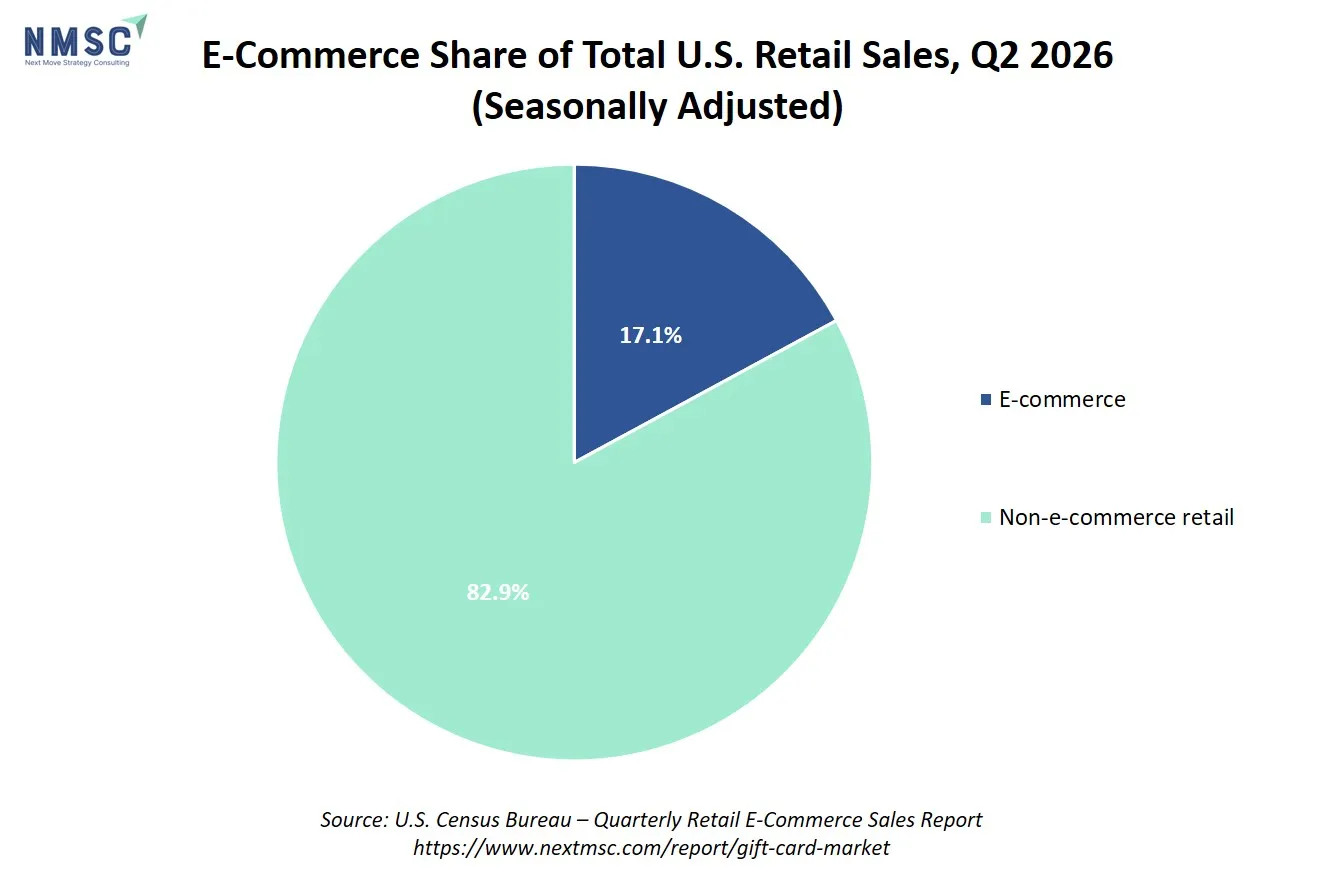
Driver 3 — E-Commerce Integration: As online retail continues to expand globally, digital gift cards are increasingly embedded directly into e-commerce checkout flows, banking apps, and buy-now-pay-later services. NMSC's analysis identifies the marketing and promotions application segment — encompassing e-commerce, fashion and lifestyle, gaming and entertainment, and online streaming — as a key growth area within the broader market, as platforms use gift cards to acquire and retain customers at lower cost than traditional advertising.
Driver 4 — Technological Innovation: QR code gift cards, AI-powered personalization, and big data-driven targeting are enabling issuers to differentiate their products and improve redemption rates. BHN's 2026 research found that nearly half of younger consumers are already using AI tools for gift shopping — comparing products, finding prices, and discovering gift card options — a behavioral pattern that will increasingly shape how gift card brands invest in digital discovery and AI-powered commerce integration.
Section Summary:
NMSC's forecast of USD 2,097.13 million by 2030 at 8.3% CAGR is supported by four durable structural drivers: expanding smartphone and digital wallet infrastructure, growing corporate B2B demand, deeper e-commerce integration, and AI-powered personalization. The primary risks to this trajectory are fraud escalation, regulatory compliance costs, and macro-driven compression of corporate benefits budgets.
-
Key Takeaway 1: Digital wallet user growth to 5.2 billion in 2026 directly expands the distribution infrastructure for virtual gift cards, reducing issuer cost-to-serve while increasing consumer accessibility.
-
Key Takeaway 2: Corporate B2B demand — driven by employee rewards, customer incentives, and loyalty programs — generates recurring, contract-based volumes that are more resilient to consumer sentiment cycles than retail gifting.
-
Key Takeaway 3: AI-powered gift shopping is already influencing nearly half of younger consumers' purchasing decisions, requiring gift card brands to invest in AI discovery and digital commerce integration to maintain visibility.
-
Key Takeaway 4: The primary downside risk to NMSC's 8.3% CAGR forecast is a combination of escalating fraud losses (USD 212 million in 2024 in the U.S. alone) and the compliance costs associated with PSD3 transition through 2027–2028.
Next Steps for Stakeholders
For C-Level Executives at Gift Card Issuers and Distributors:
The Tillo–Amilon acquisition establishes a clear strategic benchmark: platforms capable of processing £3 billion+ annually through a single API, across multiple countries and currencies, are becoming the preferred counterparty for multinational corporate clients. Executives at mid-tier distributors should conduct an immediate assessment of whether their platform architecture can support cross-border corporate programs, or whether a partnership or acquisition strategy is required to remain competitive as the market consolidates.
For Corporate HR and Procurement Leaders:
The regulatory landscape is shifting in ways that directly affect gift card program design. Germany's EUR 50 monthly non-cash benefit allowance, France's EUR 200 per-event employer gift voucher exemption, and the U.K.'s £50 trivial benefit exemption each set effective product denomination parameters for compliant corporate programs. HR and procurement teams should audit their current gift card programs against the post-April 2026 regulatory environment — particularly in California and New Zealand — and request licensing evidence from platform vendors ahead of the EU PSD3 transition in 2027–2028.
For Retail Merchants:
California SB 22's April 2026 effective date requires immediate POS system updates to support cash redemption of balances below USD 15. Merchants operating nationally should also review their gift card terms for compliance with the U.S. CARD Act's five-year minimum expiry and inactivity fee restrictions, as enforced by the FTC and FDIC. Merchants that have not yet integrated digital gift card options into their e-commerce checkout flows are leaving measurable upspend revenue on the table: BHN's data shows that 74% of consumers are willing to spend beyond the value of a USD 10 gift card, with average upspend of USD 73 per redemption.
For Institutional Investors:
The gift card market's most investable segment is the API-led aggregator category — platforms that combine merchant catalogue breadth, corporate distribution relationships, instant digital fulfilment, and fraud control infrastructure. Processed volume growth and corporate client retention rates are the most reliable leading indicators of platform value in this segment. The Tillo–Amilon deal's 30% year-over-year growth target provides a useful benchmark for evaluating comparable platforms. Investors should also monitor the EU PSD3 transition timeline, as compliance capability will become a barrier to entry for new market participants and a source of competitive advantage for established platforms.
For Fraud and Cybersecurity Teams:
The FTC's record of 41,000+ gift card fraud reports in 2024 — representing USD 212 million in losses — requires issuers to treat fraud prevention as a core product feature rather than a back-office function. Investment priorities should include real-time balance monitoring, bot detection for automated card-number attacks, tamper-evident physical card packaging, and consumer education programs aligned with FTC guidance on gift card scam identification.
Conclusion
The global gift card market is no longer a peripheral retail product category — it is a payments infrastructure segment with measurable B2B demand, regulatory complexity across three continents, and a consumer behavioral shift that is expanding its addressable use case from seasonal gifting into year-round financial management. NextMSC primary research and analysis projects the market to reach USD 2,097.13 million by 2030 at a CAGR of 8.3%, driven by digital wallet proliferation, corporate rewards demand, and e-commerce integration.
The events of 2026 — Tillo's acquisition of Amilon, California's SB 22, New Zealand's expiry rule reform, and the EU's PSD3 endorsement — collectively signal that the gift card market is entering a phase of regulatory maturation and competitive consolidation. Platforms with API reach, cross-border compliance capability, and robust fraud controls will capture a disproportionate share of the market's growth. Those without these capabilities face structural margin pressure as the market bifurcates between global aggregators and single-ecosystem closed-loop issuers.
For decision-makers across retail, corporate HR, fintech, and institutional investment, the gift card market's trajectory through 2030 warrants active strategic attention — not as a gifting category, but as a prepaid payments and engagement infrastructure with compounding network effects.
About the Author
 Sanyukta Deb
— Sanyukta Deb is Digital Marketing Team Lead at Next Move Strategy Consulting, where she has led content strategy and technical SEO for the firm's B2B market research publications for over 2 years. Her editorial process translates NextMSC's primary and secondary research — spanning technology, industrial, and consumer sectors — into commercial narratives, backed by search-intent, keyword, and competitive analysis. She brings 5 years of overall experience in digital marketing and content strategy.
About the Reviewer
 Debashree Dey
— Debashree Dey is Assistant Manager at Next Move Strategy Consulting, where she supports cross-vertical market content and communications across diverse industries for 6 years. Her professional background includes senior content writing, communications, and published manuscript authorship, with experience developing audience-focused business narratives and maintaining clear, consistent messaging. Her role supports research-led content development and editorial quality across NextMSC publications.
















Add Comment