Will Autonomous Emergency Braking Systems Dominate Road Safety in 2025?

Introduction
Road safety has entered a new legislative era. Across North America, Europe, and Asia-Pacific, regulators are no longer treating autonomous emergency braking (AEB) as a premium feature — they are mandating it as a baseline safety requirement for every new vehicle sold. This convergence of regulatory pressure, sensor miniaturization, and AI-driven detection capability is fundamentally restructuring the competitive and commercial landscape of the global automotive safety industry.
According to Next Move Strategy Consulting's Autonomous Emergency Braking System Market report, the global autonomous emergency braking system market was valued at USD 61.84 billion in 2024, estimated at USD 71.30 billion in 2025, and is projected to reach USD 145.29 billion by 2030, growing at a CAGR of 15.3%. This trajectory is not driven by broad technology enthusiasm — it is anchored in specific regulatory deadlines, measurable collision-reduction outcomes, and a rapidly expanding global vehicle fleet that now includes over 20 million electric cars sold in 2025 alone, each representing a new AEB integration opportunity.
For More Information: Download FREE Sample on Autonomous Emergency Braking System Market Report
Regulatory Mandates and Sensor Breakthroughs Converge to Redefine AEB
Euro NCAP's 2026 Protocol Overhaul: The Most Consequential Safety Revision in 17 Years
On November 26, 2025, Euro NCAP announced its most sweeping revision to vehicle safety assessment protocols since the introduction of its overall star-rating system in 2009. The updated framework, effective from 2026, restructures vehicle evaluation around four stages of safety: Safe Driving, Crash Avoidance, Crash Protection, and Post-Crash Safety — each scored independently out of 100 points.
The Crash Avoidance stage directly governs AEB performance. Under the new protocols, Euro NCAP has expanded AEB test scenarios beyond controlled highway conditions to include complex urban environments where vehicles routinely encounter powered two-wheelers, cyclists, and pedestrians crossing at irregular angles. A new "Low Speed Collisions" test category — which includes Cyclist Dooring scenarios — has been introduced, requiring AEB systems to detect and respond to stationary or slow-moving obstacles in confined urban spaces.
Dr. Michiel van Ratingen, Secretary General of Euro NCAP, stated: "The 2026 protocols further strengthen the rigour and relevance of our tests, rewarding vehicles that perform well across all stages of safety — before, during, and after a crash."
For automotive OEMs and Tier 1 suppliers, this revision has a direct commercial consequence: vehicles that previously achieved five-star ratings under the legacy protocol must now demonstrate AEB performance across a broader and more demanding set of real-world scenarios to maintain their ratings. This effectively raises the minimum sensor and software specification required for competitive positioning in the European market.
NHTSA FMVSS No. 127: A Compliance Deadline That Locks In USD Billions of AEB Spend
In April 2024, the U.S. National Highway Traffic Safety Administration (NHTSA) finalized Federal Motor Vehicle Safety Standard No. 127, mandating that all passenger cars and light trucks sold in the United States be equipped with AEB — including pedestrian AEB — by September 2029. The standard requires AEB systems to stop and avoid contact with a lead vehicle at speeds up to 62 miles per hour, apply brakes automatically up to 90 mph when a frontal collision is imminent, and detect pedestrians in both daylight and low-light conditions at speeds up to 45 mph.
NHTSA projects that FMVSS No. 127 will save at least 360 lives per year and prevent a minimum of 24,000 injuries annually once fully implemented across the U.S. light vehicle fleet. This mandate applies to nearly all U.S. light vehicles with a gross vehicle weight rating of 10,000 pounds or less, covering the vast majority of the consumer and commercial light-vehicle market.
The compliance deadline creates a non-negotiable procurement cycle for OEMs: every vehicle platform that does not currently meet FMVSS 127 performance thresholds must be re-engineered with upgraded radar, camera, or sensor fusion hardware before the 2029 model year. For suppliers, this represents a defined, time-bound revenue window that is independent of consumer preference cycles.
Bosch's SX600 and SX601 Radar SoCs: Raising the Hardware Floor for AEB Performance
In July 2025, Robert Bosch GmbH introduced two new radar system-on-chips — the SX600 and SX601 — designed specifically to support Level 2+ ADAS functions including AEB, adaptive cruise control, and lane-keeping assistance. Built on 22-nanometer RF-CMOS architecture and optimized for AI-based sensing, the SX600 targets cost-effective deployment while the SX601 delivers the highest computing power currently available in Bosch's radar portfolio, with approximately 30% greater detection range than its predecessor generation.
The significance of this launch extends beyond Bosch's own market position. By embedding AI-based signal processing directly into the radar SoC — rather than relying on a separate compute module — Bosch has reduced the bill-of-materials cost and physical footprint of high-performance AEB radar, making it commercially viable for mid-segment vehicle platforms that previously could not absorb the cost of premium sensor arrays. This architectural shift directly expands the addressable market for AEB systems beyond luxury and near-luxury segments into the volume passenger car market.
Valeo and Momenta: A Hardware-Software Alliance Targeting Global ADAS Scale
On September 5, 2025, Valeo — a global leader in ADAS hardware — and Momenta, a leading autonomous driving software company, signed a strategic partnership to jointly develop and commercialize advanced driver assistance systems, combining Valeo's sensor and actuator hardware expertise with Momenta's AI-driven perception and decision-making software stack.
This partnership is structurally significant for the AEB market because it addresses the primary integration bottleneck that has slowed AEB deployment in emerging markets: the gap between sensor hardware availability and the software calibration required to make AEB systems perform reliably across diverse road environments, traffic patterns, and weather conditions. By co-developing hardware-software integrated ADAS solutions, Valeo and Momenta are targeting OEM customers in both established and high-growth markets, including China, where electric car sales grew by nearly 40% year-on-year in 2024, raising China's share of global electric car sales to almost two-thirds, according to the International Energy Agency's Global EV Outlook 2025.
NMSC Strategic Perspective: Why This Regulatory-Technology Convergence Is Structurally Different
NextMSC primary research and analysis identifies the current period as a structural inflection point for the AEB market — distinct from prior growth phases driven primarily by consumer preference for premium safety features. Three concurrent forces are compressing the adoption timeline in a way that no single prior driver achieved independently:
First, the simultaneous activation of binding regulatory mandates in the two largest automotive markets — the U.S. (FMVSS 127, compliance by 2029) and the EU (Euro NCAP 2026 protocols, effective immediately) — eliminates the optionality that previously allowed OEMs to defer AEB integration in cost-sensitive vehicle segments. Second, the commercialization of AI-integrated radar SoCs at 22nm process nodes has reduced the per-unit hardware cost of AEB-grade radar to a level compatible with volume-segment vehicle economics, removing the cost barrier that historically confined high-performance AEB to vehicles priced above USD 35,000. Third, the rapid electrification of the global vehicle fleet — with the IEA's Global EV Outlook 2026 confirming that electric car sales exceeded 20 million globally in 2025, representing one in four new cars sold worldwide — is creating a new class of vehicle platforms that are designed from the ground up with integrated sensor architectures, making AEB integration structurally simpler and less costly than retrofitting it onto internal combustion engine platforms.
Section Summary: The AEB market's current growth trajectory is anchored in three concurrent, mutually reinforcing structural forces — binding regulatory mandates, AI-integrated radar hardware at volume-segment price points, and EV platform proliferation — rather than in discretionary consumer demand.
Key Takeaways:
-
Euro NCAP's 2026 protocol revision — the largest since 2009 — expands AEB test scenarios to complex urban environments, raising the minimum sensor specification for competitive five-star ratings.
-
NHTSA FMVSS No. 127 mandates AEB on all U.S. light vehicles by September 2029, creating a non-negotiable procurement cycle projected to save 360 lives and prevent 24,000 injuries annually.
-
Bosch's SX600/SX601 radar SoCs, built on 22nm RF-CMOS with AI-based sensing, extend AEB-grade radar performance to mid-segment vehicle economics.
-
The Valeo-Momenta partnership (September 2025) targets the hardware-software integration gap that has historically slowed AEB deployment in high-growth emerging markets.
Industry Impact Analysis
The Road Safety Imperative: Quantifying the Problem AEB Must Solve
The scale of the road safety crisis provides the clearest context for understanding why regulatory bodies across three continents have moved from voluntary guidelines to binding mandates within a compressed timeframe. According to the World Health Organization's July 2026 report on global road safety, road traffic crashes claimed 1.16 million lives in 2025 — a figure that, despite representing a 21% global decline from prior decades, remains the leading cause of death among children and young adults aged 5 to 29 years.
In the United States specifically, NHTSA's 2025 traffic fatality estimates recorded 36,640 deaths — a 6.7% decrease from 2024 and the second-lowest figure in recent years — yet the absolute number remains unacceptably high for a country where the majority of new vehicles are already equipped with some form of collision warning technology. The gap between the availability of AEB technology and its consistent, standardized deployment across all vehicle segments is precisely the gap that FMVSS 127 is designed to close.
Regional Market Dynamics: North America Leads, Asia-Pacific Accelerates
North America holds the dominant share of the global AEB market, a position reinforced by the FMVSS 127 mandate and the region's established culture of ADAS adoption among both OEMs and consumers. The U.S. market's compliance deadline structure — requiring full fleet coverage by September 2029 — means that OEM procurement decisions for AEB-compliant sensor and software systems are being made now, in the 2025–2027 planning cycle, creating immediate revenue for Tier 1 suppliers.
Asia-Pacific represents the fastest-growing regional market, driven by the intersection of rapid vehicle fleet expansion and government-led safety initiatives. The IEA's Global EV Outlook 2025 confirmed that electric car sales in China increased by nearly 40% year-on-year in 2024, with China accounting for almost two-thirds of global electric car sales. Each of these vehicles represents a new AEB integration point, and Chinese OEMs — competing aggressively on safety ratings in both domestic and export markets — are accelerating AEB adoption as a differentiator.
Europe is experiencing AEB market growth driven by the dual pressure of the EU's General Safety Regulation — which has required AEB on all new passenger vehicles since 2022 — and the newly announced Euro NCAP 2026 protocols, which raise the performance bar for AEB systems already installed in the market. Manufacturers whose existing AEB implementations were calibrated to the legacy Euro NCAP test scenarios must now invest in software updates and, in some cases, hardware upgrades to maintain competitive star ratings under the expanded urban scenario testing.
The EV-AEB Integration Opportunity
The global electric vehicle fleet's expansion is creating a structurally advantaged environment for AEB integration. Unlike internal combustion engine vehicles, where AEB systems must be integrated into pre-existing braking architectures that were not designed with electronic intervention in mind, electric vehicles are built around brake-by-wire and electronic stability control systems that are natively compatible with AEB actuation. This reduces integration complexity and cost, and enables faster response times — a critical performance parameter in pedestrian detection scenarios where reaction time differences of 50–100 milliseconds determine whether a collision is avoided or merely mitigated.
According to the IEA's Global EV Outlook 2026, global electric car sales exceeded 20 million in 2025, with one in four new cars sold worldwide being electric. As this fleet share continues to expand, the proportion of new vehicles with natively AEB-compatible braking architectures will grow correspondingly, reducing the per-vehicle integration cost and accelerating the economics of AEB standardization across all price segments.
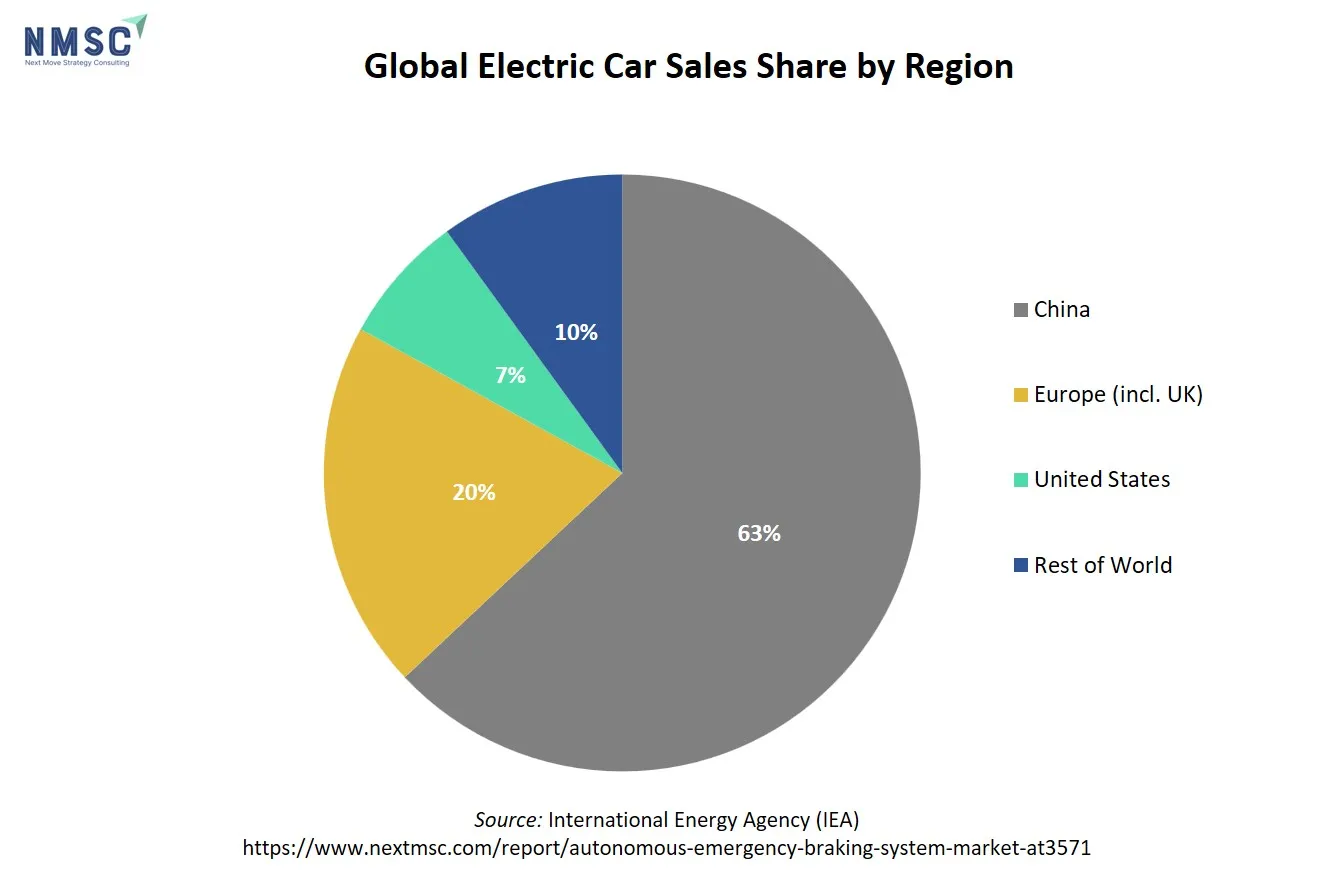
Section Summary: The AEB market's industry impact is shaped by a measurable road safety deficit, a regulatory compliance cycle that locks in procurement decisions years in advance, and the structural compatibility of electric vehicle platforms with AEB actuation systems.
Key Takeaways:
-
WHO's July 2026 report confirms 1.16 million road traffic deaths in 2025, sustaining the public health mandate for AEB standardization across all vehicle segments.
-
NHTSA recorded 36,640 U.S. traffic fatalities in 2025 — a 6.7% decline — yet the gap between AEB availability and universal deployment remains the primary policy target.
-
Asia-Pacific's AEB market growth is directly correlated with China's 40% year-on-year EV sales increase in 2024, as each new EV represents a natively AEB-compatible platform.
-
Europe's dual regulatory pressure — EU General Safety Regulation mandates plus Euro NCAP 2026 protocol upgrades — is forcing hardware and software investment even in vehicles already equipped with first-generation AEB.
Key Regulatory Milestones and Industry Developments Shaping the AEB Market
|
Event |
Date |
Key Requirement / Impact |
|
NHTSA FMVSS No. 127 Finalized |
April 2024 |
AEB mandatory on all U.S. light vehicles by September 2029; systems must detect pedestrians in daylight and darkness; projected to save 360+ lives/year |
|
EU General Safety Regulation — AEB Mandate |
2022 (existing models from December 2025) |
AEB mandatory on all new passenger vehicles in the EU; existing model lines required to comply from December 2025 |
|
Euro NCAP 2026 Protocol Revision Announced |
November 26, 2025 |
Largest revision since 2009; four-stage safety framework; expanded AEB urban test scenarios including powered two-wheelers, cyclists, and Cyclist Dooring |
|
Bosch SX600/SX601 Radar SoC Launch |
July 2025 |
22nm RF-CMOS radar chips with AI-based sensing and ~30% longer detection range; supports Level 2+ ADAS including AEB |
|
Valeo-Momenta ADAS Strategic Partnership |
September 5, 2025 |
Joint development and commercialization of ADAS systems combining Valeo hardware and Momenta AI software |
|
Global EV Sales Exceed 20 Million |
2025 |
One in four new cars sold globally was electric; China accounts for ~two-thirds of global EV sales |
|
Global Road Traffic Deaths (2025) |
July 2026 (WHO report) |
1.16 million road traffic deaths in 2025; road injuries remain leading cause of death for ages 5–29 |
Future Outlook & Forecast
The Path to USD 145.29 Billion: Segment and Technology Drivers
NextMSC primary research and analysis projects the global autonomous emergency braking system market will reach USD 145.29 billion by 2030, growing at a CAGR of 15.3% from 2025. This growth is distributed across technology, vehicle type, and regional dimensions in ways that carry distinct strategic implications for investors and operators.
By Technology: Radar-based AEB currently holds the largest technology segment share, driven by radar's all-weather, day-night detection capability — a performance characteristic that camera-only systems cannot replicate and that NHTSA's FMVSS 127 explicitly requires for pedestrian detection in darkness. However, AI-enhanced AEB — which integrates machine learning-based object classification directly into the sensor processing pipeline — represents the fastest-growing technology sub-segment, as demonstrated by Bosch's SX600/SX601 architecture and the Valeo-Momenta software integration model. Sensor fusion AEB, which combines radar, camera, and LiDAR inputs to eliminate the blind spots of any single sensor modality, is gaining traction in premium and commercial vehicle segments where the cost of a missed detection event — in both human and liability terms — justifies the higher system cost.
By Vehicle Type: Electric vehicles represent the highest-growth vehicle segment for AEB integration, driven by the structural compatibility of brake-by-wire architectures with AEB actuation and the regulatory emphasis on AEB in EV safety certification frameworks across the EU, U.S., and China. Commercial vehicles and heavy trucks represent a separate, high-value growth vector: NHTSA and the Federal Motor Carrier Safety Administration have a separate proposed rulemaking for AEB on heavy vehicles, which — when finalized — will add a substantial new compliance-driven procurement cycle on top of the light vehicle mandate.
By Region: Asia-Pacific's growth rate is projected to outpace all other regions through 2030, driven by China's EV fleet expansion, India's increasing vehicle safety regulation, and the entry of global OEMs offering AEB-equipped vehicles in Southeast Asian markets where safety awareness is rising alongside disposable incomes. North America will maintain the largest absolute market share through the FMVSS 127 compliance cycle, while Europe's market growth will be sustained by the Euro NCAP 2026 protocol's performance escalation requirements.
AI Integration: The Next Performance Frontier
The incorporation of artificial intelligence into AEB systems is transitioning from a differentiating feature to a competitive necessity. AI-based perception algorithms enable AEB systems to distinguish between a stationary vehicle, a pedestrian, a cyclist, and a roadside object with a level of contextual accuracy that rule-based sensor processing cannot achieve — particularly in the complex urban scenarios that Euro NCAP's 2026 protocols now test. NIO's Banyan 2.6.5 CN system, launched in July 2024, demonstrated AI-powered AEB capabilities that improved detection accuracy for vehicles, cyclists, and pedestrians simultaneously, reducing false-positive braking events that had previously undermined consumer acceptance of AEB in urban driving conditions.
As AI model training datasets expand — incorporating real-world edge cases from millions of connected vehicles — the detection accuracy and scenario coverage of AI-enhanced AEB systems will continue to improve, progressively reducing the performance gap between AEB and human driver reaction in complex, multi-agent traffic environments.
Section Summary: The AEB market's path to USD 145.29 billion by 2030 is driven by technology differentiation in AI-enhanced and sensor fusion systems, a new compliance-driven procurement cycle for heavy vehicles, and Asia-Pacific's structural growth advantage from EV fleet expansion.
Key Takeaways:
-
Radar-based AEB leads current technology adoption; AI-enhanced AEB is the fastest-growing sub-segment, enabled by SoC-level AI integration from suppliers such as Bosch.
-
Electric vehicles are the highest-growth vehicle segment for AEB, with brake-by-wire architectures reducing integration cost and enabling faster actuation response.
-
A separate NHTSA rulemaking for AEB on heavy vehicles — when finalized — will create an additional compliance-driven procurement cycle beyond the light vehicle mandate.
-
Asia-Pacific is projected to be the fastest-growing region through 2030, with China's EV fleet expansion serving as the primary structural growth driver.
Next Steps for Stakeholders
For OEM C-Suite Executives:
The FMVSS 127 compliance deadline of September 2029 is not a distant planning horizon — it is a current engineering and procurement decision. Vehicle platforms entering development now must be designed to meet the standard's 62 mph vehicle-to-vehicle and 45 mph pedestrian detection requirements. OEMs whose current AEB implementations rely on camera-only sensor architectures should initiate radar or sensor fusion integration assessments immediately, as the validation cycle for new sensor hardware typically spans 18–24 months before volume production readiness.
For Tier 1 Suppliers and Technology Providers:
The Euro NCAP 2026 protocol's expansion of AEB test scenarios to urban environments — including powered two-wheelers and Cyclist Dooring — creates a defined performance gap between legacy AEB calibrations and the new standard. Suppliers with AI-enhanced perception capabilities and urban-scenario training datasets are positioned to capture upgrade contracts from OEMs whose existing AEB systems were calibrated to the legacy highway-centric test protocol.
For Institutional Investors:
The AEB market's 15.3% CAGR through 2030 is underpinned by regulatory mandates in the two largest automotive markets — not by discretionary consumer demand — making it structurally more defensible than consumer-preference-driven ADAS segments. Investment theses should prioritize suppliers with dual exposure to both the light vehicle FMVSS 127 compliance cycle and the pending heavy vehicle AEB rulemaking, as the latter represents a second, largely unpriced revenue wave.
For Fleet Operators:
Commercial fleet operators should evaluate AEB retrofit options for existing vehicles ahead of any heavy vehicle mandate finalization. Early adoption of AEB in commercial fleets reduces collision-related liability exposure, lowers insurance premiums, and positions operators favorably with corporate customers who increasingly require safety certification as a procurement condition.
Conclusion
The global autonomous emergency braking system market is at a structural inflection point defined by the simultaneous activation of binding regulatory mandates, the commercialization of AI-integrated radar hardware at volume-segment price points, and the rapid expansion of an electric vehicle fleet whose native brake-by-wire architecture makes AEB integration faster and less costly than on any prior vehicle generation. According to NextMSC primary research and analysis, the market is projected to grow from USD 71.30 billion in 2025 to USD 145.29 billion by 2030 at a CAGR of 15.3% — a trajectory anchored in compliance-driven procurement cycles that are independent of consumer sentiment.
The Euro NCAP 2026 protocol revision, Bosch's SX600/SX601 radar SoC launch, and the Valeo-Momenta ADAS partnership collectively signal that the AEB market's next competitive frontier is not sensor availability — it is the intelligence, calibration accuracy, and urban-scenario performance of the software that processes sensor data. Organizations that invest in AI-enhanced AEB capabilities now will be positioned to capture both the light vehicle compliance cycle through 2029 and the heavy vehicle mandate that follows.
About the Author
 Sanyukta Deb
— Sanyukta Deb is Digital Marketing Team Lead at Next Move Strategy Consulting, where she has led content strategy and technical SEO for the firm's B2B market research publications for over 2 years. Her editorial process translates NextMSC's primary and secondary research — spanning technology, industrial, and consumer sectors — into commercial narratives, backed by search-intent, keyword, and competitive analysis. She brings 5 years of overall experience in digital marketing and content strategy.
About the Reviewer
 Debashree Dey
— Debashree Dey is Assistant Manager at Next Move Strategy Consulting, where she supports cross-vertical market content and communications across diverse industries for 6 years. Her professional background includes senior content writing, communications, and published manuscript authorship, with experience developing audience-focused business narratives and maintaining clear, consistent messaging. Her role supports research-led content development and editorial quality across NextMSC publications.

















Add Comment