Wireless Power Transmission Surges as EVs and Qi2 Drive Growth | NextMSC
Introduction
The global wireless power transmission market is undergoing a structural transformation — one driven not by incremental product upgrades, but by simultaneous convergence across three distinct fronts: the consolidation of electric vehicle charging infrastructure, the standardization of consumer device charging protocols, and the emergence of long-range power transfer technologies that are redefining what "wireless" means at scale. According to Next Move Strategy Consulting's Wireless Power Transmission Market report, the global wireless power transmission market was valued at USD 19.75 billion in 2025 and is projected to reach USD 147.88 billion by 2035, growing at a CAGR of 21.31% from 2026 to 2035.
This trajectory is not uniform across segments. NMSC's proprietary research identifies Electric Vehicle Charging Systems as the fastest-growing product category at a 26.57% CAGR, while Laser Power Transfer technology is expanding at 31.81% — the highest rate among all technology segments — as long-range, line-of-sight charging gains commercial traction in IoT and aerospace applications. Asia-Pacific anchors the market with approximately 66% of global revenue (USD 13.06 billion in 2025), while India registers the fastest country-level growth at 28.9% CAGR, reflecting the intersection of a large smartphone user base and accelerating electric vehicle adoption incentives.
For C-level executives and institutional investors, the critical question is no longer whether wireless power transmission will scale — the market's USD 121.89 billion absolute dollar opportunity between 2026 and 2035 settles that — but which technology platforms, certification standards, and geographic positions will capture disproportionate value as the market matures.
For More Information: Download FREE Sample on Wireless Power Transmission Market Report
From Niche to Infrastructure: The Events Reshaping Wireless Power Transmission
Electreon Acquires InductEV, Creating the First End-to-End Wireless EV Charging Platform
On March 10, 2026, Electreon Wireless Ltd. (TASE: ELWS) completed its acquisition of InductEV Inc., the U.S.-based provider of ultra-fast, high-power stationary wireless charging for heavy-duty transit and freight. The transaction created what Electreon describes as the industry's most comprehensive wireless EV charging portfolio — spanning dynamic in-road charging at highway speeds, semi-dynamic "burst" charging at bus stops and traffic lights, standard stationary depot charging, and InductEV's ultra-fast stationary systems for Class 8 trucks.
The strategic significance of this deal extends beyond portfolio breadth. The combined entity now holds nearly 400 granted and pending patents, and its Build America Buy America (BABA)-compliant manufacturing capability — inherited from InductEV's King of Prussia, Pennsylvania operations — positions the combined company to access U.S. federal transit funding that was previously unavailable to Electreon's offshore manufacturing model.
"Together with InductEV, we have created a truly global powerhouse," said Oren Ezer, CEO and Co-founder of Electreon, in the company's official press release dated March 10, 2026. "By combining our proven dynamic wireless product with InductEV's leadership in ultra-fast stationary charging, we offer powerful synergies in manufacturing and technology. We are now the only partner capable of delivering a wireless solution for every charging scenario, helping fleets go electric without compromising their operations."
This acquisition is a direct response to the scale of EV adoption now underway. According to the International Energy Agency's Global EV Outlook 2026, electric car sales grew 20% globally to exceed 20 million units in 2025, with one in four new cars sold worldwide being electric. Global EV sales are projected to reach 23 million in 2026, representing 28% of total car sales. The commercial fleet segment — buses, delivery vans, and Class 8 freight trucks — represents the highest-value near-term opportunity for wireless charging infrastructure, precisely because these vehicles operate on fixed routes where in-road and stationary charging infrastructure can be engineered into the route design from the outset.
Qi2 25W: The Standard That Ended Proprietary Wireless Charging Fragmentation
On July 23, 2025, the Wireless Power Consortium (WPC) launched Qi v2.2.1, commercially branded as Qi2 25W — the first standard to enable truly high-speed Qi-certified wireless charging. The new standard delivers nearly 70% more charging power than the original Qi2 (15W), which itself launched in November 2023. Fourteen devices — transmitters and receivers — completed Qi2 25W certification testing in a limited launch, with full-scale certification immediately opened to several hundred devices in the queue.
"Consumers will be delighted when they experience Qi2 25W as it delivers nearly 70% more power than the original Qi2," said Fady Mishriki, Chair of the WPC's Board of Directors, in the WPC's official press release dated July 23, 2025. "The number of devices in the Qi2 25W certification queue for launch is unprecedented, as is the quality and breadth of our members' product designs."
The commercial response was immediate. At CES 2026 on January 4, 2026, Belkin International, Inc. unveiled a full lineup of Qi2 25W-certified products, including the UltraCharge Pro 2-in-1 Convertible Charger and the UltraCharge Modular Charging Dock — both delivering 25W magnetic wireless charging with thermal management and cross-device compatibility. The WPC's own data indicates that within one year of the original Qi2 launch, over 1.5 billion certified Qi2 devices, transmitters, and receivers were in the global market — a scale of adoption that makes Qi2 25W's rollout structurally different from prior wireless charging standard transitions.
China's Space-Based Wireless Power Transmission Breakthrough Extends the Technology Frontier
In May 2026, researchers at Xidian University in Shaanxi Province, led by Duan Baoyan — a member of the Chinese Academy of Engineering — successfully demonstrated a ground-based system capable of wirelessly transmitting 1,180 watts of output power over a distance of more than 100 meters to multiple moving targets simultaneously. The system achieved a DC-to-DC transmission efficiency of 20.8%, up from 15.05% in the team's 2022 baseline, and demonstrated the ability to deliver a stable 143 watts to a drone flying at 30 kilometers per hour from 30 meters away.
The research team's long-term roadmap targets low-Earth-orbit technology verification during China's 15th Five-Year Plan (2026–2030), a megawatt-scale in-orbit test around 2030, and a commercial gigawatt-scale space solar power station by 2050. While the commercial timeline for space-based solar power remains long-dated, the near-term implication for the wireless power transmission market is the acceleration of microwave and laser power transfer research — the same technology families that NMSC's proprietary analysis identifies as the fastest-growing segments within the broader market.
NMSC Strategic Perspective: Why These Three Events Signal a Market Inflection Point
NMSC's analysis of the Electreon-InductEV acquisition, the Qi2 25W launch, and China's space-based WPT breakthrough collectively points to a market inflection that is qualitatively different from prior growth cycles in wireless power transmission.
The Electreon-InductEV deal resolves the single largest commercial barrier to fleet-scale wireless EV charging adoption: the absence of a single vendor capable of covering every charging scenario across vehicle classes. Fleet operators previously faced the complexity of integrating multiple vendors for dynamic, semi-dynamic, and stationary charging — a procurement and interoperability burden that slowed deployment decisions. The combined entity's end-to-end platform removes that barrier, and its BABA-compliant manufacturing capability unlocks access to U.S. federal infrastructure funding that was structurally inaccessible to non-compliant vendors.
The Qi2 25W standard's significance lies not in the wattage increment alone, but in the elimination of the proprietary fragmentation that previously constrained consumer wireless charging adoption. Prior to Qi2, multiple smartphone manufacturers operated incompatible fast-charging protocols, creating a market where consumers faced inconsistent charging speeds depending on which brand's charger they used. Qi2 25W's magnetic alignment architecture and cross-brand interoperability — now extending to major Android smartphones for the first time — compresses the adoption timeline for premium wireless charging accessories across the entire consumer electronics ecosystem.
China's space-based WPT breakthrough, while commercially distant, is materially relevant to the near-term market because it validates the engineering feasibility of long-range microwave and laser power transfer at power levels and efficiencies that were previously theoretical. This validation accelerates private-sector investment in RF and laser power transfer for terrestrial applications — precisely the technology segments that NMSC's research identifies as growing at 23.66% and 31.81% CAGRs respectively through 2035.
Section Summary:
-
The wireless power transmission market is being reshaped by three concurrent structural events — each addressing a distinct segment of the market's growth architecture.
-
Electreon's acquisition of InductEV on March 10, 2026 created the first end-to-end wireless EV charging platform spanning dynamic, semi-dynamic, and stationary charging for all vehicle classes, with nearly 400 combined patents and BABA-compliant manufacturing capability.
-
The WPC's Qi2 25W standard, launched July 23, 2025, delivers 70% more power than original Qi2 and extends the Qi2 ecosystem to major Android smartphones for the first time, with over 1.5 billion Qi2 devices already in the global market as a commercial foundation.
-
China's Xidian University team demonstrated 1,180W wireless power delivery over 100+ meters at 20.8% DC-to-DC efficiency in May 2026, validating long-range microwave power transfer at commercially relevant power levels.
-
NMSC's proprietary research identifies EV Charging Systems (26.57% CAGR) and Laser Power Transfer (31.81% CAGR) as the fastest-growing sub-segments, directly aligned with the commercial trajectories these events are accelerating.
Industry Impact Analysis
EV Adoption Scale Is Redefining the Addressable Market for Wireless Charging Infrastructure
The IEA's Global EV Outlook 2026 projects global EV sales to reach 23 million units in 2026, representing 28% of total car sales. This scale of adoption is not merely a demand signal for wireless charging — it is a structural prerequisite for the commercial viability of in-road dynamic charging infrastructure. Dynamic wireless charging corridors require a minimum density of compatible vehicles on a given route to generate the per-mile revenue that justifies the capital cost of embedding charging coils in road surfaces. As EV fleet density crosses commercial thresholds in key freight and transit corridors across Europe and North America, the business case for dynamic charging infrastructure — Electreon's core technology — becomes progressively more defensible.
The IEA further notes that electric truck sales more than doubled in 2025 compared with 2024, reaching 9% of all truck sales worldwide, with one in four trucks sold in China being electric. Heavy-duty commercial vehicles represent the highest-value application for wireless charging infrastructure because their fixed routes, high daily mileage, and operational uptime requirements make the total cost of ownership case for wireless charging — which eliminates cable handling, reduces battery size requirements, and enables continuous en-route charging — most compelling relative to conventional depot charging.
Qi2 25W Standardization Compresses the Consumer Charging Upgrade Cycle
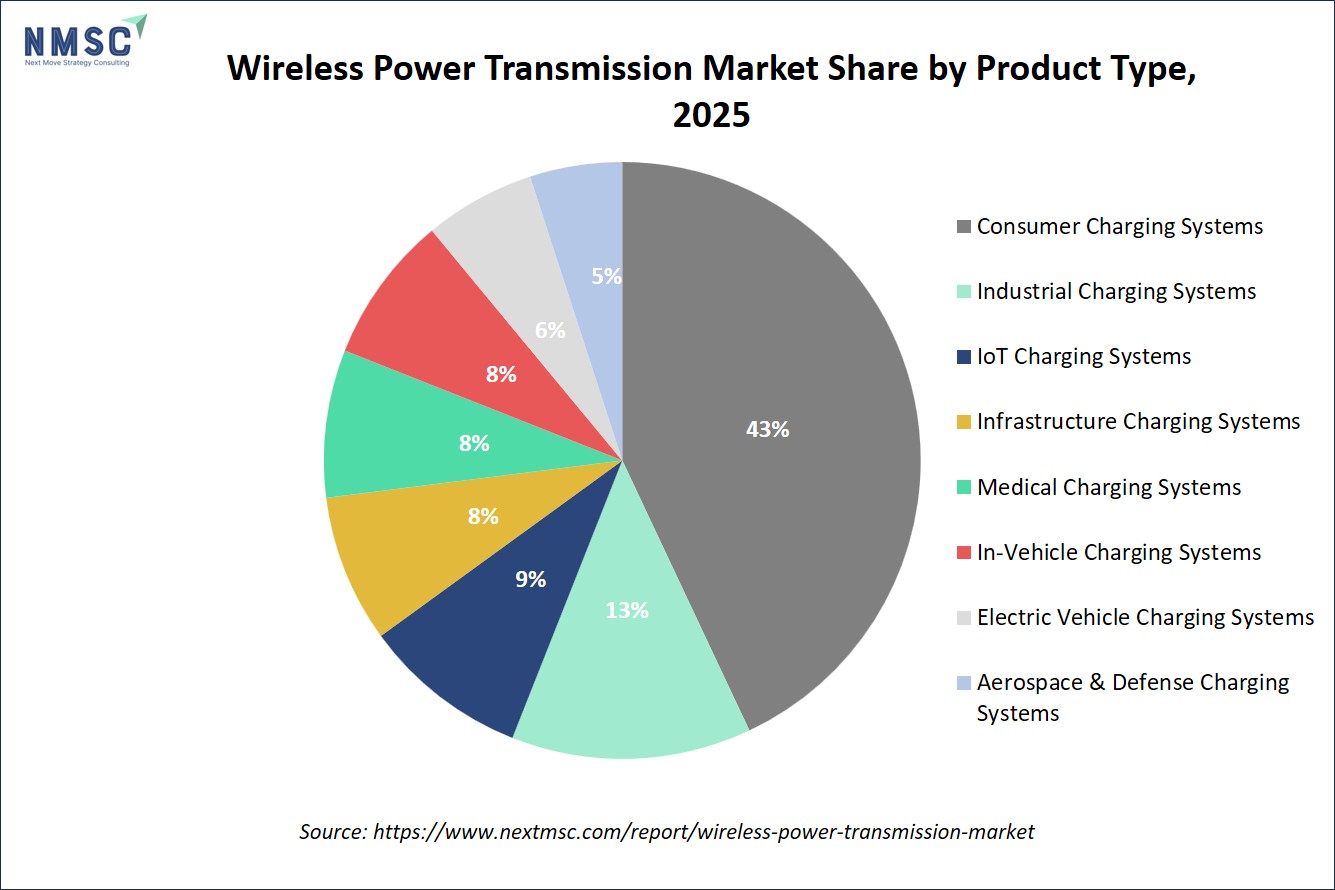
The consumer charging segment — which NMSC's research identifies as the largest product category at USD 8.42 billion in 2025 with approximately 43% market share — is entering an accelerated upgrade cycle driven by Qi2 25W adoption. The mechanism is specific: prior to Qi2, consumers who purchased a wireless charger from one brand frequently experienced degraded charging speeds when using it with a device from a different manufacturer. This interoperability gap suppressed repeat purchase rates and limited the premium accessory market. Qi2 25W's magnetic alignment architecture and cross-brand certification eliminate this friction, creating a unified premium tier that device manufacturers, accessory makers, and retailers can all market against a single performance benchmark.
Belkin's CES 2026 launch of Qi2 25W-certified chargers — including a modular dock that simultaneously charges a phone, earbuds, and smartwatch — illustrates how the standard is enabling a new category of multi-device charging accessories that were not commercially viable under prior fragmented protocols.
Industrial Automation Is Creating a Structurally New Demand Base for High-Power Inductive Charging
The industrial charging segment — valued at USD 2.66 billion in 2025 and growing at a 23.10% CAGR through 2035 per NMSC's proprietary research — is being driven by a demand pattern that is structurally distinct from consumer or EV charging. Automated guided vehicles (AGVs) and autonomous mobile robots (AMRs) in manufacturing and logistics facilities require continuous operation without manual battery swap interruptions. Wireless inductive charging docks embedded in factory floors enable these vehicles to charge opportunistically during natural operational pauses — at pick stations, loading bays, or queue points — without human intervention.
This demand pattern creates a recurring revenue model for industrial charging system vendors that is tied to the expanding installed base of warehouse and manufacturing automation — a base that is growing independently of consumer electronics or EV adoption cycles, providing the wireless power transmission market with a diversified demand architecture that reduces its exposure to any single end-market.
SAE J2954 and Qi2 Certification Breadth Are Becoming the Primary Competitive Differentiator
The SAE International J2954 standard establishes industry-wide specifications for wireless power transfer for light-duty electric vehicles, covering interoperability, electromagnetic compatibility, and safety at power levels up to 11 kW. As automakers integrate wireless charging into vehicle platforms, J2954 compliance is transitioning from a differentiating feature to a baseline procurement requirement. Vendors that hold J2954 certification alongside Qi2 and AirFuel Alliance certifications command a materially broader addressable customer base — spanning consumer electronics OEMs, automotive Tier 1 suppliers, and fleet infrastructure operators — than vendors certified under a single standard.
NMSC's analysis indicates that this certification breadth dynamic is compressing the competitive advantage of proprietary charging systems, as device manufacturers and fleet operators increasingly specify multi-standard interoperability as a procurement condition rather than a premium feature.
Section Summary:
The industry impact of current market developments is concentrated across four specific mechanisms, each with measurable commercial consequences.
-
The IEA's projection of 23 million global EV sales in 2026 (28% of total car sales) establishes the fleet density threshold that makes dynamic wireless charging corridor economics viable for commercial freight and transit operators.
-
Qi2 25W's cross-brand interoperability eliminates the proprietary fragmentation that previously suppressed premium wireless accessory repeat purchase rates, enabling a unified multi-device charging accessory category.
-
Industrial AGV and AMR charging represents a structurally independent demand base growing at 23.10% CAGR, insulated from consumer electronics and EV adoption cycle volatility.
-
SAE J2954 and Qi2 certification breadth are transitioning from differentiating features to baseline procurement requirements, concentrating competitive advantage among multi-standard certified vendors.
Key Industry Benchmarks — External Data Points (2025–2026)
|
Metric |
Value |
Source |
|
Global electric car sales in 2025 |
20+ million units (one in four new cars sold) |
IEA, Global EV Outlook 2026 |
|
Global EV sales projected for 2026 |
23 million units (28% of total car sales) |
IEA, Global EV Outlook 2026 |
|
Electric truck sales growth in 2025 vs. 2024 |
More than doubled; reached 9% of all truck sales worldwide |
IEA, Global EV Outlook 2026 |
|
Qi2 25W power output vs. original Qi2 |
~70% more power (25W vs. 15W) |
WPC, Qi2 25W Press Release, July 23, 2025 |
|
Certified Qi2 devices in global market (within 1 year of Qi2 launch) |
Over 1.5 billion devices, transmitters, and receivers |
WPC, Qi2 25W Press Release, July 23, 2025 |
|
China space-based WPT: output power delivered |
1,180W over 100+ meters to multiple moving targets |
China Daily, May 19, 2026 |
|
China space-based WPT: DC-to-DC transmission efficiency |
20.8% (up from 15.05% in 2022) |
China Daily, May 19, 2026 |
|
Electreon-InductEV combined patent portfolio |
~400 granted and pending patents |
Electreon, PR Newswire, March 10, 2026 |
Future Outlook & Forecast
The USD 147.88 Billion Destination: What the Path Looks Like by Segment and Region
NMSC's proprietary research projects the global wireless power transmission market to expand from USD 25.99 billion in 2026 to USD 147.88 billion by 2035, at a 21.31% CAGR — representing an absolute dollar opportunity of USD 121.89 billion over the forecast period. This growth is not evenly distributed across segments or geographies, and the divergence between the fastest and slowest-growing sub-segments is wide enough to materially affect investment returns depending on where capital is deployed.
At the technology level, Laser Power Transfer's 31.81% CAGR reflects the convergence of two independent demand streams: long-range IoT sensor charging in commercial buildings and retail environments (where Wi-Charge Ltd.'s infrared laser systems are already commercially deployed), and the aerospace and defense sector's requirement for line-of-sight power delivery to unmanned aerial vehicles and remote sensors. China's Xidian University breakthrough in May 2026 — demonstrating stable 143W delivery to a drone flying at 30 km/h — validates the engineering pathway for the latter application at power levels relevant to commercial UAV operations.
At the product level, Electric Vehicle Charging Systems' 26.57% CAGR — the fastest among all product categories — is anchored by the IEA's projection that the global EV fleet will grow more than sixfold by 2035 from 2025 levels, reaching as many as 510 million vehicles. As fleet density increases, the per-unit economics of in-road dynamic charging infrastructure improve, and the total cost of ownership advantage of wireless charging over conventional depot charging — smaller batteries, reduced cable handling, continuous en-route charging — becomes more pronounced for commercial fleet operators.
Asia-Pacific's Structural Advantage Will Compound Through 2035
Asia-Pacific's 22.06% CAGR — the fastest among all regions — reflects a structural advantage that is self-reinforcing: the region's consumer electronics manufacturing base generates the component supply chain, engineering talent, and production scale that enables faster and cheaper integration of wireless charging into new device categories. China's dominance in EV manufacturing — accounting for nearly 75% of electric cars produced globally in 2025 per the IEA — means that wireless charging integration decisions made by Chinese automakers propagate through the global EV supply chain. India's 28.9% CAGR — the fastest of any individual country in NMSC's analysis — reflects the intersection of a large and growing smartphone user base, accelerating EV adoption incentives, and international vendors localizing charging products for the Indian market.
The Expert View: Wireless Power as Foundational Infrastructure
"Wireless power is not what's next — it's NOW. And it is quickly becoming foundational infrastructure for smart home, AI, automation, and other industries," said Charles Goetz, CEO of Powercast, in the company's announcement ahead of CES 2026, describing the expanding role of wireless power across smart-home systems, AI, automation, robotics, data centers, and industrial applications.
NMSC's analysis supports this framing. The transition from wireless power as a consumer convenience feature to wireless power as enabling infrastructure for autonomous systems — AGVs, AMRs, IoT sensor networks, and eventually autonomous vehicles — is the structural shift that underpins the market's above-market CAGR through 2035. Each new autonomous system category that requires continuous, cable-free power delivery expands the addressable market for wireless power transmission beyond what consumer electronics adoption alone could sustain.
Section Summary:
-
NMSC's forecast of USD 147.88 billion by 2035 at a 21.31% CAGR reflects a market whose growth architecture is diversified across consumer, industrial, EV, and infrastructure applications — reducing single-segment concentration risk for investors.
-
Laser Power Transfer (31.81% CAGR) and EV Charging Systems (26.57% CAGR) offer the highest above-market growth rates, with distinct demand drivers — long-range IoT and aerospace for laser, and fleet electrification scale for EV charging.
-
Asia-Pacific's 22.06% CAGR is structurally self-reinforcing through its consumer electronics manufacturing base and EV production dominance; India's 28.9% CAGR represents the highest country-level growth opportunity in the forecast period.
-
The IEA's projection of a 510-million-vehicle global EV fleet by 2035 establishes the long-term demand foundation for wireless EV charging infrastructure investment, with commercial fleet applications offering the most defensible near-term economics.
-
The transition of wireless power from consumer convenience to enabling infrastructure for autonomous systems — AGVs, AMRs, IoT networks — is the structural shift that sustains above-market growth beyond the consumer electronics upgrade cycle.
Next Steps for Stakeholders
For C-Level Executives at Technology Vendors and OEMs:
Certification breadth across Qi2, AirFuel Alliance, and SAE J2954 standards should be treated as a non-negotiable baseline for any vendor seeking design wins across consumer electronics, automotive, and industrial customers simultaneously. The Electreon-InductEV acquisition demonstrates that the market is rewarding end-to-end platform capability over point-solution specialization — vendors that can serve multiple charging scenarios within a single customer relationship will command superior pricing power and lower customer acquisition costs as fleet operators and device manufacturers consolidate their supplier bases.
Product roadmaps should prioritize resonant inductive coupling for consumer and in-vehicle applications — where Qi2 25W adoption is accelerating — and higher power density inductive systems for industrial AGV and AMR applications, where the 23.10% CAGR reflects a demand base that is growing independently of consumer electronics cycles. Investment in RF and laser power transfer R&D is warranted for vendors with the balance sheet to sustain a 3–5 year development horizon, given the 31.81% CAGR that NMSC's research projects for laser power transfer through 2035.
For Institutional Investors and Financial Analysts:
The wireless power transmission market's USD 121.89 billion absolute dollar opportunity between 2026 and 2035 is distributed unevenly across sub-segments. Capital allocation decisions should weight EV Charging Systems (26.57% CAGR) and Laser Power Transfer (31.81% CAGR) as the highest-return entry points, with the caveat that EV charging infrastructure investments carry longer payback periods tied to fleet density thresholds, while laser power transfer investments carry higher technology risk but lower capital intensity.
Asia-Pacific — and India specifically at 28.9% CAGR — warrants overweight consideration relative to its current revenue share, given the structural tailwinds of consumer electronics manufacturing scale, EV adoption incentives, and international vendor localization activity. ESG-oriented portfolios should note that wireless power transmission's role in supporting electric mobility and reducing cable-related electronic waste aligns with sustainability-linked investment criteria, and that industrial wireless charging systems reduce manual battery handling risk in automated warehouse environments — a measurable workplace safety benefit.
For Fleet Operators and Infrastructure Developers:
The Electreon-InductEV combined platform's BABA-compliant manufacturing capability is a material consideration for U.S. transit agencies and federal contractors evaluating wireless charging infrastructure, as it determines eligibility for federal infrastructure funding. Fleet operators should evaluate dynamic and semi-dynamic wireless charging corridor deployments against the total cost of ownership framework — accounting for battery size reduction, elimination of cable handling labor, and continuous en-route charging — rather than comparing upfront infrastructure costs against conventional depot charging alone.
Conclusion
The wireless power transmission market's trajectory to USD 147.88 billion by 2035 is being shaped by events that are already in motion — not by speculative future developments. Electreon's acquisition of InductEV has resolved the platform fragmentation that previously constrained commercial fleet wireless charging adoption. The WPC's Qi2 25W standard has eliminated the proprietary interoperability barriers that suppressed premium consumer wireless charging accessory markets. And China's Xidian University breakthrough has validated long-range microwave power transfer at commercially relevant power levels, accelerating private-sector investment in the RF and laser technology segments that NMSC's research identifies as the market's fastest-growing.
For decision-makers, the wireless power transmission market's defining characteristic is its diversification across demand bases — consumer electronics, electric vehicles, industrial automation, IoT infrastructure, and medical devices — each growing at above-market rates and each driven by mechanisms that are structurally independent of one another. This diversification is the market's most durable investment attribute, and it is what distinguishes the wireless power transmission market's 21.31% CAGR from the single-driver growth stories that carry higher concentration risk. The question for stakeholders is not whether to engage with this market, but where within its USD 121.89 billion opportunity to position for maximum return.
About the Author
 Sanyukta Deb
— Sanyukta Deb is Digital Marketing Team Lead at Next Move Strategy Consulting, where she has led content strategy and technical SEO for the firm's B2B market research publications for over 2 years. Her editorial process translates NextMSC's primary and secondary research — spanning technology, industrial, and consumer sectors — into commercial narratives, backed by search-intent, keyword, and competitive analysis. She brings 5 years of overall experience in digital marketing and content strategy.
Sanyukta Deb
— Sanyukta Deb is Digital Marketing Team Lead at Next Move Strategy Consulting, where she has led content strategy and technical SEO for the firm's B2B market research publications for over 2 years. Her editorial process translates NextMSC's primary and secondary research — spanning technology, industrial, and consumer sectors — into commercial narratives, backed by search-intent, keyword, and competitive analysis. She brings 5 years of overall experience in digital marketing and content strategy.
About the Reviewer
 Debashree Dey
— Debashree Dey is Assistant Manager at Next Move Strategy Consulting, where she supports cross-vertical market content and communications across diverse industries for 6 years. Her professional background includes senior content writing, communications, and published manuscript authorship, with experience developing audience-focused business narratives and maintaining clear, consistent messaging. Her role supports research-led content development and editorial quality across NextMSC publications.
Debashree Dey
— Debashree Dey is Assistant Manager at Next Move Strategy Consulting, where she supports cross-vertical market content and communications across diverse industries for 6 years. Her professional background includes senior content writing, communications, and published manuscript authorship, with experience developing audience-focused business narratives and maintaining clear, consistent messaging. Her role supports research-led content development and editorial quality across NextMSC publications.















Add Comment