600-Store Ulta Debut and EU TPO Ban Reshape the Global Nail Care Market
Olive & June's 600-Store Ulta Beauty Debut and the EU's TPO Ingredient Ban Signal a Structural Reset for the Global Nail Care Product Market
On January 13, 2026, Olive & June — the DIY nail care brand acquired by Helen of Troy Limited under an agreement announced in November 2024 for USD 225 million in cash plus a USD 15 million performance-based earnout; the acquisition was completed on December 16, 2024— officially announced its nationwide debut at Ulta Beauty, the United States' largest beauty retailer, launching across 600 stores and on Ulta.com beginning January 18, 2026. The launch introduced more than 100 SKUs — including 18 Ulta-exclusive gel polish shades and the brand's first-ever in-store Mani System, available exclusively through Ulta — marking the first time a full-service DIY nail brand has occupied a dedicated 360-degree destination within a prestige beauty retailer in the United States. The transaction is not merely a distribution milestone; it is a structural signal that the at-home nail care segment has crossed the threshold from mass-market commodity to prestige beauty category — a reclassification with direct implications for pricing power, brand investment, and the addressable market for premium formulations.
This channel evolution arrives at a moment of sustained market expansion. According to Next Move Strategy Consulting's Nail Care Product Market report, the global nail care product market was valued at USD 28.55 billion in 2025 and is projected to reach USD 50.22 billion by 2035, growing at a CAGR of 5.81% from 2026 to 2035. The market is expected to reach USD 30.21 billion by the end of 2026, underpinned by three converging structural forces: the premiumisation of at-home nail routines accelerated by omnichannel retail expansion, the regulatory-driven reformulation of gel and colour products following the European Union's TPO ingredient ban, and the accelerating consumer shift toward clean, functional, and wellness-oriented nail care formulations that command higher average selling prices and generate stronger repeat purchase behaviour.
For More Information: Download FREE Sample on Nail Care Product Market Report
The Ulta Beauty Effect: How Prestige Retail Reclassifies the At-Home Nail Category
The Olive & June Ulta Beauty launch represents a significant expansion of DIY nail care into U.S. prestige beauty retail. Its significance lies not in the store count — 600 doors is a meaningful but not unprecedented retail footprint — but in what the partnership signals about where the nail care consumer now lives and how she shops.
"Beautiful nails for everyone has always been our mission, and we're thrilled to further expand our distribution from mass to prestige beauty retail with Ulta Beauty," said Sarah Gibson Tuttle, Founder and CEO of Olive & June, in the company's official press release dated January 13, 2026. "We have built and led the DIY movement in nails with our all-in-one Mani System and the Olive & June at-home educational method. For the first time ever, we're offering our signature Mani System in-store exclusively at Ulta Beauty. They're the perfect partner to bring our vision of a premium DIY nail destination to life."
Ulta Beauty's own merchandising leadership confirmed the strategic rationale. "This launch comes at a moment where the nail category is experiencing remarkable momentum, fueled by our guests' desire for self-care rituals and everyday moments of self-expression through their beauty routine," said Kaitlin Rinehart, Vice President of Merchandising at Ulta Beauty, in the same press release. "As they continue to embrace at-home artistry and elevated nail care, this partnership allows us to bring an even wider range of high-quality, accessible and simple solutions to their routines."
The brand's Gel Polish System, launched in October 2024, had already broken internal records — exceeding launch-day expectations by 156% and outperforming the brand's previous record launch by nearly 50% — before the Ulta partnership was announced. The Ulta debut positions Olive & June — already the No. 2 press-on nail brand in MULO (multi-outlet) retail — to compete directly with heritage salon brands including OPI, Essie, and Sally Hansen on prestige retail shelving for the first time.
According to NextMSC primary research and analysis, retail online distribution led the nail care product market in 2025 by sales volume and registered the highest CAGR, driven by brand-owned websites, e-commerce platforms, and influencer-led product discovery. The Olive & June Ulta partnership represents the physical retail complement to this digital-first growth trajectory — a recognition that the nail care consumer now operates across an interconnected purchasing ecosystem rather than a single channel.
The EU TPO Ban: Regulatory Pressure as a Formulation Catalyst
Concurrent with the retail channel shift, the European Union's enforcement of a full ban on Trimethylbenzoyl Diphenylphosphine Oxide (TPO) — a widely used photoinitiator in gel nail polish formulations — effective September 1, 2025, has imposed a mandatory reformulation requirement on every gel nail brand selling into EU markets. The ban, enacted under EU Cosmetics Regulation, classified TPO as a reproductive toxicant and prohibited its sale, marketing, and use in all cosmetics with no grace period for salons or distributors to sell through existing inventory. A further restriction — banning Silver (CI 77820) in nail products — took effect on May 1, 2026, under Commission Regulation (EU) 2025, extending the EU's ingredient scrutiny into decorative nail formulations.
The regulatory consequence is not merely compliance cost — it is a structural market accelerator for clean, non-toxic, and certified formulations. Brands that had already invested in TPO-free and HEMA-restricted formulations — including Kure Bazaar, Manucurist, and ella+mila — entered 2026 with a regulatory tailwind that their conventional competitors must now spend capital to replicate. According to NextMSC primary research and analysis, rising regulatory scrutiny across regions is increasing compliance requirements and adding operational complexity for manufacturers relying on traditional formulations, while simultaneously creating a durable competitive advantage for brands that proactively aligned product development with clean beauty and safety standards.
The U.S. Food and Drug Administration's Modernization of Cosmetics Regulation Act of 2022 (MoCRA) — the most significant expansion of FDA authority over cosmetics since the Federal Food, Drug, and Cosmetic Act — continues to extend its compliance requirements into 2026, including mandatory facility registration, product listing, and safety substantiation obligations that are reshaping how U.S. nail care brands manage their ingredient portfolios and supply chains.
Innovation Spotlight: Fiabila's SPF50+ Hybrid Nail Treatment and the Skinification of Nail Care
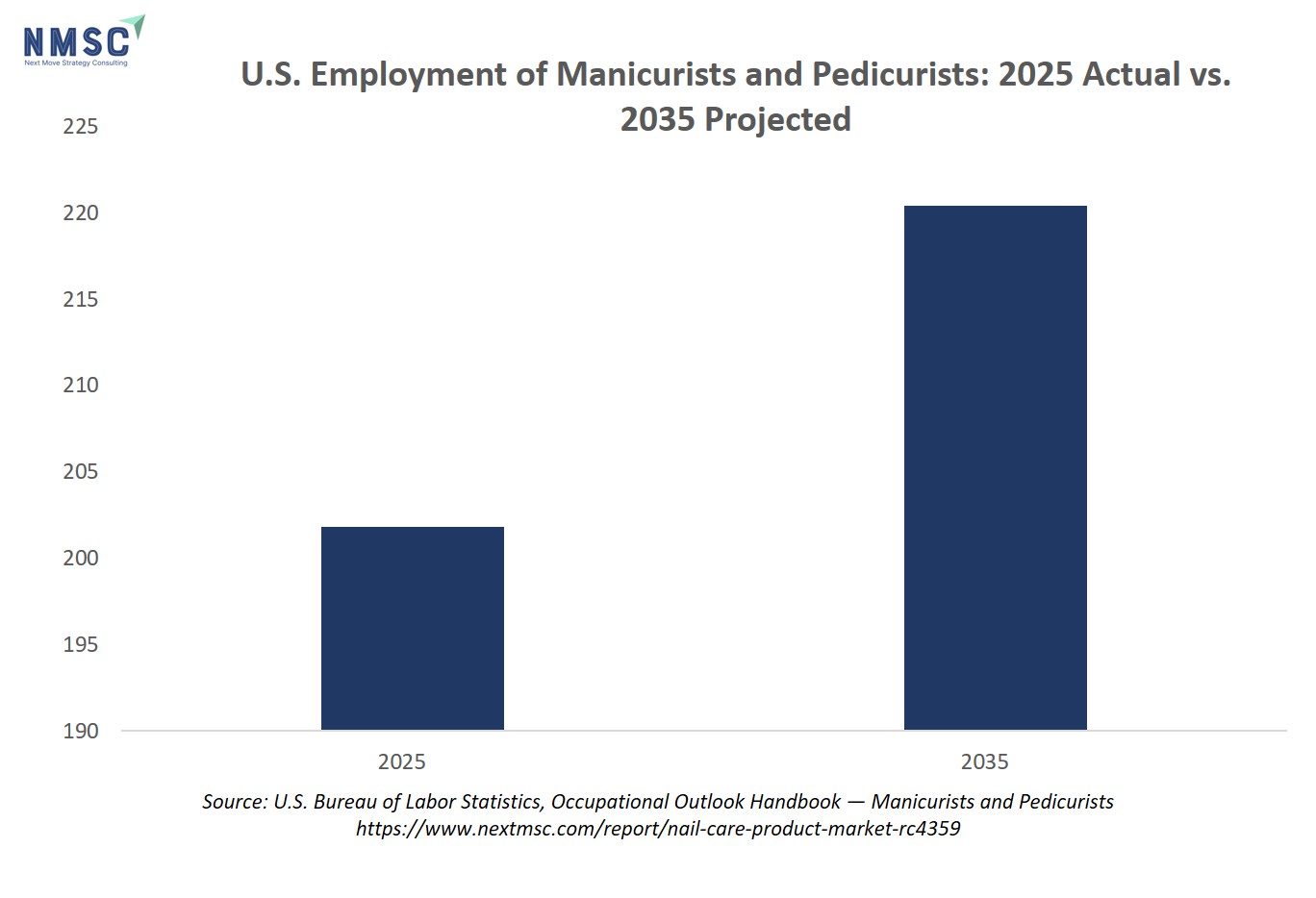
The regulatory environment is not the only force driving formulation innovation. In April 2025, French nail manufacturer Fiabila unveiled SPF50+ Base and Top — described as the first hybrid SPF50+ nail care formula with UVA/UVB sunscreen protection — a vegan base and top coat enriched with marine plant extract and antioxidants designed to prevent keratin oxidation caused by UV exposure and environmental pollution. The U.S. Bureau of Labor Statistics projects employment of manicurists and pedicurists to grow 9% from 2025 to 2035. Fiabila subsequently unveiled additional innovations at Cosmoprof Bologna in March 2026, including nail polishes with integrated SPF and a hybrid hair-and-nail care product — extending the skinification concept across adjacent personal care categories.
"Nail care products also take into account consumer demand for effective hybrid products with proven protective effects, whose ritual and use save time," said Candice Jagut, Marketing and Innovation Director at Fiabila, in an interview with Personal Care Insights published April 15, 2025. "The trend toward skinification calls for hair and nails to be treated in the same way as the skin, and for specific solutions to be found."
According to NextMSC primary research and analysis, nail treatment products — including nail strengtheners, repair serums, growth treatments, and conditioning formulations — registered the highest CAGR within the product type segmentation in 2025, as consumers increasingly adopted preventive and therapeutic nail care routines beyond purely cosmetic usage. Fiabila's SPF50+ innovation is a direct product-level expression of this structural shift: a formulation that simultaneously addresses UV protection, nail health restoration, and colour longevity — three distinct consumer needs resolved in a single SKU.
The Digital Commerce Accelerator: Beauty E-Commerce Growing 6x Faster Than In-Store
The channel dynamics reshaping the nail care product market are inseparable from the broader transformation of beauty retail. NielsenIQ's State of Beauty 2026 report, released March 31, 2026, confirmed that the global beauty market grew 10% year-over-year, with e-commerce expanding six times faster than in-store sales across 52 markets. The report further found that 53% of consumers now purchase beauty products through social platforms, 49% already receive beauty recommendations from generative AI, and 52% are willing to pay a premium for convenience — a consumer profile that maps directly onto the nail care product market's fastest-growing segments: online retail, at-home gel systems, and premium treatment formulations.
"Beauty is entering a new phase of growth defined by both resilience and rising complexity," said Tara James Taylor, Senior Vice President, Beauty Vertical at NielsenIQ, in the State of Beauty 2026 press release dated March 31, 2026. "Consumers are more intentional in how they spend, seeking products that deliver real value, simplicity, and wellbeing. At the same time, AI and digital commerce is transforming how consumers discover and evaluate products, shifting advantage to brands that show up clearly and consistently across digital ecosystems."
McKinsey & Company's State of Beauty report projects the global beauty market to grow at 5% annually, reaching USD 590 billion by 2030, with fragrance and premium personal care categories outperforming the broader market. Within this broader beauty expansion, nail care occupies a structurally advantaged position: it benefits from the same self-care and wellness tailwinds as skincare, while its relatively lower average transaction value and high purchase frequency generate the repeat engagement metrics that digital-first brands and omnichannel retailers prioritise.
The U.S. Bureau of Labor Statistics projects employment of manicurists and pedicurists to grow 9% from 2023 to 2033 — faster than the average for all occupations — reflecting sustained professional demand that complements the at-home segment's expansion rather than competing with it.
NMSC Strategic Perspective: Three Structural Forces Converging on a Single Market Inflection
According to NextMSC primary research and analysis, the nail care product market is not growing because of a single demand catalyst — it is growing because three structurally distinct forces are simultaneously expanding the addressable market, elevating average selling prices, and accelerating purchase frequency.
Force 1 — Prestige Channel Penetration Expanding the Addressable Consumer Base: The Olive & June Ulta Beauty launch is the most visible expression of a broader channel migration: nail care products are moving from mass-market shelving — where price competition compresses margins and limits brand differentiation — into prestige beauty retail environments where consumer education, in-store events, and curated assortments support premium pricing and higher basket sizes. According to NextMSC primary research and analysis, mid-range products dominated the nail care product market in 2025 by revenue share, while premium products registered the highest CAGR — a divergence that reflects the simultaneous expansion of the mass consumer base and the accelerating premiumisation of the engaged, routine-oriented nail care consumer. The Ulta partnership directly targets the premium CAGR segment by placing Olive & June's Mani System — a USD 10 press-on product with salon-quality positioning — in an environment where the consumer is already primed to invest in beauty routines.
Force 2 — Regulatory-Driven Reformulation Creating Durable Competitive Moats: The EU's TPO ban and the U.S. FDA's MoCRA compliance requirements are not temporary headwinds — they are permanent structural changes to the cost and complexity of operating in the nail care product market. Brands that have already invested in clean, non-toxic, and certified formulations — and that can substantiate their safety claims with clinical data — are positioned to capture the premium segment while their conventional competitors absorb reformulation costs. This dynamic is particularly pronounced in Europe, where NextMSC primary research and analysis identifies regulatory compliance and sustainability credentials as the primary purchasing criteria for both professional salon buyers and retail consumers.
Force 3 — Skinification of Nail Care Expanding the Treatment Segment: The convergence of nail care with skincare principles — driven by consumer demand for functional, health-oriented formulations that address nail brittleness, keratin damage, UV exposure, and cuticle health — is structurally expanding the nail treatment product segment beyond its historical niche. Fiabila's SPF50+ Base and Top, Kure Bazaar's Vernis Lumière next-generation polish, and the broader proliferation of keratin-enriched, vitamin-fortified, and botanically sourced nail formulations reflect a consumer who no longer separates nail aesthetics from nail health. According to NextMSC primary research and analysis, nail treatment products registered the highest CAGR within the product type segmentation in 2025, confirming that the treatment segment — not the colour segment — is the primary growth engine for the market's premium tier.
Major Industry Developments in the Nail Care Product Market (2025–2026)
|
Development |
Company / Entity |
Nature |
Strategic Significance |
|
Nationwide Ulta Beauty Launch — 600 Stores, 100+ SKUs |
Olive & June (Helen of Troy Limited) |
Omnichannel retail expansion |
First full-service DIY nail brand at a U.S. prestige beauty retailer; Mani System available in-store for the first time; signals prestige reclassification of at-home nail care |
|
EU TPO Ingredient Ban — Full Prohibition in All Cosmetics |
European Union (EU Cosmetics Regulation) |
Regulatory enforcement |
Mandatory reformulation for all gel nail brands in EU markets; no sell-through grace period; accelerates clean-label and TPO-free product development globally |
|
EU Silver (CI 77820) Ban in Nail Products |
European Union (Commission Regulation EU 2025) |
Regulatory enforcement |
Extends EU ingredient scrutiny into decorative nail formulations; reinforces compliance burden for conventional nail colour brands |
|
SPF50+ Base and Top Launch — First Hybrid UV-Protective Nail Formula |
Fiabila |
Product innovation |
Industry's first hybrid SPF50+/UVA-UVB nail care formula with marine plant extract; 95% of clinical trial users reported stronger nails after three weeks |
|
Fiabila x Incoco — Wear Ever Manicure Strips Launch |
Fiabila / Incoco (South Korea) |
Strategic product collaboration |
Real nail polish strips offering instant application and long-lasting wear; expands Fiabila's at-home product portfolio into the press-on and strip segment |
|
Olive & June Acquisition by Helen of Troy Limited |
Helen of Troy Limited / Olive & June |
M&A |
USD 225 million acquisition; provides Olive & June with capital and distribution infrastructure to execute prestige retail expansion |
Segmentation Analysis: Where the Market's Growth Is Concentrated
According to NextMSC primary research and analysis, the nail care product market's segmentation reveals a clear bifurcation between volume leadership and growth leadership — a pattern that has direct implications for brand strategy and investment allocation.
By Product Type: Nail colour and finish products — encompassing regular nail polish, gel nail polish, long-wear formulations, and breathable polishes — dominated revenue in 2025 due to broad consumer usage, high purchase frequency, and fashion-driven consumption. However, nail treatment products registered the highest CAGR, driven by rising consumer adoption of nail strengtheners, repair serums, growth treatments, and anti-fungal formulations as part of structured preventive nail health routines.
By Formulation Type: Solvent-based formulations maintained the largest revenue share in 2025, supported by reliable adhesion, gloss performance, and fast-drying characteristics valued by both retail consumers and professional salons. Gel-based and powder-based formulations are emerging as high-growth segments, driven by durability, premium positioning, and the expanding adoption of at-home and salon-based enhancement systems. Water-based and eco-conscious formulations are gaining traction among health- and sustainability-focused consumers — a segment directly accelerated by the EU's TPO ban and MoCRA compliance requirements.
By Price Category: Mid-range products dominated the market in 2025, balancing affordability with performance and safety claims. Premium products registered the highest CAGR, driven by premiumisation, salon-grade positioning, and brand-led differentiation — a dynamic directly reinforced by the Olive & June Ulta Beauty launch, which positions a USD 10 press-on product within a prestige retail environment.
By Distribution Channel: Retail online distribution led sales in 2025 and registered the highest CAGR, driven by brand-owned websites, e-commerce platforms, and influencer-led product discovery. Offline retail maintained a significant share, while the Olive & June Ulta partnership signals a renewed strategic investment in physical prestige retail as a brand-building and consumer education channel.
By End User: Home consumers held the largest share in 2025, supported by the structural growth of at-home manicure routines and DIY kit adoption. Nail salons, independent nail technicians, and spas recorded the fastest growth, driven by rising salon density, demand for professional-grade gel and enhancement systems, and the U.S. Bureau of Labor Statistics' projection of 9% employment growth for manicurists and pedicurists through 2033.
Regional Dynamics: North America Premiumises, Europe Regulates, Asia-Pacific Scales
|
Region |
Primary Demand Driver |
Key Development (2025–2026) |
Formulation Priority |
|
North America |
Prestige retail expansion; at-home gel system adoption; influencer-driven product discovery |
Olive & June launches in 600 Ulta Beauty stores (January 2026); Helen of Troy USD 225M acquisition provides capital for national retail scaling |
Premium gel systems, treatment serums, clean-label polishes, DIY manicure kits |
|
Europe |
Regulatory compliance; sustainability credentials; certified clean beauty |
EU TPO ban (September 2025); EU Silver ban in nail products (May 2026); EU anti-greenwashing directive pushing sustainability substantiation |
TPO-free gel formulations, vegan and cruelty-free polishes, botanically sourced treatments, ISO-certified clean formulations |
|
Asia-Pacific |
Urbanisation; digital retail; K-beauty nail art innovation; social commerce |
South Korea functions as regional trendsetter; China's social commerce (Douyin livestreaming accounts for 70% of beauty sales) drives nail product discovery |
Gel polishes, nail art systems, press-on nails, advanced enhancement systems |
|
Latin America |
Rising disposable income; personal grooming awareness; biodiversity-inspired botanicals |
Gradual retail infrastructure expansion; growing e-commerce penetration in Brazil, Argentina, and Colombia |
Affordable colour polishes, natural ingredient formulations, accessible treatment products |
|
Middle East & Africa |
Urbanisation; premium and clean-beauty trend adoption; salon service expansion |
Increasing salon density in Gulf economies; digital platform-driven product discovery |
Premium polishes, wellness-oriented treatments, natural and halal-certified formulations |
Bottom Line
The global nail care product market is undergoing a structural reset driven by three simultaneous forces: the prestige retail reclassification of at-home nail care — exemplified by Olive & June's January 2026 launch across 600 Ulta Beauty stores — the European Union's mandatory TPO ingredient ban that took effect September 1, 2025, compelling gel nail brands to reformulate or exit EU markets, and the accelerating skinification of nail care that is expanding the treatment product segment at the highest CAGR within the market. NielsenIQ's State of Beauty 2026 report confirms that global beauty e-commerce is growing six times faster than in-store sales — a channel dynamic that disproportionately benefits nail care brands with strong digital communities, direct-to-consumer capabilities, and omnichannel distribution strategies. According to NextMSC primary research and analysis, the global nail care product market is projected to grow from USD 30.21 billion in 2026 to USD 50.22 billion by 2035 at a CAGR of 5.81% — a trajectory anchored by premiumisation, regulatory-driven clean formulation adoption, and the irreversible consumer shift from purely cosmetic nail usage toward preventive, therapeutic, and wellness-oriented nail care routines.
About Next Move Strategy Consulting
Next Move Strategy Consulting is a premier market research and management consulting firm that has been committed to provide strategically analysed well documented latest research reports to its clients. The research industry is flooded with many firms to choose from, what makes NMSC different from the rest is its top-quality research and the obsession of turning data into knowledge by dissecting every bit of it and providing fact-based research recommendation that is supported by information collected from over 500 million websites, paid databases, industry journals and one on one consultations with industry experts across a diverse range of industry sectors. The high-quality customized research reports with actionable insights and excellent end-to-end customer service help our clients to take critical business decisions that enables them to move beyond time and have competitive edge in the industry.
We have been servicing over 1000 customers globally that includes 90% of the Fortune 500 companies over a decade. Our analysts are constantly tracking various high growth markets and identifying hidden opportunities in each sector or the industry. We provide one of the industry's best quality syndicate as well as custom research reports across 10 different industry verticals. We are committed to deliver high quality research solutions in accordance to your business needs. Our industry standard delivery solutions that ranges from the pre consultation to after-sales services, provide an excellent client experience and ensure right strategic decision making for businesses.
For more information, please contact:
Next Move Strategy Consulting
5th Floor 867 Boylston St, STE 500,
Boston, MA 02116, U.S.
E-Mail: [email protected]
Direct: +1-217-650-7991
Website: www.nextmsc.com
About the Author
 Sanyukta Deb
— Sanyukta Deb is Digital Marketing Team Lead at Next Move Strategy Consulting, where she has led content strategy and technical SEO for the firm's B2B market research publications for over 2 years. Her editorial process translates NextMSC's primary and secondary research — spanning technology, industrial, and consumer sectors — into commercial narratives, backed by search-intent, keyword, and competitive analysis. She brings 5 years of overall experience in digital marketing and content strategy.
Sanyukta Deb
— Sanyukta Deb is Digital Marketing Team Lead at Next Move Strategy Consulting, where she has led content strategy and technical SEO for the firm's B2B market research publications for over 2 years. Her editorial process translates NextMSC's primary and secondary research — spanning technology, industrial, and consumer sectors — into commercial narratives, backed by search-intent, keyword, and competitive analysis. She brings 5 years of overall experience in digital marketing and content strategy.
About the Reviewer
 Debashree Dey
— Debashree Dey is Assistant Manager at Next Move Strategy Consulting, where she supports cross-vertical market content and communications across diverse industries for 6 years. Her professional background includes senior content writing, communications, and published manuscript authorship, with experience developing audience-focused business narratives and maintaining clear, consistent messaging. Her role supports research-led content development and editorial quality across NextMSC publications.
Debashree Dey
— Debashree Dey is Assistant Manager at Next Move Strategy Consulting, where she supports cross-vertical market content and communications across diverse industries for 6 years. Her professional background includes senior content writing, communications, and published manuscript authorship, with experience developing audience-focused business narratives and maintaining clear, consistent messaging. Her role supports research-led content development and editorial quality across NextMSC publications.

















Add Comment