ABB-Jacobi Deal Sparks Warehouse Robotics Industry Update
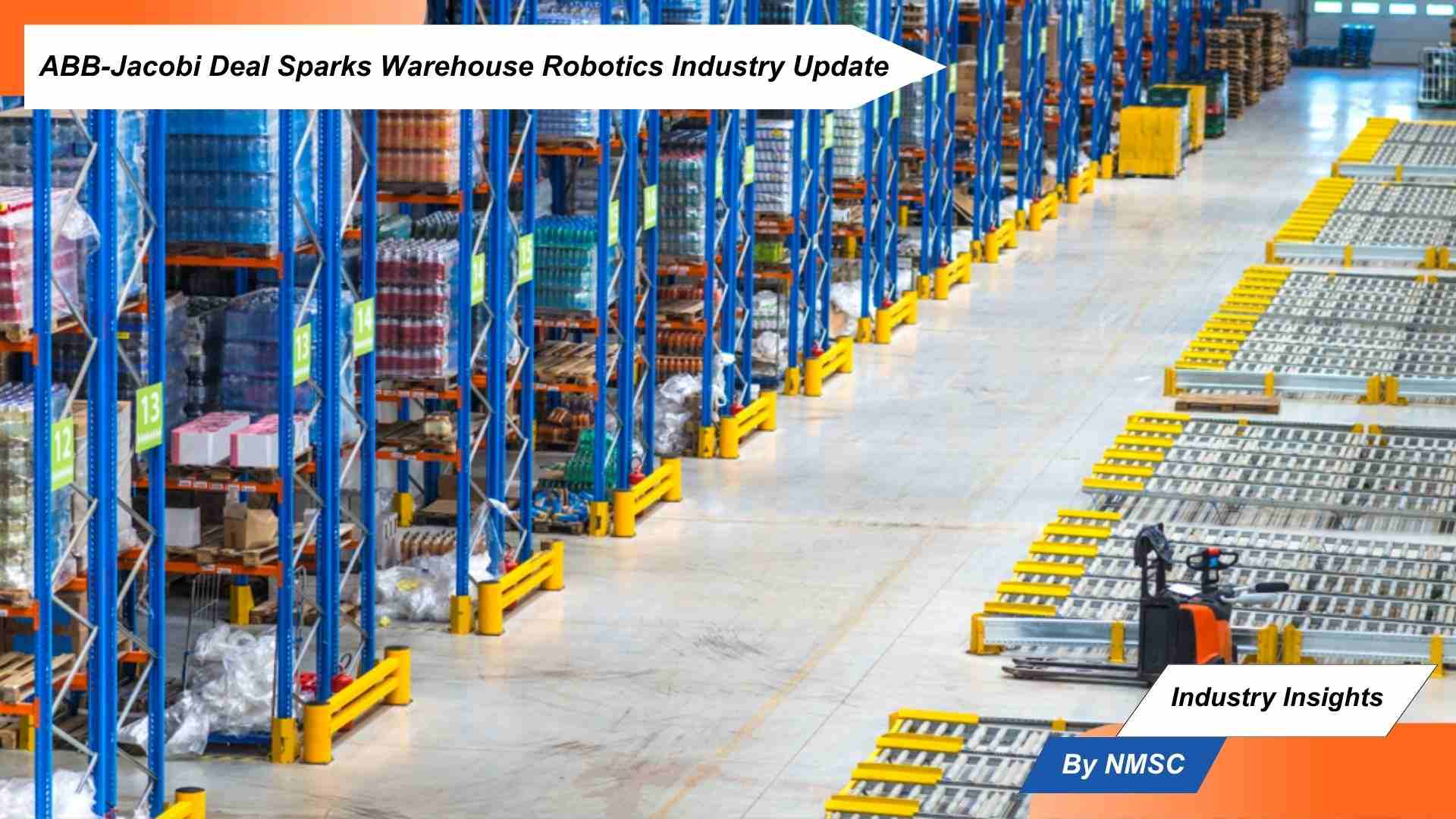
ABB-Jacobi AI Palletizing Alliance Reshapes Warehouse Robotics Expansion; Industry Forecast Raised
ZURICH, Switzerland — April 27, 2026 — ABB’s newly announced collaboration with Jacobi Robotics to deploy AI-powered mixed-case palletizing across its global integrator ecosystem is emerging as a significant inflection point for warehouse automation, signaling faster commercialization of physical AI in distribution environments. The partnership, unveiled earlier this month, integrates Jacobi’s OmniPalletizer software directly into ABB’s industrial robotics stack, enabling system integrators to deliver repeatable palletizing automation without costly warehouse redesigns.
The development arrives as logistics operators face mounting labor shortages, throughput bottlenecks, and rising pressure to automate high-cost manual handling tasks. Mixed-case palletizing—long considered one of the most difficult warehouse workflows to automate—has historically remained dependent on labor-intensive sequencing systems and customized engineering. ABB and Jacobi’s integrated approach removes much of that complexity, potentially widening adoption across grocery, retail, parcel, and third-party logistics facilities.
A Strategic Shift from Pilot Robotics to Productized AI Deployment
Unlike traditional robotic palletizing cells that require highly structured upstream processes, Jacobi’s OmniPalletizer uses physical AI, adaptive motion planning, and digital twin validation to build stable mixed-load pallets directly from live, unsequenced case flows. By embedding this capability into ABB’s global robotics hardware and service infrastructure, the companies are effectively turning a previously bespoke automation challenge into a scalable, channel-ready industrial solution.
Key operational differentiators include:
-
Brownfield-Ready Installation: Designed for deployment into existing conveyor environments without major facility shutdowns.
-
AI-Based Real-Time Adaptation: Continuously responds to carton size, weight, and arrival variability.
-
Digital Twin ROI Validation: Throughput and pallet stability tested against customer order history before installation.
-
Integrator-Friendly Standardization: ABB channel partners can now implement a validated software-hardware bundle rather than build custom logic from scratch.
Industry observers note that this materially lowers the entry barrier for mid-sized warehouses that previously lacked the capital or engineering bandwidth for advanced robotic palletizing.
Why This Matters for the Warehouse Robotics Market
According to analysts at Next Move Strategy Consulting (NMSC), the ABB-Jacobi collaboration marks an important transition in the warehouse robotics market—from isolated robotic deployments toward software-defined automation platforms that can be replicated globally through integrator channels.
“Physical AI is moving from proof-of-concept to industrial distribution,” notes Sikha Haritwal, Senior Research Analyst at Next Move Strategy Consulting. “What makes this announcement commercially relevant is ABB’s ability to industrialize Jacobi’s software through a trusted deployment network. That shortens implementation cycles, improves ROI visibility, and accelerates automation uptake among conventional warehouses.”
NMSC analysts further indicate that integrator-led robotics standardization could become one of the fastest-growing revenue catalysts in the next phase of warehouse modernization, especially as distribution operators seek lower-risk alternatives to greenfield automation.
Competitive Momentum Builds Beyond a Single Partnership
The market response has been immediate. Within days of the ABB announcement, additional industrial solution providers began aligning with Jacobi Robotics to commercialize the same AI palletizing architecture for broader supply chain deployments—an early indicator that mixed-case palletizing is shifting from niche innovation to mainstream warehouse investment priority.
This growing partner ecosystem suggests that demand is no longer centered on robotics hardware alone, but increasingly on interoperable AI software layers capable of continuous learning and fleet-wide optimization.
Warehouse Automation Enters Its Next Commercial Phase
ABB’s partnership with Jacobi Robotics is more than a software integration announcement—it reflects the broader industrial realization that warehouse efficiency gains will now come from intelligent orchestration, not just mechanized movement.
As AI-enabled pallet formation, adaptive case handling, and digital simulation become deployable through standard integrator channels, the warehouse robotics market is expected to witness a measurable acceleration in adoption across brownfield distribution centers globally.
For an industry long constrained by implementation cost and engineering complexity, April’s ABB-Jacobi announcement may prove to be one of 2026’s clearest signals that scalable physical AI has officially entered mainstream logistics automation.
Source: Robotics & Automation News
Prepared By: Joydeep Dey
About the Author
 Sanyukta Deb
— Sanyukta Deb is Digital Marketing Team Lead at Next Move Strategy Consulting, where she has led content strategy and technical SEO for the firm's B2B market research publications for over 2 years. Her editorial process translates NextMSC's primary and secondary research — spanning technology, industrial, and consumer sectors — into commercial narratives, backed by search-intent, keyword, and competitive analysis. She brings 5 years of overall experience in digital marketing and content strategy.
Sanyukta Deb
— Sanyukta Deb is Digital Marketing Team Lead at Next Move Strategy Consulting, where she has led content strategy and technical SEO for the firm's B2B market research publications for over 2 years. Her editorial process translates NextMSC's primary and secondary research — spanning technology, industrial, and consumer sectors — into commercial narratives, backed by search-intent, keyword, and competitive analysis. She brings 5 years of overall experience in digital marketing and content strategy.
About the Reviewer
 Debashree Dey
— Debashree Dey is Assistant Manager at Next Move Strategy Consulting, where she supports cross-vertical market content and communications across diverse industries for 6 years. Her professional background includes senior content writing, communications, and published manuscript authorship, with experience developing audience-focused business narratives and maintaining clear, consistent messaging. Her role supports research-led content development and editorial quality across NextMSC publications.
Debashree Dey
— Debashree Dey is Assistant Manager at Next Move Strategy Consulting, where she supports cross-vertical market content and communications across diverse industries for 6 years. Her professional background includes senior content writing, communications, and published manuscript authorship, with experience developing audience-focused business narratives and maintaining clear, consistent messaging. Her role supports research-led content development and editorial quality across NextMSC publications.
















Add Comment