Agentic AI Sends Shockwaves Across Global Software Markets
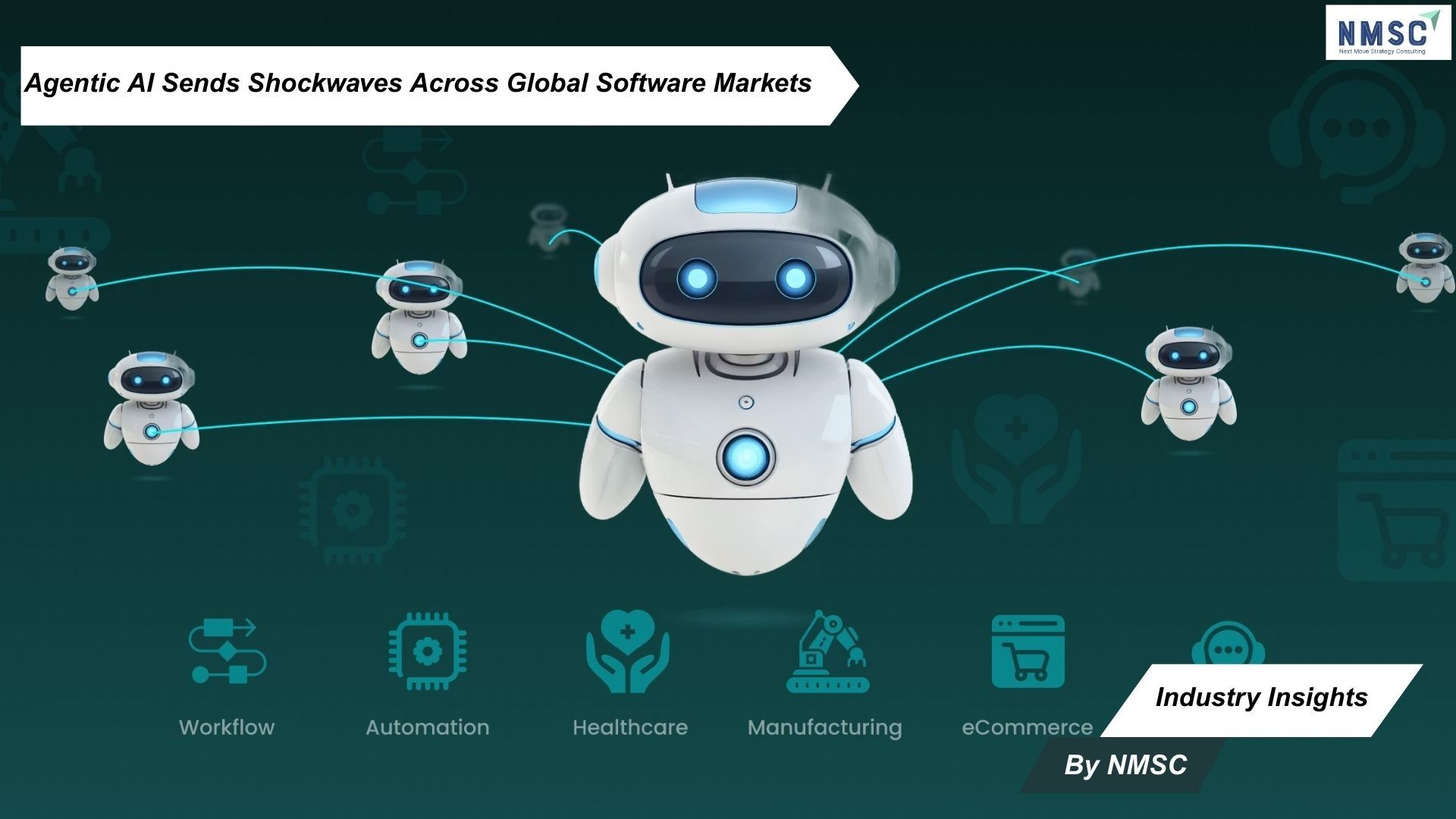
Industry Insights from Next Move Strategy Consulting
The rapid evolution of agentic AI reached a critical inflection point following Anthropic’s release of a new automation tool designed for legal workflows. While positioned as a functional enhancement, the announcement triggered widespread market volatility, underscoring how autonomous AI agents are reshaping investor sentiment and competitive dynamics across software-driven industries.
According to reports cited by Reuters, the launch sparked fears that agentic AI capabilities could disrupt entrenched software providers in sectors heavily reliant on knowledge work, including legal services, finance, and enterprise software. The response was swift and pronounced, illustrating the growing influence of AI agents not only on operational models, but also on financial markets.
Market Reaction Highlights AI’s Expanding Influence
In the days following the release, the S&P 500 software and services index declined sharply, falling nearly nine percent over five trading sessions and dropping more than 20 percent from its October high. The Nasdaq 100 Index also registered losses, reflecting broader unease among technology investors. Companies with significant exposure to legal and enterprise software were particularly affected. Thomson Reuters experienced a steep multi-day stock decline, while other major software and cybersecurity firms saw notable downward pressure before partial stabilization. Analysts interpreted this selloff as a reaction to the perceived acceleration of competition enabled by agentic AI tools.
The Rise of Agentic AI in Knowledge Work
At the center of the market reaction is a new plugin for Anthropic’s Claude Cowork AI agent, introduced to support tasks such as contract review, compliance workflows, and agreement triage. Anthropic emphasized that outputs require review by licensed professionals, reinforcing that the tool is not a replacement for human judgment but an automation layer within existing workflows. Despite these caveats, the release amplified concerns that agentic AI could reduce dependence on specialized software platforms by embedding autonomous task execution directly into AI systems. Analysts noted that the move signaled intensifying competition, particularly within legal technology ecosystems.
Caution Tempering the Hype
Industry experts have urged restraint in extrapolating the immediate impact of agentic AI. Research cited in the coverage indicates that AI adoption has not yet translated into measurable revenue or productivity gains at scale. Additionally, the legal sector has already encountered challenges linked to AI inaccuracies, including fabricated citations and erroneous outputs. Market commentators highlighted that concerns around security, data ownership, and reliability remain unresolved, limiting the near-term ability of agentic AI to fully displace mission-critical enterprise software.
Next Move Strategy Consulting’s View
From Next Move Strategy Consulting’s perspective, the market reaction to Anthropic’s release reflects a pivotal moment for the Agentic AI Market. Rather than signaling imminent disruption, the volatility illustrates heightened sensitivity to AI agents as strategic assets with long-term implications. Investors are recalibrating expectations as agentic AI transitions from experimental deployments to domain-specific applications. The episode reinforces that agentic AI is emerging as a competitive differentiator, capable of influencing valuation narratives even before widespread operational impact is realized. As enterprises and regulators continue to assess risks, governance, and real-world performance, the agentic AI market is expected to evolve cautiously, shaped as much by trust and accountability as by technological capability.
A Defining Phase for Autonomous AI Systems
Anthropic’s announcement demonstrates how agentic AI developments can reverberate far beyond product roadmaps, influencing market confidence and strategic outlooks across the software landscape. As autonomous AI agents gain visibility, their role in shaping industry structures and investment behavior is becoming increasingly difficult to ignore.
Source: Futurism
Prepared by: Next Move Strategy Consulting
About the Author
 Sanyukta Deb
— Sanyukta Deb is Digital Marketing Team Lead at Next Move Strategy Consulting, where she has led content strategy and technical SEO for the firm's B2B market research publications for over 2 years. Her editorial process translates NextMSC's primary and secondary research — spanning technology, industrial, and consumer sectors — into commercial narratives, backed by search-intent, keyword, and competitive analysis. She brings 5 years of overall experience in digital marketing and content strategy.
Sanyukta Deb
— Sanyukta Deb is Digital Marketing Team Lead at Next Move Strategy Consulting, where she has led content strategy and technical SEO for the firm's B2B market research publications for over 2 years. Her editorial process translates NextMSC's primary and secondary research — spanning technology, industrial, and consumer sectors — into commercial narratives, backed by search-intent, keyword, and competitive analysis. She brings 5 years of overall experience in digital marketing and content strategy.
About the Reviewer
 Debashree Dey
— Debashree Dey is Assistant Manager at Next Move Strategy Consulting, where she supports cross-vertical market content and communications across diverse industries for 6 years. Her professional background includes senior content writing, communications, and published manuscript authorship, with experience developing audience-focused business narratives and maintaining clear, consistent messaging. Her role supports research-led content development and editorial quality across NextMSC publications.
Debashree Dey
— Debashree Dey is Assistant Manager at Next Move Strategy Consulting, where she supports cross-vertical market content and communications across diverse industries for 6 years. Her professional background includes senior content writing, communications, and published manuscript authorship, with experience developing audience-focused business narratives and maintaining clear, consistent messaging. Her role supports research-led content development and editorial quality across NextMSC publications.















Add Comment