AI in Loan Processing Market Size, Share, Trends and Growth Analysis, By Loan Type (Consumer Loans, Mortgage Loans, SME Loans, Commercial Loans, Auto Loans, Student Loans), By Function (Loan Origination, Credit Decisioning, Workflow Automation, Risk and Compliance, Loan Servicing, Collections and Recovery, Embedded Lending), By Deployment Model, By Revenue Stream, By Enterprise Size, By Sales Channel, By Buyer Type, and Region -- Global Industry Report and Forecast, 2026–2035
Industry: BFSI | Publishing Date: July 18, 2026 | Last Updated: September 30, 2026 | No of Pages: N/A | No. of Tables: N/A | No. of Figures: N/A | Format: PDF | Report Code: BF5214
What Is the AI in Loan Processing Market Size?
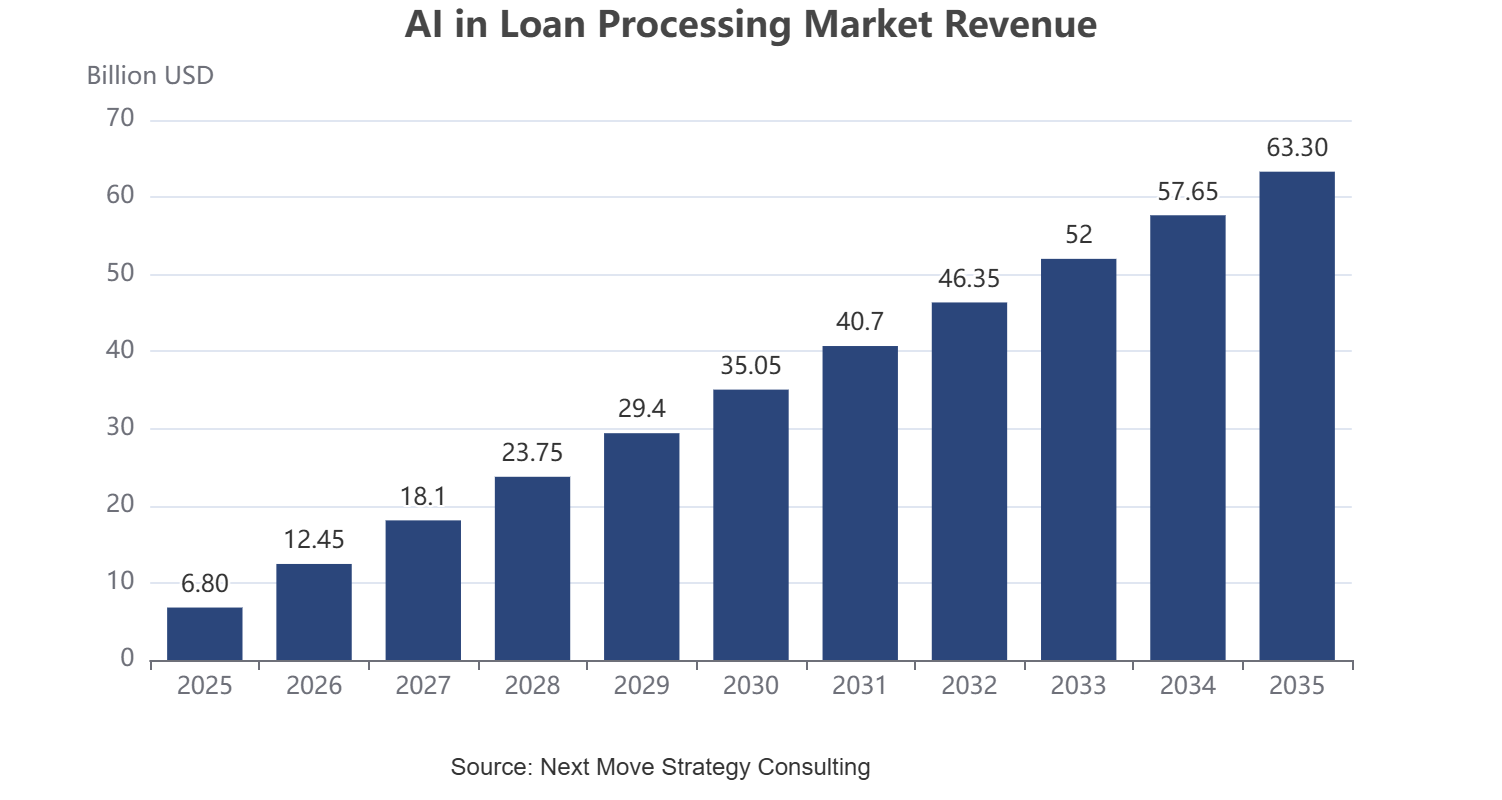
The global AI in Loan Processing Market size was valued at USD 6.80 Billion in 2025 and is estimated at USD 8.50 Billion in 2026, forecast to reach USD 63.30 Billion by 2035, expanding at a 25.0% CAGR between 2026 and 2035. North America leads with approximately 46% share, while under function, Loan Origination dominates with approximately 30% share.
We observed that the growth is broad-based across every segmentation axis, with agentic AI adoption in loan origination and embedded, API-based lending driving the dominant structural shifts through 2035.
|
Key Takeaways |
|
By Loan Type: Mortgage Loans held the largest share of approximately 28% (USD 1.90 Billion) in 2025; Buy Now Pay Later Loans is the fastest-growing sub-segment at 31.5% CAGR from 2026–2035. |
|
By Function: Loan Origination held the largest share of approximately 30% (USD 2.04 Billion) in 2025; Embedded Lending is the fastest-growing sub-segment at 33.1% CAGR from 2026–2035. |
|
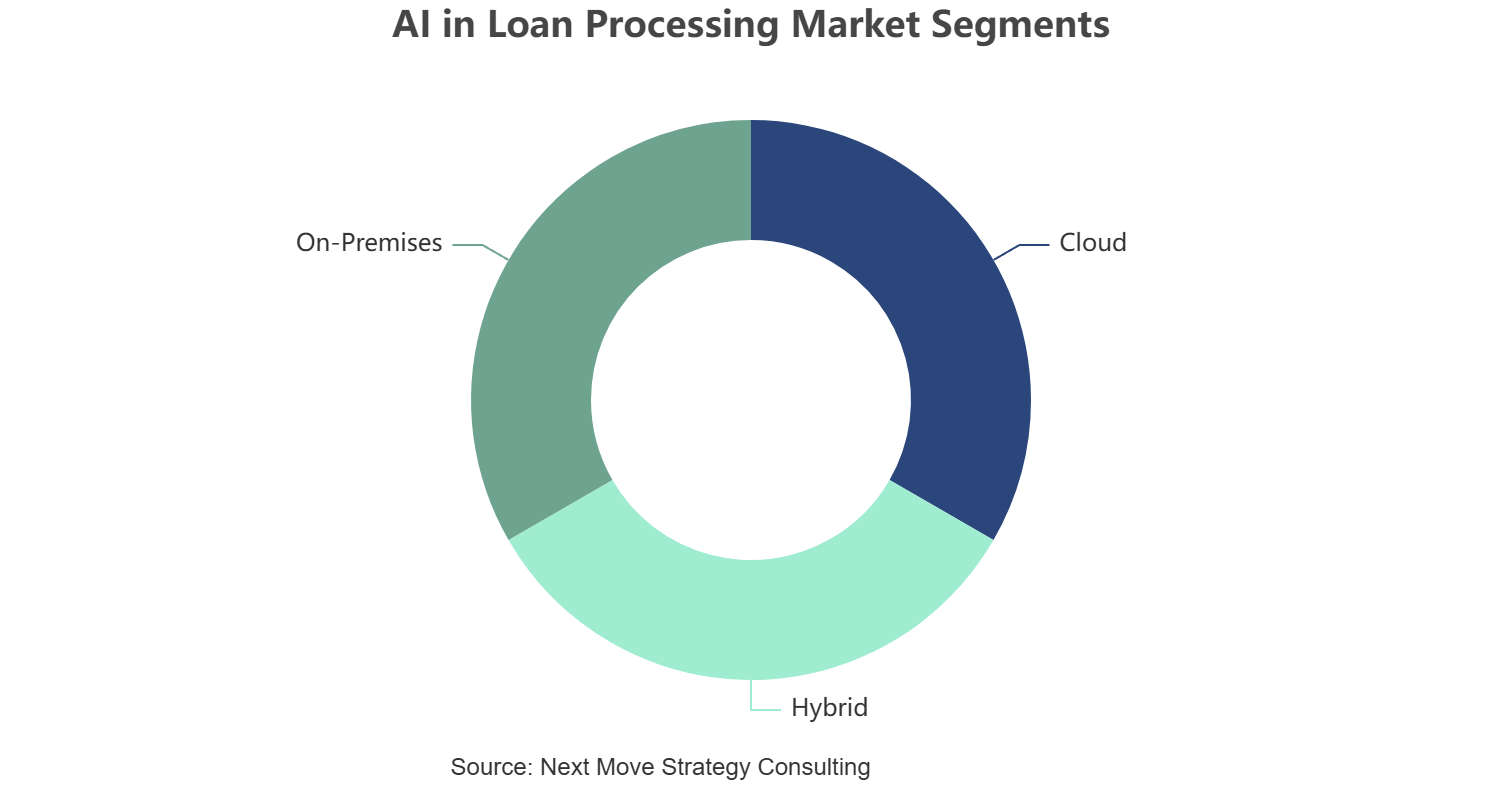
By Deployment Model: Cloud held the largest share of approximately 64% (USD 4.35 Billion) in 2025; Hybrid is the fastest-growing sub-segment at 28.0% CAGR from 2026–2035. |
|
By Revenue Stream: Subscription held the largest share of approximately 46% (USD 3.13 Billion) in 2025; Transaction Based is the fastest-growing sub-segment at 29.0% CAGR from 2026–2035. |
|
By Enterprise Size: Large Enterprises held the largest share of approximately 58% (USD 3.94 Billion) in 2025; Small Institutions is the fastest-growing sub-segment at 27.0% CAGR from 2026–2035. |
|
By Sales Channel: Direct Sales held the largest share of approximately 41% (USD 2.79 Billion) in 2025; API Channel is the fastest-growing sub-segment at 32.0% CAGR from 2026–2035. |
|
By Buyer Type: Banks held the largest share of approximately 34% (USD 2.31 Billion) in 2025; Fintech Lenders is the fastest-growing sub-segment at 30.4% CAGR from 2026–2035. |
|
Dominant Region: North America dominated with approximately 46% revenue share (USD 3.13 Billion) in 2025. |
|
Fastest-Growing Region: Asia-Pacific is expected to register the highest CAGR of 29.9% during 2026–2035. |
|
Dominant Country: U.S. led with approximately USD 2.66 Billion in 2025. |
|
Fastest-Growing Country: India is the fastest-growing country at approximately 34.0% CAGR from 2026–2035. |
Between 2026 and 2035, the AI in Loan Processing Market is set to generate an absolute dollar opportunity of USD 54.80 Billion, positioning agentic origination platforms and embedded lending decisioning as a compelling area for capital allocation.
According to NMSC analysis, sustained investment in explainable, agent-based underwriting is reshaping vendor selection criteria for banks and credit unions, as regulatory scrutiny of adverse-action explainability increasingly determines shortlisting across consumer, mortgage, and SME lending categories.
Ecosystem Analysis of the AI in Loan Processing Industry
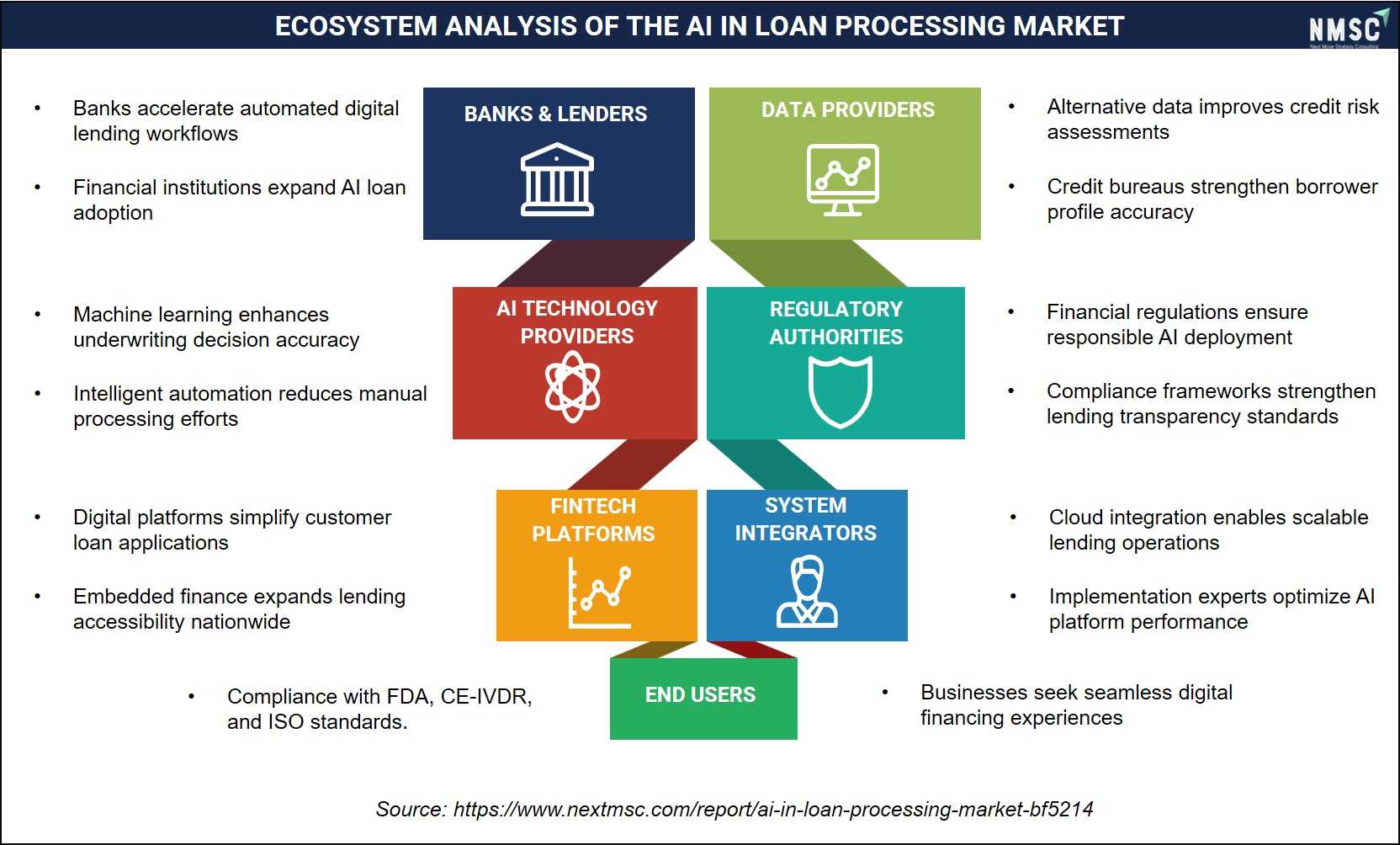
The above infographic presents an ecosystem analysis of the AI in loan processing market, where banks and financial institutions are accelerating digital lending workflows through machine learning and intelligent automation. These capabilities are supported by data providers and credit bureaus that enhance borrower profile accuracy, while fintech platforms and system integrators simplify customer applications and optimize AI performance. At the same time, financial regulations and compliance frameworks ensure responsible AI deployment and lending transparency, with cloud integration enabling scalable operations across the sector. Looking ahead, we observed that these interconnected elements collectively help businesses and consumers access seamless digital financing experiences.
What Does the AI in Loan Processing Market Encompass?
The AI in Loan Processing Market encompasses software platforms and embedded AI models that automate or augment the lending lifecycle, spanning borrower onboarding, document intake, credit decisioning, workflow orchestration, risk and compliance screening, servicing, and collections. We observed that scope spans machine learning credit scoring engines, generative AI document processing agents, and agentic orchestration layers deployed by banks, credit unions, non-banking financial companies, and fintech lenders across consumer, mortgage, SME, commercial, auto, student, and embedded lending categories. The category has evolved from rules-based loan origination systems into agent-based platforms that execute, rather than merely assist, discrete steps of the lending workflow.
The Consumer Financial Protection Bureau's guidance on adverse action notices confirms that the Equal Credit Opportunity Act applies in full to credit decisions based on complex algorithms, requiring lenders to provide specific, accurate denial reasons regardless of model complexity. The Federal Reserve and Office of the Comptroller of the Currency's SR 11-7 model risk management framework, reinforced by OCC Bulletin 2025-26, anchors governance expectations for AI-based underwriting models in the United States, while the European Union's AI Act designates credit scoring as a high-risk use case under Annex III, with conformity assessment and human oversight obligations taking effect in August 2026. We observed that technology adoption is shifting toward agentic AI systems that execute document validation, income verification, and compliance checks autonomously within human-supervised guardrails, a structural shift that is redefining vendor selection criteria across the AI in Loan Processing Market.
|
Field |
Details |
|
Market Size in 2025 |
USD 6.80 Billion |
|
Market Size in 2026 |
USD 8.50 Billion |
|
Revenue Forecast in 2035 |
USD 63.30 Billion |
|
Growth Rate |
CAGR of 25.0% from 2026 to 2035 |
|
Analysis Period |
2025–2035 |
|
Base Year Considered |
2025 |
|
Forecast Period |
2026–2035 |
|
Market Size Estimation |
Revenue (USD Billion) |
|
Companies Profiled |
20 |
|
Countries Covered |
38 |
|
Market Share |
Available for Top 10 Companies |
Key Emerging Trends
Based on research conducted by NMSC, we found that four structural trends are reshaping product development, sourcing, and stakeholder engagement across the AI in Loan Processing Market.
How Is Agentic AI Transforming Loan Origination Workflows?
Agentic AI systems that execute, rather than merely assist, discrete origination tasks are replacing bolt-on automation across the AI in Loan Processing Market. We observed that Blend Labs launched Intelligent Origination in October 2025, followed by Blend Autopilot in March 2026, an agent that completes full-file loan origination reviews in 15 seconds, and Autopilot MCP in May 2026, which opens the platform to third-party AI agents built on the Model Context Protocol. Lenders including CrossCountry Mortgage are piloting full-file quality control before funding, illustrating how agentic execution is shifting quality control from a reactive to a proactive discipline.
Why Is Explainable AI Becoming Non-Negotiable in Credit Decisioning?
Regulatory pressure for explainability is pushing vendors toward auditable AI architectures across the AI in Loan Processing Market. The CFPB's Winter 2025 Supervisory Highlights found that certain credit scoring models produced disproportionately negative outcomes for protected groups and directed institutions to search for less discriminatory alternatives. Our findings suggest that FICO's September 2025 launch of its Focused Foundation Model for Financial Services, featuring patent-pending Trust Scores that risk-rank generative AI outputs, exemplifies how vendors are embedding auditability directly into decisioning infrastructure to satisfy adverse-action and fair-lending requirements.
How Is the EU AI Act Reshaping Credit Scoring System Design?
The European Union's AI Act is compelling a redesign of credit scoring architecture ahead of its high-risk compliance deadline. We observed that Annex III, point 5(b) of Regulation (EU) 2024/1689 classifies AI systems that evaluate consumer creditworthiness as high-risk, with conformity assessment, technical documentation, data governance, and human oversight obligations becoming enforceable on 2 August 2026. Our assessment indicates that European banks and lending technology vendors are prioritizing logged human-oversight workflows and bias-monitoring pipelines to meet this deadline, reshaping procurement criteria for credit decisioning software across the region.
How Are Credit Unions and Community Banks Pooling Resources to Adopt AI Underwriting?
Smaller institutions are adopting AI underwriting through shared, cooperative technology structures rather than individual deployments. We found that Commonwealth Credit Union and Zest AI launched CU Lending Collective, a credit-union service organization created specifically to help small credit unions adopt and deploy AI-powered lending technology. This consortium model is lowering the capital threshold for AI adoption among small institutions that previously lacked the scale to build or license underwriting models independently.
Growth Drivers and Restraints
Growth Catalyst and Risk Assessment Matrix
|
Factors |
Type |
(+/−) % Impact on CAGR |
Geographic Relevance |
Impact Timeline |
|
Rising bank and credit union adoption of GenAI for document intake and underwriting automation |
Driver |
+3.4% |
Global |
2026-2035 |
|
Expansion of embedded and API-based lending among fintechs and marketplaces |
Driver |
+2.6% |
North America, Asia-Pacific |
2026-2035 |
|
FinCEN's AML/CFT modernization proposal encouraging AI-enabled transaction monitoring |
Driver |
+1.5% |
North America |
2026-2033 |
|
Rising SME and Buy Now Pay Later loan volumes requiring real-time automated decisioning |
Driver |
+2.1% |
Global |
2026-2035 |
|
Credit union and community bank consortium adoption of shared AI underwriting platforms |
Driver |
+1.2% |
North America |
2026-2032 |
|
Growth of alternative-data credit models expanding financial inclusion in emerging markets |
Driver |
+1.8% |
Asia-Pacific, Latin America |
2026-2035 |
|
EU AI Act Annex III conformity assessment and documentation burden for credit-scoring systems |
Restraint |
-1.3% |
Europe |
2026-2028 |
|
Fair lending and adverse-action explainability requirements limiting black-box model deployment |
Restraint |
-0.9% |
North America, Europe |
2026-2035 |
|
Legacy core-banking integration complexity slowing AI rollout at smaller institutions |
Restraint |
-0.7% |
Global |
2026-2032 |
What Is the Primary Growth Driver of the Market?
Agentic AI adoption in loan origination is the primary driver. Blend Labs disclosed that traditional mortgage origination averages more than USD 11,000 per loan and 20 to 30 days per cycle, a cost structure that agentic execution directly targets. We observed that this efficiency pressure, reinforced by the Consumer Financial Protection Bureau's adverse-action guidance requiring specific denial reasons regardless of model complexity, continues to anchor lender investment in explainable, agent-based origination and decisioning platforms across developed and emerging markets alike.
How Is Embedded and Fintech Lending Driving the Market Growth?
Expansion of embedded, API-based lending among fintechs and marketplaces is accelerating AI in Loan Processing Market growth toward real-time decisioning architectures. Provenir's February 2026 launch of agentic AI features within its Decision Intelligence platform, including pre-integrated access to large language model providers, illustrates how decisioning vendors are equipping fintech lenders and marketplaces with governed, plug-and-play AI capabilities. Our assessment indicates that this integration trend, combined with rising Buy Now Pay Later volumes, is compressing decisioning cycle times across fintech-originated consumer credit.
What Is Restraining AI in Loan Processing Market Expansion?
Compliance burden associated with the European Union's AI Act restrains the pace of the market expansion in Europe. Annex III of Regulation (EU) 2024/1689 classifies AI systems used to evaluate consumer creditworthiness as high-risk, requiring conformity assessments, technical documentation, and logged human oversight before the 2 August 2026 enforcement deadline. We found that smaller lending technology vendors face particular exposure, as limited compliance budgets slow their ability to complete Annex IV documentation relative to larger, diversified software groups.
Segmentation Analysis
Segment Sizing: By Loan Type
|
Segment |
2025 (USD) |
2035 (USD) |
CAGR% (2026–2035) |
|
Consumer Loans |
USD 1.36 Billion |
USD 12.19 Billion |
24.5% |
|
Mortgage Loans |
USD 1.90 Billion |
USD 14.74 Billion |
22.5% |
|
SME Loans |
USD 0.95 Billion |
USD 12.18 Billion |
29.5% |
|
Commercial Loans |
USD 0.75 Billion |
USD 6.23 Billion |
23.5% |
|
Auto Loans |
USD 0.61 Billion |
USD 4.40 Billion |
21.5% |
|
Student Loans |
USD 0.20 Billion |
USD 1.08 Billion |
17.4% |
|
Asset Finance and Leasing |
USD 0.34 Billion |
USD 3.52 Billion |
26.5% |
|
Buy Now Pay Later Loans |
USD 0.48 Billion |
USD 6.99 Billion |
31.5% |
|
Specialty Loans |
USD 0.14 Billion |
USD 1.51 Billion |
27.5% |
|
Other Loan Types |
USD 0.07 Billion |
USD 0.46 Billion |
20.5% |
|
Total |
USD 6.80 Billion |
USD 63.30 Billion |
25.0% |
Which Loan Type Segment Dominates the Market?
Mortgage Loans led the AI in Loan Processing Market with USD 1.90 Billion in 2025, supported by the high per-loan cost of manual mortgage origination and the resulting incentive to automate document validation and underwriting. We observed that Buy Now Pay Later Loans are the fastest-growing loan type, expanding at a 31.5% CAGR from 2026 to 2035, as marketplace and merchant lenders increasingly specify real-time, AI-driven decisioning to support point-of-sale credit approval.
Segment Sizing: By Function
|
Segment |
2025 (USD) |
2035 (USD) |
CAGR% (2026–2035) |
|
Loan Origination |
USD 2.04 Billion |
USD 16.58 Billion |
23.1% |
|
Credit Decisioning |
USD 1.50 Billion |
USD 16.23 Billion |
27.1% |
|
Workflow Automation |
USD 0.82 Billion |
USD 7.67 Billion |
25.1% |
|
Risk and Compliance |
USD 1.09 Billion |
USD 10.98 Billion |
26.1% |
|
Loan Servicing |
USD 0.68 Billion |
USD 4.43 Billion |
20.1% |
|
Collections and Recovery |
USD 0.34 Billion |
USD 2.57 Billion |
22.1% |
|
Embedded Lending |
USD 0.27 Billion |
USD 4.47 Billion |
33.1% |
|
Other Loan Processing Software |
USD 0.07 Billion |
USD 0.38 Billion |
18.1% |
|
Total |
USD 6.80 Billion |
USD 63.30 Billion |
25.0% |
Which Functional Segment Leads the Market Demand?
Loan Origination remained the leading functional segment within the AI in Loan Processing Market, valued at USD 2.04 Billion in 2025 on sustained investment in document intake, borrower onboarding, and application validation automation. Our findings suggest that Embedded Lending is the fastest-growing function, registering a 33.1% CAGR from 2026 to 2035, as point-of-sale and API-based lending channels increasingly embed AI decisioning directly into merchant and marketplace checkout flows.
Segment Sizing: By Buyer Type
|
Segment |
2025 (USD) |
2035 (USD) |
CAGR% (2026–2035) |
|
Banks |
USD 2.31 Billion |
USD 17.76 Billion |
22.4% |
|
Credit Unions |
USD 0.68 Billion |
USD 6.05 Billion |
24.4% |
|
Non-Banking Financial Companies |
USD 0.95 Billion |
USD 9.78 Billion |
26.4% |
|
Fintech Lenders |
USD 1.22 Billion |
USD 16.65 Billion |
30.4% |
|
Captive Finance Companies |
USD 0.27 Billion |
USD 1.80 Billion |
20.3% |
|
Mortgage Lenders |
USD 0.61 Billion |
USD 5.06 Billion |
23.4% |
|
Loan Servicers |
USD 0.41 Billion |
USD 2.91 Billion |
21.4% |
|
Marketplaces and Merchants |
USD 0.20 Billion |
USD 2.59 Billion |
29.4% |
|
Government Lending Institutions |
USD 0.10 Billion |
USD 0.50 Billion |
16.3% |
|
Other Buyer Types |
USD 0.03 Billion |
USD 0.21 Billion |
19.3% |
|
Total |
USD 6.80 Billion |
USD 63.30 Billion |
25.0% |
Which Buyer Type Is Most Widely Represented in the Market?
Banks remained the dominant buyer type across the AI in Loan Processing Market, reaching USD 2.31 Billion in 2025 due to their scale, deposit base, and established core-banking integration budgets. Based on research conducted by NMSC, we found that Fintech Lenders represent the fastest-growing buyer category at a 30.4% CAGR from 2026 to 2035, reflecting continued venture and strategic investment in AI-native underwriting platforms such as Zest AI's customer-led financing round completed in November 2025.
Growth Opportunities
Our analysis shows that three forward-looking opportunities stand out for stakeholders positioning within the market over the 2026-2035 forecast period.
How Are Refinance Recapture Agents Creating Opportunities for Mortgage Servicers?
Agentic refinance-recapture platforms present a whitespace opportunity for mortgage lenders and servicers seeking to retain existing borrowers as rates decline. Vendors that commercialize automated portfolio-scanning agents, such as Blend's Rapid Refi capability, stand to capture recurring servicing revenue as large banks and independent mortgage companies struggle to manually recapture multi-million-loan portfolios originated between 2022 and 2025.
Why Are Shared AI Underwriting Consortiums Emerging as a Growth Opportunity for Small Institutions?
Credit union service organizations built around shared AI underwriting infrastructure represent an underpenetrated opportunity for small institutions lacking individual deployment scale. Vendors that replicate the Commonwealth Credit Union and Zest AI CU Lending Collective model can secure long-term, multi-institution contracts with small credit unions and community banks, benefiting from recurring platform-access revenue tied to cooperative technology adoption.
How Are Embedded LLM Integrations Unlocking Opportunities for Fintech and Marketplace Lenders?
Fintech and marketplace lenders seeking real-time, explainable decisioning create an opportunity for decisioning vendors offering governed large language model integration. Early movers that follow Provenir's approach of pre-integrating public and private large language model providers into a single decisioning platform can differentiate with Buy Now Pay Later and point-of-sale lenders pursuing faster, more personalized approval workflows across their embedded lending portfolios.
Regional Outlook
Geographic Performance Snapshot
|
Region |
2025 (USD) |
2035 (USD) |
CAGR% (2026–2035) |
Key Driver |
|
North America |
USD 3.13 Billion |
USD 23.20 Billion |
21.9% |
Advanced AI governance frameworks (SR 11-7) and deep fintech-bank integration |
|
Europe |
USD 1.63 Billion |
USD 15.09 Billion |
24.9% |
EU AI Act Annex III compliance build-out for credit scoring |
|
Asia-Pacific |
USD 1.36 Billion |
USD 17.95 Billion |
29.9% |
Digital lending expansion in China and India |
|
Middle East & Africa |
USD 0.41 Billion |
USD 4.36 Billion |
26.9% |
Vision 2030-linked digital banking transformation |
|
Latin America |
USD 0.27 Billion |
USD 2.70 Billion |
25.9% |
Expanding fintech lending penetration in Brazil |
|
Total |
USD 6.80 Billion |
USD 63.30 Billion |
25.0% |
-- |
North America
North America leads the market with the deepest concentration of bank and credit union AI underwriting deployments. We observed that Federal Reserve and OCC model risk management expectations under SR 11-7, reinforced by OCC Bulletin 2025-26, sustain demand for auditable, well-governed AI decisioning systems, while the CFPB's adverse-action guidance shapes explainability requirements for credit denials. Technology adoption remains advanced, with agentic origination platforms from vendors such as Blend Labs and nCino driving demand for mortgage and consumer lending automation across the region's bank and fintech channels.
Europe
Europe's AI in Loan Processing Market reflects a compliance-intensive landscape shaped by the European Union's AI Act and its Annex III classification of credit scoring as high-risk. Our findings suggest that banks across the UK, Germany, and France are accelerating conformity assessment and technical documentation work ahead of the 2 August 2026 enforcement deadline. Technology adoption favors decisioning platforms with built-in logging, bias-monitoring, and human-oversight features, supported by regional vendors investing in Annex IV-compliant architecture.
Asia-Pacific
Asia-Pacific is the fastest-growing region, propelled by expanding digital lending penetration in China and India and rising fintech-led consumer credit adoption. We found that regulatory frameworks remain less harmonized than in Europe, giving lending technology vendors flexibility to scale AI-based decisioning rapidly across large unbanked and underbanked populations. Technology adoption is accelerating as regional banks and non-banking financial companies expand alternative-data underwriting to serve first-time borrowers.
Middle East & Africa
The Middle East & Africa AI in Loan Processing Industry is expanding as Gulf Cooperation Council economies pursue Vision 2030-linked digital banking transformation and rising fintech lending activity. Our analysis shows that Saudi Arabia and the UAE are attracting lending technology investment tied to national digitization programs. Regulatory influence remains moderate relative to Europe, while technology adoption is gradually shifting toward cloud-hosted AI decisioning platforms as regional banks modernize legacy core systems.
Latin America
Latin America's market is supported by growing fintech lending penetration in Brazil and Argentina and expanding digital banking infrastructure. We observed that regulatory frameworks are less stringent than in North America or Europe, though multinational banks operating locally are introducing AI-based credit scoring to serve historically underbanked populations. Technology adoption remains centered on consumer and SME lending, with competitive intensity increasing as global decisioning vendors partner with regional banks and fintechs.
U.S.
Based on our engagements, the U.S. market was valued at approximately USD 2.66 Billion in 2025 and is projected to reach USD 19.20 Billion by 2035, growing at a 21.5% CAGR. Demand is anchored by The U.S. Consumer Financial Protection Bureau's adverse-action guidance and the Federal Reserve's SR 11-7 model risk management framework, sustaining institutional and fintech investment in AI-based decisioning. Technology penetration continues to rise across origination and credit decisioning use cases, and competitive intensity remains centered on vendors able to demonstrate compliant, explainable model governance.
Canada
Through our analysis, the Canada AI in Loan Processing Industry was valued at approximately USD 0.47 Billion in 2025 and is projected to reach USD 3.78 Billion by 2035, growing at a 23.0% CAGR. Demand is anchored by Demand structure mirrors U.S. bank and credit union adoption patterns, while Office of the Superintendent of Financial Institutions guidance shapes model governance expectations, sustaining institutional and fintech investment in AI-based decisioning. Technology penetration continues to rise across origination and credit decisioning use cases, and competitive intensity remains centered on vendors able to demonstrate compliant, explainable model governance.
UK
From our assessment, the UK market was valued at approximately USD 0.49 Billion in 2025 and is projected to reach USD 4.56 Billion by 2035, growing at a 25.0% CAGR. Demand is anchored by The UK's proximity to EU AI Act obligations and the Financial Conduct Authority's AI adoption findings, with roughly 75% of firms already using artificial intelligence, sustaining institutional and fintech investment in AI-based decisioning. Technology penetration continues to rise across origination and credit decisioning use cases, and competitive intensity remains centered on vendors able to demonstrate compliant, explainable model governance.
Germany
According to evaluation, the Germany market was valued at approximately USD 0.42 Billion in 2025 and is projected to reach USD 3.67 Billion by 2035, growing at a 24.0% CAGR. Demand is anchored by European Union AI Act Annex III compliance requirements and Germany's large cooperative and savings bank sector's gradual AI adoption, sustaining institutional and fintech investment in AI-based decisioning. Technology penetration continues to rise across origination and credit decisioning use cases, and competitive intensity remains centered on vendors able to demonstrate compliant, explainable model governance.
France
Based on our engagements, the France AI in Loan Processing Industry was valued at approximately USD 0.33 Billion in 2025 and is projected to reach USD 2.63 Billion by 2035, growing at a 23.0% CAGR. Demand is anchored by European Union AI Act compliance timelines and France's concentrated retail banking sector's shift toward AI-based credit decisioning, sustaining institutional and fintech investment in AI-based decisioning. Technology penetration continues to rise across origination and credit decisioning use cases, and competitive intensity remains centered on vendors able to demonstrate compliant, explainable model governance.
China
Through our analysis, the China market was valued at approximately USD 0.46 Billion in 2025 and is projected to reach USD 5.72 Billion by 2035, growing at a 29.0% CAGR. Demand is anchored by Large-scale digital lending platforms and expanding non-banking financial company adoption of AI credit scoring, sustaining institutional and fintech investment in AI-based decisioning. Technology penetration continues to rise across origination and credit decisioning use cases, and competitive intensity remains centered on vendors able to demonstrate compliant, explainable model governance.
India
From our assessment, the India market was valued at approximately USD 0.30 Billion in 2025 and is projected to reach USD 5.21 Billion by 2035, growing at a 34.0% CAGR. Demand is anchored by Rapid fintech lending expansion and Reserve Bank of India-supervised digital lending guidelines encouraging responsible AI adoption, sustaining institutional and fintech investment in AI-based decisioning. Technology penetration continues to rise across origination and credit decisioning use cases, and competitive intensity remains centered on vendors able to demonstrate compliant, explainable model governance.
Japan
According to evaluation, the Japan AI in Loan Processing Industry was valued at approximately USD 0.19 Billion in 2025 and is projected to reach USD 1.23 Billion by 2035, growing at a 20.0% CAGR. Demand is anchored by Conservative but steady adoption of AI credit decisioning among Japan's major banking groups, sustaining institutional and fintech investment in AI-based decisioning. Technology penetration continues to rise across origination and credit decisioning use cases, and competitive intensity remains centered on vendors able to demonstrate compliant, explainable model governance.
South Korea
Based on our engagements, the South Korea market was valued at approximately USD 0.14 Billion in 2025 and is projected to reach USD 1.27 Billion by 2035, growing at a 25.0% CAGR. Demand is anchored by High digital banking penetration and fintech-led consumer lending innovation, sustaining institutional and fintech investment in AI-based decisioning. Technology penetration continues to rise across origination and credit decisioning use cases, and competitive intensity remains centered on vendors able to demonstrate compliant, explainable model governance.
Australia
Through our analysis, the Australia market was valued at approximately USD 0.11 Billion in 2025 and is projected to reach USD 0.88 Billion by 2035, growing at a 23.0% CAGR. Demand is anchored by Australian Prudential Regulation Authority model risk expectations shaping responsible AI adoption among major banks, sustaining institutional and fintech investment in AI-based decisioning. Technology penetration continues to rise across origination and credit decisioning use cases, and competitive intensity remains centered on vendors able to demonstrate compliant, explainable model governance.
UAE
From our assessment, the UAE market was valued at approximately USD 0.12 Billion in 2025 and is projected to reach USD 1.41 Billion by 2035, growing at a 28.0% CAGR. Demand is anchored by UAE Vision-linked digital banking transformation and Central Bank of the UAE's fintech innovation initiatives, sustaining institutional and fintech investment in AI-based decisioning. Technology penetration continues to rise across origination and credit decisioning use cases, and competitive intensity remains centered on vendors able to demonstrate compliant, explainable model governance.
Saudi Arabia
According to evaluation, the Saudi Arabia market was valued at approximately USD 0.14 Billion in 2025 and is projected to reach USD 1.50 Billion by 2035, growing at a 27.0% CAGR. Demand is anchored by Saudi Vision 2030 digital transformation programs and Saudi Central Bank fintech licensing activity, sustaining institutional and fintech investment in AI-based decisioning. Technology penetration continues to rise across origination and credit decisioning use cases, and competitive intensity remains centered on vendors able to demonstrate compliant, explainable model governance.
South Africa
Based on our engagements, the South Africa AI in Loan Processing Industry was valued at approximately USD 0.07 Billion in 2025 and is projected to reach USD 0.56 Billion by 2035, growing at a 24.0% CAGR. Demand is anchored by Expanding non-banking financial company lending and South African Reserve Bank fintech regulatory sandboxes, sustaining institutional and fintech investment in AI-based decisioning. Technology penetration continues to rise across origination and credit decisioning use cases, and competitive intensity remains centered on vendors able to demonstrate compliant, explainable model governance.
Brazil
Through our analysis, the Brazil market was valued at approximately USD 0.12 Billion in 2025 and is projected to reach USD 1.23 Billion by 2035, growing at a 26.0% CAGR. Demand is anchored by Brazil's large fintech lending sector and Central Bank of Brazil's open finance regulatory framework, sustaining institutional and fintech investment in AI-based decisioning. Technology penetration continues to rise across origination and credit decisioning use cases, and competitive intensity remains centered on vendors able to demonstrate compliant, explainable model governance.
Argentina
From our assessment, the Argentina market was valued at approximately USD 0.05 Billion in 2025 and is projected to reach USD 0.47 Billion by 2035, growing at a 24.0% CAGR. Demand is anchored by Steady consumer and SME lending digitization despite macroeconomic volatility, sustaining institutional and fintech investment in AI-based decisioning. Technology penetration continues to rise across origination and credit decisioning use cases, and competitive intensity remains centered on vendors able to demonstrate compliant, explainable model governance.
Regulatory Framework Impacting the AI in Loan Processing Industry
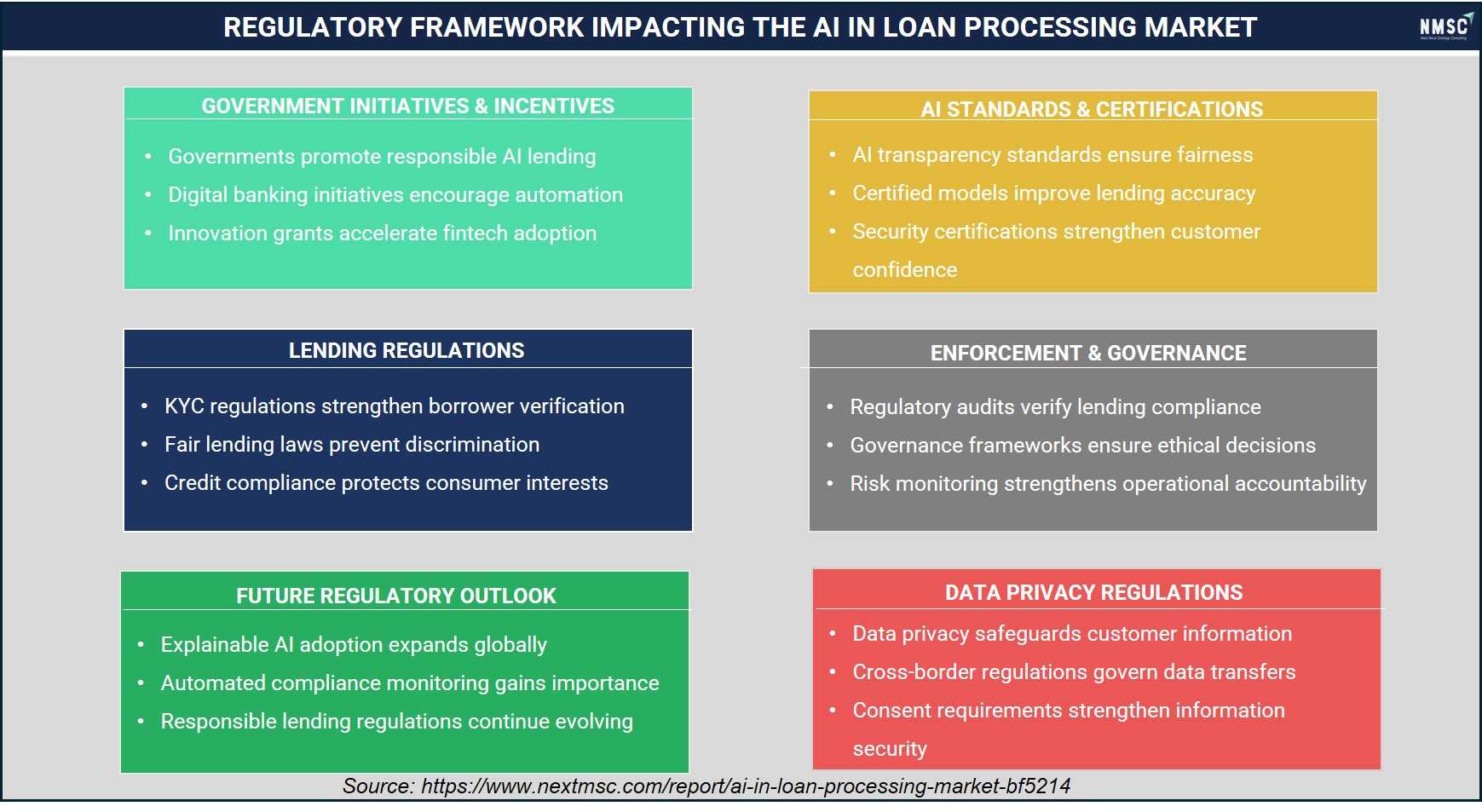
The above infographic presents a regulatory framework impacting the AI in loan processing industry, where government initiatives and innovation grants are encouraging responsible AI adoption and fintech automation. These efforts are reinforced by AI transparency standards and security certifications that ensure fairness and build customer confidence. At the same time, KYC regulations, fair lending laws, and credit compliance measures strengthen borrower verification and consumer protection. Enforcement through regulatory audits and governance frameworks ensures ethical decision-making and operational accountability. Looking ahead, we observed that explainable AI and automated compliance monitoring are gaining importance, while data privacy regulations and cross-border transfer rules continue to shape information security and responsible lending practices.
Competitive Landscape
We observed that the AI in Loan Processing Market features a moderately consolidated competitive landscape, with diversified core-banking and lending-technology groups competing alongside AI-native decisioning specialists on explainability, agentic capability, and regulatory readiness.
|
Dimension |
Description |
|
Market Structure |
Moderately consolidated; diversified lending-technology and core-banking groups compete alongside AI-native decisioning specialists, while regional software vendors serve cost-sensitive small and mid-market institutions. |
|
Innovation Focus |
Agentic AI origination, explainable credit decisioning, and embedded, API-based lending integrations dominate current innovation pipelines across leading suppliers. |
|
M&A Activity |
Selective consolidation through platform acquisitions, exemplified by Intercontinental Exchange's integration of mortgage technology capabilities to broaden its lending and servicing software portfolio. |
How Do Companies Compete in the AI in Loan Processing Market?
Companies compete primarily on explainability credentials, agentic execution capability, and core-banking integration depth across the market. Global players such as nCino and Blend Labs leverage broad origination and mortgage suite portfolios to serve large banks and independent mortgage lenders, while AI-native specialists such as Zest AI and Provenir compete on model accuracy and decisioning speed for credit unions, fintechs, and non-banking financial companies.
Which Competitive Archetypes Dominate the AI in Loan Processing Market?
Two archetypes dominate the market: diversified core-banking and lending-technology groups offering full-lifecycle origination-to-servicing platforms, and AI-native decisioning specialists focused on credit risk, fraud, and underwriting automation. Finastra Group Holdings Limited and Temenos AG exemplify the diversified archetype through integrated core-banking and lending software, while Zest AI and Provenir Group exemplify the AI-native decisioning archetype serving banks, credit unions, and fintech lenders directly.
How Are Companies Differentiating Through Innovation in AI Loan Processing?
Innovation and differentiation strategy increasingly center on agentic execution and auditable model governance. Blend Labs' Autopilot and Autopilot MCP Server and FICO's Focused Foundation Model with patent-pending Trust Scores both embed explainability and human-oversight controls directly into AI outputs. Our analysis shows that suppliers unable to demonstrate credible auditability risk exclusion from bank and credit union procurement shortlists in North America and Europe.
What M&A and Expansion Activity Is Shaping the AI in Loan Processing Market?
Mergers, acquisitions, and platform expansion continue to consolidate lending-technology capabilities within the AI in Loan Processing Market. Intercontinental Exchange's integration of mortgage technology assets broadened its origination and servicing software footprint, while Zest AI's oversubscribed, customer-led financing round completed in November 2025, backed by Citi Ventures and multiple credit unions, illustrates how strategic and institutional investors are consolidating stakes in AI-native underwriting vendors to secure long-term platform access.
Key Market Players
Our assessment indicates that the following 20 companies represent the validated competitive set actively shaping product innovation, capacity expansion, and regulatory readiness within the global AI in Loan Processing Market.
-
Intercontinental Exchange, Inc.
-
nCino, Inc.
-
Finastra Group Holdings Limited
-
Temenos AG
-
Experian plc
-
Fair Isaac Corporation
-
SAS Institute Inc.
-
Newgen Software Technologies Limited
-
Blend Labs, Inc.
-
MeridianLink, Inc.
-
Q2 Holdings, Inc.
-
Mambu B.V.
-
Nucleus Software Exports Limited
-
Provenir Group
-
Tavant Technologies, Inc.
-
TurnKey Lender Inc.
-
ZestFinance, Inc.
Latest Developments
We found that recent product launches within the AI in Loan Processing Market are concentrated on agentic origination and explainable decisioning capabilities, reflecting the industry's broader shift toward autonomous, auditable AI execution.
|
Date |
Event |
|
May 2026 |
Blend Labs launched Autopilot MCP Server, allowing lenders to build and deploy custom AI agents directly within the origination platform using the Model Context Protocol. |
|
December 2025 |
Provenir launched an AI Maturity Assessment and Data Science 101 certification to help banks and financial institutions improve AI adoption practices. |
Expert Insights
 “Customer business problems have not changed drastically; but AI is the catalyst driving a broader transformation in financial services. By delivering predictive, prescriptive, and personalized tools designed specifically for banking, we are empowering institutions to stay competitive in a rapidly changing market.”
- Sean Desmond, President and Chief Executive Officer, nCino
Statement made during nCino’s nSight 2025 conference announcing AI-powered banking solutions designed to enhance lending, loan origination, and banking operations.
Market Interpretation
The statement highlights the growing adoption of AI to transform loan processing by enabling predictive decision-making, personalized customer experiences, and intelligent workflow automation across banking operations. AI-powered lending solutions are helping financial institutions streamline loan origination, accelerate underwriting and credit assessments, improve operational efficiency, and enhance borrower engagement. As lenders increasingly prioritize faster, data-driven, and customer-centric lending processes, AI-enabled loan processing platforms are expected to play a pivotal role in modernizing financial services and strengthening competitive differentiation.
Investment Opportunities
What Capital Inflows Are Targeting the AI in Loan Processing Market?
Capital inflows into the AI in Loan Processing Market are increasingly directed toward AI-native underwriting and decisioning vendors. Zest AI's oversubscribed, customer-led financing round, completed in November 2025 and led by Citi Ventures alongside multiple credit unions, represents a significant valuation increase from its 2024 growth round. We observed that investors favor vendors demonstrating validated explainability and regulatory-readiness credentials, viewing compliance alignment as a proxy for long-term contract retention with regulated financial institutions.
How Is Infrastructure Investment Supporting AI in Loan Processing Deployment?
Infrastructure investment is expanding cloud-hosted decisioning and orchestration capacity to support agentic AI workloads across the AI in Loan Processing Market. Our findings suggest that vendors including Provenir are investing in unified data marketplaces that integrate public and private large language model providers through pre-built application programming interfaces, supporting the low-latency, high-throughput processing required for real-time credit decisioning at scale.
What ESG Considerations Are Shaping AI in Loan Processing Investment Decisions?
Environmental, social, and governance considerations are increasingly central to investment decisions across the AI in Loan Processing Market, with fair lending outcomes and model governance as key criteria. The CFPB's guidance confirming that the Equal Credit Opportunity Act applies in full to algorithmic credit decisions continues to inform institutional disclosure practices. We found that investors increasingly favor vendors with documented bias-mitigation and human-oversight controls, treating fair lending compliance as a governance indicator alongside data privacy and model risk management.
Key Benefits for Stakeholders
How Does This Report Benefit Enterprise and Industry Leaders?
Enterprise and industry leaders gain access to validated segmentation, competitive benchmarking, and regional demand forecasts that support technology sourcing and vendor selection decisions across the AI in Loan Processing Market. Our analysis shows that detailed function, buyer type, and deployment model breakdowns help procurement teams align specifications with regulatory and governance requirements while identifying underserved loan-type segments for portfolio expansion.
How Does This Report Benefit Investors and Financial Analysts?
Investors and financial analysts benefit from consistent, single-point market size and CAGR estimates that support valuation and capital-allocation decisions across the AI in Loan Processing Market supply chain. We observed that the report's regional and segment-level growth differentials help identify which decisioning vendors and lending-technology platforms are best positioned to capture above-market growth in embedded lending and fintech-served categories through 2035.
How Does This Report Benefit Technology Vendors and Product Teams?
Technology vendors and product teams gain insight into emerging design requirements, including agentic execution, explainable decisioning, and embedded lending application programming interfaces, that are reshaping the AI in Loan Processing Market. Our findings suggest that this analysis helps product and engineering teams prioritize development roadmaps around auditability and regulatory-readiness features that are increasingly required by bank and credit union procurement processes.
Key Market Segments
By Loan Type
-
Consumer Loans
-
Mortgage Loans
-
SME Loans
-
Commercial Loans
-
Auto Loans
-
Student Loans
-
Asset Finance and Leasing
-
Buy Now Pay Later Loans
-
Specialty Loans
-
Other Loan Types
By Function
-
Loan Origination
-
Borrower Onboarding
-
Application Intake
-
Document Collection
-
Identity Verification
-
Income and Asset Verification
-
Document Classification
-
Data Extraction
-
Application Validation
-
Loan Structuring
-
Pricing and Offer Generation
-
Closing and Funding
-
-
Credit Decisioning
-
Credit Scoring
-
Risk Assessment
-
Underwriting Automation
-
Real-Time Decisioning
-
Risk-Based Pricing
-
Credit Limit Management
-
Policy Management
-
Explainable AI Decisioning
-
-
Workflow Automation
-
Case Management
-
Task Orchestration
-
Process Automation
-
Agentic Automation
-
Human Review Management
-
Exception Handling
-
-
Risk and Compliance
-
Fraud Detection
-
KYC
-
KYB
-
AML Screening
-
Regulatory Compliance
-
Model Governance
-
Audit Management
-
Fair Lending Monitoring
-
-
Loan Servicing
-
Account Boarding
-
Payment Processing
-
Billing Management
-
Customer Self-Service
-
Account Maintenance
-
Customer Communication
-
Portfolio Monitoring
-
-
Collections and Recovery
-
Early Delinquency Management
-
Collection Prioritization
-
Collection Workflow Automation
-
Restructuring Management
-
Recovery Optimization
-
Charge-Off Management
-
-
Embedded Lending
-
Point of Sale Lending
-
Marketplace Lending
-
Partner Lending
-
API-Based Lending
-
-
Other Loan Processing Software
By Deployment Model
-
Cloud
-
Hybrid
-
On-Premises
By Revenue Stream
-
Subscription
-
Transaction Based
-
License
-
Implementation
-
Professional Services
-
Managed Services
-
Maintenance and Support
By Enterprise Size
-
Large Enterprises
-
Mid-Market Institutions
-
Small Institutions
By Sales Channel
-
Direct Sales
-
System Integrators
-
Technology Partners
-
OEM
-
Digital Marketplace
-
API Channel
By Buyer Type
-
Banks
-
Credit Unions
-
Non-Banking Financial Companies
-
Fintech Lenders
-
Captive Finance Companies
-
Mortgage Lenders
-
Loan Servicers
-
Marketplaces and Merchants
-
Government Lending Institutions
-
Other Buyer Types
By Region
-
North America: U.S., Canada, Mexico.
-
Europe: UK, Germany, France, Italy, Spain, Sweden, Denmark, Finland, Netherlands, Rest of Europe.
-
Asia-Pacific: China, India, Japan, South Korea, Taiwan, Indonesia, Vietnam, Australia, Philippines, Malaysia, Rest of APAC.
-
Middle East & Africa: Saudi Arabia, UAE, Egypt, Israel, Turkey, Nigeria, South Africa, Rest of MEA.
-
Latin America: Brazil, Argentina, Chile, Colombia, Rest of LATAM.
Conclusion and Recommendations
What Is the Long-Term Outlook for the AI in Loan Processing Market?
The long-term outlook for the AI in Loan Processing Market remains strongly positive, with global revenue projected to expand from USD 6.80 billion in 2025 to USD 63.30 billion by 2035 at a 25.0% CAGR. We observed that sustained agentic AI adoption in origination, explainability-driven decisioning investment, and embedded lending expansion will continue underpinning demand across banks, credit unions, and fintech lenders through the forecast period.
What Strategic Positioning Should AI in Loan Processing Vendors Pursue?
Vendors should prioritize agentic origination and explainable decisioning platforms while pursuing demonstrable fair-lending and model-governance credentials to secure long-term bank and credit union contracts. Our assessment indicates that suppliers investing early in EU AI Act-compliant documentation and human-oversight architecture will be best positioned to capture premium positioning within the AI in Loan Processing Market.
How Attractive Is the AI in Loan Processing Market for New Investment?
The AI in Loan Processing Market presents a highly attractive investment case, supported by a USD 54.80 billion absolute dollar opportunity between 2026 and 2035 and above-average growth in Asia-Pacific and embedded lending categories. We found that investment attractiveness is highest for vendors combining explainability credentials with scaled agentic execution capability, positioning them to serve both large banks and small institution consortiums simultaneously.
What Market Shifts and Key Risks Should Stakeholders Monitor?
Stakeholders should monitor EU AI Act conformity assessment timelines, evolving CFPB and OCC fair-lending guidance, and competitive pressure from diversified core-banking incumbents as key risks to the AI in Loan Processing Market. Our analysis shows that vendors unable to adapt to explainability and human-oversight specifications risk exclusion from bank and credit union procurement shortlists, particularly within Europe's increasingly regulated credit-scoring environment.
What Are the Key Growth Pathways for the AI in Loan Processing Market?
Key growth pathways include expanding agentic origination beyond mortgage into consumer and SME lending, scaling shared AI underwriting consortiums for small institutions, and deepening embedded lending integrations for fintech and marketplace channels. NMSC's analysis indicates that vendors pursuing these pathways while maintaining rigorous fair-lending compliance will be best positioned to capture the AI in Loan Processing Market's projected growth through 2035.
About the Author
 Mayurima Roy
— Mayurima Roy is Research Analyst at Next Move Strategy Consulting, where she has spent 4 years working across the firm's full industry coverage rather than a single fixed vertical. Her work centers on structured research, ongoing trend tracking, competitive assessment, and insight-led content development, translating complex market data into clear, decision-ready narratives that support informed client decision-making across diverse global industries, market sectors, and world regions every day.
Mayurima Roy
— Mayurima Roy is Research Analyst at Next Move Strategy Consulting, where she has spent 4 years working across the firm's full industry coverage rather than a single fixed vertical. Her work centers on structured research, ongoing trend tracking, competitive assessment, and insight-led content development, translating complex market data into clear, decision-ready narratives that support informed client decision-making across diverse global industries, market sectors, and world regions every day.
About the Reviewer
 Supradip Baul
— Supradip Baul is an accomplished business consultant and strategist with over a decade of rich experience in market intelligence, strategy, technology, and business transformation. His work has included rigorous qualitative and quantitative analysis across multiple industries, helping clients shape investment decisions and long-term roadmaps. Earlier in his career, he was associated with Gartner, where he contributed to industry-leading reports and market share analyses. He has worked with leading global companies and holds an MBA with a dual specialization in Marketing and Finance.
Supradip Baul
— Supradip Baul is an accomplished business consultant and strategist with over a decade of rich experience in market intelligence, strategy, technology, and business transformation. His work has included rigorous qualitative and quantitative analysis across multiple industries, helping clients shape investment decisions and long-term roadmaps. Earlier in his career, he was associated with Gartner, where he contributed to industry-leading reports and market share analyses. He has worked with leading global companies and holds an MBA with a dual specialization in Marketing and Finance.
At Next Move Strategy Consulting, we understand that insightful market research is the cornerstone of successful business decisions. That's why we employ a robust and multifaceted approach, combining various methodologies to deliver the most accurate and actionable data for our clients.

Research Landscape
We navigate the world of research with two primary approaches:
Qualitative Approach
Our qualitative research methodologies involve immersive techniques such as in-depth interviews, focus groups, and observational studies. By engaging directly with individuals and stakeholders, we uncover valuable insights that quantitative data alone may overlook.

Quantitative Research
In tandem with qualitative methodologies, NMSC leverages the power of Quantitative Research to provide a robust foundation of numerical insights. Through systematic data collection and analysis, we quantify patterns, preferences, and market trends, offering a comprehensive view of the business landscape.
Our quantitative research approach employs diverse tools, including surveys, experiments, and statistical modelling. These methodologies enable us to gather data from a large and representative sample, ensuring the statistical significance of our findings. By employing structured questionnaires and standardized data collection methods, we guarantee the reliability and validity of the information we present to our clients.
Quantitative research is particularly effective in measuring the prevalence of trends, assessing market size, and gauging the impact of various factors on consumer behavior. The numerical precision attained through this approach equips our clients with actionable insights, facilitating data-driven decision-making and strategy formulation.


Our Specialized Toolbox for Industry-Specific Market Research
We deploy a specialized arsenal of techniques tailored to meet your unique requirements. Here's a glimpse into our comprehensive toolbox:

Information Procurement
The stage entails acquiring market data or relevant information through various sources and methodologies.


Market Research Approach
We utilize both top-down and bottom-up approaches in market research analysis to achieve a comprehensive understanding of the market dynamics, leveraging the broad perspective of industry trends and macroeconomic factors alongside detailed insights from specific segments and individual companies.

Porters Five Forces Analysis
We conduct Porter's Five Forces analysis to evaluate the competitive landscape of an industry, providing us with insights into factors that affect profitability and strategic positioning.

SWOT Analysis

Forecasting
We utilize a forecasting model to predict future consumption by considering parameters like population, economics, regulations, market competition, drivers, constraints, technology, and pricing. We also employ statistical techniques such as multilinear regression, exponential smoothing, moving average, ARIMA, and Monte Carlo simulations for accurate predictions. In econometric forecasting, we analyzed short-term and long-term event impacts, attributing values based on regulatory frameworks, economic factors, and market events.





 Speak to Our Analyst