AI Robots Market Faces Cyclical Challenges
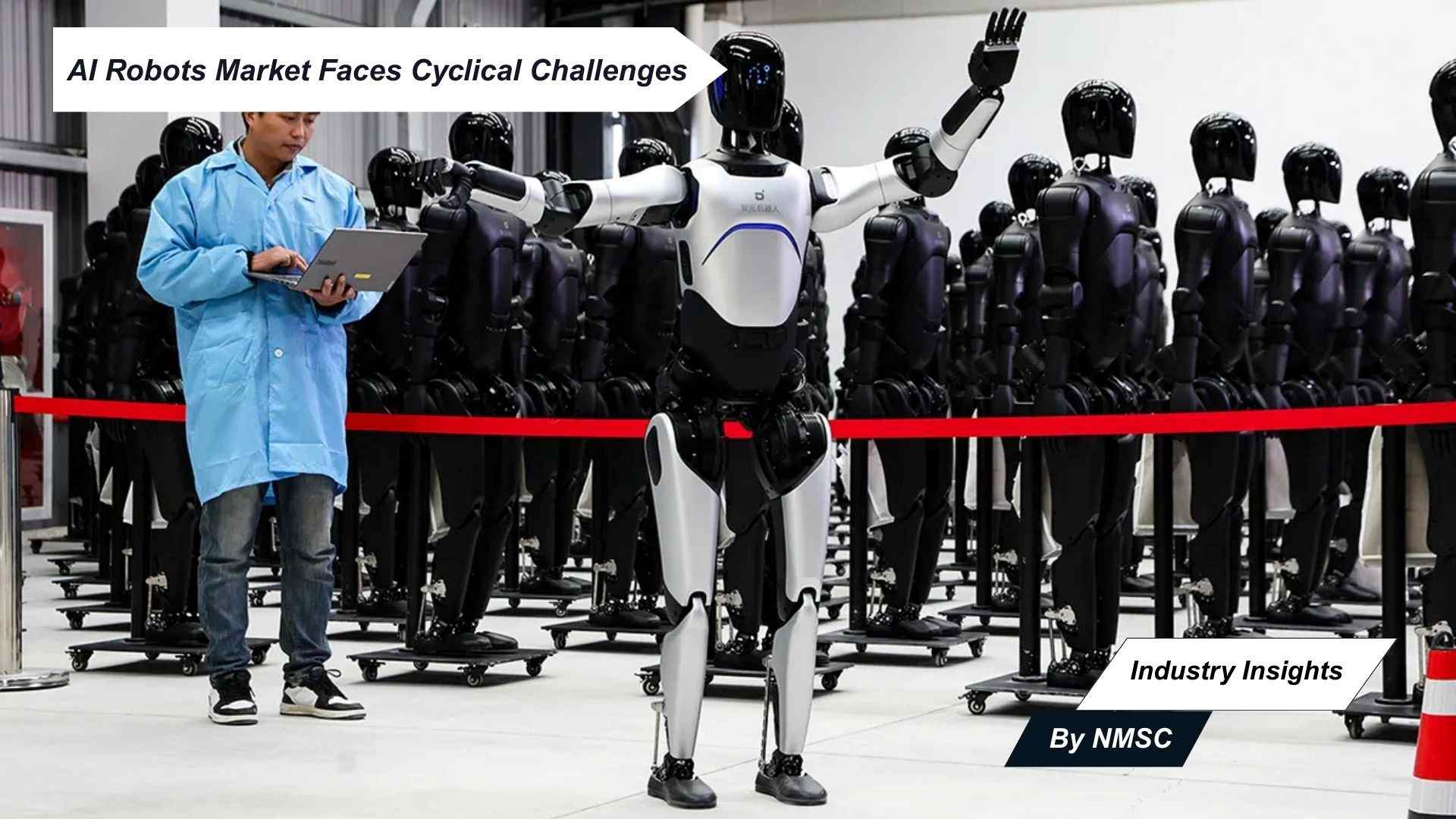
Industry Insights from Next Move Strategy Consulting
As artificial intelligence increasingly converges with industrial automation, the AI Robots Market is witnessing a complex phase where long-term technological momentum meets short-term economic cycles. Recent developments surrounding Fanuc Corporation, a global leader in industrial robotics and CNC systems, illustrate how macroeconomic trends, manufacturing demand, and evolving AI capabilities are shaping the trajectory of robotics adoption across factories worldwide.
While excitement around artificial intelligence has driven strong interest in robotics innovation, the market is currently balancing structural growth opportunities with cyclical pressures tied to global manufacturing demand and capital expenditure patterns.
A Leading Automation Player Reflects Market Realities
For decades, Fanuc has been a major supplier of industrial robots and computer numerical control (CNC) systems used across automotive, electronics, and general manufacturing sectors. These technologies form the backbone of modern automated production lines, making the company closely tied to global manufacturing cycles.
However, despite the surge in enthusiasm around artificial intelligence and robotics investments, Fanuc’s stock performance has remained relatively constrained in recent months. Analysts attribute this trend to weakening orders from machine tool builders and manufacturers, particularly in regions where demand is linked to China’s industrial investment and electronics production.
Industry observers note that such fluctuations are typical for capital-intensive automation companies. When manufacturing sentiment weakens and companies reduce capital expenditures, demand for robots and factory automation systems tends to soften. Conversely, improvements in global manufacturing indicators can quickly reignite demand and drive recovery.
Key Drivers Shaping the AI Robots Market
Several macro and technological factors continue to influence the evolution of AI-powered robotics in manufacturing environments:
-
Global Manufacturing Cycles: Industrial robot demand often mirrors manufacturing activity and capital spending trends worldwide.
-
China’s Industrial Investment: Slowdowns in Chinese capital expenditure have affected demand for machine tools and electronics-related automation equipment.
-
Reshoring and Onshoring Initiatives: Expanding factory investments in the U.S. and other regions are expected to support long-term automation adoption.
-
AI-Driven Smart Manufacturing: Integration of AI technologies such as machine vision, predictive maintenance, and autonomous production systems is gradually increasing the value of advanced robotics platforms.
-
Currency and Global Trade Dynamics: Exchange rate fluctuations and cross-border manufacturing activity also influence investment decisions in automation infrastructure.
These factors collectively demonstrate how the AI Robots Market operates at the intersection of technological innovation and broader industrial economic cycles.
Analyst Perspective and Market Sentiment
Financial analysts evaluating Fanuc’s outlook have largely adopted a balanced stance. Many brokerage firms maintain neutral or “hold” ratings, acknowledging the company’s strong balance sheet and leadership in industrial automation while highlighting near-term uncertainties tied to subdued order volumes.
The consensus view suggests that while demand for automation remains structurally strong, investors are waiting for clearer evidence of recovery in manufacturing orders before expecting significant growth acceleration in robotics companies.
According to Next Move Strategy Consulting
According to Next Move Strategy Consulting, developments surrounding companies such as Fanuc highlight a defining characteristic of the AI Robots Market: its long-term expansion potential remains closely tied to industrial investment cycles.
As industries adopt AI-enabled manufacturing technologies and automation becomes essential to addressing labor shortages and productivity challenges, robotics demand is expected to expand steadily. However, short-term fluctuations in manufacturing sentiment and global capital expenditure will continue to influence the pace of adoption across sectors.
From a strategic perspective, the increasing integration of artificial intelligence, machine vision, and advanced control systems is likely to transform industrial robots from simple automation tools into intelligent production platforms capable of driving the next wave of Industry 4.0 transformation.
Source: AD HOC News
Prepared by: Next Move Strategy Consulting
About the Author
 Sanyukta Deb
— Sanyukta Deb is Digital Marketing Team Lead at Next Move Strategy Consulting, where she has led content strategy and technical SEO for the firm's B2B market research publications for over 2 years. Her editorial process translates NextMSC's primary and secondary research — spanning technology, industrial, and consumer sectors — into commercial narratives, backed by search-intent, keyword, and competitive analysis. She brings 5 years of overall experience in digital marketing and content strategy.
Sanyukta Deb
— Sanyukta Deb is Digital Marketing Team Lead at Next Move Strategy Consulting, where she has led content strategy and technical SEO for the firm's B2B market research publications for over 2 years. Her editorial process translates NextMSC's primary and secondary research — spanning technology, industrial, and consumer sectors — into commercial narratives, backed by search-intent, keyword, and competitive analysis. She brings 5 years of overall experience in digital marketing and content strategy.
About the Reviewer
 Debashree Dey
— Debashree Dey is Assistant Manager at Next Move Strategy Consulting, where she supports cross-vertical market content and communications across diverse industries for 6 years. Her professional background includes senior content writing, communications, and published manuscript authorship, with experience developing audience-focused business narratives and maintaining clear, consistent messaging. Her role supports research-led content development and editorial quality across NextMSC publications.
Debashree Dey
— Debashree Dey is Assistant Manager at Next Move Strategy Consulting, where she supports cross-vertical market content and communications across diverse industries for 6 years. Her professional background includes senior content writing, communications, and published manuscript authorship, with experience developing audience-focused business narratives and maintaining clear, consistent messaging. Her role supports research-led content development and editorial quality across NextMSC publications.















Add Comment