Anesthesia Drugs Market: Regulatory Shifts and Global Growth

FDA Greenlights First China-Originated Intravenous Anesthetic, Signaling a New Competitive Era in the Global Anesthesia Drugs Landscape
On June 1, 2026, the U.S. Food and Drug Administration granted full marketing approval to Cypsedo (cipepofol), an innovative intravenous anesthetic developed by China's Haisco Pharmaceutical Group, marking the first time a China-originated Class 1 innovative intravenous anesthetic has entered the global pharmaceutical market through the FDA's rigorous approval pathway. The milestone carries substantial geopolitical and commercial significance: it signals that Chinese pharmaceutical innovation has reached a level of clinical rigor and regulatory compliance sufficient to compete directly with established Western manufacturers in one of medicine's most critical therapeutic categories.
The approval arrives at a pivotal moment for the global Anesthesia Drugs Market, which is navigating a convergence of long-standing supply disruptions, accelerating surgical demand across emerging economies, and a wave of regulatory actions that are fundamentally reshaping competitive dynamics. Less than twelve months prior, on August 8, 2025, the FDA had approved KETARx (ketamine) by PharmaTher Holdings through an Abbreviated New Drug Application pathway, directly addressing a ketamine shortage that had persisted on the FDA's shortage list since February 2018. Together, these two approvals represent the most consequential regulatory developments in the anesthesia drugs sector in recent years.
For More Information: Download FREE Sample on Anesthesia Drugs Market Report
A Landmark Approval with Global Competitive Implications
Cipepofol, marketed in China under the trade name Sishuning, was first approved by China's National Medical Products Administration in December 2020. Its development, which began in 2012, involved the introduction of a chiral cyclopropyl group into the molecular structure—a modification that yielded a drug with significantly reduced incidence of intraoperative respiratory depression, more stable hemodynamics, and milder injection pain compared to propofol, the current standard of care.
By May 2026, cipepofol had been incorporated into the recommendations of over 20 clinical guidelines and consensus documents, adopted by more than 3,300 medical institutions in China, and had cumulatively benefited more than 40 million patient visits. The FDA granted a waiver for Phase II trials in the United States, allowing Haisco to advance directly to pivotal Phase III trials, all of which were completed in 2024 with results demonstrating non-inferiority against propofol.
The commercial implications extend well beyond the U.S. market. Haisco has indicated it is actively advancing commercialization in the United States and other regions through collaborative arrangements, and is considering initiating a marketing authorization application in Europe. For incumbent manufacturers of propofol and other intravenous anesthetics, the entry of a clinically differentiated, cost-competitive Chinese-origin product into the U.S. market introduces a new dimension of competitive pressure.
Drug Shortages: A Structural Vulnerability Driving Regulatory Urgency
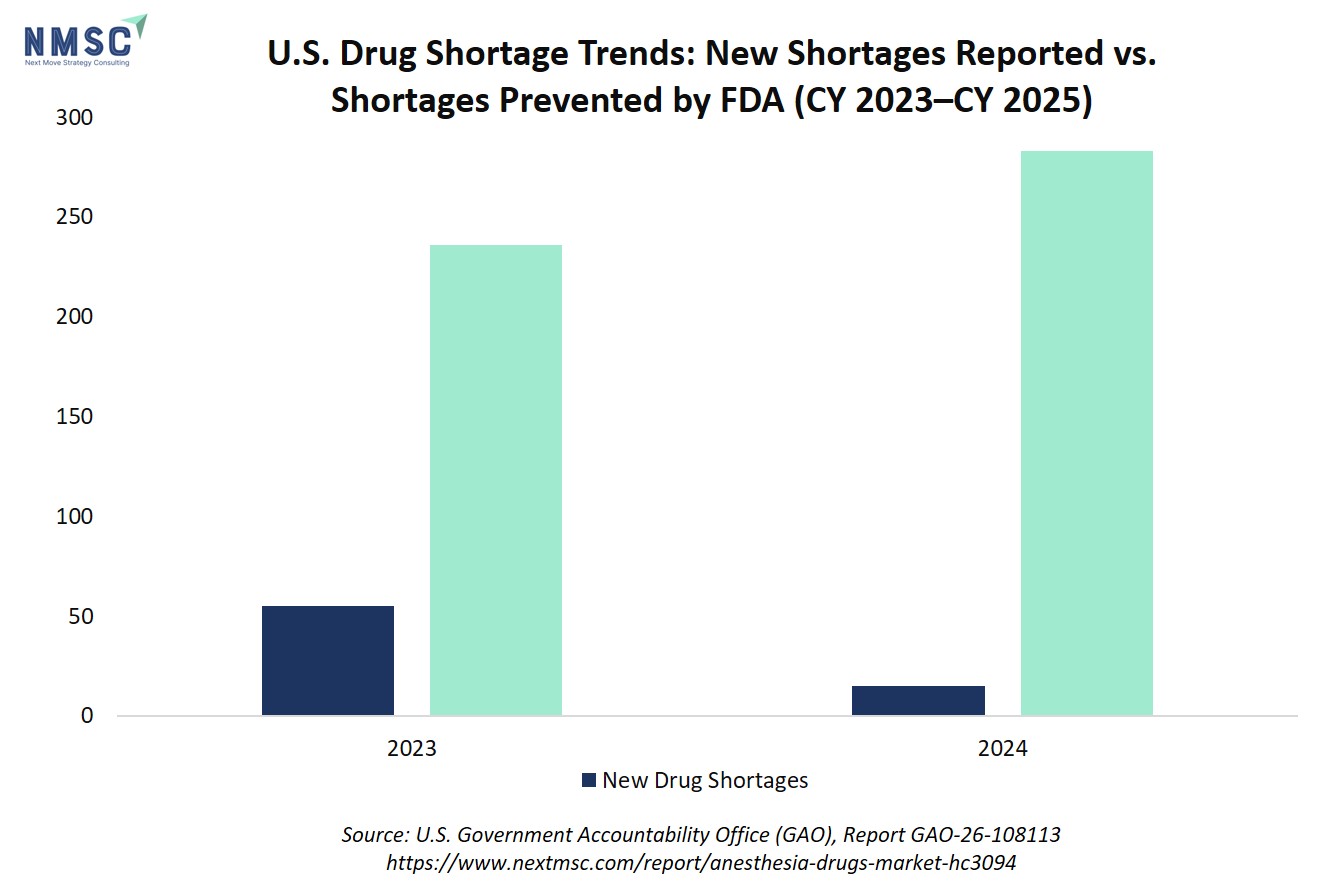
The FDA's accelerated engagement with anesthesia drug approvals reflects a broader structural problem that has long undermined clinical operations globally. According to the FDA's CY 2025 Drug Shortages Report to Congress, there were 55 new drug shortages in calendar year 2023, declining to 15 in CY 2024, and further to just 4 in CY 2025—a trend that reflects intensified FDA prevention efforts. The FDA prevented 236 shortages in CY 2023 and a record 283 in CY 2024.
Despite this progress, the American Society of Health-System Pharmacists (ASHP) reported 227 active drug shortages as of its most recent tracking period, with the duration of current shortages averaging 5.3 years in 2025—up from 4.3 years in 2024. The Government Accountability Office has reported that anesthetics and central nervous system drugs account for 17% of all drug shortages in the United States, a disproportionate share that reflects the complexity of sterile injectable manufacturing and the concentration of production among a limited number of suppliers.
The KETARx approval on August 8, 2025, directly addresses one of the most persistent shortage cases in the anesthesia category. Ketamine, a noncompetitive N-methyl-D-aspartate (NMDA) receptor antagonist that produces analgesia, anesthesia, and amnesia while preserving airway reflexes and cardiovascular stability, had been on the FDA shortage list since February 2018—a seven-year gap that forced clinical reliance on compounded products and prompted a 2023 FDA safety warning regarding the risks associated with compounded ketamine formulations. PharmaTher anticipates that the FDA will remove ketamine from its shortage list and restrict compounders from supplying the drug, opening the pathway for expanded delivery methods and additional indications including Parkinson's disease, amyotrophic lateral sclerosis, and complex regional pain syndrome.
Market Size, Growth Trajectory, and Segmentation
According to analysis by Next Move Strategy Consulting, the global anesthesia drugs market is positioned for sustained expansion through the forecast period, driven by rising surgical volumes, an aging global population, increasing prevalence of chronic diseases requiring operative intervention, and the ongoing transition toward multimodal anesthesia protocols that incorporate multiple drug classes. The NMSC report identifies general anesthesia drugs, local anesthesia drugs, and regional anesthesia agents as the primary segmentation categories, with intravenous agents—particularly propofol and its emerging competitors—commanding the largest revenue share within the general anesthesia segment.
Publicly available market intelligence corroborates this trajectory. The global anesthesia drugs market was valued at approximately USD 7.5 billion in 2025, with projections indicating growth to USD 9.3 billion by 2031 at a compound annual growth rate of approximately 3.65%. The inhalation anesthesia segment, encompassing agents such as sevoflurane, desflurane, and isoflurane, was valued at USD 1.9 billion in 2025 and is projected to grow steadily through 2033.
Regional Dynamics: North America Leads, Asia Pacific Accelerates
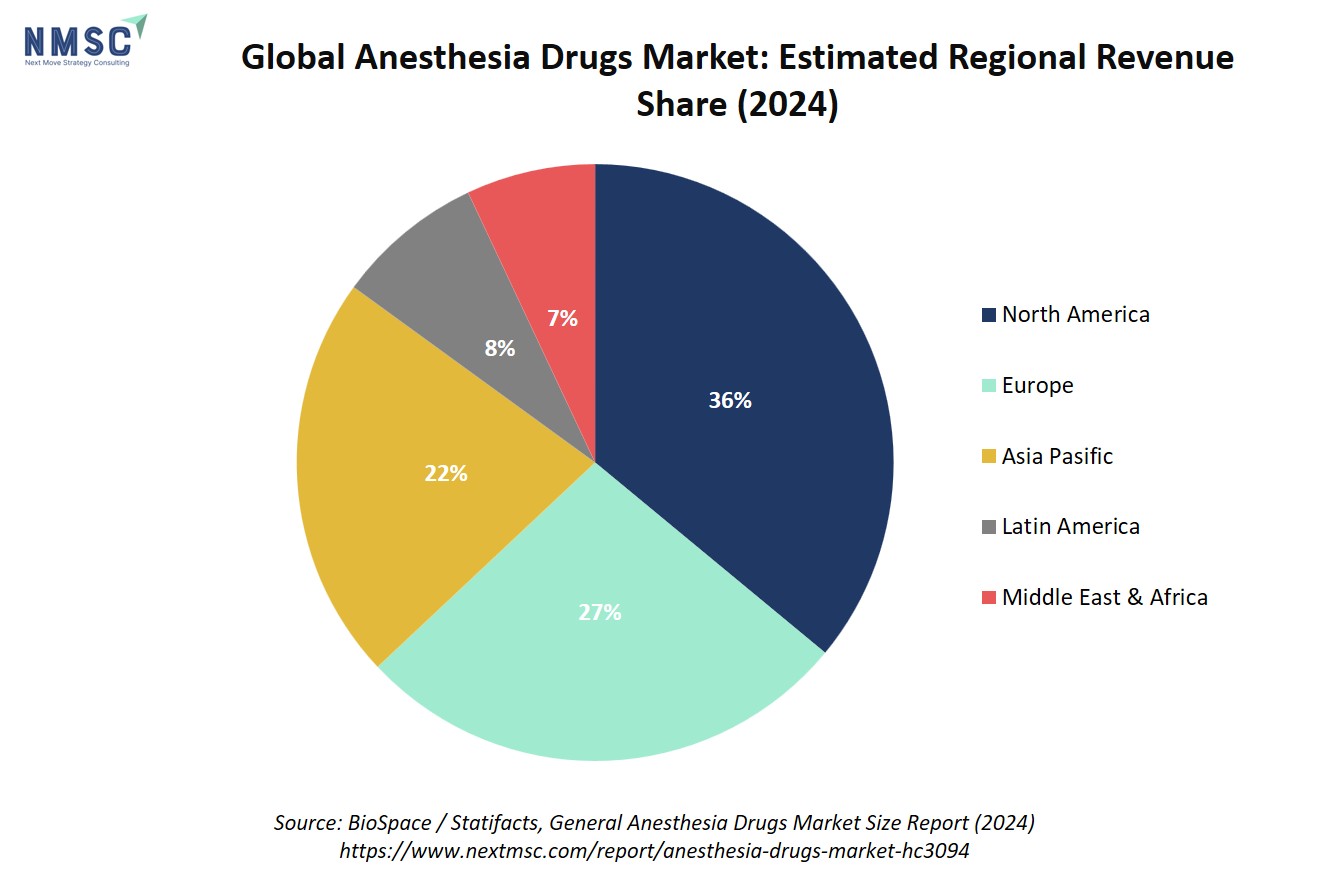
North America retains its position as the dominant regional market, accounting for approximately 36% of global anesthesia drug revenues in 2024, underpinned by the United States' advanced healthcare infrastructure, high surgical procedure volumes, and robust pharmaceutical regulatory framework. The U.S. anesthesia drugs market alone is projected to grow from USD 2.61 billion in 2024 to USD 3.67 billion by 2033.
Asia Pacific represents the fastest-growing regional market, expanding at a CAGR of approximately 5.9% over the next five years, driven by rapidly expanding healthcare infrastructure, rising surgical volumes in China, India, and Southeast Asia, and increasing government investment in hospital capacity. The Asia Pacific local anesthesia drugs segment alone generated USD 1,017.6 million in revenue in 2024.
The NMSC report highlights that emerging markets across Southeast Asia, the Middle East, and Sub-Saharan Africa represent significant long-term growth opportunities, particularly as healthcare systems in these regions invest in expanding surgical capacity to address the substantial unmet need identified by global health authorities.
The Global Surgical Demand Imperative
The demand trajectory for anesthesia drugs is inextricably linked to global surgical volumes and the persistent gap between surgical need and access. The Lancet Commission on Global Surgery's 2025 policy report estimates that the unmet need for surgery has grown to at least 160 million operations per year globally. The World Health Organization estimates that surgical interventions account for approximately 13% of the global burden of disease, yet approximately 5 billion people worldwide lack access to safe, affordable surgical and anaesthesia care when needed.
The World Bank's surgical procedures indicator confirms significant regional disparities: high-income countries such as Australia record over 10,000 surgical procedures per 100,000 population annually, while lower-income nations report rates below 500 per 100,000. As of 2023, only 45 countries—representing 36.6% of those reporting—had achieved the Lancet Commission on Global Surgery target of 5,000 procedures per 100,000 population.
Key FDA Regulatory Actions in the Anesthesia Drugs Sector (2024–2026)
|
Drug (Brand Name) |
Active Ingredient |
Manufacturer |
Regulatory Action |
Date |
Primary Indication |
|
Propofol Injectable Emulsion, USP |
Propofol |
Avenacy |
FDA Approval (Generic – Diprivan equivalent) |
2024 |
General anesthesia / IV sedation |
|
KETARx |
Ketamine HCl |
PharmaTher Holdings |
FDA Approval (ANDA pathway) |
August 8, 2025 |
Surgical anesthesia / analgesia |
|
Cypsedo |
Cipepofol |
Haisco Pharmaceutical Group |
FDA Marketing Approval (NDA) |
June 1, 2026 |
General anesthesia / ICU sedation |
U.S. Drug Shortage Statistics – Annual Overview (CY 2023–CY 2025)
|
Calendar Year |
New Drug Shortages Reported |
Shortages Prevented by FDA |
Active Shortages (Approx. Year-End) |
Avg. Shortage Duration |
|
2023 |
55 |
236 |
~295 |
N/A |
|
2024 |
15 |
283 |
98 |
4.3 years |
|
2025 |
4 |
Not separately reported |
75 |
5.3 years |
Competitive Landscape and Strategic Positioning
The anesthesia drugs market is characterized by a mix of large multinational pharmaceutical corporations, specialty pharmaceutical companies, and an expanding cohort of generic manufacturers. Key participants identified in publicly available market intelligence include Fresenius Kabi, AstraZeneca, Pfizer, Baxter International, Hikma Pharmaceuticals, and Piramal Enterprises, among others. The entry of Haisco Pharmaceutical into the U.S. market with a clinically differentiated product introduces a new competitive variable that incumbent manufacturers will need to address through pricing strategy, supply reliability, and continued innovation.
The NMSC report identifies the increasing adoption of generic anesthesia drugs as a significant market trend, driven by cost containment pressures across healthcare systems globally. Simultaneously, the report notes that multimodal anesthesia protocols—which combine multiple drug classes to reduce opioid dependence and improve patient outcomes—are gaining traction in both developed and emerging markets, creating demand for a broader portfolio of anesthetic agents.
The FDA's 2025 requirement for updated safety labeling on all opioid pain medications, with renewed emphasis on long-term use risks, is expected to accelerate the adoption of non-opioid anesthetic adjuncts, including ketamine and regional anesthesia techniques, across ambulatory surgical centers and hospital operating rooms.
The OECD's Health at a Glance 2025 report notes that per capita expenditure on retail pharmaceuticals averaged USD 766 across OECD countries in 2023, with the United States representing the highest per capita pharmaceutical spender among developed nations. This expenditure environment, combined with the structural shift toward ambulatory and minimally invasive surgical procedures, is expected to sustain demand for both branded and generic anesthesia agents across the forecast period.
Bottom Line
The global anesthesia drugs market is entering a period of accelerated transformation, driven by landmark regulatory approvals, persistent supply chain vulnerabilities, and an expanding global surgical demand that remains structurally underserved. The FDA's approval of Cypsedo (cipepofol) in June 2026 represents a geopolitical and commercial inflection point, introducing the first China-originated innovative intravenous anesthetic into the world's most regulated pharmaceutical market and intensifying competitive pressure on established propofol manufacturers. Simultaneously, the resolution of long-standing drug shortages through approvals such as KETARx signals a more proactive regulatory posture that should improve supply reliability for clinical practitioners.
For investors and strategic planners, the market's most compelling opportunities lie in Asia Pacific—where surgical infrastructure investment is accelerating at a CAGR of approximately 5.9%—and in the development of next-generation anesthetic agents that address unmet clinical needs around respiratory safety, hemodynamic stability, and opioid reduction. Key risks include manufacturing concentration among a limited number of sterile injectable producers, evolving regulatory requirements, and pricing pressure from generic market entrants. Institutions with exposure to this sector should monitor the commercialization trajectory of cipepofol in the United States and Europe as a leading indicator of broader competitive disruption.
About Next Move Strategy Consulting
Next Move Strategy Consulting is a premier market research and management consulting firm that has been committed to provide strategically analysed well documented latest research reports to its clients. The research industry is flooded with many firms to choose from, what makes NMSC different from the rest is its top-quality research and the obsession of turning data into knowledge by dissecting every bit of it and providing fact-based research recommendation that is supported by information collected from over 500 million websites, paid databases, industry journals and one on one consultations with industry experts across a diverse range of industry sectors. The high-quality customized research reports with actionable insights and excellent end-to-end customer service help our clients to take critical business decisions that enables them to move beyond time and have competitive edge in the industry.
We have been servicing over 1000 customers globally that includes 90% of the Fortune 500 companies over a decade. Our analysts are constantly tracking various high growth markets and identifying hidden opportunities in each sector or the industry. We provide one of the industry's best quality syndicate as well as custom research reports across 10 different industry verticals. We are committed to deliver high quality research solutions in accordance to your business needs. Our industry standard delivery solutions that ranges from the pre consultation to after-sales services, provide an excellent client experience and ensure right strategic decision making for businesses.
For more information, please contact:
Next Move Strategy Consulting
5th Floor 867 Boylston St, STE 500,
Boston, MA 02116, U.S.
E-Mail: [email protected]
Direct: +1-217-650-7991
Website: www.nextmsc.com
About the Author
 Sanyukta Deb
— Sanyukta Deb is Digital Marketing Team Lead at Next Move Strategy Consulting, where she has led content strategy and technical SEO for the firm's B2B market research publications for over 2 years. Her editorial process translates NextMSC's primary and secondary research — spanning technology, industrial, and consumer sectors — into commercial narratives, backed by search-intent, keyword, and competitive analysis. She brings 5 years of overall experience in digital marketing and content strategy.
Sanyukta Deb
— Sanyukta Deb is Digital Marketing Team Lead at Next Move Strategy Consulting, where she has led content strategy and technical SEO for the firm's B2B market research publications for over 2 years. Her editorial process translates NextMSC's primary and secondary research — spanning technology, industrial, and consumer sectors — into commercial narratives, backed by search-intent, keyword, and competitive analysis. She brings 5 years of overall experience in digital marketing and content strategy.
About the Reviewer
 Debashree Dey
— Debashree Dey is Assistant Manager at Next Move Strategy Consulting, where she supports cross-vertical market content and communications across diverse industries for 6 years. Her professional background includes senior content writing, communications, and published manuscript authorship, with experience developing audience-focused business narratives and maintaining clear, consistent messaging. Her role supports research-led content development and editorial quality across NextMSC publications.
Debashree Dey
— Debashree Dey is Assistant Manager at Next Move Strategy Consulting, where she supports cross-vertical market content and communications across diverse industries for 6 years. Her professional background includes senior content writing, communications, and published manuscript authorship, with experience developing audience-focused business narratives and maintaining clear, consistent messaging. Her role supports research-led content development and editorial quality across NextMSC publications.


















Add Comment