Aurora’s 30,000-Truck Goal Puts Autonomous Freight at an Inflection Point
Aurora's 30,000-Truck Blueprint and the BUILD America 250 Act Signal Autonomous Freight's Commercial Inflection Point
Two days ago, Aurora Innovation's Chief Financial Officer David Maday told TechCrunch that the company's target of 30,000 driverless trucks generating USD 5 billion in annual revenue by the end of 2030 is not aspirational — it is an operational plan built on a specific hardware transition, a shift in commercial model, and a manufacturing partnership with Aumovio (formerly Continental) that will mass-produce autonomous driving kits at scale. The disclosure, made on September 28, 2026, arrives at a moment when the autonomous truck sector is simultaneously accelerating its commercial deployments, navigating a fractured state-by-state regulatory environment, and awaiting a federal legislative framework that could resolve the patchwork of rules that currently governs driverless freight operations across 35 U.S. states.
According to Next Move Strategy Consulting's Autonomous Truck Market report, the global autonomous truck market is projected to reach USD 85.4 billion by 2030, growing at a CAGR of 12.77% from 2023 to 2030. NMSC's proprietary research and analysis identifies the convergence of a structural U.S. driver shortage, the commercial maturation of Level 4 autonomous systems on defined highway corridors, and the emergence of driver-as-a-service subscription models as the three mechanisms most directly compressing the timeline between pilot operations and industrial-scale deployment.
For More Information: Download FREE Sample on Autonomous Truck Market Report
Aurora's Commercial Scaling Architecture: From 200 Trucks to 30,000
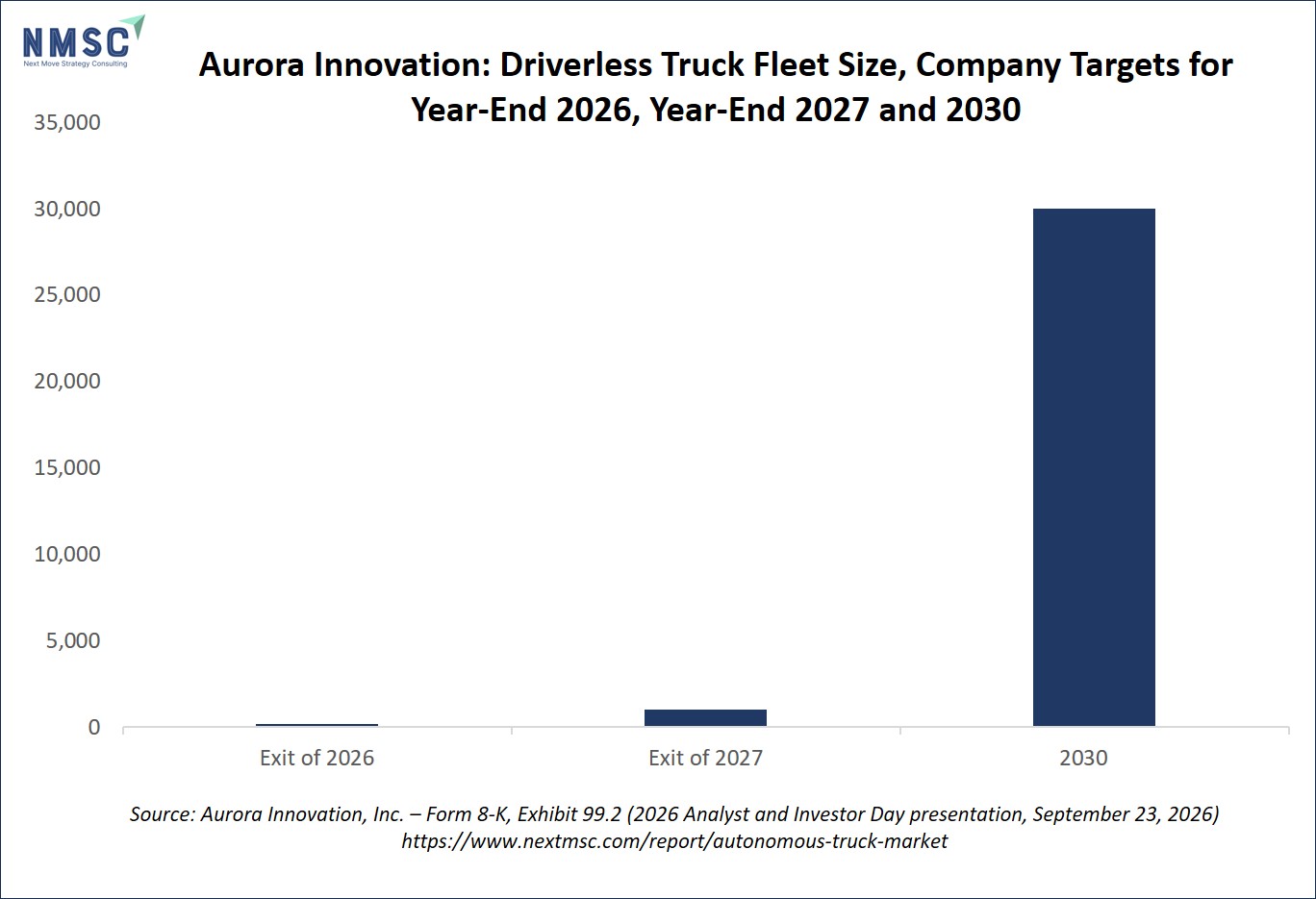
Aurora Innovation's September 23 Analyst and Investor Day laid out a sequenced scaling plan that is now the most detailed public roadmap in the autonomous trucking sector. The company expects to close 2026 with approximately 200 driverless trucks operating across 10 routes in the U.S. Sun Belt, generating an USD 80 million revenue run rate under a transportation-as-a-service model that charges customers approximately USD 2 per mile — a rate that includes a fuel surcharge and is broadly comparable to conventional carrier pricing.
The structural shift begins in 2027. Aurora plans to transition from owning and operating trucks to a driver-as-a-service model in which customers purchase the trucks and pay Aurora a per-mile subscription fee of approximately USD 0.85 for the self-driving system. This model removes the trucks from Aurora's balance sheet, which Maday identified as the critical prerequisite for scaling to thousands of units without proportional capital expenditure.
"While 30,000 kind of feels like a lot — and it does in the autonomy space for sure — in terms of trucks relative to the overall market, it's kind of pretty small," Maday told TechCrunch on September 28, 2026. "I don't think it's aspirational. I think we can do it." He noted that the four major truck manufacturers collectively produce between 250,000 and 300,000 new trucks annually, placing Aurora's 2030 target at roughly 10% of a single year's production volume.
The hardware enabling this scale was formally launched on July 22, 2026, when Aurora announced its second-generation driverless trucks, built on the International® LT® Series platform and equipped with next-generation sensors and computing hardware engineered to last one million miles. Manufacturing partner Roush is targeting an annual production run-rate of 1,000 Aurora trucks by the end of 2026.
"Last year's driverless launch proved our technology could operate safely on public roads — our new platform now provides the foundation to deliver at scale," said Chris Urmson, CEO and co-founder of Aurora, in the company's July 22, 2026 press release. "Deploying our second-generation truck allows us to put hundreds of autonomous trucks on the road and ultimately into the hands of more customers."
As of the end of June 2026, the Aurora Driver had completed nearly 440,000 driverless miles across its commercial network. In April 2026, refrigerated carrier Hirschbach Motor Lines agreed to purchase 500 Aurora Driver-powered trucks — the largest single fleet commitment in the autonomous trucking sector to date.
Volvo's Industrial-Scale Commitment and the Economics of Continuous Operation
Aurora is not the only OEM-aligned player moving from demonstration to deployment. Volvo Group has placed firm milestones behind its own autonomous trucking programme, targeting fully driverless operations in Texas in the first quarter of 2027 and more than 300 autonomous trucks on U.S. highways by the end of 2027, with industrial-scale deployment from 2028 onwards.
The economic rationale Volvo articulates goes beyond driver cost elimination. Peter Voorhoeve, President of Volvo Trucks North America, places asset uptime at the centre of the customer value proposition. "The most important thing is uptime, because when a vehicle stands still, you're losing around 2,000 dollars a day," Voorhoeve told Forbes contributor Sarwant Singh in a July 14, 2026 interview. Volvo's own data shows a 24% reduction in unplanned stops across 16,000 vehicles using its current AI-enabled diagnostics and software platform — a figure that illustrates how the productivity gains from autonomous operation begin accumulating before a truck is fully driverless.
Volvo's estimate is that autonomy can roughly double asset utilization, enabling a single truck to exceed 200,000 miles per year — a threshold that compresses capital payback timelines and allows freight that would require four to five days under human hours-of-service constraints to move across the country in two days.
Sasko Cuklev, who leads on-road solutions at Volvo Autonomous Solutions and has worked on autonomy since 2015, emphasised that the most consequential change in the sector is now organisational rather than technical. "The technology will be there," Cuklev told Forbes in the same July 14, 2026 interview, "but we need to figure out all the other things as well" — referring to dispatch protocols, service support infrastructure, customer integration, and clear accountability frameworks when operational problems arise.
Key Autonomous Truck Commercial Deployment Milestones — Selected Operators (as of September 2026)
|
Company |
Current Operational Status |
Near-Term Target |
Key Route(s) |
|
Aurora Innovation |
~200 driverless trucks by end-2026; 440,000 driverless miles completed (as of June 2026) |
1,000+ trucks by end-2027; 30,000 by 2030 |
Dallas–Houston; Fort Worth–Phoenix; Dallas–Oklahoma City |
|
Volvo Autonomous Solutions |
Driverless operations on Dallas–Oklahoma City lane |
Fully driverless Texas operations Q1 2027; 300+ trucks on U.S. highways by end-2027 |
Dallas–Oklahoma City |
|
Gatik |
Driverless box truck operations in Arizona, Arkansas, and Texas |
Ongoing commercial expansion |
PepsiCo, Walmart, Tyson Foods supply chains |
|
Kodiak AI |
Driverless operations in Permian Basin (oil field sand haulage) |
California testing permit received; expansion planned |
New Mexico and Texas Permian Basin |
|
Einride |
Driverless short-haul freight operations |
Ongoing |
Marysville, Ohio |
The Structural Driver Shortage: Why Autonomous Freight Is a Capacity Solution, Not a Substitution Play
The commercial urgency behind autonomous trucking is anchored in a labour constraint that has persisted across the U.S. freight market regardless of economic cycle. The American Trucking Associations estimates a current driver shortage of approximately 60,000, alongside a projected need for roughly 1.2 million new drivers over the next decade to cover retirements and industry growth. Turnover at large truckload carriers runs close to 90%, and the driver workforce is ageing with insufficient younger entrants to replace those exiting the profession.
Cuklev pointed to freight volume forecasts projecting a roughly fivefold increase in demand by 2050, widening the gap between transport capacity and available labour if the current driver pipeline does not materially improve. A University of Illinois study released in August 2026 estimated that driverless trucks could reduce transportation costs by 35%, providing an independent academic quantification of the efficiency gains that operators and OEMs have been projecting from operational data.
The Regulatory Fault Line: Federal Framework vs. State-by-State Fragmentation
The most consequential near-term variable for autonomous truck market scaling is not technology — it is regulatory architecture. As of August 2026, 35 U.S. states allow autonomous truck testing or deployment, but no federal framework exists to govern interstate commerce, creating a patchwork of rules that complicates multi-state route planning and fleet financing.
The BUILD America 250 Act — the bipartisan surface transportation reauthorisation bill that has advanced through the House Transportation Committee — would establish the first-ever national regulatory framework for autonomous commercial vehicles. The framework, to be drawn up within six months to two years of the legislation's passage, includes safety standards for interstate AV commerce set by the Secretary of Transportation, manufacturer-submitted safety cases demonstrating performance at least equivalent to human commercial drivers, cybersecurity policies, crash reporting requirements, and rules governing the ratio of autonomous trucks a single human dispatcher may monitor simultaneously.
"Manufacturers support a clear and consistent federal framework for autonomous commercial vehicles," said Kirbie Ferrell, NAM Director of Transportation and Infrastructure Policy, in a statement published by the National Association of Manufacturers. "Providing regulatory certainty for emerging technologies can encourage innovation, strengthen supply chains and improve the efficient movement of goods across the national freight network."
California's regulatory evolution is particularly significant given its market size. The California Department of Motor Vehicles lifted its previous ban on heavy-duty autonomous vehicles and established a structured testing pathway requiring manufacturers to complete 500,000 miles across two separate phases — totalling one million miles — and to submit a structured safety case covering hardware, software, and operations before qualifying for commercial freight operations. Aurora, Gatik, and Kodiak have all received California DMV testing permits under the new regulations.
The regulatory environment is not without friction. Teamsters California filed suit against the California DMV in August 2026, challenging the new autonomous vehicle regulations and alleging the agency violated procedural law by failing to properly evaluate economic impacts or allow adequate public feedback. "Such a critical decision with life-and-death consequences must involve public input and transparency," said Peter Finn, Teamsters California co-chair, in an August 5, 2026 statement announcing the lawsuit.
Jeff Farrah, CEO of the Autonomous Vehicle Industry Association, characterised the lawsuit as a "last-ditch attempt to undermine the regulatory authority of the Department of Motor Vehicles, and it should be rejected." A March 2026 poll by Advocates for Highway and Auto Safety found that 85% of respondents expressed concern about sharing roads with autonomous trucks — a public sentiment figure that state legislators in Alaska, Alabama, and Iowa have cited in advancing driver-in bills, most of which have stalled or been vetoed.
U.S. State Regulatory Landscape for Autonomous Truck Deployment (as of August 2026)
|
State |
Regulatory Status |
Key Development |
|
Texas |
Permits driverless freight operations |
First commercial driverless Class 8 service (Aurora, Dallas–Houston, since 2025) |
|
Arizona |
Permits driverless freight operations |
Gatik operating driverless box trucks for PepsiCo |
|
Michigan |
Permits driverless freight operations |
Ongoing testing and deployment |
|
California |
Testing permitted; commercial pathway established |
DMV lifted heavy-duty AV ban; 1M-mile safety case requirement; Teamsters lawsuit filed August 2026 |
|
Ohio |
Platooning pilot underway |
U.S. DOT grant project with Indiana on I-70; Einride operating in Marysville |
|
Alaska |
Driver-in bill passed House; stalled in Senate |
Ongoing legislative debate |
|
Colorado |
Driver-in bill vetoed by Governor Polis |
Governor cited innovation and safety rationale in veto statement |
|
Federal (U.S.) |
No framework in force |
BUILD America 250 Act advanced through House Transportation Committee |
NMSC Strategic Perspective: The Commercial Model Transition Is the Market's Critical Variable
Next Move Strategy Consulting's analysis of the autonomous truck market identifies the transition from transportation-as-a-service to driver-as-a-service as the single most consequential structural shift currently underway — and the one that will determine whether the market reaches NMSC's projected USD 85.4 billion valuation by 2030.
NMSC's proprietary research and analysis indicates that the autonomous truck market's growth trajectory is not primarily constrained by sensor technology or AI software maturity at this stage of development. The Level 4 systems now operating commercially on defined U.S. highway corridors have demonstrated sufficient reliability to attract binding fleet purchase commitments — Hirschbach's 500-truck order being the clearest evidence. The binding constraint is the commercial architecture: who owns the trucks, who finances the autonomous hardware kit, and how the per-mile economics are distributed between the technology provider, the OEM, and the carrier.
Aurora's driver-as-a-service model — in which the carrier owns the truck and pays a USD 0.85 per-mile subscription for the self-driving system — directly addresses the balance-sheet barrier that has historically prevented rapid fleet scaling. By moving the truck asset off Aurora's books and onto the carrier's, the model allows Aurora to grow its fleet count without proportional capital deployment, while giving carriers a variable-cost structure that aligns autonomous truck economics with freight rate cycles. AUMOVIO's Hardware-as-a-Service arrangement shifts autonomous hardware costs toward a per-mile commercial model and supports Aurora's asset-light scaling strategy.
NMSC's analysis further identifies the BUILD America 250 Act's federal framework provisions as a potential accelerant for institutional fleet financing. Lenders and fleet lessors have been reluctant to underwrite large autonomous truck portfolios in the absence of uniform federal safety standards and liability rules. A federal framework that establishes clear safety case requirements and crash reporting obligations would reduce the actuarial uncertainty that currently inflates insurance premiums and financing costs for autonomous fleets — directly expanding the addressable market beyond the handful of well-capitalised early adopters currently operating at scale.
The labour market dynamic reinforces NMSC's long-term growth outlook. With the American Trucking Associations projecting a need for 1.2 million new drivers over the next decade against a backdrop of 90% annual turnover at large truckload carriers, the structural case for autonomous capacity on defined long-haul corridors strengthens with each year that the driver pipeline fails to close the gap. NMSC's proprietary research and analysis positions North America as the dominant regional market through the forecast period, with Asia-Pacific — particularly China and Japan — representing the fastest-growing regional opportunity as ADAS mandates and logistics expansion accelerate adoption of Level 2 and Level 3 systems ahead of full autonomy deployment.
The competitive landscape is consolidating around OEM-technology partnerships rather than standalone AV startups. The Aurora–Volvo relationship, the Aurora–Aumovio hardware manufacturing agreement, and Daimler Truck's Torc Robotics subsidiary all reflect a structural shift toward integrated systems where the truck OEM and the autonomous technology provider share engineering accountability, safety case ownership, and commercial risk — a model that NMSC's analysis identifies as more durable than the pure-play AV developer model that characterised the sector's earlier phase.
Investment Momentum and the Private Capital Signal
Since 2018, more than USD 6 billion in private capital has been invested in the autonomous trucking industry, according to the Autonomous Vehicle Industry Association. That figure reflects sustained institutional conviction in the sector's long-term economics, even as near-term investor sentiment has been volatile — Aurora's shares fell 12.42% on September 29, 2026, the trading day following its Analyst and Investor Day, as markets weighed the gap between the company's current 200-truck fleet and its 30,000-truck target.
The divergence between private capital inflows and public market scepticism is characteristic of infrastructure-scale technology transitions, where the capital intensity of early deployment phases compresses near-term margins while the long-term unit economics — driven by hardware cost reduction, utilisation gains, and subscription revenue — remain intact. NMSC's proprietary research and analysis projects that the market's 12.77% CAGR through 2030 is supported by the compounding effect of fleet expansion, per-mile subscription revenue growth, and the progressive reduction in autonomous hardware costs as Aumovio and other Tier 1 suppliers move from hand-built prototype kits toward mass-produced units.
Bottom Line
The autonomous truck market is undergoing a structural transition from technology demonstration to commercial infrastructure, with Aurora Innovation's September 2026 investor disclosures and Volvo's firm 2027 deployment milestones marking the clearest evidence yet that the sector's scaling phase has begun in earnest. According to Next Move Strategy Consulting's proprietary research and analysis, the global autonomous truck market — valued at USD 28.4 billion in 2022 — is on a trajectory to reach USD 85.4 billion by 2030 at a 12.77% CAGR, driven by the convergence of a structural U.S. driver shortage of approximately 60,000 (American Trucking Associations), the commercial maturation of Level 4 systems on defined highway corridors, and the emergence of driver-as-a-service subscription models that remove autonomous trucks from technology providers' balance sheets and enable fleet scaling without proportional capital deployment. The BUILD America 250 Act's federal framework provisions, if enacted, would resolve the regulatory fragmentation that currently constrains institutional fleet financing and multi-state route planning. The competitive landscape is consolidating around OEM-technology partnerships — Aurora–Volvo, Aurora–Aumovio, Daimler–Torc — that distribute engineering accountability and commercial risk across integrated systems rather than standalone AV developers. Labour economics, utilisation gains, and hardware cost reduction curves all point in the same direction: the autonomous truck market's growth trajectory is structural, not cyclical.
About Next Move Strategy Consulting
Next Move Strategy Consulting is a premier market research and management consulting firm that has been committed to provide strategically analysed well documented latest research reports to its clients. The research industry is flooded with many firms to choose from, what makes NMSC different from the rest is its top-quality research and the obsession of turning data into knowledge by dissecting every bit of it and providing fact-based research recommendation that is supported by information collected from over 500 million websites, paid databases, industry journals and one on one consultations with industry experts across a diverse range of industry sectors. The high-quality customized research reports with actionable insights and excellent end-to-end customer service help our clients to take critical business decisions that enables them to move beyond time and have competitive edge in the industry.
We have been servicing over 1000 customers globally that includes 90% of the Fortune 500 companies over a decade. Our analysts are constantly tracking various high growth markets and identifying hidden opportunities in each sector or the industry. We provide one of the industry's best quality syndicate as well as custom research reports across 10 different industry verticals. We are committed to deliver high quality research solutions in accordance to your business needs. Our industry standard delivery solutions that ranges from the pre consultation to after-sales services, provide an excellent client experience and ensure right strategic decision making for businesses.
For more information, please contact:
Next Move Strategy Consulting
5th Floor 867 Boylston St, STE 500,
Boston, MA 02116, U.S.
E-Mail: [email protected]
Direct: +1-217-650-7991
Website: www.nextmsc.com
About the Author
 Sanyukta Deb
— Sanyukta Deb is Digital Marketing Team Lead at Next Move Strategy Consulting, where she has led content strategy and technical SEO for the firm's B2B market research publications for over 2 years. Her editorial process translates NextMSC's primary and secondary research — spanning technology, industrial, and consumer sectors — into commercial narratives, backed by search-intent, keyword, and competitive analysis. She brings 5 years of overall experience in digital marketing and content strategy.
Sanyukta Deb
— Sanyukta Deb is Digital Marketing Team Lead at Next Move Strategy Consulting, where she has led content strategy and technical SEO for the firm's B2B market research publications for over 2 years. Her editorial process translates NextMSC's primary and secondary research — spanning technology, industrial, and consumer sectors — into commercial narratives, backed by search-intent, keyword, and competitive analysis. She brings 5 years of overall experience in digital marketing and content strategy.
About the Reviewer
 Debashree Dey
— Debashree Dey is Assistant Manager at Next Move Strategy Consulting, where she supports cross-vertical market content and communications across diverse industries for 6 years. Her professional background includes senior content writing, communications, and published manuscript authorship, with experience developing audience-focused business narratives and maintaining clear, consistent messaging. Her role supports research-led content development and editorial quality across NextMSC publications.
Debashree Dey
— Debashree Dey is Assistant Manager at Next Move Strategy Consulting, where she supports cross-vertical market content and communications across diverse industries for 6 years. Her professional background includes senior content writing, communications, and published manuscript authorship, with experience developing audience-focused business narratives and maintaining clear, consistent messaging. Her role supports research-led content development and editorial quality across NextMSC publications.
















Add Comment