Electric Trucks Hit 9% of Global Commercial Vehicle Sales

IEA Global EV Outlook 2026 Confirms Electric Truck Sales Doubled in 2025, Surpassing 400,000 Units for the First Time as Policy, Cost Parity, and Industrial Demand Reshape the Global Commercial Vehicle Market
The global commercial transport sector crossed a structural threshold in 2025 that industry analysts had long anticipated but few expected to arrive this decisively. According to the International Energy Agency's Global EV Outlook 2026 — published in 2026 — sales of electric trucks exceeded 400,000 units globally for the first time, doubling year-on-year and reaching 9 percent of all truck sales worldwide. The milestone, driven by an extraordinary acceleration in China, sustained policy momentum in Europe, and resilient demand in North America, marks the most consequential inflection point in the electrification of the global Commercial Vehicle Market since the segment's modern industrial formation.
The IEA's findings arrive against a backdrop of broader automotive industry repositioning. The International Organization of Motor Vehicle Manufacturers (OICA), presenting its full-year 2025 data at a press conference in Beijing on April 23, 2026, confirmed that global vehicle production rose from 92.7 million units in 2024 to 96.4 million in 2025 — a 3.9 percent increase — while global sales climbed from 95.3 million to 99.8 million units, a 4.7 percent gain. OICA Secretary General François Roudier described the 2025 data as "not just a scoreboard" but "a map of industrial repositioning," underscoring the structural nature of the shifts now underway across the commercial vehicle segment.
For More Information: Download FREE Sample on Commercial Vehicle Market Report
Electric Truck Segment: A Historic Inflection Point
The IEA's Global EV Outlook 2026 provides granular decomposition of the electric truck milestone. The electric heavy freight truck (HFT) segment — vehicles with a gross weight exceeding 15 tonnes — recorded the most dramatic acceleration: sales almost tripled year-on-year, from approximately 84,000 units in 2024 to a record 230,000 in 2025. The electric medium freight truck (MFT) segment — vehicles between 3.5 and 15 tonnes — grew more moderately but still posted a 65 percent year-on-year increase, reaching 210,000 units in 2025.
Battery electric powertrains dominated the technology mix, accounting for 97 percent of all electric truck sales globally in 2025 — a reflection of both the superior cost-competitiveness of battery electric trucks relative to plug-in hybrid alternatives and the far greater availability of battery electric models across major markets.
China: One in Four Trucks Sold Was Electric
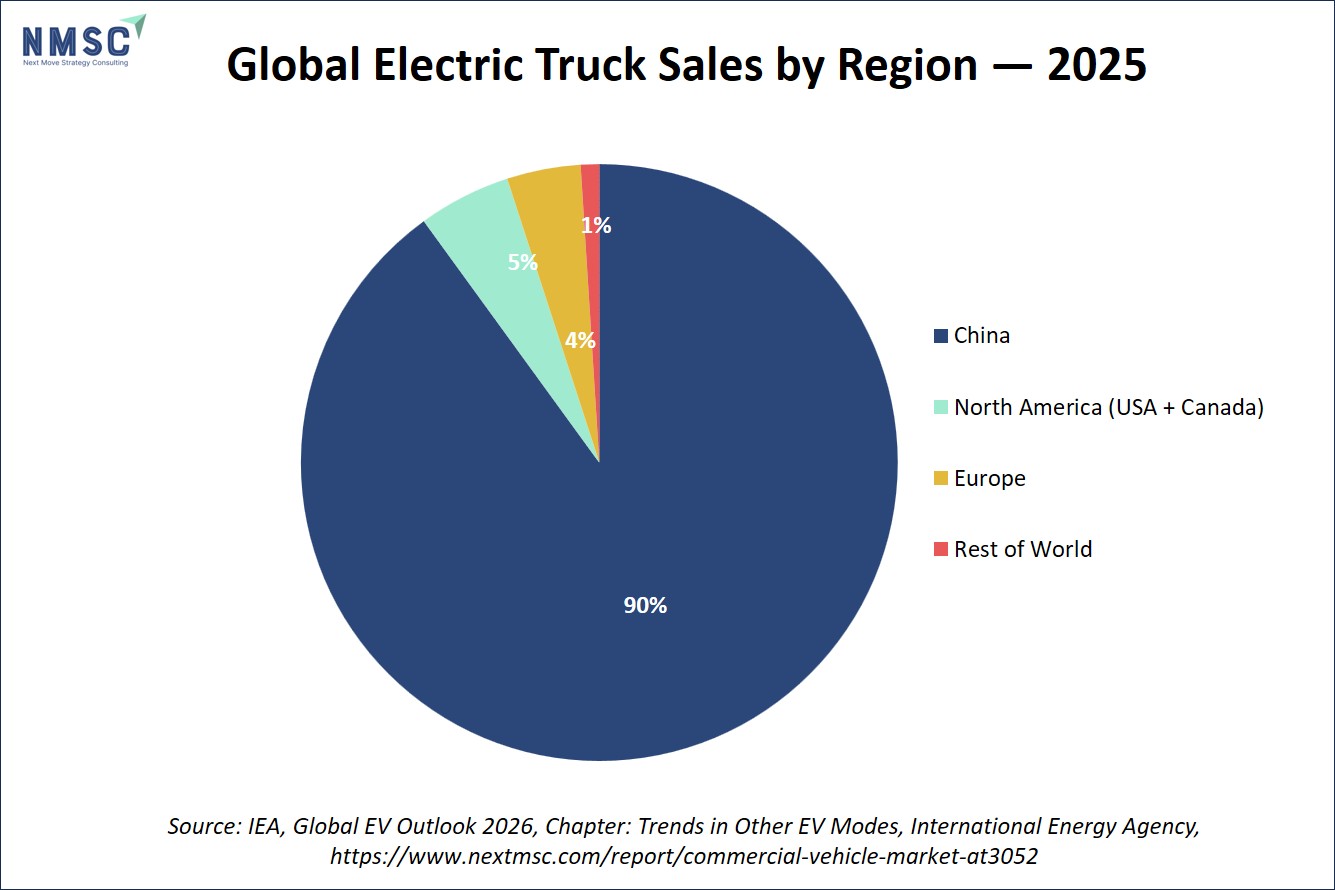
China's role in the global electric truck transition is without parallel. In 2025, electric truck sales in China surpassed 400,000 units — accounting for more than 90 percent of global electric truck sales — as momentum continued to build on the back of operational cost advantages, declining battery costs, and strong government policy.
One in four trucks sold in China in 2025 was electric. The electric HFT sales share reached 28 percent of total HFT sales in China — up from 13 percent in 2024 — while electric MFT sales reached a 24 percent share, up from 16 percent. In December 2025, the electric vehicle sales share for trucks reached approximately 50 percent for the first time, reflecting an end-of-year surge as fleet purchasers anticipated the potential conclusion of China's scrappage scheme.
The Chinese government's renewed scrappage scheme — offering owners up to approximately USD 20,000 to replace older trucks compliant with China IV emissions standards or earlier with cleaner alternatives — provided a subsidy sufficient to cover 20 to 50 percent of the average electric truck price premium. China's Stage 4 heavy-duty vehicle fuel consumption standards, which came into effect in July 2025 and require a 12 to 16 percent improvement compared to Stage 3, further reinforced the structural shift toward electrification.
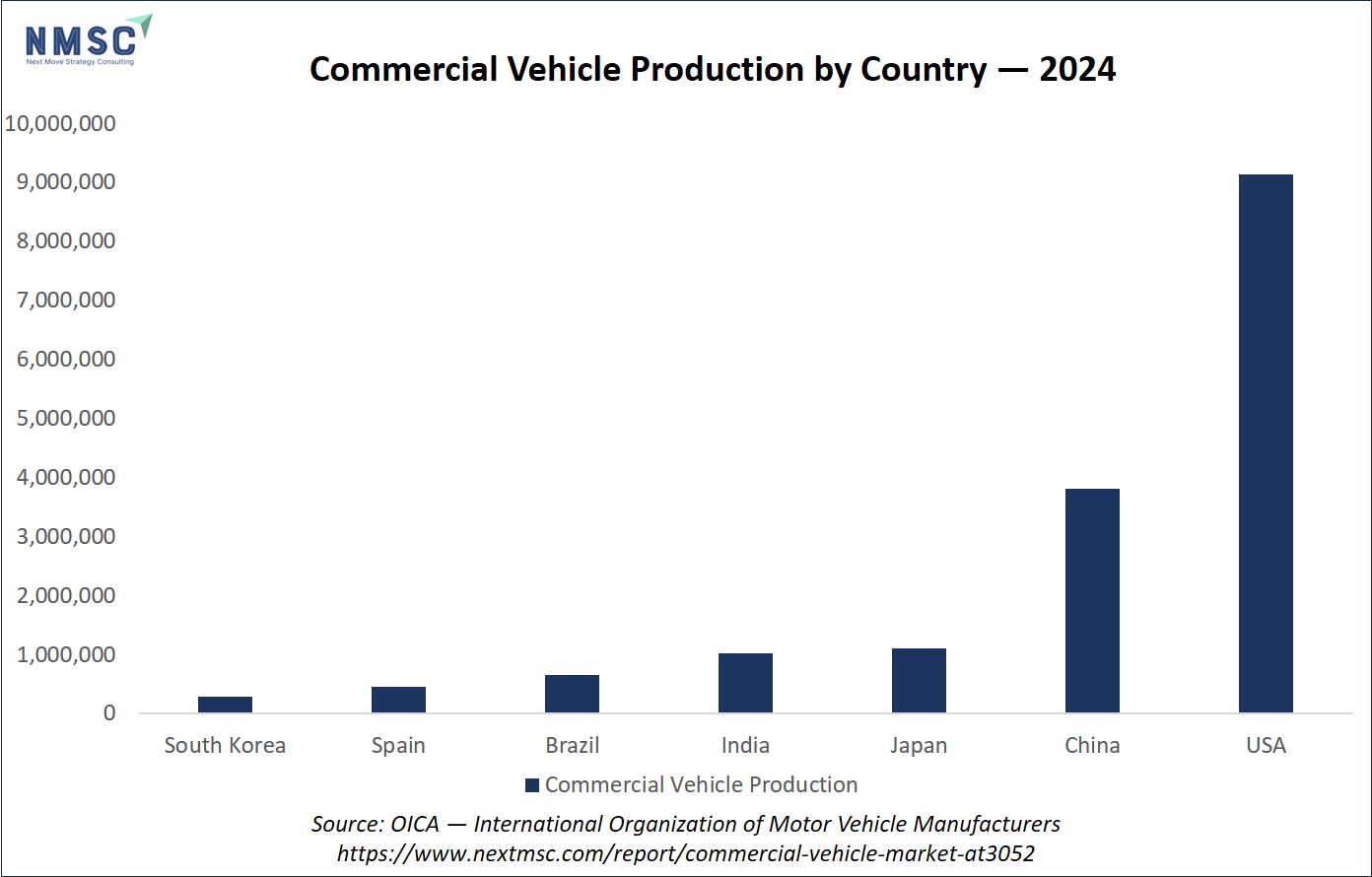
OICA confirmed that China's total vehicle production reached 34.53 million units in 2025, with new-energy vehicle production reaching 16.626 million units — a 29 percent year-on-year increase. China's commercial vehicle sales in 2025 reached 4,296,481 units, according to OICA's sales statistics database.
Europe: Regulatory Architecture Drives Adoption
In Europe, electric truck sales increased 40 percent year-on-year in 2025, reaching nearly 17,000 units and accounting for 3 percent of all truck sales in the region. The growth was underpinned by the EU's Heavy-Duty Vehicle CO2 standards, which came into effect in 2025 and target a 15 percent emissions reduction for HDVs compared to 2019 levels.
Germany — Europe's largest electric truck market — recorded sales growth from 3,400 units in 2024 to 4,400 in 2025, a nearly 30 percent year-on-year increase, supported by EUR 1.6 billion in approved funding for electric truck charging infrastructure and road toll exemptions for battery electric and fuel cell trucks. The United Kingdom led growth in percentage terms, recording more than 55 percent year-on-year growth with sales topping 3,000 units. France recorded more than 15 percent growth to 1,900 units, while Sweden's sales reached 1,000 trucks — more than doubling year-on-year.
The European Automobile Manufacturers' Association (ACEA), in its Economic and Market Report: Global and EU Auto Industry — Full Year 2025, published April 2, 2026, confirmed that Europe's broader commercial vehicle market faced a challenging year. Van registrations fell 8.8 percent, truck registrations declined 6.2 percent, and only bus registrations recorded growth — rising 7.5 percent. EU truck production declined 0.8 percent, while bus production rebounded 8.9 percent. The ACEA attributed the commercial vehicle downturn to "a normalisation toward long-term trends and ongoing challenges in fleet renewal and the transition to zero-emission powertrains."
Global Electric Commercial Vehicle Sales by Segment — 2025
|
Segment |
2024 Sales (Units) |
2025 Sales (Units) |
Year-on-Year Change |
2025 Sales Share of Total Segment |
Key Driver |
|
Electric Heavy Freight Trucks (HFT, >15 tonnes) |
~84,000 |
230,000 |
+174% (almost tripled) |
9% of total HFT sales globally |
China scrappage scheme; Stage 4 HDV standards; TCO parity |
|
Electric Medium Freight Trucks (MFT, 3.5–15 tonnes) |
~127,000 |
210,000 |
+65% |
9% of total MFT sales globally |
Amazon-Rivian partnership (USA); China policy support |
|
Electric Buses (≥10 seats) |
~62,500 |
~70,000 |
+12% |
>60% of city bus sales in China; 12% in Europe |
EU Clean Vehicles Directive; India PM E-DRIVE scheme |
|
Electric Light Commercial Vehicles (LCVs, <3.5 tonnes) |
~296,000 |
430,000 |
+45% |
10% of LCV sales in Europe; 14% in China |
EU CO2 standards; low-emission zones; new model launches |
|
Total Electric Commercial Vehicles |
~570,000 |
~730,000 |
+28% |
— |
Broad-based policy, cost, and infrastructure drivers |
North America: Growth Despite Policy Headwinds
In the United States, electric truck sales increased 25 percent to 17,000 units in 2025, despite a significant policy reversal: California's Advanced Clean Trucks regulation — which had set zero-emissions truck sales requirements — was revoked, and the U.S. Environmental Protection Agency repealed all greenhouse gas emission standards previously regulating medium- and heavy-duty vehicles.
The resilience of U.S. electric truck sales was driven primarily by Rivian's electric medium freight trucks — delivered under its partnership with Amazon — which accounted for nearly 10,000 units in 2025, representing more than 95 percent of U.S. electric truck sales in the MFT segment. Canada recorded a 35 percent increase in electric truck sales, reaching 2,700 units. North America collectively ended 2025 with approximately 20,000 electric truck sales — a 25 percent increase from 2024.
OICA data confirms that the United States produced 10.24 million vehicles in 2025 and sold 16.7 million — with commercial vehicles, including pickup trucks and light trucks, representing the dominant production category. U.S. commercial vehicle production in 2024 stood at 9,129,573 units, the highest of any single country globally, reflecting the structural importance of the light truck and pickup segment in the North American market.
India emerged as a significant growth story within the OICA 2025 data, with vehicle production rising to 6.49 million units and record domestic sales exceeding 4.6 million passenger vehicles and more than 1 million trucks and buses in fiscal year 2025–26. India's commercial vehicle sales in 2025 reached 1,027,877 units, according to OICA's sales statistics.
European Commercial Vehicle Market Performance — Full Year 2025
|
Segment |
2025 Performance |
Direction |
Key Context |
|
Van Registrations (EU) |
−8.8% year-on-year |
▼ Decline |
Normalisation post-pandemic restocking cycle; ZEV transition costs |
|
Truck Registrations (EU) |
−6.2% year-on-year |
▼ Decline |
Fleet renewal challenges; HDV CO2 compliance investment pressure |
|
Bus Registrations (EU) |
+7.5% year-on-year |
▲ Growth |
EU Clean Vehicles Directive procurement mandates; city electrification |
|
Global Van Production |
+2.0% year-on-year |
▲ Growth |
Asia-Pacific and Americas offset European weakness |
|
EU Van Production |
−6.5% year-on-year |
▼ Decline |
Demand softness; ZEV transition investment burden |
|
UK Van Production |
−70.2% year-on-year |
▼ Sharp Decline |
Structural manufacturing contraction; model transition |
|
EU Truck Production |
−0.8% year-on-year |
▼ Marginal Decline |
Broadly stable; demand normalisation |
|
EU Bus Production |
+8.9% year-on-year |
▲ Growth |
Electric bus procurement surge; Clean Vehicles Directive targets |
|
Electric Truck Sales (Europe) |
+40% year-on-year (~17,000 units) |
▲ Strong Growth |
EU HDV CO2 standards; Germany EUR 1.6B charging fund; toll exemptions |
|
Electric LCV Sales (Europe) |
+70% year-on-year (~200,000 units) |
▲ Strong Growth |
EU CO2 van standards; low-emission zones; new Ford/VW models |
Electric Bus and LCV Segments: Parallel Acceleration
The electrification of the commercial vehicle market extends well beyond freight trucks. Global electric bus sales reached nearly 70,000 units in 2025 — a 12 percent year-on-year increase — with battery electric powertrains representing 98 percent of all electric buses sold worldwide. China accounted for approximately 60 percent of global electric bus sales, though its share has gradually declined from nearly 100 percent in 2018 as uptake has accelerated in Europe, India, and Latin America.
Europe recorded 12,000 electric bus sales in 2025 — 28 percent higher than 2024 — with battery electric city buses reaching a sales share of over 55 percent in the European Union, up from approximately 45 percent the previous year. India surpassed 4,000 electric bus sales for the first time in 2025, supported by the government's PM E-DRIVE scheme targeting the deployment of up to 14,000 electric buses nationwide between 2024 and 2026. Latin America recorded more than 3,000 electric bus sales — more than tripling year-on-year — with Chile alone accounting for nearly 2,000 units, representing more than one in five buses sold in the country.
Electric light commercial vehicle sales topped 430,000 units globally in 2025 — a 45 percent year-on-year increase. Europe was the largest market, with nearly 200,000 electric LCV sales representing a 70 percent increase from 2024 and a 50 percent increase from the previous all-time high in 2023. The Netherlands recorded a particularly dramatic shift, with the electric LCV sales share rising from less than 10 percent in 2024 to more than 80 percent in 2025, driven by the introduction of low-emission zones and the removal of a vehicle tax exemption for internal combustion engine LCVs.
Key Company Developments
The competitive dynamics of the commercial vehicle market are being reshaped by the same structural forces driving electrification. BYD Company Limited — identified as a key player in the NMSC Commercial Vehicle Market report — expanded its commercial electric vehicle portfolio in April 2026 with new battery-electric buses and medium-duty trucks designed for urban logistics and municipal transportation applications, emphasizing enhanced battery efficiency, longer driving range, and lower operational costs for fleet operators transitioning toward zero-emission transportation.
Daimler Truck Holding AG announced in February 2026 the expansion of its hydrogen-powered and battery-electric truck programs across Europe and North America, including investments in charging and hydrogen refueling ecosystems, advanced fleet telematics, and long-haul sustainable freight transportation solutions to support commercial fleet decarbonization strategies.
AB Volvo announced the launch of an electric HFT with 600 km range in the second quarter of 2026 — a development that directly addresses the range limitations that have historically constrained electric truck adoption in long-haul applications. Renault Trucks unveiled an electric truck model capable of the same 600 km driving range, while China's Sany already offers an electric HFT model capable of over 800 km on a single charge.
The IEA noted that the purchase price of electric trucks remains two to three times higher than diesel equivalents — a persistent barrier to uptake, particularly for smaller fleet operators — even when the total cost of ownership (TCO) is favorable. Battery electric HFTs in China have already reached TCO parity with diesel trucks in certain use cases after five years of ownership.
TRATON SE, PACCAR Inc, Isuzu Motors Limited, and Tata Motors Limited — all identified as key players in the NMSC report — continue to navigate the dual pressures of conventional fleet demand and accelerating electrification investment requirements. Asia-Pacific's dominance in commercial vehicle production, confirmed by OICA's 2025 data showing the region accounting for more than 61 percent of global vehicle output, reinforces the strategic importance of the region for all major commercial vehicle manufacturers.
Market Outlook and Strategic Implications
According to the NMSC Commercial Vehicle Market report, the global commercial vehicle market was valued at USD 1.16 trillion in 2024 and is projected to reach USD 1.58 trillion by 2030, representing a CAGR of 6.3 percent over the forecast period 2025–2030. Asia-Pacific is expected to maintain its dominant market share throughout the forecast period, driven by the growing electric vehicle sector, increasing environmental concerns, and rising demand for sustainable transportation solutions. North America is identified as the fastest-growing region, supported by the expanding logistics industry and the critical role of freight transport in the U.S. economy.
The IEA's Global EV Outlook 2026 projects that by 2035, electric trucks will reach approximately 20 percent of truck sales globally under its Current Policies Scenario, while approximately 10 percent of the total truck stock will be electric. The trajectory of electrification will be shaped by the interplay of battery cost trajectories, charging and hydrogen refueling infrastructure deployment, regulatory frameworks across major markets, and the pace of TCO parity achievement across different truck segments and use cases.
The NMSC report identifies the implementation of fleet management solutions and Vehicle-as-a-Service (VaaS) models as a key future growth opportunity, enabling companies to maximize fleet efficiency, minimize operating expenses, and enhance sustainability through advanced data analytics and real-time tracking. The growing adoption of autonomous and connected vehicle technologies — including AI-based systems, IoT connectivity, and smart driver assistance functions — represents a parallel structural driver of commercial vehicle market evolution.
Bottom Line
The global commercial vehicle market is undergoing its most consequential structural transformation in decades, driven by the simultaneous acceleration of electric truck adoption, tightening emissions regulations across major markets, and a pronounced geographical repositioning of industrial output toward Asia. The IEA's confirmation that electric trucks reached 9 percent of global truck sales in 2025 — with China accounting for more than 90 percent of global electric truck sales — establishes a new baseline from which the sector's electrification trajectory will be measured. Europe's regulatory architecture, anchored by the EU HDV CO2 standards and expanding low-emission zone frameworks, is delivering measurable results despite a broader commercial vehicle market contraction. North America's resilience, driven by the Amazon-Rivian partnership and strong model availability in the MFT segment, demonstrates that demand-side pull can sustain adoption even in the absence of regulatory mandates. For investors and industry participants, the near-term outlook favors manufacturers with diversified propulsion portfolios, established charging and hydrogen infrastructure partnerships, and strong positioning in Asia-Pacific's high-growth markets. The NMSC Commercial Vehicle Market report projects the market to reach USD 1.58 trillion by 2030 at a CAGR of 6.3 percent — a trajectory that the IEA's 2025 electric truck data suggests is well-supported by structural demand fundamentals.
About Next Move Strategy Consulting
Next Move Strategy Consulting is a premier market research and management consulting firm that has been committed to provide strategically analysed well documented latest research reports to its clients. The research industry is flooded with many firms to choose from, what makes NMSC different from the rest is its top-quality research and the obsession of turning data into knowledge by dissecting every bit of it and providing fact-based research recommendation that is supported by information collected from over 500 million websites, paid databases, industry journals and one on one consultations with industry experts across a diverse range of industry sectors. The high-quality customized research reports with actionable insights and excellent end-to-end customer service help our clients to take critical business decisions that enables them to move beyond time and have competitive edge in the industry.
We have been servicing over 1000 customers globally that includes 90% of the Fortune 500 companies over a decade. Our analysts are constantly tracking various high growth markets and identifying hidden opportunities in each sector or the industry. We provide one of the industry's best quality syndicate as well as custom research reports across 10 different industry verticals. We are committed to deliver high quality research solutions in accordance to your business needs. Our industry standard delivery solutions that ranges from the pre consultation to after-sales services, provide an excellent client experience and ensure right strategic decision making for businesses.
For more information, please contact:
Next Move Strategy Consulting
5th Floor 867 Boylston St, STE 500,
Boston, MA 02116, U.S.
E-Mail: [email protected]
Direct: +1-217-650-7991
Website: www.nextmsc.com
About the Author
 Sanyukta Deb
— Sanyukta Deb is Digital Marketing Team Lead at Next Move Strategy Consulting, where she has led content strategy and technical SEO for the firm's B2B market research publications for over 2 years. Her editorial process translates NextMSC's primary and secondary research — spanning technology, industrial, and consumer sectors — into commercial narratives, backed by search-intent, keyword, and competitive analysis. She brings 5 years of overall experience in digital marketing and content strategy.
Sanyukta Deb
— Sanyukta Deb is Digital Marketing Team Lead at Next Move Strategy Consulting, where she has led content strategy and technical SEO for the firm's B2B market research publications for over 2 years. Her editorial process translates NextMSC's primary and secondary research — spanning technology, industrial, and consumer sectors — into commercial narratives, backed by search-intent, keyword, and competitive analysis. She brings 5 years of overall experience in digital marketing and content strategy.
About the Reviewer
 Debashree Dey
— Debashree Dey is Assistant Manager at Next Move Strategy Consulting, where she supports cross-vertical market content and communications across diverse industries for 6 years. Her professional background includes senior content writing, communications, and published manuscript authorship, with experience developing audience-focused business narratives and maintaining clear, consistent messaging. Her role supports research-led content development and editorial quality across NextMSC publications.
Debashree Dey
— Debashree Dey is Assistant Manager at Next Move Strategy Consulting, where she supports cross-vertical market content and communications across diverse industries for 6 years. Her professional background includes senior content writing, communications, and published manuscript authorship, with experience developing audience-focused business narratives and maintaining clear, consistent messaging. Her role supports research-led content development and editorial quality across NextMSC publications.

















Add Comment