Railroad Market Hits $321.6B Amid Global Rail Push

ITF-OECD Data Confirms Structural Shift Toward Rail Investment as BNSF Commits $3.6 Billion and U.S. Congress Approves $15.9 Billion in FY2026 Rail Funding
The International Transport Forum (ITF), operating under the OECD, published its July 2026 Statistics Brief on global transport infrastructure investment, confirming a structural and accelerating shift toward rail across the world's major economies. The brief, drawing on data collected through May 2026 from ITF member countries, found that 20 of 32 countries with available data had increased the share of investment directed to rail infrastructure over the preceding decade — a finding that carries significant implications for the trajectory of the global railroad industry and the capital allocation strategies of both public and private sector stakeholders.
The ITF's findings arrive at a moment of pronounced momentum in the global Railroad Market, which reached a valuation of USD 304.39 billion in 2025 and is projected to expand to USD 321.62 billion in 2026, ultimately reaching USD 527.89 billion by 2035, registering a compound annual growth rate (CAGR) of 5.66% over the forecast period, according to analysis by Next Move Strategy Consulting (NMSC). The market's expansion is underpinned by accelerating urbanization, a global policy consensus around low-carbon transport, and record-level capital commitments from both Class I freight railroads and multilateral development institutions.
For More Information: Download FREE Sample on Railroad Market Report
Leading News: ITF-OECD Confirms Rail's Rising Investment Share
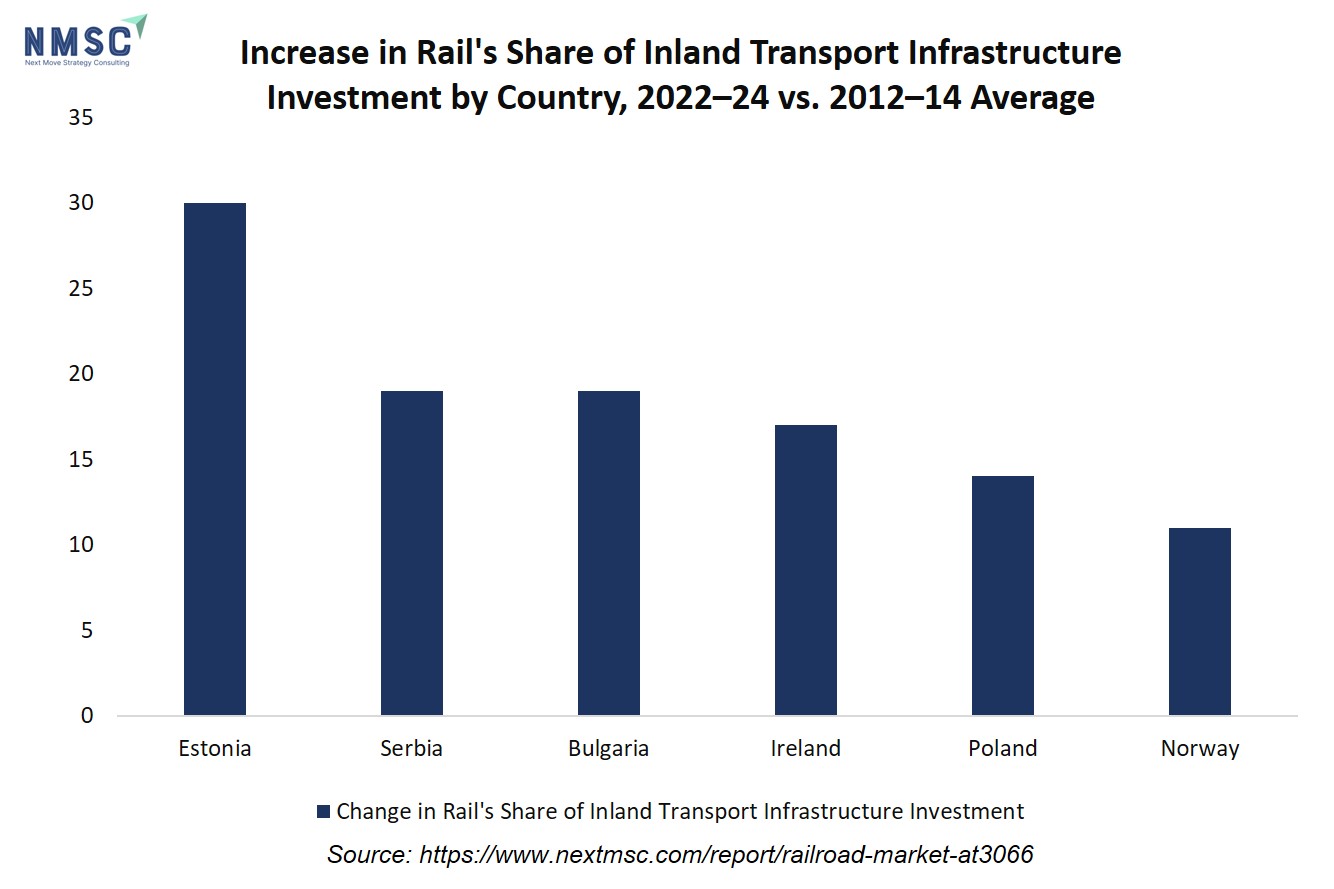
The ITF's July 2026 Statistics Brief documents a decisive reorientation of transport infrastructure capital toward rail in a growing number of jurisdictions. Among the most pronounced shifts, Estonia recorded a 30 percentage-point increase in rail's share of inland transport infrastructure investment between the 2012–14 and 2022–24 periods, driven by a EUR 500 million investment program by Estonian Railways between 2021 and 2026 to electrify rail lines, upgrade track infrastructure, and enable electric trains to operate at speeds of up to 160 km/h between Tallinn and Tartu.
Serbia recorded a 19 percentage-point increase, Bulgaria an equivalent 19 percentage-point rise, Ireland 17 percentage points, Poland 14 percentage points, and Norway 11 percentage points over the same comparative period. The ITF noted that while road infrastructure continues to dominate overall transport investment — with all countries except Belgium and France allocating more than half of their transport infrastructure investment to roads in 2024 — the directional trend toward rail is unambiguous and broadening across geographies.
U.S. Policy Catalyst: $15.9 Billion FY2026 Rail Funding Agreement
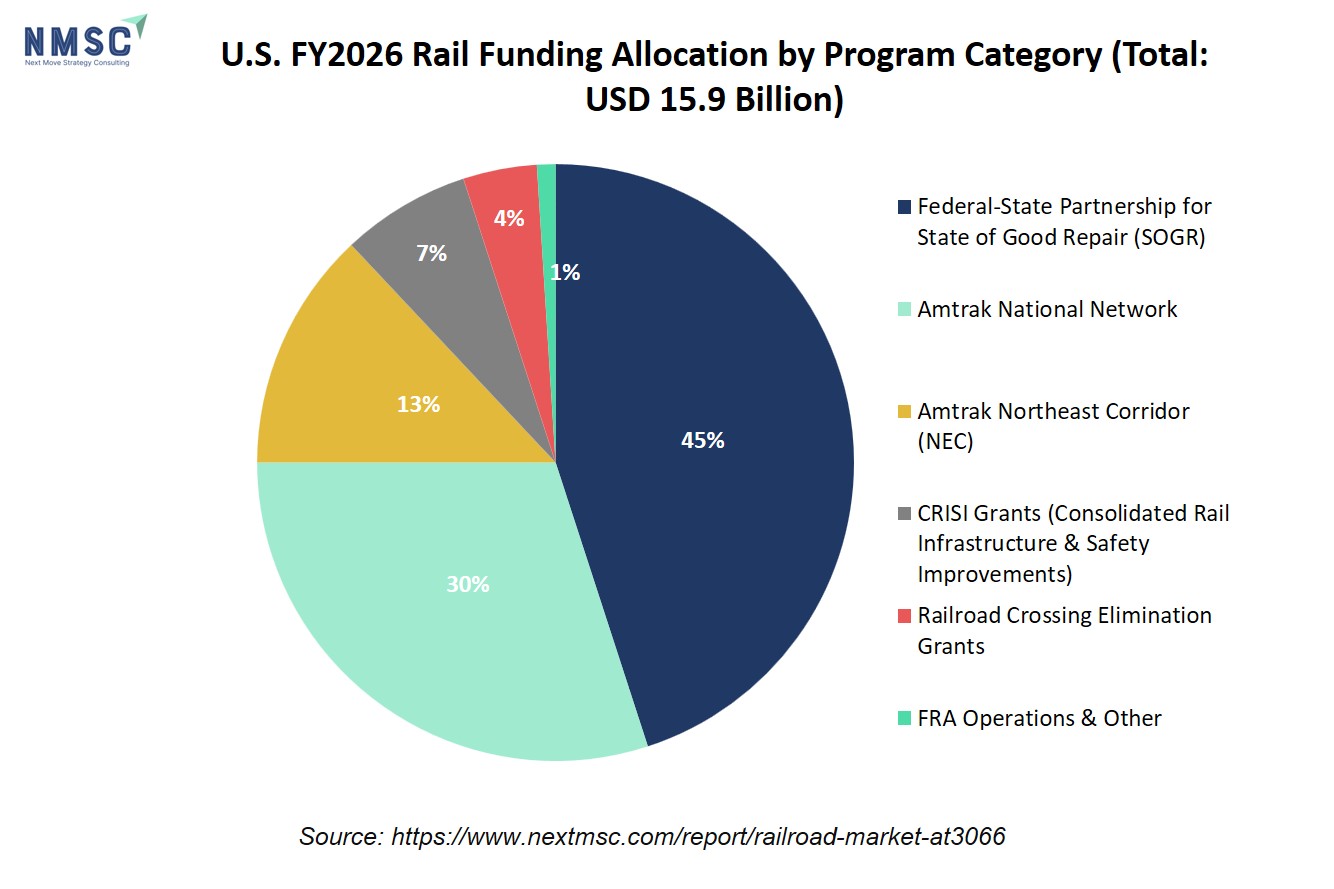
Concurrent with the ITF's global findings, the United States Congress reached a bipartisan agreement in January 2026 providing USD 15.9 billion for passenger and freight rail in Fiscal Year 2026 — a funding framework that passed the House of Representatives by a vote of 341 to 88 and represents one of the most substantial annual rail funding commitments in U.S. legislative history.
The agreement, which combines discretionary appropriations of USD 2.894 billion with USD 13.2 billion in guaranteed funds authorized under the Infrastructure Investment and Jobs Act (IIJA), preserves critical advanced appropriations for future passenger rail upgrades while delivering USD 2.4 billion for Amtrak operations — including USD 1.577 billion for the National Network and USD 850 million for the Northeast Corridor. The Consolidated Rail Infrastructure and Safety Improvements (CRISI) grant program received USD 137 million in discretionary funding, supplemented by USD 1 billion in IIJA-guaranteed funds, supporting safety modernization and infrastructure resilience projects across the national rail network.
Private Sector Commitment: BNSF's $3.6 Billion Capital Plan
Reinforcing the public sector's investment posture, BNSF Railway — one of North America's largest freight transportation providers — announced on January 26, 2026, a USD 3.6 billion capital investment plan for the year, the largest component of which, USD 2.8 billion, is devoted to maintenance of its existing network. The plan encompasses approximately 13,000 miles of track surfacing and undercutting work, the replacement of 2.5 million rail ties, and more than 400 miles of rail replacement — investments that directly address the operational reliability and capacity constraints that have historically limited freight rail's competitive positioning against road transport.
An additional USD 358 million of BNSF's 2026 capital plan is designated for expansion and efficiency projects, including continued development of the Barstow International Gateway project in California and a new intermodal facility in the Phoenix metropolitan area. BNSF President and CEO Katie Farmer stated that the 2026 capital plan "focuses on strengthening and modernizing our network so we can continue to meet our customers' evolving needs," emphasizing the railroad's commitment to improving efficiency, adding capacity, and ensuring network resilience.
The BNSF announcement follows the company's USD 3.8 billion investment in maintaining and upgrading its railroad track infrastructure in January 2025, reflecting a sustained multi-year capital commitment that underscores the structural investment cycle now underway across North American Class I railroads.
World Bank: $4.5 Billion Rail Portfolio Targeting $6 Billion Expansion
At the multilateral development level, the World Bank reported as of July 2025 that it is supporting 15 active rail investment projects totaling USD 4.5 billion across more than 20 countries, with its rail portfolio expected to grow to more than USD 6 billion over the next five years. The institution's rail logistics strategy is built around three core pillars: infrastructure financing, policy and regulatory reform, and technical assistance — an integrated approach that has delivered measurable results across multiple geographies.
In India, World Bank-supported Eastern Dedicated Freight Corridor (EDFC) projects resulted in the construction of 1,200 kilometers of new dedicated freight tracks between 2011 and 2024, with daily freight train capacity increasing fourfold on the first section — from 32 train pairs to over 130 — while logistics costs were reduced by USD 58 million and approximately 9 million days of employment were generated during project implementation. In 2024 alone, the EDFC projects reduced greenhouse gas emissions by approximately 55,000 tons of CO₂ equivalent, with cumulative emissions reductions projected to reach 13.19 million tons by 2042 — a 57% reduction from 2010 pre-project baseline levels.
World Bank Rail Investment Results by Country — Selected Outcomes
|
Country |
Project / Corridor |
Key Outcome |
Metric |
Period |
|
India |
Eastern Dedicated Freight Corridor (EDFC) |
New dedicated freight track constructed |
1,200 km |
2011–2024 |
|
India |
EDFC |
Daily freight train capacity increase |
4x (32 to 130+ train pairs) |
2011–2024 |
|
India |
EDFC |
Logistics cost reduction |
USD 58 million |
2024 |
|
India |
EDFC |
GHG emissions reduction (2024 alone) |
55,000 tCO₂e |
2024 |
|
India |
EDFC |
Projected cumulative GHG reduction by 2042 |
13.19 million tons (57% vs. 2010) |
By 2042 |
|
Egypt |
Cairo Alexandria Logistics Development |
People benefiting from improved transport access |
27.4 million (incl. 16.5M youth) |
Ongoing |
|
Cameroon |
Douala–N'Djamena Multimodal Corridor |
Container shipping cost reduction |
7% (USD 6,000 → USD 5,560 per 20-ft container) |
2012–2022 |
|
Uzbekistan |
Pap–Angren Railway |
Passenger travel cost reduction (Andijan–Tashkent) |
33% |
2015–2020 |
|
Uzbekistan |
Pap–Angren Railway |
Freight cost reduction (oil, fertilizer, automobiles) |
Up to 80% |
2015–2020 |
|
Serbia |
Railway Sector Modernization |
Fatality rate per train-km |
Reduced from 3.56 (2019) to 1.89 (2025) |
2019–2025 |
Notes: Data reflects outcomes from World Bank-supported rail logistics projects. Figures are project-specific and not directly comparable across countries due to differing project scope, scale, and measurement methodologies.
Market Segmentation and Structural Drivers
The railroad market is segmented by type into rail freight and passenger rail, by distance into long-distance and short-distance operations, and by end-use into mining, construction, agriculture, and other sectors. Rail freight constitutes the dominant revenue segment globally, driven by the cost and emissions advantages of rail over road transport for bulk commodity movements — a structural advantage that is being reinforced by rising carbon pricing mechanisms and logistics cost pressures across supply chains.
Passenger rail is the fastest-growing segment by investment volume, propelled by urbanization dynamics and government commitments to sustainable urban mobility. According to the World Bank, the global urban population reached 4.40 billion in 2023 and is projected to exceed 8.80 billion by 2050 — a doubling that will place extraordinary demand on mass transit infrastructure in cities across Asia, Africa, and Latin America.
High-speed rail represents the most significant emerging opportunity within the passenger segment. South Korea's April 2024 launch of the KTX-Cheong-ryong — a next-generation high-speed train capable of speeds up to 320 km/h — exemplifies the technological ambition driving government and private investment in premium rail infrastructure. Australia's Infrastructure Investment Program, which has maintained transport infrastructure investment at approximately 2% of GDP on average between 2022 and 2024, includes the development of high-speed rail with the Sydney-Newcastle corridor identified as the first stage of a proposed east coast network.
The IEA has documented that China's high-speed rail mileage doubled from approximately 20,000 km in 2015 to more than 40,000 km in 2024, now representing three times the total high-speed rail network of the rest of the world combined. China's total investment in railway fixed assets reached USD 117 billion in 2024, expanding by 11.3% year-on-year, reflecting the scale of state-directed capital deployment in rail infrastructure that is reshaping the global competitive landscape.
Inland Transport Infrastructure Investment as Percentage of GDP — Selected Countries, 2022–24 Average
|
Country / Region |
Investment as % of GDP (2022–24 Avg.) |
Investment Category |
Notable Context |
|
Azerbaijan |
3.5% |
Highest among ITF members |
Network expansion to international standards |
|
North Macedonia |
>2.0% |
High investment tier |
Ongoing network expansion |
|
Serbia |
>2.0% |
High investment tier |
Largest 10-year increase (+1.5 pp); 75% to roads |
|
China |
>2.0% |
High investment tier |
Decreased 0.7 pp over decade; still high absolute level |
|
Australia |
~2.0% |
High investment tier |
10-year Infrastructure Investment Program; HSR development |
|
Slovenia |
~1.1% |
Mid-range |
Sustained by long-term national transport plan (to 2030) |
|
Ireland |
0.2% |
Lowest among ITF members |
Peaked at 1.2% in 2007; rail share growing since 2020 |
|
Median (all countries) |
<1.0% |
Benchmark |
Half of countries with data spent below 1% of GDP |
Notes: Data covers total gross investment in road, rail, and inland waterways. Figures represent three-year averages (2022–24) to smooth annual volatility. ">" denotes approximate values based on ITF categorical descriptions where precise figures were not individually published. Country-level data available on OECD Data Explorer.
Regional Analysis
North America maintains its position as the dominant regional market, supported by the presence of the world's largest freight rail network and a sustained cycle of capital investment by Class I railroads. The U.S. IIJA's USD 66 billion rail authorization for fiscal years 2022–2026 has provided a structural funding floor that is catalyzing both public and private investment across the network. Key players including Union Pacific Railroad Company, BNSF, Norfolk Southern, and CSX Corporation are executing multi-billion-dollar infrastructure programs that are improving network reliability, expanding intermodal capacity, and positioning North American freight rail for long-term volume growth.
Asia-Pacific represents the fastest-growing regional market, driven by China's USD 117 billion annual railway fixed asset investment, India's USD 750 billion long-term rail infrastructure commitment targeting net-zero emissions by 2050, and accelerating rail development across Southeast Asia. The region's growth is further supported by the World Bank's expanding rail portfolio, which is delivering dedicated freight corridors, urban transit systems, and cross-border connectivity projects across multiple Asia-Pacific economies.
Europe is experiencing a regulatory-driven acceleration in rail investment, with the EU's Trans-European Transport Network (TEN-T) Regulation establishing binding standards for rail speed and axle load that are compelling member states to upgrade their networks. The European Commission's Connecting Europe Facility for 2021–27 is channeling EUR 321 million into Bulgaria alone for rail infrastructure projects, while Estonia's EUR 500 million rail modernization program and Slovenia's decade-long national transport plan illustrate the breadth of European rail investment commitments.
Competitive Landscape
The railroad market's competitive landscape is characterized by a small number of dominant Class I operators in North America — Union Pacific Railroad Company, Burlington Northern Santa Fe (BNSF), Canadian National Railway Company, Norfolk Southern Corp., CSX Corporation, and Canadian Pacific Kansas City Limited (CPKC) — alongside a broader ecosystem of regional operators, infrastructure suppliers, and technology providers.
CPKC's December 2024 unveiling of the Ottensmeyer Bridge linking Laredo, Texas, and Nuevo Laredo, Mexico, exemplifies the cross-border connectivity investments that are reshaping North American freight logistics. In Europe, Rail Cargo Austria AG's August 2024 opening of the TransFER Salzburg–Augsburg route linking central and south-eastern European markets reflects the strategic expansion strategies being pursued by European rail operators to strengthen continental logistics chains.
Among infrastructure and technology suppliers, Wabtec Corporation, L.B. Foster Company, Progress Rail Services Corporation, and Larsen & Toubro Limited are competing for a growing share of the maintenance, modernization, and digital technology contracts being generated by the global rail investment cycle. Larsen & Toubro's February 2025 announcement of the supply and installation of ballastless metro track spanning 35.2 km in Mumbai illustrates the scale of urban rail infrastructure opportunities emerging across Asia-Pacific markets.
Bottom Line
The global railroad market is entering a sustained investment supercycle, driven by the convergence of urbanization-driven demand, decarbonization policy mandates, and record-level capital commitments from governments, multilateral institutions, and private operators. The ITF-OECD's July 2026 confirmation that 20 of 32 countries have increased rail's share of transport infrastructure investment over the past decade, combined with BNSF's USD 3.6 billion 2026 capital plan and the U.S. Congress's bipartisan USD 15.9 billion FY2026 rail funding agreement, signals that the structural conditions for sustained market expansion are firmly in place. The NMSC forecast of a market growing from USD 321.62 billion in 2026 to USD 527.89 billion by 2035 at a 5.66% CAGR reflects these durable demand fundamentals. For investors and strategic planners, the most compelling opportunities lie in high-speed rail infrastructure, intermodal freight expansion, rail electrification, and digital signaling and automation technologies. Key risks include the capital intensity of rail infrastructure development, geopolitical disruptions to cross-border freight corridors, and the policy uncertainty surrounding passenger rail funding in jurisdictions undergoing fiscal consolidation. Organizations that align their capital allocation with the global modal shift from road to rail are positioned to capture significant long-term value in this structurally expanding market.
About Next Move Strategy Consulting
Next Move Strategy Consulting is a premier market research and management consulting firm that has been committed to provide strategically analysed well documented latest research reports to its clients. The research industry is flooded with many firms to choose from, what makes NMSC different from the rest is its top-quality research and the obsession of turning data into knowledge by dissecting every bit of it and providing fact-based research recommendation that is supported by information collected from over 500 million websites, paid databases, industry journals and one on one consultations with industry experts across a diverse range of industry sectors. The high-quality customized research reports with actionable insights and excellent end-to-end customer service help our clients to take critical business decisions that enables them to move beyond time and have competitive edge in the industry.
We have been servicing over 1000 customers globally that includes 90% of the Fortune 500 companies over a decade. Our analysts are constantly tracking various high growth markets and identifying hidden opportunities in each sector or the industry. We provide one of the industry's best quality syndicate as well as custom research reports across 10 different industry verticals. We are committed to deliver high quality research solutions in accordance to your business needs. Our industry standard delivery solutions that ranges from the pre consultation to after-sales services, provide an excellent client experience and ensure right strategic decision making for businesses.
For more information, please contact:
Next Move Strategy Consulting
5th Floor 867 Boylston St, STE 500,
Boston, MA 02116, U.S.
E-Mail: [email protected]
Direct: +1-217-650-7991
Website: www.nextmsc.com
About the Author
 Sanyukta Deb
— Sanyukta Deb is Digital Marketing Team Lead at Next Move Strategy Consulting, where she has led content strategy and technical SEO for the firm's B2B market research publications for over 2 years. Her editorial process translates NextMSC's primary and secondary research — spanning technology, industrial, and consumer sectors — into commercial narratives, backed by search-intent, keyword, and competitive analysis. She brings 5 years of overall experience in digital marketing and content strategy.
Sanyukta Deb
— Sanyukta Deb is Digital Marketing Team Lead at Next Move Strategy Consulting, where she has led content strategy and technical SEO for the firm's B2B market research publications for over 2 years. Her editorial process translates NextMSC's primary and secondary research — spanning technology, industrial, and consumer sectors — into commercial narratives, backed by search-intent, keyword, and competitive analysis. She brings 5 years of overall experience in digital marketing and content strategy.
About the Reviewer
 Debashree Dey
— Debashree Dey is Assistant Manager at Next Move Strategy Consulting, where she supports cross-vertical market content and communications across diverse industries for 6 years. Her professional background includes senior content writing, communications, and published manuscript authorship, with experience developing audience-focused business narratives and maintaining clear, consistent messaging. Her role supports research-led content development and editorial quality across NextMSC publications.
Debashree Dey
— Debashree Dey is Assistant Manager at Next Move Strategy Consulting, where she supports cross-vertical market content and communications across diverse industries for 6 years. Her professional background includes senior content writing, communications, and published manuscript authorship, with experience developing audience-focused business narratives and maintaining clear, consistent messaging. Her role supports research-led content development and editorial quality across NextMSC publications.

















Add Comment