Berkeley Fire Tests and California’s Zone 0 Rule Reshape Mulching Materials
UC Berkeley’s Marin County burn tests found composted mulch less flammable than non-composted products, just as California’s Board of Forestry prepares a revised five-foot combustible-mulch rule
On October 27, 2026, Berkeley Engineering, the news service of the University of California, Berkeley’s engineering college, reported results from large-scale outdoor burn tests of 10 mulch products used in Marin County, California. Composted products produced weak, unstable flames that quickly gave way to smoldering, while non-composted products sustained flaming combustion, spread fire faster and generated taller flames and higher heat flux. The findings reach the market as California’s Board of Forestry and Fire Protection prepares to take up a revised Zone 0 package on November 5, 2026, a rule that would bar combustible mulch from the first five feet around homes in the state’s highest-risk fire areas.
According to Next Move Strategy Consulting’s Mulching Materials Market report, the global mulching materials market was valued at USD 6.85 billion in 2025 and is projected to reach USD 13.29 billion by 2035, growing at a CAGR of 6.8%. NextMSC primary research and analysis identifies organic mulch, the category that includes bark and wood products, as the largest material type at USD 3.56 billion in 2025, and North America as the leading region with approximately 35% of revenue.
For More Information: Download FREE Sample on Mulching Materials Market Report
What the Marin County Burn Tests Measured
Berkeley Engineering reported that the project was spearheaded by Stephen Quarles, an advisor emeritus at UC Cooperative Extension, and Todd Lando, a battalion chief at the Marin County Wildfire Authority, with Michael Gollner, an associate professor of mechanical engineering at UC Berkeley, as principal investigator directing data collection and analysis. The team tested five composted and five non-composted products commonly sold in Marin County. Each product was laid in a circular plot and left to weather for six months. Fans then blew air across the plots while researchers ignited a narrow strip with a drip torch, and sensor boxes recorded heat flux, temperature and air velocity.
Composted Versus Non-Composted Mulch in Marin County Fire Tests
|
Observation |
Composted mulch (5 products) |
Non-composted mulch (5 products) |
|
Flame behavior |
Weak or unstable flames that moved quickly to smoldering |
Sustained flaming combustion |
|
Fire spread, flame height and heat flux |
Lower than non-composted products |
Faster spread, greater flame height and higher heat flux |
|
Residual hazard |
Smoldering persisted across the plot, though weakly |
Large flying embers able to ignite new fires; material burned completely to ash |
|
Particle size (all products) |
Larger particles linked to more vigorous flame spread and more ember spotting |
Larger particles linked to more vigorous flame spread and more ember spotting |
“It’s less of a hazard, but it’s not zero hazard.”
- Michael Gollner, Associate Professor of Mechanical Engineering and principal investigator, University of California, Berkeley, Berkeley Engineering, “Research shows mulch type matters during a wildfire”, October 27, 2026.
Gollner said the lower flammability of composted mulch reflects its high mineral content and smaller share of organic matter, and that packing density and particle-size distribution may also matter. He said he would still caution against using composted mulch in Zone 0, the band of defensible space closest to a house, because smoldering material can ignite an adjacent wood fence. Berkeley Engineering noted that the results were published in the International Journal of Wildland Fire, and that funding came from sources including the National Institute of Standards and Technology, the Insurance Institute for Business & Home Safety and the Forest Health Program of the California Department of Forestry and Fire Protection.
Zone 0: Adopted in August, Withdrawn in September, Back Before the Board
The California Board of Forestry and Fire Protection voted unanimously on August 19, 2026 to adopt Zone 0 regulations, according to the Mountain Democrat’s October 28, 2026 report. The California Wildfire & Forest Resilience Task Force published the Board’s announcement the same day, describing the rules as the first of their kind in the nation. The law firm Best Best & Krieger LLP, which described them as emergency regulations, reported on September 9, 2026 that the Board submitted the package to the Office of Administrative Law (OAL) on August 28 and that OAL’s five-calendar-day public comment period closed on September 2.
The package did not clear review. The Board withdrew it from OAL in September. Marcie Thompson, the Board’s land use planning program manager, told the Mountain Democrat the move was a routine procedural step rather than a repeal, because documentation cannot be added to a rulemaking file once it is submitted. She said OAL had raised questions about the Board’s emergency rulemaking authority, that the revised package is expected before the Board on November 5, and that the soonest the rules could take effect is the very end of November or early December. MySafe:LA, a Los Angeles wildfire-resilience nonprofit, wrote on September 11, 2026 that the withdrawal does not mean the rules were abandoned and that the Board has indicated another public comment period is likely.
California Zone 0 Rulemaking Timeline
|
Date |
Milestone |
Status and implication |
|
August 19, 2026 |
Board of Forestry and Fire Protection unanimously adopts Zone 0 regulations |
Billed by the Board as the first rules of their kind nationally |
|
September 2026 |
Board withdraws the package from OAL review |
Procedural: Board adds documentation answering OAL’s questions on emergency rulemaking authority |
|
November 5, 2026 |
Revised package expected before the Board |
Board approval would precede resubmission to OAL |
|
Late November to early December 2026 |
Soonest possible effective date, per Board program manager Marcie Thompson |
OAL approval and Secretary of State filing are required first |
What the Draft Rule Says About Mulch, and When It Applies
The Board’s August 2026 summary of the draft language says the rules would cover State Responsibility Areas and Very High Fire Hazard Severity Zones inside Local Responsibility Areas. Across the full five feet, the draft prohibits combustible materials, naming bark and wood chip mulch, fallen leaves, needles and firewood. Inspectors could allow temporary mulch exceptions to prevent erosion during construction and during emergencies, and the text defines noncombustible materials by reference to the ASTM E136 test. The Board’s summary says state leadership tasked it with the work after the Los Angeles fires of January 2025, and describes the first five feet as the place where wind-blown embers are most likely to land and where homes are most vulnerable to ignition.
Zone 0 Draft Compliance Schedule
|
Requirement |
New structures |
Existing structures |
|
Remove combustible mulch, bark, wood chips, fallen leaves, needles and firewood from the five feet |
On the effective date |
Within 3 years of the effective date |
|
Clear roof and gutter debris; remove dead or dying branches; keep live branches 10 feet from chimneys |
On the effective date |
On the effective date |
|
Vegetation-free safety zone, combustible fence and gate changes, noncombustible outbuildings |
On the effective date |
Within 3 to 5 years, on a timeline set by the responsible fire agency |
The Board’s summary says the August draft would apply to new construction on the effective date and phase in over up to five years for existing homes. Jeff Hoag, CAL FIRE’s assistant chief for the Community Risk Reduction program in the Amador-El Dorado Unit, told the Mountain Democrat that inspectors will make three visits before any punitive action and that owners showing progress will not be cited immediately. He said Zone 0 “truly is a best practice” for defending a house against embers. Cost is contested. Hoag said the work should not require expensive hardscaping beyond the second-phase fence replacement, while MySafe:LA wrote that the state’s economic analysis put average homeowner compliance costs at about USD 960, against its own field-based view that costs could exceed USD 2,500 per property.
Wildfire Exposure Behind the Rule
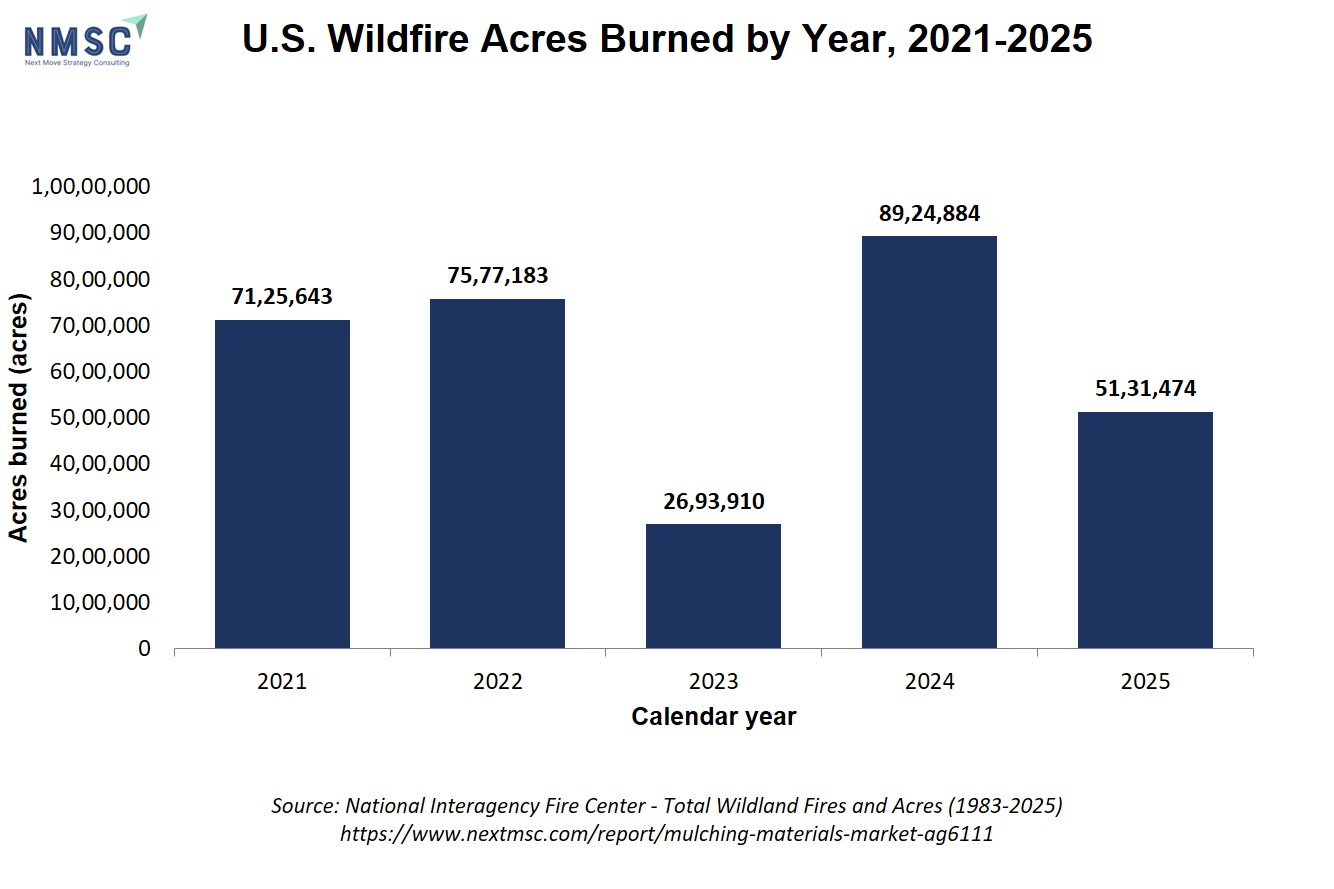
The National Interagency Fire Center reports 5,131,474 acres burned across 77,850 wildfires in 2025, down from 8,924,884 acres in 2024 even though the 2025 fire count was the highest of the past five years. The Board’s summary ties Zone 0 to the ignition of homes by wind-blown embers, a risk that acreage totals alone do not measure.
Europe Takes the Opposite Regulatory Route for Mulch Films
While California moves to clear combustible mulch from a narrow strip, the European Commission has widened the regulatory pathway for another mulch category. Commission Delegated Regulation (EU) 2024/2787 of 23 July 2024 added mulch films to the polymer category of the EU Fertilising Products Regulation and allows a soil-improver product to contain a polymer in the form of a mulch film. In NMSC’s report, biodegradable polymer mulch was worth USD 0.96 billion in 2025 and is forecast to reach USD 3.46 billion by 2035 at a 14.4% CAGR, the fastest rate among material types, against 5.4% for organic mulch.
NMSC Strategic Perspective: Regulation Now Sets Product Mix Region by Region
NextMSC primary research and analysis reads the Berkeley results and the Zone 0 draft as one signal: in fire-exposed North America, regulation is turning mulch choice from a landscaping preference into a compliance decision. The draft prohibits bark and wood chip mulch within five feet of every covered structure, and existing owners would have three years from the effective date to clear it. If the Board’s schedule holds, that places the first enforceable removal deadline for existing homes no earlier than late 2029. With organic mulch at approximately 52% of the global market and North America at approximately 35%, NMSC expects the exposure to concentrate in bark and wood products sold for foundation beds, not in the agricultural and landscaping volume that anchors the region’s USD 2.40 billion 2025 base.
The Marin County data sharpen the substitution question. Composted products burned less aggressively than non-composted ones, but Gollner’s caution against using even composted mulch in Zone 0 means it is not a safe harbor inside the band. NMSC therefore expects mineral covers, which its report groups under inorganic mulch with plastic and rubber products, to be the natural candidates for that strip, while finer or composted organic products compete in the adjoining zones where the Zone 0 prohibition does not apply.
Europe shows the other side of the same lever. The Commission’s 2024 regulation created a certification pathway for soil-biodegradable films, and NMSC’s biodegradable polymer mulch segment is forecast to grow at 14.4% a year against 5.4% for organic mulch. NMSC’s reading is that regulation is the common factor shaping product mix in both regions: it opens a CE-marking route in Europe and imposes a removal obligation on combustible organic cover in fire-exposed California. The principal risk to that reading is timing. Zone 0 is not law, OAL review is incomplete, and the Board’s own program manager describes the end of November as the soonest the rules could take effect.
Competitive Structure and Exposure
NextMSC primary research and analysis profiles 20 companies and describes the mulching materials market as moderately fragmented. It separates diversified film and biopolymer producers, with BASF SE and Berry Global Inc. as examples, from specialists in organic and rubber mulch for consumer retail and playground surfacing, represented by Scotts Miracle-Gro Company and Liberty Tire Recycling Holdco, LLC. NMSC’s report describes Scotts Miracle-Gro Company as an anchor of consumer-facing bagged mulch distribution through North American garden centers, which on NMSC’s reading places that archetype closer to the residential beds a five-foot ban would touch first. Exposure is therefore concentrated in consumer organic mulch rather than spread across the industry.
Bottom Line
Two developments frame the near-term regulatory risk for mulching materials. Berkeley Engineering’s October 27, 2026 report showed that composted mulch burns less aggressively than non-composted mulch in outdoor tests, yet the lead researcher still cautions against using it in the five-foot band beside a home. California’s Board of Forestry and Fire Protection is due to take up a revised Zone 0 package on November 5, 2026, after withdrawing the first version from state legal review in September. If the rule takes effect, new construction would face the combustible-mulch ban immediately and existing homes within three years, so any revenue effect belongs to 2029 and later rather than 2026. NMSC’s published forecast remains USD 13.29 billion by 2035 at a 6.8% CAGR, and NMSC sees the effect as a shift in product mix toward noncombustible covers near structures, certified biodegradable films in Europe, and composted or finer organic products in adjoining zones, not a contraction in global demand.
About Next Move Strategy Consulting
Next Move Strategy Consulting is a premier market research and management consulting firm that has been committed to provide strategically analysed well documented latest research reports to its clients. The research industry is flooded with many firms to choose from, what makes NMSC different from the rest is its top-quality research and the obsession of turning data into knowledge by dissecting every bit of it and providing fact-based research recommendation that is supported by information collected from over 500 million websites, paid databases, industry journals and one on one consultations with industry experts across a diverse range of industry sectors. The high-quality customized research reports with actionable insights and excellent end-to-end customer service help our clients to take critical business decisions that enables them to move beyond time and have competitive edge in the industry.
We have been servicing over 1000 customers globally that includes 90% of the Fortune 500 companies over a decade. Our analysts are constantly tracking various high growth markets and identifying hidden opportunities in each sector or the industry. We provide one of the industry’s best quality syndicate as well as custom research reports across 10 different industry verticals. We are committed to deliver high quality research solutions in accordance to your business needs. Our industry standard delivery solutions that ranges from the pre consultation to after-sales services, provide an excellent client experience and ensure right strategic decision making for businesses.
For more information, please contact:
Next Move Strategy Consulting
5th Floor 867 Boylston St, STE 500,
Boston, MA 02116, U.S.
E-Mail: [email protected]
Direct: +1-217-650-7991
Website: www.nextmsc.com
About the Author
 Sanyukta Deb
— Sanyukta Deb is Digital Marketing Team Lead at Next Move Strategy Consulting, where she has led content strategy and technical SEO for the firm's B2B market research publications for over 2 years. Her editorial process translates NextMSC's primary and secondary research — spanning technology, industrial, and consumer sectors — into commercial narratives, backed by search-intent, keyword, and competitive analysis. She brings 5 years of overall experience in digital marketing and content strategy.
About the Reviewer
 Debashree Dey
— Debashree Dey is Assistant Manager at Next Move Strategy Consulting, where she supports cross-vertical market content and communications across diverse industries for 6 years. Her professional background includes senior content writing, communications, and published manuscript authorship, with experience developing audience-focused business narratives and maintaining clear, consistent messaging. Her role supports research-led content development and editorial quality across NextMSC publications.
















Add Comment