Roundup Ruling Leaves Organic Herbicides to Compete on Policy, Not Lawsuits
Supreme Court's 7-2 Durnell Decision Narrows Roundup's Litigation Overhang as Organic Weed Control Leans on Regulation, Certified Acreage and Garden-Retail Channels
On June 25, 2026, the U.S. Supreme Court ruled 7-2 in Monsanto Co. v. Durnell that federal pesticide law bars state failure-to-warn claims seeking a cancer warning on Roundup labels, throwing out a $1.25 million Missouri jury verdict in a decision The Associated Press reported is expected to block thousands of lawsuits. Justice Brett Kavanaugh wrote for the majority that the label approved by the U.S. Environmental Protection Agency, which carries no cancer warning, is the one manufacturers must use. Bloomberg reported that Bayer shares rose as much as 20% in Frankfurt that day, the largest intraday gain since March 2003, and Bayer said in a statement it would keep pursuing final approval of a proposed USD 7.25 billion class settlement.
According to Next Move Strategy Consulting's Organic Herbicides Market report, the global organic herbicides market was valued at USD 1.81 billion in 2025 and is projected to reach USD 2.69 billion by 2035, growing at a CAGR of 3.94% from 2026 to 2035. NextMSC primary research and analysis, published on October 23, 2026, links that trajectory to jurisdiction-specific restrictions on synthetic herbicides, certified organic farmland expansion, and demand for organic-compliant weed control across turf, landscape and residential uses, with North America holding approximately 42% of 2025 revenue.
For More Information: Download FREE Sample on Organic Herbicides Market Report
What the Court Settled, and What It Left Open
The decision settles one legal question rather than the wider debate over glyphosate. The Associated Press reported that the plaintiff's attorney, Ashley Keller, has said the ruling could still leave room for suits that challenge how the product was designed, and Bayer called the outcome good for science, farmers and industries that depend on regulatory clarity. The Associated Press also reported that Bayer has already stopped using glyphosate in Roundup sold in the U.S. residential lawn and garden market, so the incumbent's flagship consumer range no longer rests on the active ingredient at the centre of the case. That matters for organic herbicides because NextMSC primary research and analysis identifies retail and e-commerce as the fastest-growing route to market, driven by residential and urban gardening demand.
“is a tragic setback for public and environmental health”
- Jay Feldman, Executive Director, Beyond Pesticides, The Associated Press, June 25, 2026.
The Policy Backdrop: Federal Support for Glyphosate, Europe's 2033 Horizon
Federal policy has moved in the same direction as the court. Reuters reported on February 19, 2026 that President Donald Trump had signed an executive order invoking the Defense Production Act to secure U.S. supply of elemental phosphorus and glyphosate-based herbicides, and that Bayer is the only company producing glyphosate in the United States while American farmers also import large volumes of generic copies from China. In the same week, Reuters reported, Bayer agreed to pay as much as USD 7.25 billion to resolve tens of thousands of cancer lawsuits. NextMSC primary research and analysis reads these moves as leaving the substitution case for organic products in the United States to state and municipal rules and to organic certification requirements, rather than to federal restriction.
Europe offers a dated horizon instead. The European Commission states that glyphosate is approved in the European Union until December 15, 2033, subject to conditions and restrictions, and that producers seeking approval beyond that date must apply for renewal by December 15, 2030. NextMSC primary research and analysis sizes the European organic herbicides market at USD 0.54 billion in 2025, rising to USD 0.82 billion by 2035 at a CAGR of 4.19%, which makes it the second-largest region behind North America.
Glyphosate Litigation and Policy Milestones Shaping the Substitution Case
|
Date |
Event |
Detail |
|
February 18, 2026 |
U.S. executive order on glyphosate supply |
Defense Production Act invoked to secure U.S. supply of elemental phosphorus and glyphosate-based herbicides; Bayer is the only U.S. producer |
|
February 2026 |
Proposed class settlement |
Bayer agreed to pay as much as USD 7.25 billion to resolve tens of thousands of Roundup lawsuits |
|
April 27, 2026 |
Oral argument |
Monsanto Co. v. Durnell argued before the U.S. Supreme Court |
|
June 25, 2026 |
Decision |
7-2 ruling that federal law preempts the state failure-to-warn claim; $1.25 million verdict reversed |
|
December 15, 2030 |
EU renewal application deadline |
Producers seeking approval beyond 2033 must apply by this date |
|
December 15, 2033 |
EU approval expiry |
Current European Union glyphosate approval ends, subject to conditions and restrictions |
Key Industry Developments: Natural Weed Control Reaches Commercial Channels
Three dated company announcements in 2026 show where product supply is forming. On March 10, 2026, SBM Life Science and Harpe Bioherbicide Solutions announced a strategic development agreement to co-develop plant-extract bioherbicides for U.S. home and garden customers, including minimum-risk products that are exempt from EPA registration, according to SBM Life Science's release, which notes that its BioAdvanced brand is sold at retailers such as Home Depot, Lowe's, Walmart and Amazon.
In April 2026, Agroportal reported that Seipasa had launched Seithor, a post-emergence foliar contact herbicide of natural origin, in Portugal after receiving authorization No. 02495 from the national agriculture and veterinary authority, DGAV. Seipasa described Seithor as its first herbicide and said it was already registered in Greece.
“Greece and Portugal are just the beginning”
- Ricardo Pinto, Head of Development in Europe, Seipasa, Seipasa announcement published by Agribusiness Global, May 26, 2026.
On August 4, 2026, Contact BioSolutions announced that its FireHawk Bioherbicide Super Concentrate, a nonanoic acid product registered with Australia's pesticides regulator, the APVMA, and certified for organic production, had become available across Australia from August 1.
Three 2026 Natural Weed-Control Announcements at a Glance
|
Company |
Date |
Development |
|
SBM Life Science and Harpe Bioherbicide Solutions |
March 10, 2026 |
Strategic development agreement for plant-extract bioherbicides for U.S. home and garden; includes minimum-risk products exempt from EPA registration |
|
Seipasa |
April 2026 |
Seithor natural-origin contact herbicide launched in Portugal under DGAV authorization No. 02495; already registered in Greece |
|
Contact BioSolutions |
August 4, 2026 |
FireHawk Bioherbicide Super Concentrate (nonanoic acid) available across Australia from August 1; APVMA-registered and certified for organic production |
Segment Dynamics: Single-Source Products Lead, Combination Products Grow Faster
NextMSC primary research and analysis values single-source organic herbicides at USD 1.27 billion in 2025, approximately 70% of global revenue, rising to USD 1.78 billion by 2035 at a CAGR of 3.26%. Multi-source products, which combine two or more eligible active types, are smaller at USD 0.54 billion in 2025 but are forecast to grow at 5.40% to USD 0.91 billion by 2035. Contact BioSolutions describes FireHawk's active as a fatty acid, the chemistry that NextMSC primary research and analysis places at the centre of the single-source category, so the August launch in Australia sits inside the segment that currently carries most of the revenue.
Regional Outlook: Where Demand Sits Versus Where Organic Land Sits
NextMSC primary research and analysis sizes North America at USD 0.76 billion in 2025, approximately 42% of global revenue, rising to USD 1.08 billion by 2035 at a CAGR of 3.42%, with the United States at approximately USD 0.670 billion. Asia-Pacific is the fastest-growing region at 5.27% from USD 0.33 billion in 2025 to USD 0.55 billion by 2035, and India is the fastest-growing country at approximately 7.26%.
Organic land does not map neatly onto that revenue. The Research Institute of Organic Agriculture FiBL and IFOAM - Organics International report in The World of Organic Agriculture 2026, published in February 2026, that 98.9 million hectares of agricultural land were organic in 2024, and that Oceania held 53.8% of it. The same report estimates that 99% of Australia's organic farmland is extensive grazing, which indicates why regional land shares and herbicide revenue diverge: North America holds just 4.4% of the world's organic agricultural land yet accounts for the largest share of NextMSC's revenue estimate.
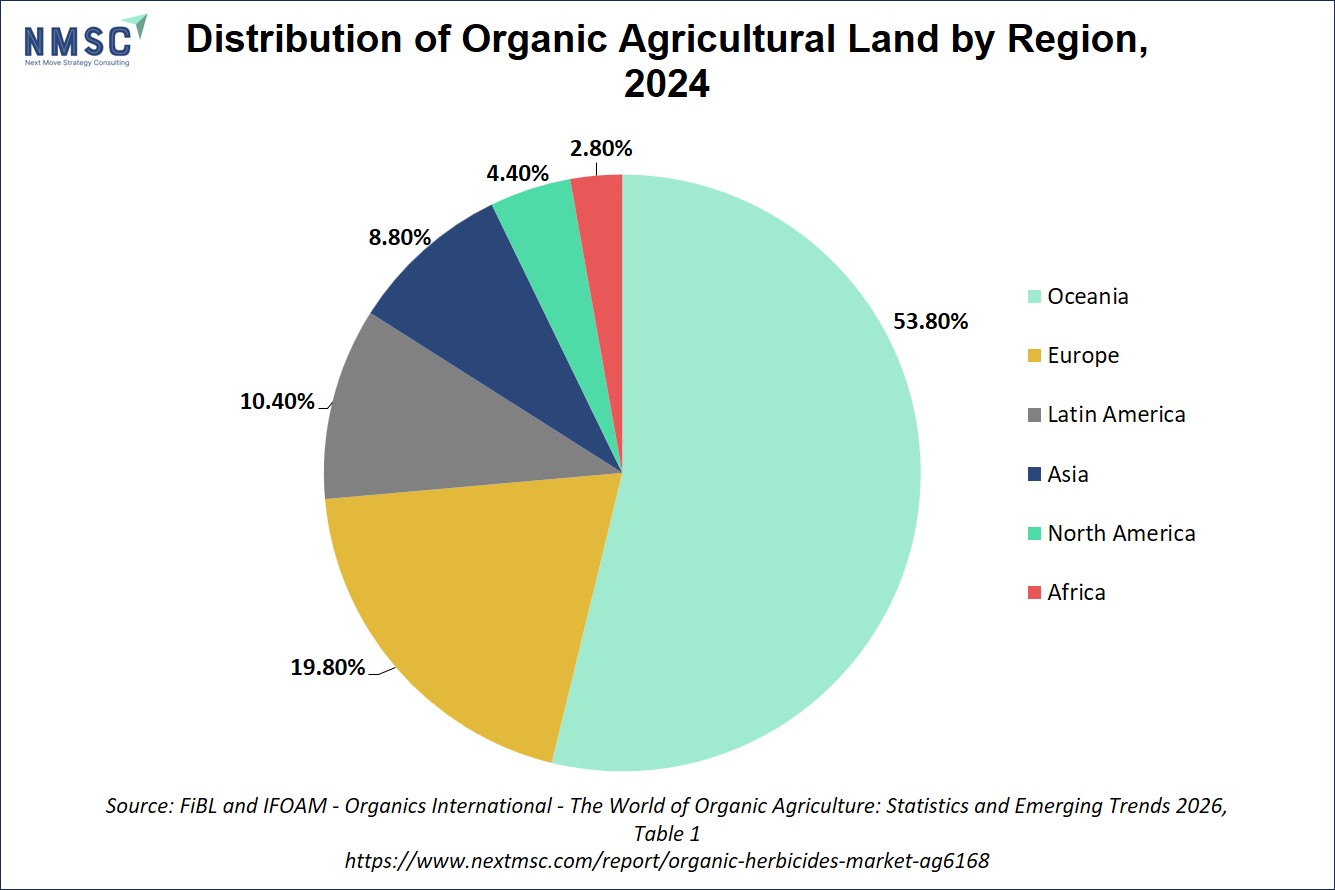
Oceania accounts for 53.8% of the 98.9 million hectares of organic agricultural land, Europe for 19.8% and North America for 4.4%, as reported by FiBL and IFOAM - Organics International for 2024.
FiBL and IFOAM - Organics International also report that organic retail sales reached EUR 145.0 billion in 2024, with the United States the largest national market at EUR 60.4 billion, a measure of consumer demand for organic products.
Largest National Organic Retail Markets, 2024
|
Market |
Organic retail sales (EUR billion) |
|
United States |
60.4 |
|
Germany |
17.0 |
|
China |
15.5 |
|
France |
12.2 |
|
European Union (regional total) |
49.5 |
Growth Drivers and Restraints
NextMSC primary research and analysis assigns the largest positive weight to restrictions on synthetic herbicide use in selected jurisdictions, estimated at 1.4 percentage points of CAGR through 2032, followed by certified organic farmland expansion at 1.2 percentage points. The farmland driver faces a measured test in the independent data. FiBL and IFOAM - Organics International report that global organic agricultural land slipped 0.2% in 2024, a decline of 176,000 hectares, and that North America's reported 30.7% increase largely reflects more complete U.S. data rather than a comparable one-year expansion. The same report attributes part of the slowdown to a two- to three-year conversion lag after the cost and inflation pressures that began in 2022, and to the transition to the EU Organic Regulation, and expects better market conditions to lift conversions in the following years.
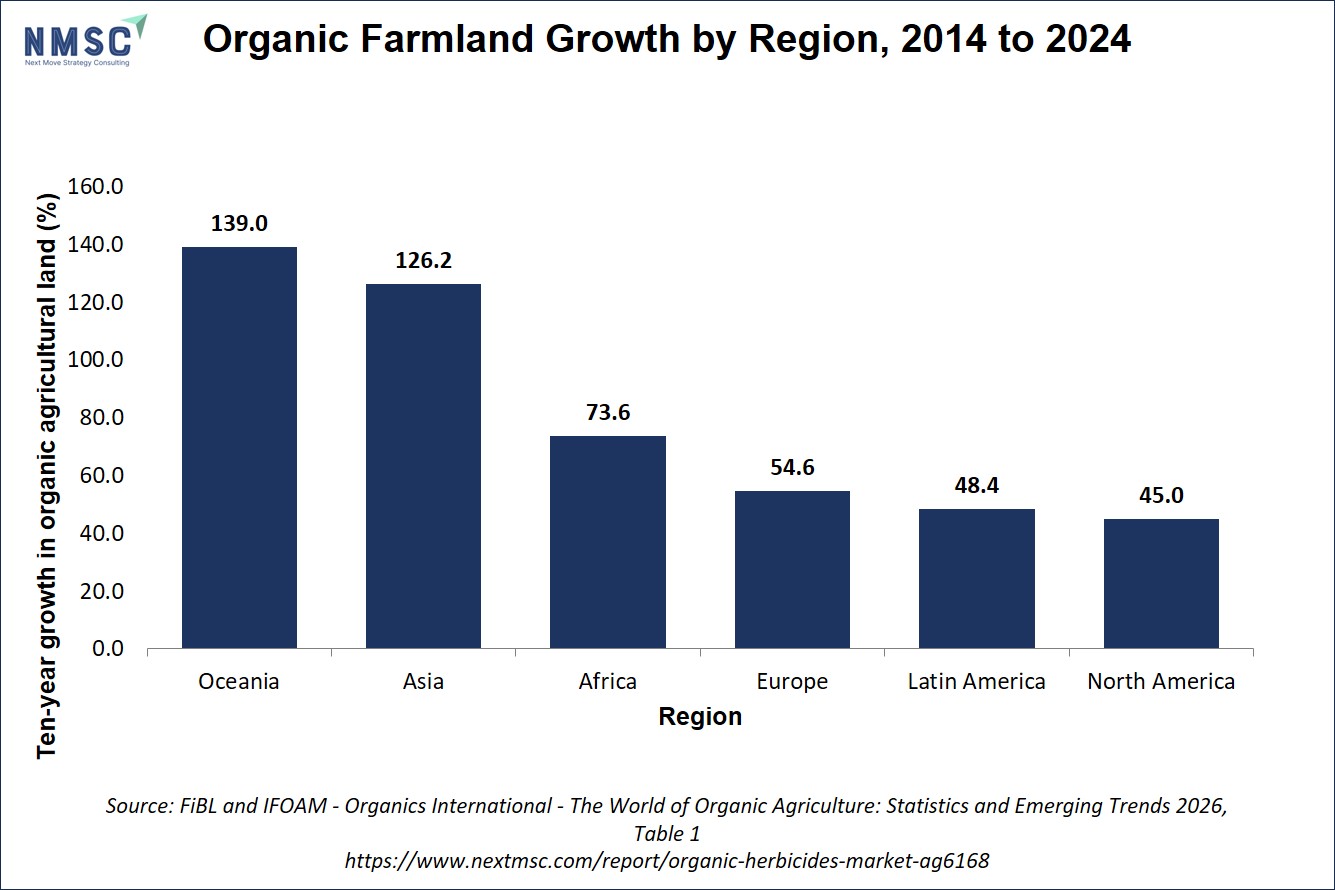
Over ten years organic agricultural land grew 139.0% in Oceania and 126.2% in Asia, against 45.0% in North America, where the latest-year increase largely reflects more complete U.S. data.
On the restraint side, NextMSC primary research and analysis puts lower field efficacy relative to some synthetic herbicides at a drag of 1.3 percentage points on CAGR, and high per-unit cost in cost-sensitive commodity crops at 0.8 percentage points. Seipasa's own description of Seithor as a contact product aimed at weeds in their early stages shows the practical constraint: timing and repeat application decide whether an organic product can substitute for a systemic one.
NMSC Strategic Perspective: Demand Now Runs on Rules and Acreage, Not Courtrooms
NextMSC primary research and analysis reads the Durnell decision as the removal of one of two pressures that had been pushing buyers toward alternatives. The first was litigation exposure, which AP and Bloomberg describe as sharply reduced for failure-to-warn claims. The second is jurisdiction-specific regulation, which the European Commission's 2033 approval date and local public-space rules continue to supply. With the first pressure narrowed, the organic herbicides forecast depends more heavily on the second pressure and on certified acreage.
That shifts the commercial test toward performance and channel. NextMSC primary research and analysis estimates the 2026 market at USD 1.90 billion and the 2026 to 2035 expansion at USD 0.79 billion, a pace of 3.94% a year. NextMSC's own driver estimates set a regulatory pull of 1.4 percentage points against an efficacy drag of 1.3 points. Suppliers that close the efficacy gap, through the combination products forecast at 5.40% or through precision application, capture the upside; suppliers that rely on regulatory substitution alone do not. NextMSC primary research and analysis also expects Asia-Pacific and India, where organic certification supports export access, to grow faster than the global rate.
Competitive Positioning
NextMSC primary research and analysis characterises the market as highly fragmented, with the top five players holding approximately 35% of global revenue across biopesticide specialists such as Certis USA and BioSafe Systems, garden-care brands such as W. Neudorff, and regional specialists such as Seipasa. The 2026 events above show competition moving into two places: the home and garden shelf, where SBM Life Science is partnering with Harpe, and national registrations, where Seipasa is adding Greece and Portugal and Contact BioSolutions is expanding in Australia. Each move is traceable to the company's own announcement.
Bottom Line
The Supreme Court's June 25, 2026 decision in Monsanto Co. v. Durnell narrows the litigation pressure that had weighed on glyphosate, and federal policy in the United States is now protecting its supply, so organic herbicide demand there depends on state and municipal rules, organic certification and product performance. In Europe, the European Commission's December 15, 2033 approval date sets a dated regulatory horizon. NextMSC primary research and analysis values the global organic herbicides market at USD 1.81 billion in 2025 and USD 2.69 billion by 2035, a 3.94% CAGR. Independent data from FiBL and IFOAM - Organics International show organic farmland stable rather than expanding in 2024, while 2026 launches by SBM Life Science, Seipasa and Contact BioSolutions show supply forming in home and garden, European and Australian channels. Buyers should watch efficacy, residential retail uptake and Asia-Pacific certification.
About Next Move Strategy Consulting
Next Move Strategy Consulting is a premier market research and management consulting firm that has been committed to provide strategically analysed well documented latest research reports to its clients. The research industry is flooded with many firms to choose from, what makes NMSC different from the rest is its top-quality research and the obsession of turning data into knowledge by dissecting every bit of it and providing fact-based research recommendation that is supported by information collected from over 500 million websites, paid databases, industry journals and one on one consultations with industry experts across a diverse range of industry sectors. The high-quality customized research reports with actionable insights and excellent end-to-end customer service help our clients to take critical business decisions that enables them to move beyond time and have competitive edge in the industry.
We have been servicing over 1000 customers globally that includes 90% of the Fortune 500 companies over a decade. Our analysts are constantly tracking various high growth markets and identifying hidden opportunities in each sector or the industry. We provide one of the industry’s best quality syndicate as well as custom research reports across 10 different industry verticals. We are committed to deliver high quality research solutions in accordance to your business needs. Our industry standard delivery solutions that ranges from the pre consultation to after-sales services, provide an excellent client experience and ensure right strategic decision making for businesses.
For more information, please contact:
Next Move Strategy Consulting
5th Floor 867 Boylston St, STE 500,
Boston, MA 02116, U.S.
E-Mail: [email protected]
Direct: +1-217-650-7991
Website: www.nextmsc.com
About the Author
 Priyanshu Das
— Priyanshu Das is SEO Executive at Next Move Strategy Consulting, where he has led on-page and off-page SEO, keyword research, and SEO audits for the firm's B2B market research publications for 2 years. His audit process combines technical crawl analysis, backlink profile review, and competitor keyword gap mapping — using tools including Screaming Frog and Google Search Console — to prioritize fixes by organic search-visibility impact, informed by his own prior in-house and agency SEO experience.
About the Reviewer
 Debashree Dey
— Debashree Dey is Assistant Manager at Next Move Strategy Consulting, where she supports cross-vertical market content and communications across diverse industries for 6 years. Her professional background includes senior content writing, communications, and published manuscript authorship, with experience developing audience-focused business narratives and maintaining clear, consistent messaging. Her role supports research-led content development and editorial quality across NextMSC publications.















Add Comment