BlackRock and JPMorgan Spark Tokenized Finance Race With New Fund Launches

BlackRock and JPMorgan Launch Competing Tokenized Money Market Funds Within Days of Each Other, Signaling a Structural Shift in How Institutional Capital Accesses On-Chain Finance
On August 3, 2026, BlackRock — the world's largest asset manager, overseeing nearly USD 1.073 trillion in cash strategies — launched two tokenized money market products directly structured to qualify as "eligible reserve assets" under the U.S. Guiding and Establishing National Innovation for U.S. Stablecoins Act (the GENIUS Act): the OnChain Shares of the BlackRock Select Treasury Based Liquidity Fund (BSTBL) and the BlackRock Daily Reinvestment Stablecoin Reserve Vehicle (BRSRV). Seven days later, on August 10, 2026, J.P. Morgan Asset Management became the largest global systemically important bank (GSIB) to launch a tokenized money market fund on a public blockchain, winning the first formally approved tokenized money market fund mandate. These two events — separated by less than a fortnight — mark the clearest institutional signal yet that tokenized real-world assets (RWAs) have crossed from pilot infrastructure into regulated, production-grade financial products.
According to Next Move Strategy Consulting's Tokenized Real-World Assets (RWAs) Market report, the global tokenized RWAs market was valued at USD 297.71 billion in 2024 and is projected to reach USD 9.43 trillion by 2030, growing at a compound annual growth rate (CAGR) of 72.8% from 2025 to 2030. The market is expected to reach USD 612.71 billion by the end of 2025, reflecting the accelerating pace at which institutional capital is migrating from legacy settlement rails onto programmable blockchain infrastructure.
For More Information: Download FREE Sample on Tokenized Real-World Assets (RWAs) Market Report
The GENIUS Act: The Regulatory Catalyst That Converted Institutional Interest Into Institutional Action
The August 2026 product launches by BlackRock and JPMorgan did not emerge in a vacuum. They were directly enabled by two regulatory developments that, taken together, removed the two most significant barriers to institutional participation in tokenized finance: legal ambiguity over what tokenized securities are, and the absence of a federal framework governing stablecoin reserve assets.
On January 28, 2026, the U.S. Securities and Exchange Commission's Divisions of Corporation Finance, Investment Management, and Trading and Markets issued a joint Statement on Tokenized Securities, formally clarifying that tokenized securities — whether issuer-sponsored or third-party-sponsored — remain subject to the full scope of federal securities laws, and that the format of issuance (on-chain versus off-chain) does not alter the legal character of the underlying instrument. This statement, while not creating new law, eliminated the interpretive uncertainty that had caused compliance officers at major financial institutions to delay tokenization programs for years.
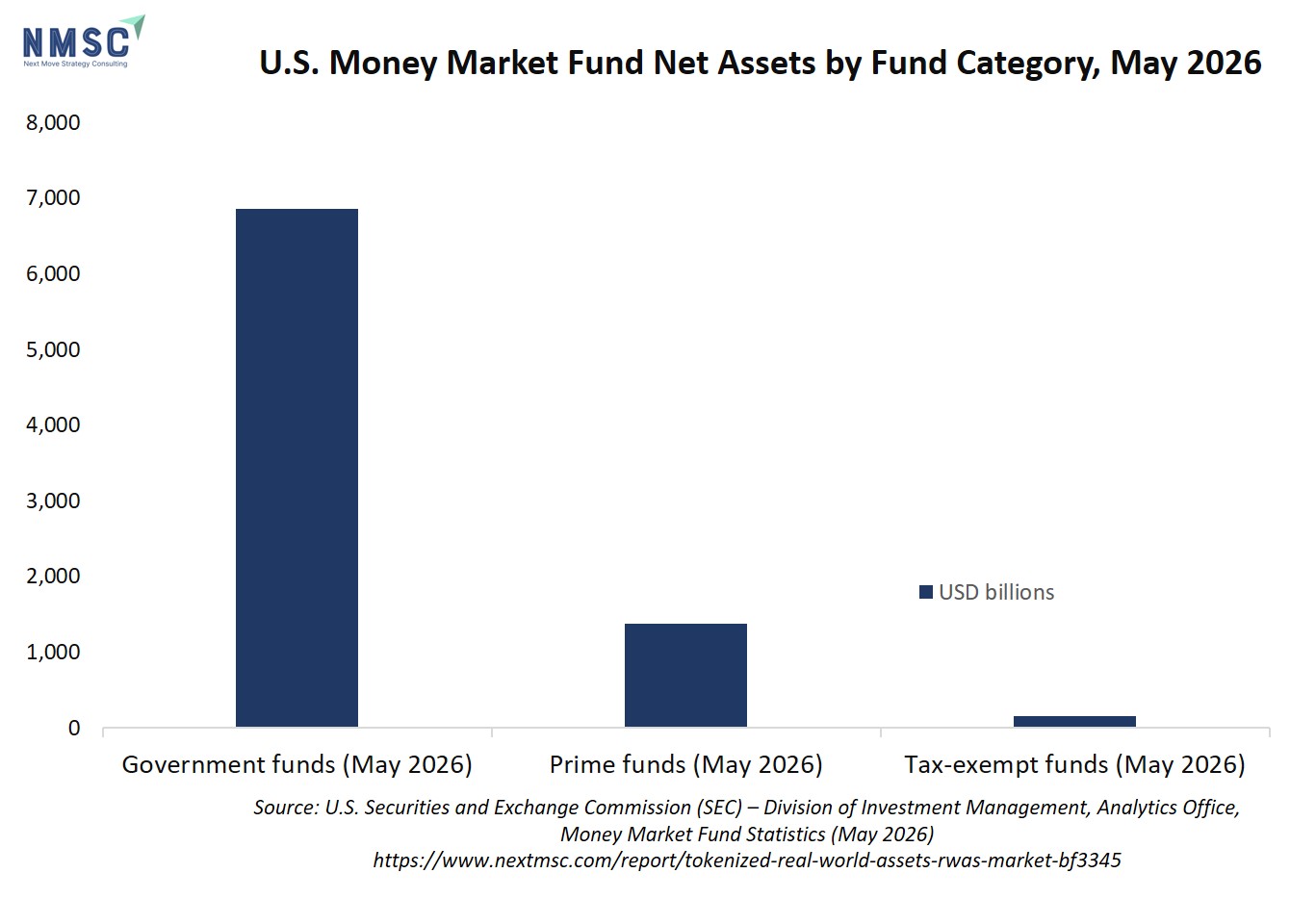
The second catalyst was the GENIUS Act, enacted in July 2025, which established the first federal framework for payment stablecoin issuers and defined the category of "eligible reserve assets" that stablecoin issuers are required to hold. Both BlackRock's BSTBL and BRSRV were explicitly structured to meet this definition, meaning that every dollar of stablecoin issued under the GENIUS Act framework now represents a potential demand source for tokenized money market fund shares. With U.S. money market funds holding more than USD 8.4 trillion in assets as of May 2026, according to the U.S. Securities and Exchange Commission, the addressable market for GENIUS Act-compliant tokenized reserve products is structurally enormous.
"Cash remains a foundational building block for investors, corporations, and financial institutions," said Jon Steel, Global Head of Product and Platform for BlackRock's Cash Management business, in the firm's August 3, 2026 press release. "As demand grows for high-quality reserve assets to support stablecoins and other tokenized financial products, these funds provide clients with additional choice in how they access and use money market fund investment solutions across traditional and digital markets."
JPMorgan's Kinexys Platform: From $2 Billion Daily to $5 Billion Daily in Under Two Years
JPMorgan's August 2026 tokenized fund mandate did not arrive as a standalone announcement. It was the commercial culmination of a multi-year infrastructure build through Kinexys by J.P. Morgan, the firm's blockchain business unit, which has processed more than USD 3 trillion in transactions since inception and now averages more than USD 5 billion in daily transaction volume — a figure that itself reflects the migration of institutional treasury operations onto programmable settlement rails. In the months preceding the fund mandate, Kinexys launched Kinexys Fund Flow, a solution that collects, harmonizes, and records investor register and transactional data on its private, permissioned blockchain network, executing its first transaction with J.P. Morgan Private Bank, J.P. Morgan Asset Management, and Citco. JPM Coin (JPMD), the firm's USD-denominated deposit token, also became available to institutional clients on Base, the Ethereum Layer 2 blockchain built within Coinbase.
In May 2026, JPMorgan had separately filed with the SEC to launch a new tokenized U.S. Treasury money-market fund on Ethereum, according to CoinDesk — a filing that preceded the August mandate win and demonstrated the firm's deliberate sequencing of regulatory engagement before commercial launch.
IMF and BIS Validate Tokenization as a Structural Shift, Not a Cyclical Trend
The institutional product launches of August 2026 coincided with a wave of multilateral institutional analysis that framed tokenization not as a fintech experiment but as a structural reorganization of financial architecture.
In April 2026, the International Monetary Fund published IMF Notes No. 26/01, "Tokenized Finance," arguing that tokenization constitutes a structural shift in financial architecture rather than a marginal efficiency gain, while simultaneously warning that financial stability risks increase as oversight becomes uneven and crisis management more complex.
On July 2, 2026, Tobias Adrian, Financial Counsellor and Director of the Monetary and Capital Markets Department at the International Monetary Fund, published a blog titled "Tokenization Can Change The World's Financial Architecture," stating that "policy choices will determine whether tokenized finance strengthens or fragments the financial system."
The Bank for International Settlements reinforced this framing in its Annual Economic Report 2026, Chapter III, "Anchoring trust in money: innovation beyond stablecoins," which assessed evolving financial architectures based on programmable platforms and set out a path toward a next-generation monetary and financial system. The BIS also highlighted Project Agorá — a multi-central-bank initiative demonstrating how tokenization can improve wholesale cross-border payments — as a model for how public-sector infrastructure can anchor private-sector tokenization activity.
An October 8, 2026 IMF blog post, "What Is Needed for Tokenization to Deliver," noted that tokenized assets — spanning credit, money market funds, and equities — now add approximately USD 65 billion in distributed on-chain value, underscoring the gap between current on-chain deployment and the multi-trillion-dollar potential identified by NMSC's proprietary research and analysis.
Franklin Templeton's Multi-Chain Deployment: The Operational Reality of Institutional Tokenization
Franklin Templeton's Franklin OnChain U.S. Government Money Fund (FOBXX) — deployed across Ethereum, Polygon, Avalanche, Arbitrum, Aptos, and Stellar — provides the most detailed public case study of how a regulated asset manager navigates the multi-chain reality of tokenized finance. The firm's proprietary Benji Technology Platform now supports four distinct tokenized funds across institutional and retail use cases, including an Intraday Yield feature unavailable in traditional fund structures.
"Our approach is chain-agnostic. We want to be where there is client demand and preference, and evaluate each environment based on a set of internally developed criteria," said Mike Reed, Senior Vice President, Head of Digital Asset Partnership Development at Franklin Templeton Investments, in the State of RWA Tokenization 2026 report published by RWA.io and Canton Network. "What we've found is that the future will likely be multi-chain, so we're working to ensure financial products can move seamlessly across those rails without compromising trust, governance, or investor protection, while delivering the speed and utility that investors expect."
EU's MiCA Framework Accelerates European Tokenization Activity
In Europe, the Markets in Crypto-Assets Regulation (MiCA) became fully applicable on December 30, 2024, establishing the first unified legal framework for crypto-asset service providers across all EU member states and directly governing how tokenized real-world assets are issued, marketed, and traded within the bloc. On May 20, 2026, the European Commission launched a targeted consultation on the review of MiCA, signaling that the regulation — while foundational — is already being assessed for expansion to cover asset classes and use cases that emerged after its original drafting.
Switzerland's FINMA and Singapore's Monetary Authority (MAS) have maintained their positions as the most permissive institutional-grade regulatory environments for tokenized securities, with both jurisdictions having enacted frameworks that recognize tokenized securities as legally equivalent to their traditional counterparts, according to NMSC primary research and analysis.
Competitive Landscape: The Two-Pronged Architecture of Institutional Tokenization
The competitive structure of the tokenized RWA market has bifurcated into two distinct strategic archetypes: incumbent financial institutions building institutional-grade tokenization infrastructure on top of existing balance sheets and regulatory licenses, and purpose-built fintech platforms innovating on compliance automation and fractional ownership mechanics.
BlackRock's BUIDL fund — which held USD 2.25 billion across nine blockchain networks as of October 6, 2026 — exemplifies the incumbent approach: a regulated fund structure, SEC-registered transfer agent (Securitize), and multi-chain deployment that leverages the firm's existing institutional client relationships.
On the fintech side, Ondo Finance's OUSG fund attracted USD 88 million in assets by offering tokenized U.S. Treasury exposure to risk-averse investors seeking to bridge traditional fixed income and decentralized finance, according to NMSC primary research and analysis. Aave Horizon, a dedicated RWA lending market launched by Aave Labs, grew to a total market size of over USD 520 million by November 2025, using Chainlink's NAVLink oracle service to deliver real-time, tamper-proof Net Asset Value data for tokenized collateral — solving the pricing challenge that had previously made RWA-backed lending operationally impractical.
Key Competitive Developments in the Tokenized RWAs Market (2026)
|
Institution / Platform |
Development |
Significance |
|
BlackRock |
Launched BSTBL and BRSRV tokenized money market products on August 3, 2026; BUIDL fund holds USD 2.25B across nine networks as of October 6, 2026 |
First tokenized money market products explicitly structured as GENIUS Act-eligible reserve assets; BNY and Securitize serve as transfer agents |
|
J.P. Morgan Asset Management / Kinexys |
Won first approved tokenized money market fund mandate (August 10, 2026); Kinexys processes USD 5B+ daily; JPM Coin (JPMD) launched on Base (Ethereum L2) |
Largest GSIB to launch a tokenized money market fund on a public blockchain; Kinexys Fund Flow commenced first transaction with J.P. Morgan Private Bank and Citco |
|
Franklin Templeton |
FOBXX deployed across six blockchain networks via Benji Technology Platform; introduced Intraday Yield feature unavailable in traditional fund structures |
Most operationally advanced multi-chain institutional fund deployment; demonstrates chain-agnostic institutional strategy |
|
Securitize, Inc. |
SEC-registered transfer agent; serves as tokenization provider for BlackRock's BRSRV |
Only SEC-registered transfer agent operating as a blockchain-native tokenization platform |
|
Ondo Finance |
OUSG fund attracted USD 88M in assets; Ian De Bode (President) articulated full-stack tokenization platform strategy |
Bridges institutional fixed income and DeFi; positioned as primary distribution layer for tokenized U.S. capital markets access |
|
Figure Technologies |
Originated over USD 19B in credit assets on Provenance Blockchain; launched Hastra protocol on Solana, surpassing USD 30M TVL within four days |
End-to-end on-chain capital markets model; 100+ basis points cost reduction per loan vs. traditional processes |
|
Aave Horizon |
Grew to USD 520M+ total market size; integrated Chainlink NAVLink for real-time NAV pricing of tokenized collateral |
Solved the RWA pricing challenge that had blocked institutional-grade on-chain lending |
The Interoperability Constraint: The Single Largest Structural Barrier to the Next Phase of Growth
Despite the institutional momentum of 2026, NMSC primary research and analysis identifies blockchain interoperability fragmentation as the most consequential structural constraint on the market's path from tens of billions to trillions in on-chain value. The Ethereum ecosystem hosts approximately 52% of total RWA value, while Polygon has captured 62% of the tokenized global bond market — but assets on these networks cannot move between them without incurring capital reallocation friction of 2–5% per transaction, according to the State of RWA Tokenization 2026 report published by RWA.io and Canton Network. This friction renders dynamic cross-chain portfolio management economically unviable for institutional investors who routinely rebalance positions in response to market conditions.
"Liquidity is the lifeblood of institutional adoption, and achieving it requires building real marketplaces — not just tokenizing assets in isolation," said Michael Tannenbaum, Chief Executive Officer at Figure Technologies, in the State of RWA Tokenization 2026 report. "Interoperability is foundational to this liquidity construct: the easier it is to move stablecoins and tokenized financing across platforms and ecosystems, the stronger the incentives become for more assets to migrate on-chain."
Cross-chain protocols including Chainlink CCIP (certified to SOC 2 and ISO 27001 standards, with institutional adoption by SWIFT, ANZ, and Standard Chartered), Cosmos IBC (deployed by Figure, Ondo, and Provenance Blockchain), and Axelar (adopted by Microsoft, Mastercard, and Deutsche Bank) are the primary infrastructure candidates for resolving this fragmentation, according to the State of RWA Tokenization 2026 report.
NMSC Strategic Perspective: Why the August 2026 Product Launches Represent a Non-Reversible Inflection Point
Next Move Strategy Consulting's proprietary research and analysis identifies three structural reasons why the August 2026 tokenized money market fund launches by BlackRock and JPMorgan represent a qualitatively different market event from prior institutional tokenization pilots:
First, the GENIUS Act has created a self-reinforcing demand loop. By legally requiring stablecoin issuers to hold eligible reserve assets — and by structuring tokenized money market fund shares to qualify as such — the U.S. regulatory framework has created a direct, statutory demand channel for tokenized RWA products that did not exist before July 2025. As stablecoin issuance grows, demand for GENIUS Act-compliant tokenized reserve assets grows proportionally. BlackRock's BRSRV and JPMorgan's tokenized fund are not competing for a fixed pool of institutional demand; they are positioned to capture an expanding pool of demand that is structurally linked to the growth of the U.S. stablecoin market.
Second, the SEC's January 28, 2026 Statement on Tokenized Securities has resolved the compliance ambiguity that was the primary reason institutional legal and compliance teams had blocked tokenization programs. By confirming that the format of issuance does not alter the legal character of a security, the SEC effectively told every registered investment adviser, broker-dealer, and fund manager in the United States that tokenized securities are not a new regulatory category requiring new exemptions — they are existing securities in a new format. This is the single most important regulatory development for institutional adoption since the emergence of the asset class.
Third, the competitive dynamic between BlackRock and JPMorgan will accelerate the build-out of tokenization infrastructure across the entire institutional ecosystem. When the two largest financial institutions in the world launch competing tokenized products within seven days of each other, every other major asset manager, custodian, and prime broker faces a strategic imperative to develop a tokenization capability or risk losing institutional mandates to competitors who have one. NMSC's proprietary research and analysis projects that this competitive pressure will drive a significant acceleration in institutional tokenization program launches through 2027, compressing what would otherwise have been a multi-year adoption curve.
The market's trajectory toward USD 9.43 trillion by 2030 — as projected in NMSC's Tokenized Real-World Assets (RWAs) Market report — is underpinned by the convergence of these three structural forces: a statutory demand mechanism (GENIUS Act), a resolved compliance framework (SEC Statement), and a competitive institutional dynamic that makes inaction increasingly costly for major financial institutions.
Regional Analysis
North America leads global tokenized RWA adoption, driven by the GENIUS Act's stablecoin reserve framework, the SEC's January 2026 tokenized securities guidance, and the concentration of the world's largest asset managers and custodians in the United States. Canada has followed with sandbox initiatives fostering innovation in tokenized securities, according to NMSC primary research and analysis.
Europe benefits from MiCA's unified legal framework, which became fully applicable on December 30, 2024, and has enabled regulated token offerings across Switzerland, Liechtenstein, and Malta. The European Commission's May 2026 consultation on MiCA review signals that the regulatory framework will continue to evolve to accommodate new asset classes and use cases.
Asia-Pacific is the fastest-growing regional market, with Singapore's MAS and Hong Kong's Securities and Futures Commission (SFC) having authorized multiple token service providers. Singapore's ADDX platform has enabled retail investors to own fractions of Singapore office towers with ticket sizes as low as USD 5,000, demonstrating the democratization potential of fractional tokenized real estate, according to NMSC primary research and analysis.
Rest of World markets, including the Middle East and Latin America, are at earlier stages of regulatory development but represent significant long-term opportunity as sovereign wealth funds and regional development banks explore tokenized infrastructure and commodity assets.
Bottom Line
The tokenized real-world assets market entered a new phase of institutional legitimacy in August 2026, when BlackRock and JPMorgan launched competing tokenized money market products within seven days of each other — both explicitly structured to comply with the GENIUS Act's stablecoin reserve requirements. These launches were enabled by the SEC's January 28, 2026 Statement on Tokenized Securities, which resolved the compliance ambiguity that had blocked institutional programs for years, and by the GENIUS Act itself, which created a statutory demand channel for tokenized reserve assets tied to the growth of the U.S. stablecoin market. The IMF and BIS have both characterized tokenization as a structural shift in financial architecture rather than a cyclical trend, while the EU's MiCA framework has established a unified legal environment for tokenized RWAs across all member states. According to NMSC primary research and analysis, the global tokenized RWAs market — valued at USD 297.71 billion in 2024 — is projected to reach USD 9.43 trillion by 2030 at a CAGR of 72.8%, with blockchain interoperability fragmentation remaining the primary structural constraint on the pace of that expansion.
About Next Move Strategy Consulting
Next Move Strategy Consulting is a premier market research and management consulting firm that has been committed to provide strategically analysed well documented latest research reports to its clients. The research industry is flooded with many firms to choose from, what makes NMSC different from the rest is its top-quality research and the obsession of turning data into knowledge by dissecting every bit of it and providing fact-based research recommendation that is supported by information collected from over 500 million websites, paid databases, industry journals and one on one consultations with industry experts across a diverse range of industry sectors. The high-quality customized research reports with actionable insights and excellent end-to-end customer service help our clients to take critical business decisions that enables them to move beyond time and have competitive edge in the industry.
We have been servicing over 1000 customers globally that includes 90% of the Fortune 500 companies over a decade. Our analysts are constantly tracking various high growth markets and identifying hidden opportunities in each sector or the industry. We provide one of the industry's best quality syndicate as well as custom research reports across 10 different industry verticals. We are committed to deliver high quality research solutions in accordance to your business needs. Our industry standard delivery solutions that ranges from the pre consultation to after-sales services, provide an excellent client experience and ensure right strategic decision making for businesses.
For more information, please contact:
Next Move Strategy Consulting
5th Floor 867
Boylston St, STE 500,
Boston, MA 02116, U.S.
E-Mail: [email protected]
Direct: +1-217-650-7991
Website: www.nextmsc.com
About the Author
 Sanyukta Deb
— Sanyukta Deb is Digital Marketing Team Lead at Next Move Strategy Consulting, where she has led content strategy and technical SEO for the firm's B2B market research publications for over 2 years. Her editorial process translates NextMSC's primary and secondary research — spanning technology, industrial, and consumer sectors — into commercial narratives, backed by search-intent, keyword, and competitive analysis. She brings 5 years of overall experience in digital marketing and content strategy.
Sanyukta Deb
— Sanyukta Deb is Digital Marketing Team Lead at Next Move Strategy Consulting, where she has led content strategy and technical SEO for the firm's B2B market research publications for over 2 years. Her editorial process translates NextMSC's primary and secondary research — spanning technology, industrial, and consumer sectors — into commercial narratives, backed by search-intent, keyword, and competitive analysis. She brings 5 years of overall experience in digital marketing and content strategy.
About the Reviewer
 Debashree Dey
— Debashree Dey is Assistant Manager at Next Move Strategy Consulting, where she supports cross-vertical market content and communications across diverse industries for 6 years. Her professional background includes senior content writing, communications, and published manuscript authorship, with experience developing audience-focused business narratives and maintaining clear, consistent messaging. Her role supports research-led content development and editorial quality across NextMSC publications.
Debashree Dey
— Debashree Dey is Assistant Manager at Next Move Strategy Consulting, where she supports cross-vertical market content and communications across diverse industries for 6 years. Her professional background includes senior content writing, communications, and published manuscript authorship, with experience developing audience-focused business narratives and maintaining clear, consistent messaging. Her role supports research-led content development and editorial quality across NextMSC publications.

















Add Comment