SEC Ends $25,000 Day-Trading Rule After 25 Years, Reshaping Online Trading

SEC Abolishes the $25,000 Pattern Day Trader Threshold After 25 Years, Triggering a Structural Expansion in the Online Trading Platform Market
On April 14, 2026, the U.S. Securities and Exchange Commission approved FINRA's proposed amendments to Rule 4210 (SR-FINRA-2025-017), formally eliminating the $25,000 minimum equity requirement and the four-trades-in-five-days threshold that had defined "pattern day trader" status for 25 years. The rule change, which took effect on June 4, 2026, replaces the binary PDT designation with dynamic intraday margin standards calibrated to a customer's real-time market exposure — a structural reform that removes the single most cited barrier to retail participation in active equity trading in the United States. The decision arrives at a moment of accelerating commercial momentum across the global online brokerage industry, and its downstream effects on platform user acquisition, margin revenue models, and competitive positioning are already reshaping the sector's near-term outlook.
According to Next Move Strategy Consulting's Online Trading Platform Market report, the global online trading platform market was valued at USD 13.82 billion in 2025 and is projected to reach USD 20.40 billion by 2030, growing at a CAGR of 8.10% from 2025 to 2030. NMSC's proprietary research and analysis identifies the convergence of three structural forces — the democratization of market access through mobile-first infrastructure, the mainstreaming of multi-asset retail portfolios, and the accelerating regulatory clarity around digital assets — as the primary mechanisms compressing the timeline to that forecast.
For More Information: Download FREE Sample on Online Trading Platform Market Report
The PDT Rule Elimination: A Demand-Side Catalyst Specific to This Market
The Pattern Day Trader rule, introduced by FINRA in 2001, required any U.S. margin account holder executing four or more day trades within five business days to maintain a minimum equity balance of $25,000. For the overwhelming majority of retail investors — particularly younger, lower-balance participants who represent the fastest-growing demographic on digital brokerage platforms — this threshold functioned as an effective prohibition on intraday trading strategies.
FINRA's April 15, 2026 announcement confirmed that the new intraday margin standards "will give customers more freedom to participate in the markets while also ensuring customers maintain equity in their margin account commensurate with the amount of market exposure they have at any given point in time during the trading day." The regulator also confirmed that member firms requiring additional implementation time would be permitted to phase in compliance over 18 months from the regulatory notice publication date.
The commercial implications for online trading platforms are direct and measurable. Platforms that had previously segmented their product offerings — routing lower-balance customers toward swing-trading tools while reserving intraday execution features for accounts above the $25,000 threshold — must now reconfigure their user experience architecture, margin calculation engines, and risk management systems to serve a materially larger addressable population of active traders. Platforms with cloud-native infrastructure and programmatic API interfaces are positioned to absorb this demand surge more rapidly than legacy desktop-terminal-dependent competitors.
Platform Financial Performance Confirms Structural Demand Strength
The regulatory shift arrives against a backdrop of robust financial results across the sector's leading publicly traded operators, validating NMSC's growth trajectory.
Interactive Brokers Group (IBKR) reported a 77% pre-tax margin in Q2 2026, with net revenue rising 28.1% year-over-year, commission revenue advancing 30.4%, and net interest income expanding 22.9%. The dual-engine revenue model — commissions and net interest income growing simultaneously — demonstrates that the platform's growth is not contingent on any single market condition, a structural advantage that distinguishes IBKR from single-revenue-stream competitors.
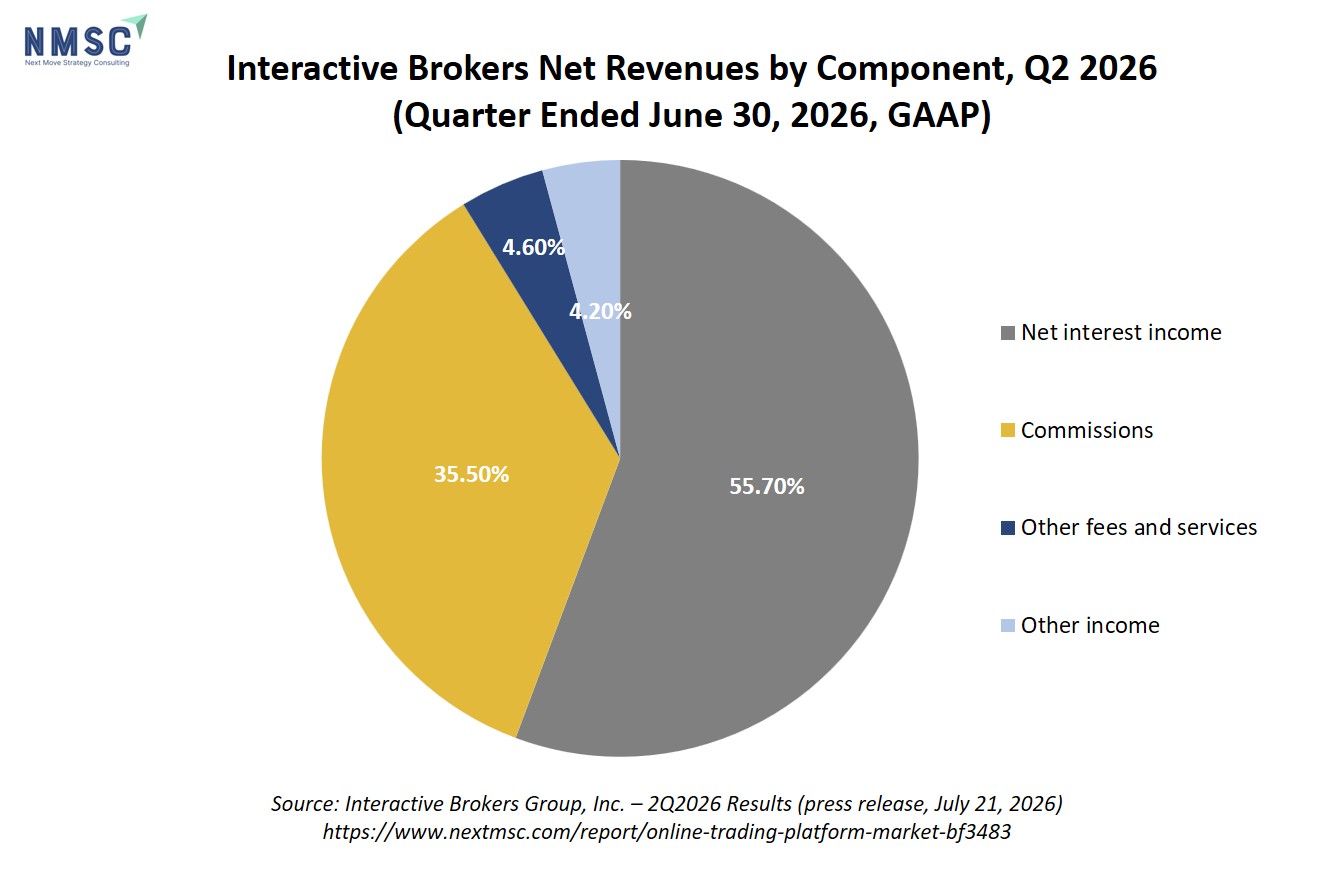
eToro, which completed its Nasdaq IPO in May 2025 at USD 52 per share, reported Q4 2025 results in February 2026 that beat analyst consensus. Net trading income from equities, commodities, and currencies rose 43% to USD 115.6 million in the fourth quarter, driven by investor rotation between crypto and traditional asset classes, with particularly strong performance in commodities. The company's assets under administration grew 11% year-on-year to USD 18.5 billion.
eToro CEO Yoni Assia noted on a call with analysts that "crypto-native customers who had mainly traded in digital assets were now trading commodities — something the company had not seen before," adding that users often start with crypto before expanding into stocks and commodities, becoming more advanced traders over time. Coin Bureau analyst Nic Puckrin, commenting on the results, stated: "eToro's earnings today suggest that crypto-native customers are approaching portfolio construction more strategically. They are not leaving risk markets entirely, but rather shifting focus as global conditions change. This is a sign of a more mature crypto market, with more opportunities to invest in commodities now available through tokenized real-world assets."
Robinhood reported that as of August 2026, funded customers totaled 28.6 million, up 7% year-over-year, while platform assets increased 26% over the same period. The Motley Fool reported in August 2026 that CBOE Global Markets recorded record revenues in Q2 2026, up 25% year-over-year, reflecting broad-based strength in trading volumes across asset classes.
|
Platform |
Key Q2/Q4 2026 Metric |
Value |
|
Interactive Brokers (IBKR) |
Q2 2026 Pre-Tax Margin |
77% |
|
Interactive Brokers (IBKR) |
Q2 2026 Net Revenue Growth (YoY) |
+28.1% |
|
Interactive Brokers (IBKR) |
Q2 2026 Commission Revenue Growth (YoY) |
+30.4% |
|
eToro |
Q4 2025 Net Trading Income (Equities, Commodities, FX) |
USD 115.6 million (+43% YoY) |
|
eToro |
Assets Under Administration (Q4 2025) |
USD 18.5 billion (+11% YoY) |
|
Robinhood |
Funded Customers (August 2026) |
28.6 million (+7% YoY) |
|
Robinhood |
Platform Assets Growth (YoY, August 2026) |
+26% |
|
CBOE Global Markets |
Q2 2026 Revenue Growth (YoY) |
+25% (record) |
Regulatory Architecture: Digital Asset Clarity Expands the Addressable Market
Concurrent with the PDT rule elimination, the regulatory environment governing digital asset trading on online platforms has undergone its most substantive restructuring in the sector's history.
On March 17, 2026, the SEC and the CFTC jointly issued an interpretation clarifying how federal securities laws apply to crypto assets, introducing a five-category token taxonomy that distinguishes between securities, commodities, and hybrid instruments. The joint interpretation, effective March 23, 2026, directly addresses the compliance uncertainty that had caused multiple online trading platforms to restrict or delay the launch of digital asset trading features for retail customers.
On August 18, 2026, the SEC proposed Regulation Crypto Assets, establishing tailored offering exemptions and a principles-based disclosure framework for digital asset issuers and trading platforms. The proposal follows the March 2026 joint interpretation and signals a shift from enforcement-by-analogy to a purpose-built regulatory framework — a development that materially reduces the legal risk premium that had suppressed institutional and retail participation in crypto trading on regulated platforms.
Justin McCormack, Head of Legal, Digital Assets Solutions at State Street, writing in State Street's Digital Digest in March 2026, characterized the regulatory trajectory as follows: "The most constructive way to view 2025 is as a year where many regulators made the landscape more buildable — without pretending it is finished. For clients and market participants, that shift matters: Clarity lowers operational risk, supports investment in durable infrastructure, and enables more credible hybrid models that bring traditional finance safeguards to tokenized workflows."
In Europe, the EU's Markets in Crypto-Assets Regulation (MiCA) continued its maturation through 2025 and into 2026, with the European Securities and Markets Authority (ESMA) issuing a December 2025 statement emphasizing that transitional regimes are uneven across member states and setting expectations around early engagement with national competent authorities. For online trading platforms operating across EU jurisdictions, MiCA's passporting provisions represent a concrete commercial opportunity to consolidate multi-country operations under a single authorization framework, reducing the per-market compliance cost that had historically constrained cross-border platform expansion.
Market Infrastructure: Extended Trading Hours Signal a 24/7 Competitive Frontier
Beyond the PDT rule and digital asset regulation, the structural architecture of U.S. equity markets is itself evolving in ways that directly expand the operational scope of online trading platforms. FINRA recently extended trade reporting hours to 4:00 a.m. Eastern Time and confirmed that the industry is preparing for 23-hour, five-day-a-week trading by December 2026. Chris Stone, FINRA Vice President, Transparency Services, explained in a FINRA Unscripted podcast that FINRA's recently implemented fractional share reporting is simultaneously eliminating what researchers had called "phantom volume" — a data quality improvement that enhances the reliability of market data feeds that online platforms sell as a revenue stream.
eToro's February 2026 launch of 24/7 trading in gold — the first non-crypto asset to trade around the clock on the platform — illustrates how leading platforms are pre-positioning for this extended-hours environment. Platforms that can offer continuous execution across equities, commodities, and digital assets within a single interface will command a structural user-retention advantage as the distinction between "trading hours" and "non-trading hours" progressively dissolves.
NMSC Market Segmentation: Where the Growth Is Concentrated
According to NMSC's proprietary research and analysis, the online trading platform market is segmented across component, platform type, deployment mode, interface type, asset class, end user, and revenue model dimensions. The mobile interface segment is the fastest-growing interface category, consistent with Pew Research Center data from 2024 showing that 91% of Americans own a smartphone — a penetration rate that has made mobile-first trading the default access mode for the retail investor demographic.
Within asset classes, the cryptocurrency segment is experiencing the most dynamic regulatory repositioning, while the equities segment is the direct beneficiary of the PDT rule elimination. The broker platform sub-segment — encompassing both discount brokers and full-service brokers — faces the most immediate competitive pressure from the rule change, as the elimination of the $25,000 threshold removes a structural moat that had historically protected full-service brokers' active-trading client base from discount-broker competition.
On the deployment mode dimension, NMSC's analysis identifies cloud-based deployment as the dominant and fastest-growing mode, enabling platforms to scale user capacity in response to demand spikes — a capability that proved critical during the retail trading surges of 2020-2021 and that will be equally important as the post-PDT-elimination user acquisition wave materializes.
Regional Dynamics: Three Distinct Growth Engines
North America is the immediate epicenter of the PDT rule elimination's commercial impact. The near-universal smartphone ownership rate — 91% of Americans, per Pew Research Center's 2024 data — means that the newly eligible day-trading population can access platform interfaces without any additional hardware investment. The competitive response is already visible: Charles Schwab has rolled out commission-free trading on U.S. and Canadian exchange-listed stocks and options, directly mirroring the zero-fee model that Robinhood pioneered.
Europe is navigating a dual regulatory transition: MiCA's full implementation for crypto-asset service providers and the FCA's anticipated publication of a policy statement on fund tokenization in the first half of 2026, following its CP25/28 consultation. Platforms that secure MiCA authorization in a single EU member state gain passporting rights across the bloc — a structural advantage that is accelerating consolidation among mid-tier European brokerages.
Asia-Pacific continues to generate the largest volume of first-time retail investors globally, driven by the demographic weight of millennials and Gen Z in India, China, and Indonesia. The Monetary Authority of Singapore's clarification of its Digital Token Service Providers regime — requiring licensing for firms serving customers outside Singapore from June 30, 2025 — has raised the compliance bar for cross-border digital asset platforms operating in the region, creating a competitive moat for well-capitalized, licensed operators.
NMSC Strategic Perspective: Three Structural Shifts Redefining Platform Competitive Advantage
NMSC's proprietary research and analysis identifies three structural shifts that will determine which platforms capture disproportionate market share through 2030:
1. The Margin Architecture Transition. The PDT rule's replacement with dynamic intraday margin standards requires platforms to invest in real-time risk calculation infrastructure capable of assessing customer exposure on a position-by-position basis throughout the trading day. Platforms that can implement this infrastructure at scale — and communicate margin requirements transparently to newly eligible retail day traders — will convert the regulatory change into a durable user acquisition advantage. Platforms that cannot will face elevated regulatory scrutiny and potential customer attrition as margin calls materialize for underprepared users.
2. The Multi-Asset Convergence Imperative. eToro's Q4 2025 data — showing crypto-native customers rotating into commodities and equities within a single platform — confirms NMSC's analytical view that the next competitive frontier is not asset-class depth but asset-class breadth within a unified interface. Platforms that require customers to maintain separate accounts for equities, derivatives, and digital assets will lose wallet share to integrated multi-asset platforms, regardless of their individual asset-class execution quality.
3. The Regulatory Clarity Dividend. The SEC-CFTC joint interpretation of March 2026 and the proposed Regulation Crypto Assets of August 2026 collectively reduce the legal risk premium that had suppressed institutional participation in crypto trading on regulated platforms. NMSC's analysis indicates that this regulatory clarity will accelerate the entry of institutional investors — asset managers, brokers, and trading firms — into the online platform ecosystem, expanding the institutional investor segment that currently represents a smaller but higher-revenue-per-user cohort relative to retail participants.
Key Players: Strategic Moves Shaping the Competitive Landscape
In March 2025, Interactive Brokers LLC expanded its global trading capabilities by introducing enhanced fractional share trading across additional international markets, alongside upgrades to its AI-driven portfolio analytics tools to improve retail and institutional decision-making.
In January 2025, The Charles Schwab Corporation completed deeper integration of TD Ameritrade platforms, enhancing thinkorswim capabilities and rolling out improved automated advisory services to strengthen its digital brokerage ecosystem.
In April 2026, eToro announced that residents of New York State could access its platform — a significant geographic expansion into one of the most populous and financially active U.S. markets.
Bottom Line
The online trading platform market is undergoing a structural reconfiguration driven by three simultaneous and mutually reinforcing forces. The SEC's April 14, 2026 elimination of the $25,000 Pattern Day Trader threshold — effective June 4, 2026 — removes the most consequential access barrier in U.S. retail trading history, directly expanding the addressable user base for active-trading features on digital brokerage platforms. Concurrently, the SEC-CFTC joint crypto interpretation of March 2026 and the proposed Regulation Crypto Assets of August 2026 are converting years of regulatory ambiguity into a buildable compliance framework, enabling platforms to launch and scale digital asset offerings with materially reduced legal risk. Against this backdrop, leading operators are reporting record or near-record financial metrics: Interactive Brokers posted a 77% pre-tax margin in Q2 2026, eToro's net trading income from traditional assets rose 43% in Q4 2025, and Robinhood's funded customer base reached 28.6 million as of August 2026. According to NMSC's proprietary research and analysis, the global online trading platform market is projected to grow from USD 13.82 billion in 2025 to USD 20.40 billion by 2030 at a CAGR of 8.10% — a trajectory that the current regulatory and competitive environment is, if anything, accelerating rather than constraining.
About Next Move Strategy Consulting
Next Move Strategy Consulting is a premier market research and management consulting firm that has been committed to provide strategically analysed well documented latest research reports to its clients. The research industry is flooded with many firms to choose from, what makes NMSC different from the rest is its top-quality research and the obsession of turning data into knowledge by dissecting every bit of it and providing fact-based research recommendation that is supported by information collected from over 500 million websites, paid databases, industry journals and one on one consultations with industry experts across a diverse range of industry sectors. The high-quality customized research reports with actionable insights and excellent end-to-end customer service help our clients to take critical business decisions that enables them to move beyond time and have competitive edge in the industry.
We have been servicing over 1000 customers globally that includes 90% of the Fortune 500 companies over a decade. Our analysts are constantly tracking various high growth markets and identifying hidden opportunities in each sector or the industry. We provide one of the industry's best quality syndicate as well as custom research reports across 10 different industry verticals. We are committed to deliver high quality research solutions in accordance to your business needs. Our industry standard delivery solutions that ranges from the pre consultation to after-sales services, provide an excellent client experience and ensure right strategic decision making for businesses.
For more information, please contact:
Next Move Strategy Consulting
5th Floor 867 Boylston St, STE 500,
Boston, MA 02116, U.S.
E-Mail: [email protected]
Direct: +1-217-650-7991
Website: www.nextmsc.com
About the Author
 Sanyukta Deb
— Sanyukta Deb is Digital Marketing Team Lead at Next Move Strategy Consulting, where she has led content strategy and technical SEO for the firm's B2B market research publications for over 2 years. Her editorial process translates NextMSC's primary and secondary research — spanning technology, industrial, and consumer sectors — into commercial narratives, backed by search-intent, keyword, and competitive analysis. She brings 5 years of overall experience in digital marketing and content strategy.
Sanyukta Deb
— Sanyukta Deb is Digital Marketing Team Lead at Next Move Strategy Consulting, where she has led content strategy and technical SEO for the firm's B2B market research publications for over 2 years. Her editorial process translates NextMSC's primary and secondary research — spanning technology, industrial, and consumer sectors — into commercial narratives, backed by search-intent, keyword, and competitive analysis. She brings 5 years of overall experience in digital marketing and content strategy.
About the Reviewer
 Debashree Dey
— Debashree Dey is Assistant Manager at Next Move Strategy Consulting, where she supports cross-vertical market content and communications across diverse industries for 6 years. Her professional background includes senior content writing, communications, and published manuscript authorship, with experience developing audience-focused business narratives and maintaining clear, consistent messaging. Her role supports research-led content development and editorial quality across NextMSC publications.
Debashree Dey
— Debashree Dey is Assistant Manager at Next Move Strategy Consulting, where she supports cross-vertical market content and communications across diverse industries for 6 years. Her professional background includes senior content writing, communications, and published manuscript authorship, with experience developing audience-focused business narratives and maintaining clear, consistent messaging. Her role supports research-led content development and editorial quality across NextMSC publications.


















Add Comment