FSB Flags $2T Private Credit Risk as Basel III, AI Reshape Credit | NextMSC

FSB Flags $2 Trillion Private Credit Vulnerability as Basel III Overhaul and AI Deployment Reshape Global Lending Architecture
The Financial Stability Board's landmark May 2026 report on private credit vulnerabilities has placed the structural integrity of global credit intermediation under its most intensive institutional scrutiny in over a decade — arriving simultaneously with the U.S. banking agencies' sweeping Basel III capital modernization proposals and JPMorgan Chase's full-scale deployment of artificial intelligence tools across its global investment banking operations. Together, these three developments are redefining the risk architecture, regulatory perimeter, and competitive dynamics of credit intermediation at a pace that no single prior cycle has matched.
According to Next Move Strategy Consulting's Credit Intermediation Market report, the global credit intermediation market is projected to reach USD 28.73 billion by 2030, growing at a CAGR of 4.15% from 2025 to 2030. The market reached USD 23.44 billion in 2025, reflecting steady structural expansion driven by the convergence of digital lending platforms, AI-powered credit decisioning, and the accelerating migration of corporate borrowers from traditional bank balance sheets into private credit vehicles — a migration now drawing direct regulatory intervention from the FSB, the Federal Reserve, and the Basel Committee simultaneously.
For More Information: Download FREE Sample on Credit Intermediation Market Report
FSB Identifies $1.5–$2 Trillion Private Credit Ecosystem as Systemically Untested
The Financial Stability Board's Report on Vulnerabilities in Private Credit, published on May 6, 2026, provides the most comprehensive multilateral assessment of the private credit sector to date, estimating total global private credit lending at between USD 1.5 trillion and USD 2 trillion as of end-2024 — a figure broadly comparable in scale to both the institutional leveraged loan market (approximately USD 1.5–1.7 trillion) and the high-yield public debt market (approximately USD 2 trillion).
The United States holds the largest single-country market at an estimated USD 1 trillion, followed by the euro area and the United Kingdom. Growth rates across member jurisdictions have been exceptional: the FSB's member survey data show average annual growth of 16% in Canada and 17% in the United Kingdom over the past five years, and 13% annually in the euro area over the past decade from a low base. The U.S. market has tripled in size since 2019.
The FSB's central concern is not the scale of private credit per se, but the sector's untested resilience. The report states explicitly: "Private credit remains untested at its current size, scope, and concentration in a few economic sectors, and a severe economic downturn could expose this range of potential vulnerabilities." Specific vulnerabilities identified include: multi-layered leverage at the portfolio company, fund, and investor levels; valuation opacity from infrequent quarterly marks and discretionary income-based approaches; liquidity mismatches in semi-liquid fund structures that are increasingly marketed to retail investors; and complex bank-private credit interlinkages through subscription lines, fund portfolio financing, and synthetic risk transfer instruments.
The FSB's data on bank-to-private-credit-fund exposures illustrate the interconnection: member data captures approximately USD 220 billion of drawn and undrawn credit lines from banks to private credit funds, while commercial data estimates suggest the true figure may exceed USD 500 billion. The top five banks account for 63% of total committed loan amounts to Business Development Companies (BDCs) in the United States, and the top ten account for approximately 84% — a concentration that the FSB flags as a potential amplifier of stress.
The Federal Reserve's May 2026 Financial Stability Report corroborates the FSB's findings from a domestic supervisory perspective. Bank credit commitments to nonbank financial institutions grew to USD 2.6 trillion in the fourth quarter of 2025, with private equity, BDCs, and private credit vehicles constituting the largest single exposure category — representing approximately 25% of total bank loan commitments to NBFIs, with year-over-year growth of 17% in 2025. Private credit loans accounted for approximately USD 1.4 trillion, or 10% of total U.S. nonfinancial corporate debt, and roughly one-third of all below-investment-grade debt excluding bank loans.
Basel III Capital Modernization: Three Proposals Recalibrate the Lending Landscape
On March 19, 2026, the Federal Reserve Board, the Federal Deposit Insurance Corporation, and the Office of the Comptroller of the Currency jointly released three proposed rulemakings to modernize the U.S. regulatory capital framework — the most significant structural revision to bank capital rules since the post-2008 reforms. The proposals are designed to streamline capital requirements, enhance risk sensitivity, and implement the final components of the Basel III international agreement.
The first proposal, applying primarily to the largest internationally active banks, would consolidate the dual-calculation approach for risk-based capital compliance into a single framework, improving calibration for credit, market, and operational risks. The second proposal, covering all but the largest banks, would better align capital requirements for traditional lending activities — including modifications to mortgage servicing capital requirements — with actual risk profiles. The third proposal, from the Federal Reserve alone, would improve the measurement of systemic risk in the surcharge framework for global systemically important banks (G-SIBs).
The agencies stated that, in aggregate, the proposals would modestly reduce capital requirements for large banks and moderately reduce requirements for smaller banks, while maintaining overall capital levels substantially above pre-financial-crisis levels. The comment period closed on June 18, 2026. The proposals carry direct implications for credit intermediation market structure: reduced capital requirements for traditional mortgage and SME lending activities could shift the competitive balance between bank and non-bank lenders in specific product segments, while the enhanced risk sensitivity for private credit-related exposures may alter the economics of bank-to-NBFI lending that currently underpins much of the private credit ecosystem's funding architecture.
JPMorgan and HSBC Signal AI-Driven Transformation of Credit Delivery
In May 2026, JPMorgan Chase became one of the first global banks to deploy artificial intelligence tools across its entire investment banking business globally. Paul Uren, JPMorgan's Asia Pacific Head of Investment Banking, confirmed the rollout to Reuters on May 21, 2026, stating: "We are in the early phase adopting AI tools throughout our investment banking business globally but are excited by the developments. Our AI tools enable us to access more information and quickly synthesize it with our internal systems. We're finding that AI streamlines the preparation of content and materials, as well as helping bankers engage with more clients more efficiently."
The deployment is part of a broader USD 19.8 billion technology budget for 2026, within which JPMorgan has allocated approximately USD 2 billion specifically to AI projects. The bank is also among a select group of financial institutions permitted by Anthropic to use its Mythos cybersecurity model under the controlled "Project Glasswing" initiative — a capability with direct implications for credit fraud detection and model governance within lending operations.
HSBC Holdings reported its Q1 2026 results on May 5, 2026, disclosing revenue of USD 18.6 billion — a 6% increase year-on-year — driven by strong Wealth fee income and higher banking net interest income. Customer lending balances increased by USD 13.6 billion compared with Q4 2025, with constant-currency lending growth of USD 20.1 billion recorded across all business segments. Banking NII reached USD 11.3 billion, up USD 0.7 billion from Q1 2025, supported by deposit balance growth and the reinvestment of the structural hedge at higher yields.
Georges Elhedery, HSBC Group CEO, stated in the Q1 2026 earnings release: "We continued to make positive progress in creating a simple, more agile, growing HSBC. Each of our four businesses contributed to firm-wide revenue growth and each delivered an annualised RoTE in excess of 17%, excluding notable items. In periods of greater uncertainty, customers turn to us more as their trusted partner to navigate complexity with the financial strength, stability and expertise they know they can rely on."
HSBC raised its 2026 banking NII guidance to approximately USD 46 billion, up from the prior guidance of at least USD 45 billion, reflecting an improved interest rate outlook — a signal that the bank's Asia-anchored lending franchise continues to generate durable net interest income even as macroeconomic uncertainty from the Middle East conflict weighs on expected credit loss provisions.
Consumer Credit Expansion Sustains Retail Intermediation Demand
The Federal Reserve's Consumer Credit G.19 release for July 2026, published September 8, 2026, shows total consumer credit outstanding reached USD 5.186 trillion — increasing at a seasonally adjusted annual rate of 4.2% in July, the strongest monthly pace recorded in 2026. Revolving credit increased at an annual rate of 2.5%, while nonrevolving credit — encompassing auto loans, student loans, and personal loans — increased at an annual rate of 4.8%.
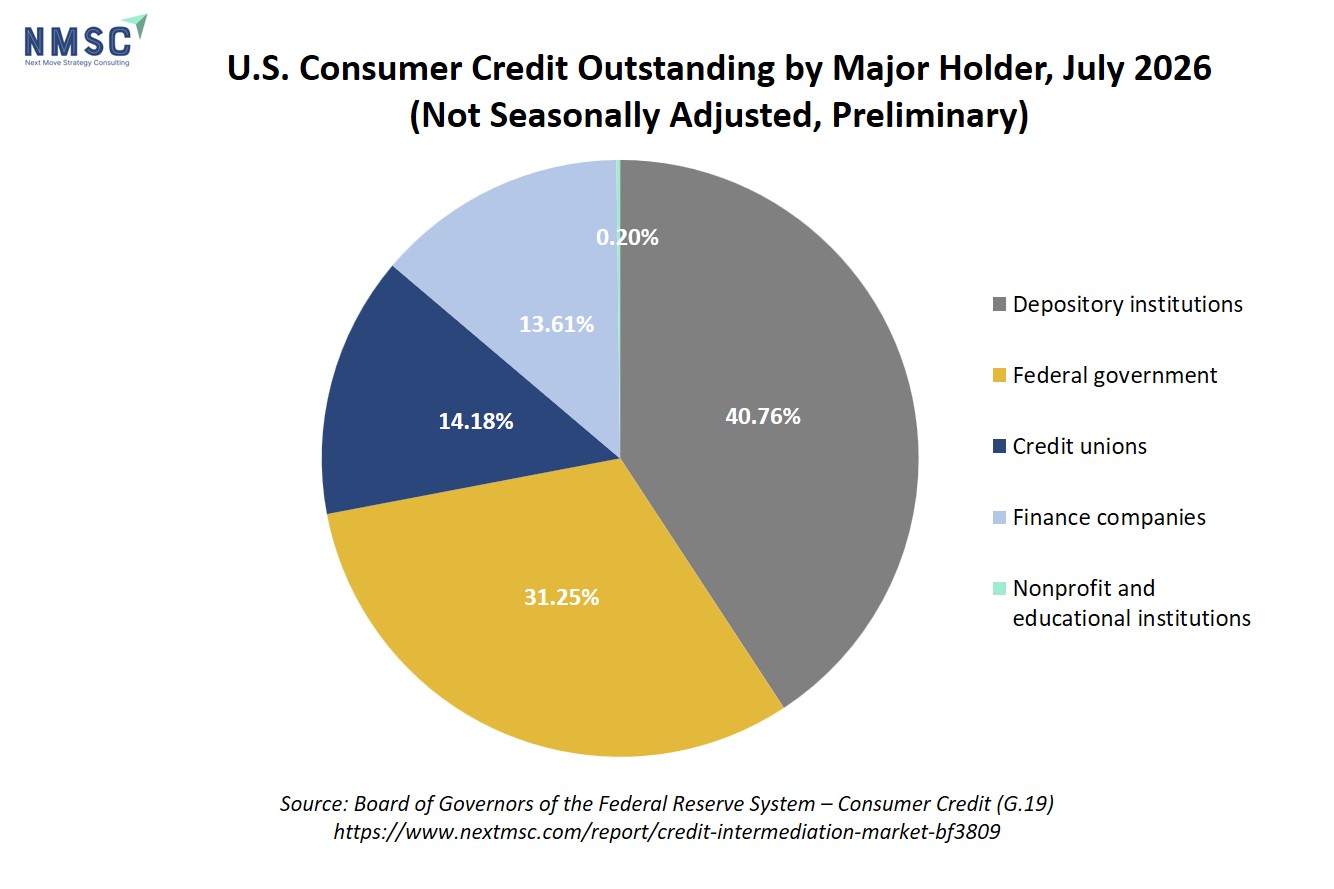
Depository institutions held USD 2.094 trillion of total consumer credit outstanding in July 2026, representing the largest single holder category. Credit unions held USD 728.6 billion, reflecting continued growth in member-based intermediation. The data confirm that retail credit demand remains structurally robust, providing a durable revenue base for both traditional depository intermediaries and the digital lending platforms that are increasingly capturing origination share in personal loan and buy-now-pay-later segments.
NMSC Strategic Perspective: Three Structural Forces Converging on Credit Intermediation
NextMSC primary research and analysis identifies three structural forces that are simultaneously reshaping the credit intermediation market's competitive architecture, risk profile, and growth trajectory through 2030.
First: The Regulatory Perimeter Is Closing Around Non-Bank Credit. The FSB's May 2026 report and the Federal Reserve's Financial Stability Report represent the opening phase of a sustained multilateral effort to bring private credit within a more structured oversight framework. The FSB identified four areas for further work: assessing vulnerabilities and liquidity mismatches across the private-finance ecosystem, mapping and defining ecosystem components, facilitating supervisory discussions, and addressing data challenges to improve monitoring.— that will progressively impose reporting, governance, and potentially capital-equivalent requirements on private credit funds. For credit intermediation market participants, this regulatory convergence creates a bifurcated opportunity: institutions that invest early in continuous model validation, explainability infrastructure, and regulator-ready audit trails will capture the compliance-driven demand that the FSB's framework will generate; those that delay will face both regulatory cost and reputational risk as the first stress events in private credit materialize.
Second: AI Is Compressing the Economics of Credit Origination, Not Just Automating It. JPMorgan's global AI deployment is not a productivity initiative — it is a structural repricing of the cost of credit analysis. When AI tools enable bankers to synthesize information across internal systems and engage more clients simultaneously, the marginal cost of originating an additional credit relationship falls. This compression benefits large-scale intermediaries with the technology budgets to deploy AI at scale, while creating existential pressure on mid-tier lenders whose competitive advantage rested on relationship-based origination. NMSC's analysis indicates that the addressable market for AI-native credit decisioning platforms — including continuous model validation, bias auditing, and explainability tooling — will expand materially as regulators in the U.S., EU, and UK formalize AI governance requirements for lending institutions.
Third: The Private Credit–Bank Nexus Is the Market's Most Consequential Structural Risk. The Federal Reserve's data showing USD 2.6 trillion in bank credit commitments to NBFIs, combined with the FSB's estimate of USD 220 billion to USD 500 billion in direct bank-to-private-credit-fund exposures, reveals a degree of interconnection that was not visible in aggregate regulatory data until 2025. The concentration of this exposure — with the top five banks accounting for 63% of BDC lending commitments — means that a stress event in private credit would transmit to the banking system through a small number of highly concentrated counterparty relationships. For credit intermediation market participants, this creates demand for stress-testing services, counterparty risk analytics, and independent validation of bank-to-NBFI exposure aggregation — service lines that did not exist at commercial scale five years ago.
Market Segmentation Snapshot
|
Segment |
Key Dynamics (2025–2030) |
Primary Demand Driver |
|
Residential Mortgages |
Regulatory capital relief under Basel III proposals may stimulate bank re-entry into mortgage origination |
Basel III mortgage servicing capital modifications |
|
Consumer Credit |
USD 5.19 trillion outstanding in U.S. (July 2026); 4.2% annualized growth rate |
Digital direct origination; BNPL expansion |
|
Commercial & Industrial |
Private credit capturing share from leveraged loan market; AI-driven underwriting |
Private equity-backed M&A; SME financing gap |
|
Trade & Supply Chain Finance |
Embedded finance and API-driven platforms expanding access in emerging markets |
Cross-border payment modernization; supply chain resilience |
|
Specialized Lending (AI Infrastructure) |
Private credit funding USD 800 billion of projected USD 1.5 trillion AI capex (2025–2028) |
Data centre construction; hyperscaler capex |
|
Non-Bank Intermediation |
Fastest-growing segment; FSB estimates ~49% of global financial assets |
Regulatory arbitrage; yield-seeking institutional investors |
Competitive Landscape: Key Developments
The credit intermediation market's competitive dynamics in 2025–2026 have been shaped by two parallel forces: the AI-driven transformation of origination and underwriting at the largest global banks, and the regulatory-driven restructuring of non-bank credit ecosystems.
In May 2026, JPMorgan Chase & Co. expanded its artificial intelligence strategy by deploying AI tools across global investment banking operations, with CEO Jamie Dimon confirming the bank would hire more AI specialists and fewer traditional bankers. The bank also announced plans to open more than 160 new branches in the U.S. — a dual strategy of digital capability expansion and physical network deepening that reflects the bifurcated nature of credit demand across customer segments.
In April–May 2026, HSBC Holdings plc reported strong Q1 2026 performance driven by its Asia-focused growth strategy and operational simplification initiatives. Customer lending balances grew USD 20.1 billion on a constant-currency basis, with growth recorded across all four business segments. The bank raised its 2026 banking NII guidance to approximately USD 46 billion, reflecting confidence in its structural hedge reinvestment strategy and deposit franchise resilience.
The FSB's May 2026 report also documents the consolidation trend within private credit: in the United Kingdom, the top five asset managers providing private credit account for over 50% of gross assets in UK-managed private credit funds — a concentration that mirrors the banking sector's own G-SIB dynamics and that the FSB identifies as a potential amplifier of systemic stress.
Bottom Line
The global credit intermediation market is navigating a structural inflection point defined by three simultaneous forces: the FSB's identification of USD 1.5–2 trillion in private credit as systemically untested and increasingly interconnected with the banking sector; the U.S. banking agencies' Basel III capital modernization proposals that will recalibrate the competitive economics of traditional versus non-bank lending; and the AI-driven transformation of origination, underwriting, and client engagement at the world's largest financial institutions. NextMSC primary research and analysis projects the market will grow from USD 23.44 billion in 2025 to USD 28.73 billion by 2030 at a CAGR of 4.15%, with the fastest growth concentrated in non-bank intermediation, AI-native credit decisioning platforms, and compliance-driven model validation services. The Federal Reserve's July 2026 consumer credit data — showing USD 5.19 trillion in outstanding balances growing at a 4.2% annualized rate — confirms that retail credit demand remains structurally robust, providing a durable revenue base for both incumbent depository institutions and the digital lenders competing for origination share. Institutions that align their technology investment, governance infrastructure, and regulatory positioning with the FSB's emerging private credit oversight framework will be best positioned to capture the market's next growth phase.
About Next Move Strategy Consulting
Next Move Strategy Consulting is a premier market research and management consulting firm that has been committed to provide strategically analysed well documented latest research reports to its clients. The research industry is flooded with many firms to choose from, what makes NMSC different from the rest is its top-quality research and the obsession of turning data into knowledge by dissecting every bit of it and providing fact-based research recommendation that is supported by information collected from over 500 million websites, paid databases, industry journals and one on one consultations with industry experts across a diverse range of industry sectors. The high-quality customized research reports with actionable insights and excellent end-to-end customer service help our clients to take critical business decisions that enables them to move beyond time and have competitive edge in the industry.
We have been servicing over 1000 customers globally that includes 90% of the Fortune 500 companies over a decade. Our analysts are constantly tracking various high growth markets and identifying hidden opportunities in each sector or the industry. We provide one of the industry's best quality syndicate as well as custom research reports across 10 different industry verticals. We are committed to deliver high quality research solutions in accordance to your business needs. Our industry standard delivery solutions that ranges from the pre consultation to after-sales services, provide an excellent client experience and ensure right strategic decision making for businesses.
For more information, please contact:
Next Move Strategy Consulting
5th Floor 867 Boylston St, STE 500,
Boston, MA 02116, U.S.
E-Mail: [email protected]
Direct: +1-217-650-7991
Website: www.nextmsc.com
About the Author
 Sanyukta Deb
— Sanyukta Deb is Digital Marketing Team Lead at Next Move Strategy Consulting, where she has led content strategy and technical SEO for the firm's B2B market research publications for over 2 years. Her editorial process translates NextMSC's primary and secondary research — spanning technology, industrial, and consumer sectors — into commercial narratives, backed by search-intent, keyword, and competitive analysis. She brings 5 years of overall experience in digital marketing and content strategy.
Sanyukta Deb
— Sanyukta Deb is Digital Marketing Team Lead at Next Move Strategy Consulting, where she has led content strategy and technical SEO for the firm's B2B market research publications for over 2 years. Her editorial process translates NextMSC's primary and secondary research — spanning technology, industrial, and consumer sectors — into commercial narratives, backed by search-intent, keyword, and competitive analysis. She brings 5 years of overall experience in digital marketing and content strategy.
About the Reviewer
 Debashree Dey
— Debashree Dey is Assistant Manager at Next Move Strategy Consulting, where she supports cross-vertical market content and communications across diverse industries for 6 years. Her professional background includes senior content writing, communications, and published manuscript authorship, with experience developing audience-focused business narratives and maintaining clear, consistent messaging. Her role supports research-led content development and editorial quality across NextMSC publications.
Debashree Dey
— Debashree Dey is Assistant Manager at Next Move Strategy Consulting, where she supports cross-vertical market content and communications across diverse industries for 6 years. Her professional background includes senior content writing, communications, and published manuscript authorship, with experience developing audience-focused business narratives and maintaining clear, consistent messaging. Her role supports research-led content development and editorial quality across NextMSC publications.


















Add Comment