CCS Market Faces Water Risk in Texas Energy Buildout
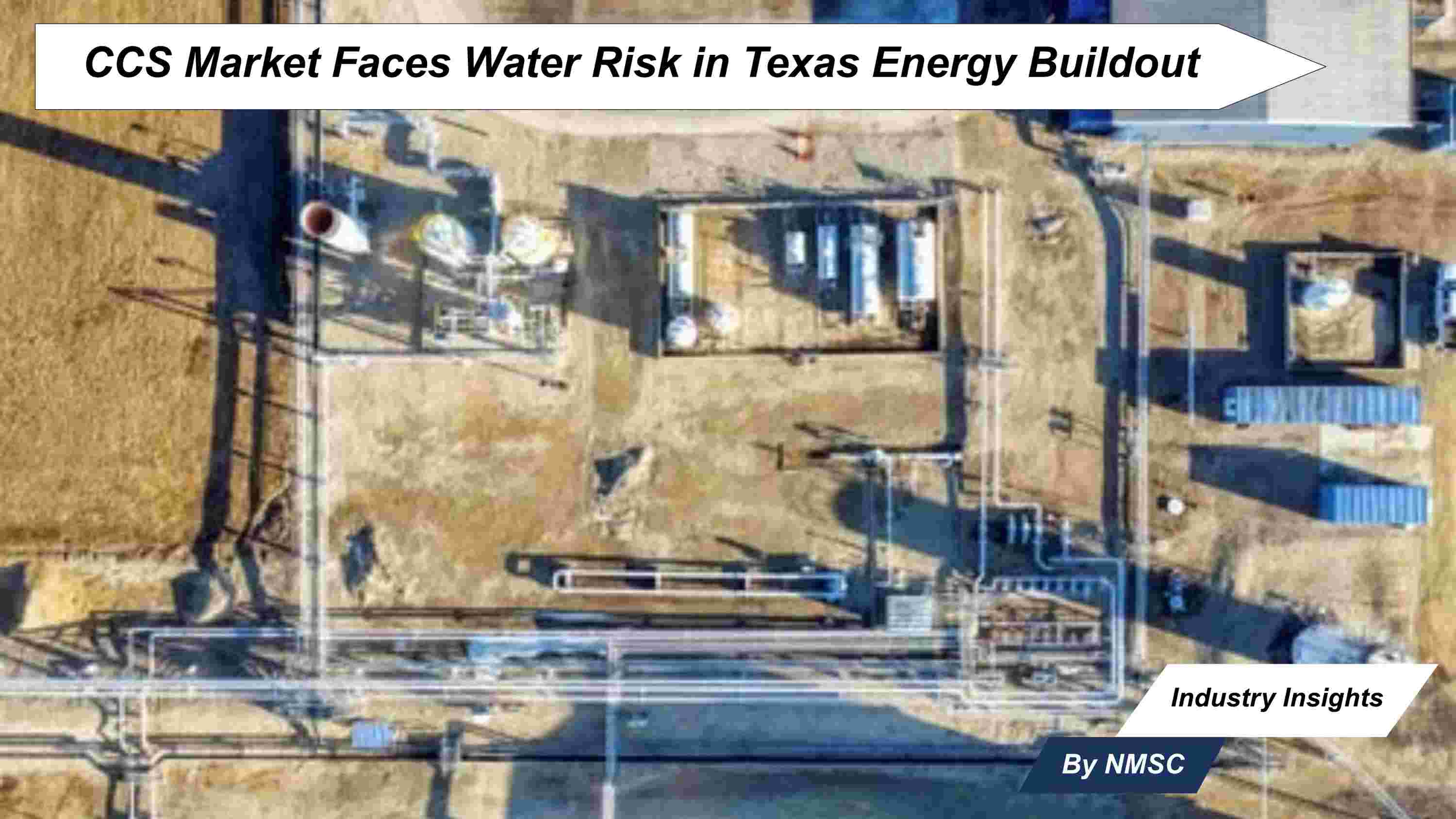
IEEFA Warns Water Scarcity Could Undermine Texas CCS and Hydrogen Expansion Plans
AUSTIN, Texas October 06, 2026 A new report from the Institute for Energy Economics and Financial Analysis (IEEFA) has identified water availability as a critical and largely overlooked risk factor threatening the expansion of hydrogen production and carbon capture and storage (CCS) projects in Texas, raising significant implications for the broader Carbon Storage and Capture Market as it scales toward commercial deployment across North America.
The IEEFA analysis, authored by energy data analyst Anika Juhn, warns that Texas a state already confronting acute water stress has failed to account for the substantial water demands of its rapidly growing hydrogen and CCS industrial base in its official long-term planning framework.
According to the report, the 2027 Texas State Water Plan projects that statewide water demand will outpace supply by 16% by 2030, even if all recommended water development projects are completed on schedule. The plan estimates Texas will require $174 billion in expenditure by 2080 to meet the future needs of its expanding population and economy yet the water consumption requirements of hydrogen production, CCS systems integration, and direct air capture (DAC) facilities are entirely absent from those projections.
The IEEFA report further notes that federal tax incentives specifically the 45V and 45Q credits for clean hydrogen production and carbon capture have attracted significant industrial interest in positioning Texas as a hub for low-carbon energy exports. However, the absence of firm offtake contracts, uncertain demand-side incentives, and shifting federal subsidy policy compound the financial risks already posed by water scarcity. Cooling systems account for the majority of water withdrawal in CCS operations, and Texas's elevated ambient temperatures increase those requirements beyond standard modeling baselines.
Key Highlights:
-
The 2027 Texas State Water Plan projects a 16% supply-demand gap by 2030, with no provision for water consumption by hydrogen, CCS, or direct air capture industries.
-
Texas faces an estimated $174 billion in water infrastructure expenditure by 2080 to meet projected demand from population growth and economic expansion alone.
-
Federal 45V and 45Q tax credits are driving CCS and hydrogen project development in Texas, but water constraints represent an unquantified systemic risk to project viability.
-
Community concerns over air quality, CO₂ pipeline routing, and hazardous substance storage add regulatory and social license risks to the CCS buildout in water-stressed counties.
Analyst Insight:
According to analysts at Next Move Strategy Consulting, the IEEFA findings underscore a structural vulnerability in the CCS deployment pipeline that market participants and policymakers have yet to fully price in. The Carbon Storage and Capture Market, valued at USD 4.03 billion in 2023 and projected to reach USD 13.76 billion by 2030 at a CAGR of 22.1%, is increasingly dependent on large-scale industrial deployments in regions such as Texas making resource constraints a material factor in long-term growth trajectories.
NMSC analysts note that as CCS projects transition from pilot and demonstration phases to full commercial scale, the intersection of water availability, regulatory frameworks, and community acceptance will become decisive variables in determining which projects advance to final investment decision. Developers and investors operating in water-stressed geographies will need to integrate hydrological risk assessments into project feasibility models as a standard practice.
Industry Outlook:
The IEEFA report arrives at a pivotal moment for the CCS sector, as the United States continues to position carbon capture as a cornerstone of its industrial decarbonization strategy. Texas, with its extensive natural gas infrastructure, favorable geology for CO₂ sequestration, and access to federal incentives, has attracted a substantial share of planned CCS capacity. However, the state's water planning gap signals that infrastructure readiness extends well beyond geological suitability and financial incentives.
Going forward, the CCS industry's ability to scale in water-constrained regions will depend on the development of low-water or water-recycling capture technologies, proactive engagement with state water authorities, and transparent community consultation processes. Regulatory bodies and project developers that fail to integrate water risk into CCS planning may face project delays, cost overruns, or community opposition that could materially affect deployment timelines across the sector.
Source: IEEFA — Institute for Energy Economics and Financial Analysis
For More Information – Download FREE Sample on Carbon Storage and Capture Market Report
Prepared By: Sanyukta Deb
About the Author
 Sanyukta Deb
— Sanyukta Deb is Digital Marketing Team Lead at Next Move Strategy Consulting, where she has led content strategy and technical SEO for the firm's B2B market research publications for over 2 years. Her editorial process translates NextMSC's primary and secondary research — spanning technology, industrial, and consumer sectors — into commercial narratives, backed by search-intent, keyword, and competitive analysis. She brings 5 years of overall experience in digital marketing and content strategy.
Sanyukta Deb
— Sanyukta Deb is Digital Marketing Team Lead at Next Move Strategy Consulting, where she has led content strategy and technical SEO for the firm's B2B market research publications for over 2 years. Her editorial process translates NextMSC's primary and secondary research — spanning technology, industrial, and consumer sectors — into commercial narratives, backed by search-intent, keyword, and competitive analysis. She brings 5 years of overall experience in digital marketing and content strategy.
About the Reviewer
 Debashree Dey
— Debashree Dey is Assistant Manager at Next Move Strategy Consulting, where she supports cross-vertical market content and communications across diverse industries for 6 years. Her professional background includes senior content writing, communications, and published manuscript authorship, with experience developing audience-focused business narratives and maintaining clear, consistent messaging. Her role supports research-led content development and editorial quality across NextMSC publications.
Debashree Dey
— Debashree Dey is Assistant Manager at Next Move Strategy Consulting, where she supports cross-vertical market content and communications across diverse industries for 6 years. Her professional background includes senior content writing, communications, and published manuscript authorship, with experience developing audience-focused business narratives and maintaining clear, consistent messaging. Her role supports research-led content development and editorial quality across NextMSC publications.
















Add Comment