China, Ghana Boost Global Cold Storage Expansion
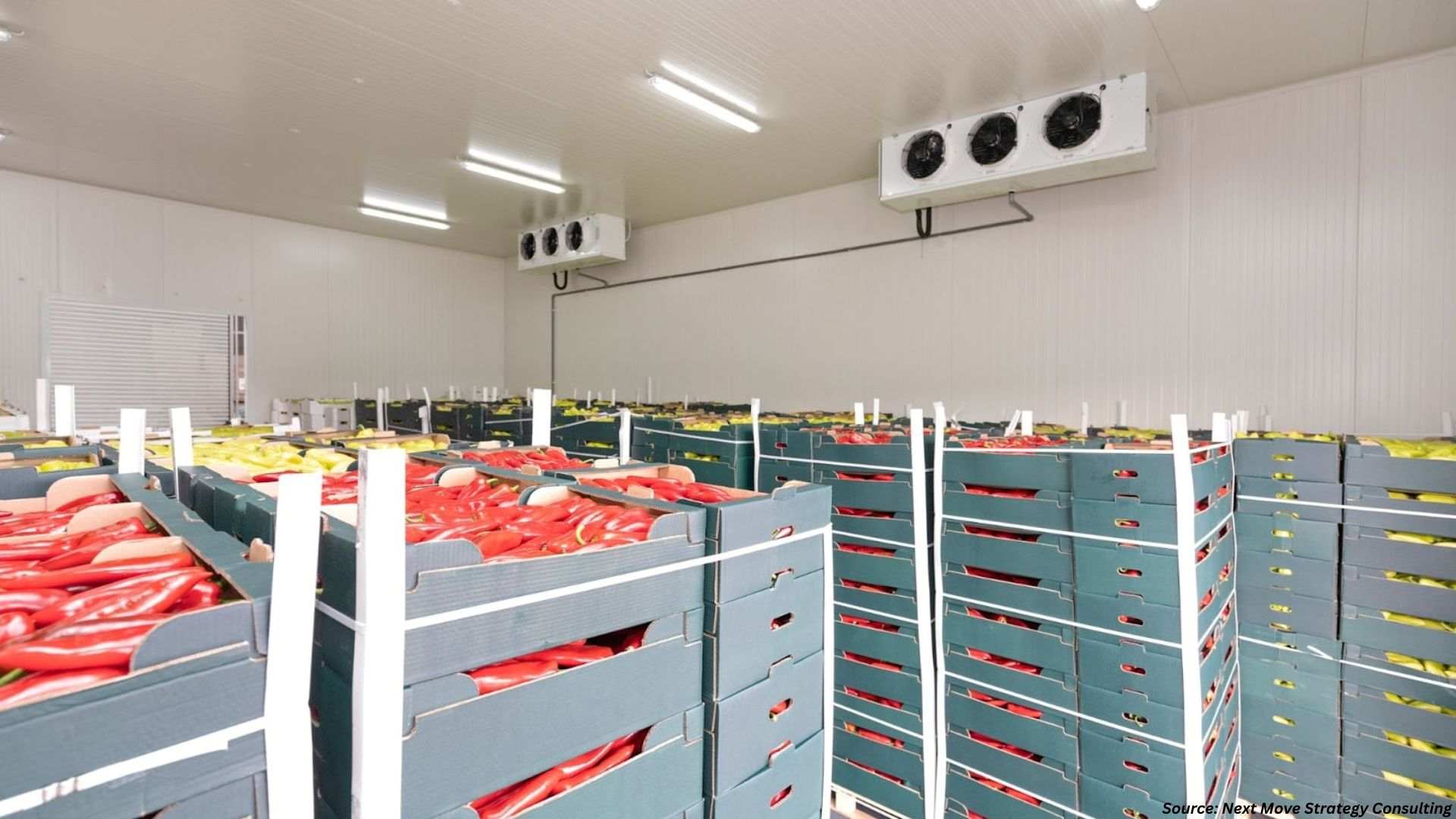
MEDLOG’s major cold warehouse rollout in China and AkoFresh’s mobile cooling deployment in Ghana are accelerating global cold-chain infrastructure demand, supporting long-term cold storage market growth.
A sharp rise in global cold-chain infrastructure spending is reshaping the refrigerated logistics industry after MEDLOG and China Master Logistics Co Ltd. (CMLOG) launched a five-facility temperature-controlled storage network across China in March, while AkoFresh this week deployed a mobile off-grid cold storage trailer to underserved agricultural regions in Ghana. Together, the two developments signal a widening global shift: cold storage is no longer confined to centralized warehouses but is expanding simultaneously across high-volume import hubs and last-mile farmgate logistics.
Latest NMSC proprietary estimates show the global Cold Storage Market is projected to more than double to USD 346.07 billion by 2030, registering a CAGR of 13.8% from 2025 to 2030 as operators race to reduce spoilage, stabilize food imports, and modernize pharmaceutical and perishables transportation worldwide.
China’s Port-Centric Cold Chain Buildout Signals Institutional Capital Shift
The strongest recent signal emerged on March 11 when MEDLOG and CMLOG formally launched a joint venture cold-chain network spanning Shanghai, Tianjin, and Ningbo, anchored by an 80,000-tonne flagship cold warehouse inside Shanghai’s Lingang Special Comprehensive Free Trade Zone. The installation, now the partners’ third and largest in China, was purpose-built to handle frozen meat, seafood, dairy, fruit, and other cross-border temperature-sensitive imports entering East Asia’s busiest maritime corridors.
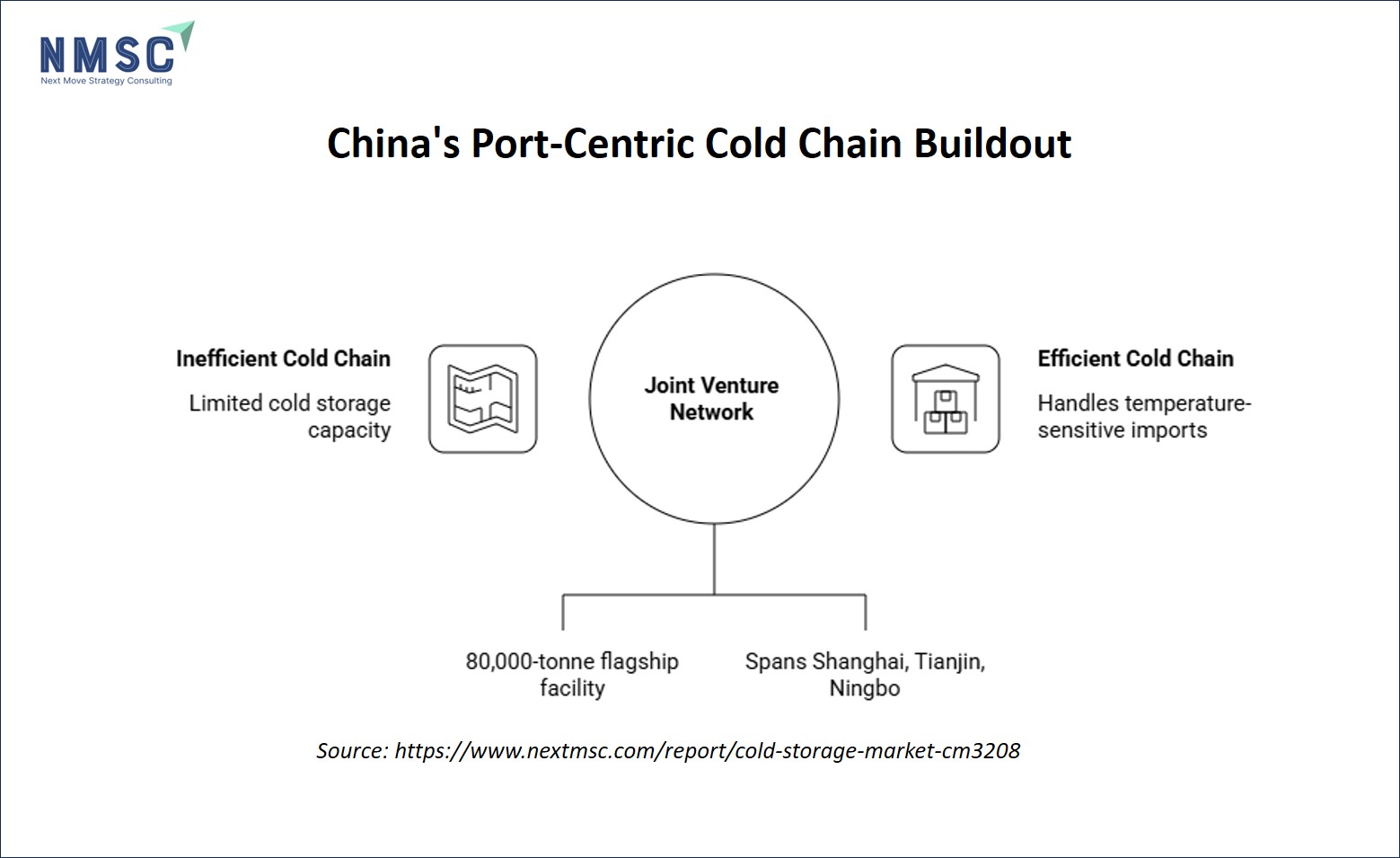
The strategic importance extends beyond storage square footage. The Shanghai site integrates bonded and non-bonded zones, automated warehouse management systems, intelligent refrigeration controls, customs support, and inland distribution interfaces — effectively creating an end-to-end refrigerated import gateway tied directly to MSC’s global ocean freight ecosystem.
Jayanta Das, Lead Analyst at Next Move Strategy Consulting, notes that this marks a broader transition in cold storage economics from passive warehousing toward “trade-linked intelligent cold logistics nodes,” where refrigerated assets are increasingly being financed as strategic trade infrastructure rather than as standalone real estate.
According to the latest NMSC proprietary dataset, institutional investors and logistics majors have accelerated capital deployment into port-adjacent reefer warehousing during the last two quarters as cross-border imports of protein, dairy, biologics, and premium perishables continue to rise.
Africa’s Mobile Cooling Model Expands the Cold Chain to Farm Level
While China’s expansion reflects import-side industrial demand, the second major trigger came on May 3 from Ghana, where AkoFresh launched a mobile cold storage trailer aimed at remote agricultural communities lacking fixed warehousing.
Unlike conventional refrigerated warehouses, the solar-powered mobile trailer is designed to travel directly to farms and local produce aggregation points, preserving tomatoes, peppers, leafy vegetables, and other highly perishable crops before they begin deteriorating in transit. Company figures indicate that the technology extends produce shelf life from just 3–5 days to as much as 21 days, while participating farmers have reported income gains of up to 40%. More than 10,000 people have already benefited through AkoFresh’s wider cold-chain interventions.
This deployment addresses one of sub-Saharan Africa’s most persistent logistics failures: post-harvest spoilage rates of 40% to 60% due to inadequate storage and weak transport connectivity.
NMSC researchers identified a measurable rise in venture and development financing for decentralized cold-chain models over the past six months, particularly mobile, solar-powered, and off-grid cooling units aimed at reducing food inflation and agricultural waste in emerging economies.
Why These Two Announcements Matter More Than Isolated Projects
Taken separately, the China and Ghana projects appear geographically unrelated. In market terms, however, they reveal the same structural truth:
Cold storage is becoming a mandatory infrastructure layer across every point of the global perishables value chain — from international seaports to rural farm exits.
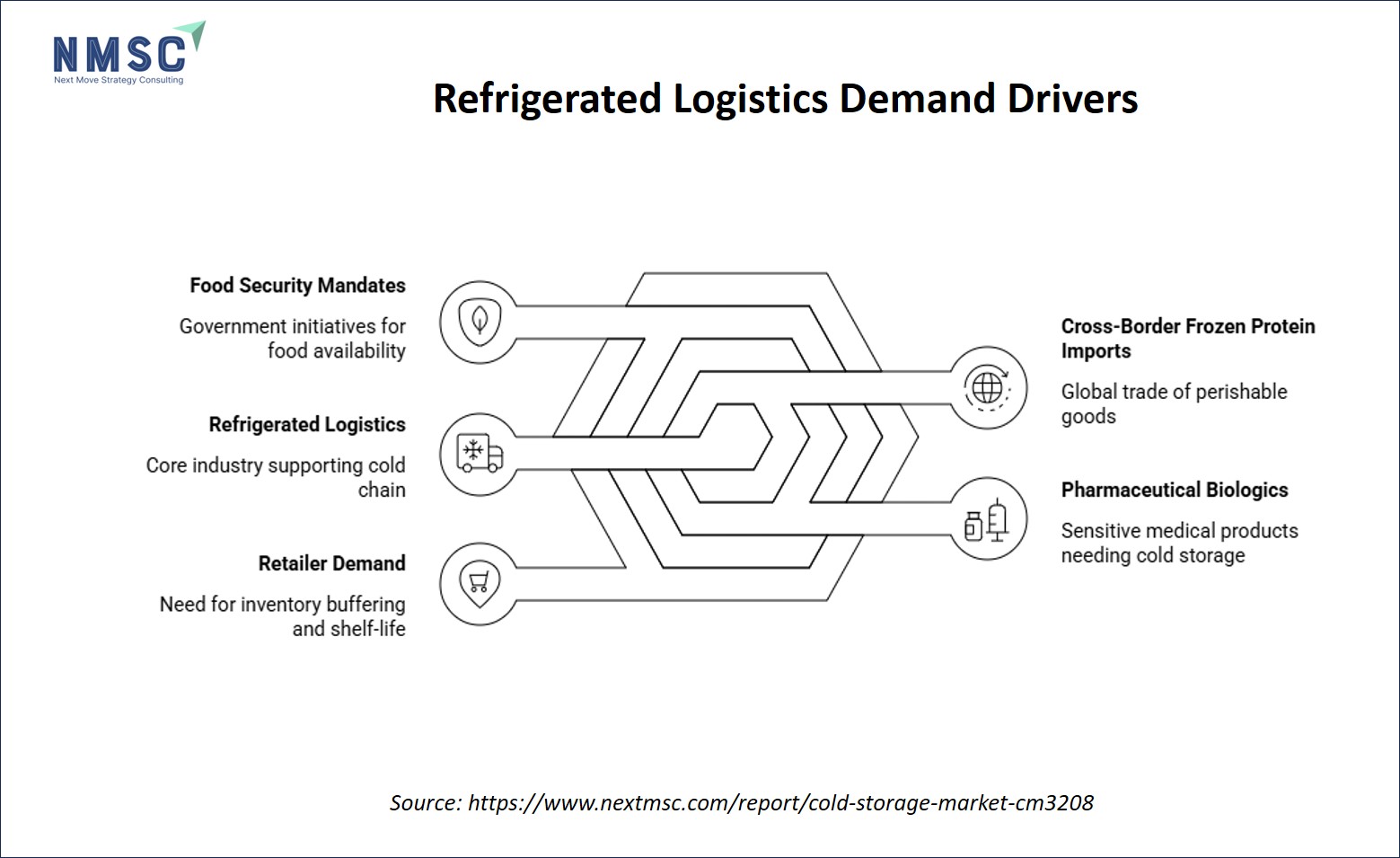
The refrigerated logistics industry is now being driven by four synchronized demand pressures:
-
growth in cross-border frozen protein imports,
-
pharmaceutical biologics requiring controlled storage,
-
food security mandates in emerging economies,
-
and retailer demand for longer shelf-life inventory buffering.
That means cold storage spending is no longer dependent on urban warehouse construction alone. Capital is moving into:
-
bonded import cold hubs,
-
smart reefer terminals,
-
mobile agricultural cooling,
-
and AI-enabled temperature monitoring systems.
Table 1: Global Cold Storage Market Outlook (NMSC Proprietary Dataset)
|
Metric |
Value |
|
Market Size 2024 |
USD 159.92 Billion |
|
Forecast 2030 |
USD 346.07 Billion |
|
CAGR (2025–2030) |
13.8% |
|
Fastest Growing Segment |
Intelligent Automated Cold Warehousing |
|
Emerging Opportunity |
Mobile/Decentralized Rural Cold Storage |
|
Key Demand Industries |
Food Imports, Pharma, Agriculture, Retail |
Table 2: Latest 2026 Infrastructure News Reshaping the Cold Storage Industry
|
Date |
Company/Event |
Region |
Strategic Industry Impact |
|
Mar 11, 2026 |
MEDLOG–CMLOG 5-site cold chain JV |
China |
Port-linked reefer import warehousing expansion |
|
May 3, 2026 |
AkoFresh mobile cold storage trailer |
Ghana |
Farmgate spoilage reduction and rural cold access |
|
Q1 2026 Trend |
Increased smart warehouse automation adoption |
Global |
Labor reduction + temperature precision gains |
|
Q1–Q2 2026 Trend |
Rise in decentralized off-grid cooling projects |
Emerging Markets |
Food security and farmer income protection |
Analyst View: What Changed in the Last 6 Months
The last six months have produced a notable change in buyer behavior:
-
Shipping conglomerates are entering refrigerated warehousing directly.
-
Agritech startups are monetizing cooling-as-a-service.
-
Governments are linking cold storage to food inflation management.
-
Investors are treating temperature-controlled logistics as resilient infrastructure.
Jayanta Das, Lead Analyst at Next Move Strategy Consulting, adds that cold storage has shifted from a “support service” to a “critical economic continuity asset,” particularly after repeated food supply disruptions and biologics distribution bottlenecks observed across 2025–2026.
What CEOs and Investors Should Do Next
-
Prioritize port-adjacent refrigerated warehousing acquisitions in high-import corridors.
-
Invest in decentralized mobile cold units for emerging agricultural economies.
-
Deploy AI/IoT refrigeration monitoring to reduce spoilage compliance losses.
-
Build integrated customs + inland transport + storage models rather than standalone warehouses.
-
Track government food security grants and agri-logistics subsidies that are accelerating public-private cold chain deployment.
About Next Move Strategy Consulting:
Next Move Strategy Consulting is a premier market research and management consulting firm that has been committed to provide strategically analysed well documented latest research reports to its clients. The research industry is flooded with many firms to choose from, what makes NMSC different from the rest is its top-quality research and the obsession of turning data into knowledge by dissecting every bit of it and providing fact-based research recommendation that is supported by information collected from over 500 million websites, paid databases, industry journals and one on one consultations with industry experts across a diverse range of industry sectors. The high-quality customized research reports with actionable insights and excellent end-to-end customer service help our clients to take critical business decisions that enables them to move beyond time and have competitive edge in the industry.
We have been servicing over 1000 customers globally that includes 90% of the Fortune 500 companies over a decade. Our analysts are constantly tracking various high growth markets and identifying hidden opportunities in each sector or the industry. We provide one of the industry’s best quality syndicate as well as custom research reports across 10 different industry verticals. We are committed to deliver high quality research solutions in accordance to your business needs. Our industry standard delivery solutions that ranges from the pre consultation to after-sales services, provide an excellent client experience and ensure right strategic decision making for businesses.
For more information, please contact:
Next Move Strategy Consulting
5th Floor 867
Boylston St, STE 500,
Boston, MA 02116, U.S.
E-Mail: [email protected]
Direct: +1-217-650-7991
Website: www.nextmsc.com
About the Author
 Sanyukta Deb
— Sanyukta Deb is Digital Marketing Team Lead at Next Move Strategy Consulting, where she has led content strategy and technical SEO for the firm's B2B market research publications for over 2 years. Her editorial process translates NextMSC's primary and secondary research — spanning technology, industrial, and consumer sectors — into commercial narratives, backed by search-intent, keyword, and competitive analysis. She brings 5 years of overall experience in digital marketing and content strategy.
Sanyukta Deb
— Sanyukta Deb is Digital Marketing Team Lead at Next Move Strategy Consulting, where she has led content strategy and technical SEO for the firm's B2B market research publications for over 2 years. Her editorial process translates NextMSC's primary and secondary research — spanning technology, industrial, and consumer sectors — into commercial narratives, backed by search-intent, keyword, and competitive analysis. She brings 5 years of overall experience in digital marketing and content strategy.
About the Reviewer
 Supradip Baul
— Supradip Baul is an accomplished business consultant and strategist with over a decade of rich experience in market intelligence, strategy, technology, and business transformation. His work has included rigorous qualitative and quantitative analysis across multiple industries, helping clients shape investment decisions and long-term roadmaps. Earlier in his career, he was associated with Gartner, where he contributed to industry-leading reports and market share analyses. He has worked with leading global companies and holds an MBA with a dual specialization in Marketing and Finance.
Supradip Baul
— Supradip Baul is an accomplished business consultant and strategist with over a decade of rich experience in market intelligence, strategy, technology, and business transformation. His work has included rigorous qualitative and quantitative analysis across multiple industries, helping clients shape investment decisions and long-term roadmaps. Earlier in his career, he was associated with Gartner, where he contributed to industry-leading reports and market share analyses. He has worked with leading global companies and holds an MBA with a dual specialization in Marketing and Finance.
















Add Comment