Extrusion Machinery Market: A New Era Begins

EU Plastic Waste Export Ban and AI-Driven Technology Wave Accelerate Structural Transformation of the Global Extrusion Machinery Sector
With the European Union's landmark ban on plastic waste exports to non-OECD countries set to take effect on November 21, 2026, the global plastics processing industry is confronting one of its most consequential regulatory inflection points in decades. The measure, confirmed by the European Commission and documented in the OECD's transboundary waste controls framework, will prohibit EU member states from shipping plastic waste to developing economies for an initial period of 30 months — a policy shift that is already reshaping investment priorities across the entire plastics value chain, from resin producers to equipment manufacturers.
For machinery builders, the regulatory signal is unambiguous: demand for advanced extrusion systems capable of processing recycled and post-consumer feedstocks is accelerating. The timing coincides with a wave of technology launches that industry analysts describe as the most significant in a generation, with equipment makers deploying AI-assisted controls, high-throughput recycling extruders, and predictive maintenance platforms across global production floors.
Against this backdrop, the global Extrusion Machinery Market — valued at USD 7.96 billion in 2024 — is projected to reach USD 10.37 billion by 2030, expanding at a compound annual growth rate of 4.5% over the forecast period, according to analysis published by Next Move Strategy Consulting.
For More Information: Download FREE Sample on Extrusion Machinery Market Report
A Technology Wave Redefines the Competitive Landscape
The K 2025 trade fair in Düsseldorf, held in October 2025, served as the industry's most visible showcase of next-generation extrusion capability, and the months since have seen those technologies move from exhibition floors to active production environments. A review published by Plastics Machinery Manufacturing on August 6, 2026 identified ten distinct innovations now entering commercial deployment, with a clear throughline: larger throughput, smarter digital controls, and superior processing of difficult or contaminated feedstocks.
KraussMaffei Extrusion debuted its ZE Petrochemical (ZE-PC) co-rotating twin-screw extruder series at K 2025, targeting large-scale polymer production with screw diameters ranging from 260mm to 400mm and throughputs of 27 to 143 tonnes per hour. A Chinese petrochemical group has already placed orders for three ZE-PC 330 machines, signaling early commercial traction in Asia's dominant manufacturing corridor. The company simultaneously refined its EdelweissTechnology platform for recycled feedstock processing, with the integrated twin-screw setup capable of reducing investment costs by up to 25% compared with conventional configurations.
BB Engineering commissioned its largest-ever single-screw extruder — a pair of 360mm PET machines now operating at a customer site in China, feeding a Brückner flat film line for high-performance optical applications. Each unit tops 45 feet in length, weighs more than 46 tonnes, and is driven by dual 700-kilowatt motors, with maximum throughput exceeding 11,900 pounds per hour.
Erema introduced its Volex water-stripping degassing system — described by the company as the first effective application of this technique on a single-screw extruder — which multiplies exposed melt surface area approximately 1,000-fold and reduces volatile organic compounds in finished recycled pellets by up to 40%. Coperion added predictive-maintenance capabilities through its Lifecycle Manager platform, while Milacron rolled out MosaicX, an upgraded extrusion control system featuring a 21.5-inch HD interface, graphical monitoring across more than 50 parameters, and multi-extruder management capability.
Plastics Demand and End-Use Industry Dynamics
The structural demand underpinning the extrusion machinery market remains robust. According to UNCTAD's Global Trade Update published in August 2025, global plastic production reached 436 million metric tons in 2023, with trade in plastics surpassing USD 1.1 trillion — equivalent to approximately 5% of total global goods trade. The OECD's Global Plastics Outlook had previously documented production growth from 234 million tonnes in 2000 to 435 million tonnes in 2020, a near-doubling in two decades that reflects the material's entrenched role across packaging, construction, automotive, and consumer goods sectors.
Global Plastics Production Trend, 2000–2024
|
Year |
Global Production (Million Tonnes) |
Notes |
|
2000 |
234 |
OECD baseline |
|
2020 |
435 |
Pre-pandemic plateau |
|
2023 |
436 |
Preliminary figure |
|
2024 |
~460 |
Industry estimate |
Units: Million Metric Tonnes
Notes: 2024 figure is an industry estimate and should be interpreted with caution. All other figures are from Tier 1 authoritative sources.
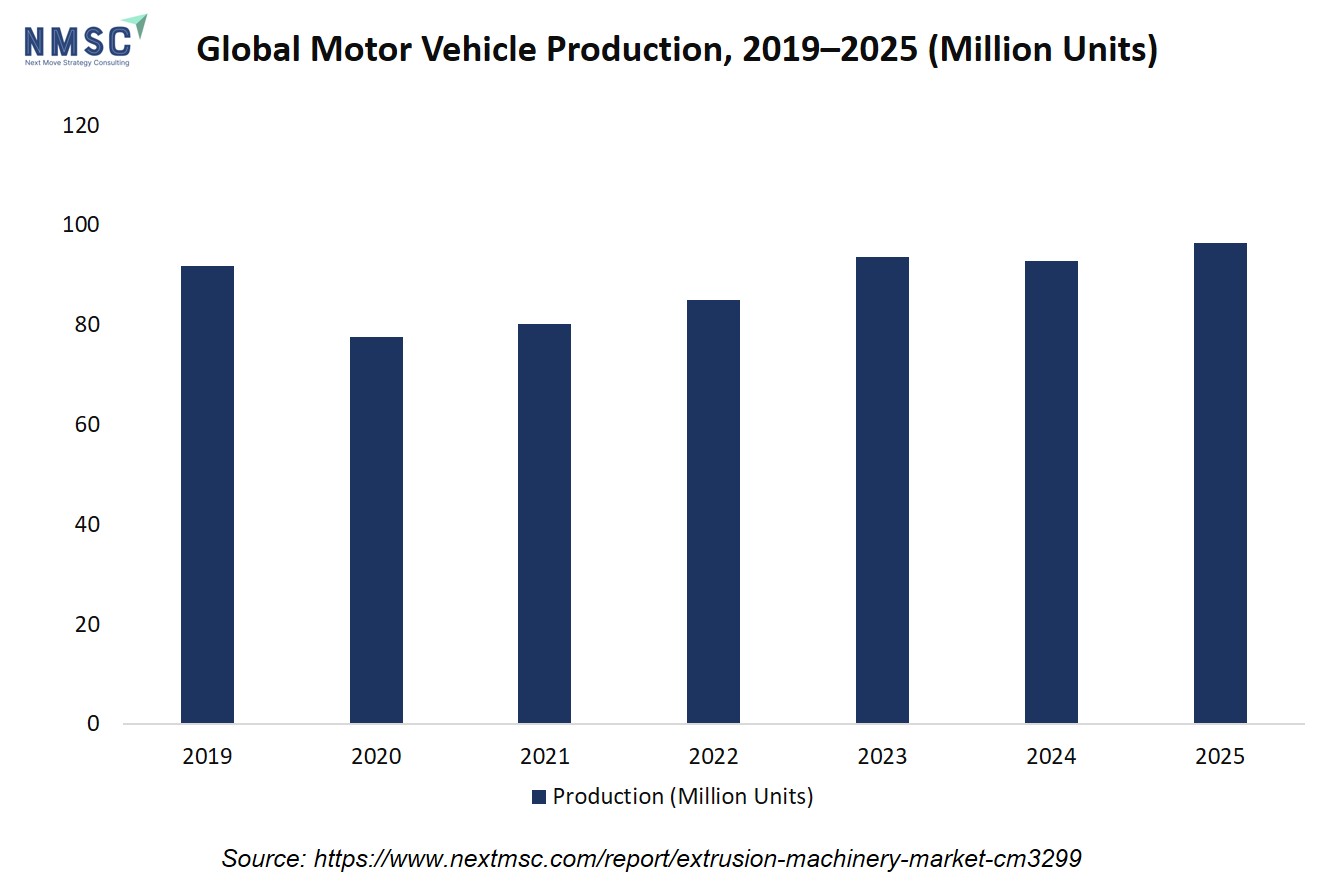
The automotive sector's recovery and expansion are particularly consequential for extrusion machinery demand. Global vehicle production reached 92.7 million units in 2024 and rose to 96.4 million units in 2025, according to OICA data — a 3.9% year-on-year increase that reflects sustained demand for extruded plastic components used in lightweighting, interior trim, and under-hood applications.
The construction sector, which held the largest end-use revenue share of 31.6% in the extrusion machinery market in 2024, continues to generate consistent demand for extruded PVC pipes, window profiles, and insulation materials, particularly across Asia-Pacific and the Middle East, where infrastructure investment programs remain active.
Regional Dynamics: Asia-Pacific Consolidates Dominance
Asia-Pacific accounted for the largest revenue share of 41.5% in the global extrusion machinery market in 2024, driven by China's extensive manufacturing base, India's expanding construction and automotive sectors, and sustained infrastructure investment across Southeast Asia. China led the regional market, supported by government initiatives promoting advanced manufacturing and rapid urbanization that continues to generate demand for extruded construction materials.
India's strategic importance to the sector was underscored on July 24, 2026, when Milacron inaugurated its first Global Capability Center in Coimbatore — a facility designed to support engineering, digital services, and customer operations across the company's international footprint. The move reflects a broader industry trend of establishing regional manufacturing and service hubs to reduce supply chain exposure and serve fast-growing emerging markets more effectively.
Europe, while growing at a more measured CAGR of 4.3%, is being reshaped by regulatory pressure. The EU's November 2026 plastic waste export ban is expected to accelerate domestic investment in mechanical and chemical recycling infrastructure, directly increasing demand for extrusion systems capable of processing post-consumer recyclate. PlasticsEurope's Circular Economy Report 2026 noted that the ban should increase the availability of plastic waste for domestic processing — a structural tailwind for equipment manufacturers with recycling-capable product lines.
North America presents a more complex picture. Extruder sales were sluggish through 2025, with machine builders citing U.S. tariff policy as a primary reason for stalled factory investment decisions. Reuters reported in December 2025 that the U.S. manufacturing sector remained under sustained pressure, with the ISM new orders sub-index declining to 47.4 — a contractionary reading that reflected persistent uncertainty over trade policy and input costs.
Global Motor Vehicle Production by Region (2023)
|
Region |
Production (Million Units) |
Share of Global Total (%) |
|
Asia |
55.1 |
~59.0% |
|
Europe |
~16.0 |
~17.2% |
|
North America |
~16.0 |
~17.2% |
|
Rest of World |
~6.4 |
~6.9% |
|
Global Total |
~93.5 |
100% |
Corporate Strategy: M&A Activity and Capital Deployment
The extrusion machinery sector has seen notable capital market activity in the past 18 months. In February 2025, Bain Capital Special Situations completed a majority investment in Milacron's injection molding and extrusion business, acquiring approximately 51% of the company for USD 287 million. Hillenbrand Inc. retained a 49% stake. Bain Capital cited the U.S. manufacturing renaissance narrative and Milacron's global engineering capabilities as the strategic rationale for the investment.
In the sheet extrusion segment, Maag announced its acquisition of Cloeren on July 28, 2026, a transaction that consolidates two established names in flat die and extrusion tooling technology and signals continued consolidation among mid-tier equipment suppliers.
Davis-Standard's January 2024 acquisition of Extrusion Technology Group (ETG), which included battenfeld-cincinnati, exelliq, and Simplas, had already expanded the competitive landscape for multi-technology extrusion platforms. These transactions collectively reflect a sector in which scale, digital capability, and geographic reach are becoming decisive competitive differentiators.
According to the NMSC report, key players including Milacron LLC, Japan Steel Works Ltd., BC Extrusion Holding GmbH, Graham Engineering, Leistritz Extrusionstechnik GmbH, Kabra ExtrusionTechnik Ltd., and Bausano & Figli S.p.A. are pursuing strategies centered on digitalization, sustainable material processing, and aftermarket service expansion to defend and grow market share.
Sustainability as a Structural Market Driver
The circular economy imperative is no longer a peripheral consideration for extrusion machinery manufacturers — it is a primary product development axis. The NMSC report identifies rising sustainability demands and the push for circular economy practices as a strong opportunity for manufacturers to innovate with eco-friendly and recycled material processing solutions.
KraussMaffei's EdelweissTechnology, capable of processing recyclates with fluctuating material properties through an integrated degassing, filtering, and compounding setup, exemplifies the direction of product development. The company's PVC multilayer pipe head, also unveiled at K 2025, processes up to 100% recycled PVC while maintaining consistent product quality through a newly designed flow system that prevents spiderlines.
Battenfeld-Cincinnati's Dual Vent Technology, which uses two independent degassing zones to remove moisture and volatiles from the melt, enables processors to run untreated regrind without pre-drying — a capability that directly reduces energy consumption and operational cost in recycling applications. The company reports approximately 25% higher output on HDPE and up to 40% higher output on PP compared with earlier designs.
The NMSC report further notes that KraussMaffei launched the Edelweiss Recycling line in March 2025, an advanced twin-screw extrusion system designed to process up to 100% recycled plastics, including PET and PP, with enhanced energy efficiency and high-quality output for circular economy applications — a development that underscores the accelerating pace of product innovation in this segment.
Market Segmentation and Technology Outlook
By machinery type, single-screw extruders led the market with a 62.7% revenue share in 2024, valued for their simplicity, cost-effectiveness, and continuous output across film, pipe, and automotive component production. Twin-screw extruders, however, are growing at a faster CAGR of 5.3%, driven by their superior process flexibility, energy efficiency, and compounding capabilities — attributes that align directly with the industry's recycling and advanced materials processing requirements.
The packaging segment is expected to grow at a CAGR of 5.3% over the forecast period, supported by e-commerce expansion and demand for flexible and rigid plastic packaging solutions. The NMSC report identifies the aftermarket segment — encompassing spare parts, remote support, training, and digital condition monitoring — as an increasingly important revenue stream for equipment manufacturers seeking to deepen customer relationships and generate recurring income.
High installation and capital costs remain a significant restraint, particularly for small and medium-sized enterprises in emerging markets. The NMSC report notes that the high upfront cost of modern, high-performance extrusion lines incorporating advanced automation and control systems represents a meaningful barrier to technology adoption, slowing the diffusion of next-generation equipment in capital-constrained regions.
Bottom Line
The global extrusion machinery market is entering a period of accelerated structural change, driven by the convergence of regulatory pressure, technological innovation, and shifting end-use demand. The EU's November 2026 plastic waste export ban represents a decisive policy catalyst that will redirect investment toward domestic recycling infrastructure across Europe, generating sustained demand for advanced extrusion systems capable of processing post-consumer and post-industrial feedstocks. Simultaneously, the technology wave emerging from K 2025 — spanning AI-assisted controls, high-throughput recycling extruders, and predictive maintenance platforms — is raising the performance ceiling for the entire equipment category.
For investors and strategic buyers, the market's 4.5% CAGR trajectory to 2030 reflects a sector with durable demand fundamentals, anchored by construction, automotive, and packaging end-use industries that collectively account for the majority of global extruded product consumption. Asia-Pacific's structural dominance, combined with India's accelerating industrialization and China's continued manufacturing investment, positions the region as the primary growth engine through the forecast period.
Key risks include tariff-driven investment hesitancy in North America, raw material price volatility, and the capital intensity of technology upgrades for smaller processors. Companies that successfully integrate recycling capability, digital monitoring, and aftermarket service into their product offerings are best positioned to capture disproportionate share in an increasingly sustainability-driven procurement environment.
About Next Move Strategy Consulting
Next Move Strategy Consulting is a premier market research and management consulting firm that has been committed to provide strategically analysed well documented latest research reports to its clients. The research industry is flooded with many firms to choose from, what makes NMSC different from the rest is its top-quality research and the obsession of turning data into knowledge by dissecting every bit of it and providing fact-based research recommendation that is supported by information collected from over 500 million websites, paid databases, industry journals and one on one consultations with industry experts across a diverse range of industry sectors. The high-quality customized research reports with actionable insights and excellent end-to-end customer service help our clients to take critical business decisions that enables them to move beyond time and have competitive edge in the industry.
We have been servicing over 1000 customers globally that includes 90% of the Fortune 500 companies over a decade. Our analysts are constantly tracking various high growth markets and identifying hidden opportunities in each sector or the industry. We provide one of the industry's best quality syndicate as well as custom research reports across 10 different industry verticals. We are committed to deliver high quality research solutions in accordance to your business needs. Our industry standard delivery solutions that ranges from the pre consultation to after-sales services, provide an excellent client experience and ensure right strategic decision making for businesses.
For more information, please contact:
Next Move Strategy Consulting
5th Floor 867
Boylston St, STE 500,
Boston, MA 02116, U.S.
E-Mail: [email protected]
Direct: +1-217-650-7991
Website: www.nextmsc.com
About the Author
 Sanyukta Deb
— Sanyukta Deb is Digital Marketing Team Lead at Next Move Strategy Consulting, where she has led content strategy and technical SEO for the firm's B2B market research publications for over 2 years. Her editorial process translates NextMSC's primary and secondary research — spanning technology, industrial, and consumer sectors — into commercial narratives, backed by search-intent, keyword, and competitive analysis. She brings 5 years of overall experience in digital marketing and content strategy.
Sanyukta Deb
— Sanyukta Deb is Digital Marketing Team Lead at Next Move Strategy Consulting, where she has led content strategy and technical SEO for the firm's B2B market research publications for over 2 years. Her editorial process translates NextMSC's primary and secondary research — spanning technology, industrial, and consumer sectors — into commercial narratives, backed by search-intent, keyword, and competitive analysis. She brings 5 years of overall experience in digital marketing and content strategy.
About the Reviewer
 Debashree Dey
— Debashree Dey is Assistant Manager at Next Move Strategy Consulting, where she supports cross-vertical market content and communications across diverse industries for 6 years. Her professional background includes senior content writing, communications, and published manuscript authorship, with experience developing audience-focused business narratives and maintaining clear, consistent messaging. Her role supports research-led content development and editorial quality across NextMSC publications.
Debashree Dey
— Debashree Dey is Assistant Manager at Next Move Strategy Consulting, where she supports cross-vertical market content and communications across diverse industries for 6 years. Her professional background includes senior content writing, communications, and published manuscript authorship, with experience developing audience-focused business narratives and maintaining clear, consistent messaging. Her role supports research-led content development and editorial quality across NextMSC publications.
















Add Comment