CRO Services Market Surges on Record M&A Activity

Thermo Fisher's $8.875 Billion Clario Acquisition Anchors a Wave of Strategic Consolidation Reshaping the Global Contract Research Organization Services Market
On 24 March 2026, Thermo Fisher Scientific completed the acquisition of Clario Holdings, Inc. for USD 8.875 billion in cash, with additional earnout and deferred payments linked to future business performance — one of the most consequential transactions in the history of the global clinical research outsourcing industry. The deal integrates Clario's endpoint data solutions — encompassing cardiac safety, respiratory, imaging, and eClinical technologies — into Thermo Fisher's Laboratory Products and Biopharma Services segment, materially expanding the company's clinical trial execution capabilities. By combining Clario's patient data analytics infrastructure with its existing clinical research portfolio, Thermo Fisher aims to accelerate drug development timelines, strengthen clinical trial decision-making, and deliver measurably greater value to pharmaceutical and biotechnology clients worldwide.
The transaction is the second-largest healthcare deal completed in the first half of 2026, trailing only Danaher Corporation's USD 9.9 billion acquisition of Masimo Corporation, and it signals a structural shift in how the world's largest life sciences companies are positioning themselves within the drug development value chain. For the global Contract Research Organization (CRO) Services Market, which is projected to reach USD 131.17 billion by 2030 at a CAGR of 9.1%, according to Next Move Strategy Consulting, the Clario acquisition represents a defining inflection point — one that accelerates consolidation, raises the competitive bar for mid-tier CROs, and intensifies the integration of technology-driven services into clinical research operations.
For More Information: Download FREE Sample on Contract Research Organization (CRO) Services Market Report
Biopharma M&A Surge Provides Structural Tailwind for CRO Demand
The Thermo Fisher-Clario transaction does not stand in isolation. According to IQVIA's mid-year 2026 biopharma M&A analysis, deal value in the sector jumped 133% compared to the same period in 2024, reaching USD 133 billion in H1 2026, with an average deal size of USD 3.1 billion. This surge in pharmaceutical M&A activity carries direct implications for CRO demand: as acquiring companies integrate new therapeutic assets and pipeline candidates, they typically accelerate clinical development programmes, generating incremental outsourcing requirements across Phase I through Phase IV trial management, regulatory consulting, bioanalytical testing, and data management services.
IQVIA had projected at the start of 2026 that biopharma M&A deal value would reach USD 140–160 billion for the full year, with a potential incremental upside of USD 20–30 billion in a best-case scenario. If this trajectory is sustained through the second half of 2026, the resulting pipeline expansion across the pharmaceutical and biotechnology sector will translate into sustained demand for outsourced clinical research services — a dynamic that directly underpins the CRO market's projected growth trajectory.
FDA Drug Approval Pipeline Sustains CRO Workload
The volume of novel drug approvals by the U.S. Food and Drug Administration provides a direct indicator of the clinical research workload that CROs are required to support. In 2025, the FDA's Center for Drug Evaluation and Research (CDER) approved 46 novel drugs — defined as new drugs never before approved or marketed in the United States — spanning therapeutic areas including oncology, cardiovascular disease, rare genetic disorders, immunology, and respiratory conditions. This compares to 50 novel approvals in 2024 and 55 in 2023, reflecting a normalisation from the elevated approval volumes of the post-pandemic period while remaining well above the historical average of approximately 38 approvals per year recorded over the preceding decade.
Each novel drug approval represents the culmination of a multi-year clinical development programme — typically spanning Phase I through Phase III trials — the majority of which are managed, in whole or in part, by CROs. The FDA's 2025 Drug Trials Snapshots Summary Report further confirms that oncology accounted for the largest single therapeutic category among 2025 approvals, consistent with the OECD's finding that cancer has represented the largest share of product indications in active development globally in every year since 2013, reaching 43% of all product-indication pairs in 2023.
Pharmaceutical R&D Investment: The Structural Engine of CRO Growth
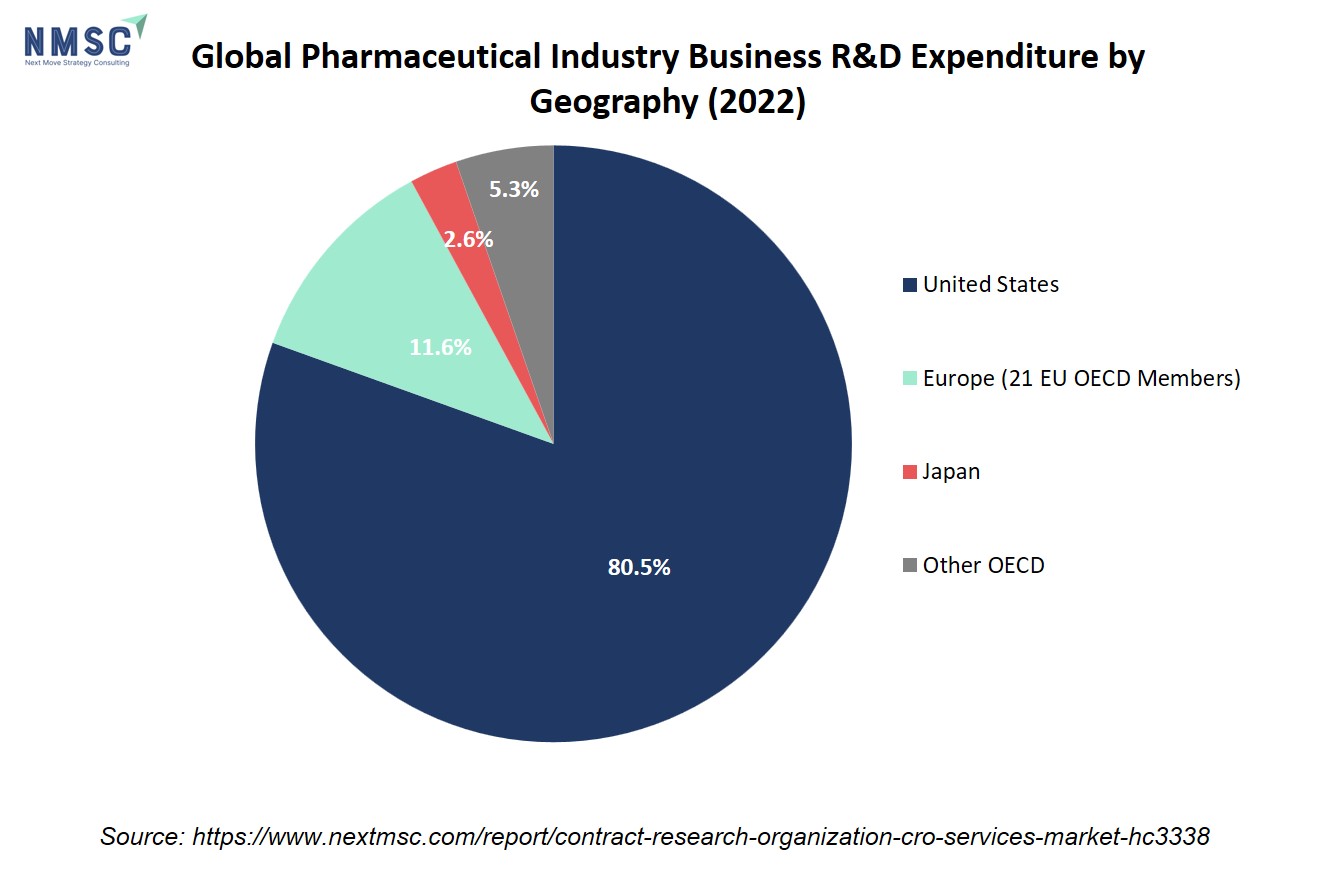
The OECD's Health at a Glance 2025 report provides authoritative context for the macroeconomic forces driving CRO market expansion. The pharmaceutical industry spent USD 129 billion on R&D in 2022, with the United States accounting for USD 103.9 billion — approximately 80.5% of the OECD total. Business enterprise expenditure on R&D (BERD) in the pharmaceutical sector increased by nearly 76% in real terms since 2010, with the United States contributing 69% of OECD growth over that period.
Critically, the non-OECD share of pharmaceutical R&D is increasing. China's pharmaceutical BERD grew from USD 5.0 billion in 2010 to USD 23.4 billion in 2022 — a 365% increase, the highest growth rate of any country tracked by the OECD. This expansion of Chinese pharmaceutical R&D investment is directly correlated with the rapid growth of domestic CRO capacity, led by companies such as WuXi AppTec and Pharmaron, which have emerged as globally competitive service providers.
Between 2013 and 2023, the total number of product-indication combinations in active development worldwide more than doubled, reaching 41,370. Cancer accounted for 43% of all product-indication pairs in development in 2023, up from 27% in 2013 — a trend that has materially increased demand for oncology-focused CRO services, including specialised patient recruitment, biomarker testing, and adaptive trial design capabilities.
Major Healthcare and CRO-Adjacent M&A Transactions Completed in H1 2026
|
Rank |
Acquiring Company |
Target Company |
Deal Value (USD) |
Completion Date |
CRO Market Relevance |
|
1 |
Danaher Corporation |
Masimo Corporation |
~$9.9 billion |
10 June 2026 |
Expands diagnostics and AI-enabled patient monitoring; supports clinical endpoint data collection |
|
2 |
Thermo Fisher Scientific |
Clario Holdings, Inc. |
$8.875 billion |
24 March 2026 |
Direct CRO impact: integrates endpoint data solutions into Thermo Fisher's biopharma services segment |
|
3 |
Gilead Sciences |
Arcellx |
~$7.8 billion |
28 April 2026 |
Accelerates CAR T-cell oncology pipeline; generates Phase III CRO demand |
|
4 |
BioMarin Pharmaceutical |
Amicus Therapeutics |
~$4.8 billion |
27 April 2026 |
Expands rare disease portfolio; drives CRO demand for specialised trial management |
|
5 |
Shionogi & Co. |
RADICAVA® global rights (Tanabe Pharma) |
$2.5 billion |
2 April 2026 |
Strengthens ALS commercial capabilities; supports post-marketing CRO requirements |
|
6 |
GSK |
35Pharma |
$950 million |
15 April 2026 |
Adds pulmonary hypertension pipeline asset; generates Phase II/III CRO outsourcing |
|
7 |
Otsuka Pharmaceutical |
Transcend Therapeutics |
$700M upfront + $525M milestones |
15 June 2026 |
Neuropsychiatry pipeline expansion; drives CRO demand for PTSD trial management |
Note: Transactions are listed in descending order of deal value. CRO-direct and CRO-adjacent deals are highlighted for their implications on clinical research outsourcing demand.
Global Clinical Trial Volume: The Demand Foundation
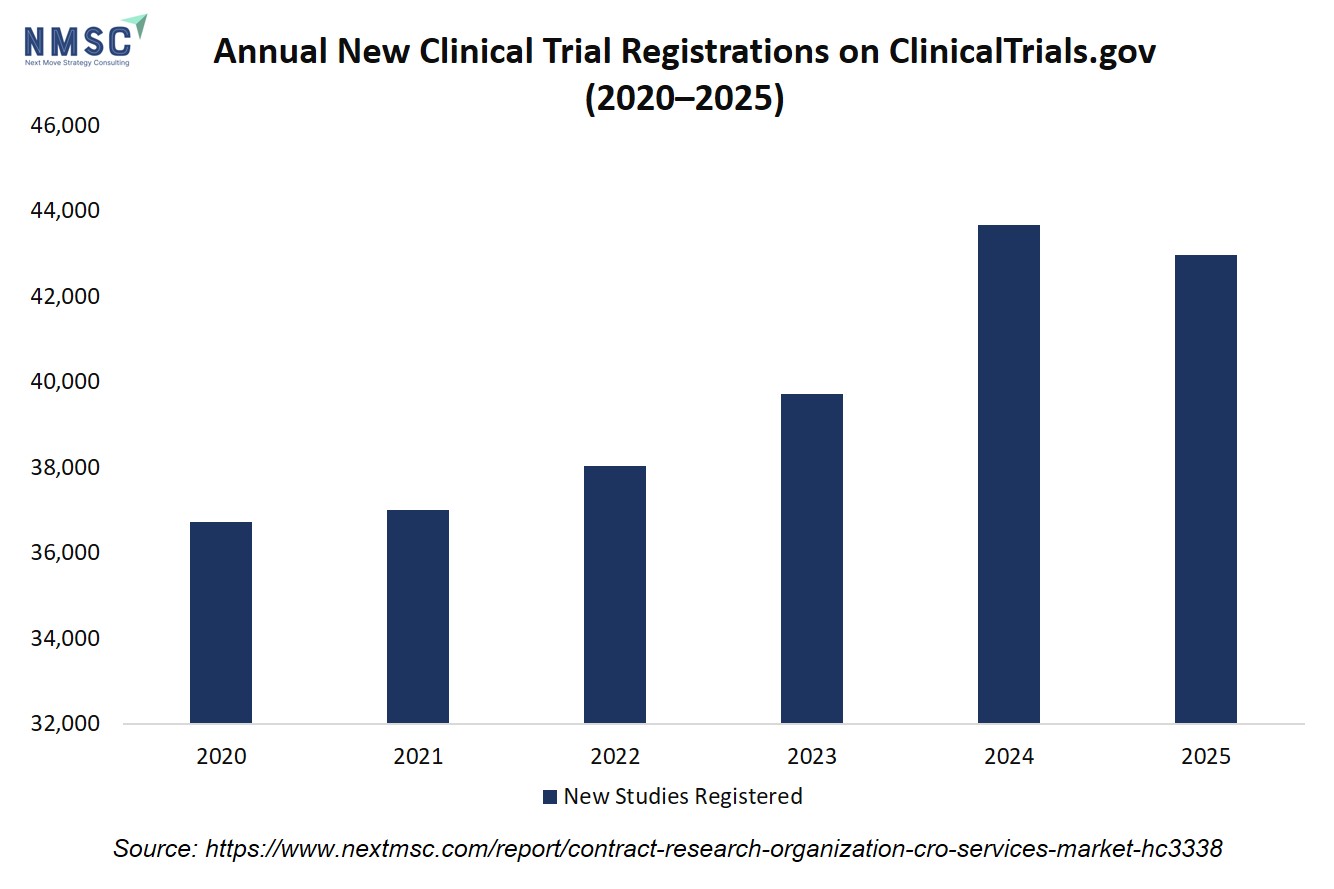
The WHO's Global Observatory on Health Research and Development, updated in June 2026, confirms that global clinical trial registration has maintained a sustained upward trajectory, with the Western Pacific region — driven primarily by China and Japan — recording 31,097 registered trials in 2025, more than 30 times the volume registered in Africa (822 trials). South-East Asia is the only WHO region that did not experience a post-pandemic decline in trial registrations, driven largely by India, which accounts for approximately 85% of South-East Asian trial registrations and nearly 10% of global trial registrations.
As of 18 August 2026, ClinicalTrials.gov lists 599,083 registered studies across all 50 U.S. states and 226 countries and territories. Of the 65,038 currently recruiting studies, 66% are located exclusively outside the United States, underscoring the increasingly global nature of clinical trial execution and the corresponding demand for CROs with multi-regional operational capabilities. The platform receives approximately 133,000 visitors per day and 3.2 million unique visitors per month, reflecting the scale of global engagement with clinical research activity.
Market Segmentation and Strategic Dynamics
According to Next Move Strategy Consulting's analysis, the Contract Research Organization (CRO) Services Market is segmented by type, therapeutic area, end user, and region. By service type, the market encompasses clinical research services (spanning Phase I through Phase IV), early phase development services (including chemistry, manufacturing and controls, preclinical services, and discovery studies), laboratory services (analytical and bioanalytical testing), consulting services, and data management services.
Clinical research services represent the largest and most strategically significant segment, driven by the volume and complexity of Phase II and Phase III trials across oncology, immunology, and neurology therapeutic areas. The oncology segment commands the largest share of therapeutic area demand, consistent with the OECD's finding that cancer accounts for 43% of all product-indication pairs in active global development. Pharmaceutical and biotechnology companies constitute the dominant end-user segment, reflecting the industry's structural shift toward outsourcing as a cost optimisation and risk mitigation strategy.
Regionally, North America maintains the largest market share, anchored by the United States' concentration of global pharmaceutical companies, research institutions, and regulatory infrastructure. The FDA's sustained novel drug approval output — 46 approvals in 2025, 50 in 2024, and 55 in 2023 — provides a consistent pipeline of clinical development activity that directly sustains CRO demand. Europe represents the second-largest regional market, supported by the EU Clinical Trials Regulation (CTR) and the Clinical Trials Information System (CTIS), which have standardised multi-country trial submissions and created new efficiencies for CROs managing pan-European studies. Asia-Pacific is the fastest-growing region, driven by China's expanding pharmaceutical R&D investment, India's growing clinical trial volume, and the cost competitiveness of regional CRO operations.
FDA Novel Drug Approvals by Year (2019–2025)
|
Year |
Novel Drug Approvals (CDER) |
Notable Therapeutic Focus |
CRO Demand Implication |
|
2019 |
48 |
Oncology, rare diseases |
High outsourcing demand; complex multi-site trials |
|
2020 |
53 |
COVID-19 vaccines/antivirals, oncology |
Surge in CRO capacity utilisation; accelerated timelines |
|
2021 |
50 |
Oncology, neurology, rare diseases |
Sustained high demand; decentralised trial adoption |
|
2022 |
37 |
Oncology, cardiovascular, immunology |
Normalisation post-pandemic; AI integration begins |
|
2023 |
55 |
Oncology, rare diseases, metabolic disorders |
Record approvals; peak CRO pipeline activity |
|
2024 |
50 |
Oncology, cardiovascular, neurology |
Continued high volume; biologics outsourcing growth |
|
2025 |
46 |
Oncology, rare diseases, respiratory, immunology |
Sustained demand; 57% of approvals were biologics |
Note: "Novel" drugs are defined as new drugs never before approved or marketed in the United States. Annual approval volumes directly correlate with CRO clinical trial workload across Phase I–IV services.
AI Integration and Decentralised Trials: The Technology Transformation
The integration of artificial intelligence into clinical trial management represents the most consequential structural shift in CRO service delivery since the adoption of electronic data capture systems in the 1990s. By 2026, leading CROs — including IQVIA, ICON, and Thermo Fisher (PPD) — have evolved into what industry analysts describe as intelligence-driven development partners, deploying AI-enabled protocol design, predictive patient recruitment, real-time trial monitoring, and outcome simulation capabilities.
The FDA's April 2026 guidance on real-time clinical trial design has further accelerated the adoption of adaptive trial methodologies, creating new service opportunities for CROs with advanced AI and data analytics capabilities. Decentralised clinical trials (DCTs), which utilise digital tools and remote patient monitoring to enable participation without requiring physical site visits, have emerged as a transformative model — particularly for patient populations in rural or underserved regions. The global decentralised clinical trials market was valued at USD 8.8 billion in 2024 and is projected to reach USD 18.8 billion by 2030, according to BCC Research, representing a significant adjacent growth opportunity for CROs that have invested in DCT infrastructure and technology partnerships.
Charles River Laboratories' March 2024 launch of its AI-powered drug discovery platform, Logica, developed in collaboration with Valo Health, exemplifies the sector's strategic direction — integrating predictive modelling and translational research to accelerate preclinical development and enhance decision-making for pharmaceutical clients. Similarly, Lokavant's June 2024 introduction of Spectrum, an AI solution enabling real-time clinical trial prediction and optimisation through thousands of simultaneous simulations, demonstrates the expanding role of technology in CRO value delivery.
Competitive Landscape and Key Players
The global CRO services market is characterised by a tiered competitive structure. At the apex, a small number of full-service global CROs — IQVIA, Thermo Fisher Scientific (PPD), Labcorp, ICON PLC, and Parexel — command the largest market shares through their ability to manage complex, multi-regional, multi-phase clinical programmes at scale. The Thermo Fisher-Clario integration materially strengthens Thermo Fisher's position in this tier by adding endpoint data capabilities that are increasingly demanded by pharmaceutical sponsors seeking integrated clinical research solutions.
The mid-tier is populated by specialised CROs with deep therapeutic area expertise — including Charles River Laboratories (preclinical and early-phase), Eurofins Scientific (laboratory and analytical services), WuXi AppTec (integrated drug development in China and globally), and Pharmaron (chemistry, manufacturing, and controls). These organisations compete on specialisation, geographic access, and cost efficiency, particularly in the Asia-Pacific market where lower operational costs and large patient populations provide structural advantages.
The competitive dynamics of the sector are being reshaped by three converging forces: consolidation through M&A (as exemplified by the Thermo Fisher-Clario transaction), technology differentiation through AI and DCT capabilities, and geographic expansion into emerging markets — particularly India, China, Brazil, and the Middle East — where regulatory frameworks are maturing and clinical trial volumes are growing rapidly.
Regulatory Environment and Policy Developments
The regulatory environment governing CRO operations is evolving across all major markets. In the European Union, the Clinical Trials Regulation (EU CTR No 536/2014) and the Clinical Trials Information System (CTIS) have standardised the submission, authorisation, and supervision of clinical trials across EU member states, reducing administrative complexity for CROs managing pan-European programmes. The CTIS platform, which became mandatory for all new clinical trial applications in January 2023, has integrated WHO ICTRP and API connectivity, with additional features including trial ownership transfer between companies added in 2025.
In the United States, the FDA has issued updated guidance requiring Diversity Action Plans (DAPs) for Phase III clinical trials and other pivotal studies, mandating that sponsors — and by extension, their CRO partners — demonstrate proactive strategies for enrolling representative patient populations across race, ethnicity, age, and sex. This regulatory requirement is creating new service opportunities for CROs with established patient recruitment networks in underrepresented communities and with expertise in community-based trial site management.
In 2022, governments across 35 OECD countries collectively budgeted USD 73 billion for health-related R&D, with the United States accounting for approximately two-thirds of the total at USD 49.5 billion. Government-allocated budgets for health-related R&D in OECD countries increased by approximately 13% in real terms between 2010 and 2023, providing a sustained public funding base that complements private pharmaceutical R&D investment and supports the academic and government research institutions that constitute a growing CRO end-user segment.
Bottom Line
The global Contract Research Organization (CRO) Services Market is entering a period of accelerated structural transformation, driven by the convergence of record pharmaceutical M&A activity, sustained FDA drug approval volumes, expanding global clinical trial registrations, and the rapid integration of AI and decentralised trial technologies into clinical research operations. Thermo Fisher Scientific's USD 8.875 billion acquisition of Clario Holdings — the most significant CRO-direct transaction of 2026 — signals that the largest life sciences companies view integrated clinical research capabilities as a core strategic asset rather than a commodity service.
Next Move Strategy Consulting projects the market will expand from USD 77.86 billion in 2024 to USD 131.17 billion by 2030, at a CAGR of 9.1%. The primary growth drivers are rising pharmaceutical R&D investment — which reached USD 129 billion in industry BERD in 2022 per OECD data — regulatory pressure for faster drug approvals, and the structural shift toward outsourcing among both large pharmaceutical companies and emerging biotech firms.
For investors, the key opportunities lie in full-service CROs with demonstrated AI capabilities, specialised oncology and rare disease service providers, and organisations with established operational infrastructure in Asia-Pacific — particularly India and China, where clinical trial volumes and pharmaceutical R&D investment are growing at rates that significantly exceed the global average. The principal risks include regulatory complexity across multi-jurisdictional programmes, data security and patient privacy obligations, and the competitive pressure on mid-tier CROs from the scale advantages of post-consolidation global leaders. Strategic positioning in technology-enabled, patient-centric trial models will define competitive differentiation in this market through 2030.
About Next Move Strategy Consulting
Next Move Strategy Consulting is a premier market research and management consulting firm that has been committed to provide strategically analysed well documented latest research reports to its clients. The research industry is flooded with many firms to choose from, what makes NMSC different from the rest is its top-quality research and the obsession of turning data into knowledge by dissecting every bit of it and providing fact-based research recommendation that is supported by information collected from over 500 million websites, paid databases, industry journals and one on one consultations with industry experts across a diverse range of industry sectors. The high-quality customized research reports with actionable insights and excellent end-to-end customer service help our clients to take critical business decisions that enables them to move beyond time and have competitive edge in the industry.
We have been servicing over 1000 customers globally that includes 90% of the Fortune 500 companies over a decade. Our analysts are constantly tracking various high growth markets and identifying hidden opportunities in each sector or the industry. We provide one of the industry's best quality syndicate as well as custom research reports across 10 different industry verticals. We are committed to deliver high quality research solutions in accordance to your business needs. Our industry standard delivery solutions that ranges from the pre consultation to after-sales services, provide an excellent client experience and ensure right strategic decision making for businesses.
For more information, please contact:
Next Move Strategy Consulting
5th Floor 867 Boylston St, STE 500,
Boston, MA 02116, U.S.
E-Mail: [email protected]
Direct: +1-217-650-7991
Website: www.nextmsc.com
About the Author
 Sanyukta Deb
— Sanyukta Deb is Digital Marketing Team Lead at Next Move Strategy Consulting, where she has led content strategy and technical SEO for the firm's B2B market research publications for over 2 years. Her editorial process translates NextMSC's primary and secondary research — spanning technology, industrial, and consumer sectors — into commercial narratives, backed by search-intent, keyword, and competitive analysis. She brings 5 years of overall experience in digital marketing and content strategy.
Sanyukta Deb
— Sanyukta Deb is Digital Marketing Team Lead at Next Move Strategy Consulting, where she has led content strategy and technical SEO for the firm's B2B market research publications for over 2 years. Her editorial process translates NextMSC's primary and secondary research — spanning technology, industrial, and consumer sectors — into commercial narratives, backed by search-intent, keyword, and competitive analysis. She brings 5 years of overall experience in digital marketing and content strategy.
About the Reviewer
 Debashree Dey
— Debashree Dey is Assistant Manager at Next Move Strategy Consulting, where she supports cross-vertical market content and communications across diverse industries for 6 years. Her professional background includes senior content writing, communications, and published manuscript authorship, with experience developing audience-focused business narratives and maintaining clear, consistent messaging. Her role supports research-led content development and editorial quality across NextMSC publications.
Debashree Dey
— Debashree Dey is Assistant Manager at Next Move Strategy Consulting, where she supports cross-vertical market content and communications across diverse industries for 6 years. Her professional background includes senior content writing, communications, and published manuscript authorship, with experience developing audience-focused business narratives and maintaining clear, consistent messaging. Her role supports research-led content development and editorial quality across NextMSC publications.
















Add Comment