Daikin’s Record Half Shows Variable Refrigerant Flow Entering the R-32 Era
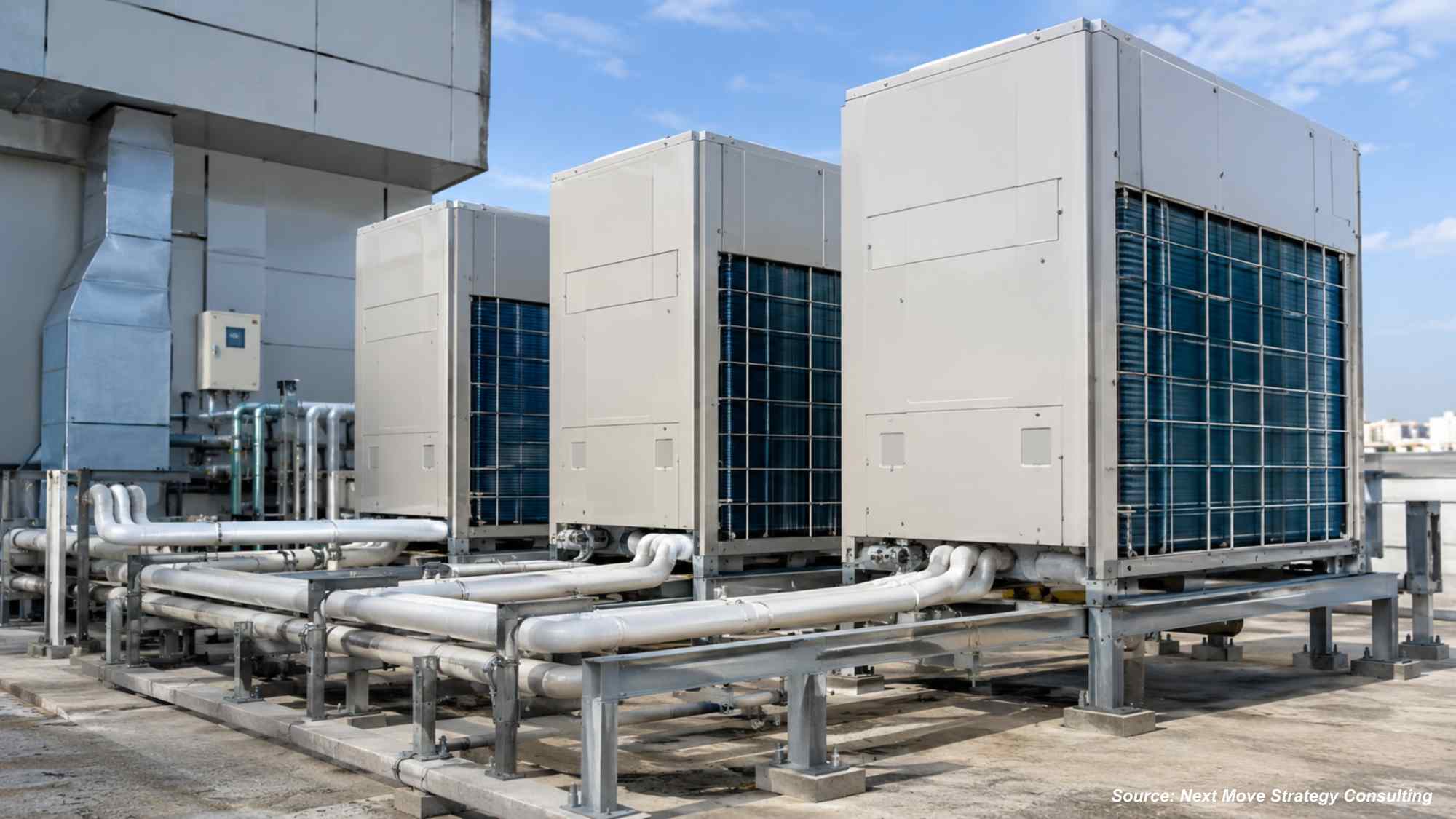
Daikin Lifts Its Sales Outlook to ¥5.44 Trillion as R-32 VRF Launches and Revised U.S. Refrigerant Rules Reshape Commercial Cooling Competition
On November 5, 2026, Daikin Industries reported record first-half results for the six months ended September 30, 2026, with consolidated net sales of ¥2,910.8 billion, up 17% year on year, and operating profit of ¥270.8 billion, up 10%. The Air Conditioning and Refrigeration Equipment segment generated ¥2,699.7 billion of that revenue, and Daikin raised its forecast for the fiscal year ending March 2027 to net sales of ¥5,440.0 billion and operating profit of ¥455.0 billion, up from ¥5,150.0 billion and ¥436.0 billion in its May forecast, according to the Daikin Industries Presentation of Financial Results for the First Half Ended in September 2026. The revised outlook comes as the U.S. VRF refrigerant transition enters its final installation phase. The January 1, 2026 restriction on manufacturing or importing new VRF systems using HFC refrigerants with a global warming potential (GWP) above 700 has already taken effect. Qualifying higher-GWP VRF equipment, with all components manufactured or imported before that date, may be installed until January 1, 2027. As of the article's November 19, 2026 publication date, the installation deadline was 43 days away, or just over six weeks. Across the broader HVAC industry, suppliers are transitioning from R-410A (GWP 2,088) toward lower-GWP A2L refrigerants, including R-32 (GWP 675) and R-454B (GWP 466). The 2026 VRF platforms discussed in this article specifically feature R-32.
According to Next Move Strategy Consulting's Variable Refrigerant Flow Systems Market report, the global variable refrigerant flow systems market was valued at USD 21.40 billion in 2024 and is projected to reach USD 38.25 billion by 2030, growing at a CAGR of 10.2% from 2025 to 2030. NextMSC primary research and analysis places the 2025 value at USD 23.58 billion and identifies energy-efficiency awareness, urbanization and technology advances as the main demand drivers, with high upfront installation cost as the principal restraint.
For More Information: Download FREE Sample on Variable Refrigerant Flow Systems Market Report
The Financial Logic: Price Increases Offset a ¥77 Billion Raw Material Burden
Daikin's headline growth needs two adjustments. The Daikin Industries presentation shows that foreign exchange added ¥200.5 billion to first-half net sales, with the yen averaging ¥159 to the U.S. dollar against ¥146 a year earlier, and that growth excluding currency effects was 9%. Operating margin fell to 9.3% from 9.9%, and gross margin narrowed to 34.2% from 35.6%, because costs rose faster than Daikin had planned in May.
The company attributed the cost increases to the Middle East situation, additional U.S. tariffs, higher raw material prices and weaker emerging-market currencies. Its operating profit bridge puts a number on each force: raw materials, including a ¥10.3 billion direct tariff cost, ¥12.6 billion of U.S. tariff refunds and logistics expense, subtracted ¥77.0 billion; fixed costs subtracted ¥35.0 billion; and those pressures were offset by ¥49.2 billion from sales expansion, ¥46.0 billion from selling-price increases, ¥35.0 billion from cost reductions and ¥6.0 billion from currency. For the full fiscal year, Daikin expects raw materials to subtract ¥170.0 billion and selling-price increases to add ¥114.0 billion, which makes pricing the largest single offset in its guidance.
Daikin Full-Year Outlook for the Fiscal Year Ending March 2027 (¥ billion)
|
Metric |
May 2026 forecast |
November 2026 revised forecast |
First-half actual |
|
Net sales |
5,150.0 |
5,440.0 |
2,910.8 |
|
Operating profit |
436.0 |
455.0 |
270.8 |
|
Ordinary profit |
414.0 |
417.0 |
247.2 |
|
Profit attributable to owners of parent |
278.0 |
280.0 |
173.0 |
For VRF suppliers the pricing mechanism matters because refrigerant changes raise component and compliance costs at the same moment that raw material costs climb. Daikin reported that it offset these pressures by shifting toward high value-added products. In Japan, the company named VRV 7, which uses R32 refrigerant, among the commercial products it promoted to customers, and in Europe it reported higher commercial sales of products using R32 refrigerant on proposals built around energy savings and environmental performance. The Daikin Integrated Report 2026 records that Daikin launched Japan's first split-multi air-conditioning system for buildings in 1982, and NextMSC primary research and analysis identifies the company as the originator of VRF technology.
Key Industry Developments: Platform Launches, Refrigerant Rules and R&D Capacity
On July 15, 2026, GE Appliances, a Haier company, announced the GE R-32 Variable Refrigerant Flow platform from its Air & Water Solutions business, comprising the GE MRV-7 and GE MRV-7S systems. The platform is supported by a VRF Resource Portal that centralizes tools and technical documentation for engineers, specification representatives and mechanical contractors, and GE Appliances said the launch advances its commercial HVAC strategy across North America. On August 18, 2026, ACHR News reported that General HVAC Solutions America Inc. had introduced the Airstage VU-7 line, which uses R-32, operates as either a heat pump or a heat recovery system, and covers capacities from 6 to 32 tons.
The U.S. refrigerant rulebook moved in parallel. On May 26, 2026, the U.S. Environmental Protection Agency (EPA) finalized revisions to its 2023 Technology Transitions rule, with the amendments becoming effective on July 27, 2026. The changes extended compliance timelines for supermarket systems, remote condensing units and cold storage warehouses. They also removed the January 1, 2026 installation deadline for qualifying residential and light-commercial air-conditioning and heat-pump equipment manufactured in the United States or imported before January 1, 2025, allowing the remaining eligible inventory to continue being installed.
Importantly, this residential and light-commercial adjustment is separate from the VRF-specific regulation. The May 2026 reconsideration did not change the VRF installation deadline. Under EPA's December 2024 VRF rule, new systems using refrigerants with a GWP above 700 may be manufactured or imported only before January 1, 2026, while qualifying equipment containing components manufactured or imported before that date may be installed until January 1, 2027. An extension until January 1, 2028, applies to qualifying VRF projects in buildings with approved permits issued before October 5, 2023, provided the permits authorized the use of an HFC refrigerant or blend and all system components meet the applicable pre-2026 manufacturing or import condition. Project teams should distinguish these separate regulatory provisions and verify equipment eligibility and installation timelines before committing to R-410A inventory.
Daikin is also adding engineering capacity outside Japan. On June 26, 2026, its Board of Directors resolved to establish Daikin Research and Development India Private Limited in Haryana, according to the Daikin India newsroom. The subsidiary will serve as a product development base for the Global South, including Asia, Oceania and Africa, with a focus on large-scale HVAC systems, and the Haryana R&D center is scheduled for completion in June 2028. Daikin cited rapid economic growth and urbanization driving construction of data centers, factories and commercial facilities as the reason for the investment.
Mitsubishi Electric Trane HVAC US described the refrigerant shift when it announced its R-32 VRF line, as reported by Refindustry on October 17, 2025. The company said it would keep supplying R-410A VRF products through the first half of 2026 to support projects already in progress.
“R-32 offers a balance of efficiency and reduced environmental impact”
- David Archer, Vice President of Commercial Business, Mitsubishi Electric Trane HVAC US, Refindustry, Mitsubishi Electric Trane HVAC US to Launch R-32 VRF Line in 2026, October 17, 2025.
Segment Dynamics: Heat Recovery, Capacity Bands and Controls
NextMSC's report segments the market by component (outdoor units, indoor units and control systems), type (heat pump and heat recovery systems), capacity (up to 10 tons, 11 to 18 tons, 19 to 26 tons and above 26 tons) and application (commercial, residential and industrial). The 2026 product launches map directly onto that structure. General HVAC Solutions America's Airstage VU-7, reported by ACHR News, offers both heat pump and heat recovery operation across 6 to 32 tons, a range that spans all four capacity bands in NextMSC's segmentation, and GE Appliances directs its VRF Resource Portal to engineers, specification representatives and contractors.
Daikin's regional commentary shows how uneven demand is across segments. In the Americas, the Daikin Industries presentation says ductless sales were affected by a decline following a demand surge that preceded changes to GWP-based refrigerant regulations, and that for VRV the company focused on bolstering sales through its sales representatives. In Asia, Daikin said commercial priority went to small and medium-sized projects, with dealer development and training supporting growth in India, Australia and Thailand, while ASEAN countries saw delays in large-scale projects caused by rising costs and shortages of construction materials.
Regional Outlook: Asia and Europe Lead Growth While China Lags in Local Currency
Daikin's first-half regional split shows where air-conditioning demand is expanding fastest. Americas net sales reached ¥1,145.9 billion, the largest regional total, while Asia grew 23%, Europe 21%, Japan 16% and Oceania 26% in yen terms. In India, net sales rose 39% in local currency terms. China was the exception: sales rose 5% in yen terms but were 91% of the prior-year level on a local-currency basis, as Daikin cited a real estate recession and weak consumer spending. The company's overseas net sales ratio stood at 85%, which means its results track global construction and replacement cycles rather than the Japanese market alone.
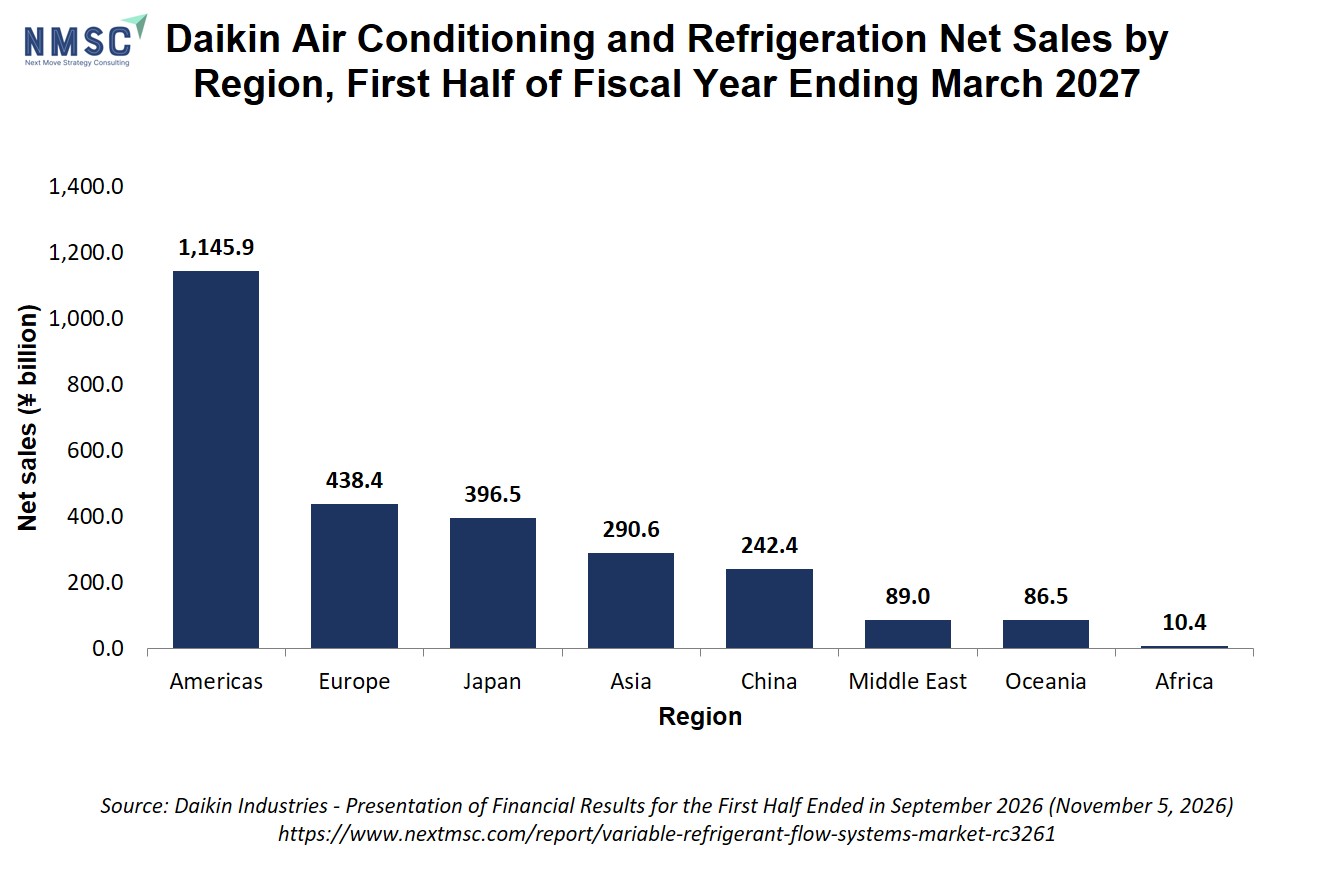
The eight regions sum to the segment total of ¥2,699.7 billion reported by Daikin, and the segment includes the filter business.
Daikin Air Conditioning and Refrigeration Net Sales by Region, First Half (¥ billion)
|
Region |
First half, prior year |
First half, current year |
Year on year (yen basis) |
|
Japan |
340.6 |
396.5 |
116% |
|
Europe |
361.4 |
438.4 |
121% |
|
China |
230.4 |
242.4 |
105% |
|
Americas |
978.9 |
1,145.9 |
117% |
|
Asia |
236.7 |
290.6 |
123% |
|
Oceania |
68.9 |
86.5 |
126% |
|
Middle East |
81.4 |
89.0 |
109% |
|
Africa |
8.6 |
10.4 |
121% |
|
Total |
2,306.9 |
2,699.7 |
117% |
NextMSC primary research and analysis identifies Asia-Pacific as the largest regional contributor to global VRF systems demand, supported by urbanization, climate diversity and government emphasis on sustainable infrastructure, with North America and Europe shaped by refrigerant regulation and building energy performance standards. Daikin's first-half data is consistent with that regional ranking of growth momentum, though its segment figures cover all air-conditioning products and the filter business, and cannot be read as VRF revenue.
Growth Drivers and Restraints: What the Evidence Shows
-
Replacement and heat-mitigation spending in Japan: the Daikin Industries presentation reports that industry commercial air-conditioning volumes in Japan rose 5% in the first half, with Daikin's own volumes up 4%, and attributes demand to retail-store and facility investment and to heat mitigation measures at factories and warehouses.
-
Refrigerant transition: The EPA's VRF-specific rule establishes January 1, 2026 as the manufacturing and import cut-off for new VRF systems using refrigerants with a GWP above 700. Qualifying higher-GWP equipment with all components manufactured or imported before that date may be installed until January 1, 2027, with a January 1, 2028 extension for eligible projects permitted before October 5, 2023. This regulatory transition is accelerating the adoption of lower-GWP A2L refrigerants, including R-32 and R-454B, as alternatives to R-410A. The new VRF platforms highlighted in this article demonstrate the industry's movement toward R-32 technology.
-
Raw material and tariff cost: Daikin expects raw materials to subtract ¥170.0 billion from full-year operating profit, and Daikin plans ¥114.0 billion of price increases to hold its full-year operating margin at 8.4%, against 8.3% a year earlier.
-
Weak housing and real estate in key regions: Daikin reports that U.S. demand recovery was limited by prolonged inflation, persistently high mortgage rates and uncertainty linked to the Middle East situation, and that China remained in a real estate recession.
-
Upfront cost: NextMSC primary research and analysis identifies the high initial cost of VRF equipment and installation as the main barrier for cost-conscious and small-scale projects, a barrier that lifecycle energy savings must offset.
NMSC Strategic Perspective: Lifecycle Value Is Replacing Unit Price as the Competitive Axis
NextMSC primary research and analysis reads Daikin's disclosures as evidence that the VRF competitive contest is shifting from equipment price to the value delivered over a system's life. The Daikin Integrated Report 2026 states that the Solutions Business, which covers maintenance, energy management, replacement and engineering services, accounted for 28% of Air Conditioning Business net sales in the fiscal year ended March 2026, and that Daikin aims to raise the share to 40% by fiscal 2030, with the Solutions Business expected to account for about 70% of the segment's gross profit growth. Daikin links that move to price competition and equipment commoditization, which left its operating margin at 8.3% against the 11.0% target in its previous plan.
This matters for the restraint that NextMSC's report identifies, high upfront cost. A supplier that can monetize energy management and maintenance across the life of a VRF installation can justify a higher purchase price with measured operating savings, which is the argument NextMSC's report says buyers need to hear. The launches from GE Appliances and General HVAC Solutions America show that new entrants are competing on specification support and R-32 compatibility, while Daikin competes on installed-base services. NextMSC primary research and analysis treats the remaining U.S. VRF installation window, which closes on January 1, 2027 for qualifying higher-GWP equipment, as one of the variables most likely to influence near-term product specifications, inventory decisions and competitive positioning. The separate January 1, 2028 extension applies only to projects meeting EPA's grandfathering requirements.
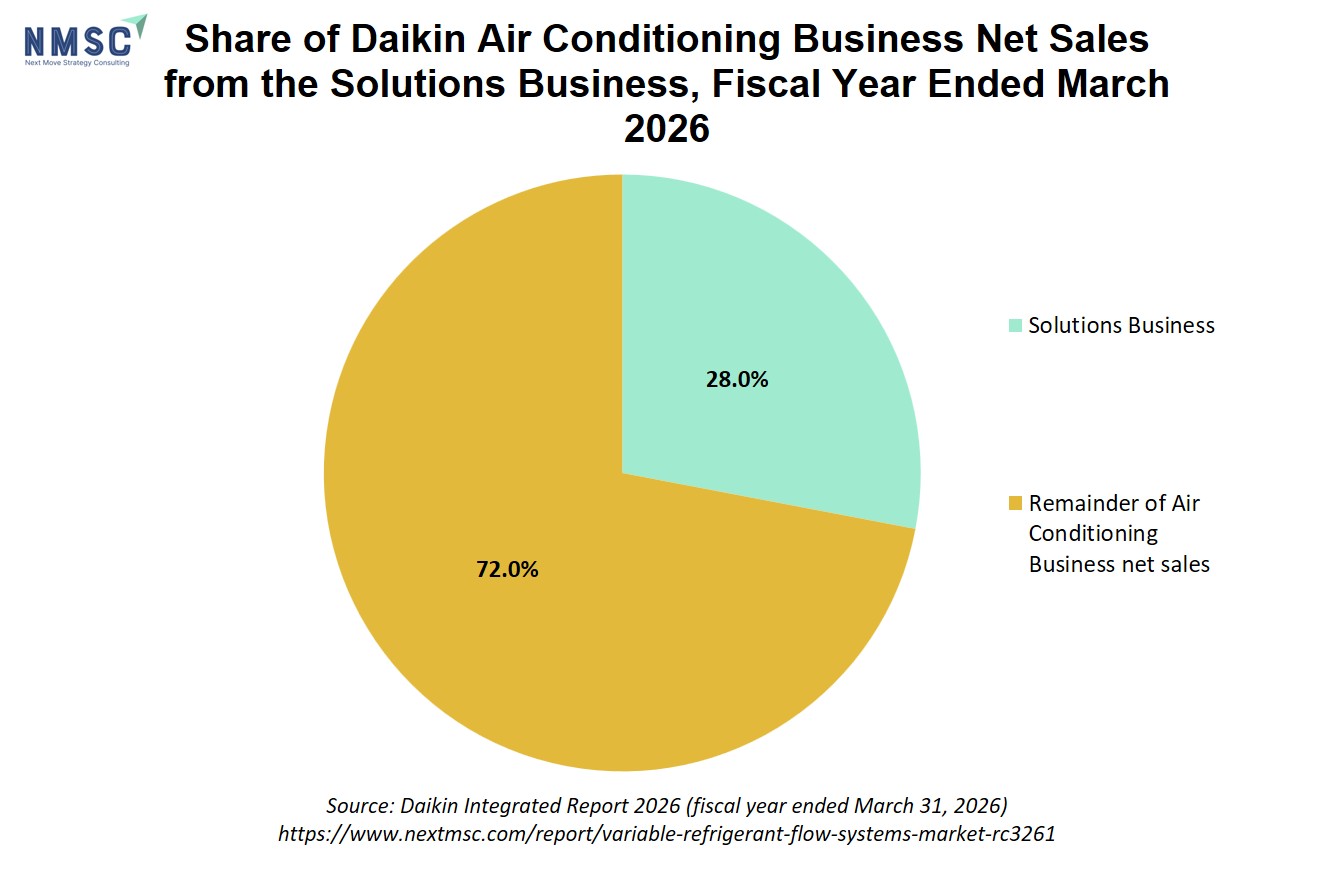
Daikin reports a 28% Solutions Business share of Air Conditioning Business net sales and a target of 40% by fiscal 2030. The remainder is the arithmetic balance of the same total.
Competitive Landscape: Four Positioning Strategies
NextMSC's report profiles 15 companies, including Daikin, Mitsubishi Electric, LG Electronics, Samsung Electronics, Panasonic, Hitachi, Johnson Controls, Carrier, GE Appliances, Lennox, Midea, Blue Star, Voltas, Danfoss and Ferguson. The dated 2026 events traced above show four distinct strategies: Daikin is building lifecycle solutions and Indian engineering capacity; GE Appliances is selling specification support for a new R-32 platform; General HVAC Solutions America is covering the full 6 to 32 ton range with heat pump and heat recovery options; and Mitsubishi Electric Trane HVAC US is running R-410A and R-32 lines in parallel through the transition.
R-32 VRF Platform Positioning Reported in 2026
|
Company |
Platform |
Reported |
Specification detail |
|
GE Appliances (a Haier company) |
GE R-32 VRF platform: GE MRV-7 and GE MRV-7S |
July 15, 2026 |
R-32 refrigerant; VRF Resource Portal with technical documentation for engineers, specification representatives and contractors |
|
General HVAC Solutions America Inc. |
Airstage VU-7 |
August 18, 2026 |
R-32 refrigerant; heat pump or heat recovery operation; capacities from 6 to 32 tons |
|
Daikin |
VRV 7 |
November 5, 2026 |
R32 refrigerant; promoted as a high value-added commercial product in Japan |
Bottom Line
Daikin's record first half and raised outlook show that large HVAC suppliers are protecting profitability through price increases and product mix rather than volume alone, with a ¥114.0 billion pricing contribution planned against ¥170.0 billion of raw material costs for the full year. For VRF buyers and investors, four milestones matter: January 1, 2026, when restrictions on manufacturing and importing new VRF systems using refrigerants above 700 GWP took effect in the United States; January 1, 2027, the installation deadline for qualifying higher-GWP VRF equipment with pre-2026 components; January 1, 2028, the extended installation deadline for eligible grandfathered projects; and June 2028, when Daikin's Haryana R&D center is scheduled for completion. Next Move Strategy Consulting's primary research and analysis sizes the global VRF systems market at USD 21.40 billion in 2024 and projects it to reach USD 38.25 billion by 2030, representing a CAGR of 10.2% from 2025 to 2030. The evidence points to a market where R-32 compatibility is becoming a baseline requirement, while durable competitive advantage will increasingly depend on specification support, installed-base services and cost discipline.
About Next Move Strategy Consulting
Next Move Strategy Consulting is a premier market research and management consulting firm that has been committed to provide strategically analysed well documented latest research reports to its clients. The research industry is flooded with many firms to choose from, what makes NMSC different from the rest is its top-quality research and the obsession of turning data into knowledge by dissecting every bit of it and providing fact-based research recommendation that is supported by information collected from over 500 million websites, paid databases, industry journals and one on one consultations with industry experts across a diverse range of industry sectors. The high-quality customized research reports with actionable insights and excellent end-to-end customer service help our clients to take critical business decisions that enables them to move beyond time and have competitive edge in the industry.
We have been servicing over 1000 customers globally that includes 90% of the Fortune 500 companies over a decade. Our analysts are constantly tracking various high growth markets and identifying hidden opportunities in each sector or the industry. We provide one of the industry’s best quality syndicate as well as custom research reports across 10 different industry verticals. We are committed to deliver high quality research solutions in accordance to your business needs. Our industry standard delivery solutions that ranges from the pre consultation to after-sales services, provide an excellent client experience and ensure right strategic decision making for businesses.
For more information, please contact:
Next Move Strategy Consulting
5th Floor 867 Boylston St, STE 500,
Boston, MA 02116, U.S.
E-Mail: [email protected]
Direct: +1-217-650-7991
Website: www.nextmsc.com
About the Author
 Sanyukta Deb
— Sanyukta Deb is Digital Marketing Team Lead at Next Move Strategy Consulting, where she has led content strategy and technical SEO for the firm's B2B market research publications for over 2 years. Her editorial process translates NextMSC's primary and secondary research — spanning technology, industrial, and consumer sectors — into commercial narratives, backed by search-intent, keyword, and competitive analysis. She brings 5 years of overall experience in digital marketing and content strategy.
About the Reviewer
 Debashree Dey
— Debashree Dey is Assistant Manager at Next Move Strategy Consulting, where she supports cross-vertical market content and communications across diverse industries for 6 years. Her professional background includes senior content writing, communications, and published manuscript authorship, with experience developing audience-focused business narratives and maintaining clear, consistent messaging. Her role supports research-led content development and editorial quality across NextMSC publications.














Add Comment