Dutch €1.3 Billion CV90 Order Pushes Tracked Vehicle Makers Toward Scale
The Hague's CV90 Nordic Edition Buy, Caterpillar's 18% Construction Sales Rise and a USD 818 Million AMPV Award Show Tracked Platforms Selling at Scale
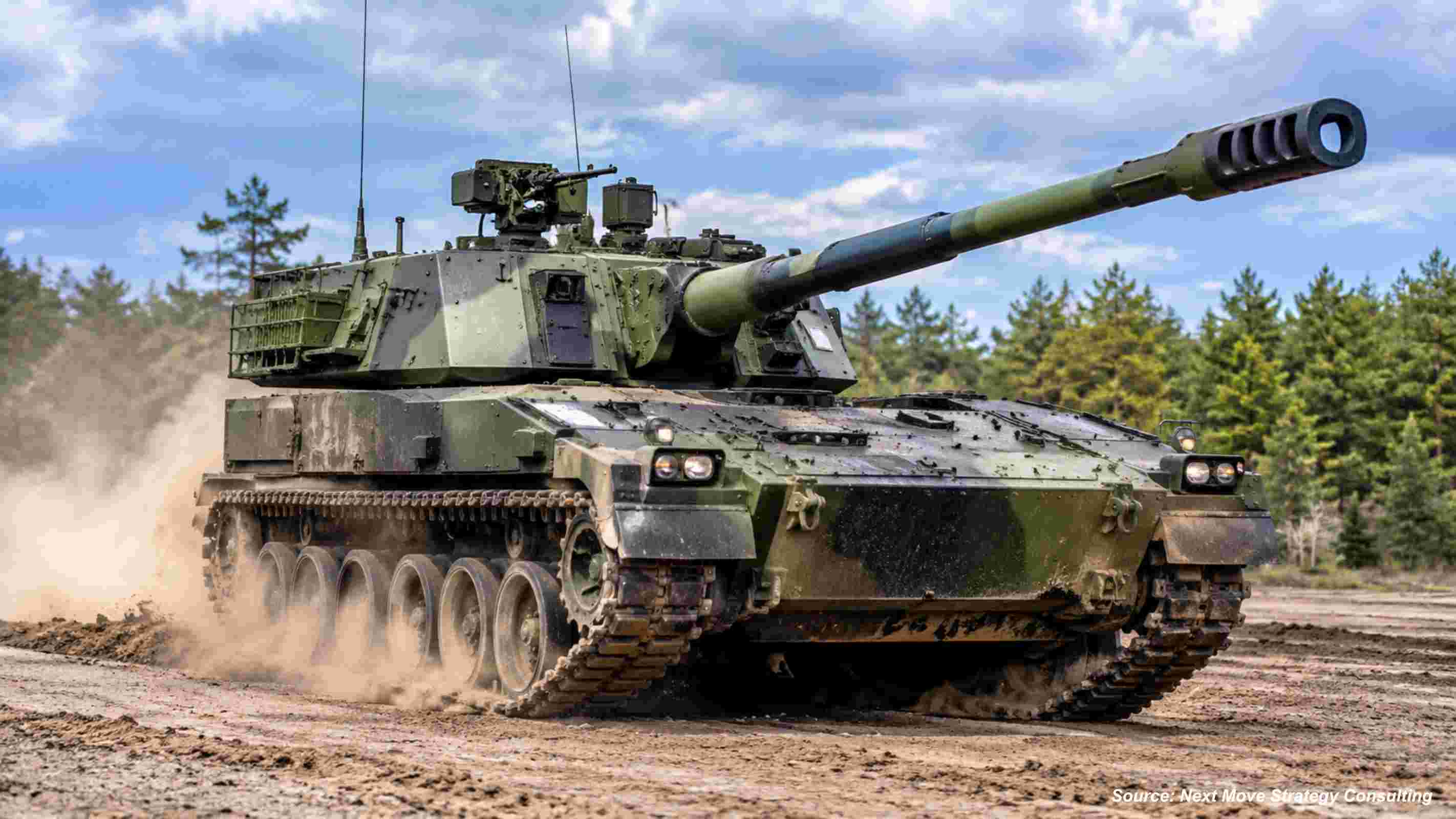
On 26 October 2026, the Dutch Ministry of Defence announced that State Secretary for Defence Derk Boswijk had told parliament in writing of a budget of €1.3 billion (USD 1.45 billion) for additional CV90 infantry fighting vehicles, to be bought through the Sweden-led Nordic initiative from BAE Systems Hägglunds for a new armoured infantry battalion. The Defense Post reported on 30 October 2026 that the package also covers spare parts, maintenance kits, ammunition and communications equipment, and that the Netherlands is procuring bridge-laying tanks, armoured breaching vehicles, tracked armoured support vehicles and Wisent-2 heavy recovery vehicles alongside the CV90s. The Dutch Ministry of Defence linked the purchase to the possibility of a large-scale conflict and stated that Van Halteren Technologies will assemble the support and recovery vehicles in the Netherlands and maintain them.
According to Next Move Strategy Consulting's Tracked Vehicle Mobility Market report, the global tracked vehicle mobility market was valued at USD 22.18 billion in 2025 and is projected to reach USD 36.47 billion by 2035, growing at a CAGR of 5.10% from 2026 to 2035. NextMSC primary research and analysis places the 2026 value at USD 23.31 billion and identifies rising NATO and allied defence modernization budgets, expanding infrastructure and mining investment, and the adoption of autonomous and electrified tracked construction machines as the structural forces behind that trajectory.
For More Information: Download FREE Sample on Tracked Vehicle Mobility Market Report
The Financial Logic: Defence Budgets Reach Record Levels Across Europe
The Stockholm International Peace Research Institute (SIPRI) put world military expenditure at USD 2,887 billion in 2025 in its fact sheet Trends in World Military Expenditure, 2025, published on 27 April 2026. That was a 2.9% real-terms rise and the 11th consecutive annual increase. SIPRI recorded European military spending of USD 864 billion, up 14% and the highest level it has measured for the region, with the 29 European NATO members accounting for USD 559 billion. Across the decade from 2016 to 2025, SIPRI found that European military expenditure rose 102%.
Germany, the fourth-largest spender worldwide at USD 114 billion, raised military expenditure by 24% in 2025, its third consecutive double-digit increase, and at 2.3% of GDP moved above 2.0% for the first time since 1990, SIPRI reported. SIPRI notes that a 2025 reform now excludes military spending above 1.0% of GDP from Germany's debt brake, which allows the government to finance defence through borrowing, and that Germany has pledged to reach 3.5% of GDP by 2029. Poland carried the heaviest burden among NATO members at 4.5% of GDP. The Netherlands spent USD 28.9 billion, up 14%, while Norway and Sweden spent USD 17.0 billion and USD 16.5 billion, up 49% and 24% respectively.
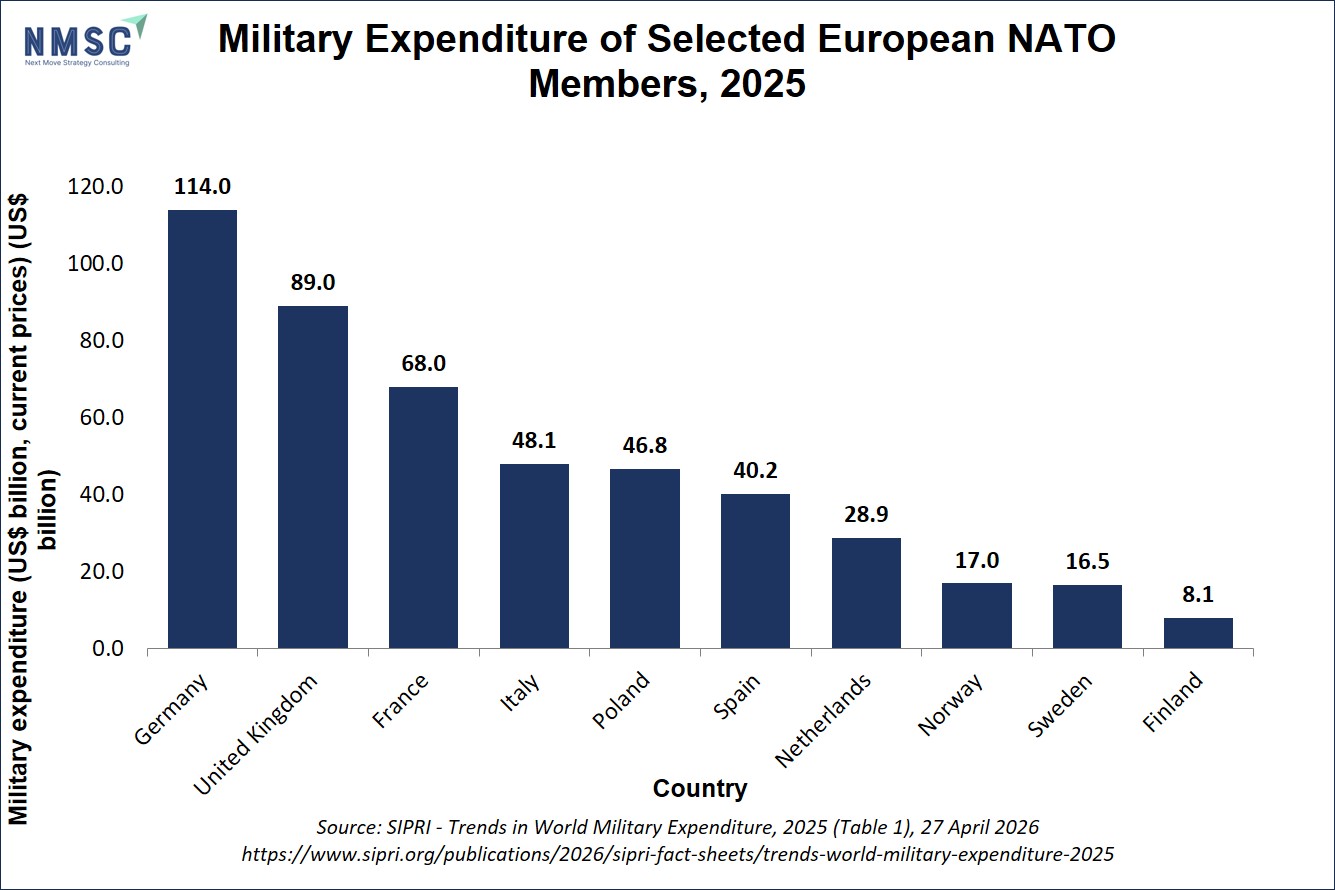
The bars show 2025 military expenditure in current US dollars for ten European NATO members drawn from SIPRI's table of the world's 40 largest spenders. Germany leads at USD 114 billion, followed by the United Kingdom at USD 89.0 billion and France at USD 68.0 billion, while the Netherlands, Norway, Sweden and Finland, which take part in the Sweden-led CV90 Nordic initiative, range from USD 28.9 billion to USD 8.1 billion.
NATO's update Defence Expenditure of NATO Countries (2014-2026), released on 7 July 2026, shows that European Allies and Canada raised core defence expenditure by nearly 20% in 2025 compared with 2024. NATO also reported that five Allies are expected to meet the 3.5% core-defence guideline in 2026 and 17 Allies the 1.5% guideline for defence- and security-related investment, well ahead of the 2035 deadline agreed at The Hague. SIPRI adds that NATO's 32 members spent USD 1,581 billion in 2025, which is 55% of world military expenditure, and that NATO and SIPRI figures diverge: NATO's figure for Canada's 2025 spending was USD 5.0 billion above SIPRI's, so the buying power behind tracked-platform demand depends on the definition each source applies.
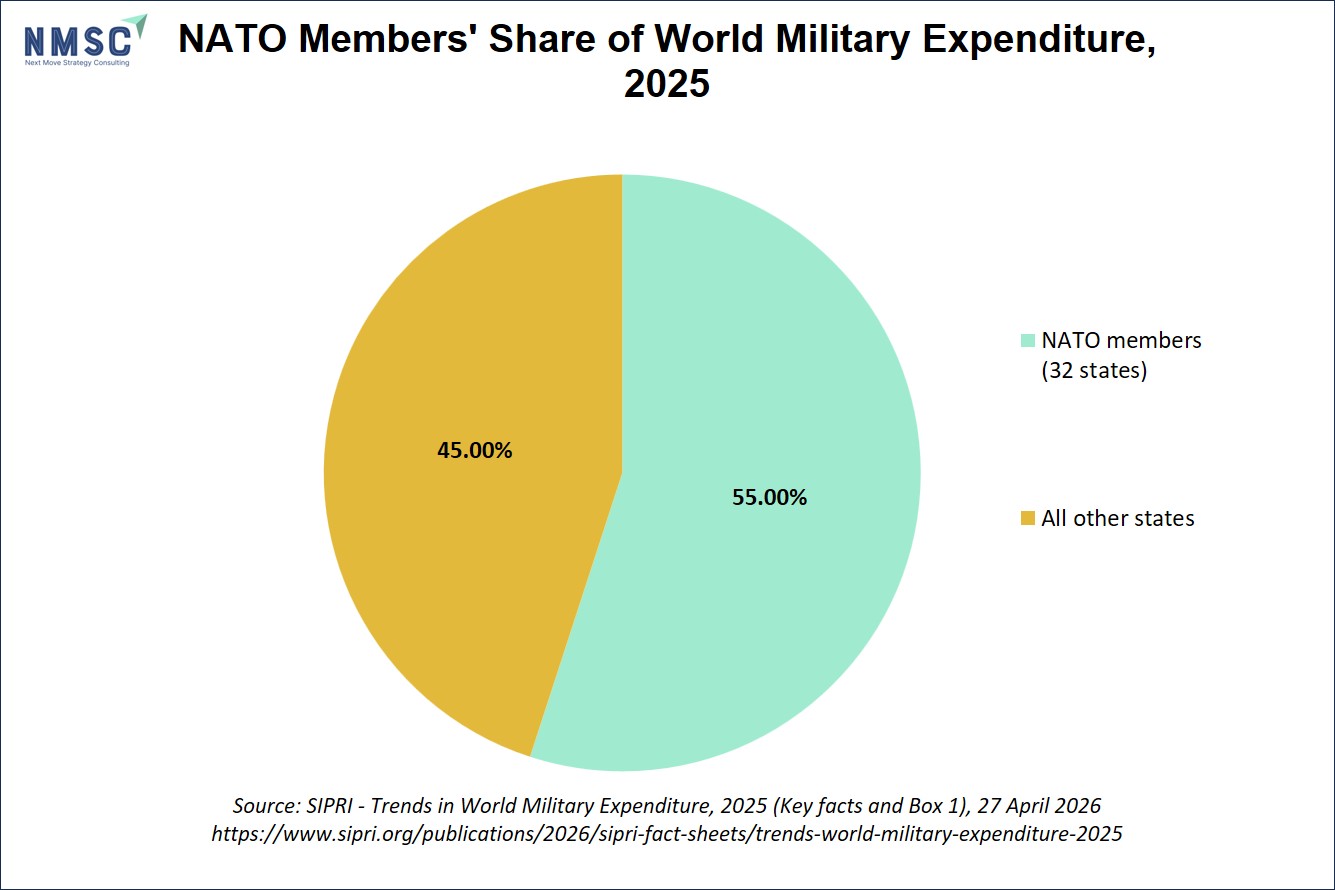
SIPRI reports that the 32 NATO members spent USD 1,581 billion in 2025, equal to 55% of world military expenditure. The remaining 45% is the complement of that published share and covers all other states.
Military Spending Change and Burden, Selected NATO Members
|
Country |
Change in spending 2024–25 (%) |
Change in spending 2016–25 (%) |
Share of GDP 2025 (%) |
Share of GDP 2016 (%) |
|
United States |
−7.5 |
11 |
3.1 |
3.4 |
|
Germany |
24 |
118 |
2.3 |
1.1 |
|
United Kingdom |
−2.0 |
32 |
2.4 |
2.0 |
|
France |
1.5 |
21 |
2.0 |
1.9 |
|
Poland |
23 |
207 |
4.5 |
1.9 |
|
Netherlands |
14 |
133 |
2.2 |
1.1 |
|
Norway |
49 |
166 |
3.3 |
1.6 |
|
Sweden |
24 |
159 |
2.5 |
1.1 |
|
Finland |
17 |
87 |
2.6 |
1.4 |
The regional split shows where the spending is concentrated and how sharply the direction differs. SIPRI's regional table records the Americas at 37% of world spending, down 6.6% in real terms in 2025, while Europe, at 30%, and Asia and Oceania, at 24%, both increased. The United States alone accounted for 90% of Americas spending, and its USD 954 billion in 2025 was 7.5% lower than in 2024, mainly because no supplemental assistance appropriations for Ukraine or Israel were allocated that year.
Military Expenditure by Region, 2025
|
Region |
Spending (USD billion) |
Change 2024–25 (%) |
Share of world spending (%) |
|
Africa |
58.2 |
8.5 |
2.0 |
|
Americas |
1,065 |
−6.6 |
37 |
|
Asia and Oceania |
681 |
8.1 |
24 |
|
Europe |
864 |
14 |
30 |
|
Middle East |
(218) |
0.1 |
(7.6) |
|
World |
2,887 |
2.9 |
100 |
Key Industry Developments: Pooled Buying, Production Starts and Order Backlogs
In the United States, the U.S. Department of War's contract announcement of 14 September 2026 recorded that BAE Systems Land & Armaments LP of York, Pennsylvania, was awarded a USD 818,355,026 modification (PZ0054) to contract W56HZV-23-C-0024 for armored multi-purpose vehicles. The Defense Post reported on 24 September 2026 that the award lifts the cumulative value of the contract to USD 3.3 billion, with work due for completion by 31 May 2030, and that the Army has not disclosed how many vehicles the modification covers. The vehicle is replacing the M113 in Armored Brigade Combat Teams, and the Army plans to replace 2,897 M113s with AMPV variants.
In Europe, Janes reported that KNDS began production of the Leopard 2A8NOR main battle tank for Norway on 15 October 2026, and that the first two vehicles had already been delivered to the Norwegian Army on 30 April 2026. Early-batch deliveries therefore preceded the start of the production line.
The civil side of the market is expanding in parallel. Caterpillar Inc. reported third-quarter 2026 results on 29 October 2026, with consolidated sales and revenues of USD 20.682 billion, up 17% from USD 17.638 billion a year earlier. Construction Industries sales rose 18% to USD 7.983 billion, with growth of 23% in North America, 26% in Latin America, 12% in Europe, Africa and the Middle East and 2% in Asia/Pacific, and segment profit rose 33% to USD 1.831 billion. Resource Industries, which covers mining, heavy construction and quarry and aggregates, grew 15% to USD 4.615 billion.
“Our third-quarter results reflect the durability of our end markets”
- Joe Creed, Chairman and Chief Executive Officer, Caterpillar Inc., Caterpillar Reports Third-Quarter 2026 Results, 29 October 2026.
Caterpillar Segment Sales, Third Quarter 2026 vs Third Quarter 2025 (USD million)
|
Segment |
Third quarter 2025 |
Third quarter 2026 |
Change (%) |
|
Construction Industries |
6,760 |
7,983 |
18 |
|
Resource Industries |
3,999 |
4,615 |
15 |
|
Power & Energy |
7,463 |
8,784 |
18 |
|
Consolidated sales and revenues |
17,638 |
20,682 |
17 |
Selected Tracked-Vehicle Awards and Production Milestones, September to October 2026
|
Date |
Programme |
Supplier |
Development |
|
14 September 2026 |
U.S. Army armored multi-purpose vehicles (contract W56HZV-23-C-0024) |
BAE Systems Land & Armaments LP |
USD 818,355,026 modification; cumulative value USD 3.3 billion; completion by 31 May 2030 |
|
15 October 2026 |
Norway, Leopard 2A8NOR main battle tank |
KNDS |
Production began; first two vehicles delivered on 30 April 2026 |
|
26 October 2026 |
Netherlands, CV90 Nordic Edition and engineering vehicles |
BAE Systems Hägglunds; Flensburger Fahrzeugbau Gesellschaft |
€1.3 billion budget for CV90s; bridge-laying, breaching, support and recovery vehicles added |
Segment Dynamics: Construction Volume Meets Defence Replacement Cycles
NextMSC primary research and analysis shows how revenue divides between the two buyer groups now placing the largest orders. Tracked construction and earthmoving vehicles were the largest product category at USD 9.32 billion in 2025, about 42% of the market, and are forecast to reach USD 14.59 billion by 2035 at a 4.5% CAGR. Tracked military vehicles followed at USD 6.88 billion, rising to USD 10.94 billion at a 4.7% CAGR. Specialty tracked mobility vehicles, which cover snow, arctic, amphibious and rescue platforms, are the fastest-growing product type at a 7.3% CAGR from a USD 1.10 billion base.
Powertrain and operating mode show where the technology shift will start from. According to NextMSC primary research and analysis, internal combustion engines accounted for about 86% of 2025 revenue, or USD 19.07 billion, yet battery electric propulsion is the fastest-growing category at a 19.8% CAGR from 2026 to 2035. Manned machines represented about 82%, or USD 18.19 billion, of 2025 revenue, while fully autonomous operation is growing at a 22.7% CAGR, the fastest of any operating mode.
Regional Outlook: Asia-Pacific Leads on Scale, Europe on Procurement Momentum
NextMSC primary research and analysis places Asia-Pacific first, with about 30% of 2025 revenue, or USD 6.65 billion, and the fastest regional growth at a 6.2% CAGR, taking the region to USD 12.04 billion by 2035. North America was valued at USD 6.21 billion in 2025 and Europe at USD 5.77 billion, each growing at 4.2% a year to USD 9.48 billion and USD 8.75 billion respectively by 2035. The United States led all countries at USD 5.10 billion in 2025, and India is the fastest-growing country at an 8.3% CAGR.
Caterpillar Inc. reported that Construction Industries sales in Asia/Pacific rose only 2% in the third quarter of 2026, against 23% in North America. That reading covers a single quarter and is not a forecast, whereas NextMSC primary research and analysis measures the region over the ten years from 2026 to 2035.
Growth Drivers and Restraints: Evidence From Public Disclosures
The evidence below draws only on named public disclosures and does not carry NextMSC growth-impact estimates.
-
Driver, budget commitments: NATO reported on 7 July 2026 that European Allies and Canada raised core defence expenditure by nearly 20% in 2025, and SIPRI recorded a 14% rise in European military spending to USD 864 billion.
-
Driver, pooled procurement: The Dutch Ministry of Defence announced on 19 December 2025 that it would join the Nordic initiative to buy CV90 vehicles quickly, and The Defense Post reported on 30 October 2026 that the Netherlands will largely adopt the standard configuration, changing only essentials such as IT systems.
-
Driver, fleet replacement: The Defense Post reported on 24 September 2026 that the U.S. Army plans to replace 2,897 M113 carriers with AMPV variants under a contract now valued at USD 3.3 billion.
-
Driver, civil demand: Caterpillar Inc. reported a 15% rise in Resource Industries sales and an 18% rise in Construction Industries sales in the third quarter of 2026.
-
Restraint, input costs: Caterpillar Inc. stated that unfavourable manufacturing costs in Construction Industries included the impact of higher freight in the third quarter of 2026.
-
Restraint, comparability and visibility: SIPRI warns that NATO's wider category of defence- and security-related spending blurs reporting boundaries, and The Defense Post noted that the Army has not disclosed the vehicle count behind the AMPV modification.
NMSC Strategic Perspective: Platform Commonality Becomes the Procurement Currency
The Dutch order shows how tracked-vehicle demand is being packaged. By joining a Sweden-led purchase and accepting the CV90 Nordic Edition largely as specified, the Netherlands avoids a national tender and adds its volume to a common baseline. NextMSC primary research and analysis reads this as supporting the 4.7% CAGR it projects for tracked military vehicles through 2035 from a USD 6.88 billion base in 2025, because multi-country procurement on shared configurations gives manufacturers multi-year production visibility.
The same logic is starting to reach the construction side. NextMSC primary research and analysis observes that manufacturers are pairing autonomous jobsite systems with electrified drivetrains on a single platform architecture, a shift that favours vertically integrated manufacturers over component-only suppliers. Caterpillar Inc.'s record backlog and 18% Construction Industries sales growth indicate that order books are supporting that investment, while the 2% Asia/Pacific figure shows that regional demand will not move in a straight line.
NextMSC primary research and analysis also separates direct tracked-platform demand from adjacent awards. The NextMSC report notes that the U.S. Army's August 2026 Mobile Tactical Cannon prototype award to Hanwha Defense USA covers a wheeled K9 Mobile Howitzer, so NextMSC treats it as adjacent artillery modernization rather than tracked-vehicle demand. Readers should watch three indicators: the vehicle count behind the AMPV modification, the formal national commitments under the Nordic initiative, and whether freight and component costs ease enough to protect segment margins.
Competitive Positioning: Defence Primes and Equipment Majors Converge on Scale
BAE Systems appears on both sides of the current order flow, through BAE Systems Land & Armaments LP, which holds the AMPV contract in York, Pennsylvania, and BAE Systems Hägglunds, the supplier of the CV90 vehicles the Netherlands is buying. KNDS moved the Leopard 2A8NOR into series production for Norway on 15 October 2026, according to Janes. In the Dutch package, Flensburger Fahrzeugbau Gesellschaft supplies the tracked armoured support and Wisent-2 recovery vehicles, while Van Halteren Technologies carries out assembly and maintenance in the Netherlands, as the Dutch Ministry of Defence and The Defense Post described. On the construction side, Caterpillar Inc. continues to report growth across Construction Industries and Resource Industries.
Bottom Line
The Dutch CV90 purchase, the USD 818 million AMPV modification and the start of Leopard 2A8NOR production for Norway show that armoured procurement across NATO countries has moved from planning to funded production. SIPRI recorded European military expenditure of USD 864 billion in 2025, and NATO reports that core defence spending by European Allies and Canada rose nearly 20% that year. On the civil side, Caterpillar Inc. lifted Construction Industries sales 18% in the third quarter of 2026 and reported a record backlog, although its Asia/Pacific construction sales grew only 2%. NextMSC primary research and analysis values the tracked vehicle mobility market at USD 22.18 billion in 2025 and USD 36.47 billion by 2035, a 5.10% CAGR, with construction, earthmoving and military platforms making up most revenue. The variables that will decide manufacturer outcomes are pooled procurement terms, input costs such as freight, and the speed at which autonomy and electric drivetrains reach series production.
About Next Move Strategy Consulting
Next Move Strategy Consulting is a premier market research and management consulting firm that has been committed to provide strategically analysed well documented latest research reports to its clients. The research industry is flooded with many firms to choose from, what makes NMSC different from the rest is its top-quality research and the obsession of turning data into knowledge by dissecting every bit of it and providing fact-based research recommendation that is supported by information collected from over 500 million websites, paid databases, industry journals and one on one consultations with industry experts across a diverse range of industry sectors. The high-quality customized research reports with actionable insights and excellent end-to-end customer service help our clients to take critical business decisions that enables them to move beyond time and have competitive edge in the industry.
We have been servicing over 1000 customers globally that includes 90% of the Fortune 500 companies over a decade. Our analysts are constantly tracking various high growth markets and identifying hidden opportunities in each sector or the industry. We provide one of the industry’s best quality syndicate as well as custom research reports across 10 different industry verticals. We are committed to deliver high quality research solutions in accordance to your business needs. Our industry standard delivery solutions that ranges from the pre consultation to after-sales services, provide an excellent client experience and ensure right strategic decision making for businesses.
For more information, please contact:
Next Move Strategy Consulting
5th Floor 867 Boylston St, STE 500,
Boston, MA 02116, U.S.
E-Mail: [email protected]
Direct: +1-217-650-7991
Website: www.nextmsc.com
About the Author
 Sanyukta Deb
— Sanyukta Deb is Digital Marketing Team Lead at Next Move Strategy Consulting, where she has led content strategy and technical SEO for the firm's B2B market research publications for over 2 years. Her editorial process translates NextMSC's primary and secondary research — spanning technology, industrial, and consumer sectors — into commercial narratives, backed by search-intent, keyword, and competitive analysis. She brings 5 years of overall experience in digital marketing and content strategy.
About the Reviewer
 Debashree Dey
— Debashree Dey is Assistant Manager at Next Move Strategy Consulting, where she supports cross-vertical market content and communications across diverse industries for 6 years. Her professional background includes senior content writing, communications, and published manuscript authorship, with experience developing audience-focused business narratives and maintaining clear, consistent messaging. Her role supports research-led content development and editorial quality across NextMSC publications.














Add Comment