Eaton’s €810 Million COL Deal Targets Data Center Power Equipment Capacity
Eaton’s COL Group Agreement and ABB’s Infinitus Launch, Three Days Apart in September 2026, Show Data Center Power Competition Shifting From Product Specifications to Capacity and DC Architecture
On 25 September 2026, Eaton signed an agreement to acquire Italy’s COL Group from Oaktree’s Power Opportunities strategy for an enterprise value of €810 million, adding medium-voltage switchgear, grid automation and modular power system capacity to serve data centre and utility customers across Europe, the Middle East and Africa. COL Group, which employs approximately 400 people at facilities in Turin, Milan, Bergamo and Catania, forecasts sales of €250 million for 2027, according to Eaton’s announcement, and the transaction, which remains subject to customary closing conditions and regulatory approvals, is expected to close in the first quarter of 2027. Calculated from those announced figures, the price equals about 3.2 times COL Group’s forecast 2027 sales, a ratio that frames the scale of Eaton’s commitment to manufacturing capacity in power distribution.
According to Next Move Strategy Consulting’s Data Center Power Infrastructure Market report, the global data center power infrastructure market was valued at USD 27.00 billion in 2025 and is projected to reach USD 104.96 billion by 2035, growing at a CAGR of 13.05% from 2026 to 2035. NextMSC primary research and analysis finds that AI campus buildouts are redistributing capital expenditure toward generation, energy storage and rack-level power delivery, shifting revenue concentration across every segment of the equipment chain.
For More Information: Download FREE Sample on Data Center Power Infrastructure Market Report
The Financial Logic: Capital Spending, Electricity Demand and Equipment Scarcity
The International Energy Agency’s report Key Questions on Energy and AI, published in April 2026, states that the capital expenditure of five large technology companies surged to more than USD 400 billion in 2025 and is set to increase by a further 75% in 2026. The same IEA report found that electricity demand from data centres grew by 17% in 2025, against growth of 3% in global electricity demand, while electricity use by AI-focused data centres rose 50%. The agency’s updated base case sees data centre electricity consumption roughly doubling from 485 TWh in 2025 to 950 TWh in 2030, after consumption of 415 TWh in 2024, equal to around 3% of global electricity demand by that date.
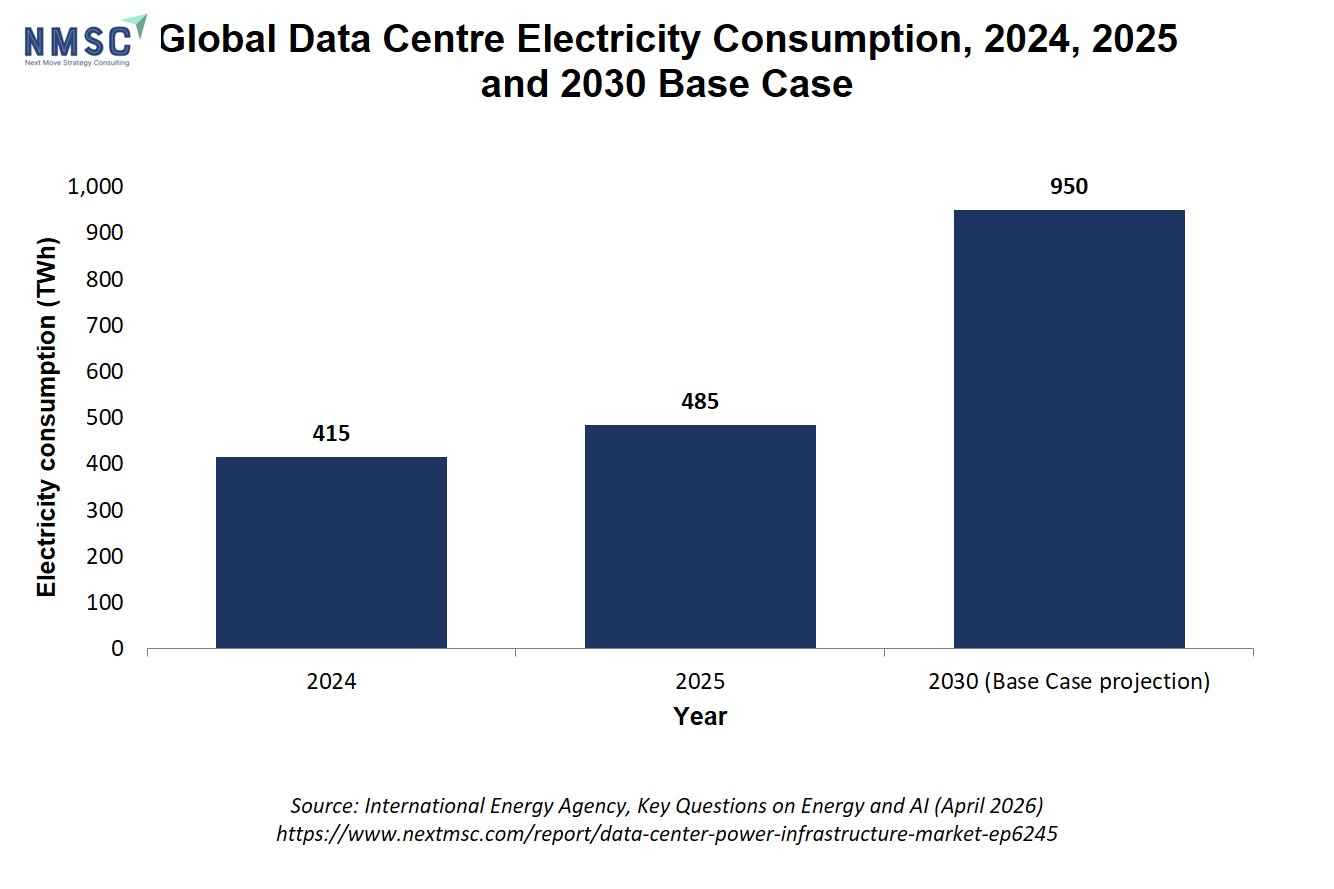
The International Energy Agency reports global data centre electricity consumption of 415 TWh in 2024 and 485 TWh in 2025. Its Base Case projects 950 TWh in 2030; that value is a projection, not an observed figure.
That demand is meeting physical limits in the supply of equipment and grid capacity. The IEA reports that supply chains for gas turbines and transformers tightened over the past year and records a 70% surge in gas turbine orders in 2025. Using data from the Electric Reliability Council of Texas, the IEA shows the state’s large-load connection queue, about three-quarters of it data centres, rising from around 63 GW in December 2024 to more than 230 GW by January 2026, against an all-time peak demand of 85 GW. Constrained by slow grid connections, developers are advancing projects with onsite natural gas generation, largely in the United States, and the IEA expects around 15 to 27 GW of onsite natural gas to power data centres by 2030. NextMSC primary research and analysis indicates that these grid bottlenecks directly accelerate operator demand for onsite turbines, switchgear, microgrid controllers and substation transformers.
Data Centre Power Demand and Supply Chain Indicators, IEA April 2026
|
Indicator |
Value |
Status |
|
Global data centre electricity consumption, 2025 |
485 TWh |
IEA estimate for 2025 |
|
Growth in data centre electricity demand, 2025 |
17% |
Reported; global demand grew 3% |
|
Growth in AI-focused data centre electricity use, 2025 |
50% |
Reported |
|
Data centre electricity consumption, 2030 base case |
950 TWh |
Projection |
|
Capital expenditure of five large technology companies, 2025 |
More than USD 400 billion |
Reported |
|
Expected change in that capital expenditure, 2026 |
75% increase |
Projection |
|
Growth in gas turbine orders, 2025 |
70% |
Reported |
|
Large-load connection queue in Texas, January 2026 |
More than 230 GW |
Reported; all-time peak demand is 85 GW |
Key Industry Developments: Two September Announcements, Two Different Bets
Eaton said the COL Group transaction expands its European power distribution platform and manufacturing footprint, and that it broadens the company’s ability to supply resilient, sustainable power infrastructure and integrated grid-to-chip power solutions to utility and data centre customers. Eaton’s data centre expansion has run through acquisitions before: in March 2025, it agreed to acquire Fibrebond, a United States designer and builder of modular power enclosures for data centres, industry, utilities and communications, according to Power Technology’s September 2026 coverage of the COL Group deal.
“Joining Eaton marks an important milestone in COL Group’s growth journey”
- Calogero Saeli, Chief Executive Officer, COL Group, Eaton acquisition announcement, as reported by DatacenterDynamics, September 2026.
Three days earlier, on 21 September 2026, ABB launched Infinitus, which it describes as the industry’s first integrated source-to-rack direct current portfolio for AI data centres. ABB’s press release lists five building blocks: medium-voltage powertrains, DC sources and power quality, DC power distribution, DC power protection and cooling optimisation, built around ABB’s solid-state transformer technology. ABB said next-generation AI chips are expected to draw 1 MW per rack and beyond, compared with almost 200 kW today, that several main components will be produced within 12 months, and that the first DC-native facilities using the complete portfolio are expected to be operational within two to three years. ABB estimates that between 25% and 40% of new data centre capacity installed in 2030 could use DC distribution, according to AWP Alliance News reporting on 21 September 2026.
The IEA adds a caution on timing. In Key Questions on Energy and AI, the agency notes that large-scale solid-state transformers are not yet commercially available and that deployment is limited to niche applications, even though the technology offers a 70% lower material footprint than traditional transformers. The IEA also explains the engineering case for the shift: doubling voltage from 400 volts to 800 volts allows the copper cable needed for the same power to shrink by a factor of four, while moving from alternating to direct current reduces the number of conversion steps between grid and chip.
Two September 2026 Announcements in Data Centre Power Supply
|
Announcement |
Date |
Key details |
|
Eaton agreement to acquire COL Group from Oaktree |
25 September 2026 |
Enterprise value of €810 million; COL Group forecasts €250 million of 2027 sales; about 400 employees; facilities in Turin, Milan, Bergamo and Catania; closing expected in the first quarter of 2027 |
|
ABB launch of the Infinitus direct current portfolio |
21 September 2026 |
Five building blocks built around solid-state transformer technology; racks of 1 MW and above versus almost 200 kW today; first DC-native facilities expected within two to three years |
Segment Dynamics: Distribution Anchors Revenue While Storage and DC Architectures Grow Fastest
NextMSC primary research and analysis shows that Power Distribution and Protection is the largest product segment, holding about 32% of the market in 2025 at USD 8.63 billion and rising to USD 31.72 billion by 2035. That segment covers transformers, switchgear, transfer switching, busway and power distribution units, the product families that COL Group’s medium-voltage switchgear portfolio addresses. Electrical Energy Storage is the fastest-growing product segment at a 16.81% CAGR from 2026 to 2035, rising from USD 1.89 billion in 2025 to USD 10.00 billion by 2035, with battery energy storage systems growing at 19.20%. The IEA’s findings point the same way: AI training and model use induce large and rapid power swings, making storage critical, and around 20 to 25 GW of battery storage could be installed in data centres globally by 2030.
By electrical architecture, NextMSC primary research and analysis finds that AC-Dominant Architecture remains the largest category, expanding from USD 23.22 billion in 2025 to USD 80.80 billion by 2035, while DC-Dominant Architecture is the fastest growing at a 24.90% CAGR from 2026 to 2035. By sales channel, EPC and Turnkey Integrator is the fastest-growing route to market at 15.17%, and NextMSC analysis projects that it overtakes direct OEM sales, valued at USD 10.26 billion in 2025, by 2035, shifting purchasing authority toward design-build contractors.
Regional Outlook: North America Leads While Europe Gains a Capacity Anchor
North America held approximately 40% of the market in 2025 at USD 10.80 billion and is projected to reach USD 38.23 billion by 2035 at an 11.92% CAGR, according to NextMSC primary research and analysis. Asia-Pacific follows at USD 8.10 billion in 2025, growing at 14.32% to USD 34.99 billion by 2035. Europe is forecast to expand from USD 5.40 billion to USD 18.17 billion at 11.32%, and Middle East & Africa is the fastest-growing region at 17.15%, rising from USD 1.49 billion to USD 8.06 billion. The IEA’s European findings explain why Eaton is adding capacity there: the agency’s analysis shows that the data centre project pipeline in the European Union implies capacity 2.3 times current installed capacity, although overcoming energy constraints will be critical to achieving it. Demand is concentrated in three regions: the IEA April 2025 report Energy and AI found that the United States accounted for 45% of global data centre electricity consumption in 2024, followed by China at 25% and Europe at 15%.
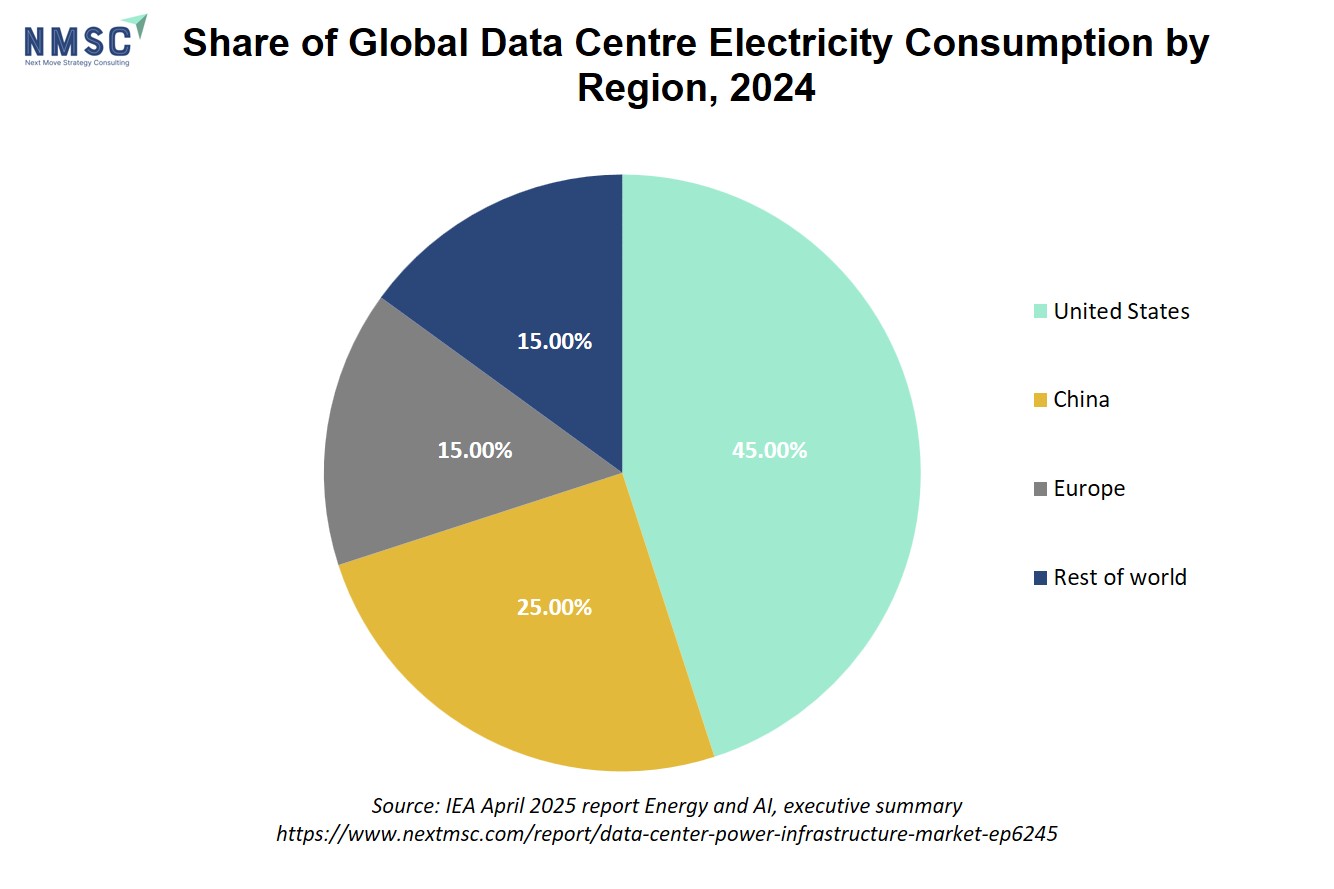
The IEA reports that the United States accounted for 45% of global data centre electricity consumption in 2024, China for 25% and Europe for 15%. The remaining 15% is the balance of the world, calculated as 100.0% minus the three reported regions.
Growth Drivers and Restraints: What the External Evidence Shows
Spending data from the United States shows the scale of investment in data centre infrastructure. The U.S. Census Bureau reported on November 2, 2026, that total construction spending for September 2026 reached a seasonally adjusted annual rate of USD 2,186.1 billion, down 1.9% from the revised August figure of USD 2,227.4 billion. However, data centre construction continued to expand. According to an Associated Builders and Contractors (ABC) analysis of Census Bureau data published on November 2, data centre construction spending increased 8.6% month over month in September and grew at an annualised rate of 217% since May 2026. ABC Chief Economist Anirban Basu noted that data centres accounted for virtually all the increase in nonresidential construction spending, highlighting the growing influence of AI infrastructure investment on the U.S. construction market.
United States Construction Spending, August 2026
|
Measure |
Value |
Basis |
|
Total construction spending, September 2026 |
USD 2,186.1 billion |
Seasonally adjusted annual rate |
|
Change in total construction spending from August 2026 |
1.9% decrease |
Month over month |
|
Nonresidential construction spending, September 2026 |
USD 1.325 trillion |
Seasonally adjusted annual rate |
|
Change in nonresidential construction spending |
0.6% increase |
Month over month |
|
Change in data centre construction spending |
8.6% increase |
Month over month |
|
Data centre construction spending growth since May 2026 |
217% |
Annualised rate |
“Frankly, it’s becoming difficult to contextualize the size and speed of this boom”
- Anirban Basu, Chief Economist, Associated Builders and Contractors, Associated Builders and Contractors analysis of U.S. Census Bureau data, as reported by Modern Distribution Management, October 2026.
The restraints are equally concrete. The IEA identifies shortages of gas turbines and transformers, together with grid connection delays and permitting strain, as the factors holding back the pace of expansion. It also states that providing reliable onsite gas power for variable data centre load requires overbuilding generation by 30% to 70% relative to demand, so onsite power does not necessarily offer a faster route to market while turbines are in short supply. Financing is a further variable: the IEA reports that normally cash-rich AI companies issued around USD 200 billion in debt in 2025, and that the pace of data centre growth will remain sensitive to market sentiment on returns from AI.
NMSC Strategic Perspective: Capacity Is the Near-Term Contest, Architecture the Next
NextMSC primary research and analysis reads the two September announcements as responses to two different scarcities. Eaton’s COL Group agreement addresses the scarcity of manufacturing capacity for medium-voltage distribution equipment, the largest product segment, which NextMSC places at USD 8.63 billion in 2025. ABB’s Infinitus launch addresses the scarcity of a validated architecture for racks drawing 1 MW and above, a shift that the IEA says remains at an early phase of commercialisation for solid-state transformers.
The sequencing matters for suppliers. NextMSC primary research and analysis shows AC-Dominant Architecture accounting for USD 23.22 billion of 2025 revenue and remaining the largest architecture in 2035, so near-term order books still depend on AC-compatible distribution capacity, while the 24.90% CAGR of DC-Dominant Architecture rewards suppliers that qualify products early. NextMSC analysis also indicates that competitive advantage in North America is increasingly driven by a supplier’s ability to guarantee early manufacturing capacity reservation for hyperscalers, and that the shift toward EPC and turnkey integrators will concentrate framework orders among suppliers able to commit capacity in advance.
Two risks qualify this view. NextMSC primary research and analysis lists a possible slowdown in AI capital spending among the principal risks to the forecast, and the IEA’s observation that data centre financing has outgrown company balance sheets supports that concern. Component supply restraints, in NextMSC’s assessment, remain temporary because of aggressive capacity expansion by key vendors, so buyers that secure equipment slots early are positioned to capture the 13.05% CAGR through 2035.
Competitive Landscape
NextMSC primary research and analysis characterises the market as moderately concentrated, with electrical majors, critical power specialists and engine and turbine manufacturers competing directly for hyperscale campus deployments. Eaton and ABB sit in the first group, which competes on portfolio breadth and global service. In NextMSC’s assessment, companies compete on delivery capacity, grid-to-rack portfolio breadth and the ability to commit manufacturing slots to hyperscale frameworks, which is consistent with Eaton’s acquisition logic and with ABB’s decision to bundle solid-state transformers, distribution, protection and cooling into a single portfolio built with NVIDIA’s 800-volt direct current architecture in view. ABB’s release notes that the portfolio extends its collaboration with NVIDIA, first announced in October 2025.
Bottom Line
Eaton’s €810 million agreement for COL Group and ABB’s Infinitus launch, announced within three days of each other in September 2026, mark the point at which data centre power competition moves from product specifications to manufacturing capacity and direct current architecture. The IEA’s April 2026 evidence supports the urgency: data centre electricity demand grew 17% in 2025, technology capital expenditure exceeded USD 400 billion, and the Texas large-load queue reached more than 230 GW against an 85 GW peak. NextMSC primary research and analysis values the market at USD 27.00 billion in 2025 and projects USD 104.96 billion by 2035 at a 13.05% CAGR, with distribution and protection the largest segment and storage and DC architectures growing fastest. Suppliers that reserve capacity and certify 800-volt products stand to gain; those exposed to a slowdown in AI spending or to unresolved turbine and transformer shortages face the main risks.
About Next Move Strategy Consulting
Next Move Strategy Consulting is a premier market research and management consulting firm that has been committed to provide strategically analysed well documented latest research reports to its clients. The research industry is flooded with many firms to choose from, what makes NMSC different from the rest is its top-quality research and the obsession of turning data into knowledge by dissecting every bit of it and providing fact-based research recommendation that is supported by information collected from over 500 million websites, paid databases, industry journals and one on one consultations with industry experts across a diverse range of industry sectors. The high-quality customized research reports with actionable insights and excellent end-to-end customer service help our clients to take critical business decisions that enables them to move beyond time and have competitive edge in the industry.
We have been servicing over 1000 customers globally that includes 90% of the Fortune 500 companies over a decade. Our analysts are constantly tracking various high growth markets and identifying hidden opportunities in each sector or the industry. We provide one of the industry’s best quality syndicate as well as custom research reports across 10 different industry verticals. We are committed to deliver high quality research solutions in accordance to your business needs. Our industry standard delivery solutions that ranges from the pre consultation to after-sales services, provide an excellent client experience and ensure right strategic decision making for businesses.
For more information, please contact:
Next Move Strategy Consulting
5th Floor 867 Boylston St, STE 500,
Boston, MA 02116, U.S.
E-Mail: [email protected]
Direct: +1-217-650-7991
Website: www.nextmsc.com
About the Author
 Sanyukta Deb
— Sanyukta Deb is Digital Marketing Team Lead at Next Move Strategy Consulting, where she has led content strategy and technical SEO for the firm's B2B market research publications for over 2 years. Her editorial process translates NextMSC's primary and secondary research — spanning technology, industrial, and consumer sectors — into commercial narratives, backed by search-intent, keyword, and competitive analysis. She brings 5 years of overall experience in digital marketing and content strategy.
About the Reviewer
 Debashree Dey
— Debashree Dey is Assistant Manager at Next Move Strategy Consulting, where she supports cross-vertical market content and communications across diverse industries for 6 years. Her professional background includes senior content writing, communications, and published manuscript authorship, with experience developing audience-focused business narratives and maintaining clear, consistent messaging. Her role supports research-led content development and editorial quality across NextMSC publications.
















Add Comment