Eco-Friendly Phone Cases Market to Reach $13.28 Billion by 2030

EU's ECGT Directive Enforcement Countdown Triggers Global Greenwashing Crackdown, Reshaping Sustainability Claims Across the Mobile Accessories Sector as Plastic Waste Crisis and Smartphone Proliferation Drive Structural Demand
On March 27, 2026, the transposition deadline for EU Directive 2024/825 — formally titled the Empowering Consumers for the Green Transition (ECGT) Directive — passed across all European Union member states, initiating a six-month countdown to full enforcement on September 27, 2026. The directive, published in the Official Journal of the European Union, fundamentally amends two foundational consumer protection instruments — the Unfair Commercial Practices Directive (2005/29/EC) and the Consumer Rights Directive (2011/83/EU) — and introduces the most stringent regulatory framework for environmental product claims in the EU's legislative history.
From September 27, 2026, generic environmental claims — including terms such as "eco-friendly," "green," "sustainable," and "climate neutral" — are prohibited across all consumer-facing communications unless substantiated by a recognized, independently verified certification scheme. Companies that do not comply may be liable for penalties reaching up to 4% of annual turnover, with national enforcement authorities empowered to impose fines and mandate product withdrawal from EU retail channels. Critically, the directive applies to any company communicating with EU consumers, regardless of where the company is headquartered — extending its reach to North American, Asian, and global brands selling into the European market.
"The ECGT Directive is expected to have implications across multiple functions within an organisation, including data, communications, procurement and legal," noted the Carbon Trust in its April 13, 2026 analysis of the directive's operational implications. "From 27 September 2026, consumer-facing claims will need to be supported by certification or sustainability labelling schemes with independent third-party verification, creating a greater opportunity for brand differentiation and to communicate climate action with greater confidence."
For the global Eco-Friendly Phone Cases Market, the ECGT Directive represents a structural inflection point of the highest order. Brands that have built market positioning on generic sustainability language — without third-party certification, lifecycle assessment data, or independently verified environmental claims — face immediate compliance risk across the EU market. Simultaneously, brands that have invested in rigorous material certification, closed-loop production systems, and transparent environmental reporting are positioned to capture significant competitive advantage as the regulatory landscape eliminates unsubstantiated "greenwashing" from the market.
For More Information – Download FREE Sample on Eco-Friendly Phone Cases Market Report
The global eco-friendly phone cases market is projected to reach USD 13.28 billion by 2030, advancing at a compound annual growth rate (CAGR) of 4.5% over the 2025–2030 forecast period, according to Next Move Strategy Consulting (NMSC).
The Plastic Waste Crisis: The Structural Foundation of Market Demand
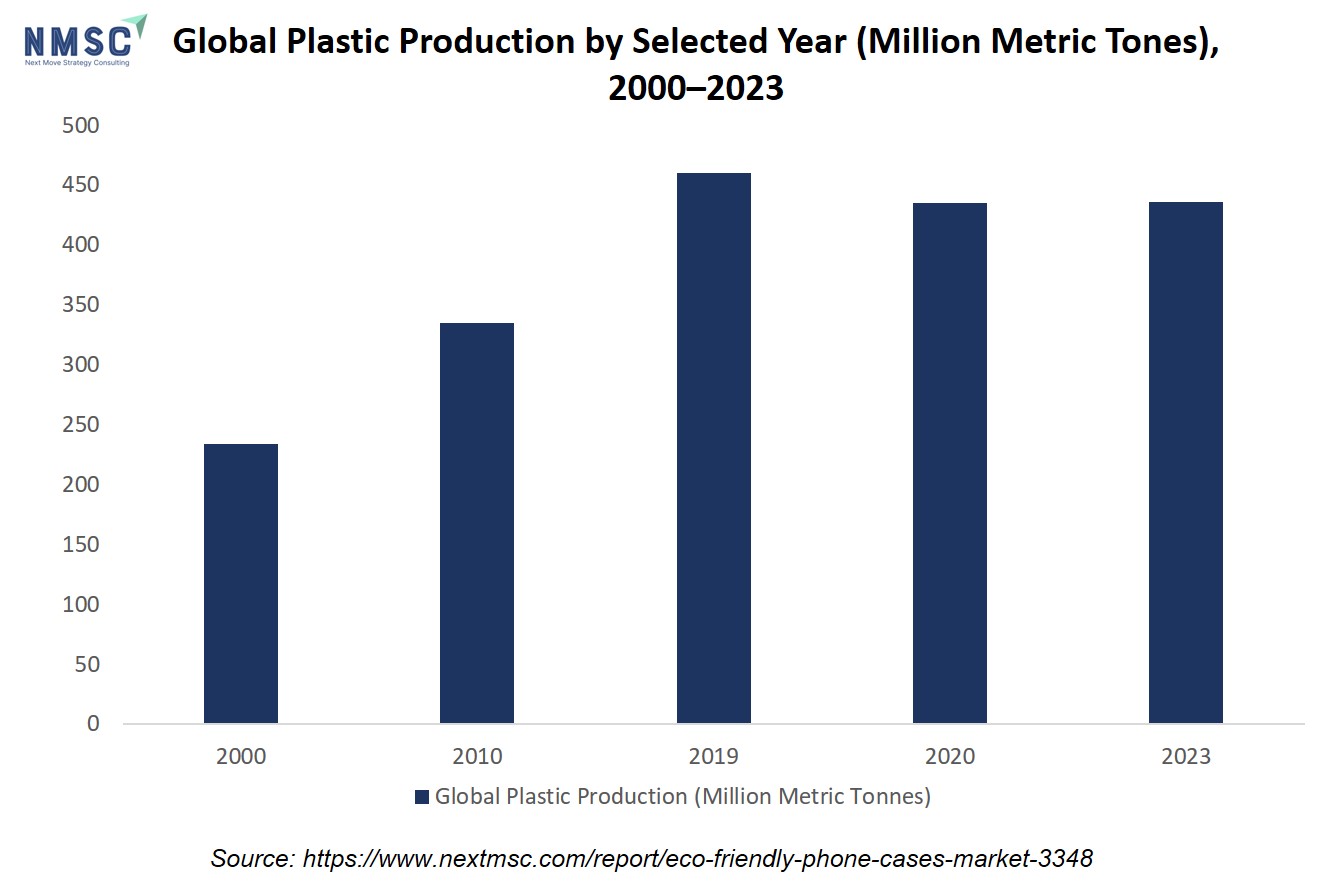
The eco-friendly phone cases market is, at its core, a market born from a global environmental emergency. Global plastic production reached 436 million metric tons in 2023, according to UNCTAD's Global Trade Update published in August 2025, with trade in plastics surpassing USD 1.1 trillion in the same year. The OECD's Global Plastics Outlook documents the trajectory of this crisis: global plastic production stood at 234 million tonnes in 2000, rising to 335 million tonnes by 2010 and reaching a pre-pandemic peak of 460 million tonnes in 2019 before declining to 435 million tonnes in 2020 due to COVID-19-related demand contraction.
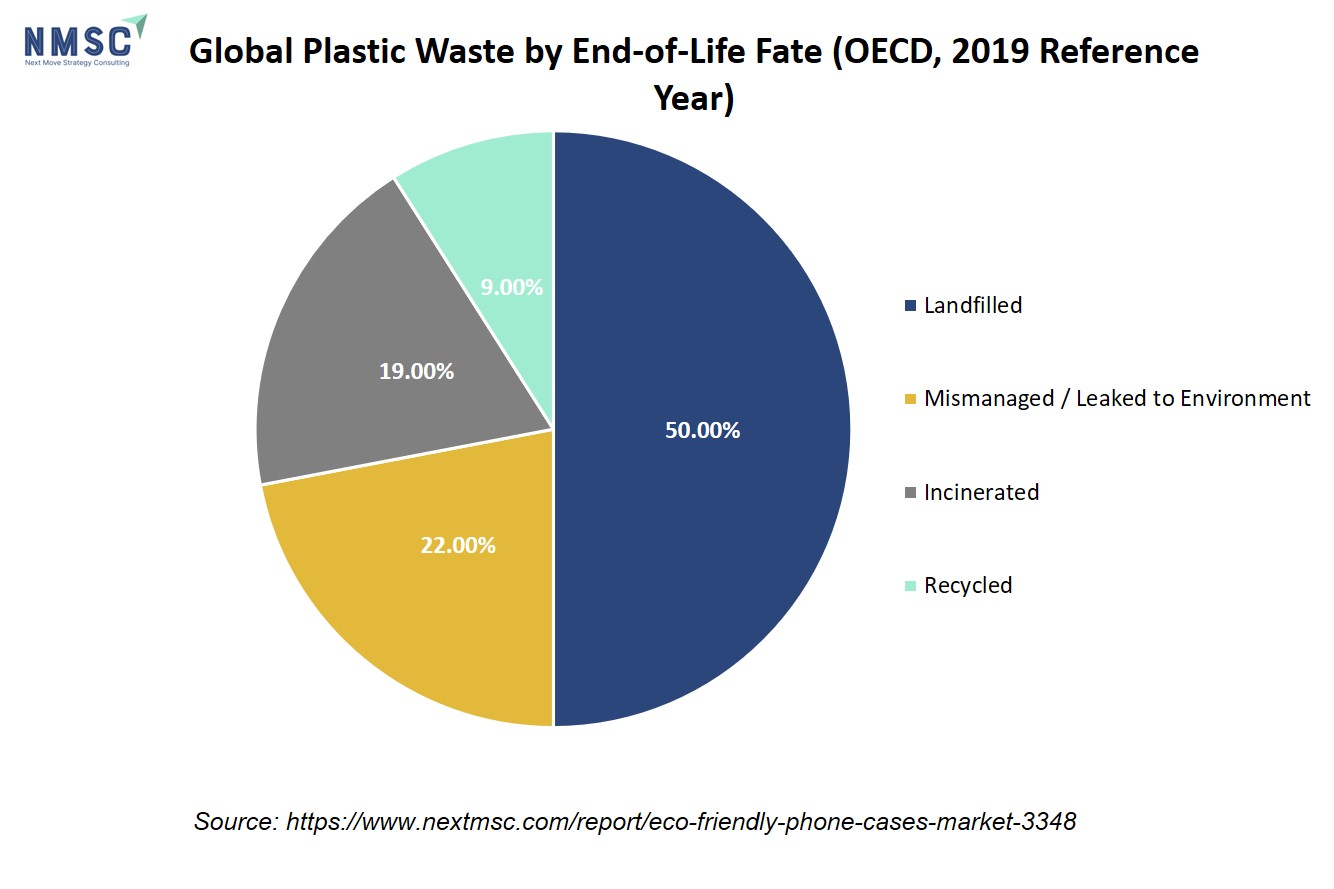
The OECD's analysis of plastic waste fate reveals the scale of the systemic failure: of all plastic waste generated globally, only 9% is recycled, 19% is incinerated, 50% is landfilled, and 22% is mismanaged or leaked into the natural environment — including oceans, waterways, and terrestrial ecosystems. Traditional phone cases — predominantly manufactured from polycarbonate, thermoplastic polyurethane (TPU), and acrylonitrile butadiene styrene (ABS) — contribute directly to this waste stream, as they are typically non-recyclable through standard curbside programs and are discarded with each device upgrade cycle.
The UNEP's Global Waste Management Outlook 2024 projects that municipal solid waste generation will grow from 2.1 billion tonnes in 2023 to 3.8 billion tonnes by 2050 under a business-as-usual scenario, underscoring the urgency of transitioning consumer goods — including mobile accessories — toward biodegradable, compostable, and recycled-material alternatives.
ECGT Directive: Operational Implications for Eco-Friendly Phone Case Brands
The ECGT Directive's operational implications for the eco-friendly phone cases sector are immediate and far-reaching. The directive introduces six categories of prohibited or restricted commercial practices directly relevant to sustainable mobile accessories brands.
-
First, generic environmental claims — including "eco-friendly," "green," "sustainable," "natural," and "climate neutral" — are prohibited unless accompanied by specific, substantiated, and independently verified evidence. For phone case brands that have relied on broad sustainability messaging without lifecycle assessment data or third-party certification, this represents a fundamental communications overhaul requirement.
-
Second, sustainability labels may only be used if based on a recognized certification scheme established by a public authority or meeting the directive's minimum criteria for transparency, impartiality, and regular third-party verification. Self-created certification schemes or unverifiable labels are prohibited from September 27, 2026.
-
Third, forward-looking environmental claims — such as "will be 100% recycled by 2026" or "net zero by 2030" — must be supported by a detailed, realistic implementation plan with measurable targets, allocated resources, and third-party verification.
The Sustainable Packaging Coalition's 2026 Sustainable Packaging Trends Report, published in April 2026, reinforces the broader regulatory momentum: "Compliance has taken center stage across teams' sustainable packaging strategies. Companies are channeling enormous bandwidth and resources into navigating Extended Producer Responsibility (EPR) programs in the U.S., the EU's PPWR legislation, and the UK's recyclability assessments and reporting requirements." The report further notes that 1 in 5 Americans now lives in an Extended Producer Responsibility state, reflecting the accelerating pace of sustainable packaging regulation across North America.
EU ECGT Directive (2024/825) — Key Compliance Requirements and Timeline for
|
Compliance Area |
Requirement |
Effective Date |
Penalty Exposure |
Applicability |
|
Transposition to National Law |
All EU member states required to incorporate ECGT into national legislation |
March 27, 2026 |
N/A (legislative deadline) |
All EU member states |
|
Generic Green Claims |
Terms such as "eco-friendly," "green," "sustainable," "climate neutral" prohibited without substantiation |
September 27, 2026 |
Up to 4% of annual turnover |
All B2C brands selling in EU |
|
Sustainability Labels |
Only labels from recognized, independently verified certification schemes permitted |
September 27, 2026 |
Up to 4% of annual turnover |
All B2C brands using eco-labels |
|
Self-Created Certification Schemes |
Prohibited; must meet minimum criteria for transparency, impartiality, and third-party verification |
September 27, 2026 |
Up to 4% of annual turnover |
All B2C brands |
|
Forward-Looking Environmental Claims |
Must be supported by detailed, independently verified implementation plans with measurable targets |
September 27, 2026 |
Up to 4% of annual turnover |
All B2C brands |
|
Supply Chain Compliance |
Retailers selling non-compliant products in EU may also face penalties |
September 27, 2026 |
Fines (amount varies by member state) |
Retailers and distributors |
|
Geographic Scope |
Applies to any company communicating with EU consumers, regardless of headquarters location |
September 27, 2026 |
Up to 4% of annual turnover |
Global brands with EU market presence |
Smartphone Proliferation: The Demand Multiplier
The eco-friendly phone cases market's growth trajectory is structurally anchored to global smartphone adoption, which continues to expand the addressable market at scale. The International Telecommunication Union (ITU) reported 6.8 billion smartphone users globally in 2024, with mobile cellular subscriptions reaching 112 per 100 inhabitants worldwide — reflecting the near-universal penetration of mobile devices across developed markets and rapidly expanding adoption across emerging economies.
Global mobile broadband subscriptions stood at 95 per 100 inhabitants in 2024, according to ITU, while 5G networks are estimated to cover 55% of the world's population in 2025 — reflecting strong momentum in advanced connectivity infrastructure that drives device upgrade cycles and, consequently, demand for new phone accessories including protective cases. The GSMA's Mobile Economy 2026 report confirms that mobile technologies and services generated USD 7.6 trillion for the global economy in 2025, equivalent to 6.4% of global GDP — underscoring the scale of the mobile ecosystem within which the eco-friendly phone cases market operates.
The NMSC report highlights that rising smartphone adoption significantly boosts eco-friendly phone case market expansion, as increasing global smartphone penetration drives demand for accessories that align with growing environmental consciousness. In regions like North America and Europe, where the U.S. Census Bureau notes a median household income of USD 81,060 in 2024 and Eurostat highlights that 93% of EU citizens prioritize environmental protection, eco-friendly phone cases made from biodegradable or recycled materials are gaining measurable commercial traction.
Global Mobile and Smartphone Connectivity Key Indicators (ITU / GSMA, 2024–2025)
|
Indicator |
Value |
Reference Year |
|
Global smartphone users |
6.8 billion |
2024 |
|
Global mobile cellular subscriptions (total) |
25.6 billion |
2024 |
|
Mobile cellular subscriptions per 100 inhabitants (world) |
112 |
2024 |
|
Mobile broadband subscriptions per 100 inhabitants (world) |
95 |
2024 |
|
Global internet users |
~6 billion (74% of world population) |
2024 |
|
5G network population coverage |
55% of world population |
2025 |
|
Mobile technologies contribution to global GDP |
USD 7.6 trillion (6.4% of GDP) |
2025 |
|
New smartphone users added globally (2021–2025) |
Over 700 million |
2021–2025 |
Source: ITU, Facts and Figures 2024 and 2025; GSMA, Mobile Economy 2026; World Bank, Mobile Cellular Subscriptions Indicator, 2024 | Units: As specified
Market Segmentation and Strategic Dynamics
The eco-friendly phone cases market encompasses a diverse and expanding product taxonomy. By material, the market is segmented into biodegradable materials, recycled materials, silicone cases, wooden cases, hemp and plant-based materials, and other materials — with biodegradable and recycled material segments registering the strongest growth momentum as consumer awareness of material lifecycle impacts intensifies. By price range, the market spans low price, mid-range price, and premium price tiers, with the premium segment benefiting from the growing willingness of environmentally conscious consumers to pay a price premium for certified sustainable products.
By distribution channel, online sales — encompassing e-commerce platforms and company websites — represent the dominant and fastest-growing channel, supported by the U.S. Department of Commerce's finding that e-commerce sales of sustainable goods grew by 12% in 2024. The NMSC report notes that key players are leveraging e-commerce to reach a wider audience and communicate their sustainability commitments, enhancing brand reputation and trustworthiness in this evolving market.
A significant market restraint remains the durability perception gap. Consumers expect phone cases to safeguard expensive devices from drops, scratches, and impacts, and some early eco-friendly alternatives faced skepticism regarding their protective capabilities relative to conventional polycarbonate cases. However, ongoing material innovation — including robust plant-based polymers, reinforced recycled composites, and mycelium-based materials — is progressively closing this performance gap, with brands investing in rigorous third-party drop-testing and transparent communication of protective specifications.
Regional Market Dynamics
-
North America maintains its position as the dominant regional market, underpinned by high environmental awareness, strong disposable income, and a concentrated base of sustainability-focused consumers. The U.S. Environmental Protection Agency reports that 67% of U.S. adults are concerned about climate change, driving demand for sustainable consumer goods. The U.S. Census Bureau's median household income figure of USD 81,060 in 2024 supports purchasing power for premium eco-friendly products. The SPC's 2026 report confirms that 1 in 5 Americans now lives in an EPR state, with Extended Producer Responsibility frameworks accelerating the transition toward sustainable packaging and materials across the consumer goods sector.
-
Europe is the most regulatory-intensive regional market, with the ECGT Directive, the EU Packaging and Packaging Waste Regulation (PPWR 2025/40), and the European Commission's Circular Economy Action Plan collectively creating a comprehensive framework that incentivizes and mandates sustainable product design. Eurostat data indicates that 93% of EU citizens view environmental protection as a priority, with Germany and Sweden leading in sustainable consumption policies. The European Environment Agency reports that 60% of consumers in Germany and Sweden prefer eco-labelled products, creating a structurally supportive demand environment for certified eco-friendly phone cases.
-
Asia-Pacific presents the highest long-term growth potential, driven by a large and rapidly expanding consumer base, increasing environmental awareness, and government sustainability initiatives across China, India, South Korea, and Japan. The UNEP notes that Asia-Pacific countries like South Korea and Taiwan are advancing sustainability through policies promoting recyclable products, while Japan's Ministry of the Environment reports growing consumer interest in eco-friendly goods driven by concerns about plastic waste. India's Digital India program enhances online access to sustainable products, expanding the addressable market for e-commerce-distributed eco-friendly phone cases.
Competitive Landscape and Strategic Developments
The global eco-friendly phone cases market is characterized by a fragmented but rapidly consolidating competitive landscape, with sustainability-focused specialists competing against mainstream accessory brands that are integrating eco-friendly product lines into their portfolios. Key players profiled in the NMSC report include Pela Case, Wave Case, Empower Impact Ltd (Goodfind), A Green Co., EcoBlvd LLC, Brown Living, Casulo, Acaso, Tomos Shop, Harper & Blake, Bambuddha, Nimble, Woodcessories, Moment Inc., and Urban Armor Gear LLC.
Strategic differentiation is increasingly centered on material innovation, closed-loop production systems, and third-party certification. Pela Case launched a fully biodegradable phone case made from Flaxstic — a blend of flax straw and plant-based biopolymers — certified to decompose in three to six months, exemplifying how material innovation can align with environmental values while delivering commercially viable products. CASETiFY's Re/CASETiFY program has recycled over 2.1 million phone cases since 2021, saving over 105,000 kg of plastic from landfills, and expanded its program in 2025 to incorporate 65% recycled plastics into new case designs with a target of 100% recycled content by 2026. These initiatives are directly aligned with the ECGT Directive's requirements for substantiated, verifiable environmental claims — positioning these brands favorably as the September 2026 enforcement deadline approaches.
The ECGT Directive is expected to function as a market consolidation catalyst, eliminating brands that rely on unsubstantiated greenwashing while rewarding those with genuine, certified sustainability credentials. Evidence from Amazon's Climate Pledge Friendly programme suggests that products communicating verified sustainability credentials achieve an average 15% sales uplift in Europe within the first year — a commercial incentive that reinforces the strategic value of ECGT compliance for eco-friendly phone case brands.
Bottom Line
The global eco-friendly phone cases market is positioned for sustained, structurally supported growth through 2030, driven by the convergence of three powerful forces: the escalating global plastic waste crisis that is reshaping consumer purchasing behavior; the relentless expansion of the global smartphone installed base that continuously enlarges the addressable market; and an accelerating regulatory environment — led by the EU's ECGT Directive — that is systematically eliminating greenwashing and rewarding brands with genuine, certified sustainability credentials. The ECGT Directive's September 27, 2026 enforcement date represents the most consequential near-term catalyst for market restructuring, creating both compliance risk for brands with unsubstantiated claims and significant competitive opportunity for those with rigorous third-party certification and transparent lifecycle data.
Key risks include the persistent durability perception gap relative to conventional cases, affordability barriers in price-sensitive emerging markets, and the high cost of obtaining and maintaining recognized sustainability certifications. However, the structural tailwinds — rising consumer environmental consciousness, expanding regulatory mandates, material innovation closing the performance gap, and e-commerce enabling direct-to-consumer sustainability storytelling — are sufficiently powerful to sustain the market's 4.5% CAGR trajectory through 2030. For investors and strategic planners, Europe offers the most immediate regulatory-driven opportunity, North America provides the strongest near-term revenue base, and Asia-Pacific represents the highest long-term growth potential. Brands capable of delivering certified, durable, and aesthetically compelling eco-friendly phone cases — backed by independently verified environmental claims — are best positioned to capture disproportionate market share as the sector matures under the new regulatory paradigm.
About Next Move Strategy Consulting
Next Move Strategy Consulting is a premier market research and management consulting firm that has been committed to provide strategically analysed well documented latest research reports to its clients. The research industry is flooded with many firms to choose from, what makes NMSC different from the rest is its top-quality research and the obsession of turning data into knowledge by dissecting every bit of it and providing fact-based research recommendation that is supported by information collected from over 500 million websites, paid databases, industry journals and one on one consultations with industry experts across a diverse range of industry sectors. The high-quality customized research reports with actionable insights and excellent end-to-end customer service help our clients to take critical business decisions that enables them to move beyond time and have competitive edge in the industry.
We have been servicing over 1000 customers globally that includes 90% of the Fortune 500 companies over a decade. Our analysts are constantly tracking various high growth markets and identifying hidden opportunities in each sector or the industry. We provide one of the industry's best quality syndicate as well as custom research reports across 10 different industry verticals. We are committed to deliver high quality research solutions in accordance to your business needs. Our industry standard delivery solutions that ranges from the pre consultation to after-sales services, provide an excellent client experience and ensure right strategic decision making for businesses.
For more information, please contact:
Next Move Strategy Consulting
5th Floor 867
Boylston St, STE 500,
Boston, MA 02116, U.S.
E-Mail: [email protected]
Direct: +1-217-650-7991
Website: www.nextmsc.com
About the Author
 Sanyukta Deb
— Sanyukta Deb is Digital Marketing Team Lead at Next Move Strategy Consulting, where she has led content strategy and technical SEO for the firm's B2B market research publications for over 2 years. Her editorial process translates NextMSC's primary and secondary research — spanning technology, industrial, and consumer sectors — into commercial narratives, backed by search-intent, keyword, and competitive analysis. She brings 5 years of overall experience in digital marketing and content strategy.
Sanyukta Deb
— Sanyukta Deb is Digital Marketing Team Lead at Next Move Strategy Consulting, where she has led content strategy and technical SEO for the firm's B2B market research publications for over 2 years. Her editorial process translates NextMSC's primary and secondary research — spanning technology, industrial, and consumer sectors — into commercial narratives, backed by search-intent, keyword, and competitive analysis. She brings 5 years of overall experience in digital marketing and content strategy.
About the Reviewer
 Debashree Dey
— Debashree Dey is Assistant Manager at Next Move Strategy Consulting, where she supports cross-vertical market content and communications across diverse industries for 6 years. Her professional background includes senior content writing, communications, and published manuscript authorship, with experience developing audience-focused business narratives and maintaining clear, consistent messaging. Her role supports research-led content development and editorial quality across NextMSC publications.
Debashree Dey
— Debashree Dey is Assistant Manager at Next Move Strategy Consulting, where she supports cross-vertical market content and communications across diverse industries for 6 years. Her professional background includes senior content writing, communications, and published manuscript authorship, with experience developing audience-focused business narratives and maintaining clear, consistent messaging. Her role supports research-led content development and editorial quality across NextMSC publications.
















Add Comment