Global Textile Market Confronts Tariff Realignment
U.S. Section 122 Tariffs on 60 Economies Trigger Global Trade Restructuring as Textile Industry Navigates Regulatory Overhaul, Supply Chain Pressures, and Sustainability Mandates
On July 24, 2026, the United States Trade Representative (USTR) imposed tariffs of 10% to 12.5% on textile and apparel imports from 60 economies under Section 122 of the Trade Act of 1974, marking one of the most consequential trade policy interventions in the global textile sector in decades. The action followed the U.S. Supreme Court's February 2026 decision invalidating the administration's earlier International Emergency Economic Powers Act (IEEPA)-based tariffs, after which the Trump administration imposed a sweeping 10% global tariff under Section 122 before escalating further with the July measures. The announcement has sent immediate shockwaves through global sourcing networks, accelerating a structural realignment that industry analysts say will reshape trade flows for years to come.
The tariff action arrives at a moment of acute vulnerability for global textile supply chains. The average tariff rate on U.S. apparel imports had already reached 35.1% in December 2025—a historic high—before the July 2026 measures were announced. For an industry that employs an estimated 60 to 75 million workers worldwide and underpins the economic stability of dozens of developing economies, the policy shift carries consequences that extend well beyond trade balances.
The global textile market, already navigating the dual pressures of geopolitical fragmentation and accelerating sustainability regulation, now faces a fundamentally altered competitive landscape. According to Next Move Strategy Consulting's analysis, the market is positioned for sustained long-term growth, driven by rising consumer demand, technological innovation in fiber production, and expanding applications in technical and industrial textiles—even as near-term headwinds from trade policy uncertainty weigh on investment decisions.
For More Information: Download FREE Sample on Global Textile Market Report
Tariff Architecture Reshapes Sourcing Geography
The July 2026 tariff action represents the latest chapter in a sweeping reconfiguration of U.S. trade policy that has unfolded since 2025. Under the new Section 122 framework, four countries—Bangladesh, Cambodia, Indonesia, and Malaysia—were granted tariff-rate quotas (TRQs) with an initial duration, while the remaining economies face the full 10% to 12.5% levy on textile and apparel imports.
The practical effect has been immediate. Fashion sourcing executives, surveyed by industry analysts in mid-2026, identified U.S. trade policies as the primary operational challenge for the year—a finding that underscores the degree to which tariff uncertainty has displaced other strategic priorities. Notably, the same surveys found little evidence that higher tariffs have encouraged large-scale reshoring of apparel production to the United States, suggesting that the structural economics of global textile manufacturing remain resistant to policy-driven reversal.
The closure of the de minimis loophole—which at its peak permitted more than 1.4 billion duty-free shipments annually, approximately half of which were textiles and apparel—has added a further layer of complexity. An executive order signed by President Trump closed the loophole for commercial shipments globally, effective late August 2025, with bipartisan legislation subsequently codifying the closure effective July 1, 2027. The National Council of Textile Organizations (NCTO) credited the closure with restoring a more level competitive environment for domestic manufacturers.
U.S. Domestic Industry: Resilience Under Strain
The U.S. textile industry entered 2026 in a state of cautious resilience. According to data published by the NCTO and sourced from the U.S. Census Bureau and Bureau of Economic Analysis, the estimated total value of U.S. man-made fiber, textile, and apparel shipments declined to $60.9 billion in 2025, from $63.9 billion in 2024—a contraction of approximately 4.7%. U.S. exports of fibers, textiles, and apparel similarly declined to $27 billion in 2025, from $28 billion in 2024.
Despite these contractions, the industry's integrated supply chain continues to employ 453,122 American workers and maintains its position as the second-largest individual country exporter of textile-related products globally. From 2017 to 2024, the industry invested $34.3 billion in advanced manufacturing capacity within the United States, with $5.5 billion deployed in new plants and equipment in 2024 alone.
The structural challenges, however, are significant. More than 40 U.S. textile plants have closed over the past two and a half years, many in rural communities where textile manufacturing represents the primary economic anchor. Illegal transshipments, customs fraud, and predatory pricing from foreign competitors have compounded the pressure on domestic producers.
The NCTO has secured several policy concessions that provide a degree of near-term relief. Qualifying textile and apparel imports from Mexico and Canada under the U.S.-Mexico-Canada Agreement (USMCA), and from Guatemala and El Salvador under the Dominican Republic-Central America Free Trade Agreement (CAFTA-DR), have been exempted from the sweeping tariff regime. The Western Hemisphere trade corridor, which accounts for approximately 70% of U.S. textile industry exports, has thus been partially insulated from the most disruptive tariff impacts. In November 2025, the Trump administration further secured trade agreement frameworks with El Salvador, Guatemala, Argentina, Ecuador, South Korea, and Switzerland—moves praised by the NCTO as a significant step in enhancing American competitiveness and bolstering the domestic textile sector.
U.S. Textile Industry Key Performance Metrics, 2024–2025
|
Metric |
2024 |
2025 |
Year-on-Year Change |
|
Total Shipments Value (USD Billion) |
63.9 |
60.9 |
–4.7% |
|
Total Exports — Fibers, Textiles & Apparel (USD Billion) |
28.0 |
27.0 |
–3.6% |
|
Industry Employment (Workers) |
~453,000 |
453,122 |
Stable |
|
Capital Investment — New Plants & Equipment (USD Billion) |
5.5 |
N/A |
— |
|
Cumulative Investment, 2017–2024 (USD Billion) |
34.3 |
— |
— |
Notes: NAICS Subsectors 313 (Textile Mills), 314 (Textile Product Mills), 315 (Apparel), and 32522 (Man-Made Fibers). 2021 data used to estimate 2025 NAICS 32522 figure. Capital investment figure reflects 2024 data, the most recent year available.
Global Fiber Production Reaches Record Levels
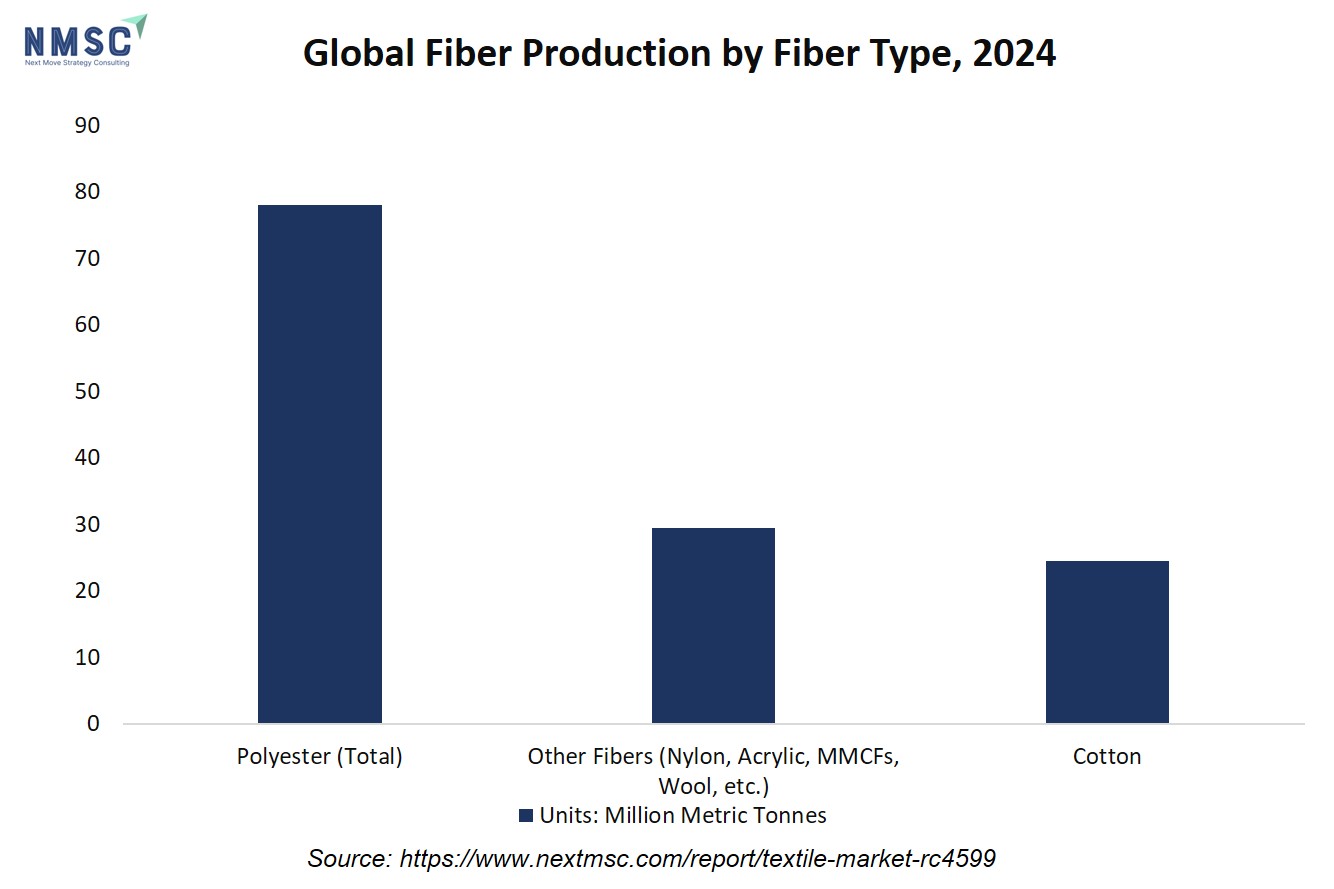
Against the backdrop of trade policy turbulence, global fiber production continued its upward trajectory in 2024. According to Textile Exchange's Materials Market Report 2025, published in September 2025, global fiber production reached 132 million tonnes in 2024, up from 125 million tonnes in 2023—a year-on-year increase of 5.6%. Production has more than doubled since 2000 and has increased by approximately 34 million tonnes since the Paris Agreement in 2015. If current trends persist, production is projected to reach approximately 169 million tonnes by 2030.
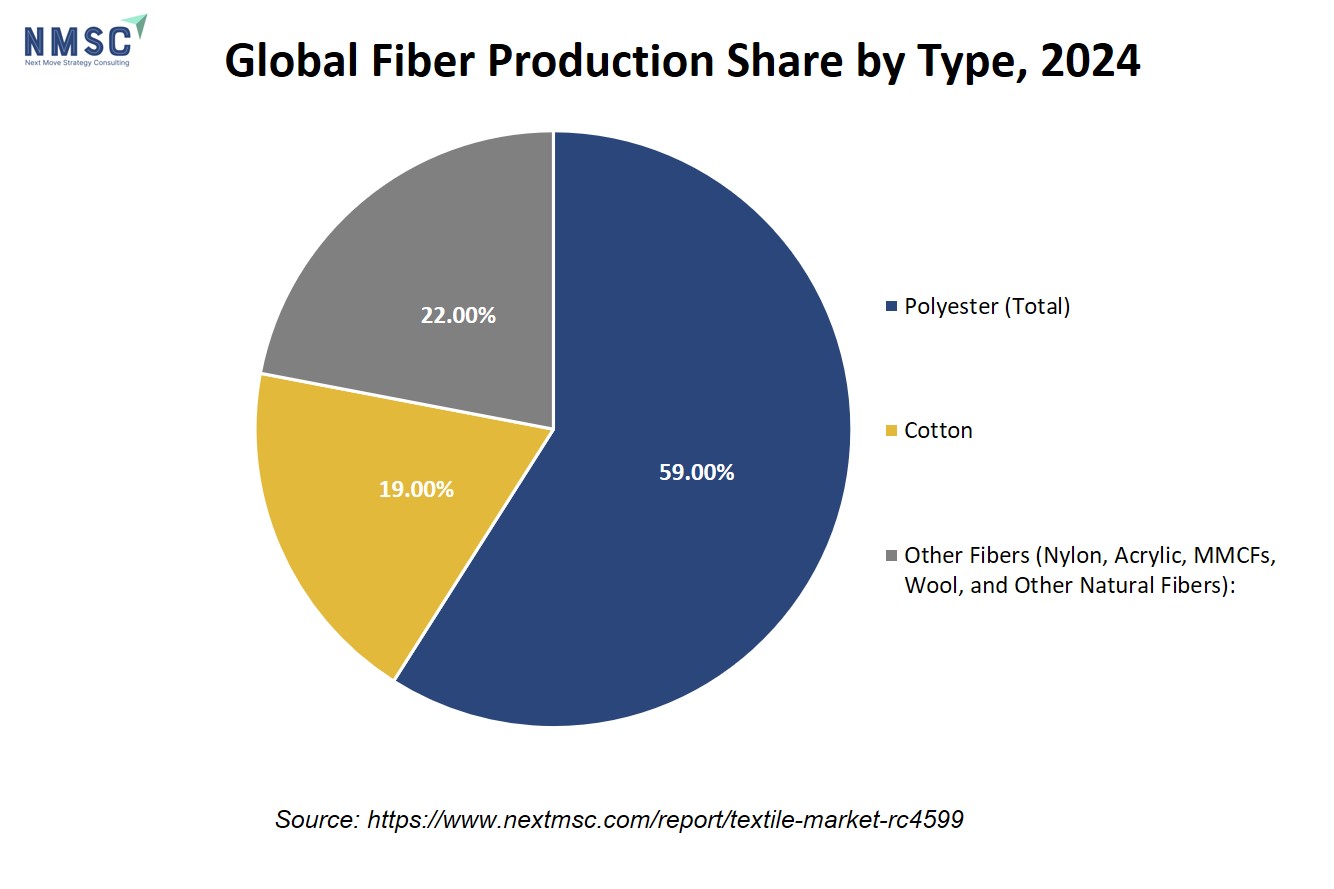
Polyester remains the dominant fiber, accounting for 59% of total global fiber output—equivalent to 78 million tonnes in 2024, up from approximately 71 million tonnes in 2023. Of this, 88% is fossil-based, underscoring the industry's continued reliance on virgin synthetic materials. Recycled polyester increased from approximately 8.9 million tonnes in 2023 to 9.3 million tonnes in 2024, though its market share declined slightly from 12.5% to 12% as virgin polyester production grew at a faster rate.
Cotton, the second most widely produced fiber, saw its global market share decline slightly to 19% in 2024, with production volumes falling marginally from 24.8 million tonnes in 2022/23 to 24.5 million tonnes in 2023/24. The overall share of recycled fibers in global production remained stable at approximately 7.6% in 2024, with less than 1% of the global fiber market derived from pre- and post-consumer recycled textiles—a figure that highlights the significant gap between industry sustainability commitments and current operational reality.
EU Regulatory Overhaul Adds Compliance Imperative
Simultaneously, the European Union's regulatory agenda is imposing a parallel set of structural demands on global textile producers. The EU's Ecodesign for Sustainable Products Regulation (ESPR), which entered into force in 2026, prohibits large enterprises from destroying unsold textiles—a practice that had been widespread across the fast fashion sector. The regulation also mandates the introduction of Digital Product Passports (DPPs), which will require brands to disclose detailed supply chain, material composition, and environmental impact data for textile products.
By December 30, 2026, all medium and large companies operating in the EU market must submit due diligence statements covering their textile supply chains. These requirements are expected to accelerate investment in supply chain traceability technology and certified fiber sourcing, with particular implications for producers in Asia, where the majority of EU-bound textile manufacturing is concentrated.
The regulatory convergence between U.S. tariff policy and EU sustainability mandates is creating a dual compliance burden for global textile manufacturers—particularly those operating across multiple jurisdictions. Industry analysts project the global textile industry to grow at a compound annual rate of approximately 2.7% beginning in 2026, with sustainability-driven product categories and technical textiles expected to outperform the broader market.
China's Market Share Erosion and the Sourcing Diversification Imperative
One of the most consequential structural shifts in global textile trade over the past several years has been the gradual erosion of China's dominance in clothing exports. China's market share in world clothing exports fell to 29.6% in 2024—the lowest level recorded since 2010. This decline reflects a combination of rising domestic labor costs, geopolitical risk aversion among Western buyers, and deliberate sourcing diversification strategies adopted by major apparel brands.
The beneficiaries of this shift have been a diverse set of emerging manufacturing hubs, including Bangladesh, Vietnam, India, Cambodia, and several Central American economies. However, the July 2026 U.S. tariff action—which targets many of these alternative sourcing destinations—has complicated the diversification calculus for global brands, introducing new cost pressures precisely in the markets to which they had been redirecting production.
In parallel, the global textile supply chain is undergoing a geographic reconfiguration driven by nearshoring and friend-shoring imperatives. The Western Hemisphere supply chain—anchored by the USMCA and CAFTA-DR frameworks—is attracting renewed investment interest from U.S. textile manufacturers seeking to reduce exposure to long-haul supply chain risks and tariff volatility. Meanwhile, in 2025, world trade in goods and commercial services increased by 8% to US$34.89 trillion, reflecting the broader resilience of global trade flows even amid policy disruption.
Global Fiber Production Trends by Type, 2023–2024
|
Fiber Type |
2023 Production (Million Tonnes) |
2024 Production (Million Tonnes) |
Year-on-Year Change |
|
Polyester (Total) |
71.0 |
78.0 |
+9.9% |
|
of which: Recycled Polyester |
8.9 |
9.3 |
+4.5% |
|
Cotton |
24.8 |
24.5 |
–1.2% |
|
Other Fibers (Nylon, Acrylic, MMCFs, Wool, etc.) |
29.2 |
29.5 |
+1.0% |
|
Total Global Fiber Production |
125.0 |
132.0 |
+5.6% |
Notes: Recycled polyester figures are a subset of total polyester production and are not additive to the total. "Other Fibers" is calculated as the residual of total production minus polyester and cotton. Cotton figures reflect the 2022/23 and 2023/24 crop seasons respectively.
Strategic Outlook: Navigating Structural Transition
The convergence of U.S. tariff escalation, EU regulatory mandates, and record-level fiber production growth is defining a period of structural transition for the global textile industry. Next Move Strategy Consulting's analysis of the textile market identifies several strategic vectors that will determine competitive positioning over the medium term.
Technical textiles—encompassing applications in automotive, aerospace, medical, defense, and construction sectors—represent one of the highest-growth segments within the broader textile market. The U.S. Berry Amendment, which mandates domestic procurement of textiles for military applications, continues to provide a protected demand base for American manufacturers of high-performance textile products. The Fiscal Year 2026 National Defense Authorization Act included provisions to expand federal investment in the textile industrial base, reinforcing the strategic dimension of domestic textile manufacturing.
Sustainability and circular economy imperatives are reshaping capital allocation across the value chain. Textile Exchange data indicates that 34% of global cotton production now comes from certified sources, and two-thirds of manmade cellulosic fibers (MMCFs) are produced using certified or controlled feedstock—progress that, while meaningful, remains insufficient relative to the scale of the industry's environmental footprint.
Digital transformation—encompassing automation, AI-driven design, and supply chain digitalization—is emerging as a critical differentiator for manufacturers seeking to offset rising input costs and labor pressures. The Textile Exchange's July 2026 launch of Version 2 of the Supply Chain Taxonomy provides an updated harmonized framework for supply chain transparency, a development expected to facilitate more consistent sustainability reporting across the industry.
Bottom Line
The global textile market is navigating one of the most complex policy and structural environments in its modern history. The July 2026 U.S. tariff action on 60 economies has introduced significant near-term uncertainty into global sourcing networks, accelerating supply chain diversification while simultaneously raising costs for brands and consumers. The closure of the de minimis loophole and the EU's Ecodesign for Sustainable Products Regulation are adding compliance complexity that will disproportionately affect smaller manufacturers and those with limited traceability infrastructure. Despite these headwinds, the long-term structural growth drivers of the textile market remain intact. Rising global fiber demand—projected to reach 169 million tonnes by 2030—expanding technical textile applications, and growing consumer preference for certified and sustainable materials provide a durable foundation for market expansion. Investors and industry participants should monitor the evolution of U.S. trade policy, particularly the status of USMCA and CAFTA-DR exemptions, the pace of EU regulatory implementation, and the trajectory of China's market share in global clothing exports. Strategic positioning in nearshore manufacturing, certified fiber sourcing, and digital supply chain infrastructure will be critical determinants of competitive advantage in the years ahead.
About Next Move Strategy Consulting
Next Move Strategy Consulting is a premier market research and management consulting firm that has been committed to provide strategically analysed well documented latest research reports to its clients. The research industry is flooded with many firms to choose from, what makes NMSC different from the rest is its top-quality research and the obsession of turning data into knowledge by dissecting every bit of it and providing fact-based research recommendation that is supported by information collected from over 500 million websites, paid databases, industry journals and one on one consultations with industry experts across a diverse range of industry sectors. The high-quality customized research reports with actionable insights and excellent end-to-end customer service help our clients to take critical business decisions that enables them to move beyond time and have competitive edge in the industry.
We have been servicing over 1000 customers globally that includes 90% of the Fortune 500 companies over a decade. Our analysts are constantly tracking various high growth markets and identifying hidden opportunities in each sector or the industry. We provide one of the industry's best quality syndicate as well as custom research reports across 10 different industry verticals. We are committed to deliver high quality research solutions in accordance to your business needs. Our industry standard delivery solutions that ranges from the pre consultation to after-sales services, provide an excellent client experience and ensure right strategic decision making for businesses.
For more information, please contact:
Next Move Strategy Consulting
5th Floor 867
Boylston St, STE 500,
Boston, MA 02116, U.S.
E-Mail: [email protected]
Direct: +1-217-650-7991
Website: www.nextmsc.com
About the Author
 Sanyukta Deb
— Sanyukta Deb is Digital Marketing Team Lead at Next Move Strategy Consulting, where she has led content strategy and technical SEO for the firm's B2B market research publications for over 2 years. Her editorial process translates NextMSC's primary and secondary research — spanning technology, industrial, and consumer sectors — into commercial narratives, backed by search-intent, keyword, and competitive analysis. She brings 5 years of overall experience in digital marketing and content strategy.
Sanyukta Deb
— Sanyukta Deb is Digital Marketing Team Lead at Next Move Strategy Consulting, where she has led content strategy and technical SEO for the firm's B2B market research publications for over 2 years. Her editorial process translates NextMSC's primary and secondary research — spanning technology, industrial, and consumer sectors — into commercial narratives, backed by search-intent, keyword, and competitive analysis. She brings 5 years of overall experience in digital marketing and content strategy.
About the Reviewer
 Debashree Dey
— Debashree Dey is Assistant Manager at Next Move Strategy Consulting, where she supports cross-vertical market content and communications across diverse industries for 6 years. Her professional background includes senior content writing, communications, and published manuscript authorship, with experience developing audience-focused business narratives and maintaining clear, consistent messaging. Her role supports research-led content development and editorial quality across NextMSC publications.
Debashree Dey
— Debashree Dey is Assistant Manager at Next Move Strategy Consulting, where she supports cross-vertical market content and communications across diverse industries for 6 years. Her professional background includes senior content writing, communications, and published manuscript authorship, with experience developing audience-focused business narratives and maintaining clear, consistent messaging. Her role supports research-led content development and editorial quality across NextMSC publications.


















Add Comment