Emerging Segments in AI in Space Exploration That Investors Should Watch
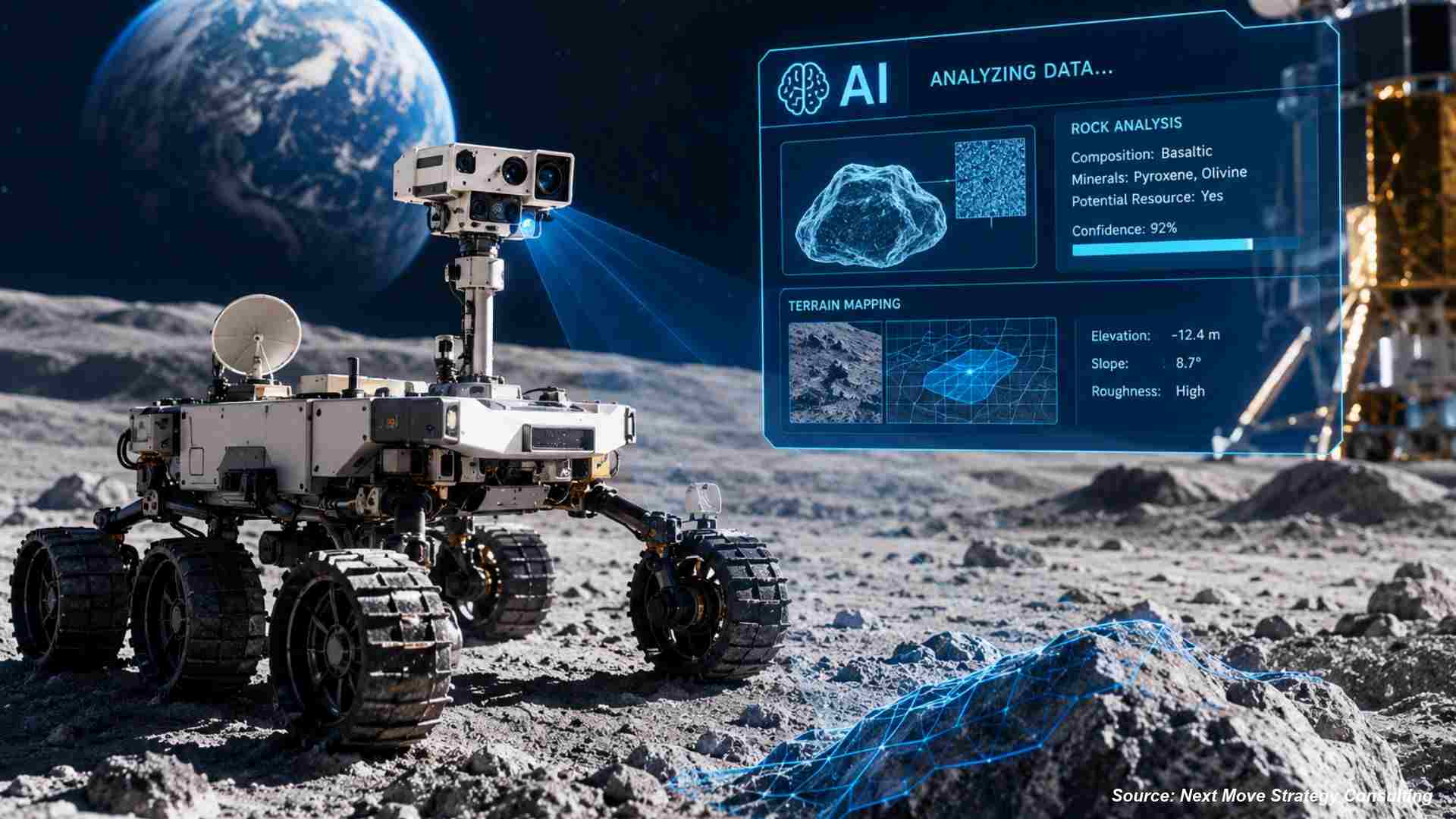
Google's October 1 TPU Satellite Launch Puts Orbital AI Hardware Into Flight Testing and Turns Investor Focus to Onboard Edge Computing, Debris Tracking, Commercial Operators and India
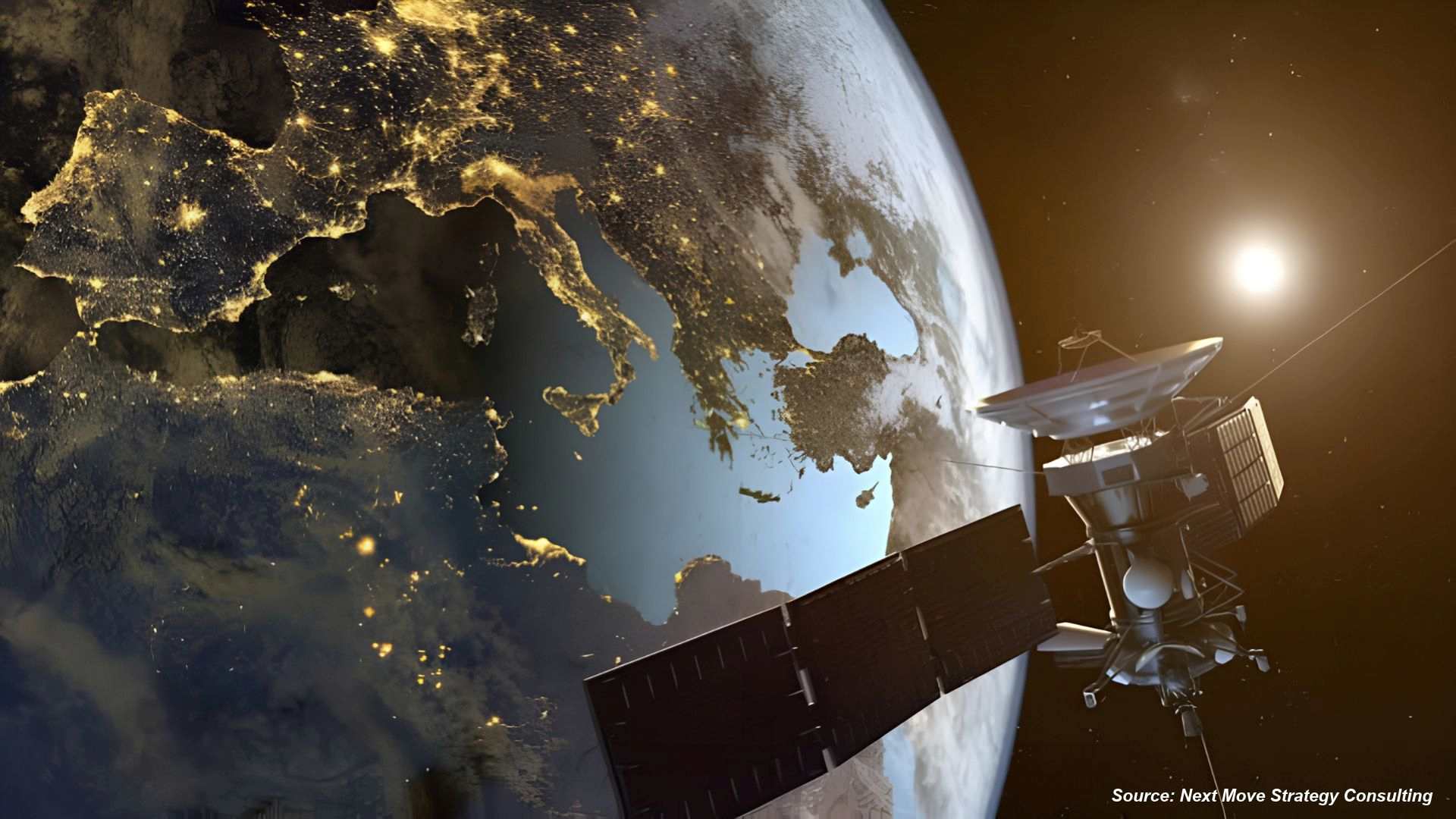
On October 1, 2026, Google launched a refrigerator-sized prototype satellite carrying four of its Tensor Processing Units aboard a SpaceX rocket, the hardware test at the center of Project Suncatcher, the company's effort to establish whether artificial intelligence compute can operate in orbit. NPR reported on October 1, 2026 that the satellite, built with Planet, will run a version of Google's Gemma model in 15-minute sessions because of heat-management limits, and Fortune reported on October 10, 2026 that the mission is planned to run experiments in low Earth orbit for about a year. The launch moves orbital AI compute from design papers to flight data, and it raises a question for investors in the space economy: which segments convert that demonstration into revenue first.
According to Next Move Strategy Consulting's AI in Space Exploration Market report, the global AI in space exploration market was valued at USD 3.20 billion in 2025 and is projected to reach USD 26.34 billion by 2035, growing at a CAGR of 23.5% from 2026 to 2035. NextMSC primary research and analysis places the 2026 market at USD 3.95 billion and finds that growth is concentrated in onboard edge computing and space situational awareness applications, with commercial satellite operators gaining the most pronounced structural momentum through 2035.
For More Information: Download FREE Sample on AI in Space Exploration Market Report
The Compute Squeeze Behind the Launch: Capital, Congestion and Data Volumes
The economic pressure behind orbital AI is visible in the sponsor's own spending. NPR reported on October 1, 2026 that Google chief executive Sundar Pichai said at the company's annual developer summit in May that demand for AI services exceeds supply, and that he expects 2026 capital expenditure of USD 180 billion to USD 190 billion, more than six times the 2022 level. NPR added that opposition to power-hungry terrestrial data centers is growing, and that Google is one of a handful of companies advancing plans to place them in orbit, where energy supply is close to unlimited.
The orbital environment those machines would enter is already crowded. The European Space Agency's Space Environment Report 2026, published on September 14, 2026 with data through the end of 2025, recorded more than 300 launches and over 4,000 new payloads placed in orbit during 2025, equal to about ten payloads launched every day. The same report states that the agency's Space Environment Health Index, a single score for the long-term sustainability of space activity, rose from about 4 to 50 within one year, and that the agency shortened its debris-projection horizon from 200 years to 100 years because the runaway effect of collisions is becoming visible much earlier. Each added satellite increases the volume of sensor data to be downlinked and the number of close approaches to be managed, which is the operating logic for autonomy on board the spacecraft rather than on the ground.
Researchers at Nanyang Technological University in Singapore quantified the data side of that logic. In a framework published in Nature Electronics on October 27, 2025, the university reported that imaging or sensing satellites fitted with AI accelerators could process raw data in orbit and transmit only the essential results, reducing transmission volumes by more than a hundredfold. For a commercial imagery operator, that is the difference between paying to downlink every frame and paying to downlink only the frames that matter, which is where NextMSC primary research and analysis locates the commercial case for onboard edge computing.
Key Industry Developments: What the First Flight Settles and What It Leaves Open
Google developed the prototype with Planet and plans two further satellites in 2027 to test laser links between spacecraft, according to NPR and Fortune. NPR reported that each future satellite is intended to carry dozens of TPU chips. The present mission is narrower. Travis Beals, Google's senior director and lead of Project Suncatcher, described the October 1 satellite to NPR as a minimal test intended to confirm that the chips can run in space, and the chips operate in 15-minute sessions because heat cannot be shed through air or water in a vacuum.
Beals was direct about the economics. He told NPR that he did not expect orbital compute to become cheaper than the terrestrial alternative within five years.
“I think it will take longer than that.”
- Travis Beals, Senior Director and Lead of Project Suncatcher, Google, NPR, Google launches Project Suncatcher, a step towards AI data centers in space, October 1, 2026.
That caution is shared at senior levels. Fortune reported on October 10, 2026 that James Manyika, Google's senior vice president for research, told The New York Times in September 2026 that the effort may follow the pattern of Google's earlier research programs, which ran for about 15 years before products appeared. NPR quoted Brandon Lucia, a professor of electrical and computer engineering at Carnegie Mellon University, who said that maintaining hardware in orbit multiplies cost and complexity by a factor of 10, possibly 100, so a large payoff is required to justify the effort.
Google is not alone in the race. Fortune reported that SpaceX filed plans with the U.S. Federal Communications Commission in early 2026 for a network of up to one million data-center satellites, and that Blue Origin filed a proposal in March 2026 to deploy 51,600 satellites under Project Sunrise. NPR added that SpaceX has said in a regulatory filing that it expects to begin deploying orbital AI compute satellites as early as 2028. Starcloud, a venture-backed startup, launched a satellite in November 2025 carrying an NVIDIA H100 chip, and Cowboy Space Corp., co-founded by Baiju Bhatt, launched its Reason-1 satellite on the same rocket as Google's, Fortune reported.
Orbital AI Compute Programs Now in Filing or Flight
|
Program |
Date |
Scale and status |
|
Google Project Suncatcher prototype, built with Planet |
October 1, 2026 |
Four TPUs; 15-minute operating sessions; about one year of planned experiments; two further satellites planned for 2027 to test laser links |
|
SpaceX orbital data-center constellation |
Early 2026 filing |
Plans filed with the U.S. Federal Communications Commission for up to one million satellites; orbital AI compute satellites expected as early as 2028 |
|
Blue Origin Project Sunrise |
March 2026 |
Proposal to deploy 51,600 satellites |
|
Starcloud satellite with NVIDIA H100 chip |
November 2025 |
Ran an AI model in orbit on a high-powered GPU |
|
Cowboy Space Corp. Reason-1 |
October 1, 2026 |
Launched on the same rocket as Google's prototype; laser power-beaming test to Earth planned |
Deep-space operations supply a second demand signal. According to NASA, the Artemis II crew of four launched on April 1, 2026 and splashed down in the Pacific Ocean on April 10, 2026 after a 10-day journey around the Moon. Missions beyond low Earth orbit face communication delays that ground control cannot bridge in real time, and NextMSC primary research and analysis identifies that constraint as the basis for the 26.4% CAGR it projects for Deep Space and Planetary Missions between 2026 and 2035.
Emerging Segment Dynamics: Where NextMSC Projects Growth Ahead of the Market
NextMSC primary research and analysis shows that the fastest-growing segments are not the segments holding the most revenue today. Ground-Based Computing was the largest deployment category at USD 1.73 billion in 2025, a share of approximately 54%, yet Onboard Edge Computing is projected to expand faster, at a 26.7% CAGR from 2026 to 2035. Earth Orbit Missions held approximately 74% of the market at USD 2.37 billion in 2025, while Deep Space and Planetary Missions lead on growth at 26.4%. Government and Defense Space Agencies were the largest end users at USD 1.66 billion, while Commercial Satellite Operators are projected to grow at 26.3%. Against the overall market's 23.5% CAGR, each of these emerging segments compounds faster.
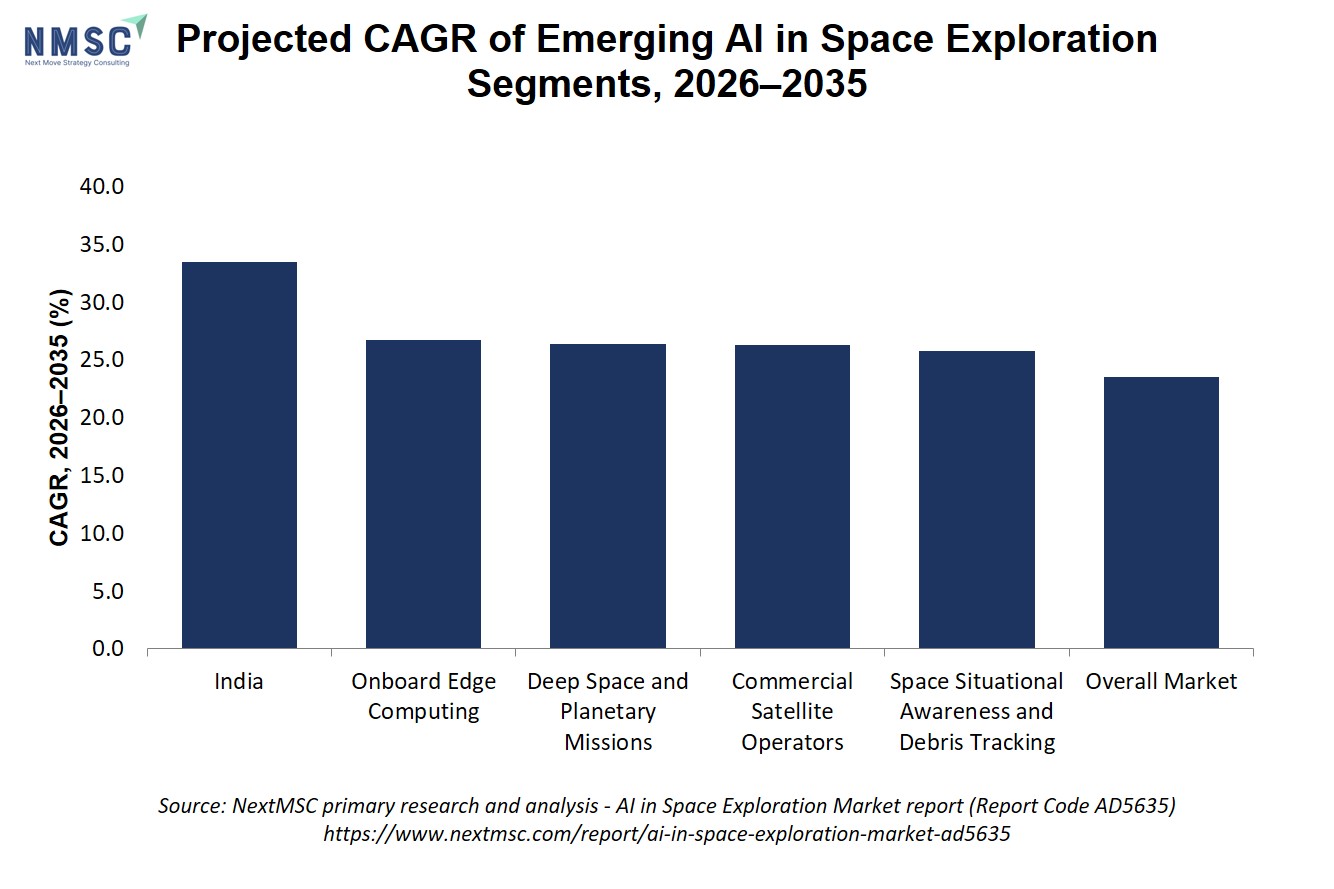
All values are NextMSC projections for 2026 to 2035 from the AI in Space Exploration Market report. India is shown at country level and the overall market is the benchmark.
Segment 1: Onboard Edge Computing
Onboard edge computing is the segment that Google's October 1 launch tests most directly. NextMSC primary research and analysis finds that technology adoption is shifting toward flight-qualified GPU and AI accelerator hardware capable of data-center-class inference in orbit, a shift that is reshaping satellite and spacecraft design. The mechanism is a bandwidth trade: processing raw sensor data before transmission reduces downlink requirements, and the Nanyang Technological University framework puts the possible reduction above 100 times. The principal restraint is qualification. NextMSC primary research and analysis assigns radiation tolerance and hardware qualification cost barriers a negative 2.3% impact on the market's CAGR, and limited onboard compute power and thermal constraints a further negative 1.5%. In NextMSC's assessment, that is why in-orbit performance data on commercial silicon carries commercial weight and not only scientific interest.
Segment 2: Space Situational Awareness and Debris Tracking
Space Situational Awareness and Debris Tracking was valued at USD 0.51 billion in 2025 and is projected to reach USD 5.00 billion by 2035 at a 25.8% CAGR, the fastest-growing application in NextMSC's segmentation. Earth Observation and Data Analytics led in 2025 at USD 0.90 billion. The European Space Agency supplies the demand evidence: its 2026 report describes a growing gap between objects that sensors can detect and objects that can be linked to a known origin, and calls for improved monitoring and space traffic management to avoid collisions and fragmentations. NextMSC primary research and analysis assigns rising satellite constellation density a positive 5.4% impact on the market's CAGR and expanding situational-awareness and debris-tracking mandates a positive 2.1% impact.
Segment 3: Commercial Satellite Operators
Commercial Satellite Operators are projected to grow from USD 1.15 billion in 2025 to USD 11.59 billion by 2035 at a 26.3% CAGR. Government and Defense Space Agencies, at USD 1.66 billion in 2025, are projected to reach the same USD 11.59 billion at a 21.2% CAGR, so NextMSC primary research and analysis shows the commercial end user closing the gap with the institutional buyer by 2035. The mechanism is fleet management at scale: with the European Space Agency counting more than 4,000 payloads placed in orbit in 2025, private operators are scaling autonomous tasking and collision avoidance to manage growing satellite fleets. Entrants such as Starcloud and Cowboy Space Corp., both cited by Fortune, show the same operators and investors testing new compute and power models in orbit.
Segment 4: Deep Space and Planetary Missions
Deep Space and Planetary Missions are projected to grow at a 26.4% CAGR from 2026 to 2035 from a base well below Earth Orbit Missions, which held approximately 74% of the market in 2025. NextMSC primary research and analysis assigns rising deep-space and crewed lunar mission investment a positive 2.8% impact on the market's CAGR in North America and Europe. Its report identifies autonomy for lunar night and communication-blackout scenarios as a point of differentiation for vendors approaching government space agencies, a requirement that NASA's April 2026 Artemis II flight illustrates at crewed scale.
Segment 5: India and Asia-Pacific
Asia-Pacific is the fastest-growing region at a 27.6% CAGR, rising from USD 0.83 billion in 2025 to USD 9.22 billion by 2035, while North America leads in size at USD 1.41 billion in 2025 and grows at 21.5%. Within the region, India is the fastest-growing country in NextMSC's report, expanding from USD 0.12 billion in 2025 to USD 1.94 billion by 2035 at a 33.5% CAGR. China is projected to rise from USD 0.32 billion to USD 3.32 billion at 26.9%, Japan from USD 0.16 billion to USD 1.48 billion at 25.2%, and South Korea from USD 0.07 billion to USD 0.74 billion at 27.6%. NextMSC primary research and analysis attributes the regional momentum to expanding national space programs and satellite constellation investment, and notes that regulatory frameworks are less harmonized than in Europe, which gives vendors flexibility to scale onboard AI deployment quickly.
NextMSC Emerging Segment Scorecard, 2026–2035
|
Segment |
Dimension |
Size, 2025 to 2035 |
CAGR |
Largest counterpart, 2025 |
|
Onboard Edge Computing |
Deployment |
Not published in report summary |
26.7% |
Ground-Based Computing, USD 1.73 billion |
|
Space Situational Awareness and Debris Tracking |
Application |
USD 0.51 billion to USD 5.00 billion |
25.8% |
Earth Observation and Data Analytics, USD 0.90 billion |
|
Commercial Satellite Operators |
End user |
USD 1.15 billion to USD 11.59 billion |
26.3% |
Government and Defense Space Agencies, USD 1.66 billion |
|
Deep Space and Planetary Missions |
Mission type |
Not published in report summary |
26.4% |
Earth Orbit Missions, USD 2.37 billion |
|
Asia-Pacific |
Region |
USD 0.83 billion to USD 9.22 billion |
27.6% |
North America, USD 1.41 billion |
|
India |
Country |
USD 0.12 billion to USD 1.94 billion |
33.5% |
United States, USD 1.24 billion |
Growth Drivers and Restraints
NextMSC primary research and analysis weights six drivers and three restraints against the market's 23.5% CAGR. Rising satellite constellation density is the largest single driver, while radiation tolerance and hardware qualification costs are the largest restraint.
AI in Space Exploration Market: Growth Catalyst and Risk Assessment Matrix
|
Factor |
Type |
Impact on CAGR |
Geography |
Timeline |
|
Rising satellite constellation density requiring autonomous operations |
Driver |
+5.4% |
North America, Asia-Pacific |
2026–2035 |
|
Expanding flight-qualified GPU and AI accelerator hardware availability |
Driver |
+4.7% |
Global |
2026–2035 |
|
Growth of commercial Earth observation data analytics demand |
Driver |
+3.6% |
North America, Europe, Asia-Pacific |
2026–2035 |
|
Rising deep space and crewed lunar mission investment |
Driver |
+2.8% |
North America, Europe |
2026–2035 |
|
Expanding space situational awareness and debris tracking mandates |
Driver |
+2.1% |
Global |
2026–2035 |
|
Growth of national space agency budgets in emerging economies |
Driver |
+1.6% |
Asia-Pacific, Middle East & Africa |
2026–2032 |
|
Radiation tolerance and hardware qualification cost barriers |
Restraint |
−2.3% |
Global |
2026–2032 |
|
Limited onboard compute power and thermal constraints |
Restraint |
−1.5% |
Global |
2026–2030 |
|
Regulatory uncertainty around autonomous spacecraft certification |
Restraint |
−1.0% |
North America, Europe |
2026–2030 |
NMSC Strategic Perspective: Flight Heritage Becomes the Investable Asset
NextMSC primary research and analysis identifies flight heritage, not constellation announcements, as the asset that separates investable vendors from aspirational ones. Satellite operators and space agencies are consolidating AI sourcing around vendors that offer radiation-tolerant, flight-qualified compute hardware paired with mission-specific software, a shift that favors diversified aerospace and semiconductor providers over single-product specialists as orbital compute infrastructure scales through 2035. Google's October 1 launch fits that pattern: over its planned year of operation it will build an in-orbit operating record for Google's TPU family, which is the kind of validated evidence that procurement teams and investors treat as a proxy for long-term contract retention.
The segment evidence points the same way. Onboard Edge Computing, Space Situational Awareness and Debris Tracking, Commercial Satellite Operators and Deep Space and Planetary Missions all grow between 25.8% and 26.7% a year in NextMSC's model, against 23.5% for the whole market. Each depends on hardware that must survive radiation and thermal extremes, which is why the restraints in the matrix above are concentrated on qualification, thermal limits and certification uncertainty and not on demand.
For investors, NextMSC primary research and analysis sizes the absolute dollar opportunity between 2026 and 2035 at USD 22.39 billion, spread across onboard AI hardware, edge computing software and mission analytics. Two cautions apply. First, the cost case for orbital data centers remains unproven by Google's own project lead, who did not expect cost parity within five years. Second, the market was valued at USD 3.20 billion in 2025, so the growth rates reflect a small base. NextMSC's recommendation is to weight exposure toward vendors that can document flight qualification and that sell into both government mission-assurance and commercial rapid-deployment buyers.
Signals that NextMSC primary research and analysis would track over the next twelve months:
-
Results from Google's prototype across its planned year of operation, and the two satellites scheduled for 2027 to test laser links, as reported by NPR on October 1, 2026.
-
SpaceX's stated start of orbital AI compute satellite deployment as early as 2028, as cited by NPR from its regulatory filing.
-
The next edition of the European Space Agency's Space Environment Report, in particular the Health Index and the share of detected objects that cannot be linked to a source.
-
Flight-qualification announcements from the 18 vendors profiled in NextMSC's report, including NVIDIA Corporation and Palantir Technologies Inc.
Competitive Landscape
According to NextMSC primary research and analysis, the market is moderately concentrated, with established aerospace and defense majors competing alongside semiconductor providers and commercial space technology entrants. NextMSC's report profiles 18 companies, including NVIDIA Corporation, Space Exploration Technologies Corp., Palantir Technologies Inc., Lockheed Martin Corporation, Northrop Grumman Corporation, Airbus SE, Thales S.A., The Boeing Company, Planet Labs PBC and Satellogic Inc. Two archetypes dominate: aerospace and defense majors such as Lockheed Martin Corporation, Northrop Grumman Corporation, Airbus SE and Thales S.A. offer mission-qualified, government-contracted autonomous systems, while NVIDIA Corporation and Satellogic Inc. offer rapid-deployment AI compute and software to satellite operators.
Planet Labs PBC, a profiled vendor, is also Google's partner on the Suncatcher satellite, according to Fortune, which illustrates the partnership model through which commercial space companies and compute providers are combining. NextMSC primary research and analysis finds that vendors unable to demonstrate flight-qualified hardware credentials risk exclusion from government mission procurement shortlists in North America and Europe, and that active partnership and integration activity is concentrated among semiconductor providers forming collaborations with launch and satellite operators.
Bottom Line
Google's October 1, 2026 launch of a four-TPU prototype satellite did not prove that orbital data centers are economical; its own project lead told NPR that cost parity will take longer than five years. What the launch did provide is flight data on commercial AI silicon, and that matters most in the segments NextMSC primary research and analysis projects to outgrow the market. The global AI in space exploration market is projected to rise from USD 3.20 billion in 2025 to USD 26.34 billion by 2035 at a 23.5% CAGR, with Onboard Edge Computing at 26.7%, Deep Space and Planetary Missions at 26.4%, Commercial Satellite Operators at 26.3% and Space Situational Awareness and Debris Tracking at 25.8%. Asia-Pacific, at 27.6%, and India, at 33.5%, lead geographically. Radiation qualification, thermal limits and certification uncertainty remain the main restraints, so investors should weigh documented flight heritage above announced constellation size when assessing vendors.
About Next Move Strategy Consulting
Next Move Strategy Consulting is a premier market research and management consulting firm that has been committed to provide strategically analysed well documented latest research reports to its clients. The research industry is flooded with many firms to choose from, what makes NMSC different from the rest is its top-quality research and the obsession of turning data into knowledge by dissecting every bit of it and providing fact-based research recommendation that is supported by information collected from over 500 million websites, paid databases, industry journals and one on one consultations with industry experts across a diverse range of industry sectors. The high-quality customized research reports with actionable insights and excellent end-to-end customer service help our clients to take critical business decisions that enables them to move beyond time and have competitive edge in the industry.
We have been servicing over 1000 customers globally that includes 90% of the Fortune 500 companies over a decade. Our analysts are constantly tracking various high growth markets and identifying hidden opportunities in each sector or the industry. We provide one of the industry’s best quality syndicate as well as custom research reports across 10 different industry verticals. We are committed to deliver high quality research solutions in accordance to your business needs. Our industry standard delivery solutions that ranges from the pre consultation to after-sales services, provide an excellent client experience and ensure right strategic decision making for businesses.
For more information, please contact:
Next Move Strategy Consulting
5th Floor 867 Boylston St, STE 500,
Boston, MA 02116, U.S.
E-Mail: [email protected]
Direct: +1-217-650-7991
Website: www.nextmsc.com
About the Author
 Sanyukta Deb
— Sanyukta Deb is Digital Marketing Team Lead at Next Move Strategy Consulting, where she has led content strategy and technical SEO for the firm's B2B market research publications for over 2 years. Her editorial process translates NextMSC's primary and secondary research — spanning technology, industrial, and consumer sectors — into commercial narratives, backed by search-intent, keyword, and competitive analysis. She brings 5 years of overall experience in digital marketing and content strategy.
About the Reviewer
 Debashree Dey
— Debashree Dey is Assistant Manager at Next Move Strategy Consulting, where she supports cross-vertical market content and communications across diverse industries for 6 years. Her professional background includes senior content writing, communications, and published manuscript authorship, with experience developing audience-focused business narratives and maintaining clear, consistent messaging. Her role supports research-led content development and editorial quality across NextMSC publications.














Add Comment