ESPEC Lifts Environmental Test Chambers Orders Forecast to ¥83 Billion
ESPEC's Jump From ¥70 Billion to ¥83 Billion in Orders Guidance and Weiss Technik's New Michigan Plant Show Reliability Testing Shifting From Cyclical Equipment Purchases to AI-Led Capacity Build-Out
On November 12, 2026, ESPEC Corp., the Tokyo-listed environmental test chamber maker (TSE: 6859), raised its orders-received forecast for the fiscal year ending March 31, 2027 from ¥70.0 billion to ¥83.0 billion, citing strong orders from the AI semiconductor and satellite communications sectors and its outlook for testing demand. The company also lifted its net sales forecast to ¥75.0 billion from ¥73.0 billion while holding operating profit at ¥8.0 billion, and reported that orders for the six months ended September 30, 2026 rose 20.6% year on year to a record ¥46,582 million. For a manufacturer whose chambers qualify electronics, batteries and spacecraft components before they ship, a ¥13.0 billion upward revision inside a single forecast cycle is a direct reading of how quickly reliability-testing capacity is being booked.
According to Next Move Strategy Consulting's Environmental Test Chambers Market report, the global environmental test chambers market was valued at USD 1,223.46 million in 2025 and is projected to reach USD 1,970.19 million by 2035, growing at a CAGR of 4.9% from 2026 to 2035. NextMSC primary research and analysis attributes this trajectory to AI semiconductor reliability testing, electrification and battery qualification programs, and rising demand for connected software and testing services, with Asia-Pacific leading regional demand.
For More Information: Download FREE Sample on Environmental Test Chambers Market Report
The Financial Logic: Orders Are Running Ahead of Sales
ESPEC Corp. reported net sales of ¥32,751 million for the six months ended September 30, 2026, up 8.0% year on year, with operating profit of ¥2,839 million, up 8.9%, and profit attributable to owners of the parent of ¥2,024 million, up 5.8%. Orders grew 20.6% over the same period, more than twice the pace of sales. In its interim filing, ESPEC attributed the gap to a high share of orders with long lead times, such as large-scale products and bulk orders of multiple units, and noted that deliveries cluster in the second and fourth quarters because customers release budgets on a fiscal-year cycle. The balance sheet reflects the same timing: the filing records a ¥1,890 million increase in inventories such as work in process, linked by the company to a larger order backlog.
Profit guidance tells a different story from the order book. ESPEC kept its full-year operating profit forecast at ¥8.0 billion because equipment-business sales are expected to improve profit but service-business sales are expected to decline under investment restraint in automotive markets. The service business bears that out: six-month net sales fell 3.6% to ¥3,645 million and the segment posted an operating loss of ¥36 million, as laboratory testing demand weakened in the automotive sector. Preventive maintenance and repair work, by contrast, grew in both orders and sales, which separates the installed-base service stream from contract laboratory testing.
ESPEC Full-Year Forecast Revision, Fiscal Year Ending March 31, 2027 (¥ million unless stated)
|
Metric |
Forecast of May 14, 2026 |
Revised forecast of November 12, 2026 |
Change |
|
Orders received |
70,000 |
83,000 |
Raised by 13,000 |
|
Net sales |
73,000 |
75,000 |
Raised by 2,000 (2.74%) |
|
Operating profit |
8,000 |
8,000 |
Unchanged |
|
Ordinary profit |
8,100 |
8,100 |
Unchanged |
|
Profit attributable to owners of parent |
5,880 |
5,880 |
Unchanged |
|
Basic earnings per share (yen) |
275.17 |
283.31 |
Raised |
Taken together, the filings allow a simple calculation. Subtracting the six-month actuals from the revised full-year forecasts implies second-half net sales of ¥42,249 million and second-half orders of ¥36,418 million, which is below the ¥46,582 million booked in the first half. This is arithmetic from ESPEC's published figures, not a company statement, but it indicates that management has built a conversion of backlog into revenue, rather than a continued acceleration of orders, into its second-half assumptions.
Key Industry Developments: Chips, Satellites and a New Michigan Plant
ESPEC's equipment business, which covers environmental test chambers, energy-device evaluation systems and semiconductor equipment, recorded six-month orders of ¥40,870 million, up 23.4%, and net sales of ¥28,753 million, up 11.1%. In its environmental test chamber field, orders rose significantly in China and North America and also increased in Taiwan, Europe, Southeast Asia and South Korea, while the Japanese market gained on firm demand for testing electronics components and equipment. In energy devices, orders rose significantly on automotive rechargeable batteries, two-wheel automotive batteries and storage batteries for data centers. ESPEC named testing demand from private operators of low-Earth-orbit satellites in North America as a separate pillar of its order growth.
ESPEC Six-Month Results by Segment, April 1 to September 30, 2026 (¥ million unless stated)
|
Segment |
Orders received |
Orders change |
Net sales |
Operating profit (loss) |
|
Equipment business |
40,870 |
+23.4% |
28,753 |
2,937 |
|
Service business |
4,198 |
-0.6% |
3,645 |
(36) |
|
Other business |
1,786 |
+19.1% |
584 |
(60) |
|
Total, after eliminations |
46,582 |
+20.6% |
32,751 |
2,839 |
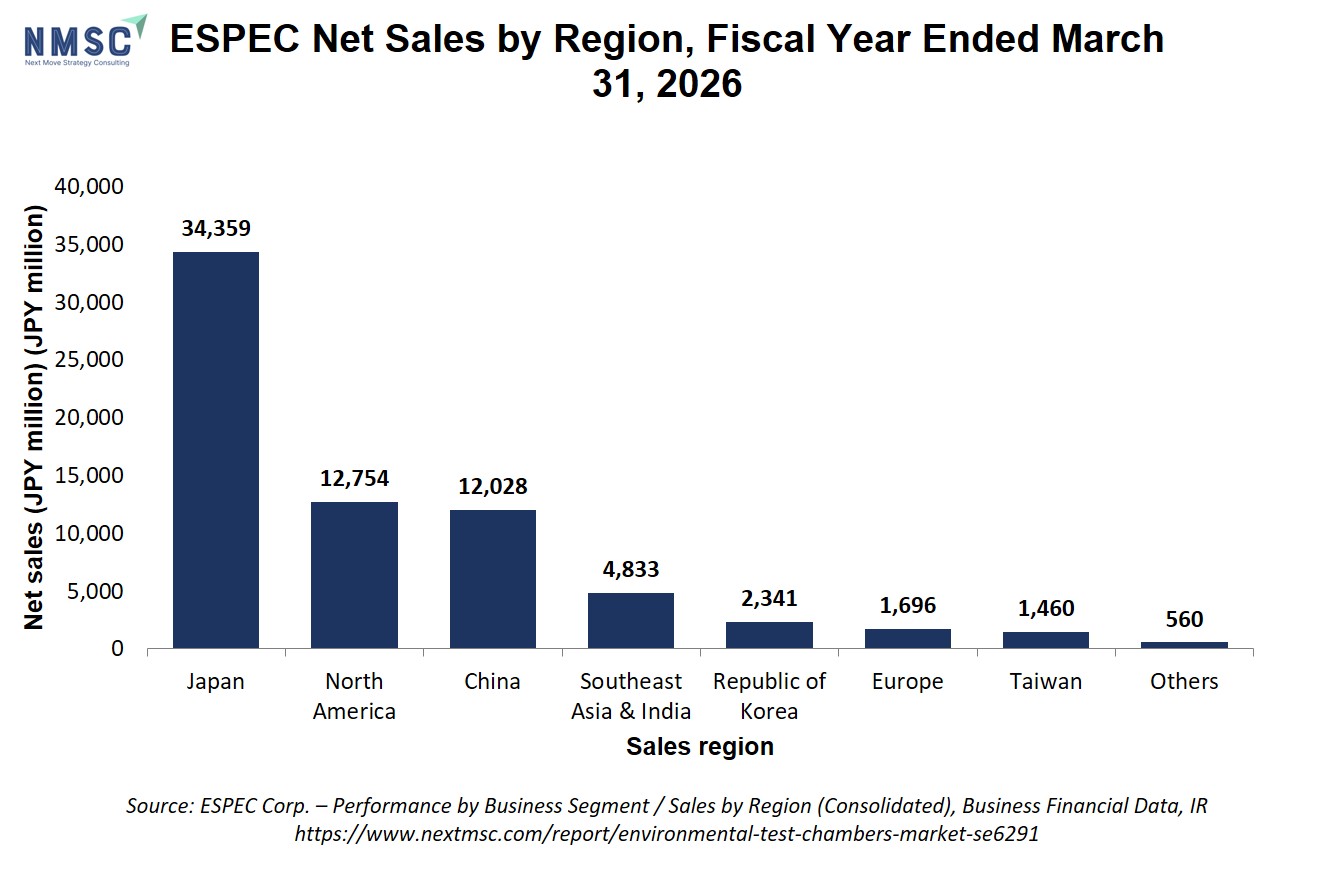
ESPEC's regional sales disclosure for the fiscal year ended March 31, 2026 shows where this demand is landing. North America contributed ¥12,754 million of consolidated net sales, up from ¥11,187 million a year earlier, and Southeast Asia and India rose to ¥4,833 million from ¥3,975 million. Europe moved the other way, falling to ¥1,696 million from ¥2,919 million, and South Korea declined to ¥2,341 million from ¥2,959 million.
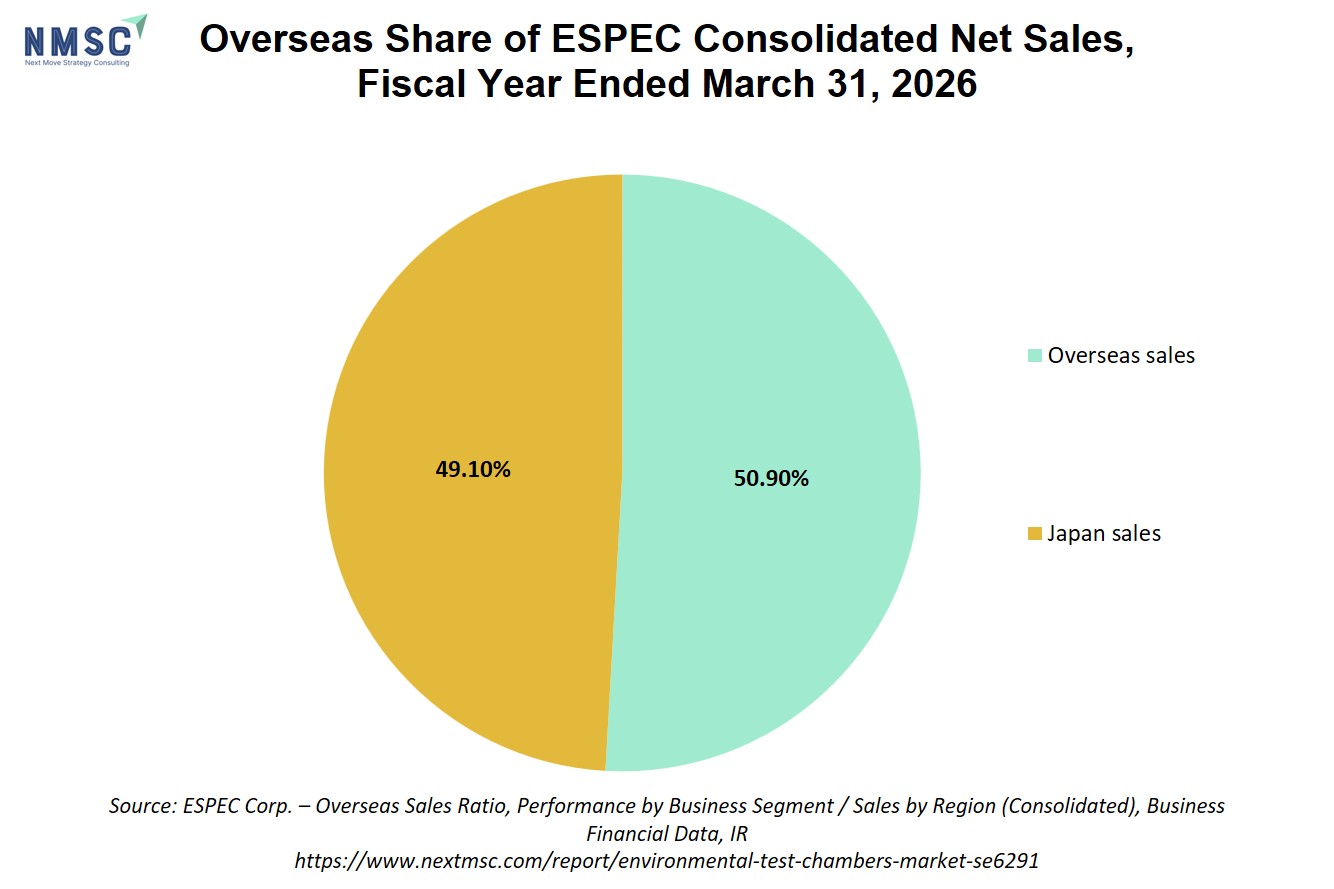
Overseas customers accounted for 50.9% of ESPEC's consolidated net sales in the fiscal year ended March 31, 2026, compared with 51.9% a year earlier. The split matters for the wider market because ESPEC's order growth is concentrated in North American satellite work and Asian AI semiconductor programs, while its domestic and automotive-related business is the weaker leg.
Capacity is also being added on the supply side. On July 21, 2026, Weiss Technik North America, a Schunk Group company, opened a new 125,000-square-foot manufacturing facility at 4401 36th Street SE in Kentwood, Michigan, completing a $25.6 million project that moves operations from three separate buildings into a single location 35% larger than the combined footprint. The company said the plant supports chambers that simulate temperature, humidity, altitude and other extreme conditions, and that the project received a Michigan Business Development Program grant along with local and state tax incentives. The Michigan Governor's Office had announced the expansion on August 21, 2025, with 36 new jobs in Kentwood.
“This facility marks a significant step forward for our organization”
- Robert Levert, Managing Director, Weiss Technik North America, Weiss Technik North America press release distributed through Weiss Technik, July 21, 2026.
Product launches show where chamber makers expect the next test workloads. On August 28, 2026, ESPEC announced that it had launched the AMR-SPM low-current conductor reliability evaluation system in July 2026, built to detect minute resistance changes in micro-bump interconnections of advanced packages, together with the AMI-SPM low-voltage insulation system. Both target chiplet and 2.5D/3D integration, where finer wiring leaves less margin for latent defects. On September 24, 2026, ESPEC announced the availability in the European Union of chambers using CO2 refrigerant R-744, which has a global warming potential of 1 compared with 1,397 for models using R-449A. ESPEC stated that the EU F-gas Regulation requires environmental test chambers to use refrigerants with a global warming potential below 150.
Capacity and Product Moves Shaping Chamber Demand
|
Date |
Organisation |
Development |
Detail |
|
August 21, 2025 |
Michigan Governor's Office |
Weiss Technik North America expansion announced |
36 new jobs created in Kentwood, Michigan |
|
July 21, 2026 |
Weiss Technik North America |
Kentwood plant opened |
$25.6 million; 125,000 square feet; three buildings consolidated into one location 35% larger |
|
August 28, 2026 |
ESPEC Corp. |
AMR-SPM and AMI-SPM reliability systems for AI semiconductor packages |
AMR-SPM applies a measurement current of 1 mA across 40 to 280 channels |
|
September 24, 2026 |
ESPEC Corp. |
CO2 refrigerant (R-744) chambers for the EU market |
Global warming potential of 1 versus 1,397 for R-449A models; EU limit is below 150 |
The upstream chip cycle explains why test capacity is tight. On November 3, 2026, the Semiconductor Industry Association reported global semiconductor sales of $517.7 billion in the third quarter of 2026, up 24.1% from the second quarter, with September sales of $172.6 billion, up 146.8% from September 2025. Every packaged AI accelerator and server board that enters these volumes passes through thermal cycling, humidity and high-temperature stress screens, which is the demand ESPEC cites for its raised order forecast.
“The global chip market grew substantially throughout the third quarter of this year”
- Michael Robbins, President and CEO, Semiconductor Industry Association, Semiconductor Industry Association press release on third-quarter 2026 global sales, November 3, 2026.
The battery side of the market is less uniform. The International Energy Agency's Global EV Outlook 2026, released on May 20, 2026, reported that electric car sales exceeded 20 million in 2025, up 20%, but fell 8% year on year in the first quarter of 2026 after policy changes in China and the United States. The agency expects 23 million electric car sales in 2026, a 28% share of total car sales. ESPEC's results mirror that split: energy-device orders rose on new battery programs while its domestic automotive-related testing and laboratory services remained subdued.
Electric Car Market Indicators Driving Battery Qualification Demand
|
Indicator |
Value |
Period |
|
Global electric car sales |
Exceeded 20 million, up 20% year on year |
2025 |
|
Electric share of new car sales worldwide |
One in four |
2025 |
|
Global electric car sales, first quarter |
Around 3.9 million, 8% lower year on year |
Q1 2026 |
|
Projected global electric car sales |
23 million, 28% of total car sales |
2026 |
|
Electric share of car sales in Europe |
28% |
2025 |
|
Electric share of car sales in China |
Nearly 55% |
2025 |
|
Electric share of car sales in the United States |
Just under 10% |
2025 |
Segment Dynamics: Software and Battery Chambers Outgrow the Core Hardware
According to NextMSC primary research and analysis, test chambers and systems held the largest share of the market by offering at USD 978.77 million in 2025, but software and controls is the fastest-growing offering at a 9.16% CAGR from 2026 to 2035, expanding from USD 48.94 million in 2025 to USD 118.21 million by 2035. Services are growing at 6.72% over the same period, from USD 195.75 million to USD 374.34 million, ahead of the 4.9% market rate. NextMSC primary research and analysis links this mix shift to installed chambers generating calibration, maintenance and connectivity spending long after the initial sale.
By chamber type, NextMSC primary research and analysis shows temperature and humidity chambers holding the largest share at USD 636.20 million in 2025, about 52% of revenue, rising to USD 955.54 million by 2035. Battery test chambers are the fastest-growing type at a 7.67% CAGR and reach USD 256.12 million by 2035. Among end-user industries, electronics and semiconductors lead at USD 379.27 million in 2025, while energy storage and renewables grow fastest at 7.26%. The ESPEC filings are consistent with this ordering: semiconductor and satellite programs lead the order book, and battery programs add volume in bursts tied to customer investment cycles.
Regional Outlook
NextMSC primary research and analysis places Asia-Pacific at about 40% of 2025 revenue, worth USD 489.39 million, growing at a 5.8% CAGR from 2026 to 2035. China leads the region at USD 269.16 million in 2025 and is projected to reach USD 497.08 million by 2035 at a 6.4% CAGR, while India is the fastest-growing national market in NextMSC's coverage at 9.2%, from USD 19.58 million in 2025. NextMSC primary research and analysis notes that pricing for standard chambers in China stays under pressure from domestic suppliers while foreign suppliers capture growth in high-specification semiconductor and battery chambers, which matches ESPEC's own disclosure of a deterioration in profitability in the Chinese market in the fiscal year ended March 2026.
North America holds about 27% of 2025 revenue at USD 330.33 million and grows at 4.3%, anchored by aerospace, space, defense and battery programs; the U.S. market was USD 282.43 million in 2025 and grows at 4.1%. Europe accounts for about 26% at USD 318.10 million and grows at 3.9%, shaped by automotive engineering, aerospace, pharmaceutical stability testing and refrigerant rules. The Middle East & Africa is the fastest-growing region at a 6.3% CAGR from USD 42.82 million in 2025, as industrial localization and defense procurement drive first-time chamber purchases.
Growth Drivers and Restraints
The evidence matrix below uses only independent company disclosures, industry-association statistics and intergovernmental data. It separates demand that is already visible in order books from risks that are visible in reported results.
Environmental Test Chambers Market: Growth Catalyst and Risk Evidence Matrix
|
Factor |
Type |
Independent evidence |
Source |
|
AI semiconductor reliability testing |
Driver |
ESPEC raised its orders forecast to ¥83.0 billion from ¥70.0 billion on AI semiconductor and satellite orders (November 12, 2026) |
ESPEC Corp. |
|
Chip volume feeding qualification workloads |
Driver |
Global semiconductor sales reached $517.7 billion in Q3 2026, up 24.1% from Q2 2026 |
Semiconductor Industry Association |
|
Satellite communications qualification |
Driver |
Testing demand from private low-Earth-orbit satellite operators in North America remained strong in the six months to September 30, 2026 |
ESPEC Corp. |
|
Battery and energy-storage evaluation |
Driver |
Energy-device orders rose on automotive rechargeable batteries, two-wheel automotive batteries and data-center storage batteries |
ESPEC Corp. |
|
Refrigerant regulation |
Driver |
EU F-gas Regulation requires a global warming potential below 150 for environmental test chambers; ESPEC's R-744 models have a global warming potential of 1 |
ESPEC Corp. |
|
Policy-driven EV demand volatility |
Restraint |
Global electric car sales of around 3.9 million in Q1 2026 were 8% lower year on year after policy changes in China and the United States |
International Energy Agency |
|
Automotive investment restraint |
Restraint |
ESPEC service-business net sales fell 3.6% to ¥3,645 million, with an operating loss of ¥36 million, in the six months to September 30, 2026 |
ESPEC Corp. |
|
Price and profitability pressure in China |
Restraint |
ESPEC cited a deterioration in profitability in the Chinese market for the fiscal year ended March 31, 2026 |
ESPEC Corp. |
NMSC Strategic Perspective: Reliability Testing Is Becoming Recurring Infrastructure
NextMSC primary research and analysis reads the ESPEC revision as evidence that demand for chambers now follows reliability risk rather than unit volume alone. AI accelerators and data-center boards run hotter and denser, so qualification programs need larger, faster and cleaner chambers, and a single program can consume capacity that previously served a dozen routine projects. That is why orders can rise 20.6% while sales rise 8.0%: the mix is shifting toward large-scale and bulk orders with long build times, and revenue recognition follows the factory, not the order date.
The service evidence needs careful reading. ESPEC's service business shrank in the six months to September 2026 because contract laboratory testing and rental tied to automotive development weakened. NextMSC's market definition measures manufacturer revenue and excludes stand-alone testing laboratory services, but includes installation, calibration, maintenance, spare parts, rental and refurbishment. On that definition, NextMSC primary research and analysis expects the recurring stream to grow faster than hardware because ESPEC's after-sales maintenance and repair orders and sales both increased, even as its laboratory testing revenue fell. The two readings are consistent, and they imply that suppliers should price calibration, monitoring software and maintenance contracts separately from chambers.
NextMSC primary research and analysis treats the electric vehicle slowdown as a timing risk rather than a demand loss. The International Energy Agency's first-quarter decline of 8% followed policy changes, yet it also recorded record sales in a number of markets and expects 23 million sales in 2026. Every new battery pack design still requires thermal cycling, humidity and safety validation, so a pause in capital spending by EV makers delays chamber orders without removing the underlying qualification need. NextMSC's strategic recommendation for suppliers is to build cleanroom-ready and fast-ramp chambers for semiconductor users, partner with battery cycler vendors on integrated test cells, and bundle software, calibration and maintenance into multi-year agreements.
For investors, NextMSC primary research and analysis identifies an absolute market opportunity of USD 691.67 million between 2026 and 2035, measured from the 2026 base to the 2035 forecast, and rates the market's attractiveness as moderate to good. The risks it flags are cyclical battery spending, price competition from regional Chinese suppliers, outsourcing to independent laboratories, and the cost of refrigerant and cyber compliance. NextMSC primary research and analysis therefore favors selective exposure to suppliers with service revenue, differentiated chambers for semiconductor and battery work, and diversified end-user bases.
Competitive Landscape
NextMSC primary research and analysis describes the market as moderately fragmented, with a few global specialists leading premium and custom segments and regional suppliers, especially in China, competing on price in standard chambers. The seven companies that passed NextMSC's eligibility tests are ESPEC Corp., Weiss Technik GmbH, Thermotron Industries, BINDER GmbH, Angelantoni Test Technologies, Thermal Product Solutions and Memmert GmbH + Co. KG.
The company evidence points to three competitive axes. The first is semiconductor qualification, where ESPEC is extending from chambers into measurement systems for advanced-package interconnects. The second is local capacity: Weiss Technik North America consolidated three buildings into one plant 35% larger, which shortens lead times for North American aerospace, space and electronics customers. The third is regulatory fit: ESPEC's R-744 chambers address the EU limit on refrigerant global warming potential, which turns compliance into a replacement trigger for older European installations. NextMSC primary research and analysis expects bolt-on acquisitions and chamber-and-cycler partnerships to continue as suppliers widen offerings without full mergers.
Bottom Line
ESPEC's November 12, 2026 decision to raise its orders forecast to ¥83.0 billion from ¥70.0 billion, together with record six-month orders of ¥46,582 million and Weiss Technik North America's new 125,000-square-foot Michigan plant, shows reliability testing absorbing AI semiconductor, satellite and battery programs faster than chamber makers can recognize revenue. According to NMSC's proprietary research and analysis, the global environmental test chambers market will expand from USD 1,223.46 million in 2025 to USD 1,970.19 million by 2035 at a 4.9% CAGR, with Asia-Pacific holding about 40% of 2025 revenue and software and controls growing fastest at 9.16%. The independent evidence also marks the limits: electric car sales fell 8% in the first quarter of 2026, and ESPEC's laboratory testing business remains under automotive investment restraint. Suppliers that pair cleanroom-ready and battery-safe chambers with calibration, software and service contracts are best placed to convert a rising order book into durable revenue.
About Next Move Strategy Consulting
Next Move Strategy Consulting is a premier market research and management consulting firm that has been committed to provide strategically analysed well documented latest research reports to its clients. The research industry is flooded with many firms to choose from, what makes NMSC different from the rest is its top-quality research and the obsession of turning data into knowledge by dissecting every bit of it and providing fact-based research recommendation that is supported by information collected from over 500 million websites, paid databases, industry journals and one on one consultations with industry experts across a diverse range of industry sectors. The high-quality customized research reports with actionable insights and excellent end-to-end customer service help our clients to take critical business decisions that enables them to move beyond time and have competitive edge in the industry.
We have been servicing over 1000 customers globally that includes 90% of the Fortune 500 companies over a decade. Our analysts are constantly tracking various high growth markets and identifying hidden opportunities in each sector or the industry. We provide one of the industry’s best quality syndicate as well as custom research reports across 10 different industry verticals. We are committed to deliver high quality research solutions in accordance to your business needs. Our industry standard delivery solutions that ranges from the pre consultation to after-sales services, provide an excellent client experience and ensure right strategic decision making for businesses.
For more information, please contact:
Next Move Strategy Consulting
5th Floor 867 Boylston St, STE 500,
Boston, MA 02116, U.S.
E-Mail: [email protected]
Direct: +1-217-650-7991
Website: www.nextmsc.com
About the Author
 Sanyukta Deb
— Sanyukta Deb is Digital Marketing Team Lead at Next Move Strategy Consulting, where she has led content strategy and technical SEO for the firm's B2B market research publications for over 2 years. Her editorial process translates NextMSC's primary and secondary research — spanning technology, industrial, and consumer sectors — into commercial narratives, backed by search-intent, keyword, and competitive analysis. She brings 5 years of overall experience in digital marketing and content strategy.
About the Reviewer
 Debashree Dey
— Debashree Dey is Assistant Manager at Next Move Strategy Consulting, where she supports cross-vertical market content and communications across diverse industries for 6 years. Her professional background includes senior content writing, communications, and published manuscript authorship, with experience developing audience-focused business narratives and maintaining clear, consistent messaging. Her role supports research-led content development and editorial quality across NextMSC publications.














Add Comment