EU Co-Formulant Ban Reshapes Agrochemical Additive Market

European Commission's Landmark Regulation (EU) 2026/1120 Forces Global Reformulation Across the Agrochemical Additive Sector as FAO Reports Record Pesticide Use in 2024
EU Bans 12 Pesticide Co-Formulants, Triggering Industry-Wide Reformulation Imperative
In a regulatory development with far-reaching consequences for global agrochemical supply chains, the European Commission formally published Commission Regulation (EU) 2026/1120 in its Official Journal in June 2026, amending Annex III to Regulation (EC) No 1107/2009—the foundational EU legislation governing plant protection products. The regulation adds 12 substances to the list of unacceptable co-formulants, prohibiting their inclusion in plant protection products and adjuvant mixtures marketed across the European Union. All existing product authorizations containing these substances must be withdrawn or amended by June 16, 2028.
The 12 newly prohibited substances—including acetaldehyde, propylene oxide, cumene, 1,4-dioxane, and three cyclosiloxane compounds (D4, D5, D6)—were identified as carcinogenic, mutagenic, or toxic for reproduction (CMR Category 1A/1B), or classified as persistent, bioaccumulative, and toxic (PBT/vPvB) substances or persistent organic pollutants (POPs). The regulation further stipulates that even unintentionally introduced impurities of these substances in finished products must remain below 0.1% (w/w), placing significant compliance pressure on upstream raw material suppliers and formulators alike.
The regulatory action arrives at a critical juncture for the global Agrochemical Additive Market. According to the Food and Agriculture Organization of the United Nations (FAO), total global pesticide use in agriculture reached 3.92 million tonnes (Mt) of active ingredients in 2024—a 5 percent increase from 2023, an 18 percent increase over the preceding decade, and more than double the volume recorded in 1990. This trajectory underscores the structural dependence of modern agriculture on chemical inputs, and by extension, on the additives, adjuvants, surfactants, and co-formulants that optimize their efficacy, stability, and delivery.
For More Information: Download FREE Sample on Agrochemical Additive Market Report
Regulatory Pressure Converges with Record Agricultural Input Demand
The EU's co-formulant ban does not exist in isolation. It is part of a broader global regulatory tightening that is simultaneously reshaping product development pipelines, raw material sourcing strategies, and market access frameworks for agrochemical additive manufacturers worldwide.
The OECD–FAO Agricultural Outlook 2026–2035, published on June 29, 2026, projects that global agricultural production will expand by 13 percent over the next decade, driven primarily by productivity improvements and intensification, with growth concentrated in Asia, sub-Saharan Africa, and Latin America. The report also notes that disruptions associated with the 2026 Middle East conflict are constraining fertilizer use and, consequently, cereal production—particularly in low-income countries—reinforcing the strategic importance of crop protection inputs, including agrochemical additives, in sustaining yield performance under adverse conditions.
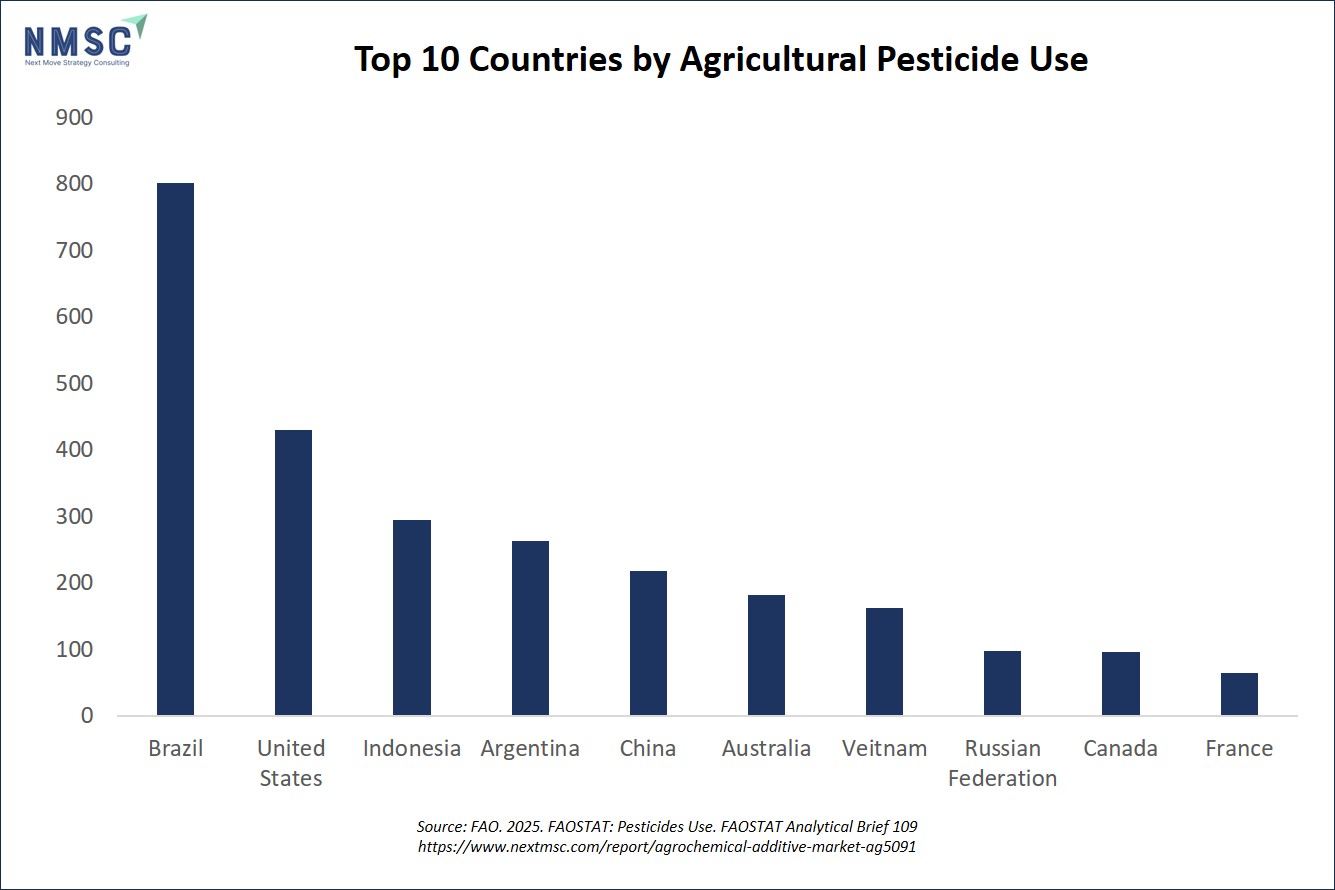
The Americas remain the world's largest pesticide-consuming region, recording 1.84 Mt of active ingredient use in 2023, followed by Asia at 1.05 Mt, Europe at 444 thousand tonnes (kt), Africa at 211 kt, and Oceania at 190 kt. Brazil led all individual countries with 801 kt of pesticide applications in 2023, approximately 86 percent higher than the United States at 430 kt. Indonesia, Argentina, and China followed with 295 kt, 263 kt, and 218 kt, respectively.
Global Pesticide Category Dynamics: Herbicides Dominate, Additives Follow
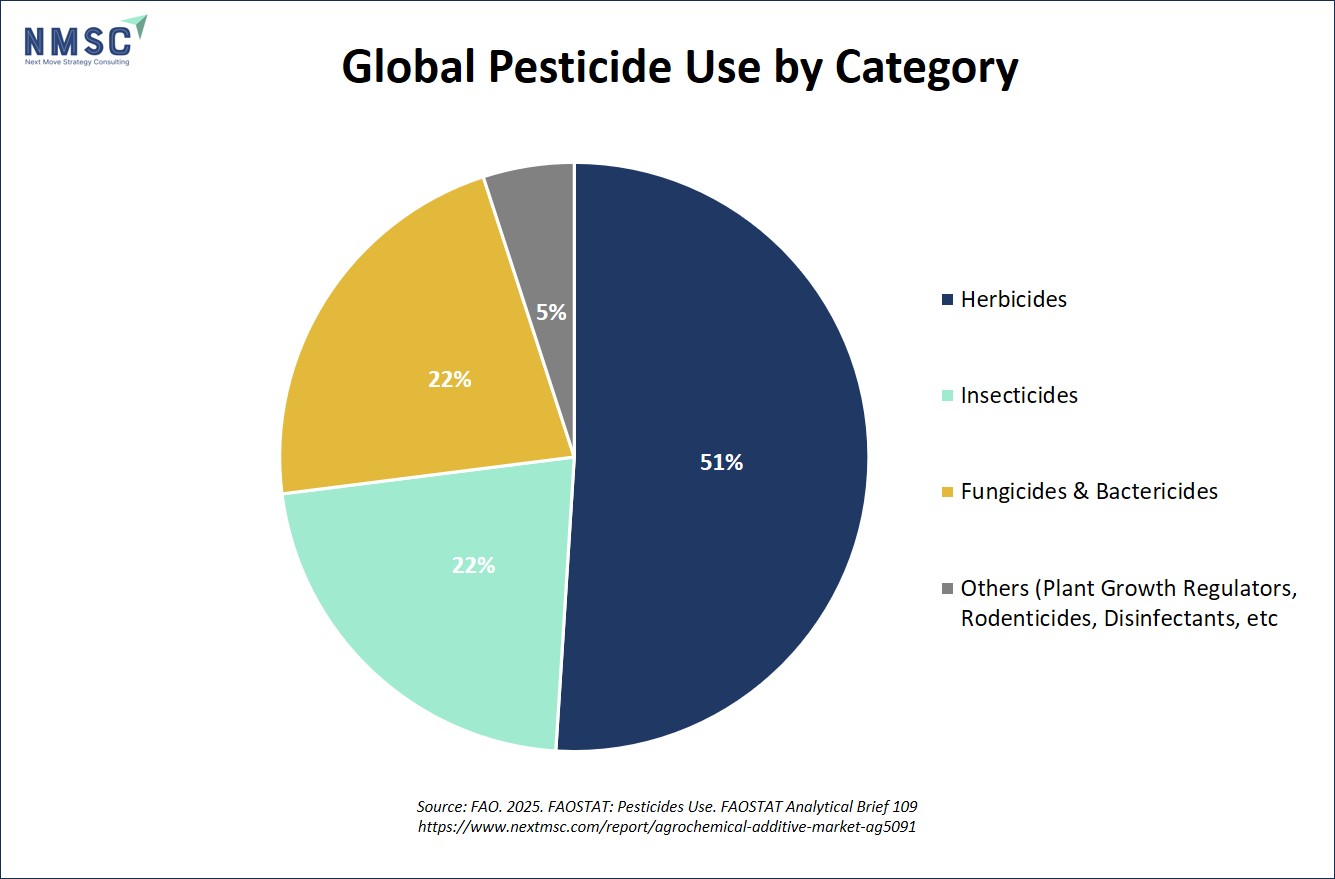
The composition of global pesticide use has shifted materially over the past three decades. Herbicides now account for 51 percent of total global pesticide use—up from 40 percent in the 1990s—while insecticides have declined from 26 percent to 22 percent, and fungicides and bactericides have similarly contracted from 25 percent to 22 percent of the global total. The remaining 5 percent comprises plant growth regulators, rodenticides, disinfectants, and other pesticide categories.
This structural shift toward herbicide dominance has direct implications for the agrochemical additive sector. Herbicide formulations are among the most additive-intensive product categories, requiring surfactants, emulsifiers, drift-control agents, and compatibility enhancers to optimize field performance. The growing share of herbicides in the global pesticide mix therefore represents a structural demand driver for the additive and adjuvant segment.
Market Intelligence: Agrochemical Additive Sector Positioned for Sustained Expansion
According to the Next Move Strategy Consulting analysis of the global agrochemical additive market, the sector is positioned for sustained growth through the forecast period, underpinned by rising global crop protection demand, the intensification of precision agriculture practices, and the accelerating shift toward bio-based and environmentally compliant formulation chemistries. The NMSC report identifies adjuvants, surfactants, emulsifiers, dispersants, and stabilizers as the primary product categories driving market expansion, with Asia-Pacific and Latin America emerging as the highest-growth regional markets.
The regulatory environment is functioning as a dual-edged catalyst. On one hand, the EU's Regulation (EU) 2026/1120 and analogous regulatory actions in other jurisdictions are eliminating certain legacy co-formulants from the market, creating near-term compliance costs and reformulation expenditures for manufacturers. On the other hand, these same regulatory pressures are accelerating demand for next-generation, regulatory-compliant additive chemistries—particularly bio-based surfactants, silicone-free adjuvants, and low-toxicity emulsifiers—that can replace the banned substances while meeting increasingly stringent environmental and human health standards.
The agricultural adjuvants segment—a key sub-category of the broader agrochemical additive market—was valued at approximately USD 4.1 billion in 2025 and is projected to grow to USD 6.0 billion in 2026, reflecting the accelerating adoption of adjuvant technologies across major agricultural economies.
Regional Agricultural Pesticide Use Statistics (2023)
|
Region |
Total Use (kt AI) |
Use per Cropland Area (kg/ha) |
Use per Capita (kg/cap) |
Decade Change (2014–2023) |
|
Americas |
1,840 |
3.13 (avg.) |
1.24 (avg.) |
+25% |
|
Asia |
1,050 |
1.61 (avg.) |
0.22 (avg.) |
+75% since 1990 |
|
Europe |
444 |
1.66 |
0.65 (avg.) |
−16% |
|
Africa |
211 |
0.45 (avg.) |
0.11 (avg.) |
+29% |
|
Oceania |
190 |
5.64 |
2.44 |
+230% |
|
World Total |
3,730 |
2.40 |
0.45 |
+14% |
EU Regulation (EU) 2026/1120: Compliance Timeline and Industry Impact
The compliance architecture established by Regulation (EU) 2026/1120 creates a structured but compressed transition window for the global agrochemical additive industry. Member States are required to withdraw or amend all product authorizations containing the 12 banned co-formulants by June 16, 2028. Following authorization withdrawal, manufacturers are granted a maximum of three months for continued sale and distribution, and up to 12 months for the disposal, storage, and use of existing inventory—yielding a total transition window of approximately 15 months from the June 2028 deadline.
For multinational agrochemical additive manufacturers, the practical implications extend well beyond EU market compliance. Given the EU's role as a global regulatory standard-setter, Regulation (EU) 2026/1120 is expected to influence co-formulant policy in jurisdictions including the United Kingdom, Canada, Australia, and several Southeast Asian markets that align their regulatory frameworks with EU precedent. Companies that proactively reformulate their product portfolios to eliminate the 12 banned substances will be better positioned to maintain market access across multiple regulatory jurisdictions simultaneously.
The regulation also introduces a significant impurity management obligation. Even where banned substances are not intentionally incorporated into formulations, their presence as unintentional impurities in compliant co-formulants must remain below 0.1% (w/w) in the finished product. This requirement necessitates enhanced raw material specification management, supplier auditing, and analytical testing protocols across the supply chain.
EU Regulation (EU) 2026/1120 — Newly Banned Pesticide Co-Formulants
|
Substance |
CAS No. |
Hazard Classification / Reason for Ban |
|
Acetaldehyde |
75-07-0 |
Carcinogen Category 1B |
|
Propylene oxide |
75-56-9 |
Carcinogen Cat. 1B / Mutagen Cat. 1B |
|
Cumene |
98-82-8 |
Carcinogen Category 1B |
|
Dodecamethylcyclohexasiloxane (D6) |
540-97-6 |
PBT / vPvB |
|
Decamethylcyclopentasiloxane (D5) |
541-02-6 |
PBT / vPvB |
|
Octamethylcyclotetrasiloxane (D4) |
556-67-2 |
PBT / vPvB |
|
2-(2'-hydroxy-3'-tert-butyl-5'-methylphenyl)-5-chlorobenzotriazole |
3896-11-5 |
vPvB |
|
Distillates (petroleum) solvent-dewaxed light paraffinic (≥3.0% DMSO-extract) |
64742-56-9 |
Carcinogen Category 1B |
|
3,5,7-Triaza-1-azoniatricyclo decane, 1-(3-chloro-2-propen-1-yl)-, chloride |
4080-31-3 |
Not approved for biocidal use (PT6) |
|
Phosphinic acid, bis(perfluoro-C6-12-alkyl) derivatives |
68412-69-1 |
Persistent Organic Pollutant (POP) |
|
1,4-Dioxane |
123-91-1 |
Carcinogen Category 1B |
|
2-(4-tert-butylbenzyl) propionaldehyde |
80-54-6 |
Toxic to Reproduction Category 1B |
Strategic Implications: Innovation, Supply Chain Realignment, and Market Opportunity
The convergence of record global pesticide demand—as documented by FAO's 2024 data release—with tightening co-formulant regulations creates a structurally favorable environment for agrochemical additive manufacturers capable of delivering compliant, high-performance formulation solutions. Several strategic dynamics are shaping the competitive landscape.
Reformulation as a Growth Catalyst: The mandatory phase-out of 12 co-formulants across the EU market is compelling manufacturers to invest in alternative additive chemistries. This reformulation imperative is generating demand for bio-based surfactants derived from plant oils and fermentation processes, silicone-free spreading agents, and low-ecotoxicity emulsifiers. Companies with established R&D capabilities in green chemistry are positioned to capture disproportionate market share during the transition period.
Asia-Pacific as the Dominant Growth Engine: FAO data confirms that Asia used 1.05 Mt of pesticides in 2023—a 75 percent increase since 1990—and the region exported the largest quantities of pesticides globally, with 3.6 Mt valued at USD 17.1 billion. The OECD-FAO Agricultural Outlook 2026-2035 projects that production growth will be concentrated in Asia, sub-Saharan Africa, and Latin America over the next decade, reinforcing the strategic importance of these regions for agrochemical additive market expansion.
Supply Chain Transparency Requirements: The impurity threshold provisions of Regulation (EU) 2026/1120 are effectively mandating greater transparency and traceability across the agrochemical additive supply chain. Manufacturers will need to implement enhanced supplier qualification programs, invest in analytical testing infrastructure, and develop digital supply chain monitoring capabilities to demonstrate compliance with the 0.1% impurity limit.
Geopolitical and Food Security Context: The OECD-FAO Agricultural Outlook 2026-2035 highlights that disruptions associated with the 2026 Middle East conflict are constraining fertilizer use and cereal production in low-income countries, increasing the premium placed on crop protection efficiency. In this environment, agrochemical additives that enhance the efficacy of existing active ingredients—enabling farmers to achieve equivalent crop protection outcomes with lower application volumes—are acquiring heightened strategic value.
Africa's Emerging Market Potential: Despite contributing only 6 percent to global pesticide use between 2015 and 2024, Africa recorded a 29 percent increase in pesticide use over the most recent decade, with imports rising 20 percent in 2023 alone. The continent's expanding agricultural sector, combined with its historically low additive penetration rates, represents a significant long-term growth opportunity for agrochemical additive suppliers willing to invest in market development and regulatory engagement.
Bottom Line
The global agrochemical additive market is navigating a period of simultaneous regulatory disruption and structural demand expansion. The European Commission's Regulation (EU) 2026/1120, which bans 12 pesticide co-formulants with a compliance deadline of June 2028, represents the most significant regulatory intervention in the sector in recent years, compelling manufacturers across the value chain to accelerate reformulation programs and strengthen supply chain compliance infrastructure. Concurrently, FAO data confirming a 5 percent increase in global pesticide use to 3.92 million tonnes in 2024—and the OECD-FAO projection of 13 percent agricultural production growth through 2035—establishes a robust demand foundation for the sector. The strategic opportunity lies at the intersection of these forces: manufacturers that invest in regulatory-compliant, high-performance additive chemistries, particularly bio-based and low-ecotoxicity formulations, are positioned to capture premium market share in both established and emerging agricultural economies. Investors and industry participants should monitor the pace of reformulation activity in the EU, the evolution of analogous co-formulant regulations in non-EU jurisdictions, and the acceleration of precision agriculture adoption in Asia-Pacific and Latin America as the primary indicators of market trajectory through 2030.
About Next Move Strategy Consulting
Next Move Strategy Consulting is a premier market research and management consulting firm that has been committed to provide strategically analysed well documented latest research reports to its clients. The research industry is flooded with many firms to choose from, what makes NMSC different from the rest is its top-quality research and the obsession of turning data into knowledge by dissecting every bit of it and providing fact-based research recommendation that is supported by information collected from over 500 million websites, paid databases, industry journals and one on one consultations with industry experts across a diverse range of industry sectors. The high-quality customized research reports with actionable insights and excellent end-to-end customer service help our clients to take critical business decisions that enables them to move beyond time and have competitive edge in the industry.
We have been servicing over 1000 customers globally that includes 90% of the Fortune 500 companies over a decade. Our analysts are constantly tracking various high growth markets and identifying hidden opportunities in each sector or the industry. We provide one of the industry's best quality syndicate as well as custom research reports across 10 different industry verticals. We are committed to deliver high quality research solutions in accordance to your business needs. Our industry standard delivery solutions that ranges from the pre consultation to after-sales services, provide an excellent client experience and ensure right strategic decision making for businesses.
For more information, please contact:
Next Move Strategy Consulting
5th Floor 867 Boylston St, STE 500,
Boston, MA 02116, U.S.
E-Mail: [email protected]
Direct: +1-217-650-7991
Website: www.nextmsc.com
About the Author
 Sanyukta Deb
— Sanyukta Deb is Digital Marketing Team Lead at Next Move Strategy Consulting, where she has led content strategy and technical SEO for the firm's B2B market research publications for over 2 years. Her editorial process translates NextMSC's primary and secondary research — spanning technology, industrial, and consumer sectors — into commercial narratives, backed by search-intent, keyword, and competitive analysis. She brings 5 years of overall experience in digital marketing and content strategy.
Sanyukta Deb
— Sanyukta Deb is Digital Marketing Team Lead at Next Move Strategy Consulting, where she has led content strategy and technical SEO for the firm's B2B market research publications for over 2 years. Her editorial process translates NextMSC's primary and secondary research — spanning technology, industrial, and consumer sectors — into commercial narratives, backed by search-intent, keyword, and competitive analysis. She brings 5 years of overall experience in digital marketing and content strategy.
About the Reviewer
 Debashree Dey
— Debashree Dey is Assistant Manager at Next Move Strategy Consulting, where she supports cross-vertical market content and communications across diverse industries for 6 years. Her professional background includes senior content writing, communications, and published manuscript authorship, with experience developing audience-focused business narratives and maintaining clear, consistent messaging. Her role supports research-led content development and editorial quality across NextMSC publications.
Debashree Dey
— Debashree Dey is Assistant Manager at Next Move Strategy Consulting, where she supports cross-vertical market content and communications across diverse industries for 6 years. Her professional background includes senior content writing, communications, and published manuscript authorship, with experience developing audience-focused business narratives and maintaining clear, consistent messaging. Her role supports research-led content development and editorial quality across NextMSC publications.
















Add Comment