Agrochemical Additive Market Size, Share, Growth & Forecast by Product Type (Adjuvants [Activator, Utility]), Chemistry (Silicone-Based, Non-Ionic, Anionic, Cationic, Amphoteric, Oil-Based, Polymer-Based, Bio-Based), Application (Herbicides, Fungicides, Insecticides, Fertilizers, Plant Growth Regulators, Seed Treatment, Tank Mix Additives), Form (Liquid, Powder, Granular, Water-Dispersible), Crop Type (Cereals & Grains), and Distribution Channel — Global Analysis 2026–2035
Industry: Agriculture | Publishing Date: July 11, 2026 | Last Updated: September 30, 2026 | No of Pages: N/A | No. of Tables: N/A | No. of Figures: N/A | Format: PDF | Report Code: AG5091
What Is the Agrochemical Additive Market Size?
The global Agrochemical Additive Market was valued at USD 3.8 billion in 2025 and is expected to reach USD 4.0 billion in 2026. Sustained demand for precision farming, rising adoption of bio-based formulation inputs, and intensifying pressure on crop protection efficacy are projected to propel the market to USD 6.2 billion by 2035, advancing at a CAGR of 5.3% from 2026 to 2035, with Agrochemical Additive Market revenue expanding across all major product segments. Key growth drivers include the expanding acreage under chemical crop protection, regulatory mandates reducing active ingredient rates (necessitating performance adjuvants), growing adoption of biological additives, and the steady transition toward sustainable agrochemical formulations across major agricultural economies worldwide.
|
Parameters |
Details |
|
Market Size in 2025 |
USD 3.8 Billion |
|
Market Size in 2026 |
USD 4.0 Billion |
|
Revenue Forecast in 2035 |
USD 6.2 Billion |
|
Growth Rate |
CAGR of 5.3% from 2026 to 2035 |
|
Analysis Period |
2025–2035 |
|
Base Year Considered |
2025 |
|
Forecast Period |
2026–2035 |
|
Market Size Estimation |
Billion USD |
|
Companies Profiled |
20 |
|
Countries Covered |
33 |
|
Market Share |
Top 10 |
Agrochemical Additive Market Overview
What Is the Agrochemical Additive Market?
The Agrochemical Additive Market encompasses specialty chemical inputs used to enhance the performance, stability, and efficacy of crop protection and nutrient management products. These additives include adjuvants, formulation additives, nutrient efficiency additives, and biological additives deployed across herbicides, fungicides, insecticides, fertilizers, and seed treatment applications. From our research, we found that agrochemical additives function as performance enablers by improving active ingredient uptake, reducing environmental drift, enhancing tank mix compatibility, and extending product shelf life across diverse agricultural settings globally.
How Has the Agrochemical Additive Market Evolved?
The Agrochemical Additive Market has progressed through distinct developmental phases. The first phase focused on basic surfactant and emulsifier applications designed to improve simple pesticide wettability. The second phase introduced specialty adjuvants and polymer-based formulation additives addressing compatibility and drift control needs. NMSC's analysis indicates that the current phase is centered on bio-based and biological additives, driven by regulatory tightening on synthetic chemical inputs, rising consumer demand for residue-free produce, and the broader industry transition toward sustainable crop protection systems across North America, Europe, and Asia-Pacific.
How Do Regulations Influence the Agrochemical Additive Market?
Regulatory frameworks have become a defining structural force in the Agrochemical Additive Market. The European Union's Farm to Fork Strategy targets a 50% reduction in chemical pesticide use by 2030, directly incentivizing the adoption of performance adjuvants that maintain efficacy at reduced active ingredient rates. The U.S. Environmental Protection Agency's pesticide re-registration programs impose stringent inert ingredient assessments for adjuvant components. Through our analysis, we observed that similar regulatory reviews in Japan, Australia, and Brazil are compelling formulators to reformulate products using approved, environmentally compliant additive chemistries.
How Is Technology Adoption Expanding Across the Agrochemical Additive Market?
Technology adoption within the Agrochemical Additive Market is accelerating as precision agriculture practices demand higher formulation performance standards. Controlled release agent technologies, silicone-based super-spreaders, and nano-encapsulation delivery systems represent the frontier of additive innovation. Based on NMSC's research, we found that digital spray optimization platforms now integrate adjuvant selection algorithms that match additive chemistry to environmental conditions, crop physiology, and active ingredient profiles in real time. These capabilities are elevating adjuvant selection from a commodity decision to a performance-critical agronomic input across leading agricultural markets.
|
Key Insight |
|
By product type, Adjuvants held the largest share of the Agrochemical Additive Market in 2025, driven by the pervasive use of activator and utility adjuvants across herbicide and fungicide tank-mix operations globally. Biological Additives is the fastest-growing product type segment in the Agrochemical Additive Market from 2026 to 2035, fueled by rising demand for microbial enhancers and bio-based surfactants in sustainable crop protection programs. |
|
By chemistry, Non-Ionic chemistry held the largest share of the Agrochemical Additive Market in 2025, owing to its broad compatibility with diverse active ingredients and tank-mix formulations across herbicide and fungicide applications. Bio-Based chemistry is the fastest-growing chemistry segment in the Agrochemical Additive Market from 2026 to 2035, driven by regulatory restrictions on synthetic chemistries and increasing formulator preference for plant-derived and fermentation-sourced additive inputs. |
|
By application, Herbicides accounted for the largest share of the Agrochemical Additive Market in 2025, supported by the widespread deployment of herbicide products across cereal, oilseed, and row-crop cultivation globally. Seed Treatment is the fastest-growing application segment in the Agrochemical Additive Market from 2026 to 2035, driven by precision seed coating technology adoption and the integration of biological and nutrient-efficiency additives into seed treatment formulations. |
|
By physical form, Liquid held the largest share of the Agrochemical Additive Market in 2025, reflecting formulators’ strong preference for liquid adjuvants and emulsifiers that enable seamless integration into spray tank operations across field crops and specialty crops. Water-Dispersible is the fastest-growing physical form segment in the Agrochemical Additive Market from 2026 to 2035, driven by reduced solvent content and improved environmental compatibility in markets with stringent volatile organic compound regulations. |
|
By crop type, Cereals and Grains held the largest share of the Agrochemical Additive Market in 2025, supported by the vast global acreage under wheat, corn, and rice cultivation requiring consistent adjuvant and formulation additive inputs. Fruits and Vegetables is the fastest-growing crop type segment in the Agrochemical Additive Market from 2026 to 2035, driven by the expansion of high-value horticulture, increasing specialty crop acreage, and growing demand for precision-performance additives in intensive cultivation systems. |
|
Asia-Pacific held the largest regional share of the Agrochemical Additive Market in 2025, supported by extensive agricultural production, high agrochemical consumption, and large cultivated acreage across China, India, and Southeast Asia. |
|
Latin America is the fastest-growing region in the Agrochemical Additive Market from 2026 to 2035, underpinned by Brazil and Argentina’s expanding row-crop acreage and rising adoption of precision crop protection technologies. |
|
China is the single largest country market in the Agrochemical Additive Market, supported by its extensive agricultural production base, significant agrochemical manufacturing capacity, and strong demand for crop protection inputs. |
|
India is the fastest-growing national market in the Agrochemical Additive Market from 2026 to 2035, supported by government-led agricultural modernization initiatives, increasing crop protection expenditure, and rising adoption of advanced farming technologies. |
Key Emerging Trends in the Agrochemical Additive Market
How Is the Shift Toward Bio-Based Additives Transforming the Agrochemical Additive Market?
Bio-based additives are fundamentally reshaping the Agrochemical Additive Market by replacing petrochemical-derived surfactants and emulsifiers with plant-derived, fermentation-sourced, and microbial alternatives. From our research, we found that formulators are increasingly using sophorolipid-based bio-surfactants and yucca extract-derived wetting agents that deliver comparable surface tension reduction with significantly improved environmental profiles. Croda International's EcoMate series and Corbion's fermentation-based platform illustrate how leading suppliers are repositioning their additive portfolios toward bio-based chemistry, driven by regulatory phase-outs of petroleum-derived adjuvant ingredients across European and North American markets.
What Role Is Precision Agriculture Playing in the Evolution of Agrochemical Additive Demand?
Precision agriculture is elevating the strategic importance of adjuvants and formulation additives within the broader Agrochemical Additive Market. Variable rate application technology and drone-based spraying systems require adjuvants specifically engineered for low-volume, high-canopy-penetration performance. Our findings suggest that drift control agents and deposition enhancers are witnessing accelerated demand as UAV adoption in precision spraying expands across Asia-Pacific and Latin America. Adjuvant formulations developed for ultra-low volume systems require substantially different rheological and surface chemistry profiles compared to conventional high-volume ground application products.
How Are Regulatory Restrictions on Active Ingredients Driving Adjuvant Innovation in the Agrochemical Additive Market?
Regulatory restrictions on widely used active ingredients are creating significant pull demand for high-performance adjuvants that sustain efficacy at reduced application rates within the Agrochemical Additive Market. The EU's Farm to Fork Strategy mandating a 50% reduction in chemical pesticide use by 2030 compels formulators to optimize active ingredient performance through superior adjuvant systems. Based on NMSC's research, we found that silicone-based organosilicone super-spreaders such as trisiloxane surfactants are being increasingly deployed with systemic herbicides and fungicides to maximize active ingredient uptake and translocation at lower dose rates.
How Is the Rise of Biological Crop Protection Creating New Additive Categories in the Agrochemical Additive Market?
The rapid growth of biological crop protection products is creating entirely new additive categories within the Agrochemical Additive Market. Biological pesticides based on Bacillus thuringiensis, Trichoderma spp., and entomopathogenic fungi require specialized formulation additives that protect microbial viability during storage and enhance canopy deposition under field conditions. Our assessment indicates that biostimulant carriers, microbial enhancers, and fermentation-based additives represent the fastest-growing emerging sub-segment. Verdesian Life Sciences, Innvictis Crop Care, and Helena Agri-Enterprises are among the market participants actively developing adjuvant systems optimized for biological active ingredient delivery.
What Are the Key Market Drivers, Breakthroughs, and Investment Opportunities that Will Shape the Agrochemical Additive Market Industry in the Next Decade?
|
Drivers / Trends / Restraints |
(+/-) % Impact on CAGR Forecast |
Geographic Relevance |
Impact Timeline |
|
Regulatory Reduction of Active Ingredient Rates |
+0.9% |
Europe, North America, APAC |
2026–2030 |
|
Growth of Biological Crop Protection Products |
+0.7% |
Global (all regions) |
2026–2035 |
|
Precision Agriculture and UAV Spray Adoption |
+0.6% |
APAC, Latin America, North America |
2026–2035 |
|
Bio-Based Additive Regulatory Compliance Demand |
+0.5% |
Europe, North America |
2025–2032 |
|
Expanding Seed Treatment Technology Adoption |
+0.4% |
Global |
2026–2030 |
|
Stringent Approval Pathways for Novel Additives |
-0.6% |
Europe, North America |
Ongoing |
|
Commodity Price Volatility Affecting Formulator Margins |
-0.4% |
Global |
2025–2028 |
|
Fragmented Regulatory Standards Across Countries |
-0.3% |
APAC, MEA, Latin America |
Ongoing |
|
Sustainable Formulation Investment Growth |
+0.5% |
Global |
2026–2035 |
|
Digital Spray Optimization Platform Adoption |
+0.3% |
North America, Europe, Australia |
2026–2033 |
What Are the Growth Drivers of the Agrochemical Additive Market?
How Is the Regulatory Mandate to Reduce Active Ingredient Rates Driving Demand in the Agrochemical Additive Market?
Regulatory pressure to reduce active ingredient application rates is one of the most powerful structural growth catalysts in the Agrochemical Additive Market. The European Commission's Farm to Fork Strategy, as published on the official EU policy portal, mandates a 50% reduction in the use and risk of chemical pesticides by 2030 relative to 2015–2017 baselines. This regulatory imperative creates sustained Agrochemical Additive Market demand for high-performance adjuvants that sustain or enhance biological efficacy at substantially lower active ingredient doses. Through our market assessment, we observed that activator adjuvants, particularly organosilicone surfactants and nitrogen-based formulations, are experiencing consistent demand growth as formulators optimize label rate efficiency across European, North American, and Australasian markets.
How Is the Global Expansion of Biological Crop Protection Products Fueling Agrochemical Additive Market Growth?
The accelerating adoption of biopesticides and biostimulants is generating sustained new demand streams within this formulation segment. The U.S. Environmental Protection Agency's Biopesticide Registration database documents a consistent annual increase in registered biopesticide active ingredients, reflecting Agrochemical Additive Market trends and the structural shift in crop protection portfolios toward biological solutions. Our analysis shows that biological active ingredients require highly specialized formulation additives including microbial enhancers, fermentation-based stabilizers, and biostimulant carriers that protect organism viability and ensure uniform canopy deposition under diverse environmental conditions, creating a dedicated and rapidly expanding additive sub-segment.
How Is Precision Agriculture and UAV-Based Spray Technology Expanding the Agrochemical Additive Market?
The global expansion of precision agriculture technologies, including unmanned aerial vehicles (UAVs), variable rate applicators, and smart spray systems, is creating new performance requirements that expand the Agrochemical Additive Market. The U.S. Department of Agriculture's National Agricultural Statistics Service reports consistent growth in technology-equipped farm operations in the United States. Based on our market evaluation, we noticed that UAV spray systems operating at ultra-low volumes require specialized adjuvant formulations engineered for fine droplet stability, high canopy penetration, and drift minimization, opening a technically differentiated and premium-priced additive segment across Asia-Pacific, Latin America, and North America.
Porter’s Five Forces Analysis of the Agrochemical Additive Industry
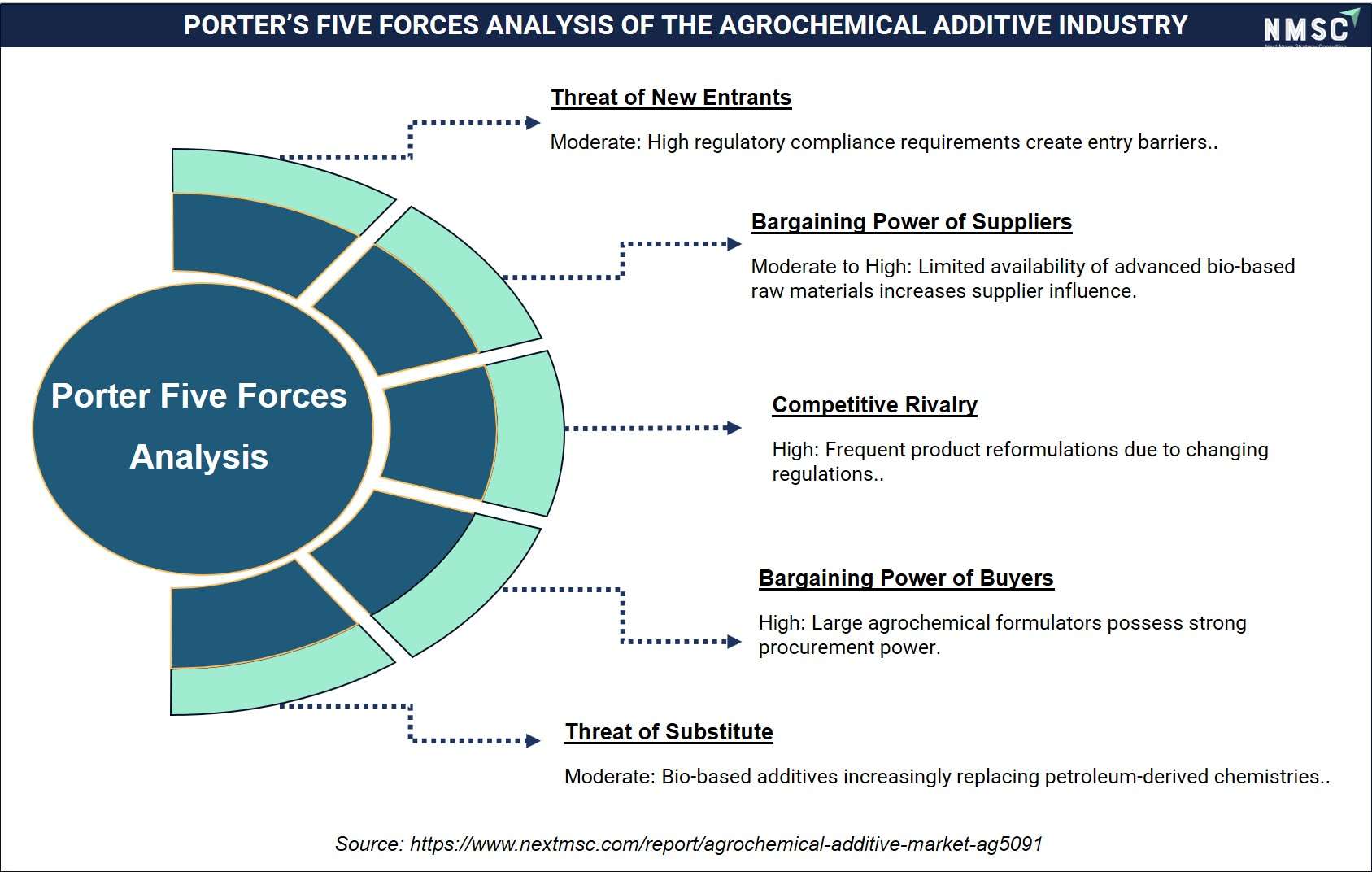
The Porter’s Five Forces analysis highlights the competitive dynamics shaping the Agrochemical Additive Market. The market experiences high competitive rivalry due to continuous product innovation, regulatory-driven reformulations, and increasing demand for sustainable crop protection solutions. Large agrochemical manufacturers possess strong bargaining power because of bulk procurement capabilities, while suppliers maintain moderate influence due to dependence on specialty chemicals and bio-based raw materials. Regulatory barriers limit new entrants, whereas the growing adoption of bio-based and biological alternatives creates a moderate threat of substitutes. Overall, the market is driven by innovation, compliance requirements, and precision agriculture advancements.
What Are the Growth Inhibitors of the Agrochemical Additive Market?
How Do Stringent Regulatory Approval Pathways Constrain Growth in the Agrochemical Additive Market?
The regulatory burden associated with registering new additive chemistries represents a significant structural constraint on the Agrochemical Additive Market. In the European Union, Regulation (EC) No 1107/2009 requires comprehensive toxicological, ecotoxicological, and environmental fate assessments for co-formulants used in plant protection products. The European Chemicals Agency (ECHA) maintains an ongoing review of substances of very high concern that periodically restricts additive ingredients from commercial formulations. Our assessment indicates that these approval timelines, often spanning three to seven years for novel additive chemistries, impede the pace of product innovation and limit competitive entry for smaller formulators and additive developers.
How Does Commodity Price Volatility Affect Profitability and Growth in the Agrochemical Additive Market?
Commodity price volatility across petroleum derivatives, oleochemicals, and fermentation feedstocks directly affects input costs and profitability within the Agrochemical Additive Market. Surfactants, emulsifiers, and solvents derived from petrochemical feedstocks are exposed to crude oil price fluctuations that compress formulator margins during price escalation periods. The U.S. Energy Information Administration tracks ethylene oxide and propylene oxide price indices, which are critical feedstocks for many non-ionic surfactant adjuvants. NMSC's analysis indicates that formulators with limited ability to pass through input cost increases to end users face earnings volatility that constrains investment in new product development and geographic expansion within this market.
SWOT Analysis of the Agrochemical Additive Market
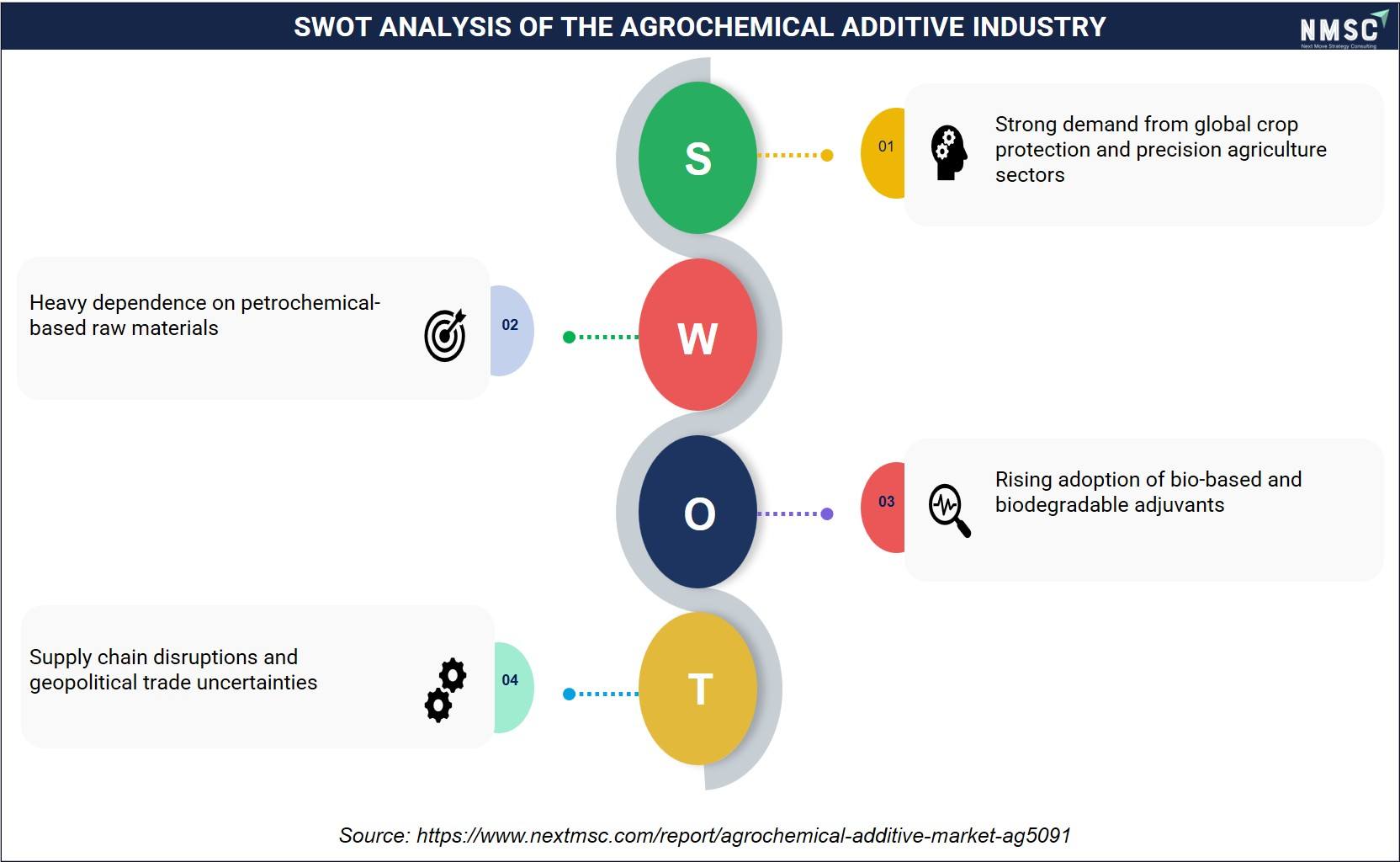
The SWOT analysis highlights the major internal and external factors influencing the Agrochemical Additive Market. Strong demand from crop protection and precision agriculture sectors supports market growth, while rising adoption of bio-based and biodegradable adjuvants creates significant growth opportunities. However, the industry remains highly dependent on petrochemical-based raw materials, exposing manufacturers to price volatility and supply risks. Additionally, geopolitical trade uncertainties and supply chain disruptions continue to challenge global operations. Overall, the market is evolving toward sustainable, high-performance formulations driven by innovation, regulatory pressure, and modern agricultural practices.
What Are the Growth Opportunities in the Agrochemical Additive Market?
How Does the Expansion of High-Value Horticulture Create Growth Opportunities in the Agrochemical Additive Market?
The rapid expansion of high-value horticultural crops, including berries, tree nuts, citrus, and protected cultivation vegetables, creates a structurally attractive growth opportunity for premium performance additives within the Agrochemical Additive Market. The U.S. Department of Agriculture's Economic Research Service documents consistent growth in specialty crop acreage and farm gate value. Our findings suggest that growers of high-value specialty crops are willing to invest in superior adjuvant formulations that deliver measurable yield or quality improvements, as marginal production cost increases are justifiable against high per-acre revenue in these crops. This dynamic supports premium pricing for specialty adjuvant and formulation additive products.
How Is the Global Seed Treatment Market Creating a Structural Opportunity for Agrochemical Additives?
The global seed treatment industry represents one of the most compelling growth pathways for the Agrochemical Additive Market, as commercial seed treatment requires specialized binders, film-forming polymers, wetting agents, and biological additive carriers. The International Seed Federation and national seed industry associations document consistent growth in treated seed acreage globally, particularly across cereal, oilseed, and vegetable segments. Our analysis shows that the integration of nutrient efficiency additives and chelating agents into seed treatment formulations represents a fast-growing innovation frontier, as formulators and crop nutrition companies develop multifunctional seed treatment packages that deliver both crop protection and nutrition benefits at planting.
How Does Sustainable Agriculture Investment Create New Commercial Pathways in the Agrochemical Additive Market?
The accelerating global investment in sustainable agriculture and regenerative farming practices creates significant new commercial pathways for bio-based and biologically derived additives within the Agrochemical Additive Market. The U.S. Department of Agriculture's Partnerships for Climate-Smart Commodities initiative allocates substantial funding toward low-carbon, sustainable crop production systems that favor reduced synthetic input use. Through NMSC's assessment, we found that soil conditioners, controlled release agents, and chelating agents that improve nutrient use efficiency while reducing leaching and runoff represent priority innovation areas, with growing retailer and consumer value chain demand for verified sustainable production practices supporting premium market positioning.
How Is the Agrochemical Additive Market Segmented in This Report, and What Are the Key Insights from the Segmentation Analysis?
How Do Product Type Segments Reflect Demand Dynamics Across the Agrochemical Additive Market?
|
Product Type Segment |
2025 (USD Bn) |
2035 (USD Bn) |
CAGR (%) |
|
Adjuvants |
1.60 |
2.42 |
4.2% |
|
– Activator Adjuvants |
0.90 |
1.36 |
4.2% |
|
– Utility Adjuvants |
0.70 |
1.06 |
4.2% |
|
Formulation Additives |
1.30 |
2.08 |
4.8% |
|
Nutrient Efficiency Additives |
0.60 |
1.10 |
6.2% |
|
Biological Additives |
0.30 |
0.60 |
8.1% |
Based on NMSC's research, this Agrochemical Additive Market report finds that the market is segmented by product type into Adjuvants, Formulation Additives, Nutrient Efficiency Additives, and Biological Additives. The Adjuvants segment, comprising Activator Adjuvants (Surfactants, Oil-Based, and Nitrogen-Based) and Utility Adjuvants (Compatibility Agents, Buffers and Acidifiers, Anti-Foaming Agents, Drift Control Agents, Deposition Agents, and Water Conditioning Agents), holds the dominant share at USD 1.6 billion in 2025, driven by its universal application across herbicide, fungicide, and insecticide tank mix operations. Formulation Additives, including Dispersing Agents, Emulsifiers, Wetting Agents, Stabilizers, Binders, Rheology Modifiers, Defoamers, and Preservatives, represent the second-largest segment, valued at USD 1.3 billion in 2025, supported by consistent new product registration activity. Biological Additives, encompassing Microbial Enhancers, Fermentation-Based Additives, and Bio-Based Surfactants, is the fastest-growing sub-segment at a CAGR of 8.1%, fueled by the biological crop protection revolution.
How Does Chemistry Segmentation Reveal Competitive Differentiation Within the Agrochemical Additive Market?
|
Chemistry Segment |
2025 (USD Bn) |
2035 (USD Bn) |
CAGR (%) |
|
Non-Ionic |
0.92 |
1.47 |
4.8% |
|
Silicone-Based |
0.68 |
1.13 |
5.2% |
|
Oil-Based |
0.57 |
0.88 |
4.4% |
|
Anionic |
0.48 |
0.74 |
4.4% |
|
Polymer-Based |
0.45 |
0.78 |
5.7% |
|
Bio-Based |
0.30 |
0.64 |
7.8% |
|
Cationic |
0.22 |
0.33 |
4.1% |
|
Amphoteric |
0.11 |
0.17 |
4.5% |
|
Others |
0.07 |
0.10 |
3.5% |
Our assessment indicates that the Agrochemical Additive Market by chemistry spans Non-Ionic, Silicone-Based, Oil-Based, Anionic, Cationic, Amphoteric, Polymer-Based, Bio-Based, and Others categories. Non-Ionic chemistry holds the dominant share at USD 0.92 billion in 2025, reflecting its broad compatibility profile, favorable environmental classification, and suitability across herbicide, fungicide, and insecticide formulations. Silicone-Based adjuvants, particularly trisiloxane and polysiloxane surfactants, represent the second-largest chemistry segment and are distinguished by their exceptional spreading and penetration properties at ultra-low concentrations. Polymer-Based chemistry is advancing steadily due to its role in controlled release and rheology modification applications. Bio-Based chemistry is the fastest-growing segment at a CAGR of 7.8%, as regulatory restrictions on petroleum-derived inputs and formulator sustainability commitments accelerate the adoption of plant-derived, fermentation-sourced, and renewable feedstock-based additive chemistries.
Which Application Segments Generate the Most Value in the Agrochemical Additive Market?
|
Application Segment |
2025 (USD Bn) |
2035 (USD Bn) |
CAGR (%) |
|
Herbicides |
1.10 |
1.70 |
4.5% |
|
Fungicides |
0.72 |
1.14 |
4.7% |
|
Insecticides |
0.60 |
0.94 |
4.6% |
|
Fertilizers |
0.60 |
1.00 |
5.2% |
| Seed Treatment
|
0.38 |
0.70 |
6.9% |
|
Plant Growth Regulators |
0.22 |
0.38 |
5.6% |
|
Tank Mix Additives |
0.18 |
0.34 |
6.6% |
Through our market assessment, we observed that the Agrochemical Additive Market is segmented by application into Herbicides, Fungicides, Insecticides, Fertilizers, Plant Growth Regulators, Seed Treatment, and Tank Mix Additives. The Herbicides segment dominates at USD 1.1 billion in 2025, underpinned by the vast global area treated with glyphosate, 2,4-D, and selective graminicide herbicides that routinely require adjuvant addition for optimum performance. Fungicide and Insecticide applications collectively represent a major additive consumption base supported by intensive disease management programs in cereals, fruits, vegetables, and plantation crops. The Seed Treatment segment is the fastest-growing application at a CAGR of 6.9%, as commercial seed treatment increasingly integrates performance additives, biological carriers, and nutrient efficiency enhancers into multifunctional seed coating systems.
How Does Physical Form Influence Adoption and Logistics in the Agrochemical Additive Market?
|
Form Segment |
2025 (USD Bn) |
2035 (USD Bn) |
CAGR (%) |
|
Liquid |
2.30 |
3.64 |
4.7% |
|
Powder |
0.60 |
0.94 |
4.6% |
|
Granular |
0.55 |
0.86 |
4.6% |
|
Water-Dispersible |
0.35 |
0.76 |
8.1% |
Based on our market evaluation, we noticed that the Agrochemical Additive Market is segmented by physical form into Liquid, Powder, Granular, and Water-Dispersible categories. Liquid form dominates the market at USD 2.3 billion in 2025, reflecting the operational preference of agrochemical formulators and farmers for liquid adjuvants and emulsifiers that integrate seamlessly into spray tank operations without additional dispersion steps. Powder formulations serve niche applications in dry formulation systems and seed treatment programs. Granular additives are applied primarily in slow-release fertilizer systems and soil amendment programs. Water-Dispersible form is the fastest-growing physical form segment at a CAGR of 8.1%, driven by its lower solvent content, reduced volatile organic compound profile, and improved handling safety characteristics that align with regulatory trends in the European Union and North America.
How Does Crop Type Segmentation Shape Demand Patterns in the Agrochemical Additive Market?
|
Crop Type Segment |
2025 (USD Bn) |
2035 (USD Bn) |
CAGR (%) |
|
Cereals and Grains |
1.20 |
1.87 |
4.5% |
|
Oilseeds and Pulses |
0.72 |
1.12 |
4.5% |
|
Fruits and Vegetables |
0.88 |
1.65 |
6.5% |
|
Plantation Crops |
0.52 |
0.84 |
4.9% |
|
Turf and Ornamentals |
0.28 |
0.42 |
4.1% |
|
Others |
0.20 |
0.30 |
4.1% |
Our findings suggest that the Agrochemical Additive Market is segmented by crop type into Cereals and Grains, Oilseeds and Pulses, Fruits and Vegetables, Plantation Crops, Turf and Ornamentals, and Others. Cereals and Grains dominate the segment at USD 1.2 billion in 2025, reflecting the enormous global acreage under wheat, corn, rice, barley, and sorghum cultivation that requires consistent adjuvant and nutrient efficiency additive inputs across multiple crop protection passes per season. Oilseeds and Pulses represent the second-largest segment driven by soybean, canola, and sunflower acreage expansion in Latin America and Asia-Pacific. The Fruits and Vegetables segment is the fastest-growing crop type category at a CAGR of 6.5%, driven by the expansion of high-value horticulture, increasing protected cultivation acreage, and grower willingness to invest in premium adjuvant performance for crop quality outcomes.
How Are Distribution Channels Reshaping Go-to-Market Dynamics in the Agrochemical Additive Market?
|
Distribution Channel |
2025 (USD Bn) |
2035 (USD Bn) |
CAGR (%) |
|
Agri Retail |
1.40 |
2.17 |
4.5% |
|
Distributor Network |
1.00 |
1.57 |
4.6% |
|
Direct Sales |
0.80 |
1.30 |
5.0% |
|
Cooperatives |
0.40 |
0.60 |
4.1% |
|
Digital Commerce |
0.20 |
0.56 |
10.8% |
Based on NMSC's research, we found that the Agrochemical Additive Market is distributed through Agri Retail, Distributor Networks, Direct Sales, Cooperatives, and Digital Commerce channels. Agri Retail holds the dominant share at USD 1.4 billion in 2025, reflecting the established role of farm supply retailers and cooperative stores in agrochemical product distribution across North America, Europe, and Asia-Pacific. Distributor Networks represent the second-largest channel, particularly important in emerging markets where tiered distribution infrastructure reaches smallholder and semi-commercial farming operations. Direct Sales are growing as major additive suppliers develop key account programs targeting large commercial farms and formulator customers. Digital Commerce is the fastest-growing channel in the Agrochemical Additive Market at a CAGR of 10.8%, as e-commerce platforms and digital procurement channels expand access to specialty additives, particularly in Asia-Pacific and North American markets.
Regional Outlook
Geographic Performance Snapshot
|
Region |
2025 (USD Bn) |
2035 (USD Bn) |
CAGR (%) |
Key Driver |
|
North America |
0.88 |
1.34 |
4.3% |
Precision agriculture adoption, biopesticide growth |
|
Europe |
0.72 |
1.08 |
4.1% |
Farm to Fork regulatory compliance, bio-based demand |
|
Asia-Pacific |
1.40 |
2.30 |
5.1% |
Crop protection expansion, row crop intensification |
|
Middle East & Africa |
0.32 |
0.54 |
5.3% |
Food security investment, agrochemical modernization |
|
Latin America |
0.48 |
0.94 |
6.8% |
Row crop acreage expansion, adjuvant penetration |
North America Agrochemical Additive Market
North America holds the largest Agrochemical Additive Market share, representing a mature and technologically sophisticated region accounting for USD 0.88 billion in 2025 and forecast to reach USD 1.34 billion by 2035 at a CAGR of 4.3%. The region is characterized by high adjuvant adoption rates, established distributor infrastructure, and strong formulator investment in performance additive innovation. Precision agriculture technologies, including variable rate application and UAV spraying, are creating new demand for specialized adjuvant formulations. The U.S. EPA's pesticide regulation framework and Canadian Pest Management Regulatory Agency guidelines shape additive approval and product placement strategies across the region.
U.S. Agrochemical Additive Market
Based on our engagements with North American crop protection stakeholders, we found that the United States represents approximately 80% of North American Agrochemical Additive Market revenue, underpinned by the world's largest commercial row crop acreage, a highly consolidated formulator base, and deep penetration of performance adjuvants across corn, soybean, wheat, and cotton production systems. The U.S. EPA's List 3 inert ingredient approval process governs adjuvant composition, creating regulatory certainty for established chemistries. Demand for drift control agents, nitrogen-based adjuvants, and water conditioning agents is growing alongside the adoption of precision spraying and cover crop integration programs across major production regions.
Canada Agrochemical Additive Market
Through our analysis, we found that Canada is a steady and technically sophisticated participant in the Agrochemical Additive Market, driven by canola, wheat, and pulse crop production in the Prairie provinces. The Pest Management Regulatory Agency's co-formulant assessment framework ensures that adjuvants used in Canadian agriculture meet environmental and toxicological standards consistent with international best practices. Demand for compatibility agents and anti-foaming adjuvants is particularly strong in canola production systems, where tank mix complexity is high. Bio-based adjuvant adoption is growing among Canadian producers aligned with sustainability certification programs in the food supply chain.
Mexico Agrochemical Additive Market
From our assessment, Mexico presents a growing opportunity within the North America Agrochemical Additive Market, driven by expanding commercial agriculture in the Bajio, Sinaloa, and Sonora regions. The Mexican crop protection market is regulated under COFEPRIS guidelines, which govern the registration and use of co-formulants and adjuvants in plant protection products. Demand for emulsifiers, wetting agents, and compatibility agents is growing alongside the modernization of commercial farming operations. Digital commerce and distributor network channels are playing an increasingly important role in delivering specialty additives to mid-sized Mexican agricultural enterprises.
Europe Agrochemical Additive Market
Europe is the second-largest region in the Agrochemical Additive Market at USD 0.72 billion in 2025, forecast to reach USD 1.08 billion by 2035 at a CAGR of 4.1%. The European market is strongly shaped by regulatory reform, with the Farm to Fork Strategy and Sustainable Use Regulation compelling formulators and farmers to shift toward performance adjuvants that support active ingredient dose reduction. Bio-based and biologically derived additive chemistries are experiencing the strongest regulatory tailwind. The European Chemicals Agency's ongoing co-formulant review is restructuring the permissible chemistry palette for adjuvant products across EU member states.
UK Agrochemical Additive Market
Based on our engagements with European agrochemical stakeholders, we found that the United Kingdom maintains a sophisticated and innovation-oriented Agrochemical Additive Market supported by the Health and Safety Executive's pesticide registration framework. Post-Brexit regulatory divergence from EU guidelines is creating both challenges and opportunities for additive suppliers operating across both markets. UK-based formulators serving cereal and oilseed rape production systems are significant consumers of drift control agents, buffer and acidifier adjuvants, and organosilicone spreaders. The UK's commitment to its Agriculture Bill targets supports continued demand for performance adjuvants that improve spray application efficiency and reduce environmental impact.
Germany Agrochemical Additive Market
According to evaluation conducted by NMSC, Germany is the largest individual country market for agrochemical additives within the European region, supported by its intensive cereal, sugar beet, and horticultural production sectors. BASF SE, headquartered in Ludwigshafen, is a globally significant supplier of formulation additives and adjuvant chemistries originating from the German market. The Federal Institute for Risk Assessment (BfR) and German Environment Agency (UBA) provide scientific oversight for co-formulant safety assessments. Bio-based additive chemistry is a priority research and investment area for German agrochemical suppliers seeking to align with EU Green Deal agricultural sustainability commitments.
France Agrochemical Additive Market
Through our analysis, we noticed that France is a major contributor to the European Agrochemical Additive Market, driven by extensive cereal, viticulture, and sunflower cultivation. The French Ministry of Agriculture's Ecophyto program, targeting a 50% reduction in pesticide use, creates strong pull demand for performance adjuvants that sustain crop protection efficacy at reduced active ingredient rates. Clariant AG and Croda International maintain significant commercial relationships with French formulator and cooperative customers. The Comité de Liaison des Enterprises Fournisseuses de l'Industrie de la Protection des Plantes (CEFIC) provides industry regulatory coordination that influences additive approval processes.
Italy Agrochemical Additive Market
From our assessment, Italy represents a mid-tier European market for agrochemical additives, driven by intensive viticulture, olive, and vegetable production that requires specialized fungicide and insecticide adjuvant systems. The Italian Ministry of Health oversees pesticide and co-formulant registration under EU Regulation 1107/2009. Demand for wetting agents, emulsifiers, and deposition enhancers is particularly strong in the horticultural and perennial crop sectors. The National Action Plan for the Sustainable Use of Pesticides guides Italian agricultural policy toward reduced-dose programs that support adjuvant market growth.
Spain Agrochemical Additive Market
Based on our evaluation, we noticed that Spain demonstrates steady demand in the Agrochemical Additive Market, supported by its position as Europe's largest producer of olives, citrus, and vegetables. The Spanish Ministry of Agriculture, Fisheries and Food governs plant protection product registration, including co-formulant and adjuvant approvals. Demand for anti-foaming agents, emulsifiers, and biological additive carriers is growing within Spain's expanding organic and low-residue certified production sectors. Southern European climate conditions, including high evaporation rates and wind speeds, elevate the importance of drift control and deposition enhancement adjuvants in spray application programs.
Sweden Agrochemical Additive Market
Through our analysis, we found that Sweden is a niche but technically demanding participant in the Agrochemical Additive Market, characterized by stringent environmental standards administered by the Swedish Chemicals Agency (KEMI). Swedish agriculture relies primarily on cereal and oilseed rape production, where herbicide and fungicide adjuvant applications are standard practice. Bio-based and environmentally certified additive chemistries command premium market positioning in Sweden's sustainability-oriented farming sector. Sweden's national action plan for pesticide risk reduction supports continued demand for performance adjuvants that enable dose reduction in crop protection programs.
Denmark Agrochemical Additive Market
According to evaluation by NMSC, Denmark operates one of Europe's most regulated agrochemical markets, with the Danish Environmental Protection Agency maintaining a restricted list of approved co-formulants for pesticide products. Demand for adjuvants approved under strict Danish environmental standards is concentrated in cereal, sugar beet, and potato production systems. Organosilicone adjuvants and non-ionic surfactants meeting Tier 1 environmental risk criteria command the majority of adjuvant volume. Denmark's leading food export sector incentivizes adoption of performance additives that support compliance with maximum residue limits in export-oriented production programs.
Finland Agrochemical Additive Market
From our assessment, Finland represents a small but specialized segment of the European Agrochemical Additive Market, characterized by short growing seasons and intensive cereal and potato cultivation. The Finnish Food Authority administers plant protection product approvals consistent with EU Regulation 1107/2009. Demand for adjuvants that maximize active ingredient performance in cool, short-season conditions is a technical priority for Finnish agrochemical end users. Bio-based wetting agents and environmentally certified compatibility agents are gaining traction in Finland's sustainability-oriented farming community aligned with the country's national climate and food system goals.
Netherlands Agrochemical Additive Market
Based on our engagements, we found that the Netherlands holds a strategically important position in the European Agrochemical Additive Market as both a major producer of horticultural crops and a global hub for agrochemical formulation and innovation. The Board for the Authorisation of Plant Protection Products and Biocides (Ctgb) oversees co-formulant assessments for the Dutch market. Protected cultivation in the Netherlands' extensive greenhouse sector creates specialized demand for low-phytotoxicity wetting agents and deposition enhancers. Corbion N.V., headquartered in Amsterdam, is a globally significant supplier of bio-based additive inputs produced partly from Dutch fermentation infrastructure.
Rest of Europe Agrochemical Additive Market
Through our analysis, we found that the Rest of Europe, comprising Poland, Romania, Hungary, Czech Republic, Greece, Portugal, Austria, Belgium, and other EU member states, represents a diverse and collectively significant portion of the European Agrochemical Additive Market. Eastern European markets are characterized by growing commercial agriculture, expanding adjuvant awareness, and rising investment in performance crop protection programs. Poland and Romania are particularly active growth markets driven by cereal and sunflower production expansion and increasing formulator distribution network penetration in rural agronomic advisory channels.
Asia-Pacific Agrochemical Additive Market
Asia-Pacific is the dominant region in the Agrochemical Additive Market at USD 1.4 billion in 2025, forecast to reach USD 2.3 billion by 2035 at a CAGR of 5.1%. The region encompasses the world's largest agricultural economies, including China, India, and Southeast Asia, where expanding crop protection intensity, rising commercial farming investment, and growing awareness of adjuvant performance benefits are driving consistent demand growth. Regulatory frameworks in China, Japan, and Australia are becoming increasingly influential in shaping additive chemistry requirements across the region.
China Agrochemical Additive Market
Based on our engagements with Asia-Pacific industry participants, we found that China is the largest single country market in the Asia-Pacific Agrochemical Additive Market, representing approximately 28% of regional revenue in 2025. China is both a major consumer and exporter of agrochemical additives, with a significant domestic formulation additive manufacturing base including silicone-based adjuvants produced by companies such as Jiangxi Hito Silicone Materials Co., Ltd. The Ministry of Agriculture and Rural Affairs administers pesticide registration including formulation additive requirements. Intensifying crop protection programs in rice, corn, and vegetable production systems are sustaining strong domestic additive demand across multiple agricultural provinces.
India Agrochemical Additive Market
Through our analysis, we found that India is the fastest-growing national market in Asia-Pacific within the Agrochemical Additive Market, advancing at a CAGR of 7.2% from 2026 to 2035. The Central Insecticides Board and Registration Committee administers agrochemical product approvals, with growing regulatory attention to co-formulant quality and environmental safety. India's expanding commercial farming sector, rising awareness of adjuvant performance benefits, and government-supported agrochemical modernization programs are driving additive market development. Demand for emulsifiers, wetting agents, and nutrient efficiency additives is growing alongside the modernization of Indian farm input supply chains.
Japan Agrochemical Additive Market
From our assessment, Japan represents a technically sophisticated and quality-focused Agrochemical Additive Market characterized by intensive rice, vegetable, and fruit production systems. The Ministry of Agriculture, Forestry and Fisheries (MAFF) oversees pesticide registration and co-formulant safety standards under the Agricultural Chemicals Regulation Law. Japanese formulators are recognized for high formulation quality standards, driving premium demand for specialty emulsifiers, stabilizers, and rheology modifiers. Organosilicone adjuvants and controlled release agents used in paddy and upland crop management systems represent key additive categories with consistent domestic consumption in the Japanese agricultural sector.
South Korea Agrochemical Additive Market
According to evaluation by NMSC, South Korea maintains a concentrated and quality-driven Agrochemical Additive Market supported by intensive rice, vegetable, and apple production. The Rural Development Administration and Ministry of Environment jointly oversee agrochemical registration and additive approval standards. Korean formulators increasingly integrate premium silicone-based adjuvants and deposition enhancement agents into specialty crop protection products. South Korea's export-oriented horticulture sector prioritizes maximum residue limit compliance, supporting demand for high-purity, low-residue formulation additives and adjuvant chemistries in fruit and vegetable production programs.
Taiwan Agrochemical Additive Market
Based on our analysis, Taiwan participates in the Agrochemical Additive Market through its intensive rice, tropical fruit, and vegetable production systems. The Taiwan Agricultural Chemicals and Toxic Substances Research Institute administers pesticide and co-formulant registrations under the Agricultural Chemicals Management Act. Demand for wetting agents, emulsifiers, and deposition enhancers is concentrated in specialty horticultural crops with high pest and disease pressure. Bio-based additive adoption is growing among Taiwanese growers aligned with organic and reduced-residue market certification programs serving domestic premium retail channels.
Indonesia Agrochemical Additive Market
From our assessment, Indonesia is a growing market for agrochemical additives, supported by extensive rice, palm oil, and rubber production systems that require consistent crop protection inputs. The Agricultural Inputs and Agri-Tools Agency administers pesticide registration, including formulation additive approvals. Demand for emulsifiers, dispersing agents, and compatibility agents is growing alongside the expansion of commercial plantation management in Sumatra and Kalimantan. Indonesia's government-led agrochemical modernization programs and rising smallholder awareness of adjuvant performance benefits are creating early-stage market development opportunities across the archipelago.
Vietnam Agrochemical Additive Market
Through our analysis, we found that Vietnam represents a fast-growing Agrochemical Additive Market participant driven by intensive rice, coffee, and aquaculture-integrated farming systems in the Mekong Delta and Central Highlands regions. The Department of Crop Production under the Ministry of Agriculture and Rural Development administers plant protection product registrations. Demand for wetting agents, anti-foaming agents, and emulsifiers is growing alongside the professionalization of Vietnamese commercial rice and coffee crop protection programs. Bio-based adjuvant awareness is at an early stage but is receiving increasing attention from export-oriented certified coffee and pepper producers.
Australia Agrochemical Additive Market
Based on our engagements, we found that Australia is a technically mature and regulation-compliant Agrochemical Additive Market participant overseen by the Australian Pesticides and Veterinary Medicines Authority (APVMA). Australian dryland cereal and cotton farming systems are significant consumers of drift control agents, water conditioning agents, and compatibility adjuvants given the country's large field scale, variable water quality, and challenging spray application conditions. Organosilicone adjuvants are widely used in Australian herbicide and fungicide programs. The APVMA's co-formulant assessment requirements ensure that additives marketed in Australia meet environmental and human safety standards consistent with international regulatory norms.
Philippines Agrochemical Additive Market
According to evaluation, the Philippines is a developing participant in the Agrochemical Additive Market, driven by rice, corn, and sugarcane production systems requiring consistent crop protection inputs. The Fertilizer and Pesticide Authority administers plant protection product registrations, including formulation additive standards. Demand for emulsifiers and wetting agents is growing as commercial farming modernization expands in Luzon and Mindanao agricultural regions. Government programs promoting integrated pest management and responsible pesticide use are creating awareness of adjuvant performance benefits among Filipino commercial and semi-commercial farming operators.
Malaysia Agrochemical Additive Market
From our assessment, Malaysia participates in the Agrochemical Additive Market primarily through its extensive oil palm, rubber, and rice production systems. The Pesticides Board of Malaysia and the Malaysian Agricultural Research and Development Institute oversee crop protection product registrations. Demand for emulsifiers, dispersing agents, and anti-foaming adjuvants is supported by large-scale plantation management operations that routinely use herbicide and fungicide programs. Malaysia's plantation agriculture export orientation creates incentives for high-quality additive adoption aligned with international maximum residue limit compliance requirements.
Rest of Asia-Pacific Agrochemical Additive Market
Through NMSC's assessment, we found that the Rest of Asia-Pacific, comprising Thailand, Myanmar, Bangladesh, Pakistan, Sri Lanka, New Zealand, and other regional markets, collectively represents an expanding opportunity in the Agrochemical Additive Market. Thailand and Bangladesh are significant rice-producing markets with growing adjuvant awareness. New Zealand's horticulture and pastoral production systems support demand for specialty adjuvants aligned with stringent environmental standards.
Middle East & Africa Agrochemical Additive Market
The Middle East and Africa region represents an emerging growth opportunity in the Agrochemical Additive Market at USD 0.32 billion in 2025, forecast to reach USD 0.54 billion by 2035 at a CAGR of 5.3%. Food security investment, agricultural modernization programs, and growing commercial farming intensity across the region are driving incremental additive demand. Regulatory frameworks are at varying levels of maturity, with Gulf Cooperation Council countries investing in advanced agricultural input quality systems and Sub-Saharan African markets at earlier stages of agrochemical formulation adoption.
Saudi Arabia Agrochemical Additive Market
Based on our engagements, we found that Saudi Arabia represents the largest agricultural technology investment market in the Middle East within the Agrochemical Additive Market. The Saudi Food and Drug Authority and the Ministry of Environment, Water and Agriculture jointly administer pesticide and agricultural input registrations. Vision 2030 agricultural modernization investments are driving demand for high-performance crop protection inputs, including specialty adjuvants for date palm, vegetable, and protected cultivation systems. Demand for controlled release agents and soil conditioners is growing alongside hydroponic and precision irrigation-based agriculture expansion.
UAE Agrochemical Additive Market
Through our analysis, we found that the UAE participates in the Agrochemical Additive Market primarily through protected cultivation, date palm management, and food security-oriented government agricultural programs. The Ministry of Climate Change and Environment oversees pesticide registration and co-formulant approvals. Demand for high-performance adjuvants compatible with drip irrigation systems and hydroponic crop protection programs is growing alongside UAE's agricultural technology investment. The UAE's position as a regional logistics hub also facilitates re-export of specialty agrochemical additive products to broader Middle Eastern and East African markets.
Egypt Agrochemical Additive Market
According to evaluation, Egypt represents the largest agricultural economy in North Africa and a significant participant in the regional Agrochemical Additive Market. The Central Administration for Plant Quarantine within the Ministry of Agriculture and Land Reclamation administers pesticide registrations. Egypt's extensive cotton, sugarcane, vegetables, and citrus production creates consistent demand for herbicide and fungicide adjuvants. Government programs expanding arable land through desert reclamation initiatives are creating new farmland requiring crop protection input systems that include performance additives.
Israel Agrochemical Additive Market
From our assessment, Israel is one of the most technically advanced participants in the Middle East Agrochemical Additive Market, characterized by high-intensity protected cultivation and drip-irrigated field crop systems. The Plant Protection and Inspection Services administer rigorous pesticide product registrations. Israeli agri-technology companies are globally recognized innovators in precision spray technology and formulation science, creating domestic demand for high-performance adjuvant chemistries. Bio-based and nano-enabled additive technologies are areas of active research and early commercial deployment within the Israeli agrochemical sector.
Turkey Agrochemical Additive Market
Based on our analysis, Turkey is a significant agricultural economy and an important participant in the regional Agrochemical Additive Market. The Ministry of Agriculture and Forestry administers pesticide registrations under frameworks aligned with EU Regulation 1107/2009 aspirations. Turkey's diverse crop base, including cereals, cotton, hazelnuts, citrus, and vegetables, creates broad demand across herbicide, fungicide, and insecticide adjuvant categories. Turkish formulators are increasingly integrating performance adjuvants into domestic crop protection formulations targeting both domestic agricultural markets and regional export markets in Central Asia and North Africa.
Nigeria Agrochemical Additive Market
Through our analysis, we found that Nigeria represents the largest agricultural market in Sub-Saharan Africa with growing participation in the Agrochemical Additive Market. The National Agency for Food and Drug Administration and Control (NAFDAC) and the Pesticide Association of Nigeria administer product registrations. Demand for basic emulsifiers and wetting agents is growing alongside the expansion of commercial maize, cassava, and cocoa crop protection programs. Market development is at an early stage, with distributor networks and agri-input cooperatives serving as the primary channels for specialty additive product introduction.
South Africa Agrochemical Additive Market
According to evaluation, South Africa is the most technically mature Agrochemical Additive Market in Sub-Saharan Africa, supported by its commercial maize, wine grape, citrus, and deciduous fruit production sectors. The Department of Agriculture, Land Reform and Rural Development administers pesticide and co-formulant registrations under the Fertilizers, Farm Feeds, Agricultural Remedies and Stock Remedies Act. South African formulators and distributors have well-established adjuvant and specialty additive distribution infrastructure. Demand for organosilicone spreaders, drift control agents, and buffer adjuvants is concentrated in high-value horticultural and export-oriented deciduous fruit production.
Rest of Middle East & Africa Agrochemical Additive Market
Based on our assessment, the Rest of Middle East and Africa, comprising Morocco, Kenya, Ethiopia, Tanzania, Algeria, Libya, Jordan, Kuwait, Oman, and other regional markets, collectively represents an early-stage but strategically important growth opportunity in the Agrochemical Additive Market. Morocco and Kenya are the most commercially active developing markets for specialty crop protection additives in the sub-region, driven by export-oriented horticultural production. Food security investment programs supported by the African Development Bank and national agricultural ministries are gradually expanding access to quality agrochemical input systems including performance additives.
Latin America Agrochemical Additive Market
Latin America is the fastest-growing region in the Agrochemical Additive Market at USD 0.48 billion in 2025, forecast to reach USD 0.94 billion by 2035 at a CAGR of 6.8%. The region's expanding row crop acreage, particularly soybeans, corn, and sugarcane in Brazil and Argentina, is driving consistent demand for adjuvants and formulation additives. Rising commercial farming intensity, growing agronomic advisory infrastructure, and increasing awareness of adjuvant performance benefits are structurally improving additive market penetration across Latin American agricultural production systems.
Brazil Agrochemical Additive Market
Based on our engagements, we found that Brazil is the dominant market for agrochemical additives in Latin America, representing approximately 60% of regional revenue in 2025. The Ministry of Agriculture, Livestock and Food Supply (MAPA) administers pesticide and adjuvant product registrations under the Agrochemicals Law (Law 7,802/1989). Brazil's vast soybean, corn, sugarcane, and cotton acreage creates persistent high-volume demand for herbicide adjuvants, emulsifiers, and drift control agents. The Brazilian Crop Protection Association (SINDIVEG) and IBAMA coordinate regulatory compliance requirements for co-formulants used in crop protection products across the country.
Argentina Agrochemical Additive Market
Through our analysis, we found that Argentina is the second-largest Agrochemical Additive Market in Latin America, driven by its extensive soybean, corn, wheat, and sunflower production landscapes. SENASA (Servicio Nacional de Sanidad y Calidad Agroalimentaria) administers plant protection product registrations including co-formulant and adjuvant approvals. Argentina's large-scale no-till production systems create consistent demand for herbicide adjuvants, particularly glyphosate activators and drift control agents used in broad-acre spray programs. Growing biological crop protection adoption is creating incremental demand for specialized biological additive carriers and microbial enhancer systems.
Chile Agrochemical Additive Market
From our assessment, Chile represents a concentrated and quality-oriented Agrochemical Additive Market participant, driven by export-oriented viticulture, table grape, stone fruit, and berry production. The Agriculture and Livestock Service (SAG) administers pesticide and co-formulant registrations. Chilean growers of export-oriented fresh produce are significant consumers of premium wetting agents, deposition enhancers, and low-residue adjuvant systems that support maximum residue limit compliance in destination markets including the European Union, United States, and China. Bio-based additive adoption is advancing in Chile's organic and low-residue certified production sectors.
Colombia Agrochemical Additive Market
According to evaluation, Colombia is a growing participant in the Latin America Agrochemical Additive Market, supported by coffee, banana, cut flower, and rice production systems. The Colombian Agricultural Institute (ICA) administers pesticide product registrations. Colombia's export-oriented floriculture and coffee sectors create demand for premium adjuvant formulations that meet international production standards. Government programs promoting sustainable agriculture and integrated pest management are creating awareness of adjuvant performance benefits among Colombian commercial farming communities, supporting incremental market penetration of specialty additives.
Rest of Latin America Agrochemical Additive Market
Based on NMSC's research, we found that the Rest of Latin America, comprising Peru, Ecuador, Bolivia, Paraguay, Uruguay, Venezuela, Central American nations, and Caribbean markets, collectively represents a diversified and growth-oriented component of the regional Agrochemical Additive Market. Peru and Ecuador are significant markets driven by export-oriented asparagus, blueberry, and banana production. Paraguay and Uruguay contribute soybean and wheat-based adjuvant demand. Central American markets, particularly Guatemala and Costa Rica, are active consumers of specialty insecticide and fungicide adjuvants for banana, pineapple, and coffee export production systems.
Competitive Landscape
Competitive Dynamics and M&A Landscape
|
Key Takeaways |
Details |
|
Market Structure |
The Agrochemical Additive Market is moderately consolidated, with competition among global specialty chemical companies, agricultural formulation specialists, and crop protection solution providers. Major participants include BASF SE, Evonik Industries AG, Clariant AG, Croda International Plc, Solvay SA, and Nouryon. Companies compete through formulation expertise, product performance, regulatory compliance, and partnerships with agrochemical manufacturers. |
|
Innovation Focus |
Innovation in the Agrochemical Additive Market is centered on sustainable adjuvants, bio-based surfactants, drift-control agents, tank-mix compatibility enhancers, and precision agriculture-compatible formulations. Manufacturers are investing in environmentally friendly additives that improve pesticide efficacy, reduce active ingredient usage, enhance spray retention, and support compliance with increasingly stringent environmental regulations. Digital agriculture integration and biological crop protection compatibility are also emerging innovation areas. |
|
M&A Activity |
Strategic acquisitions and partnerships are shaping competition across the Agrochemical Additive industry as companies seek to expand their agricultural formulation portfolios and sustainability capabilities. Recent years have witnessed increased investment in specialty surfactants, bio-based additives, and agricultural performance technologies. Large chemical companies are acquiring niche formulation technology providers and strengthening regional distribution networks to enhance their position in high-growth agricultural markets. Partnerships between additive manufacturers, agrochemical producers, and biological crop protection developers are also accelerating to address evolving farmer requirements and regulatory expectations. |
How Do Companies Compete in the Agrochemical Additive Market?
Competition in the Agrochemical Additive Market is driven by technical formulation expertise, chemistry portfolio breadth, regulatory approval coverage, and the strength of agronomic advisory services. Market leaders differentiate through proprietary chemistry platforms, including organosilicone adjuvants, bio-based surfactants, and controlled release polymer systems that command premium pricing based on demonstrated performance benefits. NMSC's analysis indicates that M&A activity has focused on capability acquisition, with large specialty chemical companies acquiring bio-based additive platforms and biological formulation expertise to address regulatory trends and market demand evolution. Geographic expansion into Latin America and Asia-Pacific represents a consistent strategic priority for North American and European additive suppliers seeking incremental growth beyond mature home markets.
Which Kind of Companies Dominate the Agrochemical Additive Market?
The Agrochemical Additive Market is led by a combination of global specialty chemical manufacturers, agricultural input providers, and dedicated adjuvant suppliers. Major companies including BASF SE, Croda International Plc, Clariant AG, Dow Inc., SUMITOMO CHEMICAL COMPANY, LIMITED, Elementis plc, Corbion N.V., and Kao Corporation provide advanced surfactants, dispersants, emulsifiers, and formulation technologies that enhance crop protection product performance. Agricultural solution providers such as Corteva, Inc., Nufarm Limited, Helena Agri-Enterprises, LLC, Wilbur-Ellis Company LLC, Verdesian Life Sciences LLC, and Drexel Chemical Company complement this landscape with application-focused additive solutions, while Adjuvants Plus Inc., Jiangxi Hito Silicone Materials Co., Ltd., Innvictis Crop Care LLC, Land O’Lakes, Inc., Miller Chemical & Fertilizer LLC, and M & M Industries strengthen the market through specialized adjuvant and spray enhancement technologies.
Sustainability-Focused Innovation Drives Success in the Agrochemical Additive Market
Innovation in the Agrochemical Additive Market is increasingly centered on sustainable formulation technologies, bio-based ingredients, and precision application solutions. Companies such as BASF SE, Croda International Plc, Clariant AG, Corbion N.V., and Kao Corporation are investing in environmentally responsible additives that improve efficacy while reducing environmental impact. At the same time, Corteva, Inc., Nufarm Limited, Helena Agri-Enterprises, LLC, Wilbur-Ellis Company LLC, and Verdesian Life Sciences LLC are developing advanced adjuvant systems designed to enhance spray coverage, retention, and nutrient utilization. Growing adoption of precision agriculture, drone-based spraying, and regulatory emphasis on sustainable farming continues to accelerate demand for high-performance agrochemical additives worldwide.
Strategic Partnerships and Portfolio Expansion Shape Competition in the Agrochemical Additive Market
Competitive dynamics in the Agrochemical Additive Market are increasingly influenced by strategic partnerships, product innovation, and portfolio expansion initiatives. Industry leaders including BASF SE, Dow Inc., SUMITOMO CHEMICAL COMPANY, LIMITED, Clariant AG, and Croda International Plc continue to strengthen their agricultural formulation capabilities through technology investments and customer-focused product development. Meanwhile, Helena Agri-Enterprises, LLC, Wilbur-Ellis Company LLC, Innvictis Crop Care LLC, Adjuvants Plus Inc., and Land O’Lakes, Inc. are expanding their market presence through distribution partnerships and value-added agronomic services. As demand for sustainable crop production grows, companies are expected to pursue collaborations and acquisitions that enhance formulation expertise, biological compatibility, and application efficiency.
Who Are the Key Market Players in the Agrochemical Additive Market?
-
Croda International Plc
-
Corteva, Inc.
-
Nufarm Limited
-
Dow Inc.
-
SUMITOMO CHEMICAL COMPANY, LIMITED
-
Elementis plc
-
Corbion N.V.
-
Kao Corporation
-
Helena Agri-Enterprises, LLC
-
Wilbur-Ellis Company LLC
-
Verdesian Life Sciences LLC
-
Drexel Chemical Company
-
Miller Chemical & Fertilizer LLC
-
Adjuvants Plus Inc.
-
Jiangxi Hito Silicone Materials Co., Ltd.
-
Innvictis Crop Care LLC
-
Land O’Lakes, Inc.
-
M & M Industries
What Are the Latest Developments in the Agrochemical Additive Market Industry?
|
Date |
Event |
|
January 2026 |
BASF Agricultural Solutions acquired biological insect control company AgBiTech to strengthen biological crop protection and agrochemical formulation portfolio. |
|
December 2024 |
Corteva launched Broadway Ultra herbicide for advanced weed control, supporting improved agrochemical formulation efficiency. |
Expert Insights
 "Our Value Innovation strategy is built on listening to farmers, understanding their challenges, and delivering solutions that enhance both profitability and sustainability. By combining advanced formulation technologies with a strong portfolio of active ingredients, we help farmers maximize efficiency, improve crop performance and reduce environmental impact."
— Gael Hili, President and CEO, ADAMA Ltd.
Statement made in the CEO Message of ADAMA's 2024 ESG Report, highlighting the role of advanced formulation technologies, sustainability-driven innovation, and farmer-centric product development in improving agricultural productivity and supporting sustainable farming practices.
Market Interpretation
The statement highlights the growing importance of advanced formulation technologies and sustainable agricultural solutions in the Agrochemical Additive Market. It indicates that agrochemical manufacturers are increasingly focusing on additives such as surfactants, adjuvants, dispersants, and drift-control agents that enhance the effectiveness of crop protection products while minimizing environmental impact. The emphasis on improving efficiency, crop performance, and sustainability aligns with the industry's shift toward precision agriculture and environmentally responsible farming practices, driving demand for high-performance agrochemical additives worldwide.
What Are the Investment Opportunities in the Agrochemical Additive Market?
Where Are Capital Inflows Directed Within the Agrochemical Additive Market?
Capital inflows within the Agrochemical Additive Market are increasingly concentrated in bio-based chemistry development, biological additive innovation, and precision spray system-compatible formulation platforms. Specialty chemical companies including Croda International and Corbion have directed significant R&D capital toward fermentation-derived and plant-based adjuvant chemistries that address regulatory phase-outs of petroleum-derived co-formulants. Our assessment indicates that investment in bio-based adjuvant manufacturing infrastructure in Europe and North America is accelerating as regulatory and sustainability market forces converge, creating durable commercial returns for early-mover investors in compliant additive chemistry platforms.
How Are ESG Considerations Influencing Investment Strategy in the Agrochemical Additive Market?
Environmental, Social, and Governance considerations are becoming central to investment decision-making and portfolio positioning within the Agrochemical Additive Market. The EU Taxonomy Regulation's criteria for environmentally sustainable economic activities are influencing how institutional investors evaluate specialty chemical companies with significant agrochemical additive portfolios. Our findings suggest that companies demonstrating measurable progress toward bio-based raw material sourcing, reduced hazard chemistry profiles, and verified reductions in ecotoxicological risk are attracting preferential capital access and improved ESG ratings. These factors create structural incentives for additive suppliers to accelerate sustainable chemistry investment beyond purely regulatory compliance timelines.
How Is Digital Transformation Creating Investment Opportunity in the Agrochemical Additive Market?
Digital transformation is creating distinct investment opportunities at the intersection of agrochemical additive technology and precision agriculture platforms. Adjuvant selection algorithm software, spray quality optimization tools, and tank mix compatibility databases represent early-stage digital investment areas within the broader Agrochemical Additive Market ecosystem. Based on our market evaluation, we noticed that companies integrating digital technical service platforms with physical adjuvant product portfolios are differentiating against commodity suppliers and generating higher customer retention metrics. Investment in data science capabilities that quantify and communicate adjuvant performance value through field trial analytics represents a high-return commercial strategy for leading additive suppliers.
What Private Equity and Venture Capital Activity Is Emerging in the Agrochemical Additive Market?
Private equity and venture capital activity in the Agrochemical Additive Market is focused primarily on bio-based additive startups, biological formulation platforms, and precision agriculture input companies that integrate digital and chemical technologies. NMSC's analysis indicates that acquisition targets attracting premium valuations include companies with proprietary fermentation-based surfactant production, validated biological carrier systems, and established registration dossiers in multiple major agricultural markets. The convergence of agri-food supply chain sustainability commitments and regulatory restrictions on conventional additive chemistries is creating a durable investment thesis for bio-based and biologically derived agrochemical additive platforms through the 2035 forecast horizon.
Key Benefits for Stakeholders
For Agrochemical Formulators
Agrochemical formulators gain comprehensive insights into additive market segmentation, growth opportunities, and emerging formulation trends across adjuvants, surfactants, compatibility agents, and biological additives. The analysis supports product portfolio optimization, pricing strategy development, and identification of high-growth application areas, enabling manufacturers to align innovation and commercialization efforts with evolving agricultural requirements.
For Specialty Chemical Suppliers
Specialty chemical suppliers benefit from detailed competitive intelligence on leading additive technologies, supplier positioning, and market expansion opportunities across major agricultural regions. The report provides visibility into innovation trends, strategic partnerships, and M&A activity, helping suppliers identify new customer acquisition opportunities, strengthen product differentiation, and expand their geographic footprint.
For Investors and Financial Analysts
Investors and financial analysts receive a structured assessment of the Agrochemical Additive Market's growth prospects, competitive landscape, and investment potential across conventional, bio-based, and precision agriculture additive segments. Market sizing, CAGR analysis, and regional growth forecasts support investment evaluation, portfolio allocation decisions, and identification of emerging market opportunities with strong long-term growth potential.
For Regulatory Affairs Professionals
Regulatory affairs professionals gain detailed insights into evolving regulatory frameworks governing agrochemical additives across North America, Europe, Asia-Pacific, Latin America, and the Middle East & Africa. The analysis supports product registration planning, compliance strategy development, and risk assessment by providing clarity on changing environmental, safety, and sustainability requirements influencing market access.
For Agricultural Retailers and Distributors
Agricultural retailers and distributors benefit from channel-level market intelligence, demand trend analysis, and regional adoption patterns across crop protection products. The report enables stakeholders to optimize inventory planning, distribution strategies, and customer engagement initiatives while identifying emerging opportunities associated with digital agriculture and precision farming technologies.
For Crop Protection Researchers and Product Developers
Researchers and product developers gain valuable insights into technology adoption trends, formulation innovations, and advancements in biological and sustainable additive solutions. The analysis highlights emerging opportunities in spray efficiency enhancement, drift reduction technologies, biological compatibility, and precision application systems, supporting future R&D and product innovation initiatives.
For Government Agricultural Agencies and Policymakers
Government agencies and policymakers gain market intelligence supporting agricultural productivity initiatives, food security planning, and regulatory policy development. The report provides evidence-based insights into industry structure, technology adoption patterns, sustainability trends, and investment flows, enabling informed decision-making regarding agricultural modernization and crop protection regulations.
Key Market Segments
By Product Type
-
Adjuvants
-
Activator Adjuvants
-
Surfactants
-
Oil-Based Adjuvants
-
Nitrogen-Based Adjuvants
-
-
Utility Adjuvants
-
Compatibility Agents
-
Buffers and Acidifiers
-
Anti-Foaming Agents
-
Drift Control Agents
-
Deposition Agents
-
Water Conditioning Agents
-
-
-
Formulation Additives
-
Dispersing Agents
-
Emulsifiers
-
Wetting Agents
-
Stabilizers
-
Binders
-
Rheology Modifiers
-
Defoamers
-
Preservatives
-
Others
-
-
Nutrient Efficiency Additives
-
Chelating Agents
-
Controlled Release Agents
-
Soil Conditioners
-
Biostimulant Carriers
-
-
Biological Additives
-
Microbial Enhancers
-
Fermentation-Based Additives
-
Bio-Based Surfactants
-
By Chemistry
-
Silicone-Based
-
Non-Ionic
-
Anionic
-
Cationic
-
Amphoteric
-
Oil-Based
-
Polymer-Based
-
Bio-Based
-
Others
By Form
-
Liquid
-
Powder
-
Granular
-
Water-Dispersible
By Crop Type
-
Cereals and Grains
-
Oilseeds and Pulses
-
Fruits and Vegetables
-
Plantation Crops
-
Turf and Ornamentals
-
Others
By Distribution Channel
-
Direct Sales
-
Agri Retail
-
Distributor Network
-
Digital Commerce
-
Cooperatives
By Application
-
Herbicides
-
Fungicides
-
Insecticides
-
Fertilizers
-
Plant Growth Regulators
-
Seed Treatment
-
Tank Mix Additives
By Region
-
North America: U.S., Canada, and Mexico.
-
Europe: UK, Germany, France, Italy, Spain, Sweden, Denmark, Finland, the Netherlands, and the rest of Europe.
-
Asia Pacific: China, India, Japan, South Korea, Taiwan, Indonesia, Vietnam, Australia, Philippines, Malaysia and the rest of APAC.
-
Middle East & Africa (MEA): Saudi Arabia, UAE, Egypt, Israel, Turkey, Nigeria, South Africa, and the rest of MEA.
-
Latin America: Brazil, Argentina, Chile, Colombia, and the rest of LATAM.
Conclusion and Recommendations
Long-Term Outlook
The Agrochemical Additive Market is entering a decade of structurally supported growth, advancing from USD 4.0 billion in 2026 to USD 6.2 billion by 2035 at a CAGR of 5.3%. This expansion reflects the dual forces of intensifying crop protection demand in emerging agricultural markets and the escalating performance requirements of regulatory-driven dose reduction programs in mature markets. NMSC's analysis indicates that the additive market's growth trajectory is more resilient than the broader crop protection market, as additive adoption continues expanding even where active ingredient volume growth moderates due to regulatory intervention.
Strategic Positioning Recommendations
Additive suppliers should prioritize bio-based chemistry development, biological formulation compatibility, and precision agriculture system integration as core differentiation pillars. Companies with established regulatory dossiers across multiple major agricultural markets are better positioned to capture premium pricing in markets undergoing accelerated co-formulant approval reviews. Geographic expansion into Latin America and Asia-Pacific, particularly India, Brazil, and Southeast Asia, should be a strategic priority given the favorable agronomic adoption dynamics and relative underpenetration of performance adjuvant systems in these high-growth regions.
Investment Attractiveness
The Agrochemical Additive Market presents a compelling investment case anchored by non-cyclical agricultural production demand, regulatory tailwinds for performance additive adoption, and the structural shift toward sustainable formulation inputs. Our assessment indicates that the highest-conviction investment themes include Biological Additives (8.1% CAGR), Water-Dispersible form formats (8.1% CAGR), Digital Commerce distribution channels (10.8% CAGR), and Bio-Based chemistry (7.8% CAGR). These sub-segments represent concentrated growth opportunities within a market that provides stable base volume growth across all major agricultural production geographies.
Market Shifts and Key Risks
The most significant structural market shift underway is the progressive replacement of petroleum-derived adjuvant chemistries with bio-based and biologically derived alternatives driven by EU and North American regulatory reform. This transition creates both opportunity for bio-based innovators and stranded asset risk for suppliers heavily invested in conventional petrochemical adjuvant manufacturing. Key risks in the Agrochemical Additive Market include regulatory acceleration of co-formulant phase-outs, macroeconomic pressures affecting farmer purchasing power in emerging markets, and consolidation dynamics in the crop protection industry that may alter formulator procurement strategies and preferred additive partnerships.
Growth Pathways
Organizations targeting growth in the Agrochemical Additive Market should pursue a phased strategic approach. In the near term (2025 to 2027), prioritize regulatory compliance portfolio upgrades and bio-based chemistry integration to protect market position in tightening regulatory environments. In the mid-term (2027 to 2031), invest in biological additive system development, precision agriculture adjuvant compatibility platforms, and Latin American market penetration to capture high-CAGR growth opportunities. In the long term (2031 to 2035), position for digital spray optimization integration and sustainable formulation certification programs that create premium value chain positioning in food supply chain-aligned specialty crop markets.
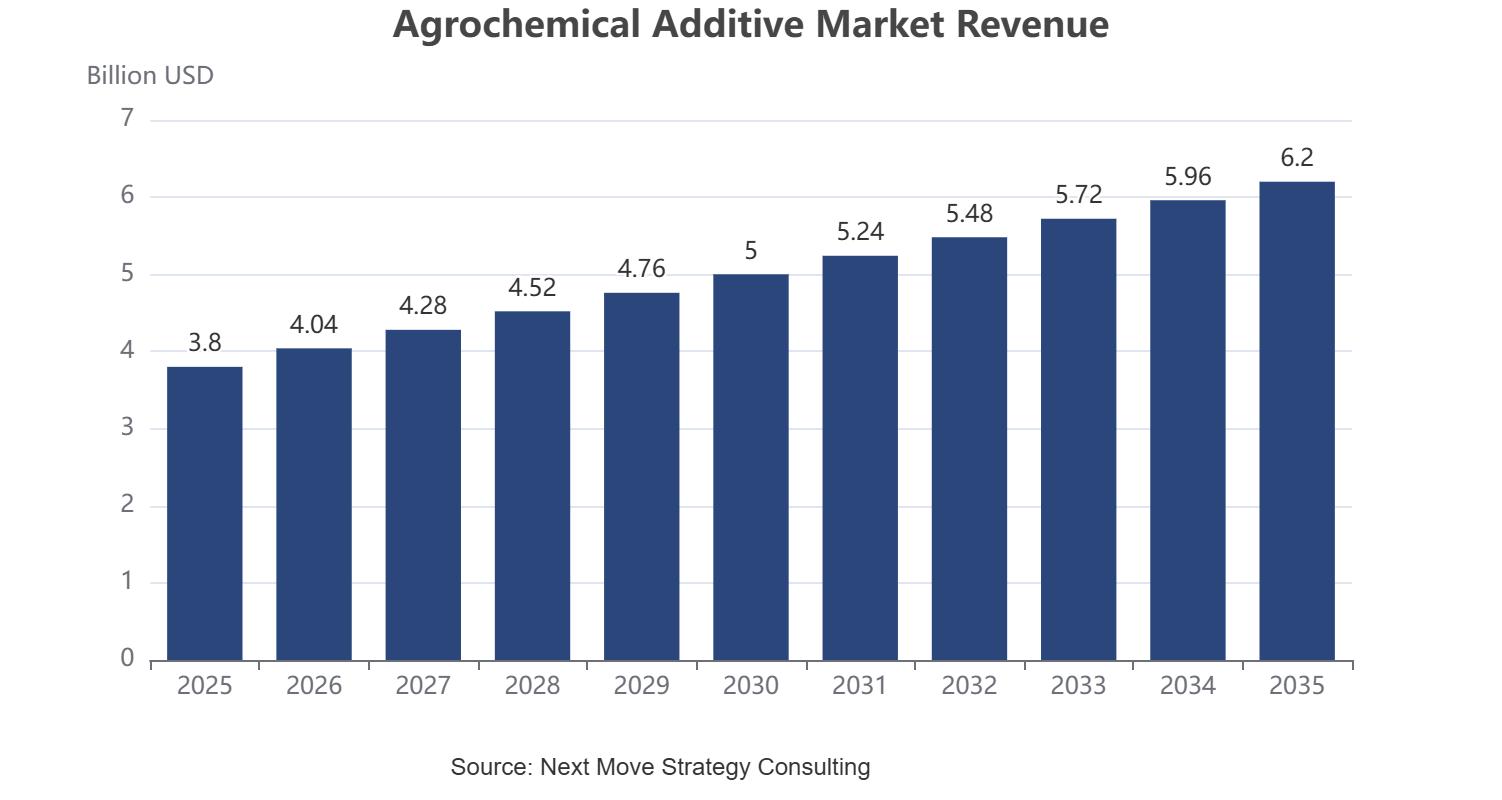
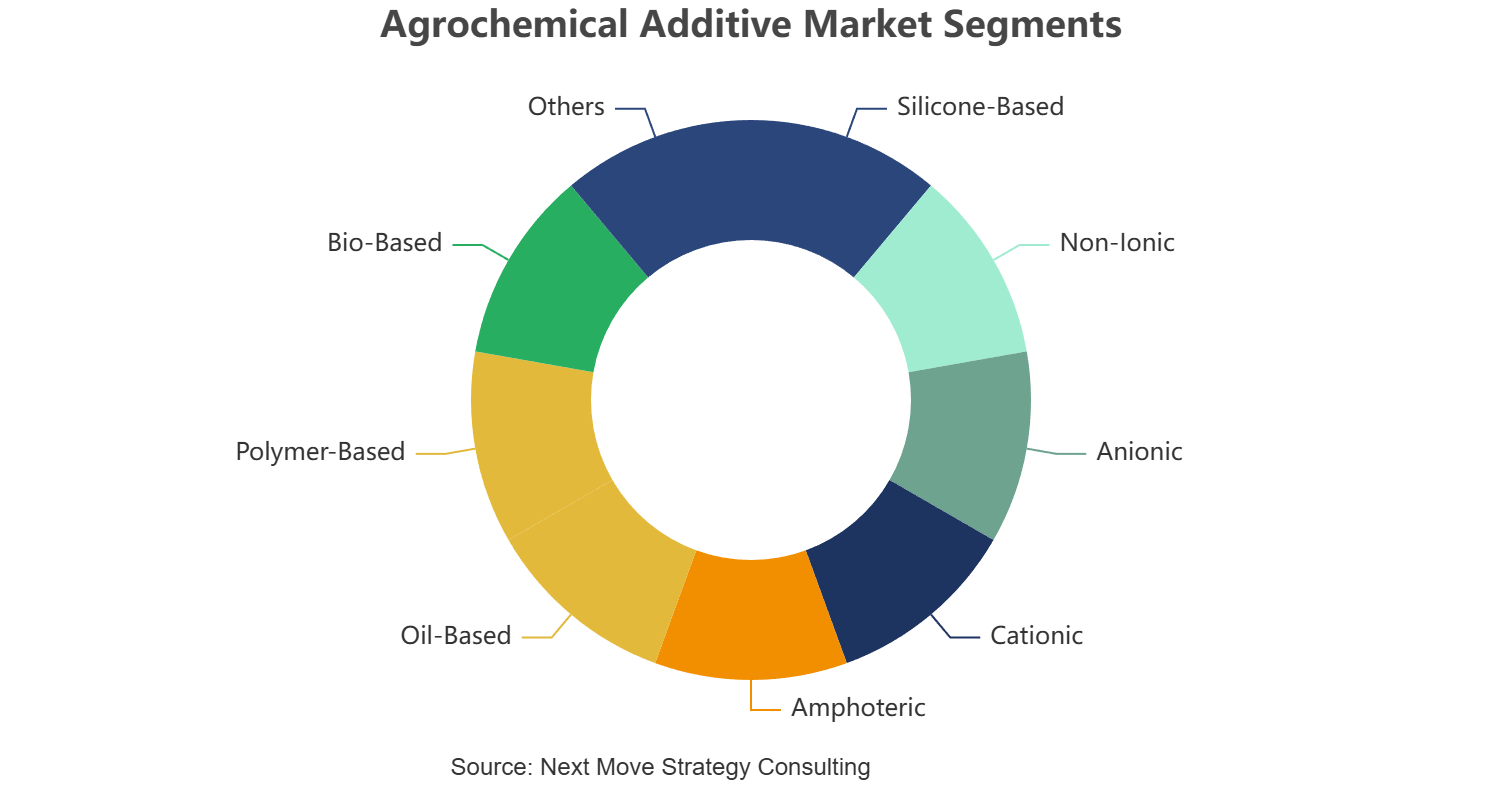
About the Author
 Liza Phukan
— Liza Phukan is Research Associate at Next Move Strategy Consulting, where she has covered emerging industries and market research across sectors for 3.5 years. Her work includes analyzing industry developments, validating market data, and developing structured business content from research findings. She uses secondary research and data-validation practices to turn complex market information into clear decision-useful market analysis for business audiences and support report development and B2B.
Liza Phukan
— Liza Phukan is Research Associate at Next Move Strategy Consulting, where she has covered emerging industries and market research across sectors for 3.5 years. Her work includes analyzing industry developments, validating market data, and developing structured business content from research findings. She uses secondary research and data-validation practices to turn complex market information into clear decision-useful market analysis for business audiences and support report development and B2B.
About the Reviewer
 Supradip Baul
— Supradip Baul is an accomplished business consultant and strategist with over a decade of rich experience in market intelligence, strategy, technology, and business transformation. His work has included rigorous qualitative and quantitative analysis across multiple industries, helping clients shape investment decisions and long-term roadmaps. Earlier in his career, he was associated with Gartner, where he contributed to industry-leading reports and market share analyses. He has worked with leading global companies and holds an MBA with a dual specialization in Marketing and Finance.
Supradip Baul
— Supradip Baul is an accomplished business consultant and strategist with over a decade of rich experience in market intelligence, strategy, technology, and business transformation. His work has included rigorous qualitative and quantitative analysis across multiple industries, helping clients shape investment decisions and long-term roadmaps. Earlier in his career, he was associated with Gartner, where he contributed to industry-leading reports and market share analyses. He has worked with leading global companies and holds an MBA with a dual specialization in Marketing and Finance.
At Next Move Strategy Consulting, we understand that insightful market research is the cornerstone of successful business decisions. That's why we employ a robust and multifaceted approach, combining various methodologies to deliver the most accurate and actionable data for our clients.

Research Landscape
We navigate the world of research with two primary approaches:
Qualitative Approach
Our qualitative research methodologies involve immersive techniques such as in-depth interviews, focus groups, and observational studies. By engaging directly with individuals and stakeholders, we uncover valuable insights that quantitative data alone may overlook.

Quantitative Research
In tandem with qualitative methodologies, NMSC leverages the power of Quantitative Research to provide a robust foundation of numerical insights. Through systematic data collection and analysis, we quantify patterns, preferences, and market trends, offering a comprehensive view of the business landscape.
Our quantitative research approach employs diverse tools, including surveys, experiments, and statistical modelling. These methodologies enable us to gather data from a large and representative sample, ensuring the statistical significance of our findings. By employing structured questionnaires and standardized data collection methods, we guarantee the reliability and validity of the information we present to our clients.
Quantitative research is particularly effective in measuring the prevalence of trends, assessing market size, and gauging the impact of various factors on consumer behavior. The numerical precision attained through this approach equips our clients with actionable insights, facilitating data-driven decision-making and strategy formulation.


Our Specialized Toolbox for Industry-Specific Market Research
We deploy a specialized arsenal of techniques tailored to meet your unique requirements. Here's a glimpse into our comprehensive toolbox:

Information Procurement
The stage entails acquiring market data or relevant information through various sources and methodologies.


Market Research Approach
We utilize both top-down and bottom-up approaches in market research analysis to achieve a comprehensive understanding of the market dynamics, leveraging the broad perspective of industry trends and macroeconomic factors alongside detailed insights from specific segments and individual companies.

Porters Five Forces Analysis
We conduct Porter's Five Forces analysis to evaluate the competitive landscape of an industry, providing us with insights into factors that affect profitability and strategic positioning.

SWOT Analysis

Forecasting
We utilize a forecasting model to predict future consumption by considering parameters like population, economics, regulations, market competition, drivers, constraints, technology, and pricing. We also employ statistical techniques such as multilinear regression, exponential smoothing, moving average, ARIMA, and Monte Carlo simulations for accurate predictions. In econometric forecasting, we analyzed short-term and long-term event impacts, attributing values based on regulatory frameworks, economic factors, and market events.





 Speak to Our Analyst