EU EPBD Rules Take Effect as ROCKWOOL Posts Record $1.13B Quarter

EU's EPBD Enforcement and ROCKWOOL's Record €1 Billion Quarter Signal a Structural Rerating of Global Technical Insulation Demand
The revised EPBD (Directive (EU) 2024/1275) entered into force on 28 May 2024. EU Member States were required to transpose it into national law by 29 May 2026, mandating that all 27 EU member states develop national building renovation plans targeting the bloc's worst-performing structures — a regulatory inflection point that directly expands the addressable market for thermal, acoustic, and fire-resistant insulation systems across commercial, industrial, and residential segments. The European Commission confirmed that buildings currently account for 40% of EU energy consumption and 36% of energy-related greenhouse gas emissions, with 75% of the EU's existing building stock carrying poor energy performance ratings — a structural deficit that the EPBD's new incentive framework for insulation retrofits and stricter standards for new construction is now legally obligated to correct.
Against this regulatory backdrop, the global technical insulation market is on a measured but durable growth trajectory. According to Next Move Strategy Consulting's Technical Insulation Market report, the global technical insulation market is projected to reach USD 11.82 billion by 2030, growing at a CAGR of 4.0% from 2024 to 2030. NMSC's model — which applies bottom-up demand analysis across industrial, commercial, and marine end-use segments, cross-referenced with regional energy-efficiency regulatory pipelines — positions the market's compound expansion as structurally anchored in decarbonisation mandates, oil and gas infrastructure investment, and the accelerating deployment of high-performance aerogel and nanoporous materials in process industries.
For More Information: Download FREE Sample on Technical Insulation Market Report
ROCKWOOL Posts Record €1 Billion Quarter as Insulation Demand Outpaces Broader Construction Activity
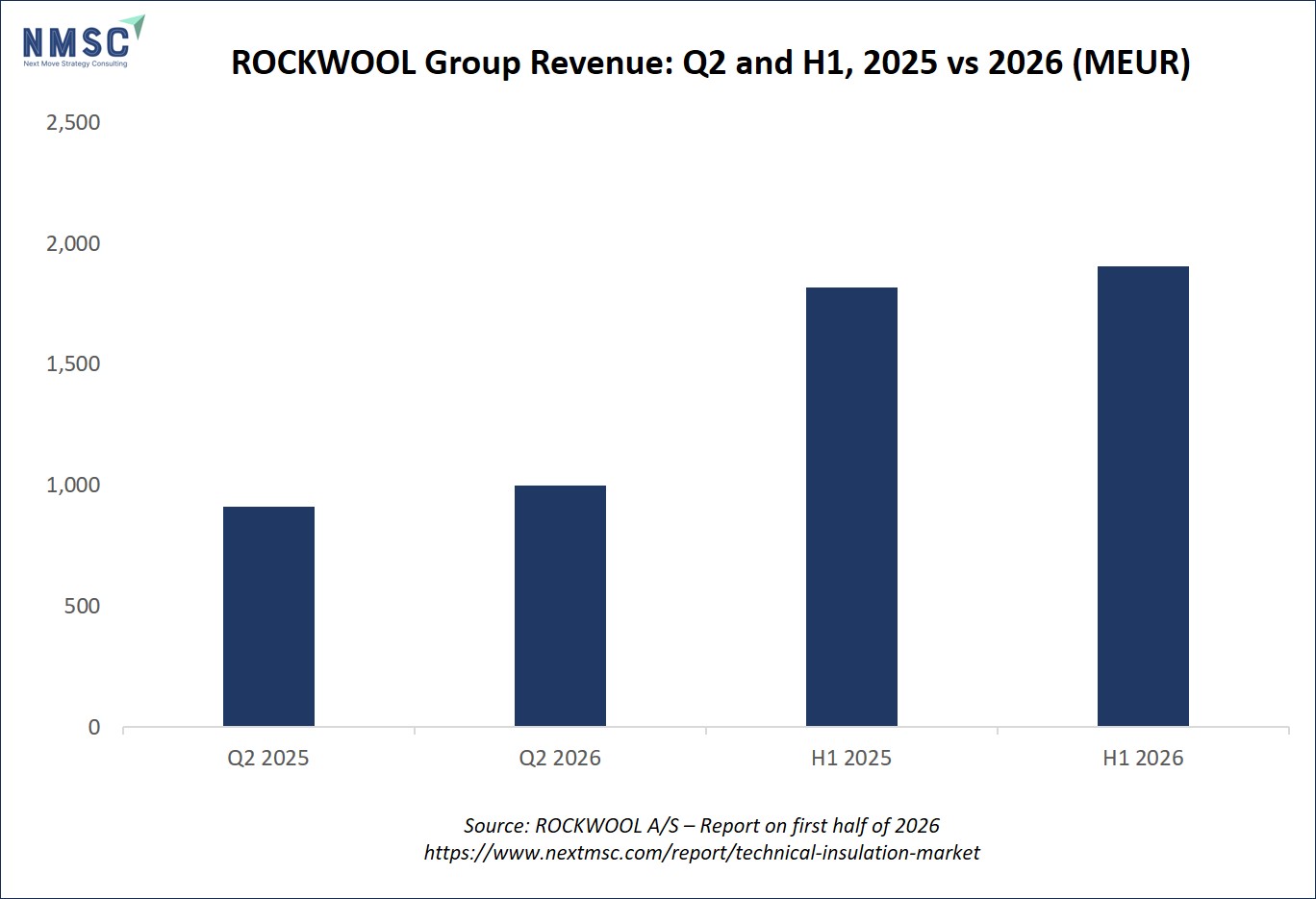
The most direct market-level validation of the EPBD's commercial impact arrived on 20 August 2026, when ROCKWOOL Group — the world's largest stone wool insulation manufacturer — reported H1 2026 revenue of 1,906 MEUR, representing 6% growth in local currencies and 5% in reported figures year-on-year. Critically, Q2 2026 alone delivered a record-high revenue of 1,000 MEUR, a 10% increase in both local currencies and reported figures, driven by volume gains rather than pricing — a distinction that signals genuine demand expansion rather than inflationary pass-through.
ROCKWOOL's H1 2026 EBITDA reached 395 MEUR, with a 20.7% EBITDA margin, and the company subsequently raised its full-year 2026 revenue growth outlook to 5–7% in local currencies, up from the prior guidance of 3–6%. The company also acquired the remaining stake in Swedish plasma technology firm ScanArc Plasma Technologies in June 2026, a move designed to accelerate its transition to fossil-free stone wool melting — a process that directly reduces the embodied carbon of its insulation products and positions ROCKWOOL to meet the lifecycle carbon reporting requirements embedded in the revised EPBD.
Jes Munk Hansen, CEO of ROCKWOOL Group, stated in the H1 2026 results release on 20 August 2026: "Energy price increases are driving greater focus on energy efficiency in the built environment, thus creating greater demand for insulation. More broadly, I am confident ROCKWOOL will continue to lead the way in shaping the market and advancing the conversation around energy efficiency, energy security, and fire safety."
Aspen Aerogels' European Thermal Barrier Ramp Reflects Aerogel's Expanding Role in Industrial Insulation
In the advanced materials segment of the technical insulation market, Aspen Aerogels, Inc. (NYSE: ASPN) reported Q2 2026 financial results on 6 August 2026 that underscore the bifurcated demand dynamics now shaping the sector. While North American Thermal Barrier volumes were constrained by changes to EV regulatory frameworks, the company's Energy Industrial segment — which encompasses aerogel blanket insulation for refineries, LNG facilities, and chemical processing plants — generated $20.4 million in Q2 2026 revenue, and the company raised its European Thermal Barrier 2026 revenue outlook to USD 20–30 million, reflecting accelerating OEM adoption across European automotive platforms.
Aspen also secured a PyroThin® thermal barrier award from Jaguar Land Rover covering two next-generation vehicle architectures across multiple JLR brands, with start of production expected in 2027 — a contract win that extends aerogel insulation's penetration into the transportation segment beyond its established base in energy infrastructure.
Don Young, President and CEO of Aspen Aerogels, commented in the Q2 2026 earnings release dated 6 August 2026: "We enter the third quarter with solid momentum, supported by accelerating Energy Industrial project activity, stabilizing North American Thermal Barrier demand, and the continued ramp in European Thermal Barrier revenue. We believe these drivers position Aspen for sustained, profitable growth in 2027 and beyond."
Grant Thoele, Chief Financial Officer and Treasurer of Aspen Aerogels, added: "Our third-quarter outlook of $65 million to $80 million in revenue and $7 million to $15 million in Adjusted EBITDA represents a meaningful improvement in financial performance."
Owens Corning's Strategic Divestiture Sharpens Competitive Focus on Core Insulation
On 30 April 2026, Owens Corning completed the sale of its Glass Reinforcements Business to Praana Group for an enterprise value of USD 645 million, a transaction that had been announced on 15 April 2026. The divestiture advances Owens Corning's stated strategy of concentrating capital and operational resources on its Insulation, Roofing, and Doors segments — a portfolio realignment that positions the company to compete more directly for the commercial and industrial insulation contracts that the EPBD renovation wave and North American energy infrastructure build-out are generating.
ISOLTEX 2026: Industry Convergence Signals Professionalisation of Technical Insulation as a Standalone Discipline
The premiere edition of ISOLTEX — the first dedicated industrial insulation technology trade fair in Central and Eastern Europe — took place on 24–26 February 2026 at Ptak Warsaw Expo, Poland, drawing 2,071 professionals from 27 countries. The event, organised in partnership with the Polish Construction Cluster, convened manufacturers of insulation materials, system designers, installation specialists, and energy company representatives under a single platform focused on thermal, acoustic, fire-resistant, and moisture-protection insulation technologies.
The Insulation Tech Forum at ISOLTEX 2026 centred on the conference theme "Innovation and Efficiency in Technical Insulation Technologies 2026," with sessions dedicated to the latest insulation material formulations, installation system advances, and energy efficiency improvements in industrial and construction applications — reflecting the sector's transition from a commodity supply chain to a performance-engineering discipline.
Market Segmentation: Application and End-User Breakdown
Technical Insulation Market — Key Competitive Developments (2026)
|
Company |
Development |
Date |
Strategic Significance |
|
ROCKWOOL Group |
H1 2026 revenue of 1,906 MEUR; record Q2 revenue of 1,000 MEUR; full-year outlook raised to 5–7% growth |
August 20, 2026 |
Confirms volume-led demand expansion across South/Eastern Europe, Asia, and the U.S. |
|
ROCKWOOL Group |
Acquired remaining stake in ScanArc Plasma Technologies (Sweden) |
June 2026 |
Accelerates fossil-free stone wool melting; aligns product carbon profile with EPBD lifecycle requirements |
|
Aspen Aerogels |
Q2 2026 Energy Industrial revenue of $20.4M; European Thermal Barrier outlook raised to $20–30M |
August 6, 2026 |
Validates aerogel's commercial penetration in European industrial and EV insulation segments |
|
Aspen Aerogels |
PyroThin® award from Jaguar Land Rover for two next-generation vehicle architectures |
August 6, 2026 |
Extends aerogel insulation into premium automotive thermal management; production start 2027 |
|
Owens Corning |
Completed sale of Glass Reinforcements Business to Praana Group for USD 645M enterprise value |
April 30, 2026 |
Concentrates portfolio on Insulation, Roofing, and Doors; frees capital for insulation segment investment |
Regional Analysis: Where Regulatory Mandates and Industrial Expansion Intersect
Europe has moved from a demand-pull to a mandate-driven market following the EPBD's 30 May 2026 enforcement date. The directive's requirement that member states develop national renovation plans targeting the worst-performing 15% of buildings — combined with new incentive structures for insulation retrofits — creates a multi-year pipeline of commercial and residential insulation contracts that ROCKWOOL's volume-led Q2 2026 performance already reflects.
Asia-Pacific retains the dominant share of the global technical insulation market, according to NMSC primary research and analysis, driven by the region's chemical manufacturing expansion and oil and gas infrastructure investment. China's crude oil production reached 208 million tons in 2023, representing 1.6% growth year-on-year, sustaining demand for pipe and duct insulation systems that prevent condensation, manage thermal fluctuations, and extend equipment service life in high-pressure extraction environments.
North America is supported by the density of operational nuclear power plants — the U.S. produced approximately 30% of worldwide nuclear electricity and approximately 18% of its own total electricity generation in 2022, according to the World Nuclear Association — The U.S.'s large nuclear-power fleet supports a continuing requirement for specialized insulation and thermal-protection systems used in nuclear facilities, although the cited generation statistics do not quantify insulation demand that require certified, high-performance technical insulation materials.
Technical Insulation Market — Regional Demand Drivers and Institutional Context
|
Region |
Primary Demand Driver |
Institutional Reference |
Market Implication |
|
Europe |
EPBD enforcement (30 May 2026): 75% of EU buildings have poor energy performance; 40% of EU energy consumed by buildings |
European Commission, Directorate-General for Communication, May 29, 2026 |
Mandatory renovation plans create multi-year insulation retrofit pipeline across 27 member states |
|
Asia-Pacific |
Chemical sector expansion; China crude oil output of 208 million tons (2023, +1.6% YoY) |
World-Energy Media, January 2024 |
Pipe and duct insulation demand for temperature management in chemical and oil & gas infrastructure |
|
North America |
U.S. nuclear power generation (~30% of global nuclear electricity output, 2022) |
World Nuclear Association, February 2024 |
Sustained demand for reactor containment and coolant system insulation in certified nuclear-grade materials |
|
North America |
Commercial real estate contribution of USD 2.3 trillion to U.S. GDP (2022) |
NAIOP, 2022 |
HVAC and building envelope insulation demand in office, hotel, and institutional construction |
|
India / Asia-Pacific |
Chemical sector projected to grow from USD 220 billion (2022) to USD 1 trillion by 2040 |
India Brand Equity Foundation, August 2023 |
Long-term industrial insulation demand for storage tanks, pipelines, and process equipment |
NMSC Strategic Perspective: Three Structural Forces Redefining the Technical Insulation Market Through 2030
NextMSC primary research and analysis identifies three structural forces that distinguish the technical insulation market's current growth phase from prior cycles and that underpin the 4.0% CAGR projection through 2030.
1. Regulatory Mandates Are Converting Latent Demand into Contracted Revenue
The EPBD's 30 May 2026 enforcement date is not a soft policy signal — it is a legally binding framework that requires EU member states to submit national building renovation plans and progressively enforce minimum energy performance standards. For technical insulation manufacturers, this converts what was previously discretionary retrofit spending into a compliance-driven procurement cycle. ROCKWOOL's decision to raise its full-year 2026 revenue growth outlook to 5–7% — specifically citing volume gains in South and Eastern Europe — is the first quantified market evidence that EPBD-linked demand is flowing through to insulation order books at scale. NMSC's analysis indicates that the European segment's regulatory tailwind will sustain above-market growth rates through at least 2028, as member states with the largest shares of pre-1980 building stock — including Germany, France, Italy, and Poland — move from plan submission to active renovation procurement.
2. Aerogel and Nanoporous Materials Are Expanding the Market's Revenue Ceiling, Not Just Its Technology Mix
The commercialisation of aerogel insulation in industrial applications — validated by Aspen Aerogels' Energy Industrial segment revenue and its Jaguar Land Rover PyroThin® contract — represents a structural expansion of the technical insulation market's addressable revenue pool. Aerogel blankets command a significant price premium over conventional fiberglass and mineral wool products, and their adoption in refineries, LNG terminals, and EV battery thermal management systems introduces the technical insulation market to end-use segments — automotive OEM supply chains, data centre thermal management — that were not historically served by conventional insulation contractors. NMSC's proprietary estimates indicate that aerogel and advanced foam insulation materials will account for a disproportionate share of market value growth through 2030, even as their volume share remains modest relative to fiberglass and mineral wool.
3. Industrial Decarbonisation Is Creating a New Procurement Category: Insulation as Carbon Management Infrastructure
The IEA's Buildings energy system data, updated as of June 2026, confirms that addressing poorly insulated buildings remains the single highest-leverage intervention available to advanced economies seeking to accelerate building sector decarbonisation. For industrial operators, this translates into a reframing of technical insulation from a maintenance cost to a carbon management asset — one that reduces process heat loss, lowers fuel consumption, and directly contributes to Scope 1 emissions reduction targets. NMSC's analysis indicates that this reframing is beginning to influence procurement decision-making in the chemical, power generation, and oil and gas sectors, where insulation system upgrades are increasingly evaluated against carbon abatement cost metrics rather than simple payback periods. This shift supports sustained demand for higher-specification insulation systems — including aerogel blankets, insulation coatings, and jacketing systems — that carry higher unit values and longer contract durations than commodity insulation products.
Bottom Line
The global technical insulation market is entering a phase of structurally reinforced demand that distinguishes the 2026–2030 period from prior growth cycles. The EU EPBD's 30 May 2026 enforcement date has converted building renovation from a discretionary investment into a compliance obligation across 27 member states — a shift already visible in ROCKWOOL's record Q2 2026 revenue of €1 billion and its upward revision of full-year guidance to 5–7% growth. Simultaneously, aerogel insulation's commercial penetration into European automotive OEM supply chains — evidenced by Aspen Aerogels' Jaguar Land Rover PyroThin® award and its raised European revenue outlook — is expanding the market's addressable revenue pool beyond conventional construction and industrial segments. Owens Corning's USD 645 million divestiture of its Glass Reinforcements Business sharpens competitive focus on insulation, roofing, and doors, signalling that leading players are concentrating capital precisely where regulatory and industrial demand is accelerating. According to NMSC primary research and analysis, the market's trajectory from USD 8.96 billion in 2023 to USD 11.82 billion by 2030 is underpinned by three durable forces: regulatory mandates converting latent retrofit demand into contracted revenue, advanced materials expanding the market's revenue ceiling, and industrial decarbonisation repositioning insulation as carbon management infrastructure.
About Next Move Strategy Consulting
Next Move Strategy Consulting is a premier market research and management consulting firm that has been committed to provide strategically analysed well documented latest research reports to its clients. The research industry is flooded with many firms to choose from, what makes NMSC different from the rest is its top-quality research and the obsession of turning data into knowledge by dissecting every bit of it and providing fact-based research recommendation that is supported by information collected from over 500 million websites, paid databases, industry journals and one on one consultations with industry experts across a diverse range of industry sectors. The high-quality customized research reports with actionable insights and excellent end-to-end customer service help our clients to take critical business decisions that enables them to move beyond time and have competitive edge in the industry.
We have been servicing over 1000 customers globally that includes 90% of the Fortune 500 companies over a decade. Our analysts are constantly tracking various high growth markets and identifying hidden opportunities in each sector or the industry. We provide one of the industry's best quality syndicate as well as custom research reports across 10 different industry verticals. We are committed to deliver high quality research solutions in accordance to your business needs. Our industry standard delivery solutions that ranges from the pre consultation to after-sales services, provide an excellent client experience and ensure right strategic decision making for businesses.
For more information, please contact:
Next Move Strategy Consulting
5th Floor 867
Boylston St, STE 500,
Boston, MA 02116, U.S.
E-Mail: [email protected]
Direct: +1-217-650-7991
Website: www.nextmsc.com
About the Author
 Sanyukta Deb
— Sanyukta Deb is Digital Marketing Team Lead at Next Move Strategy Consulting, where she has led content strategy and technical SEO for the firm's B2B market research publications for over 2 years. Her editorial process translates NextMSC's primary and secondary research — spanning technology, industrial, and consumer sectors — into commercial narratives, backed by search-intent, keyword, and competitive analysis. She brings 5 years of overall experience in digital marketing and content strategy.
Sanyukta Deb
— Sanyukta Deb is Digital Marketing Team Lead at Next Move Strategy Consulting, where she has led content strategy and technical SEO for the firm's B2B market research publications for over 2 years. Her editorial process translates NextMSC's primary and secondary research — spanning technology, industrial, and consumer sectors — into commercial narratives, backed by search-intent, keyword, and competitive analysis. She brings 5 years of overall experience in digital marketing and content strategy.
About the Reviewer
 Debashree Dey
— Debashree Dey is Assistant Manager at Next Move Strategy Consulting, where she supports cross-vertical market content and communications across diverse industries for 6 years. Her professional background includes senior content writing, communications, and published manuscript authorship, with experience developing audience-focused business narratives and maintaining clear, consistent messaging. Her role supports research-led content development and editorial quality across NextMSC publications.
Debashree Dey
— Debashree Dey is Assistant Manager at Next Move Strategy Consulting, where she supports cross-vertical market content and communications across diverse industries for 6 years. Her professional background includes senior content writing, communications, and published manuscript authorship, with experience developing audience-focused business narratives and maintaining clear, consistent messaging. Her role supports research-led content development and editorial quality across NextMSC publications.


















Add Comment