EU NGT Law and CRISPR-Combo Breakthrough Reshape Plant DNA Market | NextMSC

EU's Landmark NGT Law and CRISPR-Combo Breakthrough Reshape the Global Plant Gene-Editing Race
On June 17, 2026, the European Parliament cast a vote that eight years of scientific advocacy, political negotiation, and regulatory deadlock had failed to produce: a 431-to-201 majority in favour of a new legal framework that formally decouples gene-edited crops from the EU's decades-old GMO approval regime. The regulation — EU Regulation 32026R1388 on New Genomic Techniques (NGTs) — entered into force on July 16, 2026, and will be fully applicable by July 17, 2028, establishing a two-tier classification system under which Category 1 NGT plants (those with minor, targeted edits replicable through conventional breeding) are exempt from GMO risk assessments and consumer-end labelling requirements. The vote is the single most consequential regulatory event for plant biotechnology in Europe since the Court of Justice of the European Union's 2018 ruling that subjected gene-edited crops to full GMO oversight — and it arrives precisely as commercial investment in plant DNA alteration is accelerating globally.
According to Next Move Strategy Consulting's Altering Plant DNA Market report, the global altering plant DNA market is reached an estimated USD 1.42 billion in 2025, and is projected to reach USD 3.03 billion by 2030, growing at a compound annual growth rate (CAGR) of 15.4% from 2025 to 2030. NMSC's proprietary research and analysis identifies the convergence of liberalised regulatory frameworks across three major agricultural blocs, accelerating CRISPR tool development, and structurally elevated global food insecurity as the three interlocking forces compressing the timeline between laboratory gene edit and commercial field deployment.
For More Information: Download FREE Sample on Altering Plant DNA Market Report
The Regulatory Inflection Point: Europe, Argentina, and Pakistan Move in Unison
The EU's NGT regulation does not stand in isolation. Within the same regulatory cycle, two additional jurisdictions formalised frameworks that treat precision-bred crops as categorically distinct from transgenic GMOs — a coordinated global shift that materially reduces the regulatory risk premium that has historically suppressed private investment in plant DNA alteration.
In March 2026, Argentina's Ministry of Economy published Resolución 255/2026, replacing the 2011 framework that had established the country as a global leader in gene-edited crop permitting. The new resolution consolidates environmental safety, food safety, and commercialisation impact reviews into a single three-step procedure administered by three evaluation bodies — CONABIA, SENASA, and the Dirección Nacional de Políticas de Mercados — eliminating administrative overlap while preserving the substantive scientific content of gene-editing evaluation.
In June 2026, Pakistan approved the National Agriculture Biotechnology Policy of Pakistan 2025, introducing a three-tier classification for gene-edited crops: SDN-1 (no foreign nucleotide sequences), SDN-2 (sequences from sexually compatible donors only), and SDN-3 (foreign DNA from non-sexually compatible donors). SDN-1 and SDN-2 products — covering the vast majority of precision-bred varieties — will no longer be regulated as GMOs, representing a fundamental departure from Pakistan's previous biosafety rules, which drew no distinction between gene-edited and genetically modified plants.
Professor Johnathan Napier, Discovery Leader at Rothamsted Research, described the EU vote as "a seismic shift in how gene edited crops are regulated in Europe and reflects the pragmatic realisation that such technologies are essential for delivering resilient crops. Ultimately it is the recognition that we need to embrace the future that has driven this important change from the EU. In addition, the potential for regulatory alignment between EU and UK can further stimulate innovation and the bioeconomy."
Professor Pete Eastmond, who recently obtained marketing approval for his high-lipid PBO barley under the UK's Genetic Technology (Precision Breeding) Act 2023, added: "It's truly exciting to see the EU embracing new genomic technologies, such as gene editing, to help address the mounting challenges that face agriculture and food production. The new regulations will finally free scientists across Europe to use the best tools for the job in hand."
CRISPR-Combo: Solving the Regeneration Bottleneck That Has Blocked Perennial Crop Editing
Regulatory liberalisation alone does not translate into commercial products unless the underlying science can deliver edited plants at scale. A study published in Nature Communications on September 9, 2026, by researchers at Texas A&M AgriLife Research, the University of Maryland, and the U.S. Department of Agriculture addresses the most persistent technical barrier in plant gene editing: the inability to reliably regenerate a whole plant from a small number of edited cells — a process that, for perennial crops such as citrus, strawberry, poplar, and potato, has historically been slow, unreliable, or entirely intractable.
The team developed CRISPR-Combo, a system that simultaneously edits a target gene and activates the plant's own morphogenic genes — those governing how cells divide and develop into roots, shoots, and full plants — using the same CRISPR machinery that performs the edit. Rather than inserting exogenous copies of growth-promoting genes, CRISPR-Combo upregulates the plant's endogenous versions in situ, producing a more streamlined and scalable regeneration pathway.
The quantitative results are significant. In citrus — a crop notoriously resistant to laboratory transformation — the team screened 10 candidate morphogenic genes and identified five that pushed shoot regeneration efficiency to 80% or higher, compared with under 60% in controls. In potato, four genes identified from a 17-candidate screen raised regeneration efficiency to 45–70%, against a control baseline of 30–35%. In wild strawberry, co-activating two morphogenic genes simultaneously shortened the time required to produce a fully regenerated, gene-edited plant by more than a month relative to standard methods. In poplar, co-activation produced shoots in under a month without any external plant hormones — which are normally required in tissue culture — and the resulting lines showed the highest rates of edited cells alongside greater biomass in greenhouse conditions.
Kranthi Mandadi, Ph.D., Director of the Texas A&M AgriLife Research and Extension Center at Weslaco and Professor in the Texas A&M Department of Plant Pathology and Microbiology, stated: "Regeneration is one of the biggest roadblocks standing between a promising gene edit in the lab and a crop variety that's actually useful to growers. This work shows that we can coax a plant's own genes to regenerate faster and more reliably, and that approach holds real promise for perennial crops like citrus that have historically been very difficult to work with in the lab."
The research was supported by the Foundation for Food and Agriculture Research's Genotype-Independent Regeneration of Fertile Plants programme, with additional funding from the U.S. National Science Foundation, USDA National Institute of Food and Agriculture, the U.S. Department of Energy, and Texas A&M AgriLife.
The Food Security Imperative Driving Demand
The commercial urgency behind plant DNA alteration is inseparable from the structural food security deficit that persists globally. According to The State of Food Security and Nutrition in the World 2026, published jointly by FAO, IFAD, UNICEF, WFP, and WHO, an estimated 645 million people faced hunger in 2025, while healthy diets remain unaffordable for approximately 2.7 billion people worldwide — with the crisis deepening particularly across sub-Saharan Africa. The same report identifies agricultural productivity deficits and value chain inefficiencies as primary structural drivers of the persistently high cost of nutrient-dense foods, which account for nearly 70% of the total cost of a healthy diet.
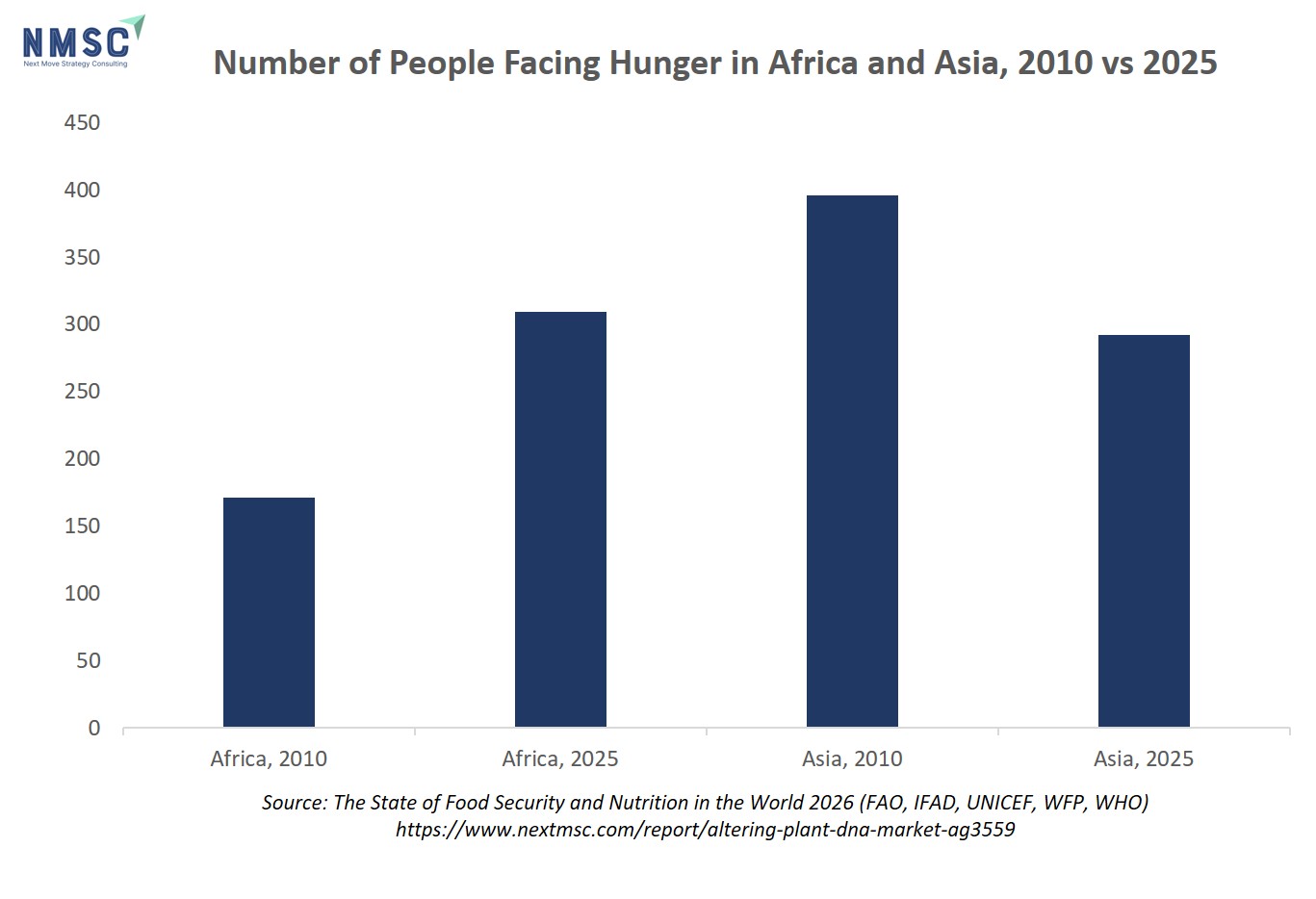
These figures define the addressable problem that plant DNA alteration technologies are positioned to solve: not incremental yield improvements, but the structural capacity to produce biofortified, climate-resilient, and pest-resistant crops at a cost that makes nutritious food economically accessible at scale. NMSC's proprietary research and analysis identifies biofortification and abiotic stress tolerance as the two trait categories with the highest near-term commercial velocity, given their direct alignment with the FAO's identified cost drivers.
Key Player Developments: From Lab to Field
|
Company |
Development |
Technology |
Date |
|
Tropic Biosciences |
Developed CRISPR gene-edited banana that resists browning by disabling polyphenol oxidase enzyme; banana remains yellow for up to 12 hours after peeling, targeting food waste reduction |
CRISPR |
March 2025 |
|
Syngenta Group |
Advanced HI-Edit technology applying CRISPR to plant genome editing; enables crops to adapt to environmental stresses and revives previously disfavoured crop varieties |
CRISPR / HI-Edit |
October 2024 |
|
Corteva Agriscience |
CRISPR pipeline spanning corn, soy, canola, and sunflower breeding programmes, targeting drought tolerance and yield enhancement; $25 million equity investment in Pairwise to accelerate gene-editing commercialisation |
CRISPR |
Ongoing |
|
Texas A&M AgriLife / USDA |
Published CRISPR-Combo system in Nature Communications, achieving 80%+ shoot regeneration efficiency in citrus and cutting strawberry regeneration time by over one month |
CRISPR-Combo |
September 2026 |
Regional Landscape: North America Leads, Europe Unlocks, Asia-Pacific Scales
North America retains the deepest commercial infrastructure for plant DNA alteration. According to the U.S. Department of Agriculture's Foreign Agricultural Service (FAS) in 2025, biotechnology contributes over USD 210 billion to U.S. GDP annually and supports more than 640,000 domestic jobs — a foundation that sustains the private R&D investment pipelines of Corteva, Bayer Crop Science, BASF, and a growing cohort of gene-editing specialists.
Europe, historically the most restrictive major agricultural market for plant biotechnology, has undergone a structural regulatory reset. The EU NGT regulation's two-tier framework — which aligns closely with the UK's Genetic Technology (Precision Breeding) Act 2023 — creates, for the first time, a pathway for Category 1 gene-edited crops to reach European farmers without the cost and timeline burden of full GMO authorisation. Rothamsted Research notes that regulatory alignment between the EU and UK frameworks should enable frictionless movement of gene-edited products between the two markets, a development that meaningfully expands the commercial addressable market for European plant biotech developers.
Asia-Pacific is scaling adoption through food security imperatives. According to the India Brand Equity Foundation (IBEF) in 2025, India's wheat stocks reached their highest level in three years, with the Food Corporation of India planning to purchase 31 million tons of wheat, while rice reserves remain elevated — reflecting the region's intensifying focus on crop productivity and supply chain resilience. Pakistan's June 2026 biotechnology policy formalises the regulatory infrastructure needed to channel this demand into commercially deployable gene-edited varieties.
Rest of the World — particularly Latin America and Africa — is leveraging plant DNA technologies to develop export-grade crops with improved shelf life, disease resistance, and post-harvest durability, enabling these regions to compete more effectively in international commodity markets. Argentina's Resolución 255/2026 positions it to accelerate approvals for export-oriented gene-edited varieties across its soy, maize, and wheat sectors.
Market Segmentation Snapshot
|
Segment Category |
Key Segments |
NMSC Analytical Note |
|
By Technology |
CRISPR (dominant), TALENs, ZFNs, RNAi, ODM, Base Editing & Prime Editing |
CRISPR leads on adoption breadth; Base Editing & Prime Editing represent the highest-growth sub-segment given precision advantages over standard Cas9 |
|
By Crop Type |
Cereals & Grains, Fruits & Vegetables, Oilseeds & Pulses, Plantation & Specialty Crops, Forage & Animal Feed Crops |
Fruits & Vegetables gaining share as CRISPR-Combo addresses the perennial crop regeneration barrier |
|
By Trait Type |
Biotic Stress Resistance, Abiotic Stress Tolerance, Quality Traits, Nutritional Traits, Growth & Development Traits |
Abiotic Stress Tolerance and Nutritional Traits aligned with FAO-identified food security priorities |
|
By Application |
Yield Enhancement, Disease & Pest Resistance, Climate Stress Tolerance, Nutritional Enhancement, Shelf-Life Extension, Reduced Chemical Input |
Climate Stress Tolerance and Reduced Chemical Input gaining commercial traction under EU Farm-to-Fork sustainability mandates |
|
By End User |
Agricultural Biotechnology Companies, Seed & Crop Production Companies, Research & Academic Institutes, Government & Public Sector, Contract Research Organizations |
Government & Public Sector programmes expanding in Asia-Pacific and Africa as food security spending rises |
|
By Region |
North America, Europe, Asia-Pacific, Rest of the World |
Europe transitioning from regulatory laggard to active commercial market following June 2026 NGT law |
NMSC Strategic Perspective: Three Structural Shifts Redefining the Market's Growth Trajectory
NMSC's proprietary research and analysis identifies three structural shifts — occurring simultaneously in 2026 — that distinguish the current growth phase of the altering plant DNA market from prior periods of incremental expansion.
First: Regulatory convergence is compressing the commercialisation timeline. The EU NGT regulation, Argentina's Resolución 255/2026, and Pakistan's National Agriculture Biotechnology Policy collectively represent the most significant multi-jurisdictional regulatory alignment in plant biotechnology since the Cartagena Protocol on Biosafety in 2000. For the first time, developers of Category 1 / SDN-1 / SDN-2 gene-edited crops can plan commercial launches across the EU, UK, Argentina, and Pakistan under broadly harmonised frameworks — eliminating the country-by-country regulatory arbitrage that previously forced companies to sequence market entries over multi-year timelines. This convergence directly expands the total addressable market accessible within a single product development cycle.
Second: The CRISPR-Combo breakthrough removes the most persistent technical barrier to perennial crop commercialisation. Prior to the September 2026 Nature Communications publication, the inability to reliably regenerate edited perennial crops — citrus, strawberry, poplar, and others — effectively excluded high-value fruit and nut categories from the commercial gene-editing pipeline. CRISPR-Combo's demonstrated 80%+ regeneration efficiency in citrus and month-long reduction in strawberry regeneration time means that the addressable crop universe for commercial gene editing has materially expanded. NMSC's analysis indicates that perennial fruit and specialty crop segments, previously underrepresented in market revenue, are positioned to contribute disproportionately to growth in the 2027–2030 forecast window.
Third: The food security financing imperative is converting public-sector demand into private-sector revenue. The FAO-IFAD-UNICEF-WFP-WHO joint finding that 645 million people faced hunger in 2025 — and that healthy diets remain unaffordable for 2.7 billion — is not merely a humanitarian statistic. It is a policy mandate that is translating into government procurement programmes, public-private research partnerships, and regulatory fast-tracking for biofortified and climate-resilient varieties. NMSC's proprietary research and analysis identifies government and public sector end users as the fastest-growing customer segment in Asia-Pacific and sub-Saharan Africa, as national food security programmes increasingly specify gene-edited crop varieties as preferred procurement targets.
Taken together, these three shifts — regulatory convergence, technical barrier removal, and public-sector demand formalisation — underpin NMSC's projection of a market reaching USD 3.03 billion by 2030 at a 15.4% CAGR, with the growth rate accelerating in the latter half of the forecast period as EU and UK regulatory pipelines begin producing commercially approved Category 1 NGT varieties.
Bottom Line
The global altering plant DNA market is entering a phase of structurally accelerated growth, driven by three simultaneous developments in 2026 that collectively remove the regulatory, technical, and demand-side barriers that have historically constrained commercialisation. The European Parliament's June 17, 2026 passage of the NGT regulation — which entered into force on July 16, 2026 — opens the EU's agricultural market to expedited approval of precision-bred crops for the first time in over two decades, while parallel reforms in Argentina and Pakistan signal a coordinated global shift away from process-based GMO regulation toward outcome-based assessment. On the technical front, the CRISPR-Combo system published in Nature Communications in September 2026 resolves the regeneration bottleneck that has blocked commercial gene editing in perennial crops, materially expanding the addressable crop universe. Against this backdrop, the FAO's finding that 645 million people faced hunger in 2025 and that healthy diets remain unaffordable for 2.7 billion people worldwide provides the structural demand mandate that is converting public-sector food security spending into private-sector revenue. According to NMSC's proprietary research and analysis, the global altering plant DNA market is projected to grow from USD 1.42 billion in 2025 to USD 3.03 billion by 2030 at a CAGR of 15.4%, with perennial crop segments and biofortification applications positioned as the highest-growth vectors within the forecast period.
About Next Move Strategy Consulting
Next Move Strategy Consulting is a premier market research and management consulting firm that has been committed to provide strategically analysed well documented latest research reports to its clients. The research industry is flooded with many firms to choose from, what makes NMSC different from the rest is its top-quality research and the obsession of turning data into knowledge by dissecting every bit of it and providing fact-based research recommendation that is supported by information collected from over 500 million websites, paid databases, industry journals and one on one consultations with industry experts across a diverse range of industry sectors. The high-quality customized research reports with actionable insights and excellent end-to-end customer service help our clients to take critical business decisions that enables them to move beyond time and have competitive edge in the industry.
We have been servicing over 1000 customers globally that includes 90% of the Fortune 500 companies over a decade. Our analysts are constantly tracking various high growth markets and identifying hidden opportunities in each sector or the industry. We provide one of the industry's best quality syndicate as well as custom research reports across 10 different industry verticals. We are committed to deliver high quality research solutions in accordance to your business needs. Our industry standard delivery solutions that ranges from the pre consultation to after-sales services, provide an excellent client experience and ensure right strategic decision making for businesses.
For more information, please contact:
Next Move Strategy Consulting
5th Floor 867 Boylston St, STE 500,
Boston, MA 02116, U.S.
E-Mail: [email protected]
Direct: +1-217-650-7991
Website: www.nextmsc.com
About the Author
 Sanyukta Deb
— Sanyukta Deb is Digital Marketing Team Lead at Next Move Strategy Consulting, where she has led content strategy and technical SEO for the firm's B2B market research publications for over 2 years. Her editorial process translates NextMSC's primary and secondary research — spanning technology, industrial, and consumer sectors — into commercial narratives, backed by search-intent, keyword, and competitive analysis. She brings 5 years of overall experience in digital marketing and content strategy.
Sanyukta Deb
— Sanyukta Deb is Digital Marketing Team Lead at Next Move Strategy Consulting, where she has led content strategy and technical SEO for the firm's B2B market research publications for over 2 years. Her editorial process translates NextMSC's primary and secondary research — spanning technology, industrial, and consumer sectors — into commercial narratives, backed by search-intent, keyword, and competitive analysis. She brings 5 years of overall experience in digital marketing and content strategy.
About the Reviewer
 Debashree Dey
— Debashree Dey is Assistant Manager at Next Move Strategy Consulting, where she supports cross-vertical market content and communications across diverse industries for 6 years. Her professional background includes senior content writing, communications, and published manuscript authorship, with experience developing audience-focused business narratives and maintaining clear, consistent messaging. Her role supports research-led content development and editorial quality across NextMSC publications.
Debashree Dey
— Debashree Dey is Assistant Manager at Next Move Strategy Consulting, where she supports cross-vertical market content and communications across diverse industries for 6 years. Her professional background includes senior content writing, communications, and published manuscript authorship, with experience developing audience-focused business narratives and maintaining clear, consistent messaging. Her role supports research-led content development and editorial quality across NextMSC publications.

















Add Comment